Themed Section : Engineering and Technology
Automatic Challan System with Vehicle Verification Using
OCR
Prof. Amit R.Welekar1, Rajesh S. Dahake2, Shubham M. Bodhane2, Tanvee B. Wawre2, Rashmi P. Umbarkar2,Priyanka S. Ghormode2
1Professor, Department of Computer Engineering, BDCE, Maharashtra, India 2Student, Department of Computer Engineering, BDCE, Maharashtra, India
ABSTRACT
The main objective of this project is to design a Quick Response code which contains overall information of the
vehicle and to introduce a system which helps R.T.O officer’s to identify the owner of the vehicle and take fine easily from them. Breaking traffic rules on road is a major issue now a day. Due to large population and traffic
congestion it is difficult to identify which vehicle has broken traffic rules. To monitor culprit vehicle manually is very difficult. Therefore, there is need to monitor these vehicles automatically. Hence, we propose a smart
monitoring system that will monitor the culprit vehicle. The proposed system will generate detailed data at the
time of incident and that data will be send to the R.T.O office database which is handling by the authorized person. With the help of these details the officer can take further action. It reduces the time in writing. Just by
scanning the QR code the Officer easily get all the information about the vehicle on his screen. The existing system is tedious and time consuming, it requires stopping the vehicle, collecting the owner information,
checking his license and collecting Fine, giving the acknowledgment and then allowing the vehicle to pass by.
The Challan System for vehicle verification is a new system which is designed to enhance the convenience for officers and vehicle owners. It saves lots of time.
Keywords: QR-code, Camera, Application program, .Net, Android, Identify every vehicle uniquely, Pay Challan, Sms-gateway
I.
INTRODUCTION
Due to traffic congestion and increasing number of
user onroad it is difficult to identify every vehicle uniquely. Tomonitor the vehicle manually is very
difficult task. The aimof this research is to automate
the identification of thevehicle. In today’s time there
are so many people breakingtraffic rules without any
with another vehicle. In today’s world there arelots of
junctions and crossings of road where traffic lightsare fitted, but at only few places the duty of traffic police
isassigned where they monitor traffic.With the ever increasing vehicles on road and the numberof users
on road, limited resources are available to monitorthe
vehicle uniquely. Hence, an intelligent monitoring ofvehicle uniquely is an important issue to be
considered. Thetraffic monitoring authorities need to find new methods ofovercoming this difficulty.In our
research, we are designing a system which will tellabout Vehicle by just scanning QR code which is
situated on vehicle.
It is popular to use mobile phone daily in modern life.
QR code is the abbreviation for quick response 2-D
code,which is a machine-readable optical label with informationon the associated item or product.
Compared with 1-Dcodes, 2-D codes can hold a larger amount of data in asmaller space and other feature
comparisons arementioned in TABLE I. In barcodes, information is codedin one direction or one
dimension only. On the other hand,in a
two-dimensional code, which the QR code is, information is coded in two directions: horizontally andvertically.
A QR code uses four standardized encodingmodes to
efficiently store data. The QR Code conveysinformation by the arrangement of its dark
and lightelements, called “modules,” in columns and
rows as below figure 1
II.
LITERATURE REVIEW
The proposed approachprovides quick response,
overcomes the noise issues in imageprocessing and at the same time fine tunes the detection technique. [1]
The QR Code system has become admired outside the
automotive industry due to its fast readability and
greaterstorage capacity compared to standard UPC barcodes. Thispaper take account of QR codes basics,
its real timeapplication in day to day life and research areas associated.With the technology of mobile
phones constantly emerging,especially in the area of mobile internet access, QR codes seemto be an
adequate tool to quickly and efficiently converseURLs
to users. This also allows offline media such asmagazines, newspapers, business cards, public
transportvehicles, signs, t-shirts and any other
medium that canembrace the print of a QR code to be used as carriers foradvertisements for online products.
QR code being so versatilebecause of its structural flexibility that it leads to so manydiverse field for
research such as increasing data capacity,security applications such as different kinds of
watermarkingand steganography as well. Some
experiments have also beendone for better recognition of the QR code image that
includesscratch removal techniques. Thus, this paper
is an attempt tohighlight some of possible research areas while considering QR codes.[2]
The volume of automobile crimes has been on the
increase and many new crime detection techniques have evolved on its account. High-speed car chases,
best way to keep track of the cars is their registration
numbers. The number plate recognition system is the most suitable solution for such cases. The number
plates often get corroded and the detection process becomes erroneous. Our contribution towards ANPR
is the inclusion of the QR codes (Quick Response
codes) on the automobiles, fine-tuning the detection technique. The proposed approach provides quick
response, overcomes the noise issues in image processing and at the same time fine tunes the
detection technique.[3]
This paper seems quite obvious that nowadays we are
able to do transactions, shopping, banking, sharing and storing confidential data like other online
services which aims to highly secured. The design and
implementation of QR is easy to use and read, combined with multifactor (ID/Password which only
user knows, Detail information that only the user has, Unique QR code that shows only the user is), camera
based all hardware. The information is in the QR code is transmitted in the encryption form. It is portable
and cost efficient. The system uses QR codes which
are small two-dimensional pictures that en-code digital data. This can be used for all hardware camera
equipped platforms that are for tablets, personal
computers, laptops, cell phones. QR is readable even if it is partially damage. It provides high level of
security and authentication with untrusted devices. Its versatility has made them quite popular, where
these are today widely used as a way to quickly store by scanning it with a camera-based mobile device. [4]
III.
OBJECTIVE OF THE PLAN
1. To verify vehicles information along with
owner’s detail.
2. Take challan charges easily without any paper work.
3. Culprit confirms their challan charges through SMS gateway.
4. All information viewed by the head of the police Department.
IV.
WORK PLAN AND METHODOLOGY
The aim of the present work is therefore to propose and experimentally evaluate an automated system,
called Challan System and vehicle verification. In this
we create an application for traffic police officers to scanning the QR which are present on the vehicle. So,
they can verify the vehicles easily just by scanning the QR scan code that required minimum time for the
process.
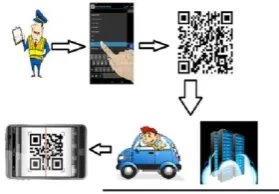
Figure 1. System Architecture design
4.1 The Working of the System: TRAFFIC POLICE OFFICER’s END:
This side of the application is only restricted to the
of public.In short the officer can issue challan, check
the details of thevehicle, alert other officers or the police department about anytheft of vehicle or any
crime attempt by a vehicle.
On Logging in the officer get a menu of two options
shown,
1. Alert: The alerts will have sub options where officer alertsother officers and police department
about any theft ofvehicle or crime committed by a vehicle.The other option will let the police officer
view the alerts thathave been triggered by other
officers.
2. Vehicle Check: The vehicle check contains further
sub optionsto check owner details, an issuechallan option.
The camera ofthe mobile can scan the QR Code.
Therefore the QR Code that willbe provided to owner at the time of registration has to be availableon the
vehicle. So that the police officer can scan and take
input.
1. Check Owner Details: The officer has option to
check owner ofthe vehicle where full detail about vehicle as well as the owneris given.
2. Issue challan: The issue challan option lets the
officer issuefine against the vehicle in case any rule has been broken.
In the issue challan option the officer check the
check-boxes againstthe rule broken. Then selects the ‘submit and send to owner’ buttonwhich will
generate a receipt and will be sent to owner’s mobile
number.
Figure 2. QR Code
VEHICLE OWNER’S END:
The mobile application is available for free to
download for mobile. The owner has to register himself to acquire the user name and password. Click
on register and fill in the details requested in the form. The form will consist of the following details –
✓ Vehicle Registration Number (this will also be
the user name example: MH-12-XX-0000)
✓ The details mentioned in the Registration
Certificate (RC) like, chasis number, Vehicle type, etc.
✓ Details of Insurance of vehicle
✓ PUC details
✓ Owners Personal information – name , address ,
contact information
Post submission of the form, an appointment page
will appear where the owner selects an available date
and time for verification of the documents with the RTO. Post selection of the appointment timing and
mobile. Owner visits the RTO to verify the details.
The original documents have to be carried for verification
After Verification the RTO issues a temporary
password, the user name will be the Vehicle
Registration number (i.e., the number on the vehicle’s
number plate).
The RTO also issues a QR Code Sticker for the vehicle.
This QR Code is for the convenience of the Traffic Police Officer which will be explained later in this
document. Now that the owner has a user name and
password he can proceed with the login by selecting the login option.
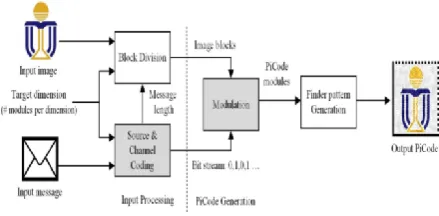
Figure 3. Encoding Flow Diagram
The given figure shows the flow of the work in which
we performing the task by scanning the QR code.
V.
REFERENCES
[1]. K.Saranya and VigneshB.andPoornishadevi.A
"SQRC-based Vehicle and ID-addressProof Verification System"International Journal of
Advanced Research Trends in Engineering and
Technology (IJARTET)Vol. 3, Special Issue 3,
April 2016 pp 145-151.
[2].Kinjal H. Pandya, Hiren J. Galiyawala, "A Survey
on QR Codes: in context of Research and Application",International Journal of Emerging
Technology and Advanced Engineering, Volume
4,pp 258-262,March 2014,ISSN 2250-2459, ISO 9001:2008 Certified Journal.
[3].BhupendraMoharil, VijayendraGhadge , Chaitanya Gokhale, Pranav Tambvekar "An
Efficient Approach for Automatic Number Plate Recognition System Using Quick Response
Codes", BhupendraMoharil et al, / (IJCSIT)
International Journal of Computer Science and Information Technology, Vol. 3(5), pp 5108-5115,
2012, ISSN: 0975-9646.
[4].DipikaSonawane, MadhuriUpadhye, PriyankaBhogade,Prof. SanchikaBajpai, "QR
Based Advanced Authentication forall Hardware Platforms",Volume 4, Issue 1,International
Journal of Scientific and Research Publications, January 2014 ,pp. 1-4.
[5].Prof. Sanchika Bajpai,"QR Based Advanced
Authentication for all Hardware Platforms",Vol1ume 4, Issue 1, International
Journalof Scientific and Research Publications,
January 2014, pp. 1-4.
[6]. K.H, H.J. Galiyawala, "Survey on QR Codes: in context of Research and Application",Volume 4, Issue 3,International Journal of Emerging