Nonlin. Processes Geophys., 20, 41–45, 2013 www.nonlin-processes-geophys.net/20/41/2013/ doi:10.5194/npg-20-41-2013
© Author(s) 2013. CC Attribution 3.0 License.
Nonlinear Processes
in Geophysics
Quantifying soil complexity using network models of
soil porous structure
M. Samec1, A. Santiago2, J. P. C´ardenas2, R. M. Benito2, A. M. Tarquis3, S. J. Mooney4, and D. Koroˇsak1,5 1Faculty of Civil Engineering, University of Maribor, Smetanova ulica 17, 2000 Maribor, Slovenia
2Grupo de Sistemas Complejos, Departamento de F´ısica, Universidad Polit´ecnica de Madrid, 28040 Madrid, Spain 3CEIGRAM ETSIA, Universidad Polit´ecnica de Madrid, 28040 Madrid, Spain
4Environmental Sciences Section, School of Biosciences, Sutton Bonington Campus, University of Nottingham,
Loughborough, Leics LE12 5RD, UK
5Institute of Physiology, Faculty of Medicine, University of Maribor, Maribor, Slovenia
Correspondence to: M. Samec ([email protected])
Received: 23 July 2012 – Revised: 16 December 2012 – Accepted: 19 December 2012 – Published: 15 January 2013
Abstract. This paper describes an investigation into the
properties of spatially embedded complex networks repre-senting the porous architecture of soil systems. We suggest an approach to quantify the complexity of soil pore structure based on the node-node link correlation properties of the net-works. We show that the complexity depends on the strength of spatial embedding of the network and that this is related to the transition from a non-compact to compact phase of the network.
1 Introduction
One of great challenges in soil science today (Lal, 2007) is to understand how soils behave as a complex system (Craw-ford, 2010). Over the last decade, network theory has become a much discussed cross-disciplinary research field contribut-ing to social, biological and information sciences (Barabasi, 2009, 2012), demonstrating that quite diverse systems might share similar topological organization. Whilst soil scientists have studied the complexity of soil pore space for decades (Berkowitz and Ewing, 1998), it is only recently that soil pore networks have been considered as complex systems. Specifically two approaches to describe soil pore structure as complex networks of pores have recently been proposed (Mooney and Koroˇsak, 2009; C´ardenas et al., 2010), both emphasizing the role of the spatial embedding of the work. Soil pore structure was described as a complex net-work of pores using a spatially embedded varying fitness
network model (Mooney and Koroˇsak, 2009) or heteroge-neous preferential attachment scheme (Santiago et al., 2008). Both approaches reveal the apparent scale-free topology of soils with a power-law distribution P (k)∝k−γ of the de-greesk of nodes as a consequence of a heterogeneous soil pore size distribution.
2 Methodology
Soil pore networks are spatial networks (Barthelemy, 2011), i.e. complex networks with nodes (pores) embedded in space. Often the interactionTij between distant nodes i and j is modelled using a gravity model:
Tij=sisjf (dij) (1)
where f describes the effect of spatial embedding of the network. In the threshold soil pore network (Mooney and Koroˇsak, 2009) model,f =dij−mand the nodes are linked if Tij> θ. Here, the non-dimensional parameter m measures the importance of the distance, and the threshold valueθ con-trols the number of links in the network. In the growing net-work mechanism with extended preferential attachment rule (Santiago et al., 2008), the probability to connect depends on the pore sizesiand the distance between the poresiandj to the power ofm.
in the growing network model multiscaling (Bianconi and Barabasi, 2001) was found withγ=1+2/w (C´ardenas et al., 2010), wherew is the normalized fitness of the nodes. The analysis of the scale-free network embedded in fractal space (Yakubo and Koroˇsak, 2011) has shown that we can distinguish three phases of embedded network: (i) noncom-pact phase form < mc0=D/(α−1)withy=2, (ii)
inter-mediate phase for mc0< m < mc1=(D+1)/(α−1), and
(iii) compact phase form > mc1.
Here, we first show using soil pore space structure data from 2-D X-CT soil image that both methods of network construction, in which we can tune the network heterogene-ity, predict topologically similar networks of soil pore struc-tures. Furthermore, we calculate the assortativity r (New-man, 2002) as a function of network heterogeneity and find that the crossover from disassortative to assortative network configuration might depend on soil fractal properties (Rieu and Sposito, 1991; Dimri, 2000) obtained from multifractal analysis of soil structural images derived from X-ray com-puted tomography (Mooney and Morris, 2008).
Finally, we use the entropy of node-node link correlations (Claussen, 2007) to quantify the complexity of soil porous architecture allowing us to relate the scaling exponent of the pore size distribution and the complexity of the network of soil porous structure. This is a computationally simple net-work complexity measure that is sensitive to the netnet-work structure. The complexity measure is defined as the entropy of node-node link correlations that are given with the matrix elementsck,k0 counting the number of links between nodes
with degreeskandk’ in the network:
ck,k0=
N
P
i,j=1
aijδkikδkjk0 k6=k
0
1 2
N
P
i,j=1
aijδkikδkjk0k=k
0
, (2)
whereaijare the elements of the adjacency matrix. The prob-ability that a randomly chosen edge links two nodes with the degree difference1k,b1kis then constructed from the node-node link correlation matrixck,k0:
b1k=
Pkmax−1k
k=1 ck,k+1k
Pkmax−1
1k=0
Pkmax−1k
k=1 ck,k+1k
. (3)
Here the denominator is equal to M (total number of edges) and the numerator gives the number of edges con-necting node pairs with the degree difference1kfor any two k, k0. Finally, the complexity is defined as an entropy mea-sure ofb1kand measures how widely the degree differences of connected node pairs in the network are distributed:
h= − kmax−1
X
1k=0
b1klogb1k. (4)
1
2
3
Figure 1: Network representation of soil pore structure obtained by the evolving network
4
(EN) model (top) and static network (SN) model (bottom) from the same set of data derived
5
from images of soil structure and with equal model parameters: equal number of links and m
6
≈ 1. The area of node corresponds to the node degree, i.e. the number of links attached. The
7
data for the network construction included sizes and positions of the pores detected from 2D
8
X-CT scanned and analysed soil images. Though here rendered differently, with positions of
9
the nodes not corresponding to actual positions of the pores in the analysed images (for a
10
networks overlayed over soil images see (Mooney and Korošak, 2009)), both networks
11
actually show similar topology with the well connected nodes (larger dots) not directly
12
linked, but preferably linked through nodes with small degrees (smaller dots). This type of
13
network structure indicates that both networks are correlated.
14
Fig. 1. Network representation of soil pore structure obtained by
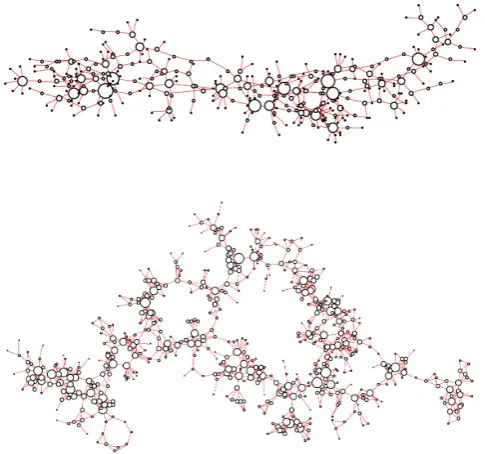
the evolving network (EN) model (top) and static network (SN) model (bottom) from the same set of data derived from images of soil structure and with equal model parameters: equal number of links andm≈1. The area of node corresponds to the node degree, i.e. the number of links attached. The data for the network con-struction included sizes and positions of the pores detected from 2-D X-CT scanned and analysed soil images. Though here ren-dered differently, with positions of the nodes not corresponding to actual positions of the pores in the analysed images (for networks overlayed over soil images, see Mooney and Koroˇsak, 2009), both networks actually show similar topology with the well-connected nodes (larger dots) not directly linked, but preferably linked through nodes with small degrees (smaller dots). This type of network struc-ture indicates that both networks are correlated.
3 Results and discussion
M. Samec et al.: Quantifying soil complexity using network models of soil porous structure 43
Table 1. Complexityhof several soil pore structures with different scaling exponents of their pore size distributions atm=mc/2. Pore space
is black.
Table 1: Complexity h of several soil pore structures with different scaling exponents of their
1
pore size distributions at !=!!/2. Pore space is black.
2
! 1,4 1,5 1,6
h 2,85231 3,06864 3,48277
3
Table 1: Complexity h of several soil pore structures with different scaling exponents of their 1
pore size distributions at !=!!/2. Pore space is black.
2
! 1,4 1,5 1,6
h 2,85231 3,06864 3,48277
3
Table 1: Complexity h of several soil pore structures with different scaling exponents of their 1
pore size distributions at !=!!/2. Pore space is black. 2
! 1,4 1,5 1,6
h 2,85231 3,06864 3,48277
3
α 1.4 1.5 1.6
h 2.85231 3.06864 3.48277
1
Figure 2: Cumulative degree distributions of evolving network (EN) model (left) and static 2
network (SN) model (right) models for small and large values of the parameter m. The 3
scaling exponent of the scale-free degree distribution obtained for small m (straight line in 4
plots) is !=2. The fits are power-laws (straight lines) and cumulative Poisson distributions. 5
6
Fig. 2. Cumulative degree distributions of evolving network (EN)
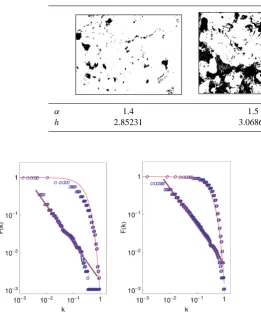
model (left) and static network (SN) model (right) for small and large values of the parameterm. The scaling exponent of the scale-free degree distribution obtained for smallm(straight line in plots) isγ=2. The fits are power laws (straight lines) and cumulative Poisson distributions.
organization for largemas shown in Fig. 2 by the cumulative degree distributions form≈1 andm1.
Multifractal analysis of the same 2-D soil images (Stan-ley and Meakin, 1988; Perrier et al., 2006) was performed, which yieldedD=Dq(q=0)≈1.74 shown in Fig. 3. In an attempt to correlate the properties of the threshold network structure with the porous structure as obtained from 2-D soil image, we considered the assortativity r (Newman, 2002), which is the Pearson’s correlation coefficient of the degrees of adjacent nodes, of the threshold network as a function of the parameterm.
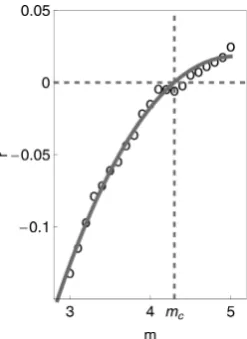
From the result displayed in Fig. 4, we see that there is a crossover from disassortative (r <0)to assortative (r >0) network structure at approximately mc≈4.3. This change is a consequence of progressively more homogeneous net-work structure with increasingm. In geographical scale-free networks this crossover was found to occur when the de-gree scaling exponent wasγ=3 (Morita, 2006). Equating
1
Figure 3: Results of the multifractal analysis of the binary soil image. Fractal dimension as a
2
function of scale parameter q is shown.
3 Fig. 3. Results of the multifractal analysis of the binary soil image.
Fractal dimension as a function of scale parameterqis shown.
the scaling coefficients for the growing network and thresh-old network models gives the crossover parameter mc= 2D/(α−1)=2mc0> mc1indicating that the crossover from
disassortative to assortative network occurs well within in the compact phase of the soil network. The degree scaling ex-ponent in the growing network model exhibits multiscaling γ=1+2/w, so a homogenous network with normalized fit-ness sharply distributed aroundw=1 will haveγ=3.
To further explore the effect of the network parameterm on node correlations, we calculated the node-node link corre-lationscij (Claussen, 2007) defined as links from node with degreeki to node with degreekj.
We expect a soil pore network with a largehto have many links that connect nodes of various degrees, while networks with lowhwill have mostly links connecting node pairs of almost the same degree resembling a lattice-like network or a network close to a complete graph.
1
Figure 4: Pearson's coefficient r applied to the links in the network as a measure of degree-2
degree correlations. r is shown as a function of parameter m in the static network model. We 3
observe a crossover from disassortative (!<0) to assortative (!>0) network structure at 4
!! = 4.3 . 5
Fig. 4. Pearson’s coefficientrapplied to the links in the network as
a measure of degree–degree correlations.ris shown as a function of parametermin the static network model. We observe a crossover from disassortative (r <0)to assortative (r >0)network structure atmc=4.3.
of the parameterm, the network changes from disassortative (nodes with different degrees preferably connected) to assor-tative type.
To quantify the complexityhof the soil pore structure rep-resented with the network, we computed the entropy of the normalized diagonal sums of the correlation matrixcij. Fi-nally, we have calculated the complexity of several soil pore structures with different scaling exponents of their pore size distributions atm=mc/2 (Table 1).
In the following we discuss two possible geophysical im-plications of our findings that may help to elucidate the role of the threshold network model parameterm: the scaling of fractures in rocks (Berkowitz et al., 2000) and the influence of the pore network properties on biological invasion in soil (Perez-Reche et al., 2009, 2012).
The study of fracture networks in rocks (Berkowitz et al., 2000) showed that the length distribution of fractures in rocks scales asn(l)∝l−a. Hereais the fracture length distribution exponent. Fora > D+1 the scaling properties are indepen-dent of system size; fora < D+1 they depend on the sys-tem size, anda=D+1 signals the connectivity threshold (Dis here the fractal dimension of the problem). In experi-ments they find that the range ofa is 1< a <3. If we com-pareato the scaling exponent of length distribution function for scale-free networks embedded in fractal space (Yakubo and Koroˇsak, 2011), a model we used to describe soil pore networks above, we have a=1−D+m(α−1). Immedi-ately we get that the connectivity thresholda=1+D corre-sponds exactly tomc=2D/(α−1), the suspected crossover from disassortative to assortative organization of the net-work. Furthermore, we have the lower bounda=1 occurring atmc0=D/(α−1), i.e. at the boundary between the
non-compact and the intermediate phase of the network structure.
a)
!
≪
1
1
2
b)
!
=
1
3
4
c)
!
≫
1
5
6
Figure 5: Correlation matrices for a smaller geographical threshold network.
7Fig. 5. Correlation matrices for a smaller geographical threshold
M. Samec et al.: Quantifying soil complexity using network models of soil porous structure 45
The embedding parameter m of the threshold soil pore network model controls the compactness of the network or-ganization. For valuesm < m1 (non-compact and
interme-diate phase) the soil pore network exhibits long range con-nections between pores, while in the compact phasem > m1
the pores in the network are mostly connected to spatially nearest neighbours. Recently, the impact of the structural het-erogeneity of soil pore networks on microbial spread in soils has been investigated using soil pore network models (Perez-Reche et al., 2009, 2012), and the idea of long range bridges that link distance pores has been introduced to explain the strong effect of the pore channel size heterogeneity on mi-crobial invasion in soils. The pore channel size was found to be correlated with the arc length of the pore channel between two poresiandjasRij ∝L−ijβ (Perez-Reche et al., 2009). It was also suggested that the pore channel size depends on the radii of poresiandj:Rij∝RiRj (Li et al., 1986). Bring-ing these observations together gives the expression for the pore channel sizeRij ∝RiRjL−ijβ that is similar in structure to the interactionTij (see Eq. 1) used to construct the soil pore network model. However, the implications of the pos-sible connection between the spatial embedding of the soil pore network and the invasion of microorganisms in soils re-main to be further investigated.
In conclusion, soil pore networks obtained from two dif-ferent models demonstrate their scale-free structure, but with characteristics such as assortativity or node-node link cor-relations that depend on the strength of spatial embedding of the network. For the evolving soil network model (Santi-ago et al., 2008, C´ardenas et al., 2010, 2012), it was shown that the scaling exponent of the asymptotic degree distribu-tion is within the interval 1< γ ≤3. Comparing the two net-work models, this finding sets the upper limit to the strength of embedding in the threshold network model m≤mc= 2D/(α−1)indicating that soil pore networks are predom-inantly disassortative. We have used an entropic measure for the complexity of the soil pore network and showed that this quantity is sensitive to differences in soil pore structure as obtained from 2-D images of soil structure.
Edited by: J. Wanliss
Reviewed by: M. Small and one anonymous referee
References
Barabasi, A.-L.: Scale-Free Networks: A Decade and Beyond, Sci-ence, 325, 412–413, 2009.
Barabasi, A.-L.: The network takeover, Nat. Phys., 8, 14–16, 2012. Barthelemy, M.: Spatial networks, Phys. Reports, 499, 1–101, 2011. Berkowitz, B. and Ewing, R. P.: Percolation theory and network modeling applications in soil physics, Surv. Geophys., 19, 23– 72, 1998.
Berkowitz, B., Bour, O., and Davy, P.: Odling N.: Scaling of fracture connectivity in geological formations, Geophys. Res. Lett., 27, 2061–2064, 2000.
Bianconi, G. and Barabasi, A.-L.: Competition and multiscaling in evolving networks, Eur. Phys. Lett., 54, 436–442, 2001. C´ardenas, J. P., Santiago, A., Tarquis, A. M., Losada, J. C.,
Borondo, F., and Benito, R. M.: Soil porous system as hetero-geneous complex network, Geoderma, 160, 13–21, 2010. C´ardenas, J. P., Santiago, A., Tarquis, A. M., Losada, J. C.,
Borondo, F., and Benito, R. M.: Community Structure in a Soil Porous System, Soil Sci., 177, 81–97, 2012.
Claussen, J. C.: Offdiagonal Complexity: A computationally quick complexity measure for graphs and networks, Physica A, 375, 365–373, 2007.
Crawford, J. W.: Can complex be simple?, Geoderma, 160, 1–2, 2010.
Dimri, V. P.: Fractal dimension of soil for flow studies, in: Applica-tion of fractals in Earth sciences, edited by: Dimri, V. P., A. A. Balkema, 189–193, 2000.
Lal, R.: Soil science and the carbon civilization, Soil Sci. Soc. Am. J., 71, 1425–1437, 2007.
Li, Y., Laidlaw, W. G., and Wardlaw, N. C.: Sensitivity of drainage and imbibition to pore structures as revealed by computer sim-ulation of displacement process, Adv. Colloid Interface Sci., 26, 1–68, 1986.
Masuda, N., Miwa, H., and Konno, N.: Analysis of scale-free net-works based on a threshold graph with intrinsic vertex weights, Phys. Rev. E, 70, 036124, doi:10.1103/PhysRevE.70.036124, 2004.
Mooney, S. J. and Koroˇsak, D.: Using Complex Networks to Model Two- and Three-Dimensional Soil Porous Architecture, Soil Sci. Soc. Am. J., 73, 1094–1100, 2009.
Mooney, S. J. and Morris, C.: A morphological approach to under-standing preferential flow using image analysis with dye tracers and X-ray Computed Tomography, Catena, 73, 204–211, 2008. Morita, S.: Crossovers in scale-free networks on geographical
space, Phys. Rev. E, 73, 035104-1–035104-4, 2006.
Newman M. E. J.: Assortative mixing in networks, Phys. Rev. Lett., 89, 208701-1–208701-4, 2002.
Perez-Reche, F., Taraskin, S., Neri, F., Gilligan, C., Costa, L. da F., Viana, M., Otten, W., and Grinev, D.: Biological invasion in soil: complex network analysis, in Proc. 16th International Con-ference on Digital Signal Processing, 2009.
Perez-Reche, F. J., Taraskin, S. N., Otten, W., Viana, M. P., Costa, L. da F., and Gilligan, C. A.: Prominent Effect of Soil Network Het-erogeneity on Microbial Invasion, Phys. Rev. Lett., 109, 098102, doi:10.1103/PhysRevLett.109.098102, 2012.
Perrier, E., Tarquis, A. M., and Dathe, A.: A program for fractal and multifractal analysis of two-dimensional binary images: Com-puter algorithms versus mathematical theory, Geoderma, 134, 284–294, 2006.
Rieu, M. and Sposito, G.: Fractal fragmentation, soil porosity, and soil water properties I. Theory, Soil Sci. Soc. Am. J., 55, 1231– 1238, 1991.
Santiago, A., C´ardenas, J. P., Losada, J. C., Benito, R. M., Tarquis, A. M., and Borondo, F.: Multiscaling of porous soils as heteroge-neous complex networks, Nonlin. Processes Geophys., 15, 893– 902, doi:10.5194/npg-15-893-2008, 2008.
Stanley, E. H. and Meakin, P.: Multifractal phenomena in physics and chemistry, Nature, 335, 405–409, 1988.