Clim. Past, 9, 1161–1179, 2013 www.clim-past.net/9/1161/2013/ doi:10.5194/cp-9-1161-2013
© Author(s) 2013. CC Attribution 3.0 License.
EGU Journal Logos (RGB)
Advances in
Geosciences
Open Access
Natural Hazards
and Earth System
Sciences
Open AccessAnnales
Geophysicae
Open AccessNonlinear Processes
in Geophysics
Open AccessAtmospheric
Chemistry
and Physics
Open AccessAtmospheric
Chemistry
and Physics
Open Access DiscussionsAtmospheric
Measurement
Techniques
Open AccessAtmospheric
Measurement
Techniques
Open Access DiscussionsBiogeosciences
Open Access Open Access
Biogeosciences
Discussions
Climate
of the Past
Open Access Open Access
Climate
of the Past
Discussions
Earth System
Dynamics
Open Access Open Access
Earth System
Dynamics
DiscussionsGeoscientific
Instrumentation
Methods and
Data Systems
Open Access
Geoscientific
Instrumentation
Methods and
Data Systems
Open Access DiscussionsGeoscientific
Model Development
Open Access Open Access
Geoscientific
Model Development
DiscussionsHydrology and
Earth System
Sciences
Open AccessHydrology and
Earth System
Sciences
Open Access DiscussionsOcean Science
Open Access Open Access
Ocean Science
DiscussionsSolid Earth
Open Access Open Access
Solid Earth
DiscussionsThe Cryosphere
Open Access Open Access
The Cryosphere
Discussions
Natural Hazards
and Earth System
Sciences
Open Access
Discussions
The Irish famine of 1740–1741: famine vulnerability
and “climate migration”
S. Engler1,2, F. Mauelshagen1, J. Werner2, and J. Luterbacher2 1Institute for Advanced Study in the Humanities, Essen, Germany
2Department of Geography, Climatology, Climate Dynamics and Climate Change, Justus-Liebig-University Giessen,
Giessen, Germany
Correspondence to: S. Engler ([email protected])
Received: 19 January 2013 – Published in Clim. Past Discuss.: 15 February 2013 Revised: 27 April 2013 – Accepted: 1 May 2013 – Published: 28 May 2013
Abstract. The “Great Frost” of 1740 was one of the coldest
winters of the eighteenth century and impacted many coun-tries all over Europe. The years 1740–1741 have long been known as a period of general crisis caused by harvest failures, high prices for staple foods, and excess mortality. Vulner-abilities, coping capacities and adaptation processes varied considerably among different countries. This paper investi-gates the famine of 1740–1741 in Ireland applying a multi-indicator model developed specifically for the integration of an analysis of pre-famine vulnerability, the Famine Vulner-ability Analysis Model (FVAM). Our focus is on Ireland, because famine has played a more outstanding role in Irish national history than in any other European country, due to the “Great Famine” of 1845–1852 and its long-term demo-graphic effects. Our analysis shows that Ireland was already particularly vulnerable to famine in the first half of the eigh-teenth century. During and after the experience of hardship in 1740–1741, many Irish moved within Ireland or left the country entirely. We regard migration as a form of adapta-tion and argue that Irish migraadapta-tion in 1740–1741 should be considered as a case of climate-induced migration.
1 Introduction
Famines occurred frequently in the agrarian societies of pre-industrial Europe (Abel, 1974). Yet, they have left little or no traces in the narratives of national historiographies – with the exception of Ireland. The “Great Famine” that struck the country in 1845–1852 (Kinealy, 2006) has been given such an outstanding role in Irish national history that it is
generally accepted as a caesura between two distinct periods of Irish history, “pre-famine Ireland” and “post-famine Ire-land”. However, the term “pre-famine Ireland” does not at all imply that Ireland was a country without famines prior to the nineteenth century. On the contrary, Ireland had been struck by famine rather frequently throughout the Middle Ages and the early modern period (Crawford, 1993). As in other coun-tries of pre-industrial Europe, many of those famines were the result of a complex interplay between social and environ-mental factors (Crawford, 1993).
In this article we investigate the Irish famine of 1740– 1741, its pre-conditions, progress and consequences. Our main purposes are (1) to integrate social and climatic pre-conditions in a single, trans-disciplinary analysis; (2) to im-prove the knowledge of Ireland’s “pre-famine” famine his-tory and thereby put the Great Famine of 1845–1852 into perspective. This is particularly important with regard to migration as a consequence of famine. Continuous mass emigration after the Great Famine caused the demographic disaster that made Ireland a shrinking society for many decades. Though this does make Ireland a unique case, it must be recognised that famine and migration had been con-nected throughout the eighteenth century (and probably ear-lier Fitzgerald and Lambkin, 2008). Therefore, it is an ob-vious question to ask if, or in what way, migration after the Great Famine followed already existing patterns that had partly been shaped by the experience of earlier famines.
Different theories – such as the Neo-Malthusian, the Food Availability Decline (FAD) and the Food Entitlement De-cline (FED) theories – provide different answers to those questions. The FED theory of Amartya Sen (1981) domi-nated famine studies in the 1980s and 1990s. Its focus was on food entitlements distributed unequally among populations, i.e. the social conditions for food distribution, and not on al-leged food availability. According to Sen (1984) “entitlement refers to the set of alternative commodity bundles that a per-son can command in a society using the totality of rights and opportunities that he or she faces”. What Sen emphasises in his own case studies (Bengal 1943, Ethiopia 1972–1974 and Bangladesh 1974) is that during a famine only certain segments of the population suffer or die from hunger, while others still live in plenty. The concept of food entitlement replaced the idea of food availability as a tool of analysis, also in order to exclude any supposedly deterministic con-cepts connecting food availability with “natural causes” such as climate fluctuations (Fogel, 1992, 2004).
However, recent famines connected with long-lasting droughts in several eastern African states (Feed the Future, 2011) and the consequences of global climate change in gen-eral have put climatic extremes and other environmental cir-cumstances back on the agenda of famine studies. Impacts of climate variability and extremes on food production and availability are particularly relevant in economies dominated by the primary sector, i.e. agriculture, which is the case in many developing countries today as well as in agrarian so-cieties of the past. Determining the biophysical impact fac-tors (BIF) of climate variations on staple crops has been one of the suggested approaches to understanding this relation-ship in specific places and for specific periods (Pfister and Br´azdil, 2006). Variations in seasonal temperature, humid-ity, precipitation, solar radiation as well as atmospheric CO2
concentration and soil condition are some of the most rele-vant variables affecting agricultural production (Reilly, 1999; R¨otter and van de Geijn, 1999; Xoplaki et al., 2001). They directly determine the size and quality of harvests, the prolif-eration and aggravation of epidemics and indirectly influence the occurrence of hunger and famine.
Today, integrating FED and FAD theories and the social and natural circumstances of famine as well is still a chal-lenge for famine theories and empirical case studies, which obviously require cooperation across the divide between nat-ural and social sciences. To meet this challenge, we define famine “as an extreme scarcity of food or a drop in ex-change entitlements in a certain region over a multi-year pe-riod that threatens the way of life of the already-vulnerable resident population and frequently leads to a higher mortality rate” (Engler, 2012a). Our methodology will be described in Sect. 2. Section 3 is dedicated to the European dimension of the crisis of 1740–1741. In Sect. 4 we provide a holistic anal-ysis of the Irish famine of 1740–1741: Sect. 4.1 is an in-depth analysis of pre-famine vulnerability; in Sect. 4.2, using tem-perature and precipitation reconstructions from Luterbacher
et al. (2004, 2007), Xoplaki et al. (2005) and Pauling et al. (2006), we describe climate conditions in Ireland between 1739 and 1741; Sect. 4.3 looks at the impacts on, and cop-ing strategies of, Irish society; finally, Sect. 4.4 deals with adaptation processes in the aftermath of the famine. Here our main focus is migration as a form of adaptation, and we will discuss the question of whether migration in the context of the Irish famine of 1740–1741 may be regarded as a case of climate-induced migration.
2 Methodology
The theoretical framework we use in our analysis of the Irish famine of 1740–1741, is provided by the “Famine Vulnerability Analysis Model” (FVAM) developed by En-gler (2012a). The FVAM is a heuristic tool, designed to sup-port the study of a wide range of famines over space and time. Emphasising the study of the pre-famine phase, it seeks to advance existing vulnerability concepts by Birkmann (2006), Bohle (2001), F¨ussel (2007), Pahs (2006) and Turner II et al. (2003). Pre-famine vulnerability studies people’s liveli-hood and its socio-economic context, before the initial drivers start affecting them. By contrast, the focus of most other models is entirely on the impacts of famine and on cop-ing strategies to mitigate these impacts (Engler, 2012b).
The concept of “vulnerability” has emerged from the wider framework of geographical and sociological studies of disaster as a key to uncovering the geographic, social and economic preconditions for disastrous events and their complex interplay (Blaikie et al., 1994; Oliver-Smith, 1994; Cutter, 1996). However, in the face of its almost inflationary use today, there is a need to define “vulnerability” (F¨ussel, 2007). As a working definition we quote the Intergovernmen-tal Panel on Climate Change (IPCC), which defines vulner-ability “as the propensity or predisposition to be adversely affected. Such predisposition constitutes an internal char-acteristic of the affected element. In the field of disaster risk, this includes the characteristics of a person or group and their situation that influences their capacity to antici-pate, cope with, resist, and recover from the adverse effects of physical events” (IPCC, 2012; cf. Wisner et al., 2004). As Collet (2012) has pointed out recently, the investigation of predispositions refocuses the study of disasters (such as famines) replacing an existing focus on their analysis as events (particularly fashionable among historians) with the examination of more long-term historical developments be-fore the onset of a disaster. In other words, understanding vulnerability adds historical depth to the study of disasters and makes them discernible as processes rather than events (Oliver-Smith, 2004).
ranging from−1 to+1. Whereby “0” means that an indica-tor is considered to influence vulnerability neither positively nor negatively, whereas “1” signifies that a given indicator is considered to have aggravating effects on famine vulnerabil-ity, and “−1” that a given indicator is considered to have mit-igating effects. Although the FVAM is composed of factors of vulnerability that we consider to be generally relevant and applicable to historical contexts, there are exceptions to this rule that necessitate modifications of our model. Historical evidence is sometimes sparse and incomplete and therefore does not allow an unambiguous evaluation of certain indica-tors. In such cases, the respective indicator will be marked with the sign Ø, and it will not be counted in our overall as-sessment. We use Ø for indicators that do not apply to the respective historical context (in our case, Ireland in the first half of the eighteenth century).
In case all indicators allow evaluation, the sum total of our pre-famine vulnerability assessment ranges from −34 (vulnerability minimum) to +34 (vulnerability maximum). Given this full range, we suggest a provisional distinction be-tween five types of famine vulnerability: A highly resilient1 society (−34 to−20), a resilient society (−19 to−6), a so-ciety in danger (−5 to 5), a vulnerable society (6 to 19) and a highly vulnerable society (20 to 34). However, it must be stressed that our indexation cannot represent any relative or comparative assessments among indicators; in other words, indicators are not weighted against each other. Nevertheless, in concrete contexts, some may be more important than oth-ers, such as the indicator group “agriculture” for the analysis of rural societies. Therefore, as well as for other obvious rea-sons, calculating a sum total from our indices does not lead to a precise quantification of vulnerability and requires caution when used for comparison. With these constraints in mind, the method of the FVAM still claims to be of considerable heuristic value for any future comparative study of famine vulnerability.
In designing the FVAM, complexity and flexibility were among the most desired features. The model integrates a wide range of factors worthy of consideration for a complex assessment of vulnerability. At the same time, its complexity needs to be combined with flexibility so that the model can be applied as a research tool to varying historical contexts. Based on an evaluation of the literature on famines around the world between 1315 and 2012, Engler (2012a) distin-guishes four chronological phases, also reflected in the struc-ture of this article: first, pre-famine vulnerability; the second phase is characterised by the initial driver, e.g. climate (as in our case), failures of political crisis management and other social or environmental circumstances such as wars or mi-crobial shocks (Engler, 2012a). Coping capacities/strategies
1According to F¨ussel (2007) “resilience focuses on the ability of
the system to maintain its basic functions and return to the original state after a perturbation”. In this view, resilience is complimentary to vulnerability.
and direct impacts on a group or society are major subjects of phase three. The adaptations to famine crises constitute the fourth phase. Major processes such as migration or learn-ing processes belong to the adaptation phase, but also link this phase to others (Engler, 2012b). These connections and feedback loops amongst the phases make the FVAM a com-plex tool of analysis (Fig. 1).
In order to apply the FVAM to historical cases such as the Irish famine of 1740–41 our theoretical approach must be supplemented by conventional historiographical methods (archival research, source criticism, etc.). The main source of information used in this paper is the existing research litera-ture on Irish history (particularly on historical famines) and historical geography. In addition, archival research has been carried out to include information from local Irish newspa-pers, letters, books, diaries, official records, and other doc-uments related to the famine of 1740–1741. The statistical information, e.g. on burials and marriages as well as recon-structed grain prices, has been drawn from both research lit-erature and primary sources. Last but not least, we assess the climatic conditions of 1740–1741 using climate field recon-structions because of their importance for the occurrence and further dispersion of the famine. All of the reconstructions used are based on first decomposing the proxy and instru-mental data into the leading modes of variability and then performing a multivariate regression between the resulting time series. One purported advantage is the inclusion of long-range correlation structures, leading to predictive skill even at locations where no data is available for the past (Smerdon et al., 2011). Thus, even while these studies did not use pre-dictors from Ireland, validation measures in these studies do indeed indicate skill for our area of interest (Luterbacher et al., 2004; Xoplaki et al., 2005; Pauling et al., 2006). Recently, it has been shown that even without explicitly including tele-connection patterns, reconstructions can still be skilful out-side the area with good data coverage in the past (Werner et al., 2013).
3 The general character of the crisis
40 1
Figure 1. Famine Vulnerability Analysis Model (Engler, 2012a) 2
3
4
5
6
7
8
9
10
11
12
13
Fig. 1. Famine vulnerability analysis model (Engler, 2012a).
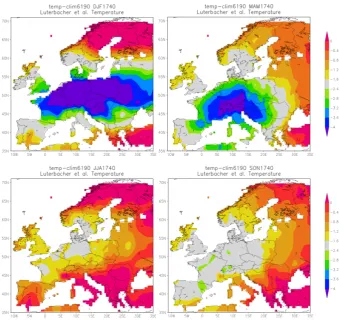
spring 1740, low temperatures persisted (Fig. 2; upper right panel). In June, July, and August 1740 Ireland, Great Britain, France, Germany, the Czech Republic, Poland and the south-ern parts of Scandinavia still suffered from temperatures that were between 0.8 and 2.4◦C lower than normal (Fig. 2; lower left panel). Autumn 1740 was again characterised by below average temperatures (Fig. 2; lower right panel).
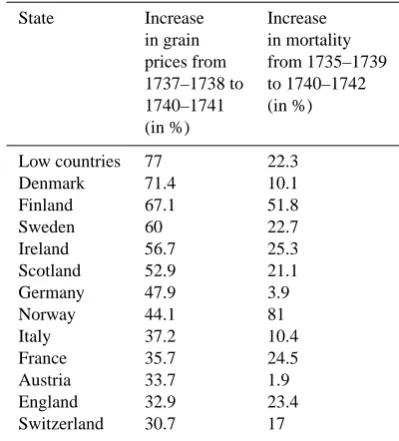
Second, as a consequence of bad harvests, increasing grain prices severely affected many European regions (Abel, 1974). Between 1735 and 1740, grain prices in Berlin, Ham-burg, and Augsburg rose between 160 and 280 % (Abel, 1974). For the same period prices also increased in other European regions (Table 1). The prices for breadstuff rose between three and five times at the Danish Sound Passages (Abel, 1974).
Third, a great mortality wave hit Europe. Summarising his research, John D. Post (1984) stated “that climatic vari-ability touched off concurrent epidemics of less fearful dis-eases which proved capable of producing European mortality waves”. For Post (1984) the rising prices of grain and fodder between 1739 and 1741 indirectly influenced the relation be-tween climate and mortality and acted as an intensifier. Ta-ble 1 refers to this indirect connection and gives numbers for several European countries. Even though 1740 and 1741 were years of hardship and suffering in great parts of Europe, the population of Ireland was struck particularly severely by the “Great Frost”, which started at the end of 1739 (see also Sects. 4.3 and 4.4).
Table 1. Development of grain prices and mortality in different Eu-ropean countries, 1735–1744 (adapted table from Post, 1995).
State Increase Increase in grain in mortality prices from from 1735–1739 1737–1738 to to 1740–1742 1740–1741 (in %) (in %)
41 1
Figure 2. Temperature anomaly (with respect to the 1961-1990 reference period) for the 2
December to February average (upper left panel), March to May average (upper right panel), 3
June to August average (lower left panel) and September to November average (lower right 4
panel) 1740, is taken from the reconstruction of Luterbacher et al. (2004, 2007) and Xoplaki 5
et al. (2005). The figure was plotted using the KNMI Climate Explorer. 6
7
8
9
10
11
Fig. 2. Temperature anomaly (with respect to the 1961–1990 reference period) for the December to February average (upper left panel), March to May average (upper right panel), June to August average (lower left panel) and September to November average (lower right panel) 1740, is taken from the reconstruction of Luterbacher et al. (2004, 2007) and Xoplaki et al. (2005). The figure was plotted using the KNMI Climate Explorer.
4 The Irish famine of 1740–1741
4.1 Vulnerability in pre-famine Ireland
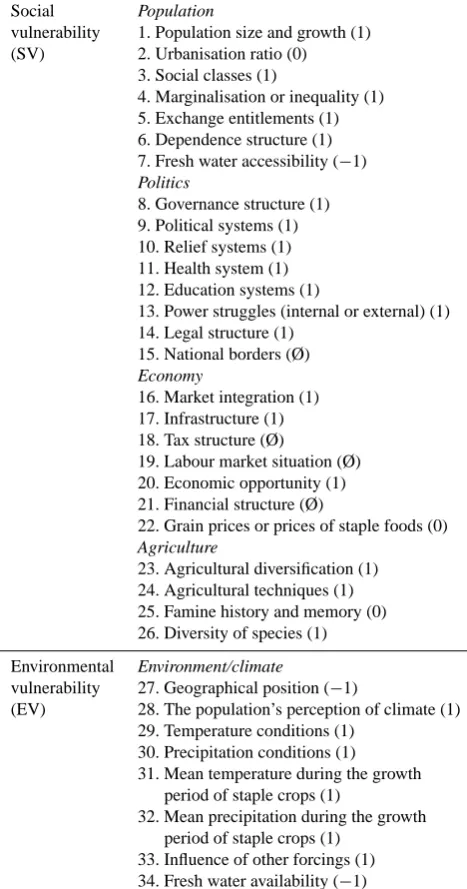
According to the model applied in this study (see section two), our analysis of pre-famine vulnerability is based on an evaluation of 30 (in this case study four of the original indica-tors do not apply in this specific context) social and environ-mental indicators. Compared with the theoretical develop-ment of the FVAM as presented by Engler (2012a,b), some of the indicators and indicator groups have been slightly modi-fied. Table 2 summarises the result of our assessment of vul-nerability in Ireland before the crisis of 1740–1741. In the following subsections (4.1.1 to 4.1.4), we will substantiate our assessment of social and environmental vulnerability by clustering sets of related indicators in the indicator groups shown in Table 2 (population, politics etc.).
In the course of applying the model to Ireland in 1740– 1741, some methodological problems occurred that required decisions on how to handle them. In the following we ex-plain the most important principles for our assessment of the variables:
1. Application of the FVAM model (like any other model consisting of a list of indicators or variables) to specific cases of famine requires subsumption of relevant histor-ical facts (correct information) to indicators. Subsump-tion is based on selecSubsump-tion and judgement, the quality of which depends on the state of knowledge (or research) and professional expertise (in our case: historical and climatological expertise). Facts subsumed under indi-cators become arguments for our assessments, which means that we select information we consider important for our assessment.
2. An important element in the expertise of historians is awareness that the facts they select have already been pre-selected and that that pre-selection is irreversible and may produce biases in historical judgement. For obvious reasons, the theoretical design of the FVAM required modification because some of the indicators could not be treated independently or sufficiently as re-gards the available information.
Table 2. Assessment of pre-famine indicators of vulnerability for the Irish Famine of 1740–1741: numbers in brackets represent the index value according to our assessment of single indicators.
Social Population
vulnerability 1. Population size and growth (1) (SV) 2. Urbanisation ratio (0)
3. Social classes (1)
4. Marginalisation or inequality (1) 5. Exchange entitlements (1) 6. Dependence structure (1) 7. Fresh water accessibility (−1) Politics
8. Governance structure (1) 9. Political systems (1) 10. Relief systems (1) 11. Health system (1) 12. Education systems (1)
13. Power struggles (internal or external) (1) 14. Legal structure (1)
15. National borders (Ø) Economy
16. Market integration (1) 17. Infrastructure (1) 18. Tax structure (Ø)
19. Labour market situation (Ø) 20. Economic opportunity (1) 21. Financial structure (Ø)
22. Grain prices or prices of staple foods (0) Agriculture
23. Agricultural diversification (1) 24. Agricultural techniques (1) 25. Famine history and memory (0) 26. Diversity of species (1)
Environmental Environment/climate
vulnerability 27. Geographical position (−1)
(EV) 28. The population’s perception of climate (1) 29. Temperature conditions (1)
30. Precipitation conditions (1) 31. Mean temperature during the growth
period of staple crops (1)
32. Mean precipitation during the growth period of staple crops (1)
33. Influence of other forcings (1) 34. Fresh water availability (−1)
contexts. Practically, this means that points made in the explanation of an earlier indicator or indicator group will be referred to later. Though obviously unavoidable, this raises questions if counting each indicator sepa-rately is justifiable in every single case. At this point we must once more stress that the summing up of our evaluations based on the indices (−1, 0, +1) does not lead to precise quantification.
4. Basic to most of our assessments of single indicators is a comparison of Ireland with other European countries, though we are lacking the space here for anything like
a comprehensive comparative approach. Thus, compar-ison is not systematic, but based on historical expertise. 5. One of the strengths of an approach that investigates pre-famine vulnerability is that it considers historical circumstances that are not just short-term. The infor-mation we use points to processes of varying temporal depth – an element that deserves further investigation to better understand the temporality of the underlying processes.
4.1.1 Population
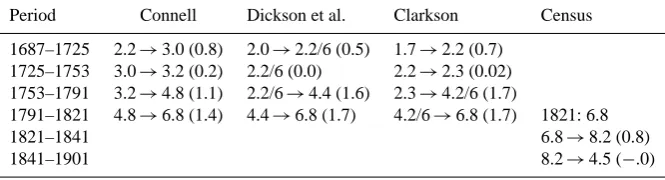
Prior to the availability of census data (from 1821 onwards), Ireland’s population history relies predominantly on esti-mates based on hearth counts for tax registration. There has been some debate about how under-recorded hearths (house-holds) were in the history of the tax and what multipliers need to be applied in order to calculate reliable population numbers (Connell, 1950; Daultrey et al., 1981; Dickson et al., 1982). As a consequence of different solutions to these problems population estimates vary considerably. However, in the context of vulnerability, absolute numbers are less rel-evant than growth rates, because population growth chal-lenged early modern societies to increase agricultural pro-duction by equivalent amounts, often forcing them to culti-vate wastelands with less-fertile soils. Demographers agree that the Irish population grew rapidly, and above European average, around the turn from the seventeenth to the eigh-teenth century, but stagnated in the decades before 1750, be-fore rapid growth set the stage for the disaster of the Great Famine, after which emigration led to population decline throughout the nineteenth century (Table 3). Though it would be too simple to regard the famine of 1740–1741 merely as the end of a Malthusian cycle, the decades of excess popula-tion growth before and after 1700 certainly had their share in the overall vulnerability of Ireland’s society.
Table 3. Synopsis of estimates of Irish population numbers and average annual growth rate by indicated period (in parentheses), 1687–1901. Numbers are based on Connell (1950), Dickson et al. (1982), and Clarkson (1981). Census data are available from 1821 onwards. The synopsis has been modified from Kennedy and Clarkson (1993).
Period Connell Dickson et al. Clarkson Census
1687–1725 2.2→3.0 (0.8) 2.0→2.2/6 (0.5) 1.7→2.2 (0.7) 1725–1753 3.0→3.2 (0.2) 2.2/6 (0.0) 2.2→2.3 (0.02) 1753–1791 3.2→4.8 (1.1) 2.2/6→4.4 (1.6) 2.3→4.2/6 (1.7)
1791–1821 4.8→6.8 (1.4) 4.4→6.8 (1.7) 4.2/6→6.8 (1.7) 1821: 6.8
1821–1841 6.8→8.2 (0.8)
1841–1901 8.2→4.5 (−.0)
countries. Moreover, in the specific context of famines, mar-ket integration, which may be regarded as a historical con-sequence of urbanisation, has been considered a mitigating factor in coping with food scarcity and rising prices for sta-ple crops (Persson, 1999). However, both the early modern discourse about food speculation as well as the more recent impact of such speculation on global financial markets raises doubts as to whether the effects of market integration are unambiguous. At this point, we are lacking a general indi-cation. Therefore, we must limit our assessment of the role of urbanisation in social vulnerability to historical compari-son between Ireland and other European countries before and around the crisis of 1740–1741. Thus, the fact that the differ-ence between Ireland and the rest of Europe became signif-icant only after 1750 is the most robust foundation for our assessment of this indicator.
Generally speaking, the famine was neither an exclusively rural nor urban event. The prevailing social inequalities, re-ligious discrimination, and great poverty led to this vulner-ability and raised food insecurity even further. A contempo-rary witness from Cork describes some of these differences: “There is in no kingdom greater inequality than in Ireland: one class of great property who live excessively sumptuous: the second and more numerous class hurting their fortunes by the imitation of the first – the third in extreme poverty” (O’Brien, 1918).
4.1.2 Politics
The vulnerability of political systems and the correspond-ing institutions and structures are at the centre of our sec-ond indicator group. Today, “good governance” has become a term in political science to measure the performance of po-litical systems to manage contingency and crises – a form of management in which representatives of the state, economy, and civil society are required to cooperate in all questions of strategic planning (Benz et al., 2007). Though the mod-ern concept of “good govmod-ernance” does not easily apply to historic contexts, it is not entirely detached from early mod-ern ideas of “good govmod-ernment”. However, these ideas hardly provide a reliable catalogue of criteria to assess the impacts of political management on famine vulnerability. What can
be said in the case of Ireland is that, whatever attempts there were at “good government”, these attempts were complicated immensely by political and religious disruptions.
Since the sixteenth century Ireland was under the con-trol of the English kingdom, which was mostly Protestant. The so-called “plantations” were regions in Ireland that were annexed and colonised by English and Scottish settlers in the course of the sixteenth and seventeenth centuries. These areas were primarily in the North of Ireland (Ulster), but also existed in the Southwest and in the centre of the is-land (Cruise O’Brien and Cruise O’Brien, 1985). These ex-ternal political as well as religious influences provoked so-cial conflicts and increased vulnerability in the context of food scarcities and famines. The Panel Laws excluded Ro-man Catholics, who represented by far the biggest population group, entirely from political participation. Between 1728 and 1793 the Roman Catholics were strictly banned from all governmental duties and had neither passive nor active vot-ing rights (McCracken, 1986; Smyth, 2006). This increased their vulnerability immensely, especially in the field of agri-culture and food production, because individuals who were not interested in the needs of the rural, Roman Catholic pop-ulation made decisions on exports and imports, price cutting strategies, etc.
In addition to the discrimination of the Roman Catholics through the “Penal Laws” (Cruise O’Brien and Cruise O’Brien, 1985), other laws complicated the operation pro-cess of certain economic sectors and raised the vulnerability of those involved. For example, the woollen manufacture got into distress, because of the numerous production-limiting laws. As a consequence, 20 000 employees emigrated to seek better chances abroad (O’Brien, 1918).
In the context of famine, we define a relief system as an or-ganised form of food aid from private actors or public in-stitutions, ready to answer the demands of the specific cri-sis. Nation-wide charitable actors – with the exception of the Church – or a political welfare system did not exist – a circumstance also noted by contemporaries (Stephens, 1746; Prior, 1741). Post (1995) considers “the combination of the severe food shortages and the ineffective or absent welfare and relief measures” to be the primary cause for high mor-tality in 1740–1741. Though that applies to other European countries as well, Ireland was clearly among the most vulner-able in terms of preparedness. As we shall see, in some Irish towns private agents or institutions did start some measures of poor relief during, but not before, the famine. Such local activities were sporadic and short-term. The city of Cashel was one of the exceptions to the rule and took action, already when the first symptoms of famine became discernible: “The great charity of this little town [Cashel] has brought above a thousand poor together, who are fed every day in the most regular manner of any I hear in any town in the kingdom; [. . . ] I wish all the towns in the kingdom wou´d take pattern” (George Faulkner, The Dublin Journal, 1741).
Only after the famine of 1740–1741, the need for a widespread health and relief system became a more pressing issue of “good government”.
Today, education is widely accepted as a pre-condition to achieving food security. The “Food and Agricultural Orga-nization of the United Nations” has argued that the “lack of education undermines productivity, employability and earn-ing capacity, leadearn-ing directly to poverty and hunger” (FAO, 2005 cited in FAO, 2007). This does not only apply to mod-ern societies with their highly diverse labour markets, but also to pre-industrial societies such as Ireland in the first half of the eighteenth century. Like almost any other element of social life, modernisation of education in Ireland was ob-structed by the circumstances of English colonial rule rein-forcing inequality along the lines of the Catholic–Protestant divide. As early as the 16th century, Henry VIII and Queen Elizabeth I had used education as “cultural weapon” to es-tablish the English tongue and the Anglican Church in Ire-land (Fallon, 2005, 118 pp.). The parish, diocesan, royal, and charter schools endowed through government or parlia-mentary grants reached out to upper or middle-class Protes-tants, but not to lower-class people and the Catholic majority (Akenson, 1970). Penal legislation in the 17th century out-lawed Catholic priests and teachers. As a result, “both pro-fessional schools and the Catholic parish schools ceased to exist” (Fallon, 2005). Instead, parents would send their chil-dren to underground “hedge schools” (called in Gaelic scoil chois cla´ı, scoil ghairid, or scoil scairte, etc.) for the “rudi-ments of learning” (Fellon, 2005). The Irish charity school movement in the early eighteenth century responded to these developments. Charity schools enrolled both Protestant and Catholic children of the lower classes, “but instruction was in the protestant religion only” (Akenson, 1970).
The medial revolution triggered by the printing press im-pacted Ireland only after 1750, although the art of print-ing had been introduced into Ireland two centuries before. Yet, “It failed to capture the imagination of the Irish peo-ple” and “was looked upon as an English institution” (Fallon, 2005). Particularly striking is the high illiteracy rate. It cor-relates positively with Gaelic as the spoken language, the Catholic religion, and non-existing communication paths (Smyth, 2006). Illiteracy was comparatively low in today’s Northern Ireland (between 40 and 60 %) and Dublin (un-der 40 %), while it was over 80 % in the West and South-west of Ireland (Smyth, 2006). We are, of course, aware that oral communication and traditional forms of education were a form of knowledge transfer operating in many traditional societies. Its value should not be underestimated. However, improvements in literacy and education of rural populations became an important element in the efforts to improve agri-cultural production almost everywhere in Western and Cen-tral Europe in the first half of the 18th century. Ireland had clearly fallen behind those developments.
English rule fostered religious and, with it, regional diver-gence, and it provoked social and political protest. In addi-tion to all other negative political aspects, the whiff of war with Spain and France lay over the kingdom and the military expenses rose, even in times of famine (Magennis, 2000).
4.1.3 Economy
Like in other parts of pre-industrial Europe, agriculture was the dominant economic sector in Ireland, and we will deal with it separately in the following section (4.1.4). In the present section our focus is on other sectors and features of the Irish economy that affected the vulnerability of the Irish population to famine. However, it must be stressed that the pre-dominance of agricultural production caused a number of important consequences: (1) landowners formed the most influential group to either foster change and improvement or to resist it, which is true not only for the agricultural sec-tor, but also for early forms of industrial production in the textile and mining industries (Proudfoot, 1993). (2) Irish ex-ports consisted largely of raw, unprocessed goods. (3) More-over, production was less commercialised compared with England or the Dutch Republic, which means that Ireland represents a case where most production merely served sub-sistence. Commercialisation of goods progressed during the eighteenth century. However, the improvement of economic exchange was confronted with structural deficiencies that also potentially increased Ireland’s vulnerability to famine.
key improvement in fostering transition from low levels of market integration to higher ones. Improvements of Ire-land’s transport infrastructure were established mostly af-ter 1750. Waaf-ter transport, which dominated trans-regional exchange, was improved by canal construction in the sec-ond half of the eighteenth and in the nineteenth century; only for some canals construction began earlier (Delaney and McCutcheaon, 1984). Between 1730 and 1750, road construction depended on so-called turnpike trusts (self-financing commercial ventures), while parishes were not re-sponsible to build new roads. The turnpike system more or less failed because the costs for construction and mainte-nance were hard to cover (Proudfoot, 1993). As regards road quality, contemporary reports diverge significantly, which is hardly surprising. Roads in and around Dublin were reported to be in good shape; but road quality deteriorated with the shrinking size of towns or villages and their relevance for trans-regional trade (Smyth, 2006).
English colonial rule in Ireland affected Irish trade with the rest of Britain and beyond. While Irish merchants had to pay taxes on exports to England, which lowered their profits, exports from England to Ireland were more or less tax-free. Free trade with other European countries, e.g. Spain, was en-tirely prohibited (O’Brien, 1918). Also trade embargoes by specific cities inside Ireland further harmed other regions and the market as a whole during the famine. Cork and Belfast were only two examples for this particular behaviour. Cork mostly stopped incoming ships from America, and Belfast stopped all ships in their harbour as soon as food shortages became discernible (The Belfast News Letter, 1740).
4.1.4 Agriculture and environment/climate
The dominance of agriculture, or the primary sector of eco-nomic production, is essential in understanding the vul-nerability of pre-industrial economies to climatic variabil-ity and extremes. In the centres of agricultural production (e.g. Europe, China), over hundreds or thousands of years human populations had established co-evolutionary relation-ships and ecological cooperation with a relatively small set of plant and animal species – small by the standards of hunter-gatherer societies which accessed a much greater variety of species. Domestication of species used in agriculture devel-oped over the long-term and created locally highly diverse and complex patterns of vulnerability of food production to climate fluctuations. Summarising this point of general im-portance as early as 1922, Lucien Febvre (1924), one of the founding fathers of the French School of Annales historians, emphasised in his geographical introduction to the study of history that “the action of climate on the natural environ-ment in which man lives must be known before we can un-derstand the action of climate on man.” The equilibrium be-tween climate and agriculture was (and is) particularly deli-cate in mountainous regions, e.g. in the Alps, the Himalayas, or the Andes, and in latitudes bordering climate zones where
agriculture becomes risky, which includes certain parts of northern Europe.
In view of the great significance that weather conditions had for the success or failure of crops during growing season, it is remarkable how little Malthusian or Neo-Malthusian, FAD and FED theories of famine, but also historians of agri-culture, have cared about climate, the weather and other en-vironmental circumstances. For the purpose of our study we must re-integrate what belongs together. We therefore dis-cuss environmental factors and agriculture in a single indi-cator group. This also includes weather/climate perceptions and memories of extreme events, because these cognitive el-ements operate at the intersection between society and the environment and, thus, influence the adaptability of individ-uals and societies to climatic variability and their resilience (Walker et al., 2004).
Agriculture is of cardinal importance for Irish history ( ´O Gr´ada, 1990), which is influenced by specific climate con-ditions. Due to its geographic proximity to the “Gulf stream” (North Atlantic Drift), Ireland normally has a climate char-acterised by comparatively mild winters and cool summers (Goodale et al., 1998). Some of the cold spells that affected continental Europe, and were typical for the period known as the “Little Ice Age” (LIA), spared Ireland or were less severe there. As regards precipitation, Ireland shows large regional differences between the western and the eastern parts of the island. “For sites at sea level, annual precipitation ranged from more than 2000 mm in the west to less than 800 mm in the east” (Goodale et al., 1998). In years diverging from these “average” conditions of Irish climate, extreme events and anomalies often led to food scarcity affecting various segments of society (Crawford, 1993).
Looking at the state of the primary sector of economy in early eighteenth-century Ireland reveals some of the social and environmental disharmonies that are characteristic for that country. All societal processes were bound to the crop cycle. Since the potato had crossed the Atlantic, it had be-come one of the two main staple foods in Irish agriculture (the other one being oats) prior to and in 1740 (Salaman, 1985). Though the potato probably helped Ireland’s growing self-sustaining rural population to survive, the monoculture-type of food production it fostered certainly increased the vulnerability of the Irish society for climate and environmen-tal impacts particularly dangerous for the potato and oat.
followed by a set of environmental problems (Smyth, 2006) such as soil erosion. The rapid destruction of woodlands also destroyed the habitats of some domestic animals.
Environmental decline was also experienced by the fishing industry, which faced major difficulties in the early 1700s. Historical research and reports by contemporary witnesses indicate that the former abundance of fish stocks in the Irish Sea was declining. According to Lecky (1913) “the wasteful system of trailing nets, however, which was illegal in France, had been introduced into the Irish fisheries about 1738, and the destruction they caused among the seaweed and among the spawn is believed to have been the cause of the decline of the fisheries.” This situation forced many traditional coastal towns to shrink, both economically and demographically.
Weather perception is instrumental in the interaction of ru-ral societies with their local environment. The memory of hardship caused by extremes has always been particularly significant in this framework, and it is obvious that without memory there is no preparedness. The three decades prior to the famine were characterised by relatively mild winters (Rutty, 1770). Thirty years are equal to a full generational shift, certainly by the standards of the average Irish life expectancy in the eighteenth century (Schellekens, 1996). Dickson (1997) already assumed that this experience “per-haps lulled people into a sense of false security as regards their food supply”. Thus it seems likely that the Irish popu-lation in 1740 was hardly prepared for the unexpected for a lack of memory of a cold winter followed by harvest fail-ures. Thirty or more years would have counted less, was it not for the highly illiterate rural population for which written memory of previous famines was hardly accessible. Records of extreme weather events, climate fluctuations, and famines for previous decades and centuries were only ac-cessible for small segments of the society. As a matter of fact, a lot of Irish newspapers reported on those events and linked them to expected harvest outcomes in rural areas (The Dublin Gazette, 1740a), but they did not reflect on previous famines (such as 1728–1729). Newspapers were printed and read mainly in cities. In rural areas, the clergy at best, in-directly communicated such reports. Overall, many aspects indicate that a great majority of the Irish living in 1740–1741 only had a very short-term and (at best) fragmentary mem-ory of previous famines caused by climatic extremes. This clearly contrasts the situation after the “Great Famine” of 1845–1852 (Kinealy, 2006).
4.2 Initiating driver
As discussed in the previous sub-section, Ireland had been on the brink of a famine for several years. However, the extreme winter of 1739–1740 and the still too dry spring seem to have caused the situation to tip.
“For several days past we have had here very cold weather, but Sunday and yesterday, most excessive cold, with hail and snow, and not three hours of continued rain since the
beginning of November, which causes as great scarcity of water as in the midst of summer, so that there is no getting corn ground at our water mills” (The Dublin Gazette, 1740b). The records of purely qualitative weather descriptions from archives need to be verified using quantitative data. We use the seasonal temperature and precipitation reconstruc-tions for Ireland by Luterbacher et al. (2004, 2007), Xoplaki et al. (2005) and Pauling et al. (2006). In Fig. 3, we present seasonal climate diagrams for temperature and precipitation (Luterbacher et al., 2000, 2004, 2007; Xoplaki et al., 2005; Pauling et al., 2006) for the early eighteenth century (1710– 1739), the 30 yr prior to the famine. A solid red vertical line marks the average values for the reference period 1961–1990 and blue dashed lines mark the respective seasons in the famine years of 1740–1741. The pre-famine situation seems to have been roughly comparable to the situation in the late twentieth century (Fig. 3). The autumn of 1739 was already slightly cooler than normal (1◦C). The winter of 1739–1740 was even cooler (about 2◦C) and much drier (−30 % pre-cipitation) than the previous years. Contemporary witnesses also noted the unusually cold weather, as can be seen from newspaper reports like the following, printed in the Dublin Gazette in January 1740: “The frost continues most severe and intense, so that there are tables and forms on the Lif-fey and selling liquors, and it is said they intend to roast an Ox on it. The thermometer is four degrees lower and colder since our last, and is now 7–9 degrees colder than ever has been known” (The Dublin Gazette, 1740c).
The dry winter and spring of 1739–1740 had a huge in-fluence on crop yields for the following year as the saplings withered: the influence of detrimental weather on plant life, especially on annual plants, is much higher during the begin-ning of the vegetation period than later in the same year.
Luterbacher et al. (2002) argue that possibly a stable high-pressure ridge over the eastern Atlantic was dominating mid- and upper-tropospheric circulation flow during winter 1739–1740 (Figs. 4 and 5). The corresponding low-pressure systems extended from the Canadian Archipelago down to Labrador and to the Black Sea. The ridge over the eastern At-lantic led to stable high-pressure conditions over the British Isles, including Ireland. Cold air during winter and early spring mostly flows around ice-shielded Greenland. There-fore, it seems that stationary atmospheric circulation patterns during winter and spring 1740 significantly conditioned sea surface temperatures and marine boundaries along the Euro-pean Atlantic coasts and also influenced the conditions over Ireland (Luterbacher et al., 2002). Briffa and Jones (2006) suggest also the development of a persistent, cold blocking high over central Europe, which reached unusually far west. This suggests that cyclonic activity was restricted to Iceland and parts of the Mediterranean regions.
Winter
T in °C
total prec in mm
Frequency
300 250 350
3.0
400 4.0
450 5.0 6.0
0
2
4
0
6
1740 1740
20th C 20th C
8 1739/40
2
10
4
1741/41 20th C 1740 1741 20th C 1740 20th C 1741 1740 1739 1741
6 1739/40 20th C
8
10
total prec in mm
Frequency
Spring
T in °C
200 240 280 6.5 7.5 8.5 9.5
0
2
4
6
8
10
12
0
2
4
6
8
10
total prec in mm
Frequency
Summer
T in °C
200 250 300 350 11.5
0
12.5
2
13.5
4
6
14.5
8
0
2
4
6
8
total prec in mm
10
Frequency
12
250 Autumn
350 T in °C
0
2
4
6
8
8.5 9.5 10.5 11.5
0
2
4
6
8
10
12
14
1740/41 20th C 20th C
1741
1741
1740
1741
Fig. 3. Seasonal climate diagrams for Ireland (averaged over land only grid cells 51◦N–56◦N, 11◦W–5◦W). The histograms show temper-atures (top panels) and seasonal precipitation (1710–1739). Solid red lines mark 1961–1990 averages; dashed blue lines denote values for seasons during the famine, years marked adjacent. Data from Luterbacher et al. (2000, 2004, 2007), Xoplaki et al. (2005) and Pauling et al. (2006).
from Belfast, that there has been for these several days last past, the coldest weather and the greatest fall of snow and sleet, that hath been known in that part of the world at this time of the year; the snow was so deep on the road between that place and Ballymena, that a person coming from thence with a horse, was in much danger of perishing, he often sunk out of sight in the snow and was oblig’d to turn back again” (The Dublin Gazette, 1740d).
4.3 Impacts and coping strategies
In the context of the FVAM the phase of coping capac-ity/strategies and direct impacts consists of consecutive feed-back loops, which are characterised by consecutive responses to one another. This phase began after the climate, as the main initial driver, started to affect the socio-environmental system in Ireland. In 1739 the potato crop failed (Salaman, 1985; Smith, 1774a). With the failure of the potato, the prices of all edible goods on the markets increased. In April 1740 George Faulkner´s The Dublin Journal noted: “There is now as great scarcity of provision in this city [Dublin] as ever known, and it is much to be feared all over this kingdom, every kind of food being at vast high prices, which is ow-ing to the great drought we have had ever since last Christ-mas, there not having been one day’s rain. During that time
forty thousand sheep have died in Connaught within these two months” (George Faulkner, The Dublin Journal, 1740a). In September 1739, prior to the harvest failure, the price for one quarter of wheat was one pound and ten schillings. With the ongoing strong frost conditions and the failing potato crop, demand for wheat and other crops rose as well as the prices for these goods (Fig. 6). The drought that fol-lowed the winter frost in spring 1740 exacerbated the food shortage. At the peak of the famine, the price for one quarter of wheat was more than three pounds, almost three times the price paid in September 1739.
30°N 40°N 50°N 60°N 70°N 30°N 40°N 50°N 60°N 70°N
H
H L
Autumn 1740 Spring 1740
20°W 0°W 20°E 40°E
L
H Winter 1739/40
Summer 1740
40°E
20°W 0°W 20°E
Fig. 4. Seasonal averages of sea level pressure in 1740. During spring a strong blocking high west of the British Isles led to cold air advection from the north. Data from Luterbacher et al. (2002).
30°N 40°N 50°N 60°N 70°N 30°N 40°N 50°N 60°N 70°N
Winter 1739/40
Summer 1740
40°E
20°W 0°W 20°E
Autumn 1740 Spring 1740
20°W 0°W 20°E 40°E
48 1
Figure 6. Average price of wheat (one quarter = 40 stone) (Data: George Faulkner, The 2
Dublin Journal, 1739-1741) 3
Fig. 6. Average price of wheat (one quarter = 40 stone) (data: George Faulkner, The Dublin Journal, 1739–1741).
in an economy in which many people depended on self-subsistence, they do reflect the hardship suffered by those segments of the Irish society participating in food markets. As Post (1995) pointed out, “food and drink accounted for some 60–75 % of the household budgets of the labouring population when cereal prices stood at normal levels”. In-creasing food prices thus severely affected the purchasing power of households.
Ireland was an export-oriented country for food products, but in times of crises this changed in certain economic sec-tors. For obvious reasons of supply, the exports of live cattle, oatmeal, etc. were cut drastically. Nevertheless, some im-portant goods for nutrition were exported in high amounts, regardless of the scarce food situation, for example butter, beef, barley and malt (O’Brien, 1918). In 1740–1741, hake was also exported in large amounts. Some counties, such as Waterford, also spent shares of their money for luxury com-modities such as tobacco, wine, etc. (Smith, 1774a).
In the course of the crisis, as a coping strategy, many poor changed their eating habits. These changes were two-fold: less and different. “Less” is obvious; “different” means that diets would include “famine foods” ( ´O Gr´ada, 2009). Nu-trient content became more important than taste. Even sour milk, nettles, charlock, and rotten potatoes were consumed (Dickson, 1997). Less and unhealthy food often harmed the immune system of individuals and made them more vulner-able to diseases. Not surprisingly, the death rate was great-est among the poor. George Faulkner’s, The Dublin Journal reported: “Here is an uncommon mortality among the poor people, by fevers and fluxes, owing, no doubt, in a great measure to their poor living” (George Faulkner, The Dublin Journal, 1740b). In March 1741, Rutty (1770) noted in his diary how the “dysentery raged greatly” among the most ex-posed segments of the Dublin population. At its peak dysen-tery caused 21 deaths in a single week, “though it was less mortal than in the country”.
Besides “famine foods”, other forms of desperation oc-curred. Some Dubliners began rioting and looting: “Last Sat-urday in the evening, Sunday and yesterday, we had very great tumults, occasioned by the great dearness of bread,
meal, &c. Several bakers shops were broke open, and their goods sold at a low price to the poor; great damages have been done on this occasion, many persons being wounded and some killed” (George Faulkner, The Dublin Journal, 1740c).
Similar incidents occurred in other places. In his account of the famine, Dickson describes the “atmosphere in the towns” as “more explosive” (Dickson, 1997) than in the countryside. As food theft became more common, the num-ber of prisoners rose and punishment for such crimes was aggravated. As a reaction to jails overcrowding in the king-dom of Ireland some of the prisoners were deported to North America (McDonnell, 1992). Clearly, these so-called “trans-portees” were forced migrants to the “New World”.
Alongside such measures, some private and public relief programs were established. The following charity actions were reported from the small town of Cashel, in County Tipperary: “Every Sunday, Tuesday and Thursday, they [the poor] are served with excellent soup well seasoned with spice and herbs, and thickened with oat meal; every other day, they have stirabout well prepared, for to every hogshead of water there is allowed half a barrel of meal, 12 pound of butter, a peck of salt, a quarter of a pound of pepper; each grown per-son, gets three pins at each mess, and every young body, half as much, which serves most of them for two good meals; this contribution is wholly confined to the town” (George Faulkner, The Dublin Journal, 1741).
In Dublin a hundred poor were fed for free at the univer-sity on a daily basis (George Faulkner, The Dublin Journal, 1740d). Furthermore, in the peak periods of the famine, the workhouse served around 34 000 poor in a week (George Faulkner, The Dublin Journal, 1740e). Huge problems were posed by increasing unemployment in the towns. As is typ-ical for pre-industrial subsistence crises, at some point the famine turned into a general economic depression, which manifested in a diminished demand for labour (McCracken, 1986). Many Irishmen tried to escape unemployment through short-term labour migration. Most went to England to work as seasonal harvesters or to find work in big cities such as London.
countryside. In Ireland, the lack of commercialised food mar-kets and the relatively low level of market integration ag-gravated these impacts of food crises, which were effective more or less everywhere in pre-industrial Europe. Though the Irish labour markets were relatively stable before the famine – there were (nearly) no reports on problems with high un-employment rates prior to 1740 – they lacked resilience to Labrousse-type crises. Already shortly after the first impacts of the extreme climatic conditions began to appear, unem-ployment rates in the towns and in their hinterlands went up. Even though coping strategies were activated, the fatal-ity ratio was unusually high. ´O Gr´ada (2009) has estimated the mortality rate during the Great Frost of 1740–1741 at 13 %, compared with 12 % during the “Great Irish Famine” in the nineteenth century. The death ratio is not the only de-mographic effect similar to the Great Famine. According to some studies, the ratio of the population moving within Ire-land or leaving the country during the famine of 1740–1741 was just as high as it was in 1845–1852 (see the following section on the adaptation phase).
4.4 Adaptation and migration
Adaptation in the aftermath of famine is the last phase con-sidered by the FVAM, which structures our study. Gener-ally, adaptive action may be taken on all levels of a soci-ety, and it may be targeted at mitigating any aspect of vul-nerability paving the way for disaster (i.e. prevention), or at improving preparedness before it strikes again. Adaptabil-ity is a key to evaluating a society’s resilience. Societies are self-organised based on communication, and written forms or media of communication provide evidence of adaptive pro-cesses in past societies. After famines in early modern Eu-rope, debates over preventive measures peaked with regular-ity. As in many other places in Europe and at different times, some observers of the Irish calamity in 1740–1741 asked for state granaries (Powell, 1757). Thomas Prior, founder of the Royal Dublin society, suggested: “The best course to guard against scarcity, is to encourage farmers to raise large quan-tities of corn yearly, that the redundancy of plentiful crops may be sufficient to answer the deficiencies of bad ones. And this can no other ways be done, than by affording them a con-stant and reasonable price for the quantities of corn they shall raise. [. . . ] It will easily occur to every one, that granaries under proper regulations would answer all those intentions” (Prior, 1741).
As mentioned in Sect. 3, diseases such as smallpox, in-fluenza, and severe fevers spread during the famine. Conse-quently, some cities started or improved their public health systems. For example the city of Cork, with the help of char-itable members of the “Musical Society”, erected a medical facility in which ten physicians and four surgeons attended the poor three hours every day (Smith, 1774b, 390f pp.). “Some years above 2000” patients were treated in such fa-cilities (Smith, 1774b, p. 391).
For the rest of this section on adaptation, our main focus will be on migration as a specific form of adaptation either during or immediately after the famine of 1740–1741. The reasons for this focus are partly contextual and partly his-torical. The contextual reason is that research for this study was carried out in the framework of the “Climates of Mi-gration” project, which studies climate fluctuations as push factors involved in historical cases of migration. The histor-ical reason is the outstanding role of migration in Ireland’s national history, which is more or less that of an unending de-mographic disaster following the onset of the Great Famine in 1845. Looking further back, into Ireland’s “pre-famine his-tory”, sheds new light on the relation between famine and migration.
Before returning to our case study, we need to explain why we consider migration as a form of adaptation at all. The an-swer is neither obvious nor trivial. Some scholars have ar-gued that people decide to leave home and move to other places only after their efforts to adapt to changing social or environmental conditions have failed. Others regard mi-gration as “last-resort adaptation” (Stern, 2007). Both these views are sound and apply in some cases of migration. Yet, the assumptions underlying these conceptualisations are not self-evident. Regarding migration as adaptive failure empha-sises people’s attachment to place and the local conditions of their livelihoods. However, this emphasis is biased in that it takes sedentary forms of society as the rule. From a his-torical perspective this is as doubtful as the idea that people choose to move only at the end of a chain of attempts to stay in place, which nurtures the expectation that the most vul-nerable, or poorest, segments of a population are also most likely to move away.
sustain their livelihoods under pressure in a certain place and at a certain time.
Though no precise totals can be given, demographers agree that the famine of 1740–1741 produced very high num-bers of migrants. Fitzgerald and Lambkin give 1741 as a “migration landmark” (Fitzgerald and Lambkin, 2008, their Fig. 5). Smyth even states that the migration rate in 1741 was as high as during the Great Irish Famine of 1845–1852 (Smyth, 2006 cited in Fitzgerald and Lambkin, 2008). How-ever, his estimates may be too high and cannot be verified. People’s movements during the crisis were mostly internal; but also very substantial emigration (external migration) oc-curred in 1740–1741 (Dickson, 1997).
Generally, the predominant pattern of internal migration was from rural to urban areas. Seeking work and food, people moving away from the countryside hoped to es-cape calamitous conditions and survive in the framework of nearby towns and cities ( ´O D´alaigh, 1995). As regards emigration, different groups of emigrants from Ireland must be distinguished, the so-called Ulster-Scots or Scotch-Irish from the northern parts of Ireland, Protestants and Pres-byterians (Fitzgerald and Lambkin, 2008; Dickson, 1997; Cullen, 1981; Wokeck, 1989, 2003; O’Brien, 1918; Steven-son, 1920). The path taken by many led to the New Eng-land colonies and Pennsylvania, with which trade connec-tions with Ireland existed (George Faulkner, The Dublin Journal, 1729; The Dublin Gazette, 1740e). A great number of Irish immigrated to Philadelphia, often following the paths of their relatives and friends who had migrated in 1728–1729 (chain migration). Wokeck (1989) found out that the immi-gration rate to Philadelphia (Pennsylvania) rose by 500 % from 1730 to 1740. In 1740 and 1741 the migrants from Southern Ireland to the Delaware Valley also increased dras-tically by around 300–400 % (Wokeck, 2003). In the North of Ireland, “the emigrants leaving Belfast and Derry for Amer-ica were no fewer than twelve thousand annually” during the famine (Stevenson, 1920). The emigration rate in the famine of 1740–1741 could have been even greater, but “mostly Irishmen [were] too poor to pay for the transatlantic passage” (Wokeck, 1989).
Of course, migration in 1740–1741 must be seen in the wider context of Irish population movements preceding or following these famine years. The demographic background of all Irish migrations before the nineteenth century – as is the case with almost all European migrations – is rather ob-scure (Cullen, 1994): full demographic statistics document-ing in and outmigration per country over decades or centuries do not exist before 1800; moreover, the Irish case is partic-ularly complicated in the eighteenth century, when inflows parallelled outflows (a pattern resembling the Netherlands in the same period). In fact, inflows and outflows were inter-connected in a sense that immigration nurtured emigration, particularly in the case of Ulster. Moreover, Cullen (1994) has pointed out that Irish emigration during the seventeenth and eighteenth centuries “was especially complex because it
flowed in so many different directions”, to continental North America, the Amazon basin, the West Indies, and to Europe. The forces behind Irish mobility were a “mix of elements of dynamism, persecution, and poverty” (Cullen, 1994).
Our study of the 1740–1741 famine questions whether the complex interplay between socio-economic and natural forces, notably climate extremes, can be grasped in purely economic categories such as “poverty”. While poverty is a static category entrenched in socio-economic structure, its interrelations with agro-meteorological risks coming from the occurrence of climatic extremes may be better suited to describe some of the characteristic dynamics fostering Irish migration in the first half of the eighteenth century. Where statistical information or reliable estimates are avail-able, e.g. numbers drawn from passenger lists of vessels that crossed the Atlantic to North America, the peaks of Irish migration and their coincidence with climatic extremes are striking. For example, the peaks of Scotch-Irish immigra-tion to North America in the eighteenth century occurred in 1717–1718, 1725–1729, 1740–1741, 1754–1755, and 1771– 1775. All these peaks coincide with some of the harshest weather conditions.
Therefore, finally we raise the question of whether Irish migration in the context of the events of 1740–1741 may – or even should – be regarded as a case of climate migra-tion. The term “climate migration” has emerged from recent debates over the probable and expectable consequences of global climate change, in which context it has provoked some controversy (Piguet et al., 2011). Many social scientists (in-cluding historians) simply consider migration too complex a problem to be explained by climatic fluctuations and reject outright the idea of climate migration as purely determin-istic. Though some studies with backgrounds in the physi-cal sciences nurture such scepticism by neglecting the social context, refusing the term “climate migration” for its (sup-posedly) inherent mono-causal reductionism is a misconcep-tion. Failure to name the multidimensionality of migration in a single word (or attribute) is not a feature specific to that term. “Labour”, “military”, or “chain migration”, like many other categories from the typologies of migration, could be rejected for the same failure; but they are not, because they are never misunderstood as attempts at explaining migration mono-causally. Rather than essentialist concepts, those terms represent a variety of research perspectives on migration as a social phenomenon.
characteristics of climate change during the LIA are still a matter of debate. The record of extremes is statistically insuf-ficient to allow attribution of a single extreme event to LIA climate change. Thus, we distinguish between the terms “cli-mate migration” and “cli“cli-mate change migration”. The latter term has been a matter of debate recently, as mass migra-tion is for many an expected consequence of global warming (e.g. El Hinnawi, 1985; Perch-Nielsen et al., 2008; McLeman and Smit, 2006). Still, it does not easily apply to historical contexts, nor does the term “forced migration” that has been connected with climate change migration. Historical exam-ples, such as the famine of 1740–1741, show that in the af-termath of climate-induced famines migration was a choice often taken voluntarily among alternative forms of adapta-tion. Though there may be examples where people believed they did not have a choice, it would be wrong to call climate migration “forced” simply by definition.
Therefore, we do indeed consider the peak of migrations during the Irish famine of 1740–1741 a case of climate mi-gration. Our use of the term does not imply that socio-economic factors are negligible in contrast to the severity of the impacts of unusual climatic extremes. Rather on the con-trary: only concrete socio-economic circumstances may ex-plain the magnitude of those impacts. This is the whole point of combining a complex study of vulnerability (the FVAM) with climate reconstructions, as we did in this study.
5 Conclusions
In 1740–1741 extremely cold temperatures struck vast areas of pre-industrial Europe, causing harvest failures that led to increased prices for staple food, famine, disease, excess mor-tality and migration. Our case study focused on Ireland. Us-ing a multi-indicator (or multi-variable) model for the analy-sis of famine vulnerability, the FVAM, we proved that Ireland was highly vulnerable to subsistence crises and famine when hit by climate extremes in 1740. Though our study was not comparative in the sense that we compared Ireland with one or more other countries, our assessment of the indicators of famine vulnerability included comparative aspects and, thus, allows us to hypothesise that Ireland was probably more vul-nerable than most other European countries. Already in the first half of the eighteenth century, Irish food production was based heavily on potatoes and oats – a pattern of cultivation providing little resilience against the risk of harvest failure after an extremely cold winter. Irish landowners showed lit-tle effort to transform agriculture as they did in other parts of early-Enlightenment Europe. Excess growth had made the situation for the Irish population all the more precarious. Moreover, Ireland was ill-prepared to deal with the conse-quences of harvest failure: public or private relief could not count on granaries or health care. Involvement in war (with Spain), religious conflicts, and the exclusion of the Catholic majority from political participation likewise affected food
entitlements of large parts of the population. As a result, Ire-land experienced excess mortality and (out-)migration higher than almost anywhere else in Europe. Though exact numbers are missing, the ratios are likely to resemble those during the Great Famine of 1845–1852. Finally, we have argued why the term “climate(-induced) migration” applies to Irish mi-gration that occurred in the context of the events of 1740– 1741.
Irish “pre-famine” famine history, i.e. the history of famines before the Great Famine of 1845–1852, has been somewhat neglected. With our study we seek to inspire fur-ther research on the same subject, which will help to put the Great Famine and Irish emigration in its aftermath into per-spective. On a general (or theoretical) level, we claim that our study
1. provides a model analysis that integrates social vulnera-bility and climatic factors in the investigation of famines occurring in societies with economies dominated by the primary sector (agriculture);
2. integrates theories of declines in both food entitlements and food availability. The FVAM, applied in this study, is a flexible model that considers food entitlement and availability and their interconnectedness. Future analy-ses applying the FVAM to historical as well as recent cases of famine, and using the FVAM as a tool for com-parison, will show whether the indicator system and the assessment of indicators require reconsideration; 3. offers a discussion of “climate migration” that makes
the term applicable to historical cases and con-texts avoiding, at the same time, any deterministic implications.
Acknowledgements. We thank the reviewers for their constructive reviews and suggestions to improve the quality of the paper. S. E.’s and F. M.’s research for this article was enabled through the grants provided by the German Federal Ministry for Research and Education (BMBF) for the project “Climates of Migration: Climatic Change and Environmental Migration in History”, of which F. M. is the primary investigator. The Institute for Advanced Study in the Humanities, Essen, and the Justus-Liebig-University, Gießen provided funds for the publication of this article. J. L. ac-knowledges support from the EU/FP7 project ACQWA (#212250). J. L. and J. P. W. are also supported by the DFG Project PRIME 2 (PRecipitation In past Millennia in Europe – extension back to Roman times), within the Priority Programme INTERDYNAMIK. The authors also thank Geert Jan van Oldenborgh (KNMI) to use the climate explorer to plot Fig. 2.
References
Abel, W.: Massenarmut und Hungerkrisen im vorindustriellen Eu-ropa, Versuch einer Synopsis, Verlag Paul Parey, Hamburg, Berlin, 1974.
Akenson, D. H.: The Irish education experiment: The national sys-tem of education in the nineteenth century, Routledge & Kegan Paul/University of Toronto Press, London, Toronto, 1970. Benz, A., L¨utz, S., Schimank, U., and Simonis, G.: Handbuch
Gov-ernance. Theoretische Grundlagen und empirische Anwendungs-felder, Verlag f¨ur Sozialwissenschaften, Wiesbaden, 2007. Birkmann, J.: Measuring vulnerability to promote disaster-resilient
societies: conceptual frameworks and definitions, in: Measuring vulnerability to natural hazards, edited by: Birkmann, J., Towards disaster resilient societies, Tokyo, New York, Paris, 9–54, 2006. Blaikie, P. M., Connon, T., Davis, J., and Wisner, B. (Eds.): At risk:
Natural hazards, people’s vulnerability, and disasters, Routledge, London, 1994.
Bohle, H.-G.: Vulnerability and criticality: perspectives from social geography, IHDP Update, Newsletter of the International Human Dimensions Programme on Global Environmental Change, 1–7, 2001.
Briffa, K. R. and Jones, P. D.: Unusual climate in northwest Eu-rope during the period 1730 to 1745 based on instrumental and documentary data, Climatic Change, 79, 361–379, 2006. Clarkson, L. A.: Irish population revisited, 1687–1821, in: Irish
population, economy, and society: Essays in honour of the late K. H. Connell, edited by: Goldstrom, J. M. and Clarkson, L. A., Oxford University Press, Oxford, New York, 14–18, 1981. Collet, D.: “Vulnerabilit¨at” als Br¨uckenkonzept der
Hunger-forschung, in: Handeln in Hungerkrisen, Neue Perspektiven auf soziale und klimatische Vulnerabilit¨at, edited by: Collet, D., Schanbacher, A., and Lassen, T., Universit¨atsverlag G¨ottingen, G¨ottingen, 13–25, 2012.
Connell, K. H.: The population of Ireland, 1750–1845, Clarendon Press, Oxford, 1950.
Crawford, M. E.: William Wilde’s Table of Irish Famines, 900– 1850, in: Fa