Hist. Geo Space Sci., 10, 25–44, 2019 https://doi.org/10.5194/hgss-10-25-2019 © Author(s) 2019. This work is distributed under
the Creative Commons Attribution 4.0 License.
from
diff
erent
spheres
to
a
common
globe
IUGG: beginning, establishment, and early development
(1919–1939)
Alik Ismail-Zadeh1,2and Jo Ann Joselyn3,*
1Karlsruhe Institute of Technology, Institute of Applied Geophysics, Karlsruhe, Germany 2International Union of Geodesy and Geophysics, Secretariat, Potsdam, Germany
3Space Environment Center, National Oceanic and Atmospheric Administration, Boulder, Colorado, USA *retired
Correspondence:Alik Ismail-Zadeh ([email protected]) and Jo Ann Joselyn ([email protected])
Received: 7 November 2018 – Revised: 18 January 2019 – Accepted: 12 February 2019 – Published: 16 April 2019
Abstract. The International Union of Geodesy and Geophysics (IUGG) was established in 1919 to promote activities of already-existing international scientific societies dealing with geodesy, terrestrial magnetism and electricity, meteorology, physical oceanography, seismology, and volcanology. At the first General Assembly a Section of scientific hydrology was added, making a total of seven Sections of the Union. This paper introduces IUGG by presenting its current mission, structure, partners, and programs; discussing various international geo-physical efforts before its origin; and describing the Union’s development from the end of World War I to the beginning of World War II. During this period (1919–1939), the number of member countries increased from the 9 founding Member countries to 35; seven General Assemblies were held, each in a different international venue; and the number of delegates attending the assemblies increased from a few dozen to more than 800 scientists. At the Fifth General Assembly in 1933, the term “section” was replaced by “international association”. Each General Assembly of the Union, since the First General Assembly in Rome, Italy, in 1922 to the VII General Assembly in Washington, DC, USA, in 1939, is summarized, and the distinguished scientists who contributed to the Union’s formation and it early development are introduced.
1 Introduction
The International Union of Geodesy and Geophysics (IUGG; http://www.iugg.org, last access: 20 February 2019) cele-brates its 100th anniversary in 2019. Under its umbrella, eight international scientific associations and several inter-disciplinary bodies comprising about 100 divisions, commis-sions, committees, working groups, and geodetic and geo-physical services cover almost all disciplines of geo- and space sciences and promote research of the Earth from its core to its space environment up to the Sun. It is dedicated to advancing basic (fundamental) science and to solving chal-lenging societal problems such as climatic and environmental changes, disaster risk reduction, water security and quality, and energy.
Written for the occasion of IUGG’s centennial, this and two subsequent articles in this special issue document the
2 IUGG today
IUGG is a dynamic non-governmental, not-for-profit, entific organization that brings together scientists and sci-ence organizations from many countries in which geophys-ical sciences and geodesy have a role. IUGG encompasses multiple scientific disciplines through its associations and commissions, and hundreds of thousands of individuals from all over the world through its Adhering Organizations (e.g., national academies, research councils, governmental agen-cies). IUGG has a long and storied history; about 100 coun-tries have been IUGG members for a full century, and since its founding in 1919, the Union has had two official lan-guages: English and French. The official title of the Union in French is l’Union Géodésique et Géophysique Internationale (UGGI).
IUGG is governed by a Council of its Adhering Bod-ies, and cooperates with an impressive list of international and intergovernmental organizations. Any country that has developed independent activity in geodesy and geophysics may adhere to the Union. National Members (the Adher-ing Body) set up IUGG National Committees that organize IUGG-related activities in their countries. Many scientists participate in Union activities through these National Com-mittees and represent their countries at IUGG general assem-blies.
Presently, there are four categories of membership: Reg-ular (the Adhering body has paid annual dues set by the Fi-nance Committee); Observer (payment of dues has temporar-ily lapsed); Associate (the Adhering Body otherwise meets the criteria for regular membership but does not pay dues); and Affiliate (organizations awarded the same rights, duties and obligations as Associate Members). Membership waxes and wanes for reasons including changes in financial circum-stances, politics, and scientific activity. For instance, finan-cial problems experienced by a scientific institution adher-ing to the union may lead to the loss of membership for the country involved. Many political borders have changed since 1919, which at times affects member countries. Less-affluent countries may lack a critical mass of scientists to share the mission and major purposes of international unions, or severe political, economic, and financial problems may prevent reg-ular membership (Ismail-Zadeh, 2016a). Scientists in these countries are encouraged to participate in IUGG’s scientific activities for the benefit of science in their countries and for their contribution to geographic coverage that is crucial for global geoscience.
Between face-to-face meetings of the Council that take place at quadrennial General Assemblies of the Union, the affairs of the Union are vested in the Bureau and the Exec-utive Committee (Fig. 1). The Bureau consists of the Presi-dent, President-Elect, Secretary General, Treasurer, and three additional Members, elected by the Council. The Executive Committee consists of the Bureau, the Presidents of the In-ternational Associations, and the immediate Past President
of the Union. The Executive Committee coordinates the sci-entific work of the Associations and formulates the general policies that guide the scientific objectives of the Union. At each General Assembly, a Finance Committee of three members is elected also by the Council. Besides advising the Council, Bureau, and the Executive Committee on finan-cial matters, the Finance Committee receives and reviews audits of the accounts, advises the Treasurer on preparing the budget and on raising funds to support Union and As-sociation activities, and reviews the category of membership of National Members. Also at each General Assembly, the Council adopts resolutions, i.e., statements affirming a sci-entific finding or plan of action. These findings are gener-ally recommended to the Council Members by the Associ-ations, which must first adopt the matter at their Associa-tion Scientific Assemblies. These resoluAssocia-tions are powerful endorsements of scientific viewpoints that have been used to establish standard nomenclature and methods of measure-ment, support international scientific campaigns, align global scientific opinion, and obtain funding from governmental and non-governmental agencies. From time to time, between General Assemblies, the IUGG Bureau may issue statements expressing a unanimous opinion on a topic of scientific sig-nificance. The most recent statement, issued on 12 June 2017, was entitled “The Earth’s climate and responsibilities of sci-entists and their governments to promote sustainable devel-opment”.
2.1 Union structure
IUGG is dedicated to advancing, promoting, and communi-cating knowledge of the Earth system, its space environment, and the dynamical processes causing change. IUGG is a con-federation of eight semi-autonomous international scientific associations, each having its own executives, and is respon-sible for a specific domain of topics or themes within the overall scope of Union activities. These associations are the following.
– International Association of Cryospheric Sciences (IACS)
– International Association of Geodesy (IAG)
– International Association of Geomagnetism and Aeron-omy (IAGA)
– International Association of Hydrological Sciences (IAHS)
– International Association of Meteorology and Atmo-spheric Sciences (IAMAS)
– International Association for the Physical Sciences of the Oceans (IAPSO)
Figure 1.The IUGG governance (designed by F. Kuglitsch).
– International Association of Volcanology and Chem-istry of the Earth’s Interior (IAVCEI)
Within the framework of the Union’s Statutes and By-laws, its International Associations adopt their own Statutes and By-laws and control their administration and finance. The beginning, establishment, and historical development of the Union Associations are subjects of related papers in this spe-cial issue.
The majority of the Union’s scientific work takes place within the Associations and their inter-Association bodies. At present, IUGG and its Associations operate through more than one hundred scientific divisions, commissions, com-mittees, working groups (WGs), and services (see Fig. 1 in Ismail-Zadeh, 2016a). The Union enables interdisciplinary science on topics of common interest through three types of IUGG interdisciplinary bodies: Union commissions, Inter-Association commissions, and Union committees. Union commissions are co-sponsored by at least four associations (listed below) and often share activities with other notable in-ternational scientific organizations. IUGG Inter-Association commissions are co-sponsored by two or three associations, the most prominent being the IUGG Tsunami Commission and the IUGG Working Group on Electromagnetic Studies of Earthquakes and Volcanoes (EMSEV). Union and Inter-Association Commissions deal with science, whereas Union committees deal with administration (the names were clar-ified in 2004). In addition, several ad hoc committees are set up before IUGG General Assemblies to deal with top-ics such as nominations, site evaluations, and resolutions. At
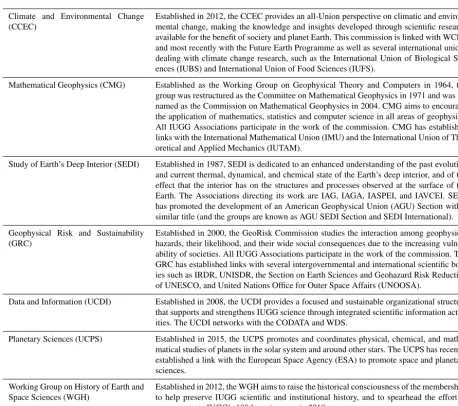
present, the following Union Commissions, Working Group, and Standing Committees are active: Union Commissions on Climatic and Environmental Changes (CCEC), Mathemati-cal Geophysics (CMG), GeophysiMathemati-cal Risk and Sustainability (GRC), Study of the Earth’s Deep Interior (SEDI), Data and Information (UCDI), and Planetary Sciences (UCPS); the Working Group on History of Earth and Space Sciences; and Standing Committees on Capacity Building and Education, Honors and Recognition, Outreach, Statutes and By-Laws, and Visioning. Brief summaries of the current Union com-missions and committees can be found in Appendix A.
2.2 Union programs and products
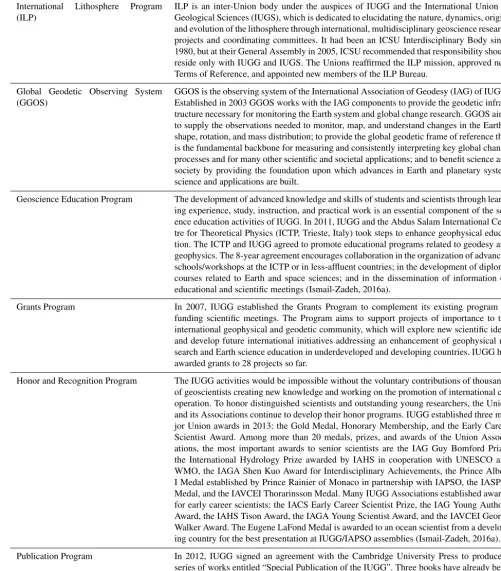
IUGG has initiated and/or vigorously supported collabora-tive efforts that have led to highly produccollabora-tive international multi- and interdisciplinary programs. Current IUGG pro-grams include the International Lithosphere Program (ILP), Global Geodetic Observing System (GGOS), Geoscience Education, Publication, Grants, and Honor and Recognition programs. Description of the programs can be found in Ap-pendix B.
Volcanic Crises. Detailed description of the products is pre-sented by Ismail-Zadeh (2016a). The internationally driven services and products of IUGG Associations are absolutely unique; they could not be done by any governmental orga-nization even though operations of the services depend on national funding.
2.3 The International Science Council and IUGG In 1899, representatives of European and US academies met in Wiesbaden, Germany, and established the International Association of Academies, which was active until WWI (Greenaway, 1996). Already during WWI, scientific leaders from the allied nations thought about the post-war renewal of international scientific cooperation because of political and scientific reasons (Good, 2000). Representatives of na-tional academies of allied countries met in London, Great Britain, in October 1918 and then in Paris, France, in Novem-ber 1918, and decided to establish an International Research Council (IRC; Wood, 1919). The IRC was established in Brussels, Belgium, in July 1919, together with several scien-tific unions including IUGG. The main aims of the Council were “(i) to coordinate international efforts in the different branches of science and its applications; (ii) to initiate the formation of international associations or unions deemed to be useful to the progress of science; (iii) to direct interna-tional scientific action in subjects which do not fall within the province of any existing association; and (iv) to enter, through the proper channels, into relations with the Govern-ments of the countries adhering to the Council to recommend the study or questions falling within the competence of the Council” (Lyons, 1919). At the beginning, IRC was a non-inclusive council by its laws excluding the Central Powers from membership in the Council and its scientific unions, and admitting neutral countries only by a three-quarters major-ity vote. However, that, immediately after the end of WWI, about two hundred members of the academies of neutral tions called on the members of the academies of allied na-tions “for cooperation in order to prevent science from be-coming divided, for the first time and for an indefinite period, into hostile political camps” (Scientific Events, 1919). The Council was a part of the general post-WWI policy of iso-lating the Central Powers (Cock, 1983). Only in 1926, IRC agreed to delete from its Statutes the clause related to ex-clusion of the Central Powers from membership, and invited Austria, Bulgaria, Germany, and Hungary to adhere to IRC. Unfortunately, none of these countries could join IRC at that time for a variety of reasons (IRC, 1928; Greenaway, 1996). The IRC was active until 1931, when the International Council of Scientific Unions (ICSU) was established to pro-mote international scientific activity in different branches of science and interdisciplinary research between the unions. IUGG was one of the active supporters behind establishing ICSU and became a founding member of the Council. ICSU formally changed its name to the International Council for
Science at an Extraordinary Assembly in 1998, keeping its acronym and logo to maintain historical continuity. ICSU provided a global forum for scientists in all scientific disci-plines to exchange ideas and information and to develop stan-dard methods and procedures for all fields of research. IUGG brought expertise on Earth and environmental studies from researchers in its International Associations and Union com-missions. IUGG strongly supported ICSU’s policy of non-discrimination, which affirms the rights and freedom of sci-entists throughout the world to engage in international scien-tific activity without limitation by such factors as citizenship, religion, creed, political stance, ethnic origin, race, color, lan-guage, age or gender.
At the ICSU extraordinary General Assembly and the General Assembly of the International Social Science Coun-cil (ISSC) held in Oslo, Norway, in October 2016, ICSU and ISSC members agreed to merge the two councils. In Octo-ber 2017, a new organization, International Science Council (ISC), was founded at the joint ICSU and ISSC General As-sembly in Taipei to advance science as a global public good and to act as a global voice of science, and was formally established on 30 June 2018. Although initially IUGG and some other ICSU and ISSC Members questioned the neces-sity and urgency of the merger (24 % of the ICSU Members and 13 % of the ISSC Members voted against it), IUGG was convinced later that the merger would benefit scientific de-velopment and play significant role in bridging science to so-ciety and policymaking. IUGG became a founding member of the new Council. The inaugural General Assembly of ISC was held on 3–5 July 2018 in Paris, France, where the first Governing Board of the new Council was elected. IUGG Sec-retary General Alik Ismail-Zadeh was elected the first Secre-tary of Council.
IUGG had participated in ICSU’s leadership since its in-ception in 1931. The first Secretary General of the Coun-cil was Sir Henry George Lyons, IUGG Secretary General (1919–1930) and the IRC Secretary General (1928–1931) (Cheetham, 1947). In recent years, Vladimir Keilis-Borok (IUGG President, 1987–1991), Uri Shamir (IUGG President, 2003–2007), and Guoxiong Wu (IUGG Executive Commit-tee Member and IAMAS President, 2007–2011) have served on the ICSU Executive Board. Tom Beer (IUGG President, 2007–2011) and Harsh Gupta (IUGG President, 2011–2015) have served on the ICSU Committee on Science Planning and Review. Gordon McBean (Member of the IUGG Bureau, 1987–1995) served as the last ICSU President from 2014 un-til 2018, when the new council was formed.
mittee on Space Research (COSPAR); the Scientific mittee on Antarctic Research (SCAR); the Scientific Com-mittee on Oceanic Research (SCOR); the Scientific Commit-tee on Solar-Terrestrial Physics (SCOSTEP); the World Data System (WDS); and the ISC Regional Offices for Africa, Asia and the Pacific, and Latin America and the Caribbean. IUGG is particularly active with the Scientific Programme of Integrated Research on Disaster Risk (IRDR) co-sponsored by ISC and the United Nations Office for Disaster Risk Re-duction (UNISDR), and the World Climate Research Pro-gramme (WCRP) co-sponsored by ICSU, the World Mete-orological Organization (WMO) and the Intergovernmental Oceanographic Commission (IOC) of the UN Educational, Scientific and Cultural Organization (UNESCO).
ICSU provided grants to promote major scientific cam-paigns proposed by the participating Unions, and IUGG pro-posals have often been successful. For example, in 2010, IUGG received an ICSU grant for a project proposal, “Ex-treme Natural Hazards and Societal Implications – EN-HANS”; in 2011, for a project proposal, “eGYAfrica – better Internet connectivity for research and education institutions in Africa”; and in 2014, for a project proposal, “Uniting and networking the magnetic community in the northern Indian Ocean region”.
2.4 Partners
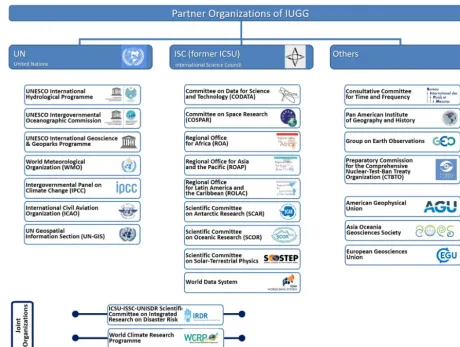
IUGG envisions a future Earth that is environmentally sus-tainable and where societies are resilient against natural haz-ards. To achieve this goal, participation in global networks of interdisciplinary programs is vital. IUGG places particu-lar emphasis on the scientific problems of economically less-developed countries by sponsoring activities relevant to their scientific needs. In addition to the many beneficial relation-ships that IUGG Associations develop with partners, IUGG as a whole also develops and maintains formal contacts with a wide range of organizations, detailed here (see Fig. 2 for the partners of the Union).
The formation of the United Nations (UN) in 1945 and its specialized agencies broadened the scope of international involvement of IUGG in scientific programs (Ismail-Zadeh, 2016a). Through its Associations, IUGG has established pro-ductive relationships with WMO; UNESCO; the UN Carto-graphic Section (now the UN Geospatial Information Sec-tion); the International Civil Aviation Organization (ICAO); the UN Committee of Experts on Global Geospatial Informa-tion Management (UN-GGIM); and the UN Environmental Program (UNEP). Cooperation with WMO includes meteo-rology (via IAMAS), hydmeteo-rology (IAHS), cryosphere (IACS), space weather (IAGA), and volcanology (IAVCEI), and ex-tends to its specialized bodies such as the Global Framework for Climate Sciences (GFCS). Particularly, after the 2010 Ey-jafjallajökull volcano eruption and at ICAO’s request, WMO and IUGG established a joint Volcanic Ash Scientific Advi-sory Group (VASAG) to provide scientific advice on volcanic
ash to civil aviation. Representatives of IUGG have been in-vited to WMO Executive Congresses and representatives of WMO have been invited to IUGG General Assemblies.
IUGG had established in 1946 (Stagg, 1947) and main-tains a working relationship with UNESCO and its scientific bodies, including IOC and International Hydrological Pro-gramme (IHP) through IAPSO and IAHS since those bod-ies’establishment in 1960 and in 1975, respectively. For ex-ample, IAHS established the International Hydrology Prize in 1981 in cooperation with IHP and WMO to award distin-guished scientists who have made an outstanding contribu-tion to hydrological science. For years, IUGG via IASPEI and IAVCEI cooperated with the UNESCO section on Earth Science and Geohazard Risk Reduction in the framework of its programs related to earthquake and volcano hazards and risks, and since 2017, in the framework of the Interna-tional Geoscience and Geoparks Programme. IUGG also co-operates with the Comprehensive Nuclear-Test-Ban Treaty Organization (CTBTO) Preparatory Commission in stud-ies related to seismology, hydroacoustics, and atmospheric transport modeling and assists scientifically in organizing the CTBT Science & Technology conferences. Compared to intergovernmental organizations, which are constrained by their governmental framework, IUGG and other non-governmental, international scientific unions, provide inde-pendent advice on scientific subjects within their expertise.
The UN General Assembly adopted the 2030 Agenda for Sustainable Development in 2015 (https://sustainabledevelopment.un.org/sdgs, last access: 20 February 2019). The Agenda seeks to link issues such as climate change, natural disasters and education. It inter-twines social, economic, and environmental targets in 17 Sustainable Development Goals (SDG). Each of the SDGs is divided into several sub-goals. All IUGG Associations, the Union Commissions on Geophysical Risk and Sustainability, Climatic and Environmental Change, and Data and Informa-tion as well as the IUGG Committee on Capacity Building and Education seek to contribute to the sub-goals related to climatic change, natural hazards and risk, gender issues, education and capacity building, research and innovation (Ismail-Zadeh, 2016b).
The Group on Earth Observations (GEO) is a voluntary partnership of governments and international organizations that provides a framework for developing projects and coor-dinating strategies and investments among partners. GEO co-ordinates efforts to build a Global Earth Observation System of Systems (GEOSS). At the GEO-X Plenary in 2014, IUGG was unanimously recognized as a Participating Organization of GEO, although several of IUGG’s bodies, including IAG, had earlier been Participating Organizations.
Figure 2.Scientific partner organizations (designed by F. Kuglitsch).
organization through which member states act together on matters related to measurement science and standards such as the leap second. PAIGH is a technical and scientific body of the Organization of American States.
3 Early development of IUGG
It is difficult to trace back to the earliest date when inter-national cooperation in geodesy and geophysics began, but it is evident that such cooperation became important in the early 19th century. For example, in the first decades of the 19th century, Edward Sabine, an Irish astronomer and geo-physicist, and Alexander von Humboldt, a German geog-rapher and naturalist, together with a few other scientists, organized widespread magnetic observations (Good, 2000; Collier, 2014). This motivated Carl Friedrich Gauss, a Ger-man mathematician, together with von Humboldt and Wil-helm E. Weber, a German physicist, to found in 1836 the Göttingen Magnetic Union, the first worldwide network of magnetic observatories. This international organization pro-moted a cooperative scheme of simultaneous observations in which more than 50 observatories distributed over five
Figure 3.The inaugural IRC General Assembly and establishment of IUGG.(a)Palais des Academies at Brussels, Belgium, where the IRC assembly was held in July 1919;(b)IUGG officers: (from left to right) Louis A. Bauer, V. Reina, Aikitsu Tanakadate, Hermant, and Charles Chree participating in the Assembly (Bauer, 1919).
By the outbreak of WWI in 1914, international organiza-tions for geodesy, seismology, meteorology, geomagnetism, geoelectricity, and oceanography had already been estab-lished. The war interrupted the operation of these bodies, al-though some were kept active by then-neutral nations. Dur-ing WWI, some scientific leaders from the allied nations gave thought to the post-war renewal of international scientific co-operation. Though early efforts in international cooperation within international associations and the network of national academies were very successful, discussion between exist-ing geoscientific societies and national academies was lim-ited, forcing scientists to devise a new model of cooperation (Good, 2000; Ismail-Zadeh, 2016a). In 1918, representatives of the scientific academies of allied nations decided to fos-ter infos-ternational scientific cooperation, and establish together with the IRC scientific unions to organize and promote inter-national cooperation. In particular, a resolution was passed in favor of establishing an international geophysical union “for the purpose of initiating and promoting researches in geophysics” (Wood, 1919), to be made up of all existing sci-entific groupings dealing with the physical sciences of the Earth. The original proposal for the name of the union was the “international geophysical union” (Ismail-Zadeh, 2016a). However, in May 1919, at a preliminary meeting, the IRC adopted an expanded name, “International Union of Geodesy and Geophysics” (IUGG), based on a motion of the represen-tative from Italy (Bauer, 1919). The motivation of the Italian representative is unknown; one conjecture is that in the be-ginning of the 20th century geodesy positioned itself as a branch of mathematics rather than a branch of physical sci-ences, and this may be the reason why geodesy was listed separately from all other physical disciplines of IUGG at the time of the Union’s establishment (Ismail-Zadeh, 2016a). At the same meeting, draft Statutes for IUGG were adopted. The International Astronomical Union (IAU) was formed at the same time; one reason for the early establishment of these two unions was that in both cases “their basic studies had always required international action so international ‘union’ came naturally” (Greenaway, 1996).
The formation of IUGG was finalized at the first IRC Gen-eral Assembly held on 18–28 July 1919 (Fig. 3), with the
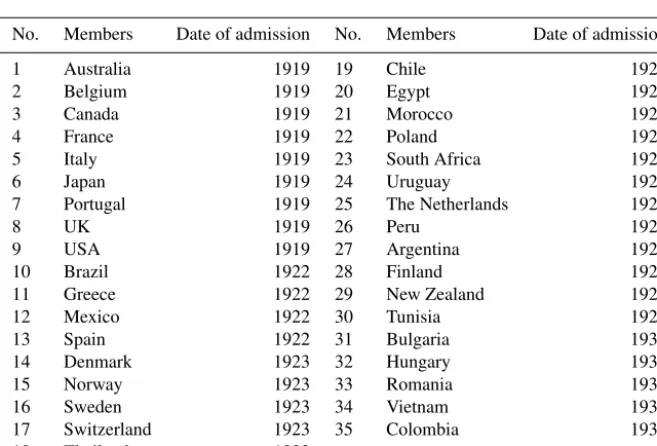
approval of its Statutes and future activities (Lyons, 1919). The first nine Member countries of IUGG were Australia, Belgium, Canada, France, Italy, Japan, Portugal, the United Kingdom, and the United States of America. IUGG included several branches of science for which special organizations had existed for many years, well before WWI. They were re-constituted as six Sections within IUGG, each with its own executive committee. According to Bauer (1919), those ini-tial Sections were (1) Geodesy (President William Bowie, USA, and Secretary Georges Perrier, France); (2) Terres-trial Magnetism and Electricity (President Aikitsu Tanaka-date, Japan, and Secretary Louis Agricola Bauer, USA); (3) Meteorology (President Sir William Napier Shaw, UK, and Secretary Charles Frederick Marvin, USA); (4) Physi-cal Oceanography (naming of a President was deferred, and Secretary Giovanni P. Magrini, Italy; later Prince Albert I of Monaco was elected President of this Section); (5) Seis-mology (the organization of the Section was deferred be-cause of the agreement among the founding member coun-tries regarding the continuation of the International Seismo-logical Association); and (6) Volcanology (President Anni-bale Riccò, Italy, and Secretary Alessandro Malladra, Italy). Charles Lallemand (France) became the first President of the Union, serving until 1933, and Sir Henry G. Lyons was the first IUGG Secretary General, serving until 1930. Four Vice-Presidents were named: H. S. H. Prince Albert I of Monaco, Bowie (USA), Sir Shaw (UK), and Tanakadate (Japan).
The Union was established for the period of 12 years, sub-ject to renewal and modification at the end of this period. Delegates of IUGG Member countries agreed to hold gen-eral assemblies of the Union every 3 years. Also, they de-cided that the Union could meet at any place and not nec-essarily at the same place as the IRC, and Union Sections could call special meetings when they found them necessary. The objectives of the Union as stated in the Statutes were (1) to promote the study of problems concerned with the fig-ure and physics of the Earth; (2) to initiate and coordinate researches which depend upon international cooperation and to provide for their scientific discussion and publication; and (3) to facilitate special researches such as the comparison of instruments used in different countries (Bauer, 1919).
4 IUGG General Assemblies
IUGG has held general assemblies (GAs) since 1922 (qua-drennially since 1963). Its first assemblies gathered only a few hundred scientists, and the GA in Washington, DC, USA, in 1939 was attended by more than 800 people, although only a little more than 200 foreign scientists could participate due to the war. Table 1 presents some statistics related to the Union’s first seven GAs, and Table 2 lists Member countries connected with the Union from 1919 to 1939.
4.1 First General Assembly (3–10 May 1922, Rome, Italy)
The First General Assembly (GA) brought together dele-gates from the founding Member countries and from four new Member countries (Brazil, Greece, Mexico, and Spain), and a number of representatives from other countries that had not yet joined the Union. The sessions were held in the Reale Accademia dei Lincei. The delegates were welcomed by the Minister of Public Instruction at the Capitol in the presence of His Majesty the King of Italy (Lyons, 1922). All Sections had made good progress in planning international coopera-tion in the years since 1919, and work plans were adopted for the next 3 years. In 1919 at the GA in Brussels, it was sug-gested that the study of variation of latitude should be con-fided to the IAU. At the GA in Rome this question was dis-cussed in detail with the IAU representatives; it was decided that the subject should remain with the Section of Geodesy, and a joint committee of geodesists and astronomers was ap-pointed to direct the work. As the International Association of Seismology still existed at the time of the GA in Brussels, the IUGG Section of Seismology was only formally consti-tuted at Rome. Seismologists discussed topics related to mi-croseisms, earthquake focal depths, and wave propagations (Lyons, 1922). One of the important discussions among me-teorologists at the GA was related to the cooperation with the International Meteorological Organization (IMO, the prede-cessor of the WMO), which brought together meteorological services of several countries. It was agreed that the
investi-gations, which required international cooperation, could be difficult for the national services to include in their activi-ties, and hence the Section of Meteorology could initiate and promote such investigations. The Section of Terrestrial Mag-netism and Electricity discussed the methods of observation required for different types of instruments, and the possibili-ties for international comparison of instruments. The Section of Physical Oceanography discussed how to facilitate inter-national cooperation in physical oceanography, and how the collection of tidal information could be improved. The Sec-tion of Volcanology discussed the classificaSec-tion of volcanic phenomena, and studies of the thermal gradients in several regions. At that GA, a Section of Scientific Hydrology was added, making a total of seven Sections. Also at that GA, it was decided that instead of electing Vice-Presidents, the Presidents of the IUGG Sections would serve in that capac-ity. Charles Lallemand (France) was elected IUGG President, and Sir Henry G. Lyons (UK) Secretary General.
4.2 Second General Assembly (1–8 October 1924, Madrid, Spain)
Table 1.IUGG General Assemblies from 1922 to 1939, and IUGG Presidents and Secretaries General.
No. Year Place No. No. Member President Secretary General
GA attendees countries
1 1922 Rome, Italy – 13 Charles Lallemand Sir Henry George Lyons
2 1924 Madrid, Spain ∼150 24 (France, 1919–1933) (UK, 1919–1930)
3 1927 Prague, Czechoslovakia ∼160 30
4 1930 Stockholm, Sweden 331 33
5 1933 Lisbon, Portugal 200 34 William Bowie Harold St. John Lloyd Winterbotham
(UK, 1930–1946) (USA, 1933–1936)
6 1936 Edinburgh, UK 344 34 Dan Barfod La Cour
7 1939 Washington DC, USA 805 35 (Denmark, 1936–1942)
Table 2.IUGG Member countries (1919–1939).
No. Members Date of admission No. Members Date of admission 1 Australia 1919 19 Chile 1924 2 Belgium 1919 20 Egypt 1924 3 Canada 1919 21 Morocco 1924 4 France 1919 22 Poland 1924 5 Italy 1919 23 South Africa 1924 6 Japan 1919 24 Uruguay 1924 7 Portugal 1919 25 The Netherlands 1925
8 UK 1919 26 Peru 1925
9 USA 1919 27 Argentina 1927 10 Brazil 1922 28 Finland 1927 11 Greece 1922 29 New Zealand 1927 12 Mexico 1922 30 Tunisia 1927 13 Spain 1922 31 Bulgaria 1930 14 Denmark 1923 32 Hungary 1930 15 Norway 1923 33 Romania 1930 16 Sweden 1923 34 Vietnam 1931 17 Switzerland 1923 35 Colombia 1938 18 Thailand 1923
4.3 Third General Assembly (3–10 September 1927, Prague, Czechoslovakia)
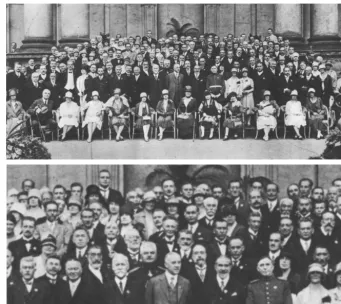
The Third General Assembly was held in Prague at the invi-tation of the Czechoslovakian Government (Fig. 4). Six new Member countries adhered to IUGG by 1927 (Table 2). The GA urged the countries concerned to improve the network of existing seismic stations by establishing new stations. A pro-posal of the US National Committee on international coop-eration in the studies of ocean deeps was strongly supported. The Section of Meteorology worked closely with IMO, com-plementing the work of the other (Davies, 1990); IMO oc-cupied with matters related to the working of the meteoro-logical services in various countries and the Section dealt with many scientific matters related to meteorology and at-mospheric physics. The Section of Terrestrial Magnetism and Electricity considered among other topics the works on at-mospheric ionization and the observations of auroras, and expressed the need for additional earth current installations.
Figure 4.Participants of the Third General Assembly (upper panel); details of the central part of the photo (lower panel) (source: IUGG archives).
4.4 Fourth General Assembly (15–23 August 1930, Stockholm, Sweden)
The Opening Ceremony of the Fourth General Assembly was held in the Concert Hall, where the Chancellor of the Univer-sities and Chairman of the Swedish National Committee wel-comed the delegates, and IUGG President Charles Lallemand replied and expressed thanks for hospitality and excellent ar-rangement of the meeting. Bulgaria, Hungary, and Romania joined IUGG in 1930. The scientific and business meetings of the GA were held in the Parliament House (Fig. 5). Sci-entific topics were discussed by the Union Sections. Felix A. Vening-Meinesz presented work on the determinations of gravity at sea, and the GA expressed the hope that other na-tions with submarines could cooperate in the work of grav-ity determination over ocean areas (Lyons, 1930). Some time was dedicated by several Union Sections to discussing activ-ities during the Second International Polar Year (IPY; 1932– 1933); for example, it was decided to publish an auroral at-las as soon as the material could be selected and brought to-gether (Lyons, 1930). Among business topics, the GA dis-cussed changes in the Union’s Statutes regarding the admis-sion of new members. The changes were associated with much freedom, which IRC provided to its Union Members in arranging their own affairs based on a new type of
rela-tionship – a “cooperative independence” within the IRC fam-ily (Spencer-Jones, 1960). Also, the GA agreed to provide greater freedom for the Union’s Sections to arrange their ac-tivities. The GA decided that future IUGG Presidents would hold office for one term and should not be immediately eligi-ble for re-election, which would assist in maintaining the or-ganization’s international character. Swedish hospitality pro-vided a number of occasions at which the delegates could discuss matters of common interest. The City Council gave a banquet in the City Hall, and H. R. H. the Crown Prince and the H. R. H. Crown Princess (Lyons, 1930) received the delegates at the Royal Palace. At that time, Harold St. John Lloyd Winterbotham (UK) became Secretary General of the Union, serving until 1946.
4.5 Fifth General Assembly (17–24 September 1933, Lisbon, Portugal)
Figure 5.Participants of the Fourth General Assembly (upper panel); details of the central part of the photo (lower panel) (source: IUGG archives).
one-quarter, and provision was made for further reduction in exceptional cases even though this reduction could have resulted in shrinking scientific activities of the Union Asso-ciations. Despite the world economic perturbation and the onset of political and military disturbance, the Second IPY was conducted in 1932–1933. Magnetic, auroral, and mete-orological data were collected from stations located in the Arctic and Antarctic, and were used to study the phenomena associated with terrestrial magnetism and weather forecast-ing. Some time was dedicated at the GA to discussing these data (IUGG, 1933; SIPY, 1933). This was the last GA to be held under the presidency of Charles Lallemand (France). William Bowie (USA) was elected President of the Union.
4.6 VI General Assembly (17–25 September 1936, Edinburgh, UK)
Delegates from IUGG Member countries and guests from several non-member countries, including Austria, Germany, India, and Russia, attended the Sixth General Assembly in Edinburgh (Fig. 7). At the opening ceremony, the President of the Royal Society, the Lord Provost of Edinburgh, the Principal of the University of Edinburgh, and the President
of the Royal Society of Edinburgh welcomed the delegates. The scientific work of the Union that had been conducted by the several international associations was presented at vari-ous scientific sessions. Two evening Union Lectures deliv-ered by A. L. Day (USA) on volcanoes and by Felix A. Vening-Meinesz (the Netherlands) on gravity measurements in submarines were the first public lectures given at a GA.
Figure 6.Participants of the Fifth General Assembly (upper panel); details of the central part of the photo (lower panel) (source: IUGG archives).
Figure 7.Participants of the VI General Assembly (upper panel); details of the central part of the photo (lower panel) (source: IUGG
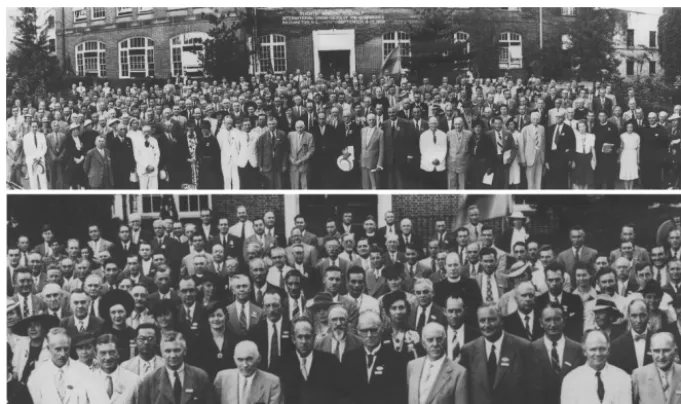
Figure 8.Participants of the VII General Assembly (upper panel); details of the central part of the photo (lower panel) (source: IUGG archives).
4.7 VII General Assembly (4–15 September 1939, Washington, DC, USA)
The Seventh General Assembly was overshadowed by the beginning of WWII. Out of 35 countries adhering to IUGG, representatives of just 20 were present; scientists of sev-eral non-member states participated in the scientific part of the GA. Meanwhile, a record number of delegates (805 in-cluding 225 non-US scientists) attended the General As-sembly (Fig. 8). The US National Research Council hosted the Assembly, the first in North America, and AGU per-formed the duties of the organizing committee. The Honor-able Cordell Hull, US Secretary of State, sent a welcoming address (IUGG, 1939; Fleming, 1940).
Preceding the Assembly, normal communication between Member countries had become impossible. By the end of Au-gust, President D. la Cour and Secretary General H. St. J. L. Winterbotham, after consulting the US Local Organizing Committee (President Richard Montgomery Field and Sec-retary John Adam Fleming), cabled to all Adhering Organi-zations that the GA would be held, but that the IUGG Execu-tive Committee agreed that its activities would be confined to scientific matters only. It was expected that many delegates would be absent from the GA due to the war and, in fact, the whole French delegation and many of the British delegates, including Secretary General Winterbotham, were recalled back to their countries. A number of business items from the original agenda were excluded, such as discussion of ad-ministrative matters, proposed amendments of the Statutes, and the election of new officers and executive committees for the Union and its seven Associations. The existing offi-cers continued their terms as an emergency measure. William Bowie, former President of the Union, was chosen as Acting Secretary General. The GA agreed to continue the financial
management of the Union and scientific programs, so far as available funds allowed. Fortunately, IUGG (and some of the Associations) had accumulated reserves, and it was hoped that the work of the Union and its Associations could be con-tinued until peace was restored (Fleming, 1940).
The absence of administrative business enabled the full time of the Assembly to be devoted to scientific discussion, including joint meetings among Union Associations. Sci-entific meetings of the GA were held in the buildings of George Washington University. There were two public lec-tures: “Geodesy and Mapping in the British Empire” by H. St. J. L. Winterbotham and “From the Mexican Gulf to the Arctic Sea: the Gulf Stream and its Significance” by Bjørn Helland-Hansen (Norway); 490 papers were presented dur-ing the GA (Flemdur-ing, 1940). It was agreed that the scientific discussions had been most useful and successful, and that the GA had been as valuable as it was harmonious. Nine-teen resolutions were adopted by the General Assembly, to be brought to the attention of governments and institutions (IUGG Archive, 1939).
us” (Fleming, 1940). At the close of the GA, US President Franklin D. Roosevelt received the Union’s officers and the Association presidents (Chapman, 1939; Fleming, 1940).
During WWII, normal communication between IUGG Member countries became difficult or impossible. Although major activities of the Union and subscriptions were sus-pended, IUGG continued to allocate grants to support work that could be done by the Union Associations and other orga-nizations to which it had access, and published some works during the early years of the war (IUGG, 1946). One of the problems that affected IUGG was the safeguarding of Union archives. For example, on the outbreak of war, the University of Strasbourg, France, where the IASPEI Secretariat was lo-cated, was evacuated to Clermont-Ferrand, France, taking the IASPEI’s library and records along with other documents. Some of this material was deposited in a chateau in the Jura mountains, but was discovered by Germans troops and taken to Jena, Germany. At the end of WWII, IUGG tried to re-cover the archives through diplomatic negotiations. Another loss: many scientists active in IUGG before WWII found that they did not have time for it because of their efforts to help the post-war recovery of their national economies and sci-ences after the war (Greenaway, 1996).
5 Distinguished leadership
When looking at the historical development of science from Ancient Egypt to the modern world, there is no doubt that science is made by individual scholars. Similarly, scientific organizations could not be created and successfully developed without the unselfish contribution of thousands of scientists. Some of them were crucial to the formation and early development of IUGG. This section presents those who led the Union and significantly contributed to its initial development.
Charles Lallemand, the first President (1919–1933) Charles Lallemand (France, 1857–1938) was a geodesist, known for his scientific work to determine precise heights above mean sea level. He graduated from l’Ecole Polytech-nique and Ecole des Mines in Paris. From 1884 until 1928 he was head of the French National Bureau of Surveying. Lallemand was the French delegate to the July 1919
meet-ing of the International Research Council in Brussels, durmeet-ing which he was elected IUGG President. He was elected to the French Academy of Sciences in 1910, and became the Presi-dent of the Academy in 1926. Lallemand was also PresiPresi-dent of the Société astronomique de France (1923–1925). Lalle-mand was described as a personality of great charm and re-finement, an expression of courtesy mingled with firmness, and a mind endowed with an admirable power of expressing its thoughts in clear and precise language (source: Perrier, 1938). (Courtesy: Academie des sciences)
Sir Henry George Lyons, the first Secretary General (1919–1930) Colonel Sir Henry George Lyons (UK, 1864– 1946), Fellow of the Royal Society, was a geologist. Lyons was educated at Wellington College and the Royal Military Academy, Woolwich, and at the age of 18 was elected to the Geological Society. In 1884 he was commissioned a Lieu-tenant in the Royal Engineers. In 1920, with the retiring rank of colonel, Lyons became director of the Science Museum in London. Lyons was elected Foreign Secretary of the Royal Society in 1928, Secretary General of the International Re-search Council in 1928, and the first ICSU Secretary Gen-eral in 1931. Lyons played a crucial role in the formation of IUGG and its earlier development, wisely managing the Union (source: Dale, 1944). (Courtesy: Royal Society)
William Bowie, President (1933–1936) William Bowie (USA, 1872–1940) was an geodetic engineer known for sci-entific work in the theory of isostasy and its applications to dynamic and structural geology. He was educated at Trin-ity College in Hartford, Connecticut (B.S. 1893; M.A. 1907; Sc.D. 1919), and Lehigh University in Bethlehem, Pennsyl-vania (C.E. 1895; Sc.D. 1922). In 1895 Bowie joined the United States Coast and Geodetic Survey. During World War I he served in the United States Army Corps of Engineers as a major. He represented the United States at various inter-national geodetic conferences and congresses. His scientific researches dealt with the theory of isostasy and its applica-tions to dynamic and structural geology. Bowie was President
of the International Association of Geodesy (1922–1933) be-fore he was elected IUGG President. “It was a difficult matter to succeed the late Charles Lallemand who led the Union so brilliantly for fourteen years [. . . ] William Bowie did add to [. . . ] the significance of that post, because his geophysical interests were unusually wide and he could envisage no fu-ture in which geodesy did not work hand in glove with geo-physics”, wrote Winterbotham (1940). The Bowie Seamount and the Bowie Canyon are named after William Bowie. The William Bowie Medal, the highest honor of the American Geophysical Union, is named in his honor (source: Fleming, 1951). (Courtesy: US National Academy of Sciences)
Brigadier Harold St. John Lloyd Winterbotham, Secre-tary General (1930–1946)Brigadier Harold St. John Lloyd Winterbotham (UK, 1879–1946) was educated at Fettes College, Edinburgh, and the Royal Military Academy and was commissioned in the Royal Engineers in 1897. He was placed in charge of the Trigonometical and Topographical Division of the Ordinance Survey at Southampton in 1911. He returned in 1920, after duty as a military surveyor in WWI, and became Chief of the Geographical Section, contributing to texts on field surveying and the development of the Travistock theodolite. He was one of the original founders of the Field Survey Association. In 1930, he was appointed Director General of the Ordnance Survey, Great Britain’s national mapping agency, retiring 1935. In 1930 he succeeded Sir Henry Lyons as IUGG Secretary General (Lyons resigned to become the IRC Secretary General) and is credited with safeguarding IUGG international interests and funds throughout WWII. He convened an Executive Committee in 1945, assisted with a radical revision of the Union’s Statutes and Bylaws, and arranged for the extraor-dinary General Assembly in 1946 that renewed the Union (source: Cheetham, 1947). (Courtesy: Mitchell families online)
Each of these scientific leaders contributed to the devel-opment of what has become a vibrant, diverse network that traverses borders of discipline, country, language, and more. As the Union has grown and matured, its impact and reach have grown.
6 Conclusions
IUGG was formed and exists to promote international scien-tific research of Earth and its space environment for the ad-vantage of their National Members, scientists, and society in general. During the period between the formation of IUGG in 1919 and the beginning of WWII, the Union grew in the number of its Member countries, increasing from 9 found-ing Member countries to 32. Seven general assemblies were held during this time of initial development, and the num-ber of delegates attending the assemblies increased from a few dozen to more than 800 people, who participated in the IUGG General Assembly in Washington, DC in 1939.
IUGG coordinated and promoted scientific activities of its Sections (later Associations) during this initial period. Sur-veys to measure the Earth’s surface in relation to the geome-try of the theoretical figure of the Earth (the geoid) required sophisticated measurements of gravitational characteristics. New instruments for the measurements become available in the 1920–30s, and they could be easily transported to dif-ferent regions of the world, allowing for comparative stud-ies. New principles were introduced in many kinds of mea-surements, and IUGG, with its Section of Geodesy and other Sections, did valuable work in making the principles widely known. The Section of Scientific Hydrology promoted scien-tifically the areas of societal need, such as the production of energy, water security, irrigation, and flooding. The Section of Meteorology had fostered international codes for transmit-ting information about meteorological conditions, and pro-posed to review scientific methods of weather forecasting as applied in different countries. In the 1930s, IUGG pro-moted standardization of methods (e.g., for rainfall measure-ments) and of instruments used in different countries. The Section of Physical Oceanography promoted a collaboration between many bodies concerned with particular seas and oceans (e.g., the Mediterranean Sea, and the Atlantic and Pa-cific oceans). In the 1920–30s, seismologists benefited from the rapid transmission of information and data by telegraph and then by radio. The Section of Seismology encouraged national seismic services to set up seismic observatories in places prone to seismic and volcanic hazards. The Section of Volcanology promoted the importance of collecting and dis-seminating information, encouraging the collection of infor-mation on active volcanoes, the substances emitted, the tem-perature, and other characteristics of lava and hot springs. This Section drew attention to importance of the study of atmospheric dust due to volcanic eruptions as well as the importance of providing information on submarine eruptions that ships observed (Greenaway, 1996).
Although the WWII interrupted active scientific coopera-tion among nacoopera-tions, after the war, cooperacoopera-tion was restored and intensively developed (Joselyn and Ismail-Zadeh, 2019; Joselyn et al., 2019). The foundations of the Union offer in-sight into the motivations for its development; and subse-quent articles in this Special Issue will explore how the orga-nization has evolved in a changing global landscape.
Data availability. The paper is based on published documents (see
Appendix A: IUGG Union Commissions, Working Group, and standing Committees
Table A1.Union commissions.
Climate and Environmental Change (CCEC)
Established in 2012, the CCEC provides an all-Union perspective on climatic and environ-mental change, making the knowledge and insights developed through scientific research available for the benefit of society and planet Earth. This commission is linked with WCRP and most recently with the Future Earth Programme as well as several international unions dealing with climate change research, such as the International Union of Biological Sci-ences (IUBS) and International Union of Food SciSci-ences (IUFS).
Mathematical Geophysics (CMG) Established as the Working Group on Geophysical Theory and Computers in 1964, the group was restructured as the Committee on Mathematical Geophysics in 1971 and was re-named as the Commission on Mathematical Geophysics in 2004. CMG aims to encourage the application of mathematics, statistics and computer science in all areas of geophysics. All IUGG Associations participate in the work of the commission. CMG has established links with the International Mathematical Union (IMU) and the International Union of The-oretical and Applied Mechanics (IUTAM).
Study of Earth’s Deep Interior (SEDI) Established in 1987, SEDI is dedicated to an enhanced understanding of the past evolution and current thermal, dynamical, and chemical state of the Earth’s deep interior, and of the effect that the interior has on the structures and processes observed at the surface of the Earth. The Associations directing its work are IAG, IAGA, IASPEI, and IAVCEI. SEDI has promoted the development of an American Geophysical Union (AGU) Section with a similar title (and the groups are known as AGU SEDI Section and SEDI International).
Geophysical Risk and Sustainability (GRC)
Established in 2000, the GeoRisk Commission studies the interaction among geophysical hazards, their likelihood, and their wide social consequences due to the increasing vulner-ability of societies. All IUGG Associations participate in the work of the commission. The GRC has established links with several intergovernmental and international scientific bod-ies such as IRDR, UNISDR, the Section on Earth Sciences and Geohazard Risk Reduction of UNESCO, and United Nations Office for Outer Space Affairs (UNOOSA).
Data and Information (UCDI) Established in 2008, the UCDI provides a focused and sustainable organizational structure that supports and strengthens IUGG science through integrated scientific information activ-ities. The UCDI networks with the CODATA and WDS.
Planetary Sciences (UCPS) Established in 2015, the UCPS promotes and coordinates physical, chemical, and mathe-matical studies of planets in the solar system and around other stars. The UCPS has recently established a link with the European Space Agency (ESA) to promote space and planetary sciences.
Working Group on History of Earth and Space Sciences (WGH)
Established in 2012, the WGH aims to raise the historical consciousness of the membership, to help preserve IUGG scientific and institutional history, and to spearhead the effort to commemorate IUGG’s 100th anniversary in 2019.
Table A2.Union standing Committees.
Capacity Building and Education Established in 2011, this committee promotes the science education program of the Union, develops international cooperation in science education, and manages the IUGG science education grants program.
Honors and Recognition Established in 2011, this committee oversees Union award and medal programs, including review of procedures for nominations and selection of awardees.
Statutes and By-Laws This long-standing committee prepares modifications of the Statutes and By-laws of the Union based on the proposals for changes submitted by Member countries or the IUGG Bureau.
Appendix B
Table B1.IUGG programs.
International Lithosphere Program (ILP)
ILP is an inter-Union body under the auspices of IUGG and the International Union of Geological Sciences (IUGS), which is dedicated to elucidating the nature, dynamics, origin, and evolution of the lithosphere through international, multidisciplinary geoscience research projects and coordinating committees. It had been an ICSU Interdisciplinary Body since 1980, but at their General Assembly in 2005, ICSU recommended that responsibility should reside only with IUGG and IUGS. The Unions reaffirmed the ILP mission, approved new Terms of Reference, and appointed new members of the ILP Bureau.
Global Geodetic Observing System (GGOS)
GGOS is the observing system of the International Association of Geodesy (IAG) of IUGG. Established in 2003 GGOS works with the IAG components to provide the geodetic infras-tructure necessary for monitoring the Earth system and global change research. GGOS aims to supply the observations needed to monitor, map, and understand changes in the Earth’s shape, rotation, and mass distribution; to provide the global geodetic frame of reference that is the fundamental backbone for measuring and consistently interpreting key global change processes and for many other scientific and societal applications; and to benefit science and society by providing the foundation upon which advances in Earth and planetary system science and applications are built.
Geoscience Education Program The development of advanced knowledge and skills of students and scientists through learn-ing experience, study, instruction, and practical work is an essential component of the sci-ence education activities of IUGG. In 2011, IUGG and the Abdus Salam International Cen-tre for Theoretical Physics (ICTP, Trieste, Italy) took steps to enhance geophysical educa-tion. The ICTP and IUGG agreed to promote educational programs related to geodesy and geophysics. The 8-year agreement encourages collaboration in the organization of advanced schools/workshops at the ICTP or in less-affluent countries; in the development of diploma courses related to Earth and space sciences; and in the dissemination of information on educational and scientific meetings (Ismail-Zadeh, 2016a).
Grants Program In 2007, IUGG established the Grants Program to complement its existing program of funding scientific meetings. The Program aims to support projects of importance to the international geophysical and geodetic community, which will explore new scientific ideas and develop future international initiatives addressing an enhancement of geophysical re-search and Earth science education in underdeveloped and developing countries. IUGG has awarded grants to 28 projects so far.
Honor and Recognition Program The IUGG activities would be impossible without the voluntary contributions of thousands of geoscientists creating new knowledge and working on the promotion of international co-operation. To honor distinguished scientists and outstanding young researchers, the Union and its Associations continue to develop their honor programs. IUGG established three ma-jor Union awards in 2013: the Gold Medal, Honorary Membership, and the Early Career Scientist Award. Among more than 20 medals, prizes, and awards of the Union Associ-ations, the most important awards to senior scientists are the IAG Guy Bomford Prize, the International Hydrology Prize awarded by IAHS in cooperation with UNESCO and WMO, the IAGA Shen Kuo Award for Interdisciplinary Achievements, the Prince Albert I Medal established by Prince Rainier of Monaco in partnership with IAPSO, the IASPEI Medal, and the IAVCEI Thorarinsson Medal. Many IUGG Associations established awards for early career scientists: the IACS Early Career Scientist Prize, the IAG Young Authors Award, the IAHS Tison Award, the IAGA Young Scientist Award, and the IAVCEI George Walker Award. The Eugene LaFond Medal is awarded to an ocean scientist from a develop-ing country for the best presentation at IUGG/IAPSO assemblies (Ismail-Zadeh, 2016a). Publication Program In 2012, IUGG signed an agreement with the Cambridge University Press to produce a
Author contributions. AIZ and JAJ contributed equally to the analysis and writing the paper, JAJ visited the AIP Niels Bohr Li-brary and Archives to work with IUGG archive documents, and AIZ prepared the paper for publication.
Competing interests. The authors declare that they have no
con-flict of interest.
Special issue statement. This article is part of the special issue
“The International Union of Geodesy and Geophysics: from differ-ent spheres to a common globe” (https://www.hist-geo-space-sci. net/special_issue996.html). It is not associated with a conference.
Acknowledgements. The authors are grateful to Tom Beer,
Harsh Gupta, Masaru Kono, and Uri Shamir for useful discus-sion; to Hans Volkert for providing references to publications on IUGG history; to Peter Stauning for providing material for Dan Barfod la Cour’s biography; and to Franz Kuglitsch for preparing Figs. 1 and 2. We are thankful to Kristine C. Harper, two anonymous reviewers, and the topical editor for constructive comments and useful suggestions for revision.
Edited by: Hans Volkert
Reviewed by: Kristine Harper and two anonymous referees
References
AIP: Records of the International Union of Geodesy and Geo-physics, 1922–2000 (bulk 1955–1998), Description of collection, American Institute of Physics, Center for History of Physics, available at: https://history.aip.org/ead/20010000.html (last ac-cess: 30 January 2019), 2019.
Angus-Leppan, P. V.: A note on the history of the International As-sociation of Geodesy, J. Geodesy, 58, 224–229, 1984.
Bauer, L. A.: Geophysics at the Brussels meetings, Science, 50, 399–403, 1919.
Beer, T., Li, L., and Alverson, K. (Eds.): Global Change and Future Earth: The Geoscience Perspective, Cambridge University Press, Cambridge, 2018.
Chapman, S.: International Union of Geodesy and Geophysics, Na-ture, 144, 717–718, 1939.
Chapman, S.: Early international co-operation in geonomy, IUGG Newsletters 10, 271–273, 1955.
Cheetham, G.: Obituary: Brigadier H. St. J. L. Winterbotham, C. B., C. M. G., Nature, 159, 362–363, 1947.
Cock, A. G.: Chauvinism and internationalism in science: the In-ternational Research Council, 1919–1926, Notes Rec. R. Soc. Lond., 37, 249–288, 1983.
Collier, P.: Edward Sabine and the “Magnetic Crusade”, in: His-tory of Cartography, edited by: Liebenberg, E., Lecture Notes in Geoinformation and Cartography, Springer, Berlin-Heidelberg, 309–323, 2014.
Dale, H. H.: Henry George Lyons, 1864–1944, Obitu-ary Notices of Fellows of the Royal Society, 794–809, https://doi.org/10.1098/rsbm.1944.0023, 1944.
Davies, A. (Ed.): Forty years of progress and achievement: A his-torical review of WMO, WMO publ. No. 721, 1990.
Egedal, J.: Dan Barfod La Cour, 1876–1942, J. Geophys. Res., 47, 261–264, 1942.
Fleming, J. A.: Washington Assembly of the International Union of Geodesy and Geophysics and The American Geophysical Union, Science, 91, 439–442, 1940.
Fleming, J. A.: William Bowie, 1872–1940: a biographical memoir, National Academy of Sciences, Washington D.C., 61–98, 1951. Good, G. A.: The Assembly of geophysics: scientific disciplines as
frameworks of consensus, Stud. Hist. Phil. Mod. Phys., 31, 259– 292, 2000.
Greenaway, F.: Science International: A history of the International Council of Scientific Unions, Cambridge University Press, Cam-bridge, UK, 1996.
Ismail-Zadeh, A.: Geoscience international: the role of scientific unions, Hist. Geo Space Sci., 7, 103–123, https://doi.org/10.5194/hgss-7-103-2016, 2016a.
Ismail-Zadeh, A.: Mapping IUGG to Sustainable Development Goals, IUGG Electronic Journal, 16, 1–2, 2016b.
Ismail-Zadeh, A., Urrutia Fucugauchi, J., Kijko, A., Takeuchi, K., and Zaliapin, I. (Eds.): Extreme Natural Hazards, Disaster Risks and Societal Implications, Cambridge University Press, Cam-bridge, 2014.
IRC: The International Research Council, Nature, 122, 389–391, 1928.
IUGG: The International Union of Geodesy and Geophysics, Na-ture, 132, 599–600, 1933.
IUGG: International Union of Geodesy and Geophysics – General Assembly at Edinburgh, Nature, 138, 650, 1936.
IUGG: Addresses at the opening assembly of the International Union of Geodesy and Geophysics on 6 Sep. 1939, Science, 90, 339–345, 1939.
IUGG: Report of the Union for the War Years 1939–1945, edited by: Stagg, J. M., Cambridge, UK, 158 pp., 1946.
IUGG Archive: Resolutions of the Seventh General Assembly of the IUGG, available at: http://www.iugg.org/resolutions/IUGG_ Resolutions_1939.pdf (last access: 16 January 2019), Washing-ton, D.C., 1939.
Joselyn, J. A. and Ismail-Zadeh, A.: IUGG evolves (1940–2000), Hist. Geo Space Sci., 10, this special issue, available at: https: //www.hist-geo-space-sci.net/special_issue996.html, 2019. Joselyn, J. A., Ismail-Zadeh, A., Beer, T., Gupta, H., Kono,
M., Shamir, U., Sideris, M., and Whaler, K.: IUGG in the 21st century, Hist. Geo Space Sci., 10, this special is-sue, available at: https://www.hist-geo-space-sci.net/special_ issue996.html, 2019.
Li, J. Swinbank, R., Grotjahn, R., and Volkert, H. (Eds.): Dynam-ics and Predictability of Large-Scale, High-Impact Weather and Climate Events, Cambridge University Press, Cambridge, 2016. Linthe, H.-J.: Observatories in Germany, in: Encyclopedia of Ge-omagnetism and PaleGe-omagnetism, edited by: Gubbins, D. and Herrero-Bervera, E., Springer, Dordrecht, the Netherlands, 729– 731, 2007.
Lyons, H. G.: The Brussels meeting of the International Research Council, Nature, 103, 464–466, 1919.
Lyons, H. G.: The International Union of Geodesy and Geophysics, Nature, 114, 697, 1924.
Lyons, H. G.: The International Union of Geodesy and Geophysics, Nature, 120, 494–495, 1927.
Lyons, H. G.: The International Union of Geodesy and Geophysics, Nature, 126, 585–586, 1930.
Perrier, G.: Funérailles de Charles Lallemand, Academie des Sci-ences, 238–245, available at: http://www.academie-sciences.fr/ pdf/eloges/lallemand_notice.pdf (last access: 20 February 2019), 1938.
Pomerantzef, I. I.: Note sur le projet de statuts pour une Associa-tion internaAssocia-tional de Sismologie, élaboré au congrès de Strass-bourg, Comptes Rendus des Séances de La Commission Sis-mique Permanente, Académie Impériale des Sciences, vol. 1, St.-Pétersbourg, 1904. (in Russian, French, and English)
Schweitzer, J.: The early German contribution to modern seismol-ogy, in: International Handbook of Earthquake and Engineering Seismology, edited by: Lee, W., Kanamori, H., Jennings, P., and Kisslinger, C., Elsevier, Berlin, 1347–1350, 2003.
Scientific Events: International science and the war, Science, 50, 453–454, 1919.
SIPY: International Commission for the Polar Year, 1932–1933, Na-ture, 131, 810–811, 1933.
Smythe-Wright, D., Gould, J., McDougall, T., Sparnocchia, S., and Woodworth, P.: IAPSO: tales from the ocean frontier, Hist. Geo Space Sci., 10, this special issue, available at: https://www. hist-geo-space-sci.net/special_issue996.html, 2019.
Spencer-Jones, H.: The early history of ICSU, ICSU Review, 2, 179, 1960.
Stagg, J. M.: The International Union of Geodesy and Geophysics, Nature, 160, 558–559, 1947.
Winterbotham, H. St. J. L.: Dr. William Bowie, Nature, 146, 645, 1940.