Page 127
PROGRESSIVE CHALLENGE SELECTION AND PROGRESS ESTIMATION IN THE CONTEXT OF E-LEARNING
Mihail Petrov
Faculty of Mathematics and Informatics, Plovdiv University, Bialo more 5, Plovdiv 4000, Bulgaria
Abstract
Not all students can progress equally, not every single educational using can be grasped with equal dept and speed. Usually, the level of understanding varies between students/classes or even an entire school. The common approach to this problem is to average the learning material based on the audience and to ensure that the concepts are understandable enough for the students in general. This approach is generally speaking a workable solution but does not fit the needs of every single student.
The E-learning platform can provide a plethora of tools for managing the level of confides of the different users regarding the learning material. The main goal of this kind of education is not only to provide a useful interface between the student and the supervisor but to make the learning process more suitable for the individual needs of the student. The ability to ignore the learning paste of the other students and to configure your own activities is one of the selling points of the electronic education, so it is necessary to approach this problem with an appropriate methodology and tools for providing the proper experience for every single student that take part of online education program
In this article, we are going to describe a concept for dynamically and progressively tailoring education program based on the student achievement in the context of the online learning platform UniPlayground used for training and analyzing the student’s behavior at Plovdiv University
Key words: eLearning, Intelligent Agents, ITL, virtual education space, behavior analysis
1. INTRODUCTION
The main metric that analyzes the achievements of a learner is the mark calculated by the accumulative achievement of a number of exams/case studies or practical assignments. At school and university, a standard digitizing or alphanumeric achievement system is used. In Bulgaria, the numbers from 2 to 6 are used, as the increase in the number leads to an increase in the final result, with 2 being the weakest score and 6 showing an excellent achievement. The use of such an empirical assessment approach, however, remains an extremely large gray area in determining the final outcome of the trainee. Often, this gray area is related to the question of whether two people who have achieved excellent results have comparable knowledge, and whether the difference between the two grades is fair enough. For this reason, the averaging of the study material leads to a fair final assessment because the level of complexity in no way exceeds the expectations of the trained group, thus the excellent evaluation defines the result of dealing with the material put, and the gaps are punished with a withdrawal of evaluation. The question arises here, what are the possibilities for achieving further improvement in the educational field, and to what extent this improvement can affect the assessment. In the traditional educational setting, such an approach is often not possible. The learning material is in line with the knowledge and skills of the average learner, with the most knowledgeable being given additional materials for self-preparation [1]. But let's not look at the issue so unilaterally. Learning should be available to both the most knowledgeable and the most ignorant, both for people with problems and those with enviable energy and striving for achievement, that is, we must be able to customize our own approach to the educational matter.
1.1. The weakness of classical education in regards to learning material customization
Page 128
be engaged with the particular question and it is up to the supervisor to filter the appropriate ones or to calculate the necessary time to spend entertaining the particular question [1].
This approach has one distinct characteristic it is generally convenient for approaching a specific information concept in active conversation with the other observers. It is great for introducing foreign concepts, familiarize the audience with specific details or actively engaging in discussions regarding problems or expectations regarding different problems.
The main problem is that not all of the attendants are going to walk out of the room with a clear understanding of the topic. The questions can be misleading or unnecessary or to complex to be discussed in the following course which makes the audience uninterested in the specific topic. The result of this engagement can be a waste of everybody time. This is one of the main reasons that the classical education approach is generally speaking ineffective and time-consuming [2].
Regarding this main problem, it is highly improbable or even impossible to create an education schedule that is going to fit the needs of the individual education participants. This fact is supported by a set of additional factors like
1.1.1. The size of the audience
The size of the audience is determent by the educational institution. Generally, the courses aimed at studding foreign language are pretty small and compact allowing the supervisor to be flexible and to have the ability to meet the expectations of any specific student. the university on the other hand lectures is being held aimed at informing a large group of people with details about a given problem [2]. The size of the audience is generally a problem regarding the time and effort necessary for approaching the needs of every single participant over the lecture. This is the reason that generally the exercises are held in a smaller group in order to produce more quality results over the limited time.
1.1.2. The needs of the audience
Let’s consider the case for people with special needs and disabilities. In order to reach them, it is necessary for the supervisor to be educated on how to work with this specific area of education. It is not enough to stick with the usual approach it is necessary to introduce a different set of educational approaches according to the needs of the audience [3].
1.1.3. The preference of the audience
The main point of this paper is to introduce the concept of the customization of the educational process. The needs for this customization stems from this problem. The audience has a preference regarding the approach necessary for their education to be successful. The customization is a complex of
Pace. The necessary time that you need to grasp a concept, topic or problem
Media. The way you best understand an information resource. It can be a lecture, text article practice assignment, etc.
Properly configured learning steps based on the topic of the current problem set.
1.2. The strengths of E-learning and how to circumvent and solve the problems of classical education
Page 129 1.2.1. Anytime anywhere rule
The content of the platform is available any time anywhere for the student to choose and engage with the learning material. This is the main point in the strategy for adopting this technology. This is not just comfortable but is also empowering because it gives the ability to students that do not have the necessary tool to participate in face to face style lecturer due to a remote location or general disability to engage in the academic process. The online communication makes it also very affordable to introduce a regular student to a process that gives theme ability to engage with an educational process with their one pace. 1.2.2. Introduction to online labs
The online education provides a helpful tool for experimenting in front of your own computer. The infrastructure of the computer lab is accessible directly from the information platform and makes it very easy to interact with the daily educational experiments [4]. This point is extremely valid for educational courses that are focused over software development and software usage but is also practical for a plethora of other processes like philosophy or literature.
1.3. The weakness of the E-learning customization process
It is necessary to consider the possibilities of introducing too many freedoms for the students to learn over their own pace. Some of the problems can arise on the surface pretty quickly
1.3.1. Lack of guidance and motivation
The customization principle dictates that the student has the ability to choose the material that he or she is interested based on the main topic of the course. But this can quickly introduce the problem of losing the main focus of the course and venturing over the unknown without the guldens of a professional. This problem can be easily prevented by constant supervision over the work of the student based on the provided homework and tasks necessary for achieving the final result.
1.3.2. Lack of structure regarding the learning material
The main problem of customization is the lack of structure regarding the customized material. A great example if the mathematic science like Math. It is not efficient to just aimlessly looking for new concepts disregarding the structure it is necessary to emerge into the concepts one by one. The problem can be resolved or even contains if the platform used to conduct the education process provide a map of related topics which would provide a proper follow-up to the learning material.
2. MODELING AN EDUCATIONAL PROCESS FOR THE DOMAIN OF THE IT
One of the most popular areas of knowledge directly affected by the progress of electronic platforms is information technology aka. IT. The IT training model can also serve as an example for other areas of knowledge that are primarily practical and less theoretical.
IT training is traditionally aimed at achieving in-depth technical skills with a programming language, environment, platform or generally speaking problem-solving technology [4]. We will focus on this traditional approach, and of course, we will also mention the theoretical aspects such as theoretical Informatics, Mathematics, and Data Analysis, which are also part of modern Information Technology. 2.1 Theoretical education
The technology related to the subject or the direction in which the student is trained is studied. This theoretical training is generally common to a wide range of technologies. For example, learning programming languages is related to learning basic concepts such as
Page 130 Specific language and technology constructions
This theoretical knowledge is characteristic of all programming languages, regardless of their ignorance and use. Normally, depending on the family to which these programming languages belong, it is entirely possible that the purely syntactic constructs and commands are completely identical.
2.2 Practical (in class) education or recorded education
The practical teaching of information technology is related to demonstrations and explanations based on the development of a practical project. The lecturer defines the initial conditions, a task that contains problematic units, the solution of which will lead to the acquisition of new knowledge and skills. During the practical session, a demonstration of approaches to solving this task is made, commenting on the different decisions taken during the session. Practical classroom training is usually combined with the perspective of other teachers, thus calling for multiple approaches to solving a problem, as well as deepening the theoretical knowledge of the language or technology currently being studied.
Due to the specifics of this type, training all demonstration examples can be recorded and published within content sharing platforms. Demonstrations typically happen by creating an application using technology or programming language that makes it easy for them to be replicated by other students in a similar direction.
2.3 Practical self-study
In 100% of the time, learning technology is the key to delivering the best IT results. Understanding technology in depth is, of course, also an important part of learning the specifics of language and technology, but it is almost always achieved through a practical understanding of the possibilities of the environment and not vice versa. Studying the theoretical approach without solid practical experience does not give adequate results in the long run.
The practical aspect in the field of IT is achieved by solving practical problems, by writing programming code, and by developing practical projects which are subsequently evaluated by a more experienced program participant, the supervisor or a machine programmatically prepared to evaluate a specific set of problems.
2.4 Major difficulties for IT students
Technologies are advancing extremely fast, the concepts we serve, even though they are basic, are subject to change every year by the development of technology. This poses several major problems for IT students.
Wide variety of technologies Rapid replacement of working tools Insufficient good practical training
The vast diversity of technologies leads to difficulties in choosing the most appropriate ones. When building a curriculum, the most popular technology proposal is often taken into account, and with the deepening of knowledge in a specific matter, the choice of tools will be much easier. The main obstacle to the good absorption of the technology is the insufficient deepening in the matter of information technology, which is often required by business today.
For this reason, it is necessary to look for alternative approaches that enable students to find the right path for them by progressively calculating their skills and abilities and guidance on the right approach.
3. USING AN INFORMATION PLATFORM FOR MODELING EDUCATION PROCESS CUSTOMIZATION IN A MANAGED ENVIRONMENT
Page 131
technologies. The system aims to act as a mediator between lecturers and students, the main idea is to analyze the behavior of learners and to give the most appropriate development guidelines in their chosen direction.
In general, information technology studies are limited to studying a particular technology or programming language. As we have already discussed, the main approach to acquiring knowledge and skills is the practice where much attention is paid to creating a working project through which you can master much of the knowledge needed to properly use the language or technology. Theoretical knowledge is often an additional aspect of learning, and focus is often on project development.
3.1 Process of developing practical project
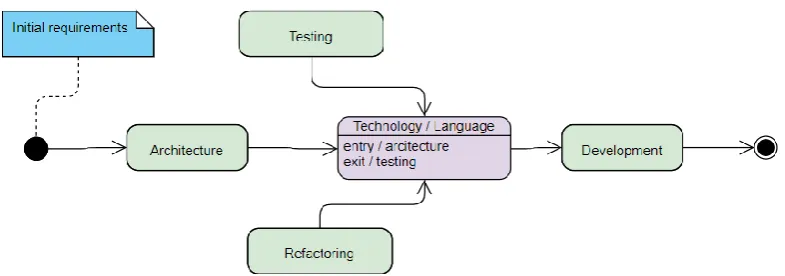
The process of developing a practical application involves several steps that are strictly complied with to achieve the best result. Figure 1. A schematic diagram of the successive steps in the development of any practical IT project.
Fig. 1. Dependency between the different aspects of programming education in the context of IT
3.1.1. Requirements
Each IT project started with a description of the assignments, the project could be small and quite elementary as well as complex requiring the knowledge of a wide range of technologies. Regardless of the scale of the assignment, it always has a consistent shape and includes it.
Description of the environment in which the user is placed Description of the features of the project to be developed Sample input data
Sample output data resulting in the system
3.1.2. Architecture
This step is related to the consideration of the project. In an architectural learning environment, we can look for when projects developed by students have a larger scale or use a variety of technologies in them. In a professional environment, architecture is an extremely important part of the process because it demonstrates the end-product analysis skills before starting the development process. This difference is due to the specific purpose of the two environments in question. In the learning environment, the goal is usually to improve the skills to work with technology, while the professional environment implies the availability of such technologies and focuses on much more abstract long-term goals.
3.1.3. Development of application or algorithm
Page 132
inattention, misunderstanding of the technology or misunderstanding of the job. These errors should be carefully analyzed both by the software development system and by the supervisor of the class. 3.1.4. Testing of the application or algorithm
This stage of the development of a practical assignment is related to the specifics of the project. In 100% of cases, the development of an algorithm is tested by an automated system provided by the course supervisor. While designing more emphasis on self-testing and quality assurance. Depending on the technology studied, programming tools accompanying the final product testing process can be considered.
3.1.5. Refactoring
An important stage in the development of code development skills is the rewriting of an already reviewed one. The role of the reviewer lies with the course supervisor, who has to give critical remarks within the framework of the development or after the submission of the verification project. Usually, this phase is associated with the use of knowledge acquired after the completion of a project and plays an important role in forming lasting knowledge about the future activities of the students.
3.2 Categorizing students as a user of the information system
Let’s see an example scenario of different type of students that can be tasked with a solution to the following problem. The following examples are based on research with 90 students from Plovdiv
University
Student A. A champion of mathematics and informatics contests. Have a background with algorithms and strong knowledge of programing task solutions and methodology. Have an ability to distinguish the necessary algorithmic approach based on the programing task description.
Student B. An entry-level student in Computer science field but already familiar with the concepts of computer programing based on its work for a product company specializing in the development of programming products. He is not familiar with the complexity of the algorithms but has a broader knowledge of computer programing and it is very familiar with a single programing language.
Student C. An entry-level student is unfamiliar with the algorithmic study. First-year Computer science student. Still learning the concepts and exploring the tasks.
The following three types of students consist of a typical student attending a class in computer science. Broad and different experience with the learning material and different level of competence in regards to computer languages and technology. The majority of students experiencing computer science for the first time can be classified over the third group as Student C. A small percent of first-year students can be classified over the first two categories as exceptional or overachiever who has previous experience in the field of IT and wants to learn more.
3.3 Tools provided by the information system UniPlaygfround
The UniPlayground information platform contains several different tools for enhancing the learning experience of the students. The following are some of the essentials components that are an important part of the education platform. Specific detail regarding the internal process of the described components are going to be listed over the next paragraphs.
3.3.1. Online programing language tools for compilation and interaction
Page 133
home. This approach is creating a consistent platform for executing a numerous educational course regarding the institution.
3.3.2. Learning material repository
As we discussed the educational process can be conducted in several different ways. So, the information necessary for achieving further result can differ also. The platform provides the necessary mechanism for storing video lecturers and text-based information but also give out the possibility for storing and recording the activity of every single student regarding the task that he is solving. This feature is extremely necessary for reviewing the steps that are taken from the students in order to solve a problem and by this to become an integral part of the learning process for the other students.
The process of automatic estimation took several steps. First, the supervisor of the course must introduce a pool of tasks categorized by their complexity level. This initial pool can act as a source of information for the system to build upon a plethora of derivative tasks based on a common application pattern. Based on the complexity level the application is building a tree of complexity and create a grading system for each and every task to be processable after a range of correct assumptions. The supervisor is able to label every single task and to introduce different constraint that is going to act as a gate to process the student to the next task.
For example, the supervisor can create a specific sequence of tasks for exceptional students. The necessary gate constraints are going to be based on the scores for example only the top scorer of the next task is going to grant you the ability to process to the next task. Every task can have an additional learning material, and extra examples based on the preferences of the supervisor.
4. PROGRESSIVE CHALLENGE ESTIMATION
The main focus of each student's work is the development of practical tasks and applications. Practical tasks are often divided into two sections.
Practical tasks with algorithmic orientation. An algorithm is developed to solve a certain class of problems.
Practical project-oriented tasks. The assignment is defined as a real problem that has to be solved by developing a software application using the technology being studied.
In the following example, we will use an algorithmic type task to explain the specifics of the approach.
A numeric array of length N is given. CREATE A FUNCTION that finds all of the duplicates. Print out all of the duplicates. If no duplicates are found the output result should contain the answer NONE
Sample input: [4 2 -2 -5 -1 1 1 4 -2 3 -2]
Sample output: [4 -2 1]
Sample input: [1 2 3 4 5 6 7 8 9 -1 -2]
Sample output: [NONE]
Page 134
The example task is a standard problem for introduction to any programing language. A variation of the following problem is a necessary step for solving a variety of more complex or diverse task so the following example is going to introduce the proses of automating progress tracking and challenge estimation of a student solving a set of problems of an algorithmic category.
The problem does not have only one solution generally speaking the programing tasks have the best solution regarding the definition of the task. For example, the task can be described so that it is necessary to work with the minimum resource or to execute as fast as possible [5]. The following constraints can be set in motion
Time constraints Space constraints
Programming language or paradigm constraints
The necessary constraints are validated based on a number of tests. The example test Sample input and output control test is necessary for the user to check if the solution is compliant with the sample input and output. The other constraints are validated with an extensive amount of test containing inputs with an increasing level of complexity.
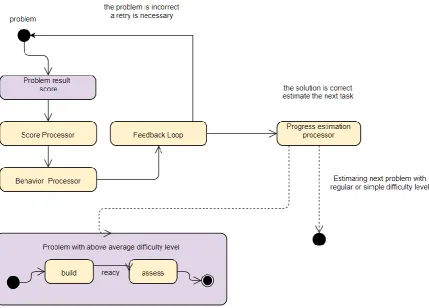
On the Fig.3. is listed the algorithm that is responsible for managing the application flow of correct and incorrect answers. The problem is determined by the characteristics of every single student using the student profile. By using those input data, it is possible for the supervisor to distinguish the entry-level students by the professionals or the one with more experience.
Page 135
The evaluation process is repeated after every single solution compilation. The student is using the necessary tool provided by the platform. After completion of the programming problem, the system is running the provided test and determine the end result.
3.4 Score and behavior processor
In order to be able to make the right decision when determining the correctness of the task several characteristics are analyzed during and after the solution is posted for processing [6].
The time spent on solving the task The number of incorrect test solutions
The number of incorrect states during the development phase before the actual solution is processed The time necessary for the final solution to be computed
Space is necessary for the final solution to be stored. The programming paradigm used for solving the problem
All of the listed characteristics are analyzed constantly in order to be used by the user activity profile. By constantly keeping track of the student behavior the system can introduce the proper next step for improving the skills based on the necessary learning materials.
3.4.1. The time spent on solving a task
Time is a great factor in determining student behavior. The concept of analyzing time intervals is based on the formalism called Interval temporal logic. The active time spends in solving a task can determent the level of understanding regarding the requirements of the task and the general time for solving a problem. It is necessary for the system to have the initial time that the user starts solving the task by first introducing him to the requirement before giving him the ability to start working over the problem. Often the students are experiencing a premature and unsuccessful transition to an attempt to solve the problem without a thorough insight into the meaning of the assignment. For this reason, it is necessary to take into account the time needed for the student to read the condition before commencing work on the project. They are only basic tools for making notes, which are also an important metric in the analysis of the final result.
The supervisor of the course has the ability to provide additional recommended time intervals necessary for calculating the progress of the students.
3.4.2. The number of incorrect test solutions
What we have already discussed to validate the most appropriate solution for the task, the system has a set of predefined tests with a growing level of complexity. These tests are defined by the course supervisor and represent an indicator of reaching a certain level of task solving. To avoid this, the system must clearly distinguish between the versions of the code being sent and create a binary tree containing the correct and wrong versions of the submitted solution.
Page 136
Fig. 4. Graphic the position of correct incorrect and complete solutions
The correctness and the completeness of the solution are two very distinct metrics. As we already discussed a correct solution can be produced by a variety of different approaches or programing concepts but the completeness of the solution is determent by the supervisor of the course. This is in term a very flexible approach because based on the strength and weaknesses of the students it is possible for a different completion solution to be defined. For example, a beginner level student in Computer science can approach the solution in the most basic possible way based on his profile but an advance one approaching the same problem in this way will score only a fracture of the maximum score also known as a complete solution.
An important moment in determining the ratio between the correct and incorrect solutions is to determine the position of the solution over the binary tree. At Fig. 4 you can see that the Incorrect position is part of a different branch of the binary tree solution tracker but it is referencing the correct solution branch. It is necessary to determent the level of experimentation based on the position of the incorrect solution over the whole graph. This means that the student is experimenting with an entirely different approach and the end result is going to be determent by the complex evaluation of the previously used solutions until the most appropriate one is discovered.
3.4.3. The number of incorrect states during the development of the solution
Another important aspect of the analysis of the solution is that of making mistakes in the process of solving assignments. An important metric related to targeting students to the right information resource for the proper development of their skills is to acquire sufficient knowledge of the level of confidence with the programming language or the technology that is used for the purpose of solving the assignment. 3.5 Feedback loop
A key part of active learning is providing feedback. When exercise control is provided entirely on automated software, it is crucial to develop a mechanism for the user to receive feedback on what has happened in the course of program implementation. The process of estimating the necessary feedback information is called a feedback loop. The procedure is intended to provide the user with information about his performance based on the characteristics of the input data. To record new information in the user profile and to inform the necessary system interfaces if a circumstance that needs to be reported has occurred. The secondary activity of the component is to act as a gate that routes the user to the next active state of the application process. In general, there are two active states:
Correct answer. The user is redirected to the progress estimation component
Incorrect answer. The user is redirected to the current question/task or practical project in order to finish the necessary activities.
Page 137 3.6 Progress estimation processor
This is an active component that estimates and analyses the correct state of the submitted solution and progresses the users to the next task based on their achievements. The progress estimation unit is the component that is aggregating and analyzing the information from score and behavior processor and assign an active graph state to the user roadmap. On Fig. 2. it is describing a tree with two possible states. A problem with an above-average level of difficulty and a regular problem. In reality, the problem with the above-average difficulty can be a set of problems with slite changes in their requirements and also can be derivate to introduce problems with below-average rate to be a part of the general study course of a beginner level student.
5. DISCUSSION
The main purpose of the information system introduced in this article is to be a general-purpose communication interface that is useful for managing educational and learning process that are not directly connected with any institution or specific agenda and to be easily integrated in any professional environment that require extensive training to the staff members or training related activities that aims to advance the level of the agents.
The main purpose of the platform is to provide additional opportunities for improving knowledge and skills related to information technology. For this reason, a survey was carried out involving employees from a local Plovdiv company specializing in software development and banking institutions Synergy GFS. The company was aiming to provide training to improve the knowledge of its employees on JavaScript and Pl/SQL development, and these are key technologies the company manages for its day-to-day operations [7].
Employees who participated in the training were divided into two groups, depending on their direction and previous experience in the field of information technology, and their training was almost entirely practical. Each employee received a practical project and set of assignments including a 10-week time period. At the beginning of each week, employees had the opportunity to listen to a theoretical lecture by one of the officially appointed supervisors to monitor employees' progress and help with registering problems within the training. It is important to note that supervisors were not responses to the realization of practical assignments, their role being strictly coordinating and acting as coordinators in the sense of the experiment.
Within the training, employees who have had previous experience in software development, and those for whom it is first working, have been identified, and in this line of thinking, a primary clash with software development in a technical company. By excluding their experience from the university, the following circumstances were observed when working with the platform:
The beginner employees
Have more confidence in their solutions because of the automated feedback loop of the system Have access to external materials based on their pace
Advance employees:
Can breeze over the trivial concepts and concentrate their mind over a more advanced task Have access to specifically prepared materials preferable for their level of understanding
Page 138 6. CONCLUSION
In order to be able to call E-learning an effective approach to teaching knowledge, it is necessary first to create a sufficiently integrated approach that meets the needs of learners involved, rather than becoming an obstacle in the attempt to reach knowledge. One such tool should be able to easily integrate into a random program and become a useful assistant to the teaching staff for the simple reason that at the end of the day the teacher is responsible for conducting the overall process of acquiring knowledge and skills.
This article examines an approach to defining a set of opportunities for learning the learning process by providing additional opportunities beyond a one-dimensional pre-defined educational path, thus easily capturing different groups of learners who progress at different speeds, serving their individual needs within the learning process.
Integrating such an approach into the learning process enables the active figure of the teacher to pass on control over the actions of acquiring new knowledge to the learner by becoming a facilitator who only guides and delivers new knowledge and skills through interactive assignments and additional materials. The information platform presented in this article is an essential tool for examining the validity of these statements. It has been successfully implemented within the information technology education process aimed at expanding the scope for other science subjects such as Chemistry, Physics, and Biology, where the focus on experiments and laboratory work is important in understanding the overall picture.
ACKNOWLEDGMENTS
The paper is co-funded by the Project FP19-FMI-002 "Innovative ICT for Digital Research Area in Mathematics, Informatics, and Pedagogy of Education" of the Scientific Fund of the University of Plovdiv Paisii Hilendarski, Bulgaria.
REFERENCES
1. Seifried, Jürgen; Wuttke, Eveline Student errors: how teachers diagnose them and how they respond to them
2. Ferruccio Mandorli, Herald Otto, Systematic Support of Learning from Errors and Negative Knowledge Development in MCAD Education: Empirical Analysis of Student Feedback
3. Steven F. Raaijmakers. Training self-regulated learning skills with video modeling examples: Do task-selection skills transfer?
4. Jesús Alonso-tapia. Knowledge Assessment and Conceptual Understanding
5. Michael Kiernan, Elizabeth Murrell, Stephen Relf. Professional education of psychologists using online problem-based learning methods: Experience at Charles Sturt University. DOI: 10.1080/00050060802479553
6. Jennifer L. Farmer, Lydia Wilkinson. Engineering success: Using problem-based learning to develop critical thinking and communication skills in a Chemical Engineering classroom. DOI: 10.24908/pceea.v0i0.13057