MOTIVATION TO PARTICIPATE IN LANGUAGE EDUCATION AMONG ADULT IMMIGRANTS IN THE CZECH REPUBLIC AND SWEDEN
Milena Öbrink Hobzová, Petra Sobková, Jiří Pospíšil
The Sts Cyril and Methodius Faculty of Theology, Palacky University, Olomouc, Univerzitni 22, 771 11, Czech Republic
Abstract
This paper deals with language education aimed at adult foreigners in Sweden and the Czech Republic in the context of lifelong learning. The aim is not only to describe ways of delivering language training for adult foreigners, but also to determine whether there are differences in the motivation of the participants to start learning the local language. According to the results of the research investigation which was carried out during 2012 in SFI courses in Sweden and in the courses of Czech language for foreigners in the Centers for support of the integration of foreigners, there essential differences in the motivation of the participants to attend the mentioned courses.
Key words: immigrants, language courses for immigrants, SFI, motivation, adults, migration, integration, the Czech Republic, Sweden
1. INTRODUCTION
At the beginning of the 21st century issues related to immigration and subsequently to integration of newcomers became relevant not only in the EU countries, but worldwide. Migration, mainly after 1989, has transformed the Czech Republic and created a culturally heterogeneous country. The reasons for this immigration stretches over a wide range, from refugees to guest workers.
Sweden is an example of a country with a long tradition of giving a shelter to refugees. At the same time the Swedish job market also needs foreign workers. Although Sweden still remains a mosaic of different ethnicities and cultures, xenophobic views seem to be on the rise and voices are more often, albeit controversially, raised about the need to restrict immigration. But is it really necessary? Can the integration of newcomers be supported by their language learning? What are their motives to learn a second language – the language of the country they immigrated to?
The aim of this paper is not only to determine whether there are any differences in the motivation among the participants, especially when choosing whether to enter language learning. It will also attempt to draw conclusions on whether the two countries can learn from each other. The courses offered in the two countries differ to some extent, but we are also convinced that the immigrants are connected by certain specific features. These are the circumstances of their migration, their new living situation in their host country (which includes learning a new language, understanding rules and values in the host society, finding friends etc.), and the fact that they are adults, which puts special demands on their training.
2. MIGRATION AS A CURRENT TOPIC IN CZECH REPUBLIC AND SWEDEN
Sweden and the Czech Republic have gone through quite different paths of development on migration and integration. To be able to discuss this, we first need to define some of the necessary terminology.
2.1 Basic terminology concerning migration and integration
According to Jandourek (2009, p. 197), migration (“spatial mobility“) represents the “movement of persons, groups or larger units of the population in geographic and social space associated with temporary or permanent change of residence“. The change of residence may be voluntary or
involuntary. The person who comes into a new country becomes an immigrant. Such people tend to be motivated to leave their native country for many reasons, reaching from a desire for economic prosperity, political issues, to family re-unification. Many of them try to escape war conflicts or natural disasters in their country. Some just want a change of surroundings.
According to the Czech Ministry of Interior (MV ČR), an immigrant (in Swedish the term “invandrare“ is used) is a human being that comes to a new country with the intention to stay on long-term basis (MV ČR 2014a). However, both the Swedish and Czech legal systems operate with the term foreigner – which refers to an individual that has a different than Czech or Swedish citizenship. According to Drbohlav et al (2010) in the Czech republic there are four basic groups of immigrants (such groups are also to found in Sweden):
1) European Union citizens (including citizens of the European Economic Area – EEA, and Switzerland) and their family members.
2) Citizens of third countries – citizens coming from states which are neither members of the European Union nor of the European Economic Area or Switzerland (these nationals usually have to apply for visas).
3) refugees – individuals that have claimed asylum status and have been granted international protection.
4) asylum-seekers – foreign nationals who seek asylum, but whose claims have not been evaluated yet.
Since this paper deals with language training of adults who are not Czech or Swedish nationals and have immigrated to the Czech Republic or Sweden with the purpose to stay for a longer time, we can use both the terms foreigners and immigrants.
The problematics of integration are closely associated with immigration. Heckman (2005, p. 100) defines the concept of integration “as the inclusion of new populations into the existing social structures of the immigration country with a consequent reduction of differences in their positions and relations“. He claims that four dimensions of the process can be distinguished. The first is structural integration (the acquisition of rights and the access to membership, positions and status in the core institutions of the receiving society – e. g. in the educational system, labour market, the access to obtaining citizenship, housing). The second is the cultural dimension of integration, which involves cultural changes both on the side of the newcomers and the majority population in the host society. The third dimension is social integration, which reflects immigrants' memberships in the new society, including their private relationships and group memberships (friendships, marriages, clubs etc.). Heckman calls the last dimension identificational integration, and it deals with how immigrants identify themselves with the hosting society (particularly in the form of an ethnic or national identification).
At this point it has to be emphasised that the integration process cannot be successful if it only includes immigrants. How effective the integration is depends to a large extent on how the newcomers are received by the majority society. But since it always is a mutual process, it is important to take into account that different dimensions of integration are interrelated. Part of this is that knowledge of the host society's language is key to successful integration (Öbrink Hobzová 2014).
2.2 Immigrants waves in the Czech Republic and Sweden – history and current situation
International migration in socialistic Czechoslovakia was very similar to the situation in other countries of the former Soviet bloc. There were heavy restrictions on the movement of people (including migrating to other socialist countries). International migration was reduced to visa facilitation, which only allowed a chosen few to travel outside the borders of Czechoslovakia into non-socialist countries. Many Czechoslovak citizens therefore tried to leave the country illegally, generally for western Europe. At the same time workers from Poland, Vietnam, Cuba, Angola and Mongolia and other socialist countries came to Czechoslovakia through different international agreements (Drbohlav et al 2010).
At present, the Czech Republic has more immigrants coming from European countries - both from EU countries (33%) and countries from outside the EU (44 % ) - than from any other continents. About 20 % of the foreign nationals from outside the EU come from Asia (Rákoczyová 2009).
While a significant number of immigrants head to the Czech Republic for economic reasons, Sweden is turning more and more into a destination country for asylum seekers or people who go there for the purpose of family reunification (Westin, Ding-Kyrklund 2003). On 31 December 2013 a total number of 441,536 foreigners from more than 180 countries worldwide lived in the Czech Republic (Český statistický úřad 2014). The majority of these immigrants come from Ukraine (105 239 immigrants), Slovakia (90 948), Vietnam (57 406), and Russia (33 415).
Sweden became a multicultural state already after the Second World War, but massive international migration to the country started in the 60s and 70s. At that time it was mainly workers from Yugoslavia who came. They were employed in the Swedish industry, which at the time experienced increasing difficulties in finding workers. In 1971, a total number of 416,600 immigrants lived in Sweden (Boye-Møller 1973).
In comparison with the Czech Republic, Sweden has a long tradition of accepting refugees. The perception of Sweden as a “country providing security” goes back to the 2nd World War, when people fled to Sweden from the Nazis. After 1948 refugees from communistic countries started to look for a shelter there, including political refugees from Czechoslovakia (with a clear rise after 1968). In the 70s the country received war refugees from Eritrea, which were replaced in the 80s with people from Latin America and Iran, and from Iraq in the 90s. The largest wave of refugees, however, hit Sweden during the civil war in former Yugoslavia (Westin & Ding-Kyrklund 2003). Currently Syria is the biggest country of origin for asylum-seekers in Sweden.
Immigrants from over 200 different countries live in Sweden today. In contrast to the Czech Republic, these immigrants tend to come from non-European countries (the Middle East – e. g. Iraq, Iran and Afghanistan, or from Africa – e. g. Somalia). However, there are also many labour migrants from the EU in Sweden (countries such as Poland, Denmark, Germany) and from other European countries – e.g. Russia (SCB Statistiska centralbyrån 2012). On the whole, 694,662 foreigners resided in Sweden in 2013 (SCB 2014).
2.3 Integrational measures in the Czech Republic and Sweden
One of the first Czech integration documents was the so-called Principles for integrating foreigners in the Czech Republic, which was approved by the Czech government July 7, 1999. A number of specified measures for the integration of foreigners was presented in the Concept of integration of foreigners in the Czech Republic in 2005. The measures involved knowledge of the Czech language, orientation in the Czech society, economic independence, and supporting relationships between foreigners and members of the majority population. This document was the first to mention a language exam in Czech as a condition for obtaining permanent residency. The four stated measures are revised annually according to the immigration situation in the Czech Republic. According to the Czech Government the target group for integration is third-country immigrants, and not EU, EEA or Swiss citizens, or refugees (they can however still participate in the State integrational program). (Vláda ČR, 2006, p. 19)
The integration of foreigners in the Czech Republic is carried out not only by the public sector on national level and local level, but also with the help of non-governmental organizations which help foreigners by providing them with language courses, information on social system or health care etc. In 2009, the Center for support of the integration of foreigners was founded. It is a facility found in every region in the Czech Republic run by the Refugee Facilities Administration and financed through various projects – especially the European Fund for the Integration of third-country nationals (MV ČR, 2014b). These Centres offer free language classes as well as help to improve the knowledge about how the Czech social, health, and legal systems work. This also means providing foreigners with information on the language tests necessary to obtain permanent residency and citizenship.
The test for permanent residency was introduced in 2009. With certain exceptions it is obligatory for third-country nationals (not refugees) who want to stay in the Czech Republic under any form of international protection. Foreigners have to prove that their level of Czech is at least A1, according to the The Common European Framework of Reference for Languages. The test for citizenship is made up by a language part (Czech at level B1) and a part with socio-cultural knowledge about Czech society. Both these two exams can be taken as examples of integrational exams, as their aim is to show how well-integrated the foreigners are (Öbrink Hobzová 2014).
Such exams, however, do not exist in Sweden, which contrary to the Czech Republic, Germany, or Great Britain, has not introduced any language or naturalization exams, even though the number of immigrants is increasing (mainly due to refugees from Syria). The official integration policy was introduced in 1997, when the bill Sverige, framtiden och mångfalden - från invandrarpolitik till integrationspolitik was approved by the Swedish Parliament. According to these documents the same rights and opportunities should be guaranteed to all without distinction of nationality, ethnicity or cultural background (Wiesbrock, 2011, p. 50). The integration of immigrants starts immediately after their arrival in Sweden. The government passed called Egenmakt mot utanförskap – regeringens strategi för integration in September 2008. This strategy for integration emphasized improving language skills and creating more learning opportunities for adults.
On December 1, 2010 a new reform was carried out which should ensure a faster entry of immigrants on the labour market and result in more active participation in society (European Commission, 2012). This reform introduced an individual integration plan, which should take into account the background of the immigrant, e.g. work experience and education. The integration program also includes an SFI course - Swedish courses for immigrants, which are available to all foreigners in Sweden who are older than 16 and have a low or none command of Swedish. The content and goals of these courses vary according to the individual needs of the student and their experience (Skolverket, 2012). They correspond to the The Common European Framework of Reference for Languages. The course A corresponds to level A1 / A1, B refers to the level A1 / A2, course C to A2 / A2 + and D to B1 / B1 + (Skolverket, 2012, p. 9).
Clearly, the two countries respond to immigration with different integration measures. But although integration is a very complex process, and is influenced by many factors, language skills are the key to all dimensions of integration (primarily structural, interactive and cultural dimension of integration). As a consequence, both countries offer some kind of language education, even though they approach to it in a different way. In the Czech Republic the main tool is language courses attended by participants in their free time (courses take place mostly in the afternoon or in the evening), and these courses are a part of non-formal adult education. They can be divided into two groups. The first is free of charge and is often offered by local non-governmental organizations, or by the local Centre for the integration of foreigners. The second possibility is courses taught by local language schools, which charge for the courses. The prices vary according to the demand on the market. In Sweden, SFI language classes are a part of formal education, and they are free of charge. Since it is obligatory for a local community to offer SFI courses as early as possible to every foreigner who comes to Sweden and intends to settle, private courses are hardly offered (Öbrink Hobzová 2014).
3. ADULT IMMIGRANTS IN THE LEARNING PROCESS AND THEIR MOTIVATION 3.1 Motivation and the learning process
Motivation is a specific internal process that activates, guides and maintains behaviour over time (Murphy, Alexander 2000). A person who is inspired, energized or activated to act is considered to be motivated. Motivation is an important topic in the field of learning process. Deci and Ryan (2000) distinguish two different types of motivation based on the different reasons or goals that give rise to an action. The basic distinction here is between intrinsic motivation and extrinsic motivation.
Intrinsic motivation is defined as engaging in an activity for the inherent satisfaction rather than for some separable consequence (Ryan, Deci, 2000, s. 56). Intrinsic motivation refers to doing something
because it is interesting or enjoyable. With intrinsic motivation students are motivated to learn because they are involved in gaining new knowledge and skills (Gom, 2009). An important part of the intrinsic motivation is the need for autonomy and competence. The significance of autonomy has been observed in studies of classroom learning. According to Grolnick and Ryan (1986) students who are overly controlled usually lose initiative and learn less well. Ryan and Deci (2000) consider it critical to remember that intrinsic motivation only occurs in activities that have some kind of novelty appeal, constitutes a challenge, or carries some kind of aesthetic value. To understand the motivation for activities that are not experienced as inherently interesting it is necessary to involve extrinsic motivation. This construct refers to doing something because it leads to a separate outcome. This outcome could be some type of reward or a way to avoid negative consequences or sanctions (Deci, Ryan 2000).
Intrinsic and extrinsic motivational factors can be also applied to adult learners. With extrinsic motivation, adults can be motivated to learn by an improved income, new job opportunities, acquiring higher qualifications etc. Adults with intrinsic motivation see the task of learning merely as a joyful experience, and they are more likely independent learners (Gom 2009).
Wlodkowski (2008) believes that knowing motivation of adult learners helps us to understand how to educate them and to help them to achieve a better academic performance.
4. A STUDY OF THE MOTIVATION
The main aim of the investigation was to compare the motives of participants in free language courses in the Czech Republic and Sweden. The research was conducted in 2012:
4.1 The characteristics of the research
The research question was as followed:
Are there any differences in the motives of participants to attend language education in the Czech Republic and Sweden?
When selecting respondents it was crucial to ensure that the courses were part of the integration policies of both countries (in the Czech Republic the participants were from courses at the Centres for the integration of foreigners, and in Sweden it was immigrants attending SFI). It was also important that the courses were free of charge. This conditions were maintained in both cases.
The respondents were chosen randomly. In the end, the questions were distributed to 227 respondents in Sweden and 102 respondents in the Czech Republic. Full data was obtained from 222 respondents in Swedish classes, from 95 respondents in Czech classes. There was rather a disproportion in the number of respondents between these two countries, and unfortunately, this was caused by the willingness and possibilities of schools to participate in the research.
As method of data collection a non-standardized questionnaire was used, since it was considered to be the most practical and the least time-consuming. This method also guaranteed anonymity of the respondents.When distributing the questionnaires it was essential to minimize the disadvantages of the method used. Therefore, much effort was put into ensuring the clarity of the instructions: they were handed out by the people behind the research themselves. In Sweden the researchers attended the classes together with a Swedish native speaker who had years of experience in teaching Swedish as a second language and who helped to explain the instructions in Swedish. In the Czech Republic most questionnaires were distributed by the researchers themselves.
We had to consider the language used in the questionnaires, since the respondents came from different countries and had achieved various levels of education and had a different knowledge of the target language (i.e. Czech and Swedish). In Sweden, we used a questionnaire in Swedish and English, because it was impossible to find out in advance from which countries the respondents would originate. In the Czech Republic the questionnaires were distributed in the following language
versions: Czech, Czech and English language version, Russian, Ukrainian, and Vietnamese. To ensure that the translation to the target language could not be misinterpreted, the Czech version was first translated to the requested languages and then the translated back into Czech, so that it would be possible to check if the translated texts corresponded to the original.
4.2 The data analysis
After the data had been collected tables were constructed in Excel and the necessary statistical calculations were done. To verify the hypotheses a test of independence chi-square for the Pivot Table was used. Based on the results, the hypotheses were accepted or rejected. In case of rejecting the null hypothesis, the significance of the differences was tested between the observed and expected frequencies in each field Pivot Table using z-score as test criterion.
In Sweden 155 women and 67 men participated in the study, and the average age of the respondents was 34.3 years. In the Czech Republic data was collected from 95 respondents, 56 of whom were women and 39 men. The average age of the respondents in the Czech Republic was lower compared than in Sweden, i.e. 31.81 years.
Regarding the country of origin, respondents in Sweden came from 64 different countries. Most of them were from Iraq (24), Iran (14), and Somalia (16). In the Czech Republic the respondents came from 34 different countries. Most participants came from Vietnam (17), Russia (16), and Ukraine (14). The question was: Why do you attend language classes?
The hypotheses were:
H0 : There is not a statistically significant difference among the motives for participation in language learning among students in the Czech Republic and Sweden.
HA: There is not a statistically significant difference among the motives for participation in language learning among students in the Czech Republic and Sweden.
The respondents could tick more possiblities: I want to do something in my spare time. / I want to meet new people. / I want to meet with old friends. / I want to learn something new. / I attend the course because of my family. / I want to be able to participate better in everyday situations. / Other reason, please write which one ...
Answers Respondents in the
Czech Republic
Respondents in
Sweden
Absolute frequency Relative frequency
Absolute frequency
Relative frequency
I want to do something in my leisure time.
18 19 % 44 20 %
I want to meet new people. 31 33 % 38 17 %
I want to meet my friends in the course.
3 3 % 6 3 %
I want to learn something new. 61 64 % 43 19 %
I attend the course because of
my family. 21 22 % 35 16 %
I want to be able to participate
better in everyday situations. 77 81 % 170 77 %
Other reasons. 22 23 % 67 30 % Table 1. Anwers of the respondents
Most respondents in the Czech Republic anwered that they came to the classes for the reason “I want to learn something new” (see Table 1), whereas the majority of the Swedish respondents wanted to participate better in everyday situations. Both examples point at different types of motivation. The reason “I want to learn somethig new“ may express instrinsic motivation – the desire to learn new things, not only to react to a new social conditions (to learn a second language to be able to adapt and thus survive). The reason “I want to participate better in everyday situations“ reflects a reaction of people who want to adapt – but rather under the influence of external conditions. Therefore, it is an example of extrinsic motivation.
Some respondents also gave other reasons. Here are some of the anwers from the Czech respondents:
It is necessary to know the Czech language when I want to stay here. (1 respondent) I want to really learn Czech. (2 respondents)
I want to speak perfect Czech. (1 respondent)
I speak Czech properly because I live here. (3 respondents) I wanted to learn grammar. (2 respondents)
I would like to work in the Czech firm. (1 respondent)
I want to have a great career in life, so I have to learn Czech. (1 respondent) I'm here to work. (3 respondents)
I want to learn Czech to study. (1 respondent) I take it as a challenge. (1 respondent)
A total number of 23 Swedish respondents stated that they wanted to learn Swedish better because they wanted to stay in this country," 12 respondents even thanked SFI for the opportunity to get further education. One respondent wrote that he "wants to get financial support from the state."
To analyze the collected data the chi-square independence for the PivotTable was chosen. According to our calculations, the value test criterion χ² = 22,685 was higher than the value of the test criterion for a given degree of freedom χ² 0.05 (5) = 11.070 , which led to the fact that we rejected the null hypothesis and accept the alternative hypothesis: There is not a statistically significant difference among the motives for participation in language learning among students in the Czech Republic and Sweden.
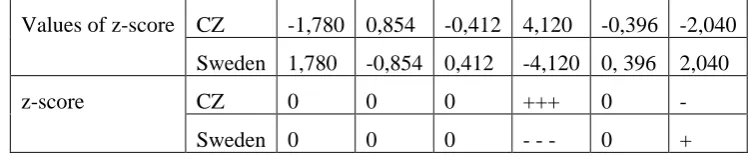
To interpret the obtained result, a z-score test was used.
Values of z-score CZ -1,780 0,854 -0,412 4,120 -0,396 -2,040
Sweden 1,780 -0,854 0,412 -4,120 0, 396 2,040
z-score CZ 0 0 0 +++ 0 -
Sweden 0 0 0 - - - 0 +
Table 2. Values of z-score
On the basis of the z-score results the followings statements were formulated:
1) The motive “to communicate in everyday situations“ appeared more than expected in case of the
Swedish respondents, and thus it was stronger in comparison with the Czech respondents (the observed rate for this motive was significantly higher than the rate expected at a significance level of 0.05).
2) The Czech respondents selected the motivation “I want to learn something new“ (the observed rate
was significantly higher than the rate expected at a significance level of 0.001, which means that the observed rate was considerably higher than the frequency expected). This may reflect the stronger intrinsic motivation in case of Czech participants in comparison to the Swedish ones.
3) The other motives (ie. “To do something in my free time“, “meet new people“, “meet with old
friends“, or “learn the language because of the family“) were statistically insignificant in both groups of respondents.
The motives that prompt immigrants to attend language courses in the Czech Republic and Sweden differ. This result was expected, since the implementation of motives is influenced by the society (Palán, 1997, p. 72).
The biggest differences are evident in two motives: to communicate in everyday situations, and to learn something new. The first motive was mentioned more often by the Swedish respondents. It may be conditioned by the fact that respondents are aware of the pressure of the hosting country to learn Swedish. From the Swedish point of view it is necessary for the immigrants to understand the Swedish values, such as equality, freedom and cooperation (Westin, Ding-Kyrklund, 2003, pp. 114-115). Řehák (1983) claims that this motive could belong to social motives. Some of the free answers contained life-experience of the immigrants suggesting that they would like to speak Swedish, but they do not meet Swedes very often. This could lead to marginalization or separation of foreigners in his new home (Berry, 2001, p. 619). It could point to the fact that some of the respondents in Sweden live in such parts of the city that are segregated from the majority. In practice, this can create problems of the integration of immigrants in Sweden.
In the Czech Republic, most respondents attending courses chose the reason “I want to learn something new”. This may reflect the fact that most respondents do not feel motivated by the exams for permanent residence, but their desire to learn is intrinsic. Daines et al (2006, p. 16) pointed out that this motive is of the key ones for adults to want to work on themselves, since this motive supplies them energy to endure further in adult language education. This motive reflects personal interests (Bednaříková, 2012), if they are stimulated, it can help the adult individual to participate in lifelong learning process.
5. CONCLUSION
As we have seen, there are some clear differences between the respondents in the two countries. Immigrants in the Czech Republic show an intrinsic desire to learn, at the same time as their counterparts in Sweden lean rather towards extrinsic motivation. In case of other possible motivations, there was no real difference between the two countries. One reason behind these results might be that immigrants in Sweden feel a stronger pressure to understand the host country. Immigrants in the Czech Republic might very well feel similarly, but the fact that immigrants in Sweden have fewer contacts with the Swedes is not only one of the possible reasons for the fact that they lean towards extrinsic motivation, but can also lead to deeper problems of integration. At the same time, the intrinsic motivation of the immigrants in the Czech Republic might help them in the integration process.
Another consequence of the results is that there might not be any need to put so much emphasis on integrational language exams, but rather that it is more important to promote other forms of study. For example – offering more evening courses within non-formal education would help some people to go to these classes and have a job at the same time, and this could support their integration in the new
society in the long run. It is also fairly clear that Sweden needs to focus more on creating space for immigrants and Swedes to meet on a regular basis. Such an arena could take many different forms, but the important part is to develop and support the growth of more intrinsic motivation. The Czech Republic might also focus less on the formal exams, since these anyway appear to bear little importance for the motivation to learn.
At the same time, it is important to remember that the immigrants in the two countries come from very different circumstances. Their background and reasons for migrating most probably have a direct influence over their choices and motivation. But because of this it is even more important for the countries to create an environment in which the students can develop both intrinsic and extrinsic motivation.
The article was financially supported by IGA_CMTF_2015_010 Project (Methods of social-educational activities in social pedagogy).
6. LITERATURE
Bednaříková, I, 2012, Kapitoly z andragogiky 2, Olomouc, Univerzita Palackého v Olomouci.
Boye-Møller, M, 1973, “Language Training For Immigrant Workers in Sweden“, International Labour Review, vol. 108, no. 6, pp. 505-15.
Český statistický úřad, 2014, “Cizinci podle kategorií pobytu, pohlaví a státního občanství – Údaje
k 31. 12. 2013“, in Czso.cz, viewed 29 July 2014
<http://www.czso.cz/csu/cizinci.nsf/tabulky/ciz_pocet_cizincu-001#.U-SxhKNHK1c>.
Daines, J, Daines, C & Graham, B, 2006, Adult learning. Adult teaching, Wales, Welsh Academic Press.
Drbohlav, D, Medová, L, Čermák, Z & Jánská, E 2010, Migrace a (i)migranti v Česku, Praha: SLON. Elmeroth, E 2003. “From Refuee Camp to Solitary Confinement: illiterate adults learn Swedish as a second language“,. Scandinavian Journal of Educational Research, vol. 47, no. 4, pp. 431-49.
European Commission, 2012, “Sweden“, in European Web Site on Integration, viewed 21 March, <http://ec.europa.eu/ewsi/en/info_sheet.cfm?ID_CSHEET=22>.
Gom, O 2009, “Motivation and Adult Learning“, Contemporary PNG Studies: DWU Research Journal, vol. 10, pp. 17-25.
Grolnick, WS & Ryan, RM 1987, “Autonomy in children’s learning: An experimental and individual difference investigation“, Journal of Personality and Social Psychology, vol. 52, no. 5, pp. 890-98. Heckman, F 2005, “National Modes of Immigrant Integration“, in Heckman, F, Boswick, W & Husband, Ch, Comparative European Research in Migration, Diversity and Identitie, Bilbao, University of Deusto, pp. 99-111.
Jandourek, J 2009, Úvod do sociologie, Praha, Portál.
Murphy, K & Alexander, P 2000, “Motivated Exploration of Motivation Terminology“, Contemporary Educational Psychology, vol. 25, pp. 3-53.
MV ČR, 2014a, “Terminologický slovník“, in Mvcr.cz, viewed 12 May,< http://www.mvcr.cz/clanek/terminologicky-slovnik.aspx>.
MV ČR, 2014b, “Integrace cizinců na území ČR“, in Mvcr, viewed 12 August, <http://www.mvcr.cz/clanek/integrace.aspx>.
Öbrink Hobzová, M, 2014, Jazykové vzdělávání dospělých imigrantů v České republice a ve Švédsku, Olomouc, Univerzita Palackého v Olomouci.
Palán, Z, 1997, Výkladový slovník vzdělávání dospělých, Praha, DAHA.
Rákoczyová, M 2009, “Přistěhovalectví v České republice aneb co vyčteme ze statistik“, in Rákoczyová, M & Trbola, R (ed.), Sociální integrace přistěhovalců v České republice, Praha, SLON, pp. 16-22.
Ryan, R & Deci, E 2000, “Intrinsic and Extrinsice Motivations: Classis Definitions and New Directions“, Contemporary Educational Psychology, vol. 25, pp. 54-67.
Řehák, M 1983, Psychologické faktory didaktiky dospělých, Praha, Ústav pro kulturně výchovnou činnost.
SCB, 2012, “Helårsstatistik - Riket Befolkning efter födelseland och ursprungsland“,. in Scb.se, viewed 10 July 2013, <http://www.scb.se/Pages/ProductTables.aspx?id=25795>.
SCB, 2014, “Utländska medborgare i riket efter medborgarskapsland, ålder och kön. År 1973 –
2013“, in Statistikdatabasen.scb.se, viewed 10 July,
<http://www.statistikdatabasen.scb.se/pxweb/sv/ssd/START__BE__BE0101__BE0101F/UtlmedbR/?r xid=7ccd541c-b9f9-4389-95bb-c63ee257d81f>.
Skolverket, 2012, Utbildning i svenska för invandrare - kursplan och kommentarer, Stockholm, Skolverket.
Vláda České republiky, 2006, “Usnesení vlády ČR č. 126 ze dne 8. února 2006 ke Koncepci integrace
cizinců v roce 2005“, in Cizinci.cz, viewed 20 July 2013,
<http://www.cizinci.cz/files/clanky/324/KIC_aktualizovana.pdf>.
Westin, Ch & Dingu-Kyrklund, E 2003, “Immigrantion and Integration of Immigrants and their Descendants: The Swedish Approach“, in Heckman, F & Schnapper, D (eds.), 2003, The Integration of Immigrants in European Societies: National Differences and Trends of Convergence, Stuttgart, Lucius & Lucius, pp. 105-34.
Wiesbrock, A, 2011, “The integration of Immigrants in Sweden: a Model for the European Union? “, International Migration, vol. 49, no. 4, pp. 48-66.
Wlodkowski, RJ, 2008, Enhancing Adult Motivation to Learn: A Comprehensive Guide for Teaching All Adults, San Francisco, Jossey-Bass.