Page 246
STUDENT SELF-EFFICACY IN INTRODUCTION TO ACCOUNTING: A CASE STUDY FROM TURKEY
Mert Erer, Çağrı Aksoy Hazır
Marmara University, Faculty of Business Administration, Istanbul, Turkey
Abstract
This study investigates the effects of academic self-efficacy on academic performance in the introduction to accounting course. We developed a survey instrument to measure the level of self-efficacy based on prior research. The sample consists of 106 students from a public university in Turkey. Our results suggest that academic self-efficacy is significantly related to the academic performance. Moreover, the results show that the instruction language is also a predictor of academic success.
Key words: self-efficacy, accounting, instruction language
1. INTRODUCTION
Introduction to Accounting course is often the deciding factor in whether a student remains an accounting major or changes to another discipline. It is also considered as a gateway course for the potential accounting major. (Eikner & Montondon 2001) It is a fundamental course in an accounting student’s curriculum and many prospective employers use this course as an indicator of a student’s ability to succeed professionally in accounting. (Sanders & Willis 2009)
Students struggle to cope with this course in learning environment that demands higher level of autonomy, initiative and self-regulation. Their incapability to cope with this environment can sometimes cause poor academic performance in accounting courses. Developing and improving problem solving and critical thinking skills are some of the criticized issues of accounting education. (Burnett, Friedman & Yang 2008) To solve those criticized issues plays self-regulated learning an important role in accounting education. A core element of regulated learning is students’ self-efficacy. Self-efficacy is defined as “the judgment of one’s capability to organize and execute the courses of action required to produce given attainments”. (Bandura 1997) Smith (2001) defined self-efficacy as the situation specific self confidence in one’s abilities to organize and execute a course of action to obtain certain outcomes. Self-efficacy exerts a critical influence on motivation and plays a critical role in self-motivation to deal with unfamiliar tasks and accepted as an important determinant of future performance. (Burnett, Xu & Kennedy 2010)
Student’s self-efficacy is not a new concept in accounting literature but there has been limited consideration of the self-efficacy in accounting discipline. The objective of this study is to analyze the extent of impact students’ self-efficacy ability has on their academic performance in Introduction to Accounting course. To the best of our knowledge, prior studies have not addressed the impact of self-efficacy on accounting course grades in Turkey. The results of this paper, therefore, should increase the awareness of faculty and policy makers on this subject and help them establish proper policies and curricula for the accounting students.
The remainder of the paper is organized as follows. Section 2 gives an overview of the prior research. Section 3 reviews the prior research and develops the hypotheses. Section 3 describes the methodology, sample and data. Section 4 presents the results and analysis. Lastly, Section 5 presents the concluding remarks.
2. LITERATURE REVIEW
Page 247
(e.g., thoughts, beliefs), and environmental conditions (Bandura 1997). According to social cognitive theory, self-efficacy is a key variable associated with both academic adjustment and achievement. (Fenollar, Roman & Cuestas 2007; Ramos-Sanchez & Nichols 2007; Zajacova, Lynch & Espenshade 2005)
Self-efficacy beliefs influence key indices of academic motivation as choice of activities (actual performances), level of effort (vicarious experiences), level of persistence (persuasions they receive from others) and emotional reactions (physiological reactions). (Schunk 1995; Zimmerman 2000) Choice of activities means that self-efficacious students undertake challenging tasks more readily than inefficacious students. According to Pajares (2002) self-efficacy beliefs affect student’s choices and the courses of action they make. In general students would engage in tasks they feel confident about and avoid those in which they do not. Self-efficacy beliefs are also predictive of two measures of students’ effort which are rate of performance and expenditure of energy. (Zimmerman 2000) Salomon (1984) has found a positive relation between self-efficacy and self-rated mental effort during students’ learning from text material. Perceived self-efficacy influences students’ skill acquisition both directly and indirectly by increasing their persistence. It can also influence students ‘methods of learning as well as their motivational processes. (Schunk 1981; Zimmermann 2000) Self-efficacy beliefs also influence the students’ tolerance level in overcoming stress and anxiety. (Pajares 2002) According to Pajares and Kranzler (1995) students’ performance in academically threatening situations depends more on efficacy than on anxiety arousal. Within key indices of academic motivation, self-efficacy is seen as a critical trait of individuals that can have an important influence on their thought patterns, learning and emotions that enable and shape their subsequent behaviors and actions. (Marzuki et al. 2017)
Academic self-efficacy refers to a student’s confidence in his/her abilities to successfully perform academic tasks at a designed level. (Schunk 1991) There has been many studies that examined the relationship between student’s self-efficacy and academic performance. (Pintrich & De Groot 1990; Zimmerman, Bandura & Martinez-Pons 1992; Bandura 1997; Pajares 2002; Christensen, Fogarty & Wallace 2002) Some of the studies found also positive correlation between academic self-efficacy and academic performance. (Bong 2001; Brown, Lent & Larkin 1989; Hackett et al. 1992; Lent, Brown & Larkin 1984; Moulton, Brown & Lent 1991; Pajares & Miller 1994; Zajacova, Lynch & Espenshade 2005).
Page 248
(2008) assessed accounting and non-accounting majors’ perceptions of their accounting knowledge of material covered in the introductory accounting course before and after three weeks of class lectures and the completion of an on-line case assignment in an intermediate accounting setting. According to results both groups have similar perceptions of their accounting knowledge and skill. Burnett, Xu and Kennedy (2010) assessed the predictive power of self-efficacy on performance in the first Intermediate Accounting course (Intermediate I) in the presence of other demographic and environmental variables. The results of the study revealed that students’ perception of their accounting skills was not associated with the grades achieved, while their grade perception was significantly related to their actual exam result. Like Jerusalem and Schwarzer (1992), Ghaderi and Salehi (2011) also compared the levels of self-efficacy, depression, and anxiety between accounting and management students in Iran. The results demonstrated that management students in Iran have more depression, anxiety and stress and lower level of self-efficacy rather than accounting students. Hassall et al. (2013) found a strong overall relationship between communication apprehension and communication self-efficacy and an equally strong association between their constituent components. Byrne, Flood and Griffin (2014) measured the levels of academic self-efficacy of first-year accounting students and also investigated whether there were any gender differences and the extent to which efficacy levels explained variation in academic performance. The findings demonstrated that being confident in one’s ability to understand the course content, to attempt questions in advance of tutorials, and to meet deadlines were associated with achieving significantly better results in the accounting modules.
3. METHODOLOGY
106 students enrolled in Introduction to Accounting class at one of the largest state universities in Istanbul/Turkey participated in the study. 69 participating students were from the Turkish speaking department and 47 participating students came from the German speaking department where the class was taught in German language. The participating students were taught by the same instructor with the same course content for each week in order to eliminate the bias caused by teaching styles. The students were neither forced nor compensated to participate in the study. The number of students in the Introduction to Accounting class and number of participating students are given in Table 1. Finally, 106 students out of 222 enrolled students participated in the study resulting in a participation rate of 47,75 %
Department Total number of students
Participating students
% of participating students
Turkish
speaking 134 69 51,49 %
German
speaking 88 47 53,40 %
Total 222 106 47,75 %
Table 1. Percentage of participating students
Page 249
Similar to the studies of Zajacova, Lynch and Espenshade (2005) and Burnett, Xu and Kennedy (2010) we measured the semester course load of the student, because the students with a higher course load may not be able spend the same amount of study time for the Introduction to Accounting course as their counterparts with lower course load. We used European Credit Transfer and Accumulation System (ECTS) credits as a proxy for workload. ECTS credits express the volume of learning based on the defined learning outcomes and their associated workload per definition (European Union 2015). We obtained the total number of ECTS credits that students took for the semester from the Students Information System of the University with the permission of the students.
Recent studies report an association between gender and academic performance (Voyer a& Voyer 2014; Smith & Nayor 2001; Eikner & Montondon 2001; Borde, Byrd & Modani 1998). Hence we controlled for GENDER in our model. Furthermore, we chose to include REPEAT as proxy for repeating students and LANG for the language of instruction as control variables.
The dependent variable in our study is the final grade (GRADE). The final grades of the students were obtained from the Student Information System of the University with the permission of the participating students. All the participating students took the final exam, so we were able use the full sample (N=106).
In the end, our regression model is constructed as follows:
GRADE = β + β1 SELF + β2LOAD + β3GENDER + β4REPEAT + β5LANG + ε Where:
GRADE = Final grade of the student (100 basis). SELF = Self-efficiency score
LOAD = Current semester workload.
GENDER = Dichotomous variable, 1 if the student is male and 0 otherwise.
REPEAT = Dichotomous variable, 1 if he/she is a repeating student and 0 otherwise. LANG = Dichotomous variable, 1 if the instruction language is Turkish and 0 otherwise.
4. EMPIRICAL TEST RESULTS
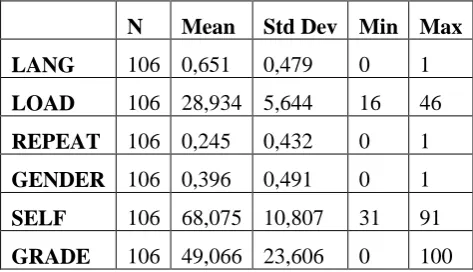
Table 2 present the descriptive statistics for the total sample. Most of the participating students are from the Turkish speaking department (mean = 0,651). The mean value of LOAD is 28,934 which lower than the regular semester workload of 30. The number of students repeating (REPEAT) the Introduction to Accounting Course is 26 (mean = 0,245) which suggests that most students pass the course in their first attempt. The mean value of 0,396 for GENDER shows that most participating students are female. The maximum (minimum) score for SELF is 91 (31) out of 100, and the mean value is 68,075. For the final grade (GRADE), the mean value is 49,066 out of 100.
N Mean Std Dev Min Max
LANG 106 0,651 0,479 0 1
LOAD 106 28,934 5,644 16 46 REPEAT 106 0,245 0,432 0 1 GENDER 106 0,396 0,491 0 1 SELF 106 68,075 10,807 31 91 GRADE 106 49,066 23,606 0 100
Page 250
Table 3 shows the correlations among variables. LANG is significantly negatively correlated with LOAD, and significantly positively correlated with SELF and GRADE. There is also a significant positive correlation between SELF and GRADE.
Multicollinearity occurs when two or more variables on the right-hand side of a regression model are highly correlated (Disatnik & Sivan 2016). Since none of the values of the correlation coefficients is larger than 0,50, multicollinearity is not an issue in our test.
LANG LOAD REPEAT GENDER SELF GRADE
LANG 1,0000
LOAD -0,4105** 1,0000
REPEAT -0,0192 0,0770 1,0000
GENDER -0,0137 0,0313 0,0370 1,0000
SELF 0,191* -0,0387 -0,1178 -0,0111 1,0000
GRADE 0,3592** -0,1845 -0,0204 0,1241 0,416** 1,0000 Table 3. Correlations
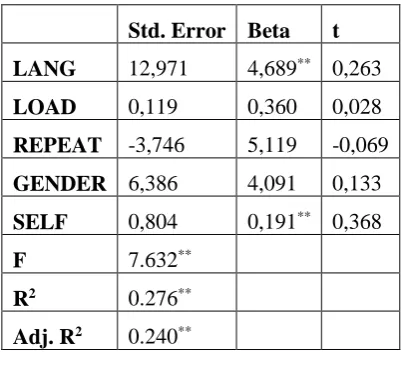
Table 4 shows the regression results. The F-statistic indicates an overall satisfactory fit which is significant at the 0,01 level. The adjusted R-squared value is 0,24 which suggests that the overall explanatory power of the regression model is quite high when the results of similar studies are considered.
Std. Error Beta t LANG 12,971 4,689** 0,263
LOAD 0,119 0,360 0,028
REPEAT -3,746 5,119 -0,069 GENDER 6,386 4,091 0,133 SELF 0,804 0,191** 0,368
F 7.632**
R2 0.276**
Adj. R2 0.240**
Table 4. Regression Results
Page 251 5. CONCLUSION
This study examines the association between the students’ self-efficacy perceptions and accounting course grades. Some characteristics of this study are worth noting. First, it is the first study in Turkey that investigates the effect of self-efficacy on accounting course grades. Second, the study extends the prior studies by including the instruction language as an independent variable in the regression model. Our results show that self-efficacy and instruction language are significantly and positively related to the accounting course grades. We found no significant relation between the accounting course grades and the semester course load, gender and repeating the course.
There are a few limitations to our study that may suggest a cautious interpretation of the results. Our sample is consisted of students from a public university in Istanbul/Turkey. The inclusion of both public and foundation universities from different cities in the sample would increase the generalizability of our results. Furthermore, the study is conducted in the introduction to accounting course. Different outcomes could emerge if self-efficacy was investigated in intermediate or advanced accounting courses.
REFERENCES
Bandura, A 1997, Self-efficacy: The exercise of control, Freeman, New York.
Bong, M 2001, ‘Role of self-efficacy and task value in predicting college students’ course performance and future enrolment intentions’, Contemporary Educational Psychology, vol. 26, no. 4, pp. 553–570.
Borde, SF, Byrd, AK & Modani, NK 1998, ‘Determinants of student performance in introductory corporate finance courses’, Journal of Financial Education, vol. 24, pp. 22-30.
Brown, S, Lent, R & Larkin, K 1989, ‘Self-efficacy as a moderator of scholastic aptitude: academic performance relationships’, Journal of Vocational Behaviour, vol. 35, no.1, pp. 64–75.
Burnett, RD, Friedman, M & Yang, Y 2008, ‘The change of students’ perception of accounting skills in intermediate accounting: A guide for accounting education reform’, Accounting Educators' Journal, vol. XVIII, pp. 81 – 101.
Burnett, RD, Xu, L & Kennedy, S 2010, ‘Student self - efficacy in intermediate accounting: A tool to improve performance and address accounting change’, Accounting Educators' Journal, vol. XX, pp.109 – 134.
Byrne M, Flood, B & Griffin, J 2014, ‘Measuring the Academic Self-Efficacy of First-year Accounting Students’, Accounting Education: An International Journal, vol. 23, no.5, pp.407 – 423. Christensen, TE, Fogarty, TJ & Wallace, WA 2002, ‘The association between the directional accuracy of self-efficacy and accounting course performance’, Issues in Accounting Education, vol. 17, no.1, pp.1-26.
Dafouz, E & Camacho-Miňano, MM 2016, ‘Exploring the impact of English-medium instruction on university student academic achievement: The case of accounting’, English for Specific Purposes, vol. 44, pp. 57-67.
Disatnik D & Sivan L 2016, ‘The multicollinearity illusion in moderated regression analysis’, Marketing Letters, vol. 27, no. 2, pp.403 – 408.
Eikner, AE & Montondon, L 2001, ‘Evidence on factors associated with success in intermediate accounting 1’, Accounting Educators' Journal, vol. XIII, pp. 1-17.
Page 252
Fenollar, P, Roman, S & Cuestas, P 2007, ‘University students’ academic performance: An integrative conceptual framework and empirical analysis’, British Journal of Educational Psychology, vol. 77, no.4, pp. 873–891.
Frederickson, JR & Pratt J 1995, ‘A model of the accounting education process’, Issues in Accounting Education, vol. 10, no.2, pp. 229-246.
Ghaderi, AR & Salehi, M 2011, ‘A study of the level of self-efficacy, depression and anxiety between accounting and management students: Iranian evidence’, World Applied Sciences Journal, vol. 12, no. 8, pp. 1299 – 1306.
Hackett, G, Betz, N, Casas, J & Rocha-Singh, I 1992, ‘Gender, ethnicity, and social cognitive factors predicting the academic achievement of students in engineering’, Journal of Counselling Psychology, vol. 39, no.4, pp. 527–538.
Hassall, T, Arquero, JL, Joyce, J & Gonzalez, JM 2013, ‘Communication apprehension and communication self-efficacy in accounting students’, Asian Review of Accounting, vol. 21, no. 2, pp. 160 – 175.
Jerusalem, M & Schwarzer, R 1992, ‘Self-efficacy as a resource factor in stress appraisal processes’, in: R Schwarzer (ed.), ‘Self-Efficacy: Thought Control of Action’, DC: Hemisphere, Washington, pp. 195 – 213
Lai, ML 2008, ‘Technology readiness, internet self-efficacy and computing experience of professional accounting students’, Campus-Wide Information Systems, vol.25, no.1, pp.18 – 29.
Lent, R, Brown, S & Larkin, K 1984, ‘Relation of self-efficacy expectations to academic achievement and persistence’, Journal of Counselling Psychology, vol. 31, no.3, pp. 356–362.
Marzuki, M, Subramaniam, N, Cooper, BJ & Dellaportas, S 2017, ‘Accounting academics’ teaching self-efficacy and ethics integration in accounting courses: A Malaysian study’, Asian Review of Accounting, vol. 25, no. 1, pp.148-170.
Mooi, TL 2006, ‘Self-efficacy and student performance in an accounting course’, Journal of Financial Reporting and Accounting, vol.4, no.1, pp.129 – 146.
Moulton, K, Brown, S & Lent, R 1991, ‘Relation of self-efficacy beliefs to academic outcomes: a meta-analytic investigation’, Journal of Counselling Psychology, vol. 38, no.1, pp. 30–38.
Owen, SV & Froman, RD 1988, ‘Development of a college academic self-efficacy scale’, paper presented at the Annual Meeting of the National Council on Measurement in Education, New Orleans, April 6-8.
Pajares F 2002, ‘Gender and perceived self-efficacy in self-regulated learning’, Theory into Practice, vol. 41, pp. 116 – 125.
Pajares, F & Kranzler, J 1995, ‘Self-efficacy beliefs and general mental ability in mathematical problem solving’, Contemporary Educational Psychology, vol. 20, pp. 426–443.
Pajares, F & Miller, M 1994, ‘Role of self-efficacy and self-concept beliefs in mathematical problem solving: a path analysis’, Journal of Educational Psychology, vol. 86, no.2, pp. 193–203.
Pintrich, PR & De Groot EV 1990, ‘Motivational and self-regulated learning components of classroom academic performance’, Journal of Educational Psychology, vol. 82, pp. 33-40.
Ramos-Sanchez, L & Nichols, L 2007, ‘Self-efficacy of first-generation and non-first-generation college students: The relationship with academic performance and college adjustment’, Journal of College Counseling, vol. 10, no.1, pp. 6–18.
Page 253
Sanders, DE & Willis, VF 2009, ‘Setting the P.A.C.E. for student success in intermediate accounting’, Issues in Accounting Education, vol.24, no.24, pp. 319 – 337.
Schunk, DH 1981, ‘Modelling and attributional feedback effects on children’s achievement: A self-efficacy analysis, Journal of Educational Psychology, vol. 74, pp.93–105.
Schunk, DH 1991, ‘Self-efficacy and academic motivation’, Educational Psychologist, vol. 26, no.3, pp. 207-231.
Schunk, DH 1995, ‘Self-efficacy and education and instruction’ in JE, Maddux (ed.), Self-efficacy, adaptation, and adjustment: Theory, research, and application, Plenum Press, New York, pp. 281-303.
Smith, P 2001, ‘Understanding self-regulated learning and its implıcations for accounting educators and researchers’, Issue in Accounting Education, vol.16, no.4, pp. 663-700.
Smith, J. & Nayor, R 2001, ‘Determinants of degree performance in UK universities: A statistical analysis of the 1993 student cohort’, Oxford Bulletin of Economics and Statistics, vol. 63, no. 1, pp. 29-60
Solberg, VS, Gusavac, N, Hamann, T, Felch, J, Johnson, J, Lamborn, S & Torres, J 1993, ‘The adaptive success identity plan (ASIP): A career intervention for college students’, The Career Development Quarterly, vol. 47, pp. 48-95.
Stone, D, Arunachalam, V & Chandler, J 1996, ‘An empirical investigation of knowledge, skill, self-efficacy and computer anxiety in accounting education’, Issues in Accounting Education, vol.11, no.2, pp. 345–376.
Subramaniam, N & Freudenberg, B 2007, ‘Preparing accounting students for success in the professional environment: enhancing self-efficacy through a work integrated learning program’, Asia – Pacific Journal of Cooperative Education, vol. 8, no.1, pp. 87-102.
Voyer, D & Voyer, SD 2014, ‘Gender differences in scholastic achievement: A meta-analysis’, Psychological Bulletin, vol. 140, no. 4, pp. 1174-1204.
Wood, RE & Locke, EA 1987, ‘The relation of self-efficacy and grade goals to academic performance’, Educational and Psychological Measurement, vol. 47, pp. 1013-1024.
Zajacova, A, Lynch, S & Espenshade, T 2005, ‘Self-efficacy, stress and academic achievement’, Research in Higher Education, vol. 46, no.6, pp. 677–699.
Zimmerman, BJ 2000, ‘Self – efficacy: An essential motive to learn’, Contemporary Educational Psychology, vol. 25, pp.82 – 91.