THE ESSENCE OF INNOVATION PROCESS IN HIGHER EDUCATION Ognyana Stoichkova1, Vihra Dimitrova2
1
Higher School of Insurance and Finance – Sofia, Bulgaria 2
Higher School of Agribusiness and Rural Development – Plovdiv, Bulgaria
Abstract
The paper examines the problem of innovation in education with the stress on higher education. Output production is the understanding of the innovation process as structurally coherent process in the course of which implement the results of fundamental and applied research. The paper focuses on objective conditions that affect the field of education in general and the situation in the universities. Finds that there is an inadequate system to take management decisions, which makes it impossible to build an innovation management system in education. Together with inadequate funding, it makes it impossible to adopt the economic rational management decisions for long-term strategic and innovative development, which in turn is a threat to the development of the competitiveness of science education. The authors analyze the new model of the contemporary university, which under the influence of modern computer and telecommunication technologies in terms of market development in the field of education combined traditional education and some basic types of institutional forms (organizational structures) of distance education.
Key words: innovation management, innovation process, innovation in education, innovative university distance learning
1. GENERAL FORMULATION OF THE PROBLEM
The development of innovative projects is essential for the development of higher education of a new type and be part of the strategic priorities of the university management. Innovation is an important part of the globalization process and a prerequisite for creating competitive advantage.
The essence of innovation is the maximization of the socio-economic impact on account of better utilization of the intellectual resources of society. In summary, the innovation process represents a structurally coherent process. In the course of the innovation process based on the results of basic and applied research and appropriate resourcing is done the creation of high-technology, organization of production and marketing of knowledge-intensive production.
On Fig. 1 a schema is represented of the process of standardization of the innovation process.
Fig.1. Scheme of the process of standardization of innovation
In contrast to the innovation process in developed countries innovation in our country are carried out in conditions of unstable economy, insufficient private capital that could be directed towards the development and utilization of the latest equipment and technology. We believe that to achieve this task is necessary to develop an innovative policy that gives priority to the development of scientific and technological development of the country and improving the competitiveness of industry in both domestic and international market. Special role in this regard is the maintenance of the system of higher education globally. Approaches for the formation of a single innovation policy are:
systematic approach for the formation of innovation policy;
priority development of knowledge-intensive production of higher education and research;
Clearly define sources of funding for priority areas;
Developing an innovative system based on scientific and technical, intellectual and financial resources of the country.
In this plan the state structures responsible for the development of innovation in the country does not fully utilize the potential of research for the necessary scientific research.
Legitimate claims of society are at the Bulgarian Academy of Sciences in the absence of tangible results of scientific studies and research, for which the state removed sensitive equipment (Chart 1).
At the same time, foreign teams and experts are compensated for assessments, conclusions and recommendations that make it important for state projects.
To ensure effective innovation requires government support, formation of state science and technology sector and defining a clear scheme to fund innovative programs and projects financed from the state budget.
The growing role of knowledge and education is generally recognized. Higher education is assigned to the particular task as important for the development of socio-economic resources of each country and the world as a whole. By World Bank study higher education provides the formation of personality and development potential of analytical capabilities, which affects the efficiency of national economies. In other words, knowledge is one of the main factors of production and the accumulation and application of knowledge is relevant to the main competitive advantage of each country.
The above is subject to a number of objective conditions that affect the field of education in general and the situation in universities in particular. Among them are:
• the growth of knowledge-intensive industries (for efficient operation, of which more than 50 percent of the staff should be composed of individuals with higher education);
• intensive growth of scientific and technical information;
• rapid technological change;
• development of the field of research taking place at the boundary between different sciences and so on.
Solving these problems requires new approaches for the formation and development of models for the training of university graduates. Most current models are now associated with the development of critical thinking, creativity of the individual, but also to develop mechanisms for managing intellectual and creative resources.
Everything said so far leads to the conclusion that the main direction in the work of universities today is not just the award of specialties and betting on a professional basis, subject to the task of continuous learning and self-development in a professional and personal level. For the effective development of higher education require different modern models of training in high school.
2. FEATURES OF THE INNOVATIVE MODEL OF EDUCATION
It should be noted that the very term "training model" is not used uniquely. Composite model of innovative learning for the first time mentioned in the work of Kozma R.B. and J. Johnson 1991. It provides:
1) Active participation of the student in the learning process; 2) The ability to use the acquired knowledge in real terms;
3) The presentation of information in different forms (text or numeric); Бюджет на БАН по години
61 290,60 65 090,60
68 098,40
82 141,40
95 772,40
74 695,10
0,00 20 000,00 40 000,00 60 000,00 80 000,00 100 000,00 120 000,00
2005 2006 2007 2008 2009 2010
година
хи
л.л
в.
Chart 1. Bulgarian Academy of Sciences Budget
th
ou
BG
N
4) The individual approach to learning the collective activity.
One of the fundamental questions concerning the dynamics of the innovation process in higher education is the shortening of the time lag between the emergence of new knowledge and its use, its implementation. These issues these days are very important because of the speed with which new knowledge is translated into practice depends on the success of the entire innovation process. As a rule, the management of the innovation process implies the removal of obstacles hindering the practical implementation of progressive ideas, receipt and storage of competitive advantage as a result of implementation in the field of innovative products and services.
An analysis of the concept of "innovation process" and its main components allow to understand the nature of innovation management. Innovation management is a set of principles and methods, tools for managing innovation processes.
Fig. 2. Place of innovation management in the system of management disciplines
It is widely recognized that innovation management as a separate field of economics and business management professional is one of the varieties of functional management, whose immediate object are innovative processes. This determines the place of innovation management in the system of management disciplines (Figure 2).
If we consider the innovative development of the education system in terms of running a university, we can conclude that the main activity is modernization of the basic education system. The most significant of these are:
• the content and structure of the curriculum;
• teaching methodology;
• principles and methods for making and maintaining the educational process.
In each of the elements of the management and operation of the high school, we can note difficulties. This is confirmed by the absence of a flexible and adaptable system of innovation management and
Strategic management M an ag em en t o f T ran sp or t M an ag em en t of Co mmu ni ca tio ns In du st rial man ag eme nt Fi nan ci al man ag eme nt In no va tio n M an ag eme nt H R M an ag eme nt M an ag em en t o f In fo rmat io n M an ag eme nt o f E du ca tio n General Management
In sectoral terms In functional aspect
strategic development of the high school, which was based on the system of management decision. And the latter is needed for effective system information support.
In existing systems, maintenance of the adopted solutions is one of the most important characteristics of the information in these days. Virtually all state universities and most private, no adequate system to take management decisions, which makes it impossible to build an innovation management system (innovation management). Together with inadequate funding, it makes it impossible to adopt the economic rational management decisions for long-term strategic and innovative development, which in turn is a threat to the development of the competitiveness of science education.
Recently in the field of innovation management quickly began to develop such sectoral disciplines - managing innovation in education, banking, transport, industry, communications and in other knowledge-intensive and high-tech industries. These management disciplines explore the specificity of methods and tools for managing innovation processes in various industries.
Education is one of the most innovative areas from which most depends creation of innovation climate and competitiveness of the economy as a whole. Nature and effectiveness of innovation processes in different sectors of the economy and in different areas of activity substantially depend on the nature and effectiveness of innovation in education. In implementing the diffusion of innovation in education creates and develops modern education system - a system of open, flexible, industrialized level of knowledge, continuous education of individual currents of life. Such a system is a unity of:
• production innovation in education in terms of new technologies (technological innovation), new methods and ways of teaching and learning (innovation in education);
• managerial innovations that include economic mechanisms in the field of education (economic innovation) and institutional arrangements in education (organizational innovation).
All this leads to a significant spread of management innovation in the educational process. As a rule right here is a significant organizational lag, i.e. introduction of innovations in production for a certain period be carried out in terms of outdated management structures and methods, which require the development and implementation of organizational innovations whose absorption is the most important factor for the development of the whole education system.
Under the force of the impact of innovative educational technologies to shape the development of market mechanisms in education. These are the new forms of public funding of education, diversification of sources of funding for education, new mechanisms for financing education business, tax incentives for investment in education, new mechanisms for wages in the same field.
These processes are not only transforming the technological base of educational institutions, and dramatically change their institutional nature. As a result of these processes in the world appear innovative organizational forms of educational institutions that use an expanding array of new methods of education, new economic and organizational and administrative mechanisms of their functioning.
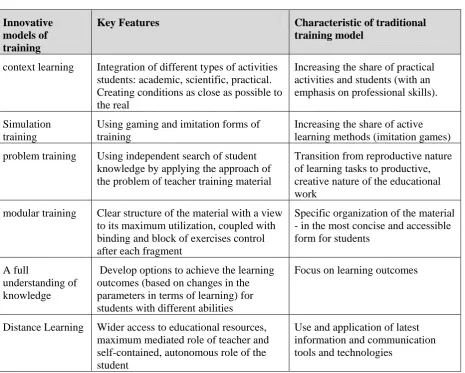
Under the influence of modern computer and telecommunication technologies in terms of market development in the field of education to form a new model of university, which combine traditional education and some basic types of institutional forms (organizational structures) of distance education (Table 1).
Innovative models of training
Key Features Characteristic of traditional
training model
context learning Integration of different types of activities students: academic, scientific, practical. Creating conditions as close as possible to the real
Increasing the share of practical activities and students (with an emphasis on professional skills).
Simulation training
Using gaming and imitation forms of training
Increasing the share of active learning methods (imitation games) problem training Using independent search of student
knowledge by applying the approach of the problem of teacher training material
Transition from reproductive nature of learning tasks to productive, creative nature of the educational work
modular training Clear structure of the material with a view to its maximum utilization, coupled with binding and block of exercises control after each fragment
Specific organization of the material - in the most concise and accessible form for students
A full
understanding of knowledge
Develop options to achieve the learning outcomes (based on changes in the parameters in terms of learning) for students with different abilities
Focus on learning outcomes
Distance Learning Wider access to educational resources, maximum mediated role of teacher and self-contained, autonomous role of the student
Use and application of latest information and communication tools and technologies
Table 1. Comparative feature innovative training models
Table 1 shows that each training model develops a particular element of the system of educational process focusing on their practical training (training context) and methodological tools (imitation learning).
In our opinion, particular attention deserves the nature of the activities of the students and the teacher (learning problem), the mode of organization of the educational process (modular training), achieving an efficiency (full absorption of knowledge) or the use of specific training tools and technology (distance learning). In any case, each of the considered models of innovation represented traditional patterns of education, revealing untapped potential.
CONCLUSIONS
Based on the foregoing, it can be concluded that the innovative education as a whole does not represent a specific model and principle of rational use of the new capabilities of already known elements of the educational process. The innovative approach to education is determined not by the use of a single model, the ability to create and shape required for the respective university element of the educational process using different schemes. Just this ability makes the process of teaching in the University of Technology, i.e. predictable and consistent with the intended results.
It should be added that in such a design is appropriate to use mixed models. For example, in the system of distance learning is very effective principle of modular training, combined with a model of the full utilization of the knowledge; content of the training is effective to systematize in the training
modules and the conditions of learning (the rate of utilization, performance of procedures) vary based on the model of a full understanding of.
There is no doubt that this approach is promising in the context of the development of educational trends of the twenty-first century, as it allows to solve one of the important tasks of the "social contract" in terms of the mass training of young people with higher education. According to us to create innovation potential is necessary to examine the components of the creative process as the accumulation of knowledge and experience through innovative and technological potential is critical. Competitiveness and efficiency of operation of the system of education and science in Bulgaria is one of the most topical issues for the future of the country. This is related to the fact that the level of education, scientific and technological progress and intellectual potential of the country have the greatest importance for the strengthening of integration not only within the EU but in the world. Therefore, a key element for the successful development, operation and competitiveness of any economic system in the long term is effectively developed innovation. Organization and implementation of scientific and educational programs is the main component of the innovative development of a modern society. The higher education system needs to build a flexible and appropriate innovation management system that provides effective and long-term development of any particular educational institution in accordance with the requirements of the economy and society as a whole. Each innovation system must take into account the realities and trends in the development of global education system, whose distinctive feature is the continuous improvement of higher education. Therefore, improving the system of higher education is not only a way to solve socio-economic problems of the society, but is a real opportunity to address persistent market positions in global high-tech and progressive educational products.
References
1. Борисов, Б., Георгиева, Т., Ев.Парашкевова. Процес на осъществяване на инвестиционни проекти в иновационната фирмена дейност. Списание “Диалог” 1, 2009
2. Великов, Н., Висшето образование в търсене на модел и алгоритъм за ефективно развитие. Сп. “Икономически алтернативи”, бр.3, 2007
3. Димитрова, В., Система от показатели за стратегическото управление на висшето образование, Сборник с доклади от научно-практическа конференция, В.Търново, 2010 4. Панайотов, И., Оценяване на качеството на висшето образование, Втора национална научна
конференция с муждународно участие на МОМН „Качеството на висшето образование в България – проблеми и перспективи”, Русе, 2009
5. Станев, Ил., Йорданова, Л., Шест идеи, които ще разтърсят висшето образование, в-к Капитал, бр. 35, 03.09.2010
6. Baregheh A, Rowley J and Sambrook S.Towards a multidisciplinary definition of innovation, Management decision, vol. 47, no. 8, 2009
7. Kozma, R. B., and J. Johnson, The technological revolution comes to the classroom, 1991