http://www.sciencepublishinggroup.com/j/ajmme doi: 10.11648/j.ajmme.20170101.14
Research on Finite Element Simulation of Direct Redrawing
Process of Extra Deep Drawing (EDD) Steel at Elevated
Temperatures
Kalavala Sai Kiran Reddy
Industrial Management, University of Central Missouri, Warrensburg, Missouri, USA
Email address:
[email protected]To cite this article:
Kalavala Sai Kiran Reddy. Research on Finite Element Simulation of Direct Redrawing Process of Extra Deep Drawing (EDD) Steel at Elevated Temperatures. American Journal of Mechanical and Materials Engineering. Vol. 1, No. 1, 2017, pp. 15-19.
doi: 10.11648/j.ajmme.20170101.14
Received: March 2, 2017; Accepted: March 24, 2017; Published: April 13, 2017
Abstract:
In the previous studies of EDD steel for direct drawing and redrawing operations, dies were designed and developed. Deep drawing and redrawing experimentations were also performed for different size of blanks at various temperatures i.e. Room Temperature, 150 C, 300 C, 450 C on 1mm EDD steel sheets. Later on Material models were constructed in the Preprocessor of LS Dyna for both direct drawing and redrawing operations. Simulations were run by using material model Barlat-36 and visco -plastic thermal model 106 at various temperatures for various blank sizes. Results were extracted from the simulations like Punch Load, thickness distribution and temperature gradient and these results were compared with the experimental results and discussed the impact of each one.Keywords:
EDD Steel, Deep Drawing, Barlat-36 and Visco-Plastic Thermal Model 1061. Introduction
Deep drawing involves conversion of flat thin sheet metal blanks into parts of desired shape. Although applications of deep drawing processes at elevated temperatures (warm forming) have not yet been used effectively nowadays, it is clear that it is going to be a very important manufacturing application in the future. Warm deep drawing process of circular blanks is investigated using a 20T hydraulic press and a finite element model coupled with thermal analysis. Extra Deep Drawing (EDD) steel is used in many EDD Steel is produced from vacuum degassed steel to achieve a very low-carbon content. It is chemically stabilized with elements such as titanium and niobium (columbium) during production to combine the remaining residual amounts of carbon and nitrogen to make it "interstitial-free." Excellent uniformity and exceptional formability characterize coated and uncoated sheet of this quality. The final product is excellent for deep drawn parts in that the sheet exhibits a high resistance to thinning during drawing.
1.1. Problem
EDD steel is used in industries which include automotive body and structural parts, aircraft components, utensils, white goods….etc. So at different temperatures material will fail with deformation we need to determine the failure.
1.2. Purpose of Study
Extra deep drawing steels are +extensively used in many applications such as cookers, refrigerator panels, baths, kitchenware, sink units. So in order to use this, the material properties at different temperatures are determined.
1.3. Need for Study
By determining the properties of the material on this topic, it definitely benefits all manufacturing companies over the world so they can make products based on temperature criteria.
2. Review of Literature
Extra deep drawing (EDD) exhibits a high resistance to thinning during drawing and has excellent formability characteristics. Extra deep drawing (EDD) steels are the most widely used steel material today for automotive applications to reduce the weight of outer-body car panels while maintaining strength, formability and dent resistance. Extra deep drawing steels are extensively used in enamelling applications such as cookers, refrigerator panels, baths, kitchenware, sink units. Texture being one of the important parameter of steel sheets as it induces plastic anisotropy that would be beneficial to draw ability of steels. (Raman., K, Eashwar. P., & Singh, S. K.) Factors like mechanical properties, metallographic, lubrication with blank, die and punch geometry, process parameters like punch speed, Blank holding force (BHF) etc., will contributes the success or failure of the component (Kumar, D). Metal forming is one of the most important steps in manufacturing of a large variety of Products. In the recent practical cost conscious world, owing for relatively low cost, high productivity and greater control over technical and aesthetic parameters, so many expensive casts, rolled and forged parts have been replacing with sheet metal parts.
Deep Drawing
Drawing is a manufacturing process widely used in the industry due to its versatility and good mechanical Properties namely good surface finish and dimensional accuracy. Successful drawing operations require careful selection of process parameters and consideration of many other factors.
The main variables involved in this type of process are: 1. Blank Thickness
2. Die radius 3. Punch Radius 4. Friction
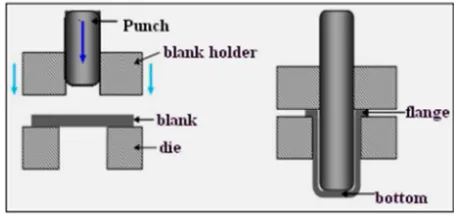
Deep drawing is a metal forming process in which a flat piece of plate or sheet is forced into a die cavity to take a shape, such as a cup. It is the basic test for cup drawing, and during the operation various stresses that act on the blank are compression at the outer section of the blank (cup flange), bending at punch and die corners and tension at the cup wall (bi axial tensile stress). At room temperature Deep drawing operation have some drawbacks such as large flow stresses and deformation.
Figure 1. Deep Drawing process.
The typical remedy to overcome the difficulties of deep drawing is the division of the process into a sequence of operations where the first operation moves sufficient material into the high deformation zone and then allows for the final drawing depth to be reached in subsequent redrawing operations.
In conventional deep drawing, the depth of draw is confined to less than the diameter of the cup, various methods have being resorted to obtain deeper cups, which includes the assistance of hydraulic pressure in a recently Introduced process, which helps to increase the draw ratio in the drawing of cylindrical cups to 3.5. Maslennikov’s technique is one of the best methods, which produces very deep cups at draw ratios of 6 or more from flatness. The redrawing process is mainly intended to produce deep cups with a height-to-diameter ratio of more than unity. The redrawing operation can be done in two ways, i.e. direct redrawing and reverse redrawing.
also the information of intermediate steps, like the distributions of displacement, stress, strain and other internal variables.
F.-L. Cheng carried out experiments on redraw ability of Several Organic Coated Container Steels and concluded that Steels with lower work hardening exponent and higher tensile strength have better redraw ability than those of higher work hardening exponent and lower tensile strength. The variables such as the average strain ratio, thickness, surface finish and metallic coating will not have a significant effect on the redraw ability. Also the limiting redrawing ratio generally decreases with the increase of drawing ratio (Cheng, F., Aichbhaumik, D., & Peterson)
Mamalis carried out the simulation of the deep-drawing of cylindrical cups using the explicit FE code DYNA 3D and evaluated, the strain distributions of the deformed material, CPU time cost, process characteristics and the macroscopic deformation modes. This helped in directing towards the selection of most efficient material model and punch parameters (Mamalis, A., Manolakos, D., & Baldoukas, A. 1997).
Simulation was also based on rigid-plastic FEM (Finite Element Method) but he used bilinear Quadrilateral elements to analyze the axi symmetric multi-stage deep drawing operation. Simulations used a semi implicit Formulation with two layers of bilinear quadrilateral Elements for drawing, redrawing, and ironing in can manufacturing. They applied the commercial implicit Program MARC (Machine Readable Cataloging Records) to model the reverse redrawing of round cups using bilinear quadrilateral elements and demonstrated that the commercial dynamic Explicit program PAM-STAMP can be used to simulate Multi-stage drawing operations of complex three-dimensional Automotive components (Parsa, M. H., Yamaguchi, K., & Takakura, N. 2001).
In conventional sheet metal forming operation large amount of time is consumed in trial and error method and there are high chances that the tools must be redesigned whenever the desired products are not obtained. The main drawback of trial and error methods are loss of time and wastage of expenditure. To overcome from such problems, process modeling by computer simulation called Finite Element Method (FEM) has been introduced which simulates the actual process and thus saves time and money. In the present computerized world so Many commercial codes are available for Finite Element Analysis in metal forming such as Dynaform, Abacus, Nike 2D, deform-3d etc. The code can be used for the applications such as sheet metal forming, occupant safety, automobile crashworthiness, and underwater explosions. It is a non-linear dynamic simulation package which can simulate different types of sheet metal processes including deep drawing, stretching, bending, hydro forming, stamping, etc. To predict stresses, strains, thickness distribution, etc. and the effect of various design parameters of tooling on final product can be studied.
3. Methodology
3.1. Population
The target population for this research is, Deep drawing and redrawing experimentations were also performed for different size of blanks at various temperatures i.e. Room Temperature, 150°C, 300°C, 450°C on 1mm EDD steel sheets. Later on Material models were constructed in the Preprocessor of LS Dyna for both direct drawing and redrawing operations. Simulations were run by using material models.
3.2. Location
The location for research is at Mechanical Research Lab in Gokaraju Rangaraju Institute of Engineering and Technology which is at Hyderabad, India.
3.3. Selection Criteria
The target population for this research is Extra Deep Drawing (EDD) Steel, which is the steel selected based on thermal property. In order to determine that at which temperature how material is behaving and at what temperature it is failing.
4. Instruments and/or Apparatus to Be
Used
Figure 2. Induction Furnace Developed to draw the materials at elevated temperatures.
Figure 3. Complete Experimental test rig.
5. Statistical Analysis
As discussed in the previous sections EDD material was first drawn with curtain diameter punch and then again it is redrawn with reduced diameter punch in a direct redrawing process. Experimentally drawn cups cut it into two halves and thickness was measured using pointed anvil micro meter these graphs are presented in figures. Simulations were carried out using explicit finite element code LS DYNA using parameter model constitutive equation. It is because the material is not only anisotropic at room temperature but also at elevated temperature. Thickness contours produced from the simulation are presented in figures.
The time duration of my research is 4 months August to November. I will complete all activities according to the prepare schedule. This time task analysis will be help me to do work on time without any delay.
Research plan:
This Research is mainly about the determining the properties and behavior of material (EDD) steel. The Finite Element Analysis of EDD Steel for Direct Redrawing process is carried out at different temperatures and thickness characteristics have been generated.
6. Results and Findings
temperature. As it can be seen from all these thickness contours that the thickness of the drawn cup is much more uniform in the redrawing process and by increasing the temperature both experimental and simulation shows that thickness are not only uniform but also the minimum thickness decreases with increasing temperature. As expected in the direct draw necking appears at the punch, corner radius and the thickness keeps on increasing in the wall region. Up on redrawing the cup necking portion of the direct draw shifts into the wall region of redraw and this phenomenon can be seen in all the thickness contours. That thickness in the wall slightly decreases corresponding to the previous necking region. As it can be observed that when 84mm diameter blank is redrawn at room temperature there is a failure at the bottom of the cup. Up on increasing the temperature redrawn cups can be successfully drawn because of a decrease in the mean flow stresses. At 150°C, 0.73mm thickness is being observed in the redrawn cup at 150°C. This is very close to fracture and this tendency of necking has subsided when there is an increase in temperature. It is because by increasing the temperature lesser punch loads will be required to redraw the cup. For 80mm diameter as expected thickness is much more uniform because lesser die pressures are sufficient to deform the material.
7. Conclusions and Recommendations
7.1. Conclusion
The Finite Element Analysis of EDD Steel for Direct Redrawing process is carried out at different temperatures and thickness characteristics have been generated. From the results it is clear that at elevated temperatures, as mean flow stresses are less, necking due to deep draw disappears in the redrawn cup. When we use blanks with different diameters at same temperature for redrawing, it can be seen that dynamic strain regime and strain hardening play a major role in determining the Draw Ratio.
7.2. Recommendation
Based on above properties if we manufacture the products with the material then it will be safe and also we can use for different applications.
References
[1] Agnew, S. R., & Duygulu, Ö. (2005). Plastic anisotropy and the role of non-basal slip in magnesium alloy AZ31B.
International Journal of Plasticity, 21 (6), 1161-1193. doi: 10.1016/j.ijplas.2004.05.018.
[2] Cheng, F., Aichbhaumik, D., & Peterson (1983). The redrawability of several organic coated container steels and the characteristics of redrawn cans. Journal of Applied Metalworking,3 (1), 12-22. doi: 10.1007/bf02833872.
[3] Goud, R., K, E. Prasad., & Singh, S. K. (2014). Redrawing of EDD steel at elevated temperature. International Journal of Advanced Materials Manufacturing & Characterization,4 (1), 75-80. doi: 10.11127/ijammc.2014.03.13.
[4] Kumar, D. R. (2002). Formability analysis of extra-deep drawing steel. Journal of Materials Processing Technology, 130-131, 31-41. doi: 10.1016/s0924-0136(02)00789-6.
[5] Mamalis, A., Manolakos, D., & Baldoukas, A. (1997). Simulation of sheet metal forming using explicit finite element techniques: Effect of material and forming characteristics. Journal of Materials Processing Technology, 72 (1), 110-116. doi: 10.1016/s0924-0136(97)00137-4.
[6] Nakamachi, E., Xie, C., & Harimoto, M. (2001). Drawability assessment of BCC steel sheet by using elastic/crystalline viscoplastic finite element analyses. International Journal of Mechanical Sciences, 43 (3), 631-652. doi: 10.1016/s0020-7403(00)00048-5.
[7] Parsa, M. H., Yamaguchi, K., & Takakura, N. (2001). Redrawing analysis of aluminum–stainless-steel laminated sheet using FEM simulations and experiments. International Journal of Mechanical Sciences, 43 (10), 2331-2347. doi: 10.1016/s0020-7403(01)00038-8.
[8] Ray, R. K., Jonas, J. J., & Hook, R. E. (1994). Cold rolling and annealing textures in low carbon and extra low carbon steels. Int. Mat. Rev. International Materials Reviews,39 (4), 129-172. doi: 10.1179/095066094790326112.
[9] S. Kumar, V. Kumar, P. Prudvi, and A. Kumar, “Finite element simulation of ironing process under warm,” vol. 3, no. 1, pp. 71–78, 2013.