INSIDE GAME EFFECTIVENESS IN NBA BASKETBALL:
ANALYSIS OF COLLECTIVE INTERACTIONS
Javier Courel-Ibáñez
1, Allistair P. McRobert
2, Enrique Ortega Toro
1,
and David Cárdenas Vélez
31
University of Murcia, Faculty of Sport Sciences, Department of Physical Activity and Sport,
San Javier (Murcia), Spain
2
Liverpool John Moores University, Research Institute for Sport and Exercise Sciences,
Liverpool, United Kingdom
3
University of Granada, Faculty of Sport Sciences, Department of Physical Education and Sport,
Granada, Spain
Original scientific paper https://doi.org/10.26582/k.50.2.5 UDC: 796.323.2:796.012.33
Abstract:
The inside game constitutes an essential aspect of modern basketball, particularly in the National Basketball Association (NBA), in where the best players of the world compete. The purpose of this study was to identify players’ dynamics that increase game performance when using inside pass in the NBA, considering game contextual effects. The sample included 808 inside passes from 25 randomly selected matches of the 2011 NBA Playoffs series. A series of logistic regression analyses were used to analyse passers and receivers’ actions and their effectiveness during inside passes, both isolated and combined. Main results revealed that the interactions combining passer’s previous actions (dribbling or faking) with receiver’s cuts towards the basket achieved the highest offensive effectiveness. Performing screens in favour to the receiver was an effective alternative to increase inside passing options since it reduces the defensive pressure. Furthermore, player’s actions prior to passing the ball were even more successful if combined and synchronized with the receivers’ displacements, especially cutting to the basket. This information allows a better understanding of basketball collective strategies, contributing to the design of precise practice tasks and so improving the training process.
Key words: performance analysis, predictive analysis, team configurations, collective behaviour
Introduction
In modern basketball, offensive efficiency
depends on the balance between the outside game and the post-game (Courel-Ibáñez, Suárez-Cadenas, & Cárdenas-Vélez, 2017; Gomez, Gasperi, & Lupo, 2016; Mavridis, Laios, Taxildaris, & Tsiskaris, 2004). A better understanding of tactical elements through collective behaviour assessment is of vital importance to improve performance, supporting the training process and preparation for the match (Lemmink & Frencken, 2013). A recent review on basketball tactical analysis emphasized on consid-ering variables pertaining to game context, game phase, players’ role and game condition when exploring players’ behaviours (Courel-Ibáñez, McRobert, Ortega, & Cárdenas, 2017). According to these authors, due to the complex and multidi-mensional nature of the game, collective
perfor-mance rely on a variety of factors concerning game context, game phase, players’ role and game
condi-tion. Particularly in tactics, contextual influence
like match status (winning, drawing or losing) or the quality of opposition (team’s ranking position) appears to be relevant to players’ decision making (Gómez, Lago, & Pollard, 2013); however, varia-bles of this kind are rarely considered in basketball tactical assessment, which highly limit the
prac-tical application of the findings (Courel-Ibáñez,
McRobert, et al., 2017; Lemmink & Frencken, 2013).
game (García, Ibáñez, Martinez De Santos, Leite,
& Sampaio, 2013). More specifically, the inside
pass (i.e., a pass made to a player stepping into the restricted area) is an action that creates defensive imbalance, creates more 1 on 1 situations close to the basket, generates open spaces for shooting and increases scoring options (Courel, Suárez, Ortega, Piñar, & Cárdenas, 2013). In the NBA, there is a greater use of the inside pass compared to the Euro-pean teams (Mavridis, Tsamourtzis, Karipidis, & Laios, 2009). In basketball, the majority of
posses-sions are solved in the inside, chiefly in the NBA
due to the athletic complexion of centers, making them specialists in shooting near the basket and
dunking with a higher rate of effectiveness (Erčulj
& Štrumbelj, 2015). Previous research exploring NBA playoffs series reported greater effectiveness in ball possessions when using inside pass (Courel-Ibáñez, McRobert, Ortega Toro, & Cárdenas Vélez, 2016). Particularly, offensive success rate increased from 51.8% to 70.2% if the reception was dynamic (the receiver gets the ball after a fake or displace-ment), and rose up to 86.7% if receiving on the weak side (away from the ball) and against no
defen-sive help (briefly leaving the direct pair to defend
the unmarked receiver’s action). Therefore, it is
suggested that specific passer-receiver interactions
could result in a positive outcome when playing the inside pass.
To detect dynamics of the game and quantify its effectiveness, players’ performance evaluation becomes one of the main aims for basketball coaches (Cervone, D’Amour, Bornn, & Goldsberry, 2014; Gomez, et al., 2016). The better the players move and cooperate, the more likely the attack succeeds.
Players’ dynamics are determined by specific offen -sive aims such as to create free space to pass and shoot, enhance effective scoring options and mini-mize defensive pressure (Remmert, 2003). Through the categorization of player interactions in matches,
research studies have identified a variety of actions
used in the offence to create (1 vs. 1, screens on and off the ball, cuts towards the basket) and protect (defensive help, switch, screen deny) space (Lamas, et al., 2011; Santana, et al., 2015). These techniques have been implemented to analyse and model offensive and defensive interactions in elite teams (Lamas, Santana, Heiner, Ugrinowitsch, & Fell-ingham, 2015; Lorenzo Calvo, García, & Navandar, 2017; Vaquera, García-Tormo, Gómez Ruano, & Morante, 2016). Therefore, identifying trends and game patterns are key to the preparation of training sessions aimed at improving players’ tactical
perfor-mance and decision-making according to specific
game situations and constraints (Eccles, Ward, & Woodman, 2009). However, current information on game dynamics is primarily from the European basketball teams and there are limited studies using the National Basketball Association (NBA), the
most popular and important basketball league in the world (Courel-Ibáñez, McRobert, et al., 2017).
In sum, achieving a play inside the paint constitutes an essential offensive aim in basket-ball; however, to the best of our knowledge, there is no report available on how players should interact to enhance inside game options and performance in the NBA. Notational analysis allows recording and quantifying data through the observation of emerging players’ behaviours during the compe-tition (O’Donoghue, 2015). Recently, Lamas et al.
(2011, 2015) have defined a series of actions to effec -tively explore players’ interactions through obser-vational analysis. This information is essential in detecting players’ strength and weakness and, more importantly, in evaluating the quality of the players’ decisions and its contribution to the whole attack phase (Cervone, et al., 2014). The purpose of this study was therefore to identify those passer and receiver’s actions that increase offensive perfor-mance when passing the ball to the inside in the National Basketball Association (NBA), the most important basketball competition.
Methods
Sample
Eight hundred and eight (808) inside passes from 25 matches of the 2011 NBA Playoffs series were recorded for further analysis. Games were randomly selected considering particular inclu-sion (we included four teams from each confer-ence with a win and a defeat for each team) and exclusion criteria (we excluded overtime games). Based on previous proposals (Gomez, et al., 2016; Sampaio & Janeira, 2003), the ball possessions were included in the analysis if the current score difference was below 10 points (i.e., close score
difference). The choice of this specific sample was
deliberate to explore inside game dynamics and supported by previous studies (Courel-Ibáñez, et al., 2016; Courel-Ibáñez, Suárez-Cadenas, et al.,
2017); first, the NBA is the most important basket -ball club competition and recruits the best inside players of the world; most of them receive the highest salaries in their teams (Berri, Brook, Frick, Fenn, & Vicente-Mayoral, 2014); second, the play-offs confront the top 16 teams of the season for becoming the champion, thus a similar competitive level between teams is expected (Moreno, Gómez, Lago, & Sampaio, 2013), and third, possessions in close score differences make the game becoming unpredictable and force teams to show their highest performance to beat the opponent (Gomez, et al., 2016).
Measures
pertaining to players’ (passer and receiver) actions and interactions, offensive and defensive perfor-mance and game context were included in the
anal-yses. Players’ actions were classified following the
proposal by Lamas et al. (2011) as shown in Table 1.
Then, two different analyses were conducted: first,
we explored isolated effects (e.g., a pass made after the ball dribbled, a reception after the on-ball screen); second, we combined both players’ actions to study the effects of passer and receiver interac-tions (a pass and reception due to the ball dribbled after the on ball screen).
Offensive and defensive performance was explored through dichotomous categorical variables (Courel-Ibáñez, et al., 2016). Offensive performance assessment comprised (i) effectiveness (successful ball possessions: when the offensive team scored
a 2- or a 3-point field-goal, secured a rebound, or
received a foul, including foul throw; unsuccessful ball possession: when the offensive team missed
a 2- or 3-point field-goal, received a block shot,
committed a foul, made a turnover, or made any other rule violation, and (ii) shooting options (shot: a receiver’s shot right upon receiving the ball; no shot: when the receiver made a pass, dribbled the ball or stayed positional). Defensive performance involved (i) defensive pressure (Csataljay, James, Hughes, & Dancs, 2013), maximal pressure was considered when the receiver got the ball contacting or very close to an opponent, and (ii) defensive help
(help: a teammate defender briefly leaves his/her
direct pair in order to stop the receiver’s action; no help: no other opponent rather than the direct pair tried to stop the receiver’s action).
Finally, contextual variables were considered as covariates, by measuring: (i) team ranking (top 4 and low 4 teams according to the end-of-season
classification), (ii), game period (first to fourth
quarter); (iii); game location (home and away
team), and (iv) match status (whether the team was winning, drawing or losing at the moment of the pass). Match status was obtained using the accu-mulative differences between points scored and allowed in each ball possession and then converted into a categorical variable using a two-step cluster analysis (Sampaio, Drinkwater, & Leite, 2010).
Three clusters were identified and categorised as
“moderate disadvantage” (differences between -10 and -4 points), “balanced” (differences between -3 and 3 points), “moderate advantage” (differences between 4 and 10 points).
Procedures
Four pairs of observers specialising in basket-ball analysed all games after a 3-week training period. The observers’ objectivity (inter-observer reliability) and reliability (intra-observer reliability) were assessed using the multi-rater k free index (Randolph, 2008) and Cohen’s kappa respectively. The inter-observer reliability scores obtained were over 0.87; intra-observer reliability scores were over 0.91. Thus, objectivity and reliability were
classi-fied as ‘almost perfect agreement’ (Altman, 1991).
Ball possessions were recorded using the LINCE software (Gabin, Camerino, Anguera, & Castañer,
2012), a flexible digital recording software that
allows data exportation for its treatment on statis-tical packages. Then, variables were numerically
encoded from the first category (lowest value) to
the last category (highest value). For instance, game
period was coded from the first quarter (1) to fourth
quarter (4); passer’s action from the ball dribbled (1) to positional (4); receiver’s action from OBS and roll (1) to positional (6). Dichotomous variables, like team ranking, game location, attack effectiveness, shooting options, defensive pressure and defensive help, were coded considering 1 and 2 values. The present study follows the research ethics guidelines
Table 1. Definitions of passer and receiver’s actions; modified from Lamas et al. (2011)
Passer action Description
Ball dribbled (BD) Individual actions by dribbling the ball.
Ball not dribbled (BND) Similar to BD but without a dribble, using only body displacement techniques (i.e., ball fakes, jab step).
On ball screen (OBS) One or more players try to free a teammate with the ball by interposing their body to the path of the defender.
Positional (P) Player states without making BD or BND.
Receiver’s action Description
OBS and roll (OBS&roll) The screener moves towards the basket after blocking and receives the ball. Out of ball screen (OoBS) Similar to OBS but freeing a teammate without the ball.
OoBS and roll (OoBS&roll) Similar to OBS&roll when performing OoBS.
Space creation w/o ball (WB) Previous movement without the ball to create space and receive it properly. Dive cut (DC) Displacement from the outside towards the basket.
established by Liverpool John Moores University, in accordance with the Helsinki Declaration as revised in 2013.
Statistical analysis
Descriptive analysis included frequencies and percentages of the studied variables. Odds ratio (OR)
and 95% confidence intervals (CI) were calculated
by a multiple binomial logistic regression to identify the effects of players’ interaction (predictor) and game context (covariate) on offensive and defensive performance (dependent variables). The Cox and Snell and the Nagelkerke R2 were used to assess the
effect size as the final amount of variance explained
by the regression models tests, considering 0.10 = small effect, 0.30 = medium effect, and 0.50 = large
effect (Fritz, Morris, & Richler, 2012). Significance
of associations was assessed by means of Wald’s test (p<.05). Independence of observations was assumed, as interactions between players during ball possessions constitute an unpredictable task and environment-related functional information (Duarte, Arajo, Correia, & Davids, 2012). Statis-tical analyses were conducted in IBM SPSS v. 20.0 for Macintosh (Armonk, NY: IBM Corp.).
Results
Table 2 displays distribution of factors, covari-ates and game performance variables. Individually, P and BD passers’ actions accounted for the 71.2% of the total, whilst P, DC and OBS&roll receivers’ actions were the most prevalent with 83.8%. Besides, we detected 17 passer-receiver interac-tions, being the most common BD – DC, P – P, OBS – OBS&roll, BD – P and BD – WB (75.7%).
Table 3 shows the effects of isolated passer and receiver’s actions on game performance when using the inside pass. Passer action reported posi-tive effects on receivers’ shooting options (BD), defensive pressure (BD and BND) and defensive
help (BD), not finding differences in attack effec -tiveness. Receiver’s actions, however, did not show
any significant effect. Regarding covariates influ -ence, receiver players from high-ranked teams were capable to make more shots right after getting the ball in the inside. Moreover, defensive
pres-sure increased during the first and third quarter
compared to the last period. In particular, receiver’s
positional standing during the first quarter raised
maximal opposition situations and enlarged the appearance of defensive help.
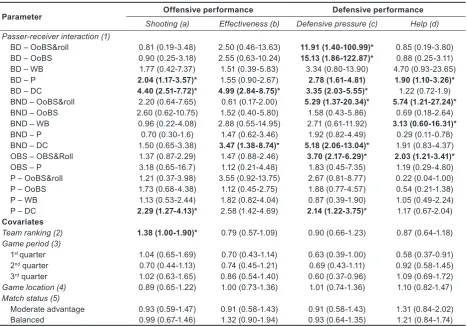
Finally, results from passer and receiver inter-actions are presented in Table 4. Combined inter-actions
revealed a greater influence on both the offensive
and defensive performance in the inside pass situ-ations. A series of positive effects were observed: a greater attack effectiveness (BD – DC and BND – DC), larger shooting options (BD – P, BD – DC, and P – DC), a lower defensive pressure (BD – OoBS&roll, BD – OoBS, BD – P, BD – DC, BND – OoBS&roll, OBS – OBS&Roll, OBS – OBS&Roll, and P – DC) and lower defensive helps (BD – P, BND – OoBS&roll, BND – WB, and OBS – OBS&Roll). In overall, receivers’ dive cut through the basket increased shooting options, being the most effective way to score, whilst the use of screens considerably decreased defensive pressure. Regarding covariates, although the best-positioned teams in the ranking were able to make more shots right after receiving the ball, interactive effects were not conclusive to make interpretations.
Table 2. Data frequency counts and percentage of total inside pass ball possessions (n=808)
Players’ actions n % Game context n % Game performance n %
Passer’s action Team ranking Attack effectiveness
Ball dribbled (BD) 286 35.4 Top-4 466 57.7 Successful 516 63.9 Ball not dribbled (BND) 103 12.8 Low-4 342 42.3 Unsuccessful 292 36.1 On ball screen (OBS) 129 16.0 Game period Shooting options
Positional (P) 289 35.8 1st quarter 257 31.8 Shot 545 67.4
Receiver’s action 2nd quarter 199 24.6 No shot 263 32.6
OBS and roll (OBS&roll) 121 15.0 3rd quarter 196 24.3 Defensive pressure
Out of ball screen (OoBS) 33 4.1 4th quarter 157 19.4 Maximal 317 39.2 OoBS and roll (OoBS&roll) 43 5.3 Game location No maximal 491 60.8 Space creation without ball (WB) 55 6.8 Local 412 51.0 Defensive help
Dive cut (DC) 241 29.8 Away 396 49.0 Help 437 54.1 Positional (P) 315 39.0 Match status No help 371 45.9
Table 3. Effects of players’ actions (isolated) on game performance during inside pass situations. Values expressed in odds ratio and their 95% interval confidence (IC)
Parameter Offensive performance Defensive performance
Shooting (a) Effectiveness (b) Defensive pressure (c) Help (d)
Passer’s action (1)
Ball dribbled (BD) 1.91 (1.32-2.76)* 1.87 (1.30-2.70) 2.44 (1.72-3.48)* 1.53 (1.08-2.15)*
Ball not dribbled (BND) 0.88 (0.53-1.44) 1.20 (0.72-1.99) 2.02 (1.21-3.36)* 1.26 (0.77-2.06) On ball screen (OBS) 2.60 (0.51-13.20) 0.84 (0.21-3.33) 1.29 (0.32-5.16) 1.18 (0.29-4.71)
Receiver Action (1)
OBN and roll (OBN&roll) 0.36 (0.06-1.91) 1.04 (0.24-4.36) 2.24 (0.53-9.52) 1.86 (0.44-7.83) Out of ball screen (OoBS) 0.94 (0.44-2.03) 0.81 (0.37-1.74) 2.30 (1.00-5.26) 0.96 (0.46-2.01) OoBS and roll (OoBS&roll) 0.94 (0.48-1.84) 0.70 (0.36-1.36) 1.43 (0.73-2.80) 0.59 (0.30-1.16) Space creation without ball (WB) 0.70 (0.33-1.47) 0.96 (0.44-2.08) 0.79 (0.43-1.47) 1.51 (0.83-2.78) Dive cut (DC) 0.91 (0.33-2.46) 1.07 (0.39-2.97) 1.15 (0.80-1.66) 1.08 (0.76-1.54)
Covariates
Team ranking (2) 1.44 (1.07-2.01)* 0.84 (0.62-1.14) 0.94 (0.69-1.27) 0.84 (0.62-1.13)
Game period (3)
1st quarter 0.89 (0.66-1.20) 1.00 (0.62-1.59) 0.62 (0.36-0.98)* 0.57 (0.37-0.88)* 2nd quarter 0.74 (0.46-1.17) 0.74 (0.46-1.17) 0.71 (0.44-1.13) 0.93 (0.60-1.45) 3rd quarter 1.03 (0.64-1.66) 1.03 (0.64-1.66) 0.60 (0.38-0.96)* 1.08 (0.69-1.69)
Game location (4) 0.81 (0.59-1.11) 0.83 (0.61-1.13) 1.02 (0.76-1.38) 1.07 (0.80-1.43)
Match status (5)
Moderate advantage 1.33 (0.97-1.83) 1.01 (0.88-1.65) 0.94 (0.61-1.47) 1.31 (0.85-2.02) Balanced 1.03 (0.70-1.49) 1.02 (0.70-1.50) 0.96 (0.66-1.39) 1.22 (0.85-1.75) Note. *Wald’s test p<.05; effect size: R2>.10 (small effects). Dependent variable references: (a) not shooting; (b) unsuccessful; (c) maximal pressure; (d) help. [Note that positive defensive OR indicate higher pressure and more helps]. Predictor references: (1) positional; (2) low-4 teams [Note that it is a dichotomous variable]; (3) fourth quarter; (4) away team; (5) moderate disadvantage.
Table 4. Effects of players’ actions (combined) on game performance during inside pass situations; values expressed in odds ratio and their 95% interval confidence (IC)
Parameter Offensive performance Defensive performance
Shooting (a) Effectiveness (b) Defensive pressure (c) Help (d)
Passer-receiver interaction (1)
BD – OoBS&roll 0.81 (0.19-3.48) 2.50 (0.46-13.63) 11.91 (1.40-100.99)* 0.85 (0.19-3.80) BD – OoBS 0.90 (0.25-3.18) 2.55 (0.63-10.24) 15.13 (1.86-122.87)* 0.88 (0.25-3.11) BD – WB 1.77 (0.42-7.37) 1.51 (0.39-5.83) 3.34 (0.80-13.90) 4.70 (0.93-23.65) BD – P 2.04 (1.17-3.57)* 1.55 (0.90-2.67) 2.78 (1.61-4.81) 1.90 (1.10-3.26)*
BD – DC 4.40 (2.51-7.72)* 4.99 (2.84-8.75)* 3.35 (2.03-5.55)* 1.22 (0.72-1.9) BND – OoBS&roll 2.20 (0.64-7.65) 0.61 (0.17-2.00) 5.29 (1.37-20.34)* 5.74 (1.21-27.24)*
BND – OoBS 2.60 (0.62-10.75) 1.52 (0.40-5.80) 1.58 (0.43-5.86) 0.69 (0.18-2.64) BND – WB 0.96 (0.22-4.08) 2.88 (0.55-14.95) 2.71 (0.61-11.92) 3.13 (0.60-16.31)*
BND – P 0.70 (0.30-1.6) 1.47 (0.62-3.46) 1.92 (0.82-4.49) 0.29 (0.11-0.78) BND – DC 1.50 (0.65-3.38) 3.47 (1.38-8.74)* 5.18 (2.06-13.04)* 1.91 (0.83-4.37) OBS – OBS&Roll 1.37 (0.87-2.29) 1.47 (0.88-2.46) 3.70 (2.17-6.29)* 2.03 (1.21-3.41)*
OBS – P 3.18 (0.65-16.7) 1.12 (0.21-4.48) 1.83 (0.45-7.35) 1.19 (0.29-4.80) P – OoBS&roll 1.21 (0.37-3.98) 3.55 (0.92-13.75) 2.67 (0.81-8.77) 0.22 (0.04-1.00) P – OoBS 1.73 (0.68-4.38) 1.12 (0.45-2.75) 1.88 (0.77-4.57) 0.54 (0.21-1.38) P – WB 1.13 (0.53-2.44) 1.82 (0.82-4.04) 0.87 (0.39-1.90) 1.05 (0.49-2.24) P – DC 2.29 (1.27-4.13)* 2.58 (1.42-4.69) 2.14 (1.22-3.75)* 1.17 (0.67-2.04)
Covariates
Team ranking (2) 1.38 (1.00-1.90)* 0.79 (0.57-1.09) 0.90 (0.66-1.23) 0.87 (0.64-1.18)
Game period (3)
1st quarter 1.04 (0.65-1.69) 0.70 (0.43-1.14) 0.63 (0.39-1.00) 0.58 (0.37-0.91) 2nd quarter 0.70 (0.44-1.13) 0.74 (0.45-1.21) 0.69 (0.43-1.11) 0.92 (0.58-1.45) 3rd quarter 1.02 (0.63-1.65) 0.86 (0.54-1.40) 0.60 (0.37-0.96) 1.09 (0.69-1.72)
Game location (4) 0.89 (0.65-1.22) 1.00 (0.73-1.36) 1.01 (0.74-1.36) 1.10 (0.82-1.47)
Match status (5)
Discussion and conclusions
The current study aimed at identifying game dynamics that increased offensive performance when using the inside pass. Regression analyses
identified important influences of passer and
receiver’s actions and interactions on game offen-sive and defenoffen-sive effectiveness. Overall results revealed positive outcomes if the passer included previous displacements with (dribble) or without the ball (fake), and the receiver moved towards the basket or set a screen. More importantly, the anal-ysis of the combined passer and receiver interaction
pointed out specific game dynamics that resulted
in a greater performance. For instance, passer’s previous ball dribbling may be followed by dive cuts (increased scoring likelihood and shooting opportunities), out of ball screen and roll (decreased defensive pressure) or a rolling after a screen on the ball (diminished defensive help). Although the notion of developing game dynamics to increase the inside pass effectiveness has been reported earlier (Courel-Ibáñez, et al., 2016), the current research
provides novel insights into specific perimeter and post players’ configurations that contribute to
game performance. This information allows a better understanding of basketball collective behaviours, contributing to the design of precise practice tasks and so improving the training process. Moreover,
the reported influence of contextual variables may
promote the design of game drills to be prepared
against specific game situations, especially during the first and third quarter.
Offensive performance
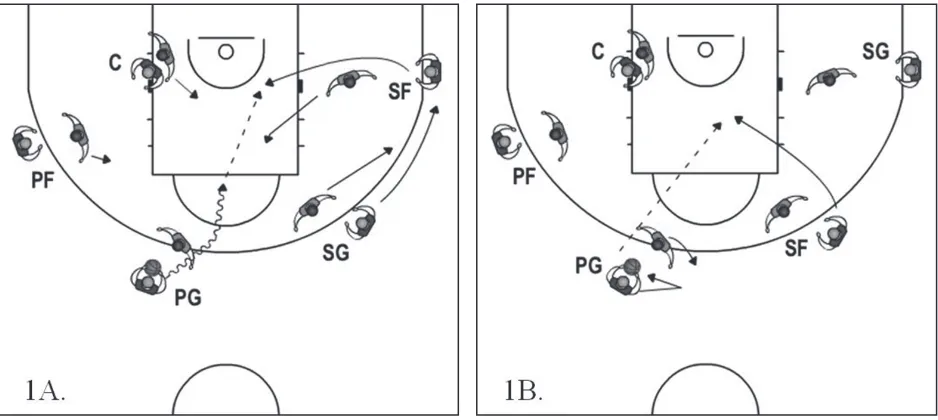
Interactions combining passer’s previous actions with receiver’s cuts towards the basket achieved
the highest offensive effectiveness (Figure 1). First, dribbling towards the basket creates mismatch and defensive unbalance (Gómez, Battaglia, et al., 2015; Guppillotte, 2008; Lorenzo Calvo, et al., 2017). Particularly in the NBA, outside players have great 1 on 1 skills and are extremely athletic, with optimal jump, speed and power skills, making them really dangerous when approaching to the basket (Mateus, et al., 2015; Sampaio, et al., 2015). Similarly, faking actions and movements when having the ball are aimed at catching the opponent’s attention, reducing the interpersonal space and avoiding possible help to other defenders, thus making easy for the team-mates to receive a pass. Second, our results indicate that these actions preceding passing the ball, are more successful if combined and synchronized with the receivers’ displacement, especially teammate’s to the basket. Hence, it is supported the greater
bene-fits of overlapping and concatenation of disruptive actions for progressively creating sufficient space
and enhance scoring odds in basketball (Lamas, et al., 2015; Remmert, 2003). Certainly, NBA players are characterized by a superior strength, jump conditions (Gonzalez, et al., 2013; Sampaio, Lago, & Drinkwater, 2010) and a strong role specializa-tion (Sampaio, et al., 2015). Then, it seems logical to
promote predefined and coordinated outside-inside
behaviours like cutting towards the basket for an alley-oop, since players’ physical condition allows
them to easily score through dunking (Erčulj & Štrumbelj, 2015). More importantly, our findings point out the importance of specific inside players’
displacement without the ball to increase odds of receiving the ball in optimal conditions as close to the basket as possible, enhancing scoring options. To this purpose, it is suggested developing inside players agility to quickly fake, move, and act to
provide the passer with a clear target to pass the ball (Guppillotte, 2008). Likewise, it is reinforced the increasing need in modern basketball of a spati-otemporal coordination (timing) between the ball handler, the future receiver, and the rest of team-mates to succeed in passing and receiving the ball,
chiefly in overprotected locations such as the inside
(Lamas, Barrera, Otranto, & Ugrinowitsch, 2014). Defensive performance
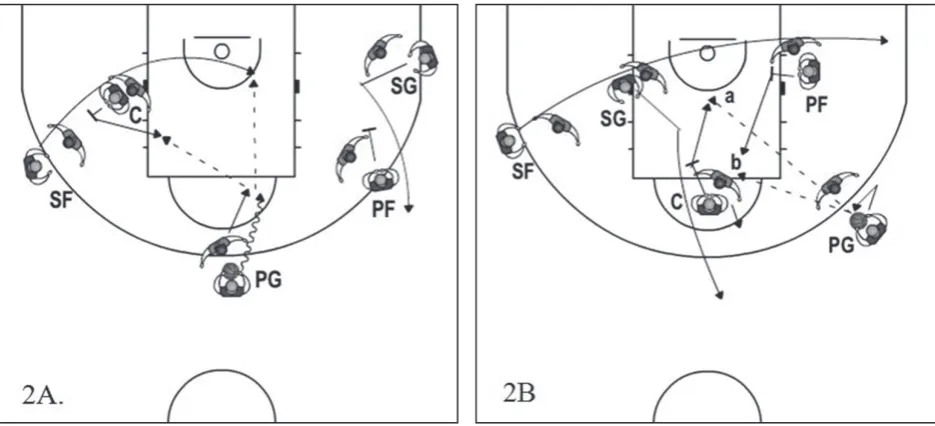
Interactions including on-ball and out-of-ball screens reduced defensive pressure and help on the receiver however they did not produce the highest effectiveness or enlarge shooting options (Figure 2). These results concur with those of Lamas et al. (2015) who observed that pick actions were the most prevalent space creation dynamics, being used both to attempt scoring and to initiate offenses. Ball screen effectiveness relies on how the drib-bler perceives defender’s actions and how well the screener sets the screen to free the player with the ball (Gómez, et al., 2015; Hollins, 2003; Vaquera, et al., 2016). On the contrary, out-of-ball screens involve at least three players (the passer, the receiver, and the screener), multiplying offensive options and
creating serious difficulties to the defence, particu -larly if the screener rolls. Considering the fact that the post area is naturally well protected for its prox-imity to the basket, it is proposed performing screens in favour of the receiver as an effective alternative to increase inside passing options since it reduces the defensive pressure. This aligns with the study by Lamas et al. (2015), who reported that making the ball to reach the post generates a concentration of defensive players inside the zone to protect the
basket, which often leads to the concatenation of a new offensive action. It is also worth noting that the linkage of teamwork actions should be performed under a relative intensity, which requires an active player cooperation (i.e., performing a sequence of screens and rolls during a limited ball possession time) to avoid defensive anticipation (Bazanov, Haljand, Võhandu, & Vohandu, 2005; Cárdenas, et al., 2015).
Contextual variables
An important aspect of the present study was
the analysis of contextual variables during specific
basketball actions (Gómez, Alarcón, & Ortega,
2015). According to our findings, the high-ranked
teams get more shooting options when using the inside pass, especially if dribbling the ball before passing, which may suggest that a better ball handling ability of best teams allow them to increase shooting rates in optimal conditions during inside pass situations. This was quite unexpected since similar offensive ability standard can be hypothetically assumed within the NBA Playoff Finals teams, particularly when performing such common actions like dribbling or passing in the inside. Unfortunately, we were not able to provide
solid reasons to explain this finding since the inter -active effects obtained were not strongly conclusive, probably due to a limited sample size as a result of data splitting (Gómez, et al., 2013). Additionally, there is a lack of variables pertaining to shooting in the current study. In this line, recently interesting approaches made in elite basketball (Cervone, et al., 2014) evaluated how tactical decisions quality, such as consider rebound players’ disposal or passing
References
Altman, D.G. (1991). Practical statistics for medical research. London: Chapman & Hall.
Bazanov, B., Haljand, R., Võhandu, P., & Vohandu, P. (2005). Offensive teamwork intensity as a factor influencing the result in basketball. International Journal of Performance Analysis in Sport, 5(2), 9-16.
Berri, D.J., Brook, S.L., Frick, B., Fenn, A.J., & Vicente-Mayoral, R. (2014). The short supply of tall people: Competitive imbalance and the National Basketball Association. Journal of Economic Issues, 39(4), 1029-1041. doi: 10.1080/00213624.2005.11506865
Cárdenas, D., Ortega, E., Llorca, J., Courel, J., Sánchez-Delgado, G., & Piñar, M.I. (2015). Motor characteristics of fast break in high level basketball. Kinesiology, 47(2), 208-214.
Cervone, D., D’Amour, A., Bornn, L., & Goldsberry, K. (2014). POINTWISE: Predicting points and valuing decisions in real time with NBA Optical Tracking Data. In SLOAN Sports Analytics Conference (pp. 1-9).
Courel-Ibáñez, J., McRobert, A.P., Ortega, E., & Cárdenas, D. (2017). Collective behaviour in basketball: A systematic review. International Journal of Performance Analysis in Sport, 17(1-2), 44-64. doi: 10.1080/24748668.2017.1303982 Courel-Ibáñez, J., McRobert, A.P., Ortega Toro, E., & Cárdenas Vélez, D. (2016). Inside pass predicts ball possession
effectiveness in NBA basketball. International Journal of Performance Analysis in Sport, 16(2), 711-725. doi: 10.1080/24748668.2016.11868918
Courel-Ibáñez, J., Suárez-Cadenas, E., & Cárdenas-Vélez, D. (2017). Inside game ball transitions according to players’ specific positions in NBA basketball. Cuadernos de Psicologia Del Deporte, 17(3), 239-248.
Courel, J., Suárez, E., Ortega, E., Piñar, M., & Cárdenas, D. (2013). Is the inside pass a performance indicator? Observational analysis of elite basketball teams. Revista de Psicologia Del Deporte, 22(1), 191-194.
Csataljay, G., James, N., Hughes, M., & Dancs, H. (2013). Effects of defensive pressure on basketball shooting performance. International Journal of Performance Analysis in Sport, 13(3), 594-601. doi: 10.1080/24748668.2013.11868673 Duarte, R., Arajo, D., Correia, V., & Davids, K. (2012). Sports teams as superorganisms: Implications of sociobiological models of behaviour for research and practice in team sports performance analysis. Sports Medicine, 42(8), 633-642. doi: 10.2165/11632450-000000000-00000
Eccles, D.W., Ward, P., & Woodman, T. (2009). Competition-specific preparation and expert performance. Psychology of Sport and Exercise, 10(1), 96-107. doi: 10.1016/j.psychsport.2008.01.006
Erčulj, F., & Štrumbelj, E. (2015). Basketball shot types and shot success in different levels of competitive basketball. PloS One, 16(6), e0128885. doi: 10.1371/journal.pone.0128885
Fewell, J.H., Armbruster, D., Ingraham, J., Petersen, A., & Waters, J.S. (2012). Basketball teams as strategic networks. PLoS ONE, 7(11), e47445. doi: 10.1371/journal.pone.0047445
to an open mate, might contribute to the team success. However, there is still an open challenge in basketball performance analysis to understand how players should behave and cooperate to support the ball handler (in shooting or passing) or another teammate (in receiving the ball in optimal condi-tions) to increase offensive effectiveness.
This study has important limitations that should be acknowledged. The current game dynamics were obtained from the 2011 season which could
not totally reflect the current trends in the NBA.
Given the absence of previous reports concerning passer and receiver’s actions during inside game situations, these data may encourage future studies
to confirm whether or not the findings reflect the
real performance of the NBA teams. Another limi-tation of the present study is the absence of taking
into consideration specific defensive actions. As
recently reported (Lamas, et al., 2015; Santana, et
al., 2015), every offensive action is influenced by
the defensive reaction, thus future studies should be
improved by including a complete tactical model-ling design exploring offensive-defensive interac-tions. Furthermore, we only explored behaviour of passers and receivers during offence; so we were not able to determine how the other teammate’s
collaboration might have influenced the inside
pass effectiveness. Hence, according to Cervone et al. (2014), what is now required is a better under-standing of how players’ actions contribute to the whole possession success and not just the events that end it, for instance, by applying network metrics (Fewell, Armbruster, Ingraham, Petersen, & Waters, 2012). Also, considering that the NBA recruits the best inside players of the world, most of whom receive the highest salaries in their teams (Berri, et al., 2014), it would be interesting to
iden-tify and describe specific inside players’ profiles
Fritz, C.O., Morris, P.E., & Richler, J.J. (2012). Effect size estimates: Current use, calculations, and interpretation. Journal of Experimental Psychology: General, 141(1), 2-18.
Gabin, B., Camerino, O., Anguera, M.T., & Castañer, M. (2012). Lince: Multiplatform sport analysis software. Procedia – Social and Behavioral Sciences, 46, 4692-4694. doi: 10.1016/j.sbspro.2012.06.320
García, J., Ibáñez, S.J., Martinez De Santos, R., Leite, N., & Sampaio, J. (2013). Identifying basketball performance indicators in regular season and playoff games. Journal of Human Kinetics, 36, 163-170.
Gómez, M.Á., Alarcón, F., & Ortega, E. (2015). Analysis of shooting effectiveness in elite basketball according to match status. Revista de Psicología Del Deporte, 24(3), 37–41.
Gómez, M.Á., Battaglia, O., Lorenzo, A., Lorenzo, J., Jiménez, S., & Sampaio, J. (2015). Effectiveness during ball screens in elite basketball games. Journal of Sports Sciences, 33(17), 1844-52. doi: 10.1080/02640414.2015.1014829 Gomez, M.Á., Gasperi, L., & Lupo, C. (2016). Performance analysis of game dynamics during the 4th game quarter
of NBA close games. International Journal of Performance Analysis in Sport, 16(1), 249-263.
Gómez, M.Á., Lago, C., & Pollard, R. (2013). Situational variables. In T. McGarry, P. O’Donoghue, & J. Sampaio (Eds.), Routledge handbook of sports performance analysis (pp. 259-269). London: Routledge.
Gonzalez, A.M., Hoffman, J.R., Rogowski, J.P., Burgos, W., Manalo, E., Weise, K., …, & Stout, J.R. (2013). Performance changes in NBA basketball players vary in starters vs. nonstarters over a competitive season. Journal of Strength and Conditioning Research, 27(3), 611-615.
Guppillotte, A. (2008). The inside-outside game. FIBA Assist Magazine, 34, 8-11. Hollins, K. (2003). The screens and various options. FIBA Assist Magazine, 5, 6-13.
Lamas, L., Barrera, J., Otranto, G., & Ugrinowitsch, C. (2014). Invasion team sports: Strategy and match modeling. International Journal of Performance Analysis in Sport, 14(1), 307-329.
Lamas, L., De Rose Junior, D., Santana, F., Rostaiser, E., Negretti, L., & Ugrinowitsch, C. (2011). Space creation dynamics in basketball offence: Validation and evaluation of elite teams. International Journal of Performance Analysis in Sport, 11(1), 1.
Lamas, L., Santana, F., Heiner, M., Ugrinowitsch, C., & Fellingham, G. (2015). Modeling the offensive-defensive interaction and resulting outcomes in basketball. PLoS ONE, 10(12), e0144435. doi: 10.1371/journal.pone.0144435 Lemmink, K., & Frencken, W. (2013). Tactical performance analysis in invasion games: Perspectives from a dynamic
system approach with examples from soccer. In T. McGarry, J. Sampaio & P. O’Donoghue (Eds.), Routledge handbook of sports performance analysis (pp. 89-100). London: Routledge.
Lorenzo Calvo, J., García, A.M., & Navandar, A. (2017). Analysis of mismatch after ball screens in Spanish professional basketball. International Journal of Performance Analysis in Sport, 17(4), 555-562. doi: 10.1080/24748668.2017.1367999
Mateus, N., Goncalves, B., Abade, E., Liu, H., Torres-Ronda, L., Leite, N., & Sampaio, J. (2015). Game-to-game variability of technical and physical performance in NBA players. International Journal of Performance Analysis in Sport, 15(3), 764-776.
Mavridis, G., Laios, A., Taxildaris, K., & Tsiskaris, G. (2004). Developing offense in basketball after a return pass outside as crucial factor of winning. Inquiries in Sport and Physical Education, 2(1), 81-86.
Mavridis, G., Tsamourtzis, E., Karipidis, K., & Laios, A. (2009). The inside game in world basketball. Comparison between European and NBA teams. International Journal of Performance Analysis in Sport, 9(2), 157-164. Moreno, E., Gómez, M.Á., Lago, C., & Sampaio, J. (2013). Effetcs of starting quarter score, game location, and quality of
opposition in quarter score in elite women’s basketball. Kinesiology, 45(1), 48-54. doi: 10.1080/17461391003699104 Nunes, H., Iglesias, X., Daza, G., Irurtia, A., Caparrós, T., & Anguera, M. T. (2016). The influence of pick and roll in
attacking play in top-level basketball. Cuadernos de Psicologia Del Deporte, 16(1), 129-142.
O’Donoghue, P. (2015). An introduction to performance analysis of sport. London, New York: Routledge Taylor & Francis Group. doi: 10.4324/9781315816340
Oliver, D. (2004). Basketball on paper: Rules and tools for performance analysis. Washington, DC: Potomac Books Inc. Randolph, J.J. (2008). Onlinekappa calculator [Computer software]. Retrieved November 29, 2016, from http://justus.
randolph.name/kappa
Remmert, H. (2003). Analysis of group-tactical offensive behavior in elite basketball on the basis of a process orientated model. European Journal of Sport Science, 3(3), 1-12. doi: 10.1080/17461390300073311
Sampaio, J., Drinkwater, E.J., & Leite, N.M. (2010). Effects of season period, team quality, and playing time on basketball players’ game-related statistics. European Journal of Sport Science, 10(2), 141-149. doi: 10.1080/17461390903311935 Sampaio, J., & Janeira, M. (2003). Statistical analyses of basketball team performance: Understanding teams’ wins
and losses according to a different index of ball possessions. International Journal of Performance Analysis in Sport, 3(1), 40-49.
Sampaio, J., Lago, C., & Drinkwater, E. (2010). Explanations for the United States of America’s dominance in basketball at the Beijing Olympic Games. Journal of Sports Sciences, 28(2), 147-152. doi: 10.1080/02640410903380486 Sampaio, J., McGarry, T., Calleja-González, J., Jiménez Sáiz, S., Schelling, X., & Balciunas, M. (2015). Exploring game
Santana, F.L., Rostaiser, E., Sherzer, E., Ugrinowitsch, C., Barrera, J., & Lamas, L. (2015). Space protection dynamics in basketball: Validation and application to the evaluation of offense-defense patterns. Motriz: Revista de Educação Física, 21(1), 34-44. doi: 10.1590/S1980-65742015000100005
Vaquera, A., García-Tormo, J.V., Gómez Ruano, M.Á., & Morante, J. C. (2016). An exploration of ball screen effectiveness on elite basketball teams. International Journal of Performance Analysis in Sport, 16(2), 475-485. doi: 10.1080/24748668.2016.11868902
Submitted: June 27, 2017 Accepted: April 19, 2018
Published Online First: July 11, 2018
Correspondence to: Javier Courel-Ibáñez, Ph.D. Faculty of Sport Sciences
Argentina s/n, 30720, Santiago de la Ribera, Murcia, Spain