R E S E A R C H A R T I C L E
Open Access
A modified Delphi study of screening for fetal
alcohol spectrum disorders in Australia
Rochelle E Watkins
1*, Elizabeth J Elliott
2,3,4, Jane Halliday
5,6, Colleen M O
’
Leary
1,7, Heather D
’
Antoine
8,
Elizabeth Russell
9, Lorian Hayes
10, Elizabeth Peadon
2,3, Amanda Wilkins
1,11, Heather M Jones
1, Anne McKenzie
1,
Sue Miers
12, Lucinda Burns
13, Raewyn C Mutch
1,11, Janet M Payne
1, James P Fitzpatrick
2,4, Maureen Carter
14,
Jane Latimer
4and Carol Bower
1Abstract
Background:There is little reliable information on the prevalence of fetal alcohol spectrum disorders (FASD) in Australia and no coordinated national approach to facilitate case detection. The aim of this study was to identify health professionals’perceptions about screening for FASD in Australia.
Method:A modified Delphi process was used to assess perceptions of the need for, and the process of, screening for FASD in Australia. We recruited a panel of 130 Australian health professionals with experience or expertise in FASD screening or diagnosis. A systematic review of the literature was used to develop Likert statements on screening coverage, components and assessment methods which were administered using an online survey over two survey rounds.
Results:Of the panel members surveyed, 95 (73%) responded to the questions on screening in the first survey round and, of these, 81 (85%) responded to the second round. Following two rounds there was consensus agreement on the need for targeted screening at birth (76%) and in childhood (84%). Participants did not reach consensus agreement on the need for universal screening at birth (55%) or in childhood (40%). Support for targeted screening was linked to perceived constraints on service provision and the need to examine the performance, costs and benefits of screening.
For targeted screening of high risk groups, we found highest agreement for siblings of known cases of FASD (96%) and children of mothers attending alcohol treatment services (93%). Participants agreed that screening for FASD primarily requires assessment of prenatal alcohol exposure at birth (86%) and in childhood (88%), and that a checklist is needed to identify the components of screening and criteria for referral at birth (84%) and in childhood (90%).
Conclusions:There is an agreed need for targeted but not universal screening for FASD in Australia, and sufficient consensus among health professionals to warrant development and evaluation of standardised methods for targeted screening and referral in the Australian context. Participants emphasised the need for locally-appropriate, evidence-based approaches to facilitate case detection, and the importance of ensuring that screening and referral programs are supported by adequate diagnostic and management capacity.
Background
Prenatal alcohol exposure causes a range of disorders of fetal development [1-3]. The term fetal alcohol spectrum disorders (FASD) is used to identify one group of conditions that can result from prenatal exposure to alcohol [4]. Fetal alcohol spectrum disorders feature characteristic combinations of facial anomalies, growth impairment,
intellectual disability, behavioural disorders and birth defects [5-8], although the spectrum of disorders most commonly includes impairments of neurological func-tion that are not accompanied by characteristic facial anomalies or growth deficit [9,10]. There is some vari-ation in the range of disorders recognised within the spectrum and the use of specific diagnostic termin-ology between different diagnostic guidelines. How-ever, all guidelines include the well-established diagnostic category of fetal alcohol syndrome (FAS) [6,8,11-13], and most include diagnostic categories for * Correspondence:[email protected]
1
Telethon Institute for Child Health Research, Centre for Child Health Research, The University of Western Australia, Perth, Australia Full list of author information is available at the end of the article
partial FAS (PFAS), and alcohol-related neurodevelopmental disorder (ARND) or its equivalent [6,8,11,13].
The diagnosis of FASD is often delayed or missed [4,14-16], despite evidence linking diagnosis and inter-vention to improved educational, social and health outcomes [17,18]. Failure to identify children with FASD has been attributed to the limited ability of health ser-vice providers to access affected children and their mothers, a lack of accurate routine screening for FASD or of routine screening for maternal alcohol use during pregnancy, limited clinical capacity to recognise and diagnose these disorders, and the difficulty of identifying all but the most severe cases at birth [19,20]. The identi-fication of FASD in Australia is likely to be limited by poor awareness of diagnostic features among paediatricians [21] and other health professionals [22], and the absence of na-tional guidelines for diagnosis. Concern about stigma as a result of diagnosis [22] may also influence the willingness to diagnose or to be diagnosed.
There is only limited information available on the prevalence of FASD in Australia [15], with no routine screening or surveillance established for the disorders. The need to address significant gaps in the capacity to identify and diagnose FASD in Australia is reflected in recent health policy [23] and the launch of an Australian federal government inquiry into the incidence and pre-vention of FASD in 2011 [24]. Although not yet implemented, the Western Australian FASD Model of Care [23] recommends multi-stage population screening to identify at risk newborns and children based on his-tory of maternal alcohol consumption, abnormal growth parameters and developmental delay. Targeted screening is also recommended in a number of sub-groups considered at high risk, including children of mothers who receive al-cohol treatment services and children in state care.
Screening for FASD provides a means to facilitate re-ferral, diagnosis and support [6]; however, several factors complicate the identification of, and screening for, FASD [12]. Screening for FAS has primarily utilised identifica-tion of the three characteristic FAS facial anomalies (short palpebral fissures, smooth philtrum and thin upper lip) that are collectively specific to FAS [25]; al-though routinely collected data from neonatal medical records including growth, head circumference, maternal alcohol use and other criteria have also been used [26]. Screening for FAS using facial photographs to detect the characteristic facial anomalies has been found to be ef-fective in high-risk populations in North America, with a positive predictive value of 86% and a negative predict-ive value of 100% [27].
Screening for FASD is more difficult because facial dysmorphology is frequently absent, impairments of neurological function are predominant [6], and the neurobehavioural features are not unique to FASD [28].
Inconsistency in the methods used for screening and re-ferral internationally [29] is linked to a lack of screening instruments for FASD that are specific and sensitive to the fetal effects of prenatal alcohol exposure [6]. Bio-chemical screening has the potential to facilitate early diagnosis; however, apart from the detection of ethyl esters in newborn meconium, screening methods are not well established [30,31]. Heterogeneity among the observed features of FASD due to variation in genetic factors, patterns of alcohol exposure and other maternal risk factors adds to the complexity of screening for FASD [29]. Nevertheless, the use of standard screening processes may facilitate the appropriate identification of individuals who require specialist diagnostic assessment.
Screening programs for both FAS and FASD fre-quently use assessment methods that are directly linked to diagnostic criteria. Published screening assessments have included prenatal alcohol exposure, weight, height, head circumference, developmental delay, learning diffi-culties, behavioural problems and the presence of char-acteristic FAS facial anomalies [9,26,32]. However, screening programs do not always assess the full range of diagnostic features. For example, facial dysmorphology as-sessment has been excluded from FASD screening cri-teria [9,32], consistent with the recommended need for experienced assessors, the infrequent occurrence of fa-cial anomalies among individuals with FASD, and the lack of norms for ethnically diverse populations [29].
There is little locally-relevant evidence on which to base policy decisions about FASD screening in Australia. There is no coordinated national approach to facilitate the identification of FASD in Australia, and it is unclear to what extent current policy and capacity for service delivery are consistent with clinician perspectives of pri-orities and needs. We aimed to evaluate perceptions about screening for FASD among Australian health professionals with experience or expertise in FASD screening or diagnosis to guide research and policy on FASD screening in Australia.
Methods
A modified Delphi process [33] was used to assess Australian health professionals’perceptions of the need for and process of FASD screening in Australia. The modified Delphi design generally diverges from the classical Delphi method in the use of alternative means to derive the content of the initial quantitative questionnaire round [33] while still allowing the collection of rich data based on multiple ques-tionnaire iterations [34]. Modified Delphi studies are par-ticularly appropriate where relevant knowledge exists.
Questionnaire development
the design of screening for FASD in Australia. The search strategy for this review was updated to include literature published up to and including September 2010, and expanded to include additional search terms (fetal alcohol effects, fetal alcohol disorders, partial fetal alcohol syndrome, alcohol related birth defects, alcohol related neurodevelopmental disorder, screen$, diagnos$). Additional relevant databases were also searched (CINAHL, PsychINFO and Web of Science).
Descriptions of screening programs identified in the published literature were used to design Likert statements to evaluate perceptions about screening coverage, screening components, and assessment methods. Participants were asked to rate their agreement with each statement on a 5-point Likert scale which ranged from‘strongly agree’ to ‘strongly disagree’, and a response option of ‘no comment’was provided to enable participants to indi-cate that a statement was outside their area of expert-ise. Each question area also included open ended questions and participants were encouraged to provide comments on their responses and identify where the statements did not reflect their beliefs. The questions on screening were administered as part of a larger survey on the screening and diagnosis of FASD in Australia. Perceptions about the diagnosis of FASD have been reported elsewhere [36]. The questionnaire was pilot tested with 16 health professionals and health researchers to examine coherence, feasibility and face validity prior to administration.
Panel recruitment
We aimed to recruit a large panel of Australian health professionals with experience or expertise in FASD screening or diagnosis. Panel members were identified using three purposive sampling strategies [37]: i) medical practitioners who reported a diagnosis of FAS to the Australian Paediatric Surveillance Unit (APSU) in a pre-vious study [15], ii) health professionals who were identi-fied by study investigators as having experience or expertise in FASD screening or diagnosis, and iii) individuals who responded to calls to health professional organisations for individuals who had relevant experi-ence or expertise.
Recruitment of panel members with relevant experi-ence or expertise underpins the validity of this study, and processes used to enrol panel members varied by sampling strategy based on the need to confirm relevant expertise prior to enrolment. Information about this study was distributed to 57 eligible medical practitioners who had reported a diagnosis of FAS to the APSU, and all were included in the study apart from 17 who either actively declined to participate or who could not be contacted (based on an invalid email address or an automated email reply). In contrast, all other invited health professionals were only included in the panel if
they actively confirmed their suitability and willingness to participate. Among these 149 invited health professionals, 90 accepted the invitation to participate. The modified Delphi process commenced with 130 Australian panel members: including 40 who had reported a diagnosis of FAS to the APSU, 59 who were identified as having ex-perience or expertise in FASD screening or diagnosis, and 31 who were recruited from professional organisations.
Questionnaire administration
The online password-protected questionnaire was administered from a secure web server, and responses were automatically saved to a secure MySQL database. All panel members were invited by email to complete the first round ques-tionnaire within 14 days, and two email reminders were sent prior to the round deadline. Due to requests for a longer period for response, the round 1 deadline was extended by 8 days, and 21 days was provided for re-sponse to the round 2 questionnaire. Where contact details were available, panel members who had not visited the study website were targeted for additional follow-up. One contact attempt was made by telephone at least 5 days before the closure date of rounds 1 and 2. Participants who did not complete round 1 were excluded from round 2.
Round 2 questionnaire revision
Both quantitative and qualitative responses were considered in the questionnaire revision process. Due to the length of the round 1 questionnaire, revisions aimed to minimise the length of the round 2 questionnaire and exclude question areas that had achieved consensus. If at least 70% of participants agreed or strongly agreed with a statement, it was considered endorsed. This level of consensus was decideda priori. If fewer than 60% of participants agreed or strongly agreed with a statement, the statement was rejected or modified based on qualitative findings. How-ever, where multiple statements were related to the same issue, consensus was sought for the question area rather than for each statement in isolation. As such, several statements that either achieved consensus agreement or less than 60% agreement were included in round 2 where clear consensus was not achieved for that question area. New statements were also included in round 2 if qualita-tive findings indicated that the round 1 questionnaire failed to represent a relevant alternative perspective. The round 2 questionnaire included feedback of representative comments as well as group and individual per cent agree-ment results from round 1 to enable participants to reflect on their previous responses.
Analysis
(inter-quartile deviation). Associations between ratings for key statements on screening coverage and individual characteristics, were explored using the Chi square test or Fisher’s exact test [38]. The Wilcoxon signed rank test was used to compare agreement between statements on screening coverage, and between alternative screening methods for growth. All analyses were evaluated using two-tailed test statistics.
Qualitative data were coded and analysed independ-ently by two investigators using an inductive content analysis approach [39,40]. Data from each open ended question were reviewed alongside the quantitative data, compared and coded based on the underlying meaning of the responses. Both analysts’ coding schemes were reviewed for consistency to ensure credibility and trust-worthiness of the analysis process [39]. This study was approved by the University of Western Australia Human Research Ethics Committee and the Western Australian Aboriginal Health Information and Ethics Committee.
Results
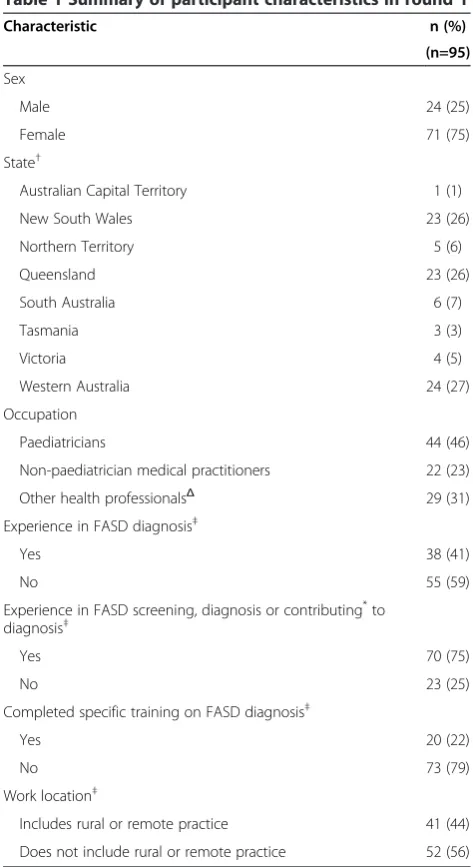
Of the 130 panel members, 95 (73%) responded in round 1, and 81 of these 95 (85%) responded in round 2. Re-sponse in round 1 was: 68% (27/40) among panel members who reported a diagnosis of FAS to the APSU; 78% (46/59) among panel members recruited by the study investigators; and 71% (22/31) among panel members recruited through professional organisations. Round 1 participants were most commonly paediatricians (46%), and approximately three quarters reported experi-ence in FASD screening or diagnosis (Table 1).
Screening coverage
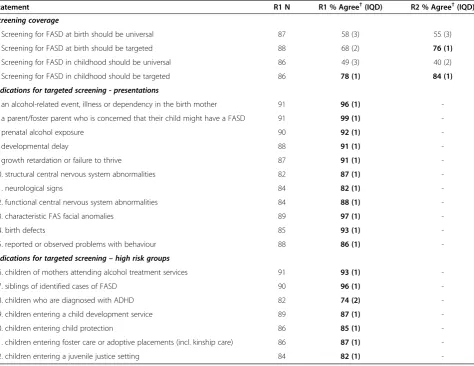
Due to a lack of consensus on the use of targeted screening at birth following round 1, all four statements evaluating screening coverage were re-administered in round 2 (Table 2, statements 1-4). After round 2 there was no strong evidence of a difference in agreement that screening for FASD at birth should be targeted (76%) or universal (55%; Wilcoxon Z=-1.7, p=0.09). Participants most commonly agreed that screening for FASD in childhood should be targeted (84%), and were more likely to agree that it should be targeted than universal (40%; Wilcoxon Z=-4.1, p<0.001). They were also more likely to agree with the use of targeted screening in childhood compared with targeted screening at birth (Wilcoxon Z=-2.2, p=0.03). We found no evidence of differences in agreement about screening coverage at birth or in childhood according to experience in screening or diagnosis (all p>0.7).
There was clear consensus agreement on all indications for targeted screening evaluated in round 1 (Table 2, statements 5-22). Over 95% of participants agreed with screening for FASD where there is parental concern that
their child may have a FASD; evidence of characteristic FAS facial anomalies; an alcohol-related illness or depend-ency in the birth mother; and a sibling with FASD.
In round 1, 61 participants (64%) provided comments about their preferences for screening coverage. Comments most frequently indicated support for universal screening as an ideal and ethical approach that decreases the risk of missed cases, helps overcome the limitations of a poten-tially unreliable maternal alcohol history, and enables early diagnosis and intervention. However, targeted screening Table 1 Summary of participant characteristics in round 1
Characteristic n (%)
(n=95)
Sex
Male 24 (25)
Female 71 (75)
State†
Australian Capital Territory 1 (1)
New South Wales 23 (26)
Northern Territory 5 (6)
Queensland 23 (26)
South Australia 6 (7)
Tasmania 3 (3)
Victoria 4 (5)
Western Australia 24 (27)
Occupation
Paediatricians 44 (46)
Non-paediatrician medical practitioners 22 (23)
Other health professionalsΔ 29 (31)
Experience in FASD diagnosis‡
Yes 38 (41)
No 55 (59)
Experience in FASD screening, diagnosis or contributing*to diagnosis‡
Yes 70 (75)
No 23 (25)
Completed specific training on FASD diagnosis‡
Yes 20 (22)
No 73 (79)
Work location‡
Includes rural or remote practice 41 (44)
Does not include rural or remote practice 52 (56)
†Valid n = 89. ‡Valid n = 93.
ΔOther health professionals includes nurses, allied health professionals, health
workers and health researchers.
*
of high risk groups was commonly supported as a more feasible and effective approach. Participants commonly iden-tified practical constraints associated with screening and diagnosis, including the need for increased service capacity and provider training, the need for adequate early interven-tion services, and the evolving and variable nature of FASD presentations. Respondents also expressed concerns about the absence of well-established or accurate screening tests and the sensitivity, specificity and cost-effectiveness of screening. They also indicated support for the universal collection of a maternal history of alcohol use during the prenatal period and at birth to enable preventive interventions and targeted follow-up. Participants less commonly described adverse psychosocial consequences of screening or of assigning an aetiological diagnostic label such as maternal blame or stigma; and a lack of support for screening programs which focus on a sin-gle condition.
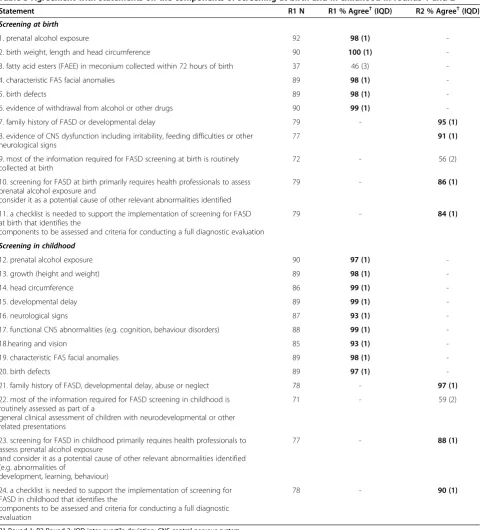
Components of screening
Consensus was achieved for all components of screening assessed apart from the testing of fatty acid esters (Table 3, statements 1-8 and 12-21). Some participants commented in round 1 that the agreed components of screening for FASD were already routinely assessed at birth or dur-ing the assessment of neurodevelopmental problems presenting in childhood; that the primary need is for health professionals to assess prenatal alcohol expos-ure and consider it as a potential cause of identified abnormalities; and that a screening checklist and criteria for referral are required. Additional statements were included in the round 2 questionnaire to evaluate participants’ perceptions of these issues (Table 3, statements 9-11 and 22-24). Following round 2 there was no consensus agreement that information required for screening is currently routinely collected. However, there was consensus agreement that screening primarily requires Table 2 Agreement with statements on screening coverage and indications in rounds 1 and 2
Statement R1 N R1 % Agree†(IQD) R2 % Agree†(IQD)
Screening coverage
1. Screening for FASD at birth should be universal 87 58 (3) 55 (3)
2. Screening for FASD at birth should be targeted 88 68 (2) 76 (1)
3. Screening for FASD in childhood should be universal 86 49 (3) 40 (2)
4. Screening for FASD in childhood should be targeted 86 78 (1) 84 (1)
Indications for targeted screening - presentations
5. an alcohol-related event, illness or dependency in the birth mother 91 96 (1)
-6. a parent/foster parent who is concerned that their child might have a FASD 91 99 (1)
-7. prenatal alcohol exposure 90 92 (1)
-8. developmental delay 88 91 (1)
-9. growth retardation or failure to thrive 87 91 (1)
-10. structural central nervous system abnormalities 82 87 (1)
-11. neurological signs 84 82 (1)
-12. functional central nervous system abnormalities 84 88 (1)
-13. characteristic FAS facial anomalies 89 97 (1)
-14. birth defects 85 93 (1)
-15. reported or observed problems with behaviour 88 86 (1)
-Indications for targeted screening–high risk groups
16. children of mothers attending alcohol treatment services 91 93 (1)
-17. siblings of identified cases of FASD 90 96 (1)
-18. children who are diagnosed with ADHD 82 74 (2)
-19. children entering a child development service 89 87 (1)
-20. children entering child protection 86 85 (1)
-21. children entering foster care or adoptive placements (incl. kinship care) 86 87 (1)
-22. children entering a juvenile justice setting 84 82 (1)
-R1-Round 1; R2-Round 2; IQD-inter-quartile deviation. †Includes responses‘agree’and‘strongly agree.’
health professionals to assess prenatal alcohol exposure and consider it as a potential cause of other relevant ab-normalities identified at birth (86%) and in childhood (88%); and that a screening checklist is required to iden-tify criteria for referral at birth (84%) and in childhood (90%).
Participant comments linked improved awareness of and ability to screen for FASD with improved case iden-tification. Screening for prenatal alcohol exposure, al-though potentially unreliable, was considered by some participants to be the most important element of screening for FASD due to the difficulty of screening for Table 3 Agreement with statements on the components of screening at birth and in childhood in rounds 1 and 2
Statement R1 N R1 % Agree†(IQD) R2 % Agree†(IQD)
Screening at birth
1. prenatal alcohol exposure 92 98 (1)
-2. birth weight, length and head circumference 90 100 (1)
-3. fatty acid esters (FAEE) in meconium collected within 72 hours of birth 37 46 (3)
-4. characteristic FAS facial anomalies 89 98 (1)
-5. birth defects 89 98 (1)
-6. evidence of withdrawal from alcohol or other drugs 90 99 (1)
-7. family history of FASD or developmental delay 79 - 95 (1)
8. evidence of CNS dysfunction including irritability, feeding difficulties or other neurological signs
77 91 (1)
9. most of the information required for FASD screening at birth is routinely collected at birth
72 - 56 (2)
10. screening for FASD at birth primarily requires health professionals to assess prenatal alcohol exposure and
consider it as a potential cause of other relevant abnormalities identified
79 - 86 (1)
11. a checklist is needed to support the implementation of screening for FASD at birth that identifies the
components to be assessed and criteria for conducting a full diagnostic evaluation
79 - 84 (1)
Screening in childhood
12. prenatal alcohol exposure 90 97 (1)
-13. growth (height and weight) 89 98 (1)
-14. head circumference 86 99 (1)
-15. developmental delay 89 99 (1)
-16. neurological signs 87 93 (1)
-17. functional CNS abnormalities (e.g. cognition, behaviour disorders) 88 99 (1)
-18.hearing and vision 85 93 (1)
-19. characteristic FAS facial anomalies 89 98 (1)
-20. birth defects 89 97 (1)
-21. family history of FASD, developmental delay, abuse or neglect 78 - 97 (1)
22. most of the information required for FASD screening in childhood is routinely assessed as part of a
general clinical assessment of children with neurodevelopmental or other related presentations
71 - 59 (2)
23. screening for FASD in childhood primarily requires health professionals to assess prenatal alcohol exposure
and consider it as a potential cause of other relevant abnormalities identified (e.g. abnormalities of
development, learning, behaviour)
77 - 88 (1)
24. a checklist is needed to support the implementation of screening for FASD in childhood that identifies the
components to be assessed and criteria for conducting a full diagnostic evaluation
78 - 90 (1)
R1-Round 1; R2-Round 2; IQD-inter-quartile deviation; CNS-central nervous system. †Includes responses‘agree’and‘strongly agree.’
the spectrum of disorders at birth, and the fact that central nervous system (CNS) dysfunction is often not apparent in very young children. Other participants referred to diffi-culties in screening associated with nondisclosure of alco-hol use during pregnancy, or where no maternal history is available. Several participants also identified the limited usefulness of screening for facial anomalies when screening for FASD.
Assessment methods
Almost all statements on screening assessment methods achieved consensus in round 1 (Table 4). There was a high level of agreement that the assessment of prenatal alcohol exposure should identify and record the number of standard drinks consumed on a typical drinking occa-sion, the frequency of drinking, the frequency of exces-sive drinking and the timing of alcohol intake during pregnancy (Table 4, statements 1-5). Most participants (71%) believed that prenatal alcohol exposure should be assessed using a formal tool (Table 4, statements 6-7).
The most commonly recommended formal assessment tool was the AUDIT-C (21%) [41], followed by Lifescripts (17%) [42] which incorporates the AUDIT-C, T-ACE (14%) and TWEAK (13%) [43]. Most participants reported that they were not familiar with the Lifescripts (63%), TWEAK (62%), T-ACE (62%) and AUDIT-C (59%) tools, and no alternative formal assessment tools were proposed. Following round 2, the role of informal inquiry in prenatal alcohol exposure assessment was clarified, with consensus agreement for the combination of informal and formal methods of inquiry. After receiving further information about the AUDIT-C in round 2, 89% of participants considered that it provided a useful screening tool for pre-natal alcohol exposure (Table 4, statements 8-10).
Participants most frequently supported the compari-son of height and weight with population standards to assess growth deficit (Table 4, statements 11-14), and there was a high level of consensus on the specific facial anomalies that should be assessed during screening (Table 4, statement 15). Participant comments in round 1 indicated a lack of distinction between screening and diagnostic assessments, the need for training to use fa-cial anomaly assessment tools reliably, the lack of suit-able Australian reference data for comparison, and the need for screening methods to be efficient. Following round 2 there was consensus agreement that formal as-sessment of facial anomalies could be used, but was not required, to assess facial anomalies at the screening stage (Table 4, statements 17-22).
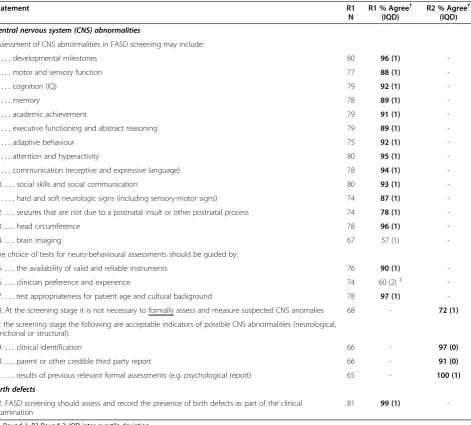
There was agreement on the assessment of a broad range of CNS abnormalities in screening, and limited support for the use of brain imaging (Table 5, statements 1-14). Participant comments in round 1 highlighted the need to distinguish between screening and diagnostic
assessments, and the need for a pragmatic approach to assessment considering cost and resources, including the possibility of qualitative assessment of core areas at the screening stage. Round 2 results indicated agreement that clinical identification or third party report were ac-ceptable indicators of CNS abnormality at the screening stage (Table 5, statements 18-21).
Response completeness
Over half of the 95 participants (57%) completed 10 or fewer of the round 1 Likert statements on screening. Non-complete responses most commonly included a re-sponse of ‘no comment’, indicating that the statements were outside participant’s areas of expertise. Completion of 10 or fewer statements was more frequent among participants who reported no experience in diagnosis or screening (87%) and health professionals other than paediatricians (73%) than among participants who reported experience in diagnosis or screening (49%,
χ2
=11.7, p=0.001) and paediatricians (39%, χ2=11.3, p=0.001) respectively.
Assessment of the association between response com-pleteness and perceptions found clear evidence of an as-sociation with response completeness for only one of the statements about screening coverage, components, and assessment methods. Participants who completed 10 or fewer statements were less likely to agree with the use of clinician preference and experience in the choice of neuro-behavioural assessment methods (42%) compared with participants who completed more than 10 statements (73%,χ2=7.2, p=0.007: Table 5, item 16).
Discussion
This is the first systematic evaluation of health professionals’ perceptions of the need for and design of screening for FASD in Australia. We found consensus support for targeted screening, and more frequent agreement with screening in childhood than at birth. Although about half the participants supported the need for universal screening for FASD as an ideal and ethically responsible approach to minimise missed cases, consensus agreement was only achieved for targeted screening of individuals with relevant clinical presentations and groups at high risk of FASD. Par-ent or caregiver concern that their child may have a FASD and clinical presentations associated with the likelihood of prenatal alcohol exposure were most strongly endorsed as indications for targeted screening.
to have acceptable sensitivity, specificity and cost-effectiveness. These findings reflect previously identi-fied difficulties in screening for FASD [20,29,30], and deficits in diagnostic and management capacity to sup-port screening [9,14,15,29,44,45].
We found consensus agreement on the need for a checklist and criteria for referral to support the imple-mentation of screening for FASD. We also found con-sensus agreement that screening primarily requires health professionals to assess prenatal alcohol exposure Table 4 Agreement with statements on screening assessment methods for prenatal alcohol exposure, growth deficit and characteristic fetal alcohol syndrome facial anomalies in rounds 1 and 2
Statement R1
N
R1 % Agree† (IQD)
R2 % Agree† (IQD)
Prenatal alcohol exposure
Assessment of prenatal alcohol exposure should identify and record the:
1.. . .number of standard drinks consumed during a typical drinking occasion 85 98 (1)
-2.. . .frequency of drinking occasions 86 98 (1)
-3.. . .frequency of excessive (binge) drinking (5+ standard drinks per occasion) 86 95 (1)
-4.. . .timing of alcohol intake during pregnancy 86 97 (1)
-5. Alcohol exposure should be assessed alongside other lifestyle factors (e.g. diet) 85 92 (1)
-6. Prenatal alcohol exposure can be effectively assessed using an informal approach (e.g. inquiring during a consultation)
82 52 (2) 41 (2)
7. Prenatal alcohol exposure should be assessed using a formal tool 69 71 (2)
-8. The use of formal tools for the assessment of prenatal alcohol exposure should be combined with a clinical interview to obtain more detailed information about alcohol consumption patterns, potential indicators of addiction and other relevant contextual information
80 - 88 (1)
9. Information on alcohol use from family members, other health professionals or community members (if appropriate) should be sought if indicated
78 - 77 (0)
10. The AUDIT-C would be a useful tool for the formal assessment of prenatal alcohol exposure 74 - 89 (0)
Growth deficit
11. Growth should be assessed by comparing height and weight with population standards 70 93 (1)1
-12. Growth should be assessed by comparing weight to height ratio with population standards 66 68 (2)1
-13. Growth should be assessed by comparing weights over time (to identify decelerating weight over time) 68 90 (1)1
-14. Assessment of growth deficit should consider other factors that may affect growth (e.g. gestational age parental size, gestational diabetes, nutritional status, illness)
78 100 (1)
-Characteristic fetal alcohol syndrome (FAS) facial anomalies
15. The presence of the following characteristic FAS facial anomalies should be assessed: smooth philtrum, thin upper lip, and small palpebral fissures
81 100 (1)
-16. Assessment of characteristic FAS facial anomalies should use appropriate anthropometric population standards for race and age where available
77 95 (1)
-At the screening stage, characteristic FAS facial anomalies can be effectively assessed using:
17.. . .clinical observation(R1) /Facial anomalies can be assessed using clinical observation for evidence of the characteristic FAS facial anomalies, with formal physical measurement of these features not essential at the screening stage (R2)
69 73 (1) 77 (0)
18.. . .physical measurement of palpebral fissures 50 76 (0)
-19.. . .the University of Washington Lip-Philtrum Guide 49 86 (1)
-20.. . .the facial photographic screening tool 45 76 (1.5)
-21. Palpebral fissure length must be assessed using formal physical measurement and comparison with population references at the screening stage
62 - 39 (2)
22. Thin upper lip and smooth philtrum must be assessed using formal tools such as the University of Washington Lip-Philtrum Guide at the screening stage
61 - 46 (2)
R1-Round 1; R2-Round 2; IQD-inter-quartile deviation. †Includes responses‘agree’and‘strongly agree’.
Results for statements that reached 70% agreement (consensus) are presented in bold.
1
and consider it as a possible cause of abnormalities. These findings are consistent with the need for greater awareness of FASD and improved capacity for screening among Australian health professionals [46,47], and high-light support for targeted screening as a strategy which can be integrated into usual clinical practice and passive case finding. Over half of participants agreed that most of the information required for FASD screening is assessed at birth or during relevant clinical presentations in childhood, which indicates some capacity for FASD screening in Australia. However, perceptions of participants in this study could differ systematically from health
professionals who do not have experience or expertise in FASD screening or diagnosis.
Participants indicated that standard, explicit and effi-cient screening criteria are needed to determine when referral for a diagnostic evaluation is required. Few for-mal, validated instruments for FASD screening exist, and no single instrument is suitable for all ages and settings [29]. The absence of a single common distinguishing feature of FASD that can be used to indicate the need for a diagnostic evaluation has required programs to use aetiological risk factors and diagnostic features to de-termine whether a diagnostic evaluation is required. Table 5 Agreement with statements on screening assessment methods for central nervous system abnormalities in rounds 1 and 2
Statement R1
N
R1 % Agree† (IQD)
R2 % Agree† (IQD)
Central nervous system (CNS) abnormalities
Assessment of CNS abnormalities in FASD screening may include:
1.. . .developmental milestones 80 96 (1)
-2.. . .motor and sensory function 77 88 (1)
-3.. . .cognition (IQ) 79 92 (1)
-4.. . .memory 78 89 (1)
-5.. . .academic achievement 79 91 (1)
-6.. . .executive functioning and abstract reasoning 79 89 (1)
-7.. . .adaptive behaviour 75 92 (1)
-8.. . .attention and hyperactivity 80 95 (1)
-9.. . .communication (receptive and expressive language) 78 94 (1)
-10.. . .social skills and social communication 80 93 (1)
-11.. . .hard and soft neurologic signs (including sensory-motor signs) 74 87 (1)
-12.. . .seizures that are not due to a postnatal insult or other postnatal process 74 78 (1)
-13.. . .head circumference 78 96 (1)
-14.. . .brain imaging 67 57 (1)
-The choice of tests for neuro-behavioural assessments should be guided by:
15.. . .the availability of valid and reliable instruments 76 90 (1)
-16.. . .clinician preference and experience 74 60 (2)‡
-17.. . .test appropriateness for patient age and cultural background 78 97 (1)
-18. At the screening stage it is not necessary to formally assess and measure suspected CNS anomalies 68 - 72 (1)
At the screening stage the following are acceptable indicators of possible CNS abnormalities (neurological, functional or structural):
19.. . .clinical identification 66 - 97 (0)
20.. . .parent or other credible third party report 66 - 91 (0)
21.. . .results of previous relevant formal assessments (e.g. psychological report) 65 - 100 (1)
Birth defects
22. FASD screening should assess and record the presence of birth defects as part of the clinical examination
81 99 (1)
-R1-Round 1; R2-Round 2; IQD-inter-quartile deviation. †Includes responses‘agree’and‘strongly agree’.
‡Statement excluded from round 2 as proportion agreement was 59.5%.
Although these screening methods have been considered unreliable, time consuming and rudimentary [48], most participants supported the use of screening indicators linked to aetiological and diagnostic factors, and emphasised the need to identify efficient and ef-fective screening criteria.
Inaccurate FASD screening and case ascertainment have been linked to deficits in practitioner training and the use of inconsistent case definitions [8,26]. Formal as-sessment of facial dysmorphology and functional CNS performance at the screening stage was not considered necessary, reliable or appropriate in all settings. The need for valid population reference data for comparison was also identified. Although more than half of participants were not familiar with the formal assessment instruments for alcohol exposure presented, we found consensus agree-ment on the need for formal assessagree-ment methods, and on the usefulness of the AUDIT-C assessment instrument [41] following description of this instrument in round 2.
The facial photographic screening tool was considered to provide a feasible alternative to the measurement of facial anomalies by inexperienced assessors, although some participants indicated concerns about the use of facial dysmorphology assessment in FASD screening. While facial anomalies have been used to screen for FAS [26,27,29] facial anomalies are not commonly assessed in FASD screening [9,32]. The assessment of facial anomal-ies has been considered inappropriate in general popula-tion screening for FASD due to multiple factors, including its low predictive value for FASD [29]. However, diagnos-tic guidelines and criteria for referral recognise the signifi-cance of the characteristic FAS facial anomalies as an indicator of the need for diagnostic evaluation, particularly in the absence of confirmed prenatal alcohol exposure [6,9,12].
Criteria have been established to identify when popula-tion screening is appropriate and ethically justified, and to ensure that screening does more good than harm [49]. The variable application of these criteria in practice has been attributed to their inherent subjectivity and a lack of evi-dence to comprehensively evaluate screening interventions [50]. Criteria for the evaluation of population-based screening interventions include whether the potential im-pact of the condition is sufficient to justify screening; whether there is a benefit from early diagnosis and treat-ment; whether there is a cost-effective and acceptable screening test; and whether appropriate diagnostic services and treatment are available [49-51]. Our finding of a lack of consensus on the need for universal screening of appar-ently healthy individuals is consistent with the failure of FASD screening to meet some of these requirements.
Targeted screening for high risk presentations and groups was supported as a strategy to improve the identifi-cation of FASD in Australia, consistent with developments
in health policy [23]. Participant comments emphasised the importance of ensuring the effectiveness of screening interventions prior to their use to ensure that the interven-tion benefits both individuals screened and the community. There is little reliable information on the epidemiology of FASD in Australia, and it is not clear what proportion of individuals with FASD would be identified by targeted screening of high-risk groups. Our findings highlight the complex issues that must be addressed when pursuing the deceptively simple objective of early diagnosis [49], and the real need for systematic evaluation of the risks and benefits of proposed screening interventions [50].
The Delphi method provides a strong basis for the construct validity of the study findings, with participants able to validate their initial responses and identify areas of uncertainty [34]. This study was primarily based on an exploration of established screening methods, and our use of non-representative sampling and a modified Delphi process may have limited our ability to evaluate all potentially relevant information on the design of FASD screening programs in Australia. Nevertheless, participants provided diverse perspectives on the use of screening for FASD, including the identification of risks associated with screening, and the importance of both individual case finding and a population based approach. Further research is needed to evaluate potential strat-egies to facilitate improved identification of FASD, and to evaluate their performance and acceptability in the Australian context.
We aimed to recruit health professionals who had spe-cific experience or expertise in FASD screening or diag-nosis to identify consensus perceptions on the approach to FASD screening in Australia. Paediatricians were most highly represented within the study sample, reflecting the profession’s key role in diagnosis in Australia. The round 1 response in this study exceeded the 70% recommended level [52] and was similar to that observed in other Delphi studies involving clinician panels [53,54]. Attrition was greatest between the time of agreement to participate in the study and returning the round 1 questionnaire, and similar to that reported by others [53]. Delay between recruitment of the panel and distribution of the questionnaire, as well as the cruitment of a large panel [55] may have reduced re-sponse in this study. Although we found rere-sponse completeness was associated with participant occupa-tion and experience, there was little evidence of differences in perceptions about screening according to response completeness.
investigation of practical barriers to success, including the ability to engage with high risk groups. The development of effective screening interventions can improve our understanding of the epidemiology of FASD and its preva-lence in high risk groups; contribute to the identification of appropriate strategies for FASD management and pre-vention; and provide an empirical evidence base for FASD policy in Australia.
It is clear from our findings that additional strategies are also required to improve passive case-finding, referral and diagnosis in Australia. Signs of FASD are frequently non-specific, and barriers to seeking or accessing appropriate diagnostic and intervention services are likely to be im-portant obstacles to passive case finding. Strategies that can be used to improve passive case finding capacity and the identification of FASD in Australia include the devel-opment of resources and programs to improve awareness of the disorders and their prevention among health professionals, other relevant professionals and the wider community; the development of standard criteria to guide health professionals on appropriate referral of individuals who require specialist assessment, as implemented in North America [6,12]; and improved diagnostic capacity and access to specialist services.
Conclusion
Our findings provide an agreed basis for the develop-ment and evaluation of targeted screening for FASD in high risk groups, standard criteria for referral, and other strategies to improve passive case identification, includ-ing improved awareness of the disorders among health professionals. Health professionals require well-defined, effective and ethically justified methods to identify and refer individuals who require specialist diagnostic assess-ment, and appropriate training to deliver these services. Established capacity for diagnosis and management is also essential, and the development of effective targeted screening interventions can contribute to the identifica-tion of appropriate strategies for the design and resour-cing of FASD diagnosis, management and prevention services in Australia.
Competing interests
The authors declare that they have no competing interests.
Authors’contributions
CB, EJE and JMP designed the study and CB and EJE supervised the study. CB, EJE, REW, JL and HJ designed the study questionnaire, and all authors, including consumer and community representatives, were members of a project steering group that reviewed the study methods and procedures. REW programmed the online questionnaire and analysed the data. REW drafted the manuscript and all authors edited the manuscript. All authors read and approved the final version of the manuscript.
Acknowledgements
We particularly thank the health professionals who completed the survey. We acknowledge the contributions of Alison Anderson who provided specialist programming advice, Laura Bond who was employed as a project
officer, and Dr Bill Kean who was a project observer appointed by the Australian Government Department of Health and Ageing.
This study was funded by the Australian Government Department of Health and Ageing. Individual contributions were also supported by National Health and Medical Research Council (NHMRC) Research Fellowships (CB 634341 and JH 1021252), an NHMRC Program Grant (CB and JMP 572742), NHMRC Practitioner Fellowships (EJE 457084 and 1021480), an NHMRC Enabling Grant (EJE and CB 402784) and an Australian Research Council Future Fellowship (JL FT0991861).
Author details
1
Telethon Institute for Child Health Research, Centre for Child Health Research, The University of Western Australia, Perth, Australia.2Discipline of Paediatrics and Child Health, Sydney Medical School, University of Sydney, Sydney, Australia.3The Children’s Hospital at Westmead, Sydney, Australia. 4
The George Institute for Global Health, Sydney, Australia.5Public Health Genetics, Genetic Disorders, Murdoch Childrens Research Institute, Melbourne, Australia.6Department of Paediatrics, University of Melbourne, Melbourne, Australia.7Centre for Population Health Research, Curtin University, Perth, Australia.8Menzies School of Health Research, Charles Darwin University, Darwin, Australia.9Russell Family Fetal Alcohol Disorders Association, Cairns, Australia.10Centre for Chronic Disease, School of Medicine, University of Queensland, Brisbane, Australia.11Child and Adolescent Health Service, Department of Health Western Australia, Perth, Australia.12National Organisation for Fetal Alcohol Syndrome and Related Disorders, Adelaide, Australia.13National Drug and Alcohol Research Centre, University of New South Wales, Sydney, Australia.14Nindilingarri Cultural Health Services, Fitzroy Crossing, Australia.
Received: 23 August 2012 Accepted: 21 January 2013 Published: 25 January 2013
References
1. Bailey BA, Sokol RJ:Prenatal alcohol exposure and miscarriage, stillbirth, preterm delivery, and sudden infant death syndrome.Alcohol Res Health 2011,34(1):86–91.
2. Jones KL:The effects of alcohol on fetal development.Birth Defects Res C Embryo Today2011,93(1):3–11.
3. O'Connor MJ, Paley B:Psychiatric conditions associated with prenatal alcohol exposure.Dev Disabil Res Rev2009,15(3):225–234.
4. Sokol R, Delaney-Black V, Nordstrom B:Fetal alcohol spectrum disorder.
JAMA2003,290(22):2996–2999.
5. Astley SJ, Clarren SK:Diagnosing the full spectrum of fetal alcohol-exposed individuals: Introducing the 4-Digit Diagnostic Code.Alcohol Alcohol2000,35:400–410.
6. Chudley AE, Conry J, Cook JL, Loock C, Rosales T, LeBlanc N:Fetal alcohol spectrum disorder: Canadian guidelines for diagnosis.Can Med Assoc J 2005,172(5 Suppl):S1–S21.
7. Jones KL, Smith DW, Ulleland CN, Streissguth P:Pattern of malformation in offspring of chronic alcoholic mothers.Lancet1973,1(7815):1267–1271. 8. Stratton K, Howe C, Battaglia F:Fetal alcohol syndrome: diagnosis,
epidemiology, prevention, and treatment. Institute of medicine. Washington, DC: National Academy Press; 1996.
9. Astley SJ:Profile of the first 1,400 patients receiving diagnostic evaluations for fetal alcohol spectrum disorder at the Washington State Fetal Alcohol Syndrome Diagnostic & Prevention Network.Can J Clin Pharmacol2010,17(1):e132–164.
10. Chudley AE:Fetal alcohol spectrum disorder: counting the invisible -mission impossible?Arch Dis Child2008,93(9):721–722.
11. Astley SJ:Diagnostic guide for fetal alcohol spectrum disorders: the 4-digit diagnostic code. 3rd edition. Seattle: University of Washington; 2004. 12. Bertrand J, Floyd RL, Weber MK:Guidelines for identifying and referring
persons with Fetal Alcohol Syndrome.MMWR2005,54(03/02/2005):1–14. 13. Hoyme HE, May PA, Kalberg WO, Kodituwakku P, Gossage JP, Trujillo PM,
Buckley DG, Miller JH, Aragon AS, Khaole N,et al:A practical clinical approach to diagnosis of Fetal Alcohol Spectrum Disorders: Clarification of the 1996 institute of medicine criteria.Pediatrics2005,115(1):39–47. 14. Benz J, Rasmussen C, Andrew G:Diagnosing fetal alcohol spectrum
15. Elliott E, Payne J, Morris A, Haan E, Bower C:Fetal alcohol syndrome: a prospective national surveillance study.Arch Dis Child2008,93(9):732–737. 16. Morleo M, Woolfall K, Dedman D, Mukherjee R, Bellis MA, Cook PA:
Under-reporting of foetal alcohol spectrum disorders: an analysis of hospital episode statistics.BMC Pediatr2011,11:14.
17. Bertrand J:Interventions for children with fetal alcohol spectrum disorders (FASDs): overview of findings for five innovative research projects.Res Dev Disabil2009,30(5):986–1006.
18. Streissguth AP, Bookstein FL, Barr HM, Sampson PD, O'Malley K, Young JK:
Risk factors for adverse life outcomes in fetal alcohol syndrome and fetal alcohol effects.J Dev Behav Pediatr2004,25(4):228–238.
19. Clarren SK, Lutke J:Building clinical capacity for fetal alcohol spectrum disorder diagnoses in Western and Northern Canada.Can J Clin Pharmacol2008,15(2):e223–237.
20. May PA, Gossage JP, Kalberg WO, Robinson LK, Buckley D, Manning M, Hoyme HE:Prevalence and epidemiologic characteristics of FASD from various research methods with an emphasis on recent in-school studies.
Dev Disabil Res Rev2009,15(3):176–192.
21. Elliott E, Payne J, Haan E, Bower C:Diagnosis of foetal alcohol syndrome and alcohol use in pregnancy: a survey of paediatricians' knowledge, attitudes and practice.J Paediatr Child Health2006,42:698–703. 22. Payne J, France K, Henley N, D'Antoine H, Bartu A, O'Leary C, Elliott E, Bower
C:Changes in health professionals' knowledge, attitudes and practice following provision of educational resources about prevention of prenatal alcohol exposure and fetal alcohol spectrum disorder.Paediatr Perinat Epidemiol2011,25(4):316–327.
23. Department of Health Western Australia:Fetal alcohol spectrum disorder model of care. Perth. Western Australia: Health Networks Branch, Department of Health; 2010.
24. House of representatives committees, parliament of Australia; http://www.aph. gov.au/Parliamentary_Business/Committees/
House_of_Representatives_Committees?url=spla/fasd/report.htm. 25. Astley SJ, Clarren SK:A fetal alcohol syndrome screening tool.Alcohol Clin
Exp Res1995,19(6):1565–1571.
26. Weiss M, Cronk CE, Mahkorn S, Glysch R, Zirbel S:The wisconsin fetal alcohol syndrome screening project.Wis Med J2004,103(5):53–60. 27. Astley SJ, Stachowiak J, Clarren SK, Clausen C:Application of the fetal
alcohol syndrome facial photographic screening tool in a foster care population.J Pediatr2002,141:712–717.
28. Mattson SN, Roesch SC, Fagerlund A, Autti-Ramo I, Jones KL, May PA, Adnams CM, Konovalova V, Riley EP:Toward a neurobehavioral profile of fetal alcohol spectrum disorders.Alcohol Clin Exp Res2010,34(9):1640–1650.
29. Goh YI, Chudley AE, Clarren SK, Koren G, Orrbine E, Rosales T, Rosenbaum C:
Development of Canadian screening tools for fetal alcohol spectrum disorder.Can J Clin Pharmacol2008,15(2):e344–366.
30. Mizejewski GJ:Can prenatal screening for fetal alcohol spectrum disorder be justified? a commentary.Gynecol Obstet Invest2010,69(2):128–130. 31. Pass KA, Mizejewski GJ:Is it time for newborn screening for fetal alcohol
spectrum disorders: a commentary.J Pediatr Sci2009,1:e5.
32. Conry J, Asante K:Youth probation officers' guide to FASD screening and referral. British Columbia: The Asante Centre for Fetal Alcohol Syndrome; 2010. 33. Keeney S, Hasson F, McKenna H:The delphi technique in nursing and health
research. Chichester: Wiley-Blackwell; 2011.
34. Okoli C, Pawlowski SD:The Delphi method as a research tool: an example, design considerations and applications.Inf Manage2004,
42:15–29.
35. Elliott L, Coleman K, Suewongpat A, Norris S:Fetal Alcohol Spectrum Disorders (FASD): systematic reviews of prevention, diagnosis and management. Christchurch, New Zealand: Health Services Assessment Collaboration, University of Canterbury; 2008.
36. Watkins RE, Elliott EJ, Mutch RC, Latimer J, Wilkins A, Payne JM, Jones HM, Miers S, Peadon E, McKenzie A,et al:Health professionals' perceptions of the adoption of existing guidelines for the diagnosis of fetal alcohol spectrum disorders in Australia.BMC Pediatr2012,12(1):69. 37. Hasson F, Keeney S, McKenna H:Research guidelines for the Delphi
survey technique.J Adv Nurs2000,32(4):1008–1015.
38. McDonald JH:Handbook of biological statistics. 2nd edition. Baltimore, Maryland: Sparky House Publishing; 2009.
39. Elo S, Kyngas H:The qualitative content analysis process.J Adv Nurs2008,
62(1):107–115.
40. Streubert-Speziale HJ, Carpenter DR:Qualitative research in nursing: advancing the humanistic imperative. 3rd edition. Philadelphia: Lippincott Williams and Wilkins; 2003.
41. Bush K, Kivlahan DR, McDonell MB, Fihn SD, Bradley KA:The AUDIT alcohol consumption questions (AUDIT-C): an effective brief screening test for problem drinking. Ambulatory Care Quality Improvement Project (ACQUIP). Alcohol Use Disorders Identification Test.Arch Intern Med1998,
158(16):1789–1795.
42. Australian Government Department of Health and Ageing:Pregnancy lifescripts: helping pregnant women prevent alcohol-related harm. Canberra, Australian Capital Territory: Commonwealth of Australia; 2006. 43. Russell M:New assessment tools for risk drinking during pregnancy:
T-ACE, TWEAK and others.Alcohol Health Res World1994,18(1):55–61. 44. Clarren SK, Lutke J, Sherbuck M:The Canadian guidelines and the
interdisciplinary clinical capacity of Canada to diagnose fetal alcohol spectrum disorder.J Popul Ther Clin Pharmacol2011,18(3):e494–499. 45. Mutch R, Peadon EM, Elliott EJ, Bower C:Need to establish a national
diagnostic capacity for foetal alcohol spectrum disorders.J Paediatr Child Health2009,45(3):79–81.
46. Payne J, Elliott E, D'Antoine H, O'Leary C, Mahony A, Haan E, Bower C:
Health professionals' knowledge, practice and opinions about Fetal Alcohol Syndrome and alcohol consumption in pregnancy.Aust N Z J Public Health2005,29(6):558–564.
47. Payne JM, France KE, Henley N, D'Antoine HA, Bartu AE, Mutch RC, Elliott EJ, Bower C:Paediatricians' knowledge, attitudes and practice following provision of educational resources about prevention of prenatal alcohol exposure and Fetal Alcohol Spectrum Disorder.J Paediatr Child Health 2011,47(10):704–710.
48. Hopkins RB, Paradis J, Roshankar T, Bowen J, Tarride JE, Blackhouse G, Lim M, O'Reilly D, Goeree R, Longo CJ:Universal or targeted screening for fetal alcohol exposure: a cost-effectiveness analysis.J Stud Alcohol Drugs2008,
69(4):510–519.
49. Wilson JMG, Jungner G:Principles and practice of screening for disease. Public Health Papers No 34. Geneva: World Health Organization; 1968.
50. Botkin JR:Assessing the new criteria for newborn screening.Health Matrix Clevel2009,19(1):163–186.
51. Wald NJ:The epidemiological approach. 2nd edition. London: Wolfson Institute of Preventive Medicine; 1991.
52. Sumsion T:The Delphi technique: an adaptive research tool.Br J Occup Ther1998,61:153–156.
53. Myers H, Thomas E, Dziedzic K:What are the important components of the clinical assessment of hand problems in older adults in primary care? results of a Delphi study.BMC Musculoskelet Disord2010,11:178. 54. Downs J, Bergman A, Carter P, Anderson A, Palmer GM, Roye D, van Bosse
H, Bebbington A, Larsson EL, Smith BG,et al:Guidelines for management of scoliosis in Rett syndrome patients based on expert consensus and clinical evidence.Spine2009,34:E607–617.
55. Hsu CC, Sandford BA:The Delphi technique: making sense of consensus.
Practical Assessment, Research and Evaluation2007,12(10):1–8.
doi:10.1186/1471-2431-13-13
Cite this article as:Watkinset al.:A modified Delphi study of screening
for fetal alcohol spectrum disorders in Australia.BMC Pediatrics2013
13:13.
Submit your next manuscript to BioMed Central and take full advantage of:
• Convenient online submission
• Thorough peer review
• No space constraints or color figure charges
• Immediate publication on acceptance
• Inclusion in PubMed, CAS, Scopus and Google Scholar
• Research which is freely available for redistribution