Atmos. Meas. Tech., 12, 35–50, 2019 https://doi.org/10.5194/amt-12-35-2019
© Author(s) 2019. This work is distributed under the Creative Commons Attribution 4.0 License.
Using a speed-dependent Voigt line shape to retrieve O
2
from Total
Carbon Column Observing Network solar spectra to
improve measurements of XCO
2
Joseph Mendonca1, Kimberly Strong1, Debra Wunch1, Geoffrey C. Toon2, David A. Long3, Joseph T. Hodges3, Vincent T. Sironneau3, and Jonathan E. Franklin4
1Department of Physics, University of Toronto, Toronto, ON, Canada 2Jet Propulsion Laboratory, Pasadena, CA, USA
3National Institute of Standards and Technology, Gaithersburg, MD, USA
4Harvard John A. Paulson School of Engineering and Applied Sciences, Cambridge, MA, USA
Correspondence:Joseph Mendonca ([email protected]) Received: 23 February 2018 – Discussion started: 3 April 2018
Revised: 23 August 2018 – Accepted: 17 September 2018 – Published: 3 January 2019
Abstract.High-resolution, laboratory, absorption spectra of thea11g←X36g−oxygen (O2) band measured using
cav-ity ring-down spectroscopy were fitted using the Voigt and dependent Voigt line shapes. We found that the speed-dependent Voigt line shape was better able to model the mea-sured absorption coefficients than the Voigt line shape. We used these line shape models to calculate absorption coeffi-cients to retrieve atmospheric total columns abundances of O2 from ground-based spectra from four Fourier transform
spectrometers that are a part of the Total Carbon Column Ob-serving Network (TCCON). Lower O2 total columns were
retrieved with the speed-dependent Voigt line shape, and the difference between the total columns retrieved using the Voigt and speed-dependent Voigt line shapes increased as a function of solar zenith angle. Previous work has shown that carbon dioxide (CO2) total columns are better retrieved
us-ing a speed-dependent Voigt line shape with line mixus-ing. The column-averaged dry-air mole fraction of CO2(XCO2) was
calculated using the ratio between the columns of CO2and
O2 retrieved (from the same spectra) with both line shapes
from measurements taken over a 1-year period at the four sites. The inclusion of speed dependence in the O2retrievals
significantly reduces the air mass dependence of XCO2, and
the bias between the TCCON measurements and calibrated integrated aircraft profile measurements was reduced from 1 % to 0.4 %. These results suggest that speed dependence should be included in the forward model when fitting
near-infrared CO2 and O2 spectra to improve the accuracy of
XCO2measurements.
1 Introduction
Accurate remote sensing of greenhouse gases (GHGs) such as CO2, in the Earth’s atmosphere is important for
study-ing the carbon cycle to better understand and predict cli-mate change. The absorption of solar radiation by O2in the
Earth’s atmosphere is important because it can be used to study the properties of clouds and aerosols and to determine vertical profiles of temperature and surface pressure. Wallace and Livingston (1990) were the first to retrieve total columns of O2from some of the discrete lines of thea11g←X36−g
band of O2centred at 1.27 µm (which will be referred to
bel-low as the 1.27 µm band) using atmospheric solar absorp-tion spectra from Kitt Peak Naabsorp-tional Observatory. Mlawer et al. (1998) recorded solar absorption spectra in the near-infrared (NIR) region to study collision-induced absorption (CIA) in thea11g←X36g−band as well as two other O2
discrete transitions of the 1.27 µm band were measured in multiple studies (Cheah et al., 2000; Newman et al., 1999, 2000; Smith and Newnham, 2000), as was collision-induced absorption (CIA) (Maté et al., 1999; Smith and Newnham, 2000), while Smith et al. (2001) validated the work done in Smith and Newnham (2000) using solar absorption spectra.
The 1.27 µm band is of particular importance to the To-tal Carbon Column Observing Network (TCCON) (Wunch et al., 2011). TCCON is a ground-based remote sensing network that makes accurate and precise measurements of GHGs for satellite validation and carbon cycle studies. Us-ing the O2 column retrieved from solar absorption spectra,
the column-averaged dry-air mole fraction of CO2(XCO2)
has been shown to provide better precision than when us-ing the surface pressure to calculate XCO2 (Yang et al.,
2002). The O2 column is retrieved from the 1.27 µm band
because of its close proximity to the spectral lines used to retrieve CO2, thereby reducing the impact of solar tracker
mispointing and an imperfect instrument line shape (ILS) (Washenfelder et al., 2006a). To improve the retrievals of O2
from the 1.27 µm band, Washenfelder et al. (2006a) found that adjusting the spectroscopic parameters in HITRAN 2004 (Rothman et al., 2005) decreased the air mass and tempera-ture dependence of the O2 column. These revised
spectro-scopic parameters were included in HITRAN 2008 (Roth-man et al., 2009). Atmospheric solar absorption measure-ments from this band taken at the Park Falls TCCON site by Washenfelder et al. (2006a) were the first measurements to observe the electric-quadrupole transitions (Gordon et al., 2010). Leshchishina et al. (2011, 2010) subsequently used cavity ring-down spectra to retrieve spectroscopic parame-ters for the 1.27 µm band using a Voigt spectral line shape and these parameters were included in HITRAN 2012 (Roth-man et al., 2013a). Spectroscopic parameters for the discrete spectral lines of the O2 1.27 µm band from HITRAN 2016
(Gordon et al., 2017) are very similar to HITRAN 2012 ex-cept that HITRAN2016 includes improved line positions re-ported by Yu et al. (2014).
Extensive spectral line shape studies have been performed for the O2A-band, which is centred at 762 nm and used by
the Greenhouse Gases Observing Satellite (GOSAT) (Yokota et al., 2009) and the Orbiting Carbon Observatory-2 (OCO-2) satellite (Crisp et al., 2004) to determine surface pressure. Studies have shown that the Voigt line shape is inadequate to describe the spectral line shape of the discrete O2 lines
in the A-band. Dicke narrowing occurs when the motion of the molecule is diffusive due to collisions changing the ve-locity and direction of the molecule during the time that it is excited. This diffusive motion is taken into account by aver-aging over many different Doppler states, resulting in a line width that is narrower than the Doppler width (Dicke, 1953). Long et al. (2010) and Predoi-Cross et al. (2008) found it necessary to use a spectral line shape model that accounted for Dicke narrowing when fitting the discrete lines of the O2
A-band. Line mixing, which occurs when collisions
trans-fer intensity from one part of the spectral band to another (Lévy et al., 1992), was shown to be prevalent in multiple studies (Predoi-Cross et al., 2008; Tran et al., 2006; Tran and Hartmann, 2008). Tran and Hartmann (2008) showed that including line mixing when calculating the O2A-band
absorption coefficients reduced the air mass dependence of the O2 column retrieved from TCCON spectra. When
fit-ting cavity ring-down spectra of the O2 A-band, Drouin et
al. (2017) found it necessary to use a speed-dependence Voigt line shape, which takes into account different speeds at the time of collision (Shannon et al., 1986), with line mixing to properly fit the discrete spectral lines of the O2A-band.
The need to include non-Voigt effects when calculating ab-sorption coefficients for the O21.27 µm band was first shown
in Hartmann et al. (2013) and Lamouroux et al. (2014). In Hartmann et al. (2013) and Lamouroux et al. (2014), Lorentzian widths were calculated using the requantised classical molecular dynamics simulations (rCMDSs) and used to fit cavity ring-down spectra with a Voigt line shape for some isolated transitions in the O2 1.27 µm band. The
studies concluded that a Voigt line shape is insufficient for modelling the spectral lines of the O2 1.27 µm band and
that effects such as speed dependence and Dicke narrowing should be included in the line shape calculation.
In this study, air-broadened laboratory cavity ring-down spectra of the O2 1.27 µm band were fitted using a spectral
line shape that takes into account speed dependence. The derived spectroscopic parameters for the speed-dependent Voigt line shape were used to calculate absorption coeffi-cients when fitting high-resolution solar absorption spectra. XCO2was calculated from O2total columns retrieved using
the new absorption coefficients and CO2 total columns
re-trieved with the line shape model described in Mendonca et al. (2016). These new XCO2values were compared to the
XCO2retrieved using the Voigt line shape. Section 2 details
the formulas used to calculate absorption coefficients using different spectral line shapes. In Sect. 3, we describe the re-trieval of spectroscopic parameters from three air-broadened cavity ring-down spectra fitted with a speed-dependent Voigt line shape. For Sect. 4, the speed-dependent line shape along with the retrieved spectroscopic parameters is used to fit solar absorption spectra from four TCCON sites and retrieve total columns of O2, which is compared to O2retrieved using a
Voigt line shape. In Sect. 5, we investigate the change in the air mass dependence of XCO2 with the new O2retrievals.
In Sect. 6, we discuss our results and their implications for remote sensing of greenhouse gases.
2 Absorption coefficient calculations
2.1 Voigt line shape
broad-J. Mendonca et al.: Improving the retrieval of O2total columns 37
ening of the spectral line respectively. The corresponding ab-sorption coefficient,k, at a given wave numbervbecomes k (v)=NX
jSj
1 γDj
!
ln(2) π
1/2
Rec v, xj, yj
, (1) where N is the number density, Sj is the line intensity of
spectral linej,γDj is the Doppler half-width (HWHM),cis
the complex error function, and
xj=
v−voj−P δoj γDj
(ln(2))1/2, yj= γLj
γDj
(ln(2))1/2. (2) Here,voj is the position of the spectral linej,P is the pres-sure, and δjo is the pressure-shift coefficient. The Lorentz half-width,γLj, is calculated using the following:
γLj(T )=P γ
o Lj 296 T n , (3)
whereγLo
jis the air-broadened Lorentz half-width coefficient
(at reference temperature 296 K) and n is the exponent of temperature dependence. The Voigt line shape assumes that pressure broadening is accurately represented by a Lorentz profile calculated for the statistical average velocity at the time of collision.
2.2 Speed-dependent Voigt line shape
The speed-dependent Voigt line shape refines the pressure-broadening component of the Voigt by calculating multiple Lorentz profiles for different speeds at the time of colli-sion. The final contribution from pressure broadening to the speed-dependent Voigt is the weighted sum of Lorentz pro-files (weighted by the Maxwell–Boltzmann speed distribu-tion) calculated for different speeds at the time of collision. The speed-dependent Voigt line shape (Ciuryło, 1998) with the quadratic representation of the Lorentz width and pres-sure shift (Rohart et al., 1994) is as follows:
k (v)= (4)
N 2 π32
! X
jSj
∞ Z
−∞
e−V2V tan −1
xj−Baδ
j
V2−1.5+V
yj
1+aγLj V
2−1.5
dV,
whereaγLj is the speed-dependent Lorentz width parameter (unitless) for linej,aδjis the speed-dependent pressure-shift
parameter (unitless),B is (ln(2))γ 1/2
Dj ,V is the ratio of the ab-sorbing molecule’s speed to the most probable speed of the absorbing molecule, and all other variables were defined be-fore.
3 Fitting laboratory spectra
O2, unlike CO2and CH4, cannot produce an electric dipole
moment and therefore should not be infrared active. How-ever, O2 has two unpaired electrons in the ground state
that produce a magnetic dipole moment. Due to the un-paired electrons in the ground state (X36g−) the rotational state (N) is split into three components which are given by J =N−1, J=N and J=N+1, while in the upper state (a11g),J=N. When labelling a transition, the
follow-ing nomenclature is used: 1N (N00)1J (J00)(Leshchishina et al., 2010), where 1Nis the difference between N0 in the upper state and N00 in the lower state; 1J is the dif-ference betweenJ0 in the upper state andJ00 in the lower state. The magnetic transitions of a11g←X36g− allow
for 1J=0, ±1. This leads to nine observed branches: P (N00)Q(J00),R(N00)Q(J00)andQ(N00)Q(J00)for1J=0; O(N00)P (J00), P (N00)P (J00), and Q(N00)P (J00) for 1J= −1; andS(N00)R(J00),R(N00)R(J00)andQ(N00)R(J00)for 1J=1.
Absorption coefficients for three room temperature air-broadened (NIST Standard reference materal® 2659a con-taining 79.28 % N2, 20.720 (43) % O2, 0.0029 % Ar,
0.00015 % H2O and 0.001 % other compounds) spectra were
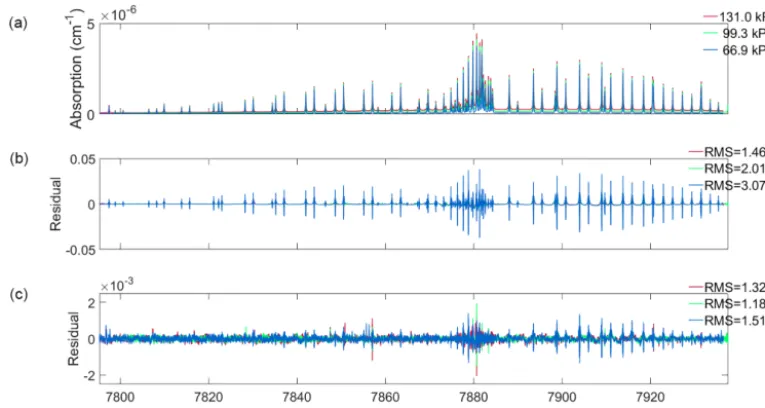
measured at the National Institute of Standards and Technol-ogy (NIST) using the frequency-stabilised cavity ring-down spectroscopy (FS-CRDS) technique (Hodges et al., 2004; Hodges, 2005). The absorption spectra were acquired at pres-sures of 131, 99.3 and 66.9 kPa, at temperatures of 296.28, 296.34 and 296.30 K respectively. Figure 1a shows the three measured absorption spectra. A more detailed discussion of the present FS-CRDS spectrometer can be found in Lin et al. (2015).
The spectra were fitted individually using a Voigt line shape (Eq. 1), with Sj, γLoj and δoj for the main
iso-tope of the magnetic dipole lines of the O2 1.27 µm
band for lines with an intensity greater than 7.0×
10−28cm−1(molecule cm−2)−1. The spectroscopic parame-ters measured in Leshchishina et al. (2011) for the spec-tral lines of interest were used as the a priori for the re-trieved spectroscopic parameters. The line positions were left fixed to the values measured in Leshchishina et al. (2011), and all other O2 spectral lines (intensity less
spec-Figure 1. (a)Cavity ring-down absorption coefficients for O2measured at the three pressures indicated in the legend at approximately room temperature and a volume mixing ratio of 0.20720 (43). The difference between measured absorption coefficients and those calculated using (b)a Voigt line shape and(c)the speed-dependent Voigt line shape. Note the difference in scale between panels(b)and(c).
Figure 2.The same as Fig. 1 but expanded to show four spectral lines in theP branch of the O21.27 µm band.
troscopic parameters. The plot shows that residual structure still remains for all three spectra. The root mean square (rms) residual values for the spectra are given by the legend at the side of the plot.
Figure 2 is the same plot as Fig. 1 but for theP (11)P (11), P (11)Q(10),P (9)P (9)and P (9)Q(8)spectral lines only. Figure 2b shows that for all four spectral lines there is a W-shaped residual at the line centre. TheP (11)P (11)line was also measured by Hartmann et al. (2013) at pressures rang-ing from 6.7 to 107 kPa. Figure 5 of Hartmann et al. (2013) shows theP (11)P (11)line at a pressure of 66.7 kPa, which is approximately the pressure of the 66.9 kPa spectrum (blue
J. Mendonca et al.: Improving the retrieval of O2total columns 39
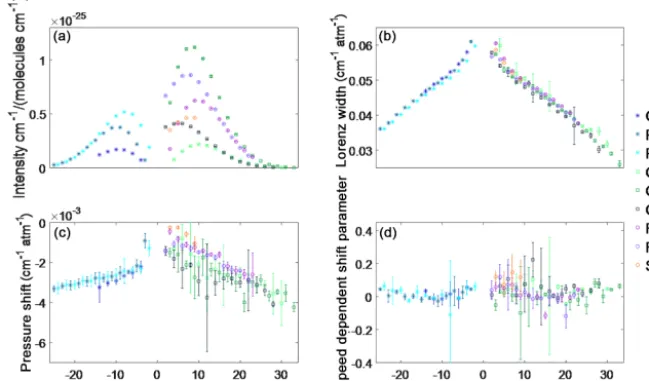
Figure 3.The averaged measured(a)intensity,(b)Lorentz line width,(c)pressure shift and(d)speed-dependent pressure shift retrieved from the three cavity ring-down spectra of the 1.27 µm band of O2. All data are plotted as a function ofm, which ism= −Jfor theP-branch lines,m=Jfor theQbranch andm=J+1 for theRbranch (whereJis the lower state rotational quantum number) and the uncertainties shown are 2σ.
Figure 1c shows the residual when using the speed-dependent Voigt (Eq. 4) to fit each spectrum individu-ally. Using Eq. (4) requires integration over all possible speeds, which is not computationally practical, so we em-ploy the simple numerical integration scheme as was done by Wehr (2005). When fitting the spectra, parametersSj,γLoj,
δjo,aγLi andaδj were retrieved for lines of intensity greater
than 7.0×10⁻²⁸cm−1(molecule cm−2)−1, while all other O2lines were calculated using a Voigt line shape and
spec-troscopic parameters from HITRAN 2012 (Rothman et al., 2013b). The retrieved spectroscopic parameters are available in the Supplement. The Jacobian matrix was created by tak-ing the derivative with respect to each parameter of interest, as was done with the Voigt fits. By taking speed-dependent effects into account, the residuals were reduced to 25 times smaller than those for the Voigt fit and the rms residuals (given in the legend of Fig. 1c) are 10 times smaller. How-ever, some residual structure still remains, which is more ev-ident in the in theQandRbranches than theP branch. Fig-ure 2c shows the four lines in the P branch, as discussed when analysing the Voigt fits. A small residual W remains at the line centre as well as residuals from weak O2lines.
Figure 3 shows the averaged intensity Lorentz width co-efficient, pressure shift coefficient and speed-dependent shift coefficient of the 1.27 µm O2band, retrieved from the three
spectra, plotted as a function of quantum numberm, which is m= −J(whereJis the lower state rotational quantum num-ber) for the P-branch lines,m=J for the Q-branch lines andm=J+1 for theR-branch lines. The intensity, Lorentz widths and pressure shifts show a mdependence for these parameters for the P and R sub-branches. The measured
Lorentz widths and pressure shifts for theQsub-branches show amdependence but are not as strong as theP andR sub-branches. This is because theQbranch lines are broad-ened enough to blend with each other, since they are spaced closer together than theP orRbranch lines. Figure 1c shows that some of the residual structure in theQbranch increases with pressure and is partly due to the blending of these transi-tions as the pressure increases. The weak O2absorption lines
also blend in with theQbranch, contributing to the resid-ual structure in Fig. 1c. We tried retrieving the spectroscopic parameters for the weak O2absorption lines, but since they
were overlapping with the strong O2lines, it was not
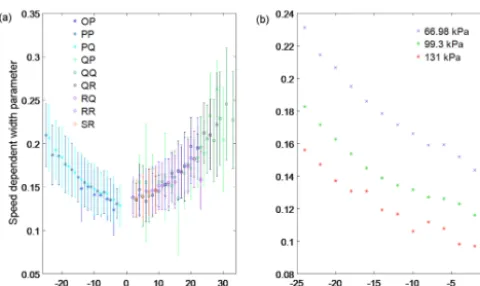
possi-ble. Figure 4a shows the retrieved speed-dependent width pa-rameter averaged over the three spectra, plotted as a function ofm, showing that it increases withm. Error bars correspond to the 2σ standard deviation and are large regardless of sub-branch. Figure 4b shows the retrieved speed-dependent width for theP Qsub-branch for the different pressures. The speed-dependent width shows the samemdependence regardless of pressure, but also increases with decreasing pressure as is the case for sub-branches. It should be noted that the speed-dependent width parameter should be inspeed-dependent of pres-sure.
4 Fitting solar spectra
instru-Figure 4. (a) The averaged measured speed-dependent width pa-rameter of the 1.27 µm band of O2 plotted as a function ofm. (b) The measured speed-dependent width parameter for spectral lines that belong to theP Qsub-branch plotted as a function ofm.
ment were processed into spectra using the I2S software package (Wunch et al., 2015) that corrects solar intensity variations (Keppel-Aleks et al., 2007), phase errors (Mertz, 1967) and laser sampling errors (Wunch et al., 2015), and then performs a fast Fourier transform to convert the inter-ferograms into spectra (Bergland, 1969). The GGG software package (Wunch et al., 2015) is used to retrieve total columns of atmospheric trace gases. GFIT is the main code that con-tains the forward model, which calculates a solar absorption spectrum using a line-by-line radiative transfer model and an iterative non-linear least square fitting algorithm that scales an a priori gas profile to obtain the best fit to the measured spectrum. A priori profiles for GHGs are created by an em-pirical model in GGG that is based on measurements from the balloon-borne JPL MkIV Fourier transform spectrometer (FTS) (Toon, 1991), the Atmospheric Chemistry Experiment (ACE) FTS instrument aboard the SCISAT satellite (Bernath et al., 2005) and in situ GLOBALVIEW data (Wunch et al., 2011). Temperature and pressure profiles, as well as H2O a
priori profiles are generated from the National Centers for Environmental Prediction (NCEP) data. The calculations are performed for 71 atmospheric layers (0 to 70 km), so all a priori profiles are generated on a vertical grid of 1 km.
In the current GGG software package (Wunch et al., 2015), the forward model of GFIT calculates absorption coeffi-cients for the discrete lines of the O2 1.27 µm band
us-ing a Voigt line shape and spectroscopic parameters from Washenfelder et al. (2006a) and Gordon et al. (2010). To take CIA into account, absorption coefficients are calculated using a Voigt line shape and spectroscopic parameters from the foreign-collision-induced absorption (FCIA) and self-collision-induced absorption (SCIA) spectral line lists pro-vided with the GGG software package (Wunch et al., 2015). Spectroscopic parameters in the FCIA and SCIA line lists were retrieved by Geoff C. Toon by fitting the laboratory spectra of Smith and Newnham (2000). This was done by
retrieving the integrated absorption at every 1 cm−1 of the spectrum and using a Voigt line shape, with fixed Lorentz width and no pressure shift. In GFIT, a volume scale factor is retrieved for the CIA and discrete lines separately so that the O2column is derived from the discrete lines of the 1.27 µm
band only. Airglow is not considered when fitting the 1.27 µm band, since the spectrometer views the sun directly and air-glow is overwhelmed by this a bright source. The continuum level and tilt of the 100 % transmission level is fitted using a weighted combination of the first two Legendre polynomials. Absorption coefficient for all other trace gases are calculated using a Voigt line shape and spectroscopic parameters from the atm.101 line list (Toon, 2014a) and solar lines are fitted using the solar line list (Toon, 2014b).
Figure 5 shows the spectral fit to a solar absorption spec-trum recorded at Eureka on 27 March 2015, at a solar zenith angle (SZA) of 81.32◦(air mass of 6.3). This spectrum is an
average of five Eureka scans. The TCCON standard is sin-gle scan but five scans were averaged to decrease the noise. The measured spectrum (red circles), calculated spectrum (black circles) and transitions from all gases in the window (coloured lines, refer to the legend for different gases) are shown in Fig. 5b. The residual obtained using a Voigt line shape to calculate the discrete lines of the O21.27 µm band
is shown in red in Fig. 5a. The blue residual is the result of using a speed-dependent Voigt line shape with the spectro-scopic parameters retrieved from fitting the absorption co-efficients in Section 3. To decrease the amount of time it takes to calculate the absorption coefficients, the quadratic speed-dependent Voigt (qSDV) computational approach of Ngo et al. (2013) and Tran et al. (2013) was used instead of Eq. (4) since it requires the Voigt calculation only twice, while Eq. (4) requires numerical integration scheme with 33 iterations. The temperature-dependent parameter of the Lorentz width of the discrete lines of the O21.27 µm band
reported in HITRAN 2012 was used to take temperature de-pendence into account forγLj(T ). There was only a slight
improvement in the fit residuals with the new absorption co-efficients (using the qSDV), as seen in Fig. 5a. Absorption coefficients calculated with the qSDV were used to retrieve total columns of O2from solar spectra recorded over a 1-year
period at TCCON sites in Eureka (eu) (Nunavut, Canada) (Batchelor et al., 2009; Strong et al., 2017), Park Falls (pa) (Wisconsin, USA) (Washenfelder et al., 2006a; Wennberg et al., 2017a) , Lamont (oc) (Oklahoma, USA) (Wennberg et al., 2017b) and Darwin (db) (Australia) (Deutscher et al., 2010; Griffith et al., 2017). In total 131 124 spectra were fitted using the qSDV and the average root mean square (rms) residual of the fit only decreased by 0.5 %.
5 Impact of O2columns on XCO2measurements
The O2column retrieved from the 1.27 µm band with a Voigt
J. Mendonca et al.: Improving the retrieval of O2total columns 41
Figure 5. (a)The residuals (measured minus calculated) for a spectrum measured at Eureka on 27 March 2015 at a SZA of 81.32◦. The red residual is the result of using the Voigt line shape and the blue is from using the qSDV.(b)The measured (red dots) and calculated values (black dots), with the qSDV spectrum, along with the gases included in the fit (refer to the legend to the right) in the spectral window.
line list (Toon, 2014a) has an air mass dependence such that the O2 column retrieved increases as a function of the
so-lar zenith angle (or air mass). Using spectra recorded from Eureka, Park Falls, Lamont and Darwin over 1-year periods, total columns of O2were retrieved using (1) a Voigt spectral
line shape with spectroscopic parameters from the atm.101 line list and (2) the qSDV with the spectroscopic parameters determined in Sect. 3. Figure 6 shows the percent difference calculated as the column from the qSDV retrieval minus the column from the Voigt retrieval, which was then divided by the latter and multiplied by 100, plotted as a function of solar zenith angle (SZA). At the smallest SZA, the qSDV retrieves 0.75 % less O2than the Voigt, with the difference
increas-ing to approximately 1.8 % as the SZA approaches 90◦.
Fig-ure 7 shows XAIR for the entire data set plotted as a func-tion of SZA. XAIR is the column of air (determined using surface pressure recorded at the site) divided by the column of O2 retrieved from the spectra and multiplied by 0.2095,
which is the dry-air mole fraction of O2 in the Earth’s
at-mosphere. Ideally XAIR should be 1 but when using O2
re-trieved with a Voigt line shape (Fig. 7a) to calculate XAIR the average XAIR value for the entire data set is 0.977. Us-ing O2retrieved with the qSDV to calculate XAIR, the
aver-age value is 0.986, which is closer to the expected value of 1. However, XAIR has a dependence on SZA regardless of line shape used. Figure 7a shows that XAIR decreases as a function of SZA (evident at SZA>75◦), which means that the retrieved column of O2increases as a function of SZA.
Figure 7b shows that XAIR increases as a function of SZA (evident at SZA>70◦), which means that the retrieved col-umn of O2decreases as a function of SZA. Therefore
retriev-ing total columns of O2with the qSDV changes the air mass
Figure 6.The percent difference between the O2column retrieved with the Voigt and qSDV line shapes for a year of measurements from Eureka (eu), Park Falls (pa), Lamont (oc) and Darwin (db).
dependence of the O2column, which in turn will impact the
air mass dependence of XCO2.
5.1 Air mass dependence of XCO2
Since the standard TCCON XCO2 (and all other XGas) is
calculated using the column of O2instead of the surface
pres-sure, errors associated with the retrieval of O2, such as the
air mass dependence of the O2 column, will affect XCO2.
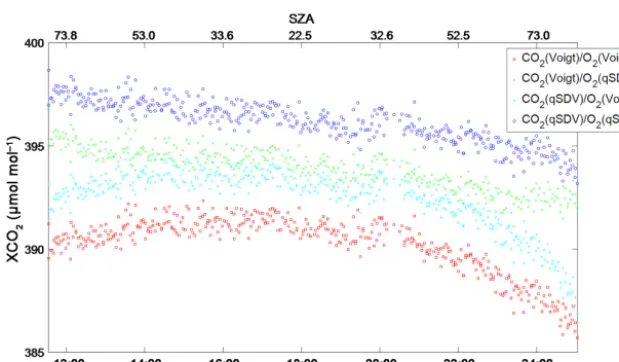
Figure 8 is XCO2calculated for four different combinations
pertaining to the two CO2column retrievals and the O2
col-umn retrievals. The CO2columns were retrieved with either
Figure 7. (a)XAIR as a function of SZA calculated using the total column of O2retrieved using the Voigt line shape. Panel(b)is the same as panel(a)except the total column of O2was retrieved with the qSDV.
Figure 8.XCO2calculated from the CO2and O2columns retrieved from Park Falls spectra recorded on 18 June 2013. The CO2columns were retrieved using either the Voigt line shape or the qSDV with line mixing, while the O2columns were retrieved using either the Voigt or qSDV line shapes. XCO2was calculated in four ways: (1) both CO2and O2columns retrieved using the Voigt line shape (red), (2) CO2 columns retrieved with the Voigt and O2columns retrieved with the qSDV (green), (3) CO2columns retrieved with the qSDV and line mixing and O2columns retrieved with the Voigt (cyan) and (4) CO2columns retrieved with the qSDV and line mixing and O2columns retrieved with the qSDV (blue). The topxaxis is the SZA that corresponds to the hour on the bottomxaxis.
standard GGG2014 approach) or the new qSDV approach developed here. Figure 8 shows a spurious symmetric com-ponent to XCO2 when the total column of O2 is retrieved
with the Voigt line shape, regardless of line shape used to re-trieve CO2. When the qSDV is used to retrieve total columns
of O2, the symmetric component of XCO2 is dismissed
re-gardless of line shape used to retrieve CO2. This is because
the air mass dependence of the column of O2retrieved using
the qSDV is more consistent with the air mass dependence of the column of CO2(for both line shapes used to retrieve
CO2). Mendonca et al. (2016) showed that using the qSDV
with line mixing results in better fits to the CO2 windows
and impacts the air mass dependence of the retrieved column
of CO2. When using a Voigt line shape the retrieved column
amount of CO2decreases as air mass increases until the air
mass is large (SZA of about 82◦), at which point the retrieved column of CO2increases as the air mass increases, changing
the shape of the air mass dependence of the CO2 column.
When the qSDV with line mixing is used, the retrieved col-umn of CO2decreases as a function of air mass (up until the
sun is above the horizon).
To correct for this, an empirical correction is applied to all TCCON XCO2(and XGas). The empirical correction
de-termines the antisymmetrical component of the day’s XCO2,
which is assumed to be the true variation of XCO2
J. Mendonca et al.: Improving the retrieval of O2total columns 43
caused by the air mass dependence of the retrieved column of the gas of interest and O2. We can, therefore, represent a
measurement as (Wunch et al., 2011)
yi= ˆy[1+αS (θi)+βA (ti)], (5)
whereyˆ is the mean value of XCO2measured that day,β is
the fitted coefficient of the antisymmetric functionA (ti)and αis the fitted coefficient of the symmetric functionS(θi). The
antisymmetric function is calculated by (Wunch et al., 2011) A (ti)=sin(2π (ti−tnoon)) , (6)
whereti is the time of the measurement andtnoonis the time
at solar noon, both in units of days. The symmetric function is calculated by (Wunch et al., 2011)
S (θi)=
θ
i+13◦
90◦+13◦
3
−
45◦+13◦
90◦+13◦
3
, (7)
whereθi is the SZA in degrees. To determineαfor the
dif-ferent line shapes, total columns of CO2were retrieved using
the Voigt line shape (Wunch et al., 2015) and the qSDV with line mixing (Mendonca et al., 2016). Henceforth, we will re-fer to XCO2 calculated from O2 and CO2 using the Voigt
line shape as XCO2Voigt and the qSDV line shape as XCO2
qSDV.
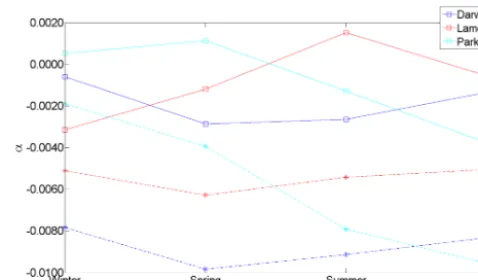
Figure 9 shows the average αcalculated for each season at Darwin, Lamont and Park Falls. Eureka XCO2cannot be
used to determineαbecause Eureka measurements do not go through the same range of SZAs as the other three sites due to its geolocation. The averageαvalues derived from XCO2
Voigt are represented by stars in Fig. 9, while the squares indicate XCO2qSDV. At all three sites,αis closer to 0 when
the qSDV line shape is used in the retrieval compared to the Voigt retrieval, regardless of the season. The averageαfor XCO2 Voigt calculated from a year of measurements from
Darwin, Park Falls and Lamont is−0.0071±0.0057 and that for XCO2qSDV is−0.0012±0.0054.
For all four sites, α= −0.0071 is used to correct XCO2
Voigt measurements. Figure 10a shows the XCO2 Voigt
anomalies plotted as a function of SZA. The data are ex-pressed as the daily XCO2anomaly, which is the difference
between the XCO2value and the daily median value, in
or-der to remove the seasonal cycle. When XCO2 is left
un-corrected for air mass dependencies, XCO2 decreases as a
function of SZA up to approximately 82◦and increases as a function of SZA at angles greater than 82◦. Figure 10b shows
XCO2Voigt corrected for the air mass dependence. This air
mass correction works well only up to a SZA of approxi-mately 82◦. Figure 10c is the same as Fig. 10a but for the uncorrected XCO2 qSDV measurements, while Fig. 10d is
the same as Fig. 10b but for the corrected XCO2qSDV
mea-surements. When the air mass correction is applied to XCO2
qSDV, there is a small difference between the corrected and uncorrected XCO2qSDV measurements, with the difference
Figure 9. The average air-mass-dependent correction factor for XCO2derived from a year of spectra measured at Darwin, Lamont and Park Falls for different seasons. The dashed lines with stars are theαfor XCO2retrieved using a Voigt line shape for both CO2and O2columns. The solid lines with squares are from XCO2retrieved using the qSDV for both CO2and O2columns.
only noticeable for the Darwin measurements recorded at SZA>60◦. For XCO2qSDV measurements taken at SZA>
82◦, XCO2 does not increase with SZA as it does with the
Voigt.
5.2 Accuracy of XCO2
To assess the accuracy of TCCON XCO2 measurements,
they are compared to aircraft XCO2 profile measurements
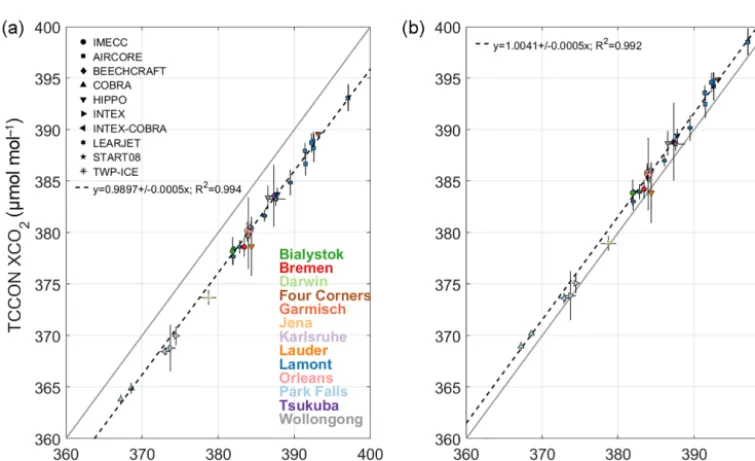
using the method described in Wunch et al. (2010). Fig-ure 11a shows the comparison between the aircraft XCO2
(Deutscher et al., 2010; Lin et al., 2006; Messerschmidt et al., 2010; Singh et al., 2006; Wofsy, 2011) measurements (legend at the top details the different aircraft) and TCCON XCO2 Voigt measurements for 13 TCCON sites (given by
the colour-coded legend at the bottom right). The grey line indicates the one-to-one line and the dashed line is the line of best fit. There is a bias of 0.9897±0.0005 given by the slope of the line of best fit in Fig. 11a for the XCO2Voigt
measurements. Figure 11b is the same as Fig. 11a but for the XCO2 qSDV measurements. The bias between the aircraft
XCO2measurements and the XCO2qSDV measurements is
1.0041±0.0005 as given by the slope of the line of best fit in Fig. 11b. This increase in the slope can be explained by an in-crease in the retrieved column of CO2when using the qSDV
with line mixing as shown in Mendonca et al. (2016) as well as combined with a decrease in the retrieved O2column due
to using the qSDV. As discussed previously (Sect. 5) the de-crease in the retrieved O2column is an improvement but the
expected column of O2 is still approximately 1.2 % higher
(at the smallest SZA) than it should be. Therefore, the re-trieved column of CO2 is higher than it should be, and the
slope would be greater if the retrieved column of O2 was
Figure 10. (a)XCO2Voigt anomaly for a year of measurements from the four TCCON sites. The XCO2anomaly is the difference between each XCO2value and the daily median XCO2.(b)The XCO2Voigt anomaly after the air mass dependence correction is applied to the XCO2Voigt data.(c)XCO2qSDV anomaly.(d)XCO2qSDV anomaly after correction for the air mass dependence.
Figure 11. (a)Correlation between TCCON and aircraft XCO2Voigt measurements for 13 TCCON sites. Each aircraft type is indicated by a different symbol given by the legend in the top-left corner. Each site is represented by a different colour given by the legend in the bottom right corner. The grey line indicates the one-to-one line and the dashed line is the line of best fit for the data. The slope of the line of best fit as well as the error on the slope are given in the plot.(b)The same as panel(a)but for XCO2qSDV.
columns of CO2and O2reduces the difference between
TC-CON XCO2and aircraft XCO2measurements by 0.62 %.
TCCON XCO2measurements are divided by the scale
fac-tors (or bias determined in Fig. 11) to calibrate to the WMO scale. For all TCCON XCO2measurements retrieved with a
Voigt line shape, the air mass correction is first applied to the data and the result is divided by the determined bias factor, 0.9897. Figure 12a to d shows XCO2Voigt (for Eureka, Park
Falls, Lamont and Darwin) indicated by red square boxes
in the plots. XCO2Voigt measurements taken at SZA>82◦
have been filtered out because they cannot be corrected for the air mass dependence. The blue boxes are XCO2qSDV
corrected for air mass dependence and scaled by 1.0041. No filter was applied to the XCO2qSDV measurements for SZA
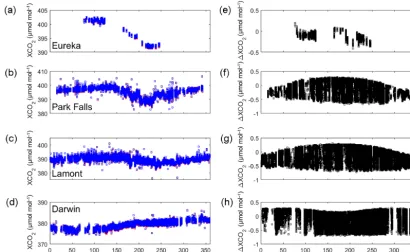
since the air mass dependence correction works at all SZA. Figure 12e–h shows the difference between XCO2Voigt and
XCO2 qSDV for Eureka, Park Falls, Lamont and Darwin.
J. Mendonca et al.: Improving the retrieval of O2total columns 45
Figure 12. (a–d)XCO2plotted as a function of day of the year for Eureka (2014), Park Falls (2013), Lamont (2010) and Darwin (2006). The mostly hidden red boxes are XCO2calculated from using a Voigt line shape in the retrieval and the blue boxes are from using the qSDV. (e–h)The difference between XCO2Voigt and XCO2qSDV.
h are 0.113±0.082, −0.102±0.223, −0.132±0.241 and
−0.059±0.231 µmol mol−1 (ppm) for Eureka, Park Falls, Lamont and Darwin respectively. The difference throughout the day at Park Falls, Lamont and Darwin varies between
−0.6 and 0.2 µmol mol−1and is SZA dependent.
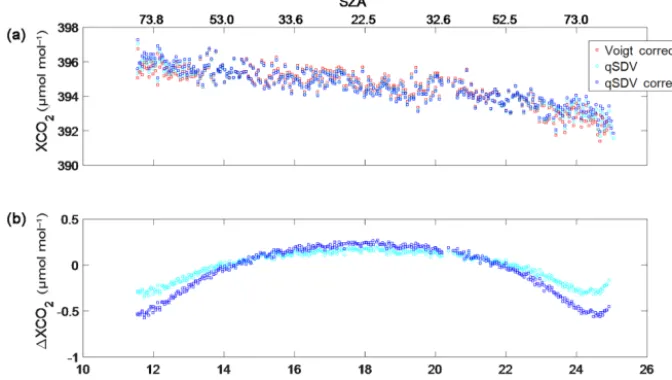
Figure 13a shows XCO2Voigt corrected for the air mass
dependence, as well as XCO2 qSDV, uncorrected and
cor-rected for the air mass dependence. These XCO2
measure-ments were retrieved from Park Falls spectra recorded on 18 June 2013. For all three XCO2measurements, the amount
of XCO2decreases throughout the day. Figure 13b shows the
difference between the corrected Voigt XCO2and the
uncor-rected qSDV XCO2, as well as the difference between the
corrected Voigt XCO2 and the corrected qSDV XCO2. The
difference between the Voigt and the qSDV (corrected and uncorrected) shows that at the start and end of the day, more XCO2is retrieved with the qSDV, while at midday less is
re-trieved with the qSDV. The range in the differences seen in Fig. 12e to h varies with SZA throughout the day as shown in Fig. 13b.
6 Discussion and conclusions
Using cavity ring-down spectra measured in the lab, we have shown that the Voigt line shape is insufficient to model the line shape of O2for the 1.27 µm band, consistent with the
re-sults of Hartmann et al. (2013) and Lamouroux et al. (2014).
By using the speed-dependent Voigt line shape when calcu-lating the absorption coefficients, we were better able to re-produce the measured absorption coefficients than using the Voigt line shape. However, some residual structure remains as seen Figs. 1 and 2. This is partly due to the blending of spectral lines (i.e. line mixing) and the inability to retrieve the spectroscopic parameters for weak O2transitions. Fitting
low-pressure spectra would help with isolating spectral lines and decreasing the uncertainty on the retrieved spectroscopic parameters for theQbranch lines.
Accurate measurements of the pressure shifts in the 1.27 µm band have been hard to obtain as shown in New-man et al. (1999) and Hill et al. (2003). While the retrieved pressure shifts show a dependence on quantum numberm (Fig. 3c) as one would expect, this dependence is not as strong as themdependence of the Lorentz widths (Fig. 3b). This can be explained by the fact that line mixing, which is shown to be important for the O2 A-band, was not
Figure 13. (a)XCO2from Park Falls retrieved from spectra recorded on 18 June 2013. Retrieved XCO2is plotted (1) with a Voigt line shape and corrected for the air mass dependence (red squares), (2) with the qSDV (cyan circles) and (3) with the qSDV and corrected for the air mass dependence (blue squares).(b)The difference between the corrected Voigt XCO2and the qSDV XCO2(cyan circles) and the difference between the Voigt corrected XCO2and the corrected qSDV XCO2(blue squares). The topxaxis is the SZA that corresponds to the hour on the bottomxaxis.
one would see in the discrete lines when neglecting line mix-ing. The remaining structure, as seen in Fig. 1c, could be due to neglecting line mixing, especially in theQbranch, where the spacing between spectral lines is small (in comparison to theP andRbranches) and line mixing is most likely preva-lent. The large error bars for the measured pressure shifts and speed-dependent pressure shifts as well as a deviation from a smoothmdependence of these parameters could be due to neglecting line mixing when fitting the lab spectra. Figure 3c and d show that the spectral lines that have large error bars and deviate from an expectedmdependence belong mainly to theQ-branch spectral lines (which are mostly likely im-pacted by line mixing). To achieve the results obtained in this study it is best to use the parameters as they are instead of trying to apply an interpolation that depends onmor even omitting them, unless one tests these changes on atmospheric spectra that cover different range of conditions (i.e. seasons, dry/wet, SZA, geographical locations). It is evident that the parameters might be compensating for effects (such as line mixing) that were not included when fitting the lab spectra, and changing these parameters (or omitting them) could lead to degradation in the quality of the spectral fits of solar spec-tra and a change in the air mass dependence of the retrieved column of O2, which would impact the air mass dependence
of XCO2.
The pressure dependence of the retrieved speed-dependent width parameter is an indication that Dicke narrowing needs to be taken into account, as shown by Bui et al. (2014) for CO2. When both speed dependence and Dicke
narrow-ing are present, a multispectrum fit needs to be used due to the correlation between the parameters (Bui et al., 2014).
Domysławska et al. (2016) recommend using the qSDV to model the line shape of O2based on multiple line shape
stud-ies of the O2B-band. In these studies, a multispectrum fit to
low-pressure (0.27–5.87 kPa) cavity ring-down spectra was performed testing multiple line shapes that took speed de-pendence and Dicke narrowing into account both separately and simultaneously. They found that the line shapes that only used Dicke narrowing were not good enough to model the line shape of the O2B-band lines, but a line shape that
in-cluded either speed dependence or both speed dependence and Dicke narrowing produced similar quality fits, ultimately concluding that speed dependence has a larger effect than Dicke narrowing. It was noted in the study by Wójtewicz et al. (2014) that both Dicke narrowing and speed-dependent effects might simultaneously play an important role in mod-elling the line shape of the O2 B-band lines. However, the
speed-dependent and Dicke narrowing parameters are highly correlated at low pressures. Reducing the correlation requires either a multispectrum fit of spectra at low pressures with a high enough signal-to-noise ratio or spectra that cover a wide range of pressures (Wójtewicz et al., 2014). So, by combin-ing the high-pressure spectra used in this study with low-pressure spectra in a multispectral fit, both the speed depen-dence and Dicke narrowing parameters could be retrieved. The temperature dependence of the Lorentz width coeffi-cients of this band has never been measured before, which could have an impact on the air mass dependence of O2.
Combining high-pressure cavity ring-down absorption coef-ficient measurements with those for low pressures and differ-ent temperatures as done in Devi et al. (2015, 2016) for CH4
J. Mendonca et al.: Improving the retrieval of O2total columns 47
By taking speed dependence into account for both CO2(in
the work of Mendonca et al., 2016) and O2 (the work
pre-sented here), we were able to significantly decrease the air mass dependence of TCCON XCO2 and the bias between
TCCON and aircraft XCO2. XAIR calculated with the
col-umn of O2retrieved with the qSDV is now closer to the
ex-pected value of 1, but XAIR still has an air mass dependence which is the result of the retrieved total column of O2
de-creasing as a function of SZA at large SZA. This remaining air mass dependence could be due to neglecting effects such as Dicke narrowing and line mixing in the absorption coef-ficient calculations, as well as assuming a perfect instrument line shape in the retrieval algorithm. However, retrieving O2
with the qSDV significantly decreases the air mass depen-dence of XCO2. With the qSDV line shape, XCO2
measure-ments taken at SZA>82◦no longer have to be discarded. We recommend using the full range of SZA, which would result in more XCO2measurement available from all TCCON sites.
This is particularly important for high-latitude TCCON sites such as Eureka because measurements taken from late Febru-ary to late March and from late September to mid-October are taken at SZA>82◦. Filtering out these large SZA mea-surements thus limits the knowledge of the seasonal cycle of XCO2at high latitudes. The air mass dependence of the O2
column not only affects XCO2but all trace gases measured
by TCCON and in the future the air mass dependence of all XGas will be determined with these new O2columns.
Data availability. All TCCON data are available from the TC-CON data archive hosted by CaltechDATA and located at https: //tccondata.org/ (last access: 19 December 2018). Site-specific data used in this work can be obtained from the links in the relevant cited references. Solar absorption spectra can be obtained by contacting the TCCON site PIs. Laboratory O2cavity ring-down spectra can be obtained by contacting David Long at the National Institute of Standards and Technology.
Supplement. The supplement related to this article is available online at: https://doi.org/10.5194/amt-12-35-2019-supplement.
Competing interests. The authors declare that they have no conflict of interest.
Acknowledgements. This work was primarily supported by the Canadian Space Agency (CSA) through the GOSAT and CAFTON projects and the Natural Sciences and Engineering Research Council of Canada (NSERC). The Eureka measurements were taken at the Polar Environment Atmospheric Research Labora-tory (PEARL) by the Canadian Network for the Detection of Atmospheric Change (CANDAC), which has been supported by the AIF/NSRIT, CFI, CFCAS, CSA, Environment Canada (EC), Government of Canada IPY funding, NSERC, OIT, ORF, PCSP,
and FQRNT. The authors wish to thank the staff at EC’s Eureka Weather Station and CANDAC for the logistical and on-site support provided. Thanks to CANDAC Principal Investigator James R. Drummond, PEARL Site Manager Pierre Fogal and CANDAC/PEARL operators Mike Maurice and Peter McGovern for their invaluable assistance in maintaining and operating the Bruker 125HR. The research at the Jet Propulsion Laboratory (JPL), and California Institute of Technology was performed under contracts and cooperative agreements with the National Aeronautics and Space Administration (NASA). Geoffrey C. Toon and Debra Wunch acknowledge support from NASA for the de-velopment of TCCON via grant number NNX17AE15G. Darwin TCCON measurements are possible thanks to support from NASA grants NAG5-12247 and NNG05-GD07G, the Australian Research Council grants DP140101552, DP110103118, DP0879468 and LP0562346, and the DOE ARM programme for technical support. The research at the National Institute of Standards and Technology was performed with the support of the NIST Greenhouse Gas Measurements and Climate Research Program. Certain commercial equipment, instruments, or materials are identified in this paper in order to specify the experimental procedure adequately. Such identification is not intended to imply recommendation or endorse-ment by the National Institute of Standards and Technology, nor is it intended to imply that the materials or equipment identified are necessarily the best available for the purpose.
Edited by: Frank Hase
Reviewed by: two anonymous referees
References
Abrarov, S. M. and Quine, B. M.: Efficient algorithmic implemen-tation of the Voigt/complex error function based on exponential series approximation, Appl. Math. Comput., 218, 1894–1902, https://doi.org/10.1016/j.amc.2011.06.072, 2011.
Batchelor, R. L., Strong, K., Lindenmaier, R., Mittermeier, R. L., Fast, H., Drummond, J. R., and Fogal, P. F.: A New Bruker IFS 125HR FTIR Spectrometer for the Polar Environment At-mospheric Research Laboratory at Eureka, Nunavut, Canada: Measurements and Comparison with the Existing Bomem DA8 Spectrometer, J. Atmos. Ocean. Tech., 26, 1328–1340, https://doi.org/10.1175/2009JTECHA1215.1, 2009.
Bergland, G.: A radix-eight fast Fourier transform subroutine for real-valued series, IEEE T. Acoust. Speech, 17, 138–144, https://doi.org/10.1109/TAU.1969.1162043, 1969.
Bui, T. Q., Long, D. A., Cygan, A., Sironneau, V. T., Hogan, D. W., Rupasinghe, P. M., Ciuryło, R., Lisak, D., and Okumura, M.: Observations of Dicke narrowing and speed dependence in air-broadened CO2lineshapes near 2.06 µm, J. Chem. Phys., 141, 174301, https://doi.org/10.1063/1.4900502, 2014.
Cheah, S.-L., Lee, Y.-P., and Ogilvie, J. F.: Wavenumbers, strengths, widths and shifts with pressure of lines in four bands of gaseous 16O2 in the systems a11g−X36−g and
b16g+−X36−g, J. Quant. Spectrosc. Ra., 64, 467–482, https://doi.org/10.1016/S0022-4073(99)00126-0, 2000. Ciuryło, R.: Shapes of pressure- and Doppler-broadened spectral
lines in the core and near wings, Phys. Rev. A, 58, 1029–1039, https://doi.org/10.1103/PhysRevA.58.1029, 1998.
Crisp, D., Atlas, R. M., Breon, F.-M., Brown, L. R., Burrows, J. P., Ciais, P., Connor, B. J., Doney, S. C., Fung, I. Y., Jacob, D. J., Miller, C. E., O’Brien, D., Pawson, S., Randerson, J. T., Rayner, P., Salawitch, R. J., Sander, S. P., Sen, B., Stephens, G. L., Tans, P. P., Toon, G. C., Wennberg, P. O., Wofsy, S. C., Yung, Y. L., Kuang, Z., Chudasama, B., Sprague, G., Weiss, B., Pollock, R., Kenyon, D., and Schroll, S.: The Orbiting Car-bon Observatory (OCO) mission, Adv. Space Res., 34, 700–709, https://doi.org/10.1016/j.asr.2003.08.062, 2004.
Deutscher, N. M., Griffith, D. W. T., Bryant, G. W., Wennberg, P. O., Toon, G. C., Washenfelder, R. A., Keppel-Aleks, G., Wunch, D., Yavin, Y., Allen, N. T., Blavier, J.-F., Jiménez, R., Daube, B. C., Bright, A. V., Matross, D. M., Wofsy, S. C., and Park, S.: Total column CO2measurements at Darwin, Australia – site description and calibration against in situ aircraft profiles, At-mos. Meas. Tech., 3, 947–958, https://doi.org/10.5194/amt-3-947-2010, 2010.
Devi, V. M., Benner, D. C., Sung, K., Crawford, T. J., Yu, S., Brown, L. R., Smith, M. A. H., Mantz, A. W., Boudon, V., and Ismail, S.: Self- and air-broadened line shapes in the 2ν3
P andRbranches of12CH4, J. Mol. Spectrosc., 315, 114–136, https://doi.org/10.1016/j.jms.2015.05.003, 2015.
Devi, V. M., Benner, D. C., Sung, K., Brown, L. R., Crawford, T. J., Yu, S., Smith, M. A. H., Mantz, A. W., Boudon, V., and Is-mail, S.: Spectral line parameters including line shapes in the 2ν3Qbranch of12CH4, J. Quant. Spectrosc. Ra., 177, 152–169, https://doi.org/10.1016/j.jqsrt.2015.12.009, 2016.
Dicke, R. H.: The Effect of Collisions upon the Doppler Width of Spectral Lines, Phys. Rev., 89, 472–473, https://doi.org/10.1103/PhysRev.89.472, 1953.
Domysławska, J., Wójtewicz, S., Masłowski, P., Cygan, A., Bielska, K., Trawi´nski, R. S., Ciuryło, R., and Lisak, D.: A new approach to spectral line shapes of the weak oxygen transitions for at-mospheric applications, J. Quant. Spectrosc. Ra., 169, 111–121, https://doi.org/10.1016/j.jqsrt.2015.10.019, 2016.
Drouin, B. J., Benner, D. C., Brown, L. R., Cich, M. J., Craw-ford, T. J., Devi, V. M., Guillaume, A., Hodges, J. T., Mlawer, E. J., Robichaud, D. J., Oyafuso, F., Payne, V. H., Sung, K., Wishnow, E. H., and Yu, S.: Multispectrum analysis of the oxygen A-band, J. Quant. Spectrosc. Ra., 186, 118–138, https://doi.org/10.1016/j.jqsrt.2016.03.037, 2017.
Gordon, I. E., Kassi, S., Campargue, A., and Toon, G. C.: First iden-tification of the electric quadrupole transitions of oxygen in solar and laboratory spectra, J. Quant. Spectrosc. Ra., 111, 1174–1183, https://doi.org/10.1016/j.jqsrt.2010.01.008, 2010.
Gordon, I. E., Rothman, L. S., Hill, C., Kochanov, R. V., Tan, Y., Bernath, P. F., Birk, M., Boudon, V., Campargue, A., Chance, K. V., Drouin, B. J., Flaud, J.-M., Gamache, R. R., Hodges, J. T., Jacquemart, D., Perevalov, V. I., Perrin, A., Shine, K. P., Smith, M.-A. H., Tennyson, J., Toon, G. C., Tran, H., Tyuterev, V. G., Barbe, A., Császár, A. G., Devi, V. M., Furtenbacher, T., Harrison, J. J., Hartmann, J.-M., Jolly, A., Johnson, T. J., Karman, T., Kleiner, I., Kyuberis, A. A., Loos, J., Lyulin, O. M., Massie, S. T., Mikhailenko, S. N., Moazzen-Ahmadi, N., Müller, H. S. P., Naumenko, O. V., Nikitin, A. V., Polyansky, O. L., Rey, M., Rotger, M., Sharpe, S. W., Sung, K., Starikova, E., Tashkun, S. A., Auwera, J. V., Wagner, G., Wilzewski, J., Wcisło, P., Yu, S., and Zak, E. J.: The HITRAN2016 molecu-lar spectroscopic database, J. Quant. Spectrosc. Ra., 203, 3–69, https://doi.org/10.1016/j.jqsrt.2017.06.038, 2017.
Griffith, D. W. T., Deutscher, N. M., Velazco, V. A., Wennberg, P. O., Yavin, Y., Keppel-Aleks, G., Washenfelder, R. A., Toon, G. C., Blavier, J.-F., Paton-Walsh, C., Jones, N. B., Kettlewell, G. C., Connor, B. J., Macatangay, R. C., Roehl, C., Ryczek, M., Glowacki, J., Culgan, T., and Bryant, G. W.: TCCON data from Darwin (AU), Release GGG2014.R0, https://doi.org/10.14291/tccon.ggg2014.darwin01.R0/1149290, 2017.
Hartmann, J.-M., Sironneau, V., Boulet, C., Svensson, T., Hodges, J. T., and Xu, C. T.: Collisional broaden-ing and spectral shapes of absorption lines of free and nanopore-confined O2 gas, Phys. Rev. A, 87, 032510, https://doi.org/10.1103/PhysRevA.87.032510, 2013.
Hill, C., Brown, J. M., and Newnham, D. A.: An up-per limit for the magnitude of pressure shifts in the O2
a11g←X36−g(0–0) band, J. Mol. Spectrosc., 221, 286–287, https://doi.org/10.1016/S0022-2852(03)00227-3, 2003. Hodges, J. T.: Automated high-resolution frequency-stabilized
cav-ity ring-down absorption spectrometer, Rev. Sci. Instrum., 76, 023112, https://doi.org/10.1063/1.1850633, 2005.
Hodges, J. T., Layer, H. P., Miller, W., and Scace, G. E.: Frequency-stabilized single-mode cavity ring-down apparatus for high-resolution absorption spectroscopy, Rev. Sci. Instrum., 75, 849– 863, https://doi.org/10.1063/1.1666984, 2004.
Keppel-Aleks, G., Toon, G. C., Wennberg, P. O., and Deutscher, N. M.: Reducing the impact of source brightness fluctuations on spectra obtained by Fourier-transform spectrometry, Appl. Op-tics, 46, 4774, https://doi.org/10.1364/AO.46.004774, 2007. Lamouroux, J., Sironneau, V., Hodges, J. T., and
Hart-mann, J.-M.: Isolated line shapes of molecular oxy-gen: Requantized classical molecular dynamics calcu-lations versus measurements, Phys. Rev. A, 89, 042504, https://doi.org/10.1103/PhysRevA.89.042504, 2014.
Leshchishina, O., Kassi, S., Gordon, I. E., Rothman, L. S., Wang, L., and Campargue, A.: High sensitivity CRDS of the a11−gX36g− band of oxygen near 1.27 µm: Extended observations, quadrupole transitions, hot bands and minor isotopologues, J. Quant. Spectrosc. Ra., 111, 2236–2245, https://doi.org/10.1016/j.jqsrt.2010.05.014, 2010.
J. Mendonca et al.: Improving the retrieval of O2total columns 49
Lévy, A., Lacome, N., and Chackerian Jr., C.: Collisional Line Mix-ing A2, in: Spectroscopy of the Earth’s Atmosphere and Interstel-lar Medium, edited by: Weber, K. and RaoAlfons, N., Academic Press, San Diego, CA, 261–337, 1992.
Lin, H., Reed, Z. D., Sironneau, V. T., and Hodges, J. T. Cavity ring-down spectrometer for high-fidelity molecular ab-sorption measurements, J. Quant. Spectrosc. Ra., 161, 11–20, https://doi.org/10.1016/j.jqsrt.2015.03.026, 2015.
Lin, J. C., Gerbig, C., Wofsy, S. C., Daube, B. C., Matross, D. M., Chow, V. Y., Gottlieb, E., Andrews, A. E., Pathmathevan, M., and Munger, J. W.: What have we learned from intensive atmo-spheric sampling field programmes of CO2?, Tellus B, 58, 331– 343, https://doi.org/10.1111/j.1600-0889.2006.00202.x, 2006. Long, D. A., Havey, D. K., Okumura, M., Miller, C. E., and
Hodges, J. T.: O2 A-band line parameters to support atmo-spheric remote sensing, J. Quant. Spectrosc. Ra., 111, 2021– 2036, https://doi.org/10.1016/j.jqsrt.2010.05.011, 2010. Maté, B., Lugez, C., Fraser, G. T., and Lafferty, W. J.:
Absolute intensities for the O2 1.27 µm continuum ab-sorption, J. Geophys. Res.-Atmos., 104, 30585–30590, https://doi.org/10.1029/1999JD900824, 1999.
Mendonca, J., Strong, K., Toon, G. C., Wunch, D., Sung, K., Deutscher, N. M., Griffith, D. W. T., and Franklin, J. E.: Improving atmospheric CO2 retrievals using line mixing and speed-dependence when fitting high-resolution ground-based solar spectra, J. Mol. Spectrosc., 323, 15–27, https://doi.org/10.1016/j.jms.2016.01.007, 2016.
Mertz, L.: Auxiliary computation for Fourier spectrometry, Infrared Phys., 7, 17–23, https://doi.org/10.1016/0020-0891(67)90026-7, 1967.
Messerschmidt, J., Macatangay, R., Notholt, J., Petri, C., Warneke, T., and Weinzierl, C.: Side by side measurements of CO2 by ground-based Fourier transform spectrometry (FTS): Side By Side Measurements Of CO2 By FTS, Tellus B, 62, 749–758, https://doi.org/10.1111/j.1600-0889.2010.00491.x, 2010. Mlawer, E. J., Clough, S. A., Brown, P. D., Stephen, T.
M., Landry, J. C., Goldman, A., and Murcray, F. J.: Ob-served atmospheric collision-induced absorption in near-infrared oxygen bands, J. Geophys. Res.-Atmos., 103, 3859–3863, https://doi.org/10.1029/97JD03141, 1998.
Newman, S. M., Lane, I. C., Orr-Ewing, A. J., Newnham, D. A., and Ballard, J.: Integrated absorption intensity and Einstein coef-ficients for the O2a11g−X36−g (0,0) transition: A comparison of cavity ringdown and high resolution Fourier transform spec-troscopy with a long-path absorption cell, J. Chem. Phys., 110, 10749–10757, https://doi.org/10.1063/1.479018, 1999.
Newman, S. M., Orr-Ewing, A. J., Newnham, D. A., and Ballard, J.: Temperature and pressure dependence of line widths and in-tegrated absorption intensities for the O2 a11g−X36g−(0,0) transition, J. Phys. Chem. A, 104, 9467–9480, 2000.
Ngo, N. H., Lisak, D., Tran, H., and Hartmann, J.-M.: An isolated line-shape model to go beyond the Voigt profile in spectroscopic databases and radiative transfer codes, J. Quant. Spectrosc. Ra., 129, 89–100, https://doi.org/10.1016/j.jqsrt.2013.05.034, 2013. Predoi-Cross, A., Hambrook, K., Keller, R., Povey, C., Schofield, I.,
Hurtmans, D., Over, H., and Mellau, G. C.: Spectroscopic line-shape study of the self-perturbed oxygen A-band, J. Mol. Spec-trosc., 248, 85–110, https://doi.org/10.1016/j.jms.2007.11.007, 2008.
Rohart, F., Mäder, H., and Nicolaisen, H.-W.: Speed dependence of rotational relaxation induced by foreign gas collisions: Studies on CH3F by millimeter wave coherent transients, J. Chem. Phys., 101, 6475–6486, https://doi.org/10.1063/1.468342, 1994. Rothman, L. S., Jacquemart, D., Barbe, A., Chris Benner, D., Birk,
M., Brown, L. R., Carleer, M. R., Chackerian Jr., C., Chance, K., Coudert, L. H., Dana, V., Devi, V. M., Flaud, J.-M., Gamache, R. R., Goldman, A., Hartmann, J.-M., Jucks, K. W., Maki, A. G., Mandin, J.-Y., Massie, S. T., Orphal, J., Perrin, A., Rinsland, C. P., Smith, M. A. H., Tennyson, J., Tolchenov, R. N., Toth, R. A., Vander Auwera, J., Varanasi, P., and Wagner, G.: The HITRAN 2004 molecular spectroscopic database, J. Quant. Spectrosc. Ra., 96, 139–204, https://doi.org/10.1016/j.jqsrt.2004.10.008, 2005. Rothman, L. S., Gordon, I. E., Barbe, A., Benner, D. C., Bernath,
P. F., Birk, M., Boudon, V., Brown, L. R., Campargue, A., Champion, J.-P., Chance, K., Coudert, L. H., Dana, V., Devi, V. M., Fally, S., Flaud, J.-M., Gamache, R. R., Goldman, A., Jacquemart, D., Kleiner, I., Lacome, N., Lafferty, W. J., Mandin, J.-Y., Massie, S. T., Mikhailenko, S. N., Miller, C. E., Moazzen-Ahmadi, N., Naumenko, O. V., Nikitin, A. V., Or-phal, J., Perevalov, V. I., Perrin, A., Predoi-Cross, A., Rins-land, C. P., Rotger, M., Šimeˇcková, M., Smith, M. A. H., Sung, K., Tashkun, S. A., Tennyson, J., Toth, R. A., Vandaele, A. C., and Vander Auwera, J.: The HITRAN 2008 molecular spec-troscopic database, J. Quant. Spectrosc. Ra., 110, 533–572, https://doi.org/10.1016/j.jqsrt.2009.02.013, 2009.
Rothman, L. S., Gordon, I. E., Babikov, Y., Barbe, A., Chris Benner, D., Bernath, P. F., Birk, M., Bizzocchi, L., Boudon, V., Brown, L. R., Campargue, A., Chance, K., Cohen, E. A., Coudert, L. H., Devi, V. M., Drouin, B. J., Fayt, A., Flaud, J.-M., Gamache, R. R., Harrison, J. J., Hartmann, J.-M., Hill, C., Hodges, J. T., Jacquemart, D., Jolly, A., Lamouroux, J., Le Roy, R. J., Li, G., Long, D. A., Lyulin, O. M., Mackie, C. J., Massie, S. T., Mikhailenko, S., Müller, H. S. P., Nau-menko, O. V., Nikitin, A. V., Orphal, J., Perevalov, V., Per-rin, A., Polovtseva, E. R., Richard, C., Smith, M. A. H., Starikova, E., Sung, K., Tashkun, S., Tennyson, J., Toon, G. C., Tyuterev, V. G., and Wagner, G.: The HITRAN2012 molecu-lar spectroscopic database, J. Quant. Spectrosc. Ra., 130, 4–50, https://doi.org/10.1016/j.jqsrt.2013.07.002, 2013a.
Shannon, I., Harris, M., McHugh, D. R., and Lewis, E. L.: Low-pressure spectral line profiles: an analysis in terms of symmet-ric speed-dependent Voigt profiles, J. Phys. B-At. Mol. Opt., 19, 1409, https://doi.org/10.1088/0022-3700/19/10/011, 1986. Singh, H. B., Brune, W. H., Crawford, J. H., Jacob, D. J.,
and Russell, P. B.: Overview of the summer 2004 In-tercontinental Chemical Transport Experiment-North Amer-ica (INTEX-A), J. Geophys. Res.-Atmos., 111, D24S01, https://doi.org/10.1029/2006JD007905, 2006.
Smith, K. M. and Newnham, D. A.: Near-infrared absorption cross sections and integrated absorption intensities of molecular oxy-gen (O2, O2-O2, and O2-N2), J. Geophys. Res.-Atmos., 105, 7383–7396, https://doi.org/10.1029/1999JD901171, 2000. Smith, K. M., Newnham, D. A., and Williams, R. G.:
Strong, K., Mendonca, J., Weaver, D., Fogal, P., Drum-mond, J. R., Batchelor, R., and Lindenmaier, R.: TC-CON data from Eureka (CA), Release GGG2014.R1, https://doi.org/10.14291/tccon.ggg2014.eureka01.R1/1325515, 2017.
Toon, G. C.: The JPL MkIV interferometer, Opt. Photonics News, 2, 19–21, https://doi.org/10.1364/OPN.2.10.000019, 1991. Toon, G. C.: Telluric line list for GGG2014,
TC-CON data archive. Carbon Dioxide Inf. Anal. Cent. Oak Ridge Natl. Lab., Oak Ridge, Tenn., USA, https://doi.org/10.14291/tccon.ggg2014.atm.R0/1221656, 2014a.
Toon, G. C.: Solar line list for GGG2014. TCCON Data Arch. Hosted Carbon Dioxide Inf. Anal. Cent. Oak Ridge Natl. Lab., Oak Ridge, Tenn., USA, https://doi.org/10.14291/TCCON.GGG2014.SOLAR.R0/1221658, 2014b.
Tran, H. and Hartmann, J.-M.: An improved O2A band absorp-tion model and its consequences for retrievals of photon paths and surface pressures, J. Geophys. Res.-Atmos., 113, D18104, https://doi.org/10.1029/2008JD010011, 2008.
Tran, H., Boulet, C., and Hartmann, J.-M.: Line mixing and collision-induced absorption by oxygen in the A band: Labo-ratory measurements, model, and tools for atmospheric spec-tra computations, J. Geophys. Res.-Atmos., 111, D15210, https://doi.org/10.1029/2005JD006869, 2006.
Tran, H., Ngo, N. H., and Hartmann, J.-M.: Efficient computation of some speed-dependent isolated line profiles, J. Quant. Spectrosc. Ra., 129, 199–203, https://doi.org/10.1016/j.jqsrt.2013.06.015, 2013.
Wallace, L. and Livingston, W.: Spectroscopic observations of at-mospheric trace gases over Kitt Peak. I – Carbon dioxide and methane from 1979 to 1985, J. Geophys. Res., 95, 9823–9827, https://doi.org/10.1029/JD095iD07p09823, 1990.
Washenfelder, R. A., Toon, G. C., Blavier, J.-F., Yang, Z., Allen, N. T., Wennberg, P. O., Vay, S. A., Matross, D. M., and Daube, B. C.: Carbon dioxide column abundances at the Wis-consin Tall Tower site, J. Geophys. Res.-Atmos., 111, D22305, https://doi.org/10.1029/2006JD007154, 2006a.
Wehr, R. A.: Dicke-narrowed spectral lines in carbon monoxide buffered by argon, PhD thesis, University of Toronto, Canada, 2005.
Wennberg, P. O., Roehl, C. M., Wunch, D., Toon, G. C., Blavier, J.-F., Washenfelder, R., Keppel-Aleks, G., Allen, N. T., and Ayers, J.: TCCON data from Park Falls (US), Release GGG2014.R0, https://doi.org/10.14291/tccon.ggg2014.parkfalls01.R0/1149161, 2017a.
Wennberg, P. O., Wunch, D., Roehl, C. M., Blavier, J.-F., Toon, G. C., Allen, N. T., Dowell, P., Teske, K., Martin, C., and Martin, J.: TCCON data from Lamont (US), Release GGG2014.R0, https://doi.org/10.14291/tccon.ggg2014.lamont01.R0/1149159, 2017b.
Wofsy, S. C.: HIAPER Pole-to-Pole Observations (HIPPO): fine-grained, global-scale measurements of climatically important at-mospheric gases and aerosols, Philos. T. Roy. Soc. A, 369, 2073– 2086, https://doi.org/10.1098/rsta.2010.0313, 2011.
Wójtewicz, S., Cygan, A., Masłowski, P., Domysławska, J., Lisak, D., Trawi´nski, R. S., and Ciuryło, R.: Spec-tral line shapes of self-broadened P-branch transitions of oxygen B band, J. Quant. Spectrosc. Ra., 144, 36–48, https://doi.org/10.1016/j.jqsrt.2014.03.029, 2014.
Wunch, D., Toon, G. C., Wennberg, P. O., Wofsy, S. C., Stephens, B. B., Fischer, M. L., Uchino, O., Abshire, J. B., Bernath, P., Biraud, S. C., Blavier, J.-F. L., Boone, C., Bowman, K. P., Brow-ell, E. V., Campos, T., Connor, B. J., Daube, B. C., Deutscher, N. M., Diao, M., Elkins, J. W., Gerbig, C., Gottlieb, E., Grif-fith, D. W. T., Hurst, D. F., Jiménez, R., Keppel-Aleks, G., Kort, E. A., Macatangay, R., Machida, T., Matsueda, H., Moore, F., Morino, I., Park, S., Robinson, J., Roehl, C. M., Sawa, Y., Sher-lock, V., Sweeney, C., Tanaka, T., and Zondlo, M. A.: Cali-bration of the Total Carbon Column Observing Network us-ing aircraft profile data, Atmos. Meas. Tech., 3, 1351–1362, https://doi.org/10.5194/amt-3-1351-2010, 2010.
Wunch, D., Toon, G. C., Blavier, J.-F. L., Washenfelder, R. A., Notholt, J., Connor, B. J., Griffith, D. W. T., Sherlock, V., and Wennberg, P. O.: The Total Carbon Column Ob-serving Network, Philos. T. Roy. Soc. A, 369, 2087–2112, https://doi.org/10.1098/rsta.2010.0240, 2011.
Wunch, D., Toon, G. C., Sherlock, V., Deutscher, N. M., Liu, C., Feist, D. G., and Wennberg, P. O.: The Total Carbon Column Observing Network’s GGG2014 Data Version, https://doi.org/10.14291/tccon.ggg2014.documentation.R0/1221662, 2015.
Yang, Z., Toon, G. C., Margolis, J. S., and Wennberg, P. O.: Atmospheric CO2 retrieved from ground-based near IR solar spectra, Geophys. Res. Lett., 29, 1339, https://doi.org/10.1029/2001GL014537, 2002.
Yokota, T., Yoshida, Y., Eguchi, N., Ota, Y., Tanaka, T., Watanabe, H., and Maksyutov, S.: Global Concentrations of CO2and CH4 Retrieved from GOSAT: First Preliminary Results, Sola, 5, 160– 163, https://doi.org/10.2151/sola.2009-041, 2009.
Yu, S., Drouin, B. J., and Miller, C. E.: High resolution spec-tral analysis of oxygen. IV. Energy levels, partition sums, band constants, RKR potentials, Franck-Condon factors involving the