https://doi.org/10.5194/amt-12-1409-2019 © Author(s) 2019. This work is distributed under the Creative Commons Attribution 4.0 License.
Dual-wavelength radar technique development for snow rate
estimation: a case study from GCPEx
Gwo-Jong Huang1,2, Viswanathan N. Bringi2, Andrew J. Newman3, Gyuwon Lee1, Dmitri Moisseev4,5, and Branislav M. Notaroš2
1Center for Atmospheric REmote sensing (CARE), Kyungpook National University, Daegu 41566, Republic of Korea 2Department of Electrical and Computer Engineering, Colorado State University, Fort Collins, Colorado 80523, USA 3Research Applications Lab, National Center for Atmospheric Research, Boulder, Colorado 80307, USA
4Institute for Atmospheric and Earth System Research, University of Helsinki, 00560 Helsinki, Finland 5Finnish Meteorological Institute, 00101 Helsinki, Finland
Correspondence:Gwo-Jong Huang ([email protected]) Received: 29 June 2018 – Discussion started: 6 August 2018
Revised: 13 January 2019 – Accepted: 31 January 2019 – Published: 1 March 2019
Abstract. quantitative precipitation estimation (QPE) of snowfall has generally been expressed in power-law form between equivalent radar reflectivity factor (Ze) and liquid
equivalent snow rate (SR). It is known that there is large variability in the prefactor of the power law due to changes in particle size distribution (PSD), density, and fall veloc-ity, whereas the variability of the exponent is considerably smaller. The dual-wavelength radar reflectivity ratio (DWR) technique can improve SR accuracy by estimating one of the PSD parameters (characteristic diameter), thus reducing the variability due to the prefactor. The two frequencies com-monly used in dual-wavelength techniques are Ku- and Ka-bands. The basic idea of DWR is that the snow particle size-to-wavelength ratio is falls in the Rayleigh region at Ku-band but in the Mie region at Ka-band.
We propose a method for snow rate estimation by using NASA D3R radar DWR and Ka-band reflectivity observa-tions collected during a long-duration synoptic snow event on 30–31 January 2012 during the GCPEx (GPM Cold-season Precipitation Experiment). Since the particle mass can be es-timated using 2-D video disdrometer (2DVD) fall speed data and hydrodynamic theory, we simulate the DWR and com-pare it directly with D3R radar measurements. We also use the 2DVD-based mass to compute the 2DVD-based SR. Us-ing three different mass estimation methods, we arrive at three respective sets of Z–SR and SR(Zh, DWR)
relation-ships. We then use these relationships with D3R measure-ments to compute radar-based SR. Finally, we validate our
method by comparing the D3R radar-retrieved SR with ac-cumulated SR directly measured by a well-shielded Pluvio gauge for the entire synoptic event.
1 Introduction
A detailed understanding of the geometric, microphysical, and scattering properties of ice hydrometeors is a vital requisite for the development of radar-based quantitative pre-cipitation estimation (QPE) algorithms. Recent advances in surface and airborne optical imaging instruments and the wide proliferation of dual-polarization and multi-wavelength radar systems (ground based, airborne or satellite) have al-lowed for observations of the complexity inherent in winter precipitation via dedicated field programs (e.g., Skofronick-Jackson et al., 2015; Petäjä et al., 2016). These large field programs are vital given that the retrieval problem is severely underconstrained due to large number of geometrical and microphysical parameters of natural snowfall, their extreme sensitivity to subtle changes in environmental conditions, and co-existence of different populations of particle types within the sample volume (e.g., Szyrmer and Zawadzki, 2014).
(MASC; Garrett et al., 2012). When these instruments are used in conjunction with a well-shielded GEONOR or PLU-VIO gauge, it is shown that a physically consistent represen-tation of the geometric, microphysical, and scattering prop-erties needed for radar-based QPE can be achieved (Szyrmer and Zawadzki, 2010; Huang et al., 2015; von Lerber et al., 2017; Bukovˇci´c et al., 2018). In this study, we use the 2DVD and PLUVIO gauge located within a double fence interna-tional reference (DFIR) wind shield to reduce wind effects.
Radar-based QPE has generally been based onZe–SR (Ze
is reflectivity; SR is liquid equivalent snow rate) power laws of the form Ze=α(SR)β, where the prefactor and
expo-nent are estimated based on (i) direct correlation of radar-measuredZewith snow gauges (Rasmussen et al., 2003;
Fu-jiyoshi et al., 1990; Wolfe and Snider, 2012) or (ii) using imaging disdrometers such as 2DVD or PIP (Huang et al., 2015; von Lerber et al., 2017). Recently, Falconi et al. (2018) developedZe–SR power laws at three frequencies (X-, Ka-,
and W-band) by direct correlation of radar and PIP observa-tions. These studies have highlighted the large variability of αdue to particle size distribution (PSD), density, fall veloc-ity, and dominant snow type, whereas the variability inβ is considerably smaller. Similarly, both methods, (i) and (ii), have been used to estimate ice water content (IWC) from Ze using power laws of the form Ze=a(IWC)b based on
airborne particle probe data, direct measurements of IWC, and airborne measurements ofZe(principally at X-, Ka-, and
W-bands) (e.g., Heymsfield et al., 2005, 2016; Hogan et al., 2006). The advantage of airborne data is that a wide variety of temperatures and cloud types can be sampled (Heymsfield et al., 2016).
The dual-wavelength reflectivity ratio (DWR, the ratio of reflectivity from two different bands) radar-based QPE was proposed by Matrosov (1998), Matrosov et al. (2005) to im-prove SR accuracy by estimating the PSD parameter (me-dian volume diameter D0) with relatively low dependence
on density if assumed constant. There has been limited use of dual-λ techniques for snowfall estimation, mainly using vertical-pointing ground radars or nadir-pointing airborne radars (Liao et al., 2005, 2008, 2016; Szyrmer and Zawadzki, 2014; Falconi et al., 2018). The dual-λmethod is of interest to us due to the availability of the NASA D3R scanning radar (Vega et al., 2014), which, to the best of our knowledge, has not been exploited for snow QPE to date.
The DWR is defined as the ratio of the equivalent radar re-flectivity factors at two different frequency bands. The main principle in DWR is that the particle’s size-to-wavelength ra-tio falls in the Rayleigh region at a low-frequency band (e.g., Ku-band) but in the Mie region at a high-frequency band (e.g., Ka-band) (Matrosov, 1998; Matrosov et al., 2005; Liao et al., 2016). Previous studies have shown that the DWR can be used to estimateDm, whereDmis defined as the ratio of
the fourth moment to the third moment of the PSD expressed in terms of liquid-equivalent size or mass (Liao et al., 2016). In this sense the DWR is similar to differential reflectivity
(Zdr) in dual-polarization radar technique, whereZdris used
to estimateDm (but the physical principles are, of course,
different; Meneghini and Liao, 2007). The SR is obtained by “adjusting” the coefficientαin theZe–SR power law based
on the estimation ofDmprovided by the DWR. The prefactor
αdepends on the intercept parameter of the PSD (von Lerber et al., 2017) and not onDmdirectly. However, because of the
apparent negative correlation betweenDmand PSD intercept
parameter for a snowfall of a given intensity (Delanoë et al., 2005; Tiira et al., 2016), measurements ofDmcan be used to
adjust theZe–SR power law.
This paper is organized as follows. In Sect. 2, we intro-duce the approach and methodologies proposed and used in this study, which may be considered technique development. We briefly explain how to estimate the mass of ice particles using a set of aerodynamic equations based on Böhm (1989) and Heymsfield and Westbrook (2010). We also give a brief introduction of the scattering model based on particle mass. Section 3 provides a brief overview of instruments installed at the test site and the dual-wavelength radar used in this study (D3R: Vega et al., 2014). We analyze surface and D3R radar data from one synoptic snowfall event during GCPEx and compare SR retrieved from DWR-based relations with SR measured by a snow gauge. The conclusions and possi-bilities for further improvement of the proposed techniques are discussed in Sect. 4. The acronyms and symbols are listed in Appendix.
2 Methodology
2.1 Estimation of particle mass
The direct estimation of the mass of an ice particle is difficult and at present there is no instrument available to do this auto-matically. The conventional method is to use a power-law re-lation between the mass and the maximum dimension of the particle of the formm=aDb, where the prefactoraand ex-ponentbare computed via measurements of particle size dis-tributionN (D) from aircraft probes and independent mea-surements of the total ice water content as an integral con-straint (Heymsfield and Westbrook, 2010). A similar method was used by Brandes et al. (2007), who used 2DVD data for N (D) and a snow gage for the liquid equivalent snow ac-cumulation over periods of 5 min. These methods are more representative of an average relation when one particle type (e.g., snow aggregates) dominates the snowfall with large de-viations possible for individual events with differing particle types (e.g., graupel).
methodol-ogy has been described in detail by Szyrmer and Zawadzki (2010), Huang et al. (2015), and von Lerber et al. (2017), and we refer to these articles for details. The essential feature is the unique nonlinear relation between the Davies (1945) number (X) and the Reynolds number (Re), whereXis the ratio of mass to area orm/A0r.25 (Ar=Ae/Ais the area
ra-tio, where Ae is the effective projected area normal to the
flow andAis the area of the minimum circumscribing cir-cle or ellipse that completely containsAe) and theReis the
product of terminal fall speed and the characteristic dimen-sion of the particle. We have neglected the environmental pa-rameters (air density, viscosity) as well as boundary layer depth of Abraham (1970) and the inviscid drag coefficient. The procedure is to (i) computeRefrom fall velocity mea-surements and characteristic dimension of the particle (usu-ally the maximum dimension), (ii) compute the Davies num-berX, which is expressed as a nonlinear function ofRe, and boundary layer parameters (C0=0.6 andδ0=5.83; Böhm,
1989) and (iii) estimate particle mass fromXandAr.
Heyms-field and Westbrook (2010) proposed a simple adjustment (based on field and tank experiments) by defining a mod-ified Davies number as proportional to m/A0r.5 along with different boundary layer constants (C0=0.292;δ0=9.06)
from Böhm. Their adjustment was shown to be in very good agreement with recent tank experiments by Westbrook and Sephton (2017), especially for particles like pristine den-drites with low Ar and at low Re. Note that the difference
ofC0andδ0in Böhm and Heymsfield–Westbrook equations
is mainly due to differences in the shape-correcting factor (Ar) to find the optimal relation between drag coefficient (or
Davies number, X) and Reynolds number (Re). This is the main parameterization error in this set of equations.
2.2 Geometric and fall speed measurements
One source of uncertainty in applying the Böhm or Heyms-field and Westbrook (HW) method is calculating the area ratio (Ar) using instruments such as 2DVD or precipitation
instrument package (PIP) as they do not give the projected area normal to the flow (i.e., they do not give the needed top view, but rather the 2DVD gives two side views on orthogo-nal planes as illustrated in Fig. 1). This is reasonable for snow aggregates which are expected to be randomly oriented. The other source of uncertainty is in the definition of characteris-tic dimension used inRe, which in the HW method is taken to be the diameter of the circumscribing circle that completely encloses the projected area, the maximum dimension (Dmax;
this is what we use for the 2DVD in our application of the HW method). For the Böhm method we use the procedure in Huang et al. (2015), which used Dapp defined as the
equal-volume spherical diameter.
The two-dimensional video disdrometer (2DVD) used herein is described in Schönhuber et al. (2000), and calibra-tion and accuracy of the instrument are detailed in Bernauer et al. (2015). The 2DVD is equipped with two line-scan
cam-eras (referred to as camcam-eras A and B) which can capture the particle image projection in two orthogonal planes (two side views). As mentioned earlier the area ratio (Ar) should be
obtained from the projected image in the plane normal to the flow (i.e., top or bottom view). However, to the best of our knowledge, there are no ground-based instruments that can automatically and continuously capture the horizontal projected views (i.e., in the plane orthogonal to the flow) of precipitation particles (however, 3-D-reconstruction based on multiple views can give this information; Kleinkort et al., 2017). Compared with other optical-based instruments, such as HVSD (hydrometeor velocity size detector; Barthazy et al., 2004) or SVI (snow video imager; Newman et al., 2009), which only captures the projected view in one plane, the 2DVD offers views in two orthogonal planes, giving more geometric information. Figure 1 shows a snowflake observed by a 2DVD from two cameras. The thick black line is the contour of the particle and the thin black lines show the holes inside the particle. The effective projected areaAein the
defi-nition of area ratio is easy to compute by counting total pixels from the particle’s image, and then multiplying by horizon-tal and vertical pixel width. The blue line is the minimum circumscribed ellipse. The area of the ellipse isAin the def-inition of area ratio. The size of particle measured by 2DVD is called the apparent diameter (Dapp) which is defined as the
diameter of the equivalent volume sphere (Schönhuber et al., 2000; Huang et al., 2015). TheDapp is used when
comput-ingRe, as mentioned earlier. The area ratio andDappare the
geometric parameters that are used in our implementation of the Böhm method.
In our application of the HW method, theAis based on the diameter of the circumscribed circle that completely encloses the projected pixel area (Ae), which is easy to calculate from
the contours in Fig. 1. Thus the area ratio is Ae/A, while
the characteristic dimension inReis the diameter of the cir-cumscribing circle. Note that the area ratio and characteristic dimension inRedepend on the type of instrument used (e.g., advanced version of snow video imager by von Lerber et al., 2017; the HVSD by Szyrmer and Zawadzki, 2010). These instruments give a projected view in one plane only and thus geometric corrections are used as detailed in the two refer-ences.
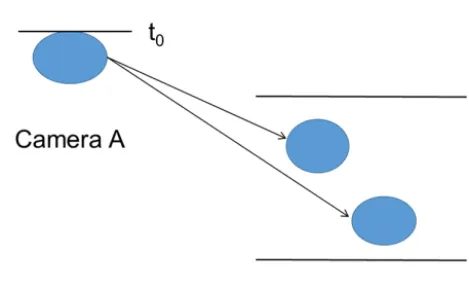
The two optic planes of the 2DVD are separated by around 6 mm and the accurate distance is based on calibration by dropping 10 mm steel balls at three corners of the sensing area (details of the calibration as well as accuracy of size, fall speed, and other geometric measures are given in Bernauer et al., 2015). During certain time periods, more than one pre-cipitation particle falls in the 2DVD observation area. Since the two cameras look in different directions, the particles ob-served by camera A and camera B need to be paired. This pairing procedure is called “matching”, and it is illustrated in Fig. 2. The time period [t1,t2] is dependent on the assumed
respec-Figure 1.A snowflake observed by a 2DVD from two views. The thick black line is the contour of the snowflake and the thin black lines show the holes inside the snowflake. The effective area,Ae, equals the area enclosed by the thick black curve minus the area enclosed by thin lines. The blue line represents the minimum circumscribed ellipse, the enclosed area of which is denoted byA.
tively, the distance between two optic planes isDd, and
cam-era A observed a particle att0, we have t1=t0+Dd/vmax
andt2=t0+Dd/vmin. After matching, the fall speed can be
calculated as Dd/1t, where 1t is the time difference
be-tween two cameras observing the same particle. Because the fall speed of the 2DVD is dependent on matching, the ge-ometric features and fall speeds will be in error when mis-match occurs. Huang et al. (2010) analyzed snow data from the 2DVD and found that the 2DVD manufacturer’s match-ing algorithm for snow resulted in a significant mismatchmatch-ing problem (see also Bernauer et al., 2015). In the Appendix of Huang et al. (2010), they showed that the mismatch will cause the volume, vertical dimension, and fall speed of par-ticles to be overestimated. Subsequently, the mass of parti-cles will also be overestimated, mainly because of fall speed. To get the best estimation of mass, they used 2DVD single-camera data and re-did the matching based on a weighted Hanesch criteria (Hanesch, 1999). If the match criteria are not satisfied, then that particle is rejected; it follows that the concentration will tend to be underestimated. To readjust the measured concentration for this underestimate (assumed to be a constant factor), the procedure described in Huang et al. (2015) is used, which only involves the ratio of the to-tal number of particles counted in the scan area of the single camera to the number of successfully matched particles in the virtual measurement area. For the event analyzed here (using method 1 in Sect. 3.3), this adjustment factor is between 1.1 and 1.5. The Pluvio gauge accumulation is not used as a con-straint in method 1. The disadvantage of using single-camera data, as described in Huang et al. (2015), is that the particle contour data are not available (i.e., the manufacturer’s code does not provide line scan data from single camera). With-out contour data, bothDapp andAcan only be estimated by
the maximum width of the scan line and height of the parti-cle as detailed in Huang et al. (2015). Moreover, the
diame-Figure 2.Illustration of the matching procedure. In the situation shown, it is assumed that camera A observed a particle at timet0, and afterwards during a certain time period,t1tot2, camera B ob-served two particles. The matching procedure decides which par-ticle observed by camera B is the same parpar-ticle observed by cam-era A.
ter of the circumscribing circle or ellipse cannot be obtained without contour data. The only quantity included in single-camera data isAein terms of number of pixels. The Huang
and Bringi approach (Huang et al., 2015) is referred to as HB, because both PSD (particle size distribution) and reflectivity (Ze) are computed usingDappas the measure of particle size.
For methods 2 and 3 in Sect. 3.3, we used the manufac-turer’s matching algorithm, which gives the contour data. To avoid overestimating mass due to mismatch, we need to filter out those particles with unreasonable fall speeds. The ver-tical dimension of the particle’s image before match is ex-pressed as a number of scan lines (i.e., how many scan lines are masked by the particle). After match (sovtis known), the
vertical pixel width isvt/fs, wherefs is the scan frequency
Table 1.Hanesch 2DVD scan line criteria.
Max of total Difference of scan lines scan lines
≤20 <3
21–44 15 %–11 %
45–181 11 %
≥182 20
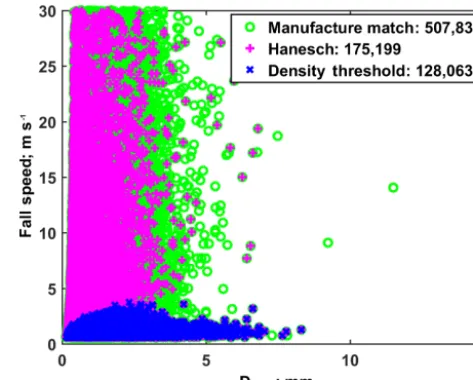
is the vertical pixel width multiplied by the number of scan lines. Because two optical planes of the 2DVD are parallel, theoretically, the number of scan lines from cameras A and B should be the same. Considering the distance from the par-ticle to the two cameras (projective effect of a camera), the digital error of a camera and particle rotation in two planes, the difference in the number of scan lines between two cam-eras may not always be the same but should be very close. Hanesch (1999) gave a set of matching criteria, the most important being the tolerance of the number of scan lines between the two cameras (see Table 1). To obtain reliable fall speeds, we examined all matched particles (given by the manufacturer’s matching algorithm, numbering 507 833 for the event and marked as green in Fig. 3) and removed those particles which did not satisfy the Hanesch scan line criteria, resulting in 175 199 (34.5 %) of particles that did satisfy the match criteria (magenta marks in Fig. 3). We used the fall speeds of these filtered particles to compute their mass for both Böhm and Heymsfield–Westbrook methods, and then divided the mass by apparent volume (=π Dapp3 /6) to get the particle density. Since the maximum density of ice par-ticles is around 0.9 g cm−3, we further remove particles with density larger than 1 g cm−3. After this two-step filtering, the particles we use for further analysis (numbering 128 063) are shown in Fig. 3 as blue points. The filtering will eliminate particles, which will reduce the liquid equivalent snow accu-mulation. Hence, the Pluvio gauge accumulation is used as an integral constraint, i.e., the concentration in each bin is increased by a constant factor to match the 2DVD accumula-tion to the Pluvio accumulaaccumula-tion. This constraint is only used in methods 2 and 3 in Sect. 3.3.
2.3 Scattering model
The scattering computation of ice particles is difficult be-cause of their irregular shapes with large natural variabil-ity (e.g., snow aggregates or rimed crystals). The most com-mon scattering method used in the meteorological commu-nity is the discrete dipole approximation (DDA; Draine and Flatau, 1994). However, DDA is very time consuming and not suitable for large numbers of particles, especially at W-band (e.g., Chobanyan et al., 2015). On the other hand, the T-matrix method (Mishchenko et al., 2002) is more time ef-ficient and commonly used in radar meteorology but it re-quires that the irregular particle shape be simplified to an
Figure 3.Fall speed vs. Dapp for the synoptic case on 31 Jan-uary 2012 at the CARE site. The green circles represent the results of the manufacturer’s matching algorithm, which is known to allow mismatched particles with unrealistic fall speeds. The first filter-ing step is the selection of matched particles which satisfy Hanesch scan line criteria (magenta). The second filter step is shown as blue crosses, which are based on particles with density (from mass com-puted by Böhm’s or Heymsfield–Westbrook method) lower than 1 g cm−3.
axis-symmetric shape (e.g., spheroid). Ryzhkov et al. (1998) have shown that, in the Rayleigh region, the radar cross sec-tion is mainly related to particle’s mass squared and less to the shape. For Mie scattering, however, the irregular snow shape plays a more significant role. Westbrook et al. (2006, 2008) used the Rayleigh–Gans approximation to develop an analytical equation for the scattering cross sections of sim-ulated snow aggregates of bullet rosettes using an empiri-cal fit to the form factor that accounts for deviations from the Rayleigh limit. Here, we use two scattering models, one based on the soft spheroid (Huang et al., 2015) with a fixed axis ratio and quasi-random orientation. The apparent den-sity is calculated as the ratio of mass to apparent volume. There is considerable controversy in the literature on the ap-plicability of the soft spheroid model with a fixed axis ratio, especially at Ka and higher frequencies such as W-band (e.g., Petty and Huang, 2010; Botta et al., 2010; Leinonen et al., 2012; Kneifel et al., 2015). However, Falconi et al. (2018) used the soft spheroid scattering model using T-matrix to computeZe (at X-, Ka-, and W-bands) and showed that an
effective optimized axis ratio of (oblate) spheroid could be selected that directly matches measuredZe by radar (their
model at W-band and concluded that the axis ratio can be used as a tuning parameter. They also showed the impor-tance of size integration to computeZe, i.e., the product of
N (D) and the radar cross section for the soft spheroid vs. complex-shape aggregates. Their result implied that smaller particles had a larger value for the product when using a soft spheroid of 0.6 axis ratio relative to complex aggregates and vice versa for larger particles, leading to compensation when Zeis computed by size integration over all sizes. Thus, the
soft spheroid model with axis ratio at 0.8 used by Huang et al. (2015), and which is used herein at Ku- and Ka-bands, is a reasonable approximation.
The second scattering model we used herein is from Liao et al. (2013), who use an effective fixed density approach to justify the oblate spheroid model. To compare the scattering properties of a snow aggregate with its simplified equal-mass spheroid, Liao et al. (2013) used six-branch bullet rosette snow crystals with maximum dimensions of 200 and 400 µm as two basic elements that simulate snow aggregation. They computed the backscattering coefficient, extinction coeffi-cient, and asymmetry factor for simulated snowflakes, using the DDA and for the corresponding spheres and spheroids with the same mass but density fixed at 0.2 or 0.3 g cm−3, and hence the apparent sphere volume equals the mass divided by the assumed fixed density. They showed that, when the fre-quency was lower than 35 GHz (Ka-band), the Mie scattering properties of spheres with a fixed density equal to 0.2 g cm−3 were in a good agreement with the scattering results for the simulated complex-shaped aggregate model with the same mass using the DDA (see also Kuo et al., 2016). They also showed this agreement with a spheroid model with a fixed axis ratio of 0.6 and random orientation. Here, we use the Liao et al. (2013) equivalent spheroid model with a fixed effective density of 0.2 g cm−3 at Ku- and Ka-bands (note that we estimate the mass of each particle from 2DVD mea-surements as described in Sect. 2.1). Note that this fixed-density spheroid scattering model is not based on micro-physics (where the density would fall off inversely with in-creasing size) but on scattering equivalence with a simulated (same-mass) complex-shaped aggregate snowflake (Liao et al., 2016).
3 Case analysis
3.1 Test site instrumentation and the synoptic event The GPM Cold-season Precipitation Experiment (GCPEx) was conducted by the National Aeronautics and Space Administration (NASA), USA, in cooperation with Envi-ronment Canada in Ontario, Canada from 17 January to 29 February 2012. The goal of GCPEx was “. . . to char-acterize the ability of multi-frequency active and passive microwave sensors to detect and estimate falling snow. . . ” (Skofronick-Jackson et al., 2015). The field experiment
Figure 4.A map of the GCPEx field campaign. The five test sites are CARE, Sky Dive, Steam Show, Bob Morton, and Huronia. The ground observation instruments, namely 2DVD, D3R, and Pluvio, used in this research, were located at CARE.
sites were located north of Toronto, Canada between Lake Huron and Lake Ontario. The GCPEx had five test sites, namely CARE (Centre for Atmospheric Research Experi-ments), Sky Dive, Steam Show, Bob Morton, and Huronia. The locations of five sites are shown in Fig. 4. The CARE site was the main test site for the experiment, located at 44◦13058.4400N, 79◦46053.2800W and equipped with an
ex-tensive suite of ground instruments. The 2DVD (SN37) and OTT Pluvio2400 used for observations and analyses in this paper were installed inside a DFIR (double fence intercom-parison reference) wind shield. The frequency dual-polarized doppler radar (D3R) was also located at the CARE site (Vega et al., 2014) near the 2DVD. The instruments used in this paper are depicted in Fig. 5. Because the radar and the instrumented site were nearly collocated, we can effec-tively view the set-up as similar to a vertical-pointing radar as described in more detail in Sect. 3.2.
tem-Figure 5. Instruments used in this study: (a) 2DVD (SN37), (b) D3R (dual-wavelength dual-polarized doppler radar), and (c) OTT Pluvio2400 precipitation gauge.
perature (K), relative humidity (%), and winds (m s−1) at 00:00 UTC, 31 January, during the middle of the accumu-lating snowfall. A trough axis is apparent just to the west of the GCPEx domain (green star in Fig. 6). Low-level warm-air advection forcing upward motion is coincident with high relative humidity on the leading edge of the trough, over the GCPEx domain (Fig. 6). Temperatures in this layer were around−10 to−15◦C throughout the event, supporting effi-cient crystal growth, aggregation, and potentially less dense snowfall as this is in the dendritic crystal temperature zone (e.g., Magono and Lee, 1966). Aircraft probe data during a descent over the CARE site between 23:15 and 23:43 UTC showed the median volume diameter (D0) of 3 mm, with
particles up to a maximum of 8 mm (aggregates of den-drites) at 2.2 km m.s.l. with a large concentration of smaller sizes<0.5 mm (dendritic and irregular shapes; Skofronick-Jackson et al., 2015). At the surface, photographs of the pre-cipitation types by the University of Manitoba showed small irregular particles and aggregates (<3 mm) at 23:30 UTC on 30 January.
3.2 D3R radar data
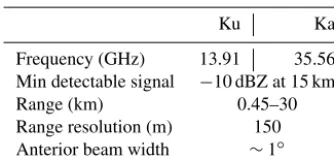
The D3R is a Ku- and Ka-band dual-wavelength polarimet-ric scanning radar. It was designed for ground validation of rain and falling snow from GPM satellite-borne DPR (dual-frequency precipitation radar). The two frequencies used in the D3R are 13.91 GHz (Ku) and 35.56 GHz (Ka). These two frequencies were used for scattering computations in this re-search as well. Some parameters of the D3R radar relevant for this paper are shown in Table 2. The range resolution of the radar is adjustable but usually set to 150 m and the near-field distance is∼300 m; the practical minimum operational range is around 450 m. The minimum detectable signal of the D3R is−10 dBZ at 15 km. This means that whenZhis −10 dBZ at 15 km, the signal-to-noise ratio (SNR) is 0 dB. Therefore, the SNR at any range,r, can be computed as fol-lows:
SNR(r)=Zh(r)+10+20log10
15
r
[dB]. (1)
The SNR is a very important indicator for radar data quality control (QC), the other important parameter for QC (in terms
Figure 6.The 00:00 UTC, 31 January 2012, 850 hPa geopotential heights (m, black solid contours), temperature (K, red: above freez-ing, blue: below freezing), relative humidity (%, green shaded con-tours), and wind (m s−1, wind barbs). The red dot in the center right portion of the figure denotes the general location of the GCPEx field instruments.
of detecting “meteo” vs. “nonmeteo” echoes) being the tex-ture of the standard deviation (SD) of the differential propa-gation phase (ϕdp). We randomly selected 20 out of 85 RHI
sweeps from 31 January 2012 and computed the SD of Ku-band ϕdp for each beam over 10 consecutive gates where
SNR≥10 dB. According to the histogram of the SD ofϕdp,
90 % of the values were less than around 8◦. Radar data at a range gatemare identified as “good” data (i.e., meteoro-logical echoes) only if the standard deviation of ϕdp from
the (m−5)th gate to the (m+4)th gate is less than 8◦. This criterion sets a good data mask for each beam at Ku-band. On the other hand, theϕdpat Ka-band was determined to be
Table 2.Some D3R parameters relevant for this study. Full D3R specifications can be found in Vega et al. (2014).
Ku Ka
Frequency (GHz) 13.91 35.56 Min detectable signal −10 dBZ at 15 km
Range (km) 0.45–30
Range resolution (m) 150 Anterior beam width ∼1◦
Note that both radars are mounted on a common pedestal so that the Ku and Ka-band beams are perfectly aligned.
There are four scan types that can be performed by the D3R, namely PPI (plan position indicator), RHI (range height indicator), surveillance, and vertical pointing. Figure 7 shows the scan strategies of the D3R on 31 January 2012, which consisted of a fast PPI scan (surveillance scan; 10◦per second) followed by four RHI scans (1◦per second), except from 01:00 to 02:00 UTC. The RHI scans with an azimuth angle of 139.9◦ point to the Steam Show site and those at 87.8◦point to the Sky Dive site. There were no RHI scans pointing to the Bob Morton site, and Huronia (52 km) was beyond the operational range (maximum 30 km) of the D3R. During the most intense snowfall the D3R scans did not cover the instrument clusters at the Sky Dive and Steam Show sites. So we were left with the analysis of the D3R radar data at close proximity to the 2DVD or effectively vertical-pointing equivalent using RHI data from 75 to 90◦at the nearest prac-tical range of 600 m. PPI scan data at low elevation angle (3◦) were also used from range gate at 600 m. The assumption is that there is little evolution of particle microphysics from about 600 m height to the surface and that the synoptic-scale snowfall was uniform in azimuth (confirmed by Skofronick-Jackson et al., 2015). The snowfall was spatially uniform around the CARE site so we selected data at 600 m range to be compared with the 2DVD and Pluvio observations (this range was selected based on the minimum operational range of 450 m; see Table 2) to which 150 m was added based on close examination of data quality. For RHI scans, the Zhat
each band was averaged over the beams from 75 to 90◦. The 75◦is obtained from 600·cos(75◦)≈155 m which is close to the range resolution. For the fast PPI scan,Zhwas averaged
over all azimuthal beams at 600 m range.
Figure 8 shows the time profile of the averagedZeat
Ku-and Ka-bKu-ands. There are two problems indicated in this fig-ure. First, theoretically, the Ku-band Ze should be greater
than or equal to the Ka-bandZe. The smaller Ku-bandZh
indicates that aZoffset exists at both bands. The other prob-lem is that, compared with the Ka-band, there are many dips in the Ku-band Zh. By comparing Fig. 8 with Fig. 7, we
found that these dips occur only at RHI scans with azimuth angle larger than 300◦. We examined those RHI scans beam by beam from 90 to 75◦. We further found that when the
el-Figure 7.D3R scan strategies on 31 January 2012. Theyaxis is azimuth angle (RHI; red x) or elevation angle (PPI; blue o). The scan rate of RHI was 1◦s−1and 10◦s−1for PPI.
Figure 8.The time series of averaged raw Zhat the CARE site. There are two problems indicated in this figure: (i) the Ku-bandZh is smaller than the Ka-bandZhon average. (ii) Compared with the Ka-band, there are many too small values of the Ku-bandZh.
evation angle is smaller than 78◦, the unreasonably lowZh
disappears. Therefore, the RHI scans with azimuth angles larger than 300◦were averaged over the 75 to 78◦elevation angles. To compute the DWR, we need to know theZ off-set between the two bands. The measuredZhincludes three
components (neglecting attenuation):
Zhmeas=Zhtrue±error(Zh)+Zoffset, (2)
Figure 9.The averaged rawZhfor Ku- and Ka-bands. TheZhwas randomly selected from 20 of 85 RHI scans with Ku-band Zh< 0 dBZ, range<1 km, and Ka-band SNR>3 dB.
being in units of dBZ. The measured DWR is as follows: DWRmeas=DWRtrue∓error(DWR)+1Zoffset, (3)
where error (DWR) is now increased, since the Ku- and Ka-band measurement fluctuations are uncorrelated (standard deviation of around 1.4 dB). The 1Zoffset is determined by
selecting data where the scatterers (snow particles) are suffi-ciently small in size so that Rayleigh scattering is satisfied at both bands, i.e., DWRtrue=0 dB. The criteria are used here to select gates where Ku-band Zh<0 dBZ along with
spa-tial averaging, which reduces the measurement fluctuations in DWR to estimate1Zoffsetin Eq. (3). Figure 9 shows the
averagedZhfor the two bands from 20 RHI scans which
sat-isfy the conditions above. After removing three extreme val-ues (outliers) from Fig. 9,1Zoffsetwas estimated as−1.5 dB,
which is used in the subsequent data processing. 3.3 2DVD data analysis
The 2DVD used in this study was also located at the CARE site. The particle-by-particle mass estimation is based on three methods as follows:
1. Following the procedure in Huang et al. (2015) we use 2DVD single-camera data and apply the weighted Hanesch-matching algorithm (Hanesch, 1999) to re-match snowflakes. A PSD adjustment factor is com-puted as in Huang et al. (2015) without using the Plu-vio gauge as a constraint. Mass is computed from fall speed,Dapp and environmental conditions using Böhm
(1989). The apparent density of the snow (ρ) is defined as 6m/π Dapp3 . A mean power-law relation of the form ρ=αDβappis derived for the entire event as in Huang et
al. (2015) as well as 1 min averagedN (Dapp)is
calcu-lated. Note that the scattering model is based on the soft spheroid model with fixed axis ratio=0.8 and appar-ent densityρ. The results obtained by this method are denoted HB in the figures and in the rest of the paper. 2. Use the manufacturer’s (Joanneum Research, Graz,
Austria) matching algorithm and filter-mismatched snowflakes as described in Sect. 2.2. The mass is com-puted from Böhm’s equations. The PSD adjustment fac-tor is based on using the Pluvio gauge accumulation as a constraint. Following Liao et al. (2013) as far as the scattering model is concerned, the density is fixed at 0.2 g cc−1and the volume is computed from mass= density·volume. The effective equal-volume diameter isDeffand the corresponding PSD is denotedN (Deff),
which is different fromN (Dapp)in (1) above.
Hence-forth, this method is denoted LM.
3. Use Joanneum matching and filtering method as in (2) but compute mass using Heymsfield–Westbrook equa-tions as well as the revised Deff and N (Deff). This
method is denoted HW. Thus, the only difference with (2) is in the estimation of mass and the difference inDeff
andN (Deff). The PSD adjustment factor is based on
us-ing the Pluvio gauge accumulation as a constraint. The scattering model follows Liao et al. (2013).
The 2DVD measured liquid equivalent snow rate (SR) can be computed directly from mass as follows:
SR=3600 1t
N
X
i=1
M
X
j=1
Vj
Aj
; hmm h−1i, (4)
where1tis the integral time (typically 60 s),Nis the number of size bins (typically 101 for the 2DVD),Mis the number of snowflakes in theith size bin, andAj is the measured area
of thejth snowflake. Further,Vjis the liquid equivalent
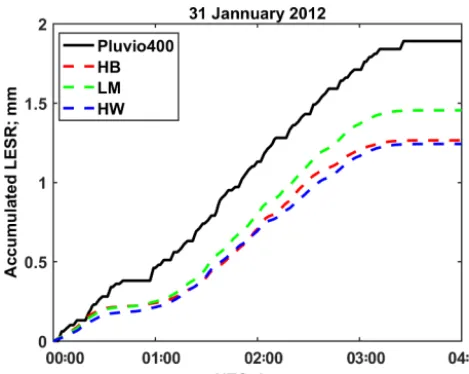
Figure 10. Comparison of liquid equivalent accumulations com-puted using HB, LM, and HW methods based on 2DVD measure-ments and that were directly measured by the collocated Pluvio snow gauge. We used the total accumulation to estimate the PSD adjustment factor for the LM and HW methods.
agree with Pluvio, rather the method described in Huang et al. (2015) is used giving the adjustment factor of 1.54 for 00:00–00:45 UTC and 1.11 for 00:45–04:00 UTC. From the Pluvio accumulation data in Fig. 10 the SR is nearly constant at 0.7 mm h−1between relative times of 1.5 and 3 h (or actual time from 01:00 on 30 January to 02:30 UTC).
The radar reflectivities at the two bands are simulated by using the T-matrix method assuming a spheroid shape with an axis ratio of 0.8, consistently with Falconi et al. (2018). The PSD is adjusted for methods 1, 2, and 3 as described above. The orientation angle distribution is assumed to be quasi-random with Gaussian distribution for the zenith angle [mean=0◦, σ =45◦] and uniform distribution for the
az-imuth angle. However, other studies have assumedσ =10◦ (Falconi et al., 2018). The recent observations of snowflake orientation by Garrett et al. (2015) indicate that substantial broadening of the snow orientation distribution can occur due to turbulence. Figure 11 compares the time series of D3R-measuredZhwith the 2DVD-derivedZefor the entire event
(20:00–03:30 UTC at (a) Ku- and (b) Ka-band). The Zefor
both bands computed by the three methods generally agree with the D3R measurements to within 3–4 dB. Overall, LM gives the highestZeand HB gives the lowest, which is
espe-cially evident at Ka-band. This is consistent with scattering calculations by Kuo et al. (2016) of single spherical snow aggregates using constant density (0.3 g cc−1) giving higher radar cross sections and size-dependent density, i.e., density falls off as inverse size (giving lower cross sections). This feature is consistent with the scattering models referred to herein as LM and HB.
Figure 11.Comparison of the 2DVD-derivedZhwith D3R mea-surements for the entire event, Ku-band(a), and Ka-band(b). This synoptic system started at around 21:00 Z on 30 January and ended at around 03:30 Z on 31 January 2012.Zeby LM is close to HW and slightly higher, whereas the HB method gives the lowestZe. Zeresults computed by all methods generally agree with D3R mea-suredZh.
From 00:45 to 01:30 UTC on 31 January 2012, the three 2DVD-derived Ze simulations deviate systematically from
the D3R results for both bands. The other period is from 23:00 to 23:30 UTC on 30 January 2012, when the Ku-band Ze has significant deviation from the D3R observations but
the Ka-bandZe generally agrees with the D3R. Note that
Zh in the range 15–20 dBZ around the CARE site, which
is in reasonable agreement with the D3R radar observations (Skofronick-Jackson et al., 2015).
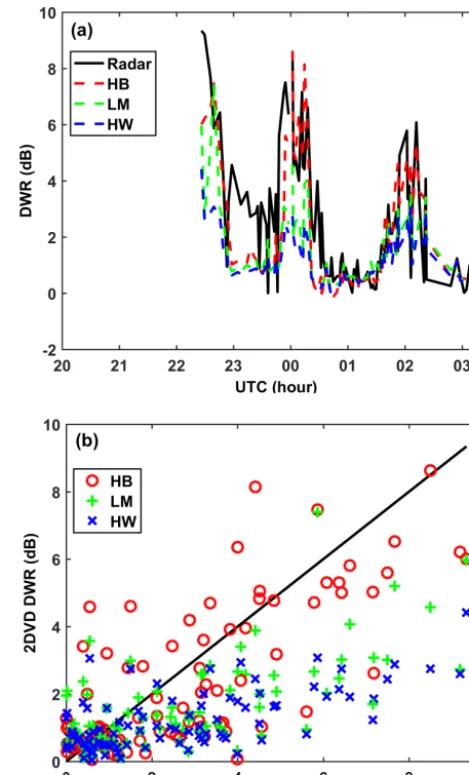
Figure 12a compares the time series of DWR simu-lated from 2DVD observations with the D3R measurements, whereas Fig. 12b shows the scatterplot In general, HB ap-pears in qualitatively better agreement (better correlated and with significantly less bias) with D3R measurements rela-tive to both LM and HW (significant underestimation rel-ative to D3R). The scatterplot in Fig. 12b is an important result since in the HB method the soft spheroid scattering model is used with density varying approximately inverse with Dapp (density-Dapp power law where the larger snow
particles have lower density). Hence for a given mass the Dapp is larger (relative to Ka-band wavelength) and enters
the Mie regime, which lowers the radar cross section at Ka-band (relative to same mass but constant density radar cross section in LM and HW). Whereas at Ku-band the differ-ence in radar cross sections is less between the two methods (Rayleigh regime). The significant DWR bias in LM and HW relative to DWR observations is somewhat puzzling in that the Liao et al. (2013) scattering model radar cross sections agree with the synthetic complex shaped snow aggregates of the same mass at Ka-band, whereas the HB model un-derestimates the radar cross section relative to the synthetic complex shaped aggregates. On the other hand, Falconi et al. (2018) demonstrate that the soft spheroid model is ade-quate at X (close to Ku-band) and Ka-band and by inference adequate for DWR calculations with the caveat that different effective axis ratios may need to be used at Ka- and W-bands. We also refer to airborne (Ku, Ka) band radar data at 00:30 UTC which showed DWR measurements of 3–6 dB about 1 km height MSL around the CARE site but nearly 0 dB above that all the way to the echo top (Skofronick-Jackson et al., 2015). The latter is not consistent with aircraft spirals over the CARE site about an hour earlier where max-imum snow sizes reach∼8 mm. In spite of the difficulty in reconciling the observations from the different sensors, the appropriate scattering model in this particular event appears to favor the soft spheroid model used in HB based on better agreement with DWR observations. The other factor to be considered is the PSD adjustment factor, which is assumed constant and independent of size, which may not be the case, especially for the LM and HW methods as considerable filter-ing is involved due to mismatch (as discussed in Sect. 2.2). Note that a constant PSD adjustment factor will not affect DWR but it will affect Ze. For the HB method Huang et
al. (2015) determined the PSD adjustment factor for four events by comparing the 2DVD PSD to that measured by a collocated SVI (snow video imager which was assumed to be the “truth”) for each size bin. The PSD adjustment was found to not be size dependent for the HB method. On the other hand, because of the filtering of mismatched particles by the LM and HW methods, the PSD adjustment factor may be size dependent in which case the DWR will also change.
Figure 12.Comparison of the 2DVD-derived DWR using HB, LM, and HW methods with the D3R-measured DWR. Panel(a)shows the time profile of the D3R, and(b)shows the scatterplot.
More case studies are clearly needed to understand the appli-cability of the LM and HW methods of simulating DWR. 3.4 Snow rate estimation
To obtain radar–SR relationships, we use the 2DVD data and simulations. Since we employ a constant PSD adjustment factor, it will scale bothZeand SR similarly. Figure 13 shows
the scatterplot of the 2DVD-derivedZevs. 2DVD-measured
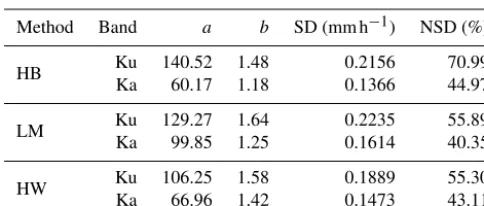
Table 3.Coefficients and exponents of the power-lawZ–SR rela-tionship for HB, LM, and HW methods and Ku- and Ka-bands, re-spectively.
Method Band a b SD (mm h−1) NSD (%)
HB Ku 140.52 1.48 0.2156 70.99
Ka 60.17 1.18 0.1366 44.97
LM Ku 129.27 1.64 0.2235 55.89
Ka 99.85 1.25 0.1614 40.35
HW Ku 106.25 1.58 0.1889 55.30
Ka 66.96 1.42 0.1473 43.11
at Ka-band the scatter is significantly lower with NSD from 40 % to 45 %. The errors in Table 3 are generally termed pa-rameterization errors.
By using dual-wavelength radar, we can estimate SR using Zeat two bands as follows:
(
SRKu=a01·Z
b01
Ku
SRKa=a02·Z
b0 2
Ka
, (5)
wherea0=(1/a)b0 andb0=1/b. To reduce error, we may take the geometric mean of these two estimators as follows: SR=(SRKu·SRKa)1/2=c·ZdKu·DWRe, (6)
wherec=(a10a20)1/2,d=(b01+b02)/2, ande= −b20/2. Note that the DWR in Eq. (6) is on a linear scale, i.e., expressed as a ratio of reflectivity in units of mm6m−3. Using Table 3 to set the initial guess of (c,d,e), nonlinear least squares fitting was used to determine the optimized (c,d,e) with the cost function being the squared difference between the 2DVD-based measurements of SR andcZdKuDWRe, whereZKuand
DWR are from 2DVD simulations. Figure 14 shows the SR computed from the 2DVD simulations of Ku-bandZeand the
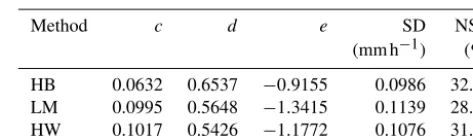
DWR using Eq. (6) vs. the 2DVD-measured SR. The (c,d,e) values for the three methods are given in Table 4. As can also be seen from Fig. 14 and Table 4, the SR(ZKu,DWR)using
the LM method results in the lowest NSD of 28.49 %, but the other two methods have similar values of NSD (≈30 %) and, as such, these differences are not statistically significant. Al-though SR(ZKu,DWR)has a smaller parameterization error
than Ze–SR, the SR(ZKu,DWR)estimation is biased high
when SR<0.2 mm h−1 (see Fig. 14). When SR is small, the size of snowflakes is usually also small and falls in the Rayleigh region at both frequencies, resulting in DWR very close to 1 (when expressed as a ratio). This implies that there is no information content in the DWR so including it just adds to the measurement error. Hence, for small SR or when DWR≈1, we use theZe–SR power law.
So far the single-frequency SR retrieval algorithms were based on 2DVD-based simulations with a PSD adjustment factor using the total accumulation from Pluvio as a con-straint. The algorithm we propose for radar-based estimation
Figure 14. Estimated SR using Ze and DWR of the 2DVD and Eq. (10) vs. 2DVD SR scatterplot for the HB method (a), LM method(b), and HW method(c).
Table 4.Coefficients and exponents of the SR(ZKu,DWR) relation (see Eq. 10) for three methods.
Method c d e SD NSD
(mm h−1) (%)
HB 0.0632 0.6537 −0.9155 0.0986 32.45 LM 0.0995 0.5648 −1.3415 0.1139 28.49 HW 0.1017 0.5426 −1.1772 0.1076 31.52
of SR is to use Eq. (6) when DWR>1 and SR>0.2 mm h−1, else we use theZKa–SR power law (note that we do not use
the ZKu-SR power law as the measurement errors of ZKu
seem to be on the high side, Fig. 9). The precise thresholds used herein aread hocand may need to be optimized using a much larger data set. Figure 15a shows the radar-derived accumulation usingZKa–SR vs. the Pluvio accumulation vs.
time. The total accumulation from the Pluvio is 2.5 mm and the three radar-based total accumulations, for HB, LM, and HW methods amount to [2.6, 1.8, 2.6 mm]. Except for the underestimation in the LM method (−28 %), the other two methods agree with the Pluvio accumulation in this event. Figure 15b is the same as Fig. 15a, except the combination algorithm mentioned above is used. For this case,∼33 % of data used theZKa–SR power law due to threshold constraints
given above. The event accumulations for HB, LM, and HW methods amount to [2.4, 1.9, 2.2 mm], which are consistent with the algorithm that uses only the ZKa–SR power law.
However, the criteria of relative bias error in the total ac-cumulation (in events with low acac-cumulations such as this one) are not necessarily an indication that the DWR-based algorithm is not adding value. Rather, the criteria should be snow rate intercomparison, which could not be done due to the low resolution (0.01 mm min−1) of the Pluvio2400 gauge along with the low event total accumulation of only 2.5 mm. A close qualitative examination of Fig. 15b shows that the HB method more closely “follows” the gauge accumulation relative to HB in time in Fig. 15a. In Fig. 15, the time grid is different for the radar-based data and the gauge data. It is common to linearly interpolate the gauge data to the radar sampling time and if this is done, the rms error for the HB method reduces from 0.1 mm (when using only theZKa–SR
power law) to 0.045 mm for the DWR algorithm, which con-stitutes a significant reduction by a factor of 2.
The total error in the radar estimate of SR is composed of both parameterization errors as well as measurement er-rors with measurement erer-rors dominating, since the DWR in-volves the ratio of two uncorrelated variables. From Sect. 8.3 of Bringi and Chandrasekar (2001), the total error of SR in Eq. (6) is around 50 % (ratio of standard deviation to the mean). The assumptions are (a) the standard deviation of the measurement ofZeis 0.8 dB, (b) the standard deviation of the
Figure 15.Comparison of the radar-derived accumulated SR us-ing HB, LM, and HW methods with Pluvio gauge measurement. (a)The radar SR is computed byZKa–SR relationships. The Pluvio-accumulated SR on 03:18 UTC is 2.48 mm. The radar-Pluvio-accumulated SRs for HB, LM, and HW are 2.64, 1.81, and 2.66 mm. (b)The radar SR is computed by combining SR(ZKu,DWR) andZKa–SR as described in the text. The accumulated SR derived from the radar using HB method is 2.38 mm, using LM it is 1.94 mm and using HW it is 2.24 mm.
Zefluctuations in Fig. 9, the measurement standard deviation
probably exceeds 0.8 dB, especially at Ku-band. Thus, suffi-cient smoothing of DWR is needed to minimize the measure-ment error as much as possible while maintaining sufficient spatial resolution.
Note that the error model used here is additive with the parameterization, and measurement errors modeled as zero mean and uncorrelated with the corresponding error vari-ances estimated either from data or via simulations (as de-scribed in Sect. 7 of Bringi and Chandrasekar, 2001). This is a simplified error model since it assumes that radar Z
and snow gage measurements are unbiased based on accu-rate calibration. A more elaboaccu-rate approach of quantifying uncertainty in precipitation rates is described by Kirstetter et al. (2015).
4 Summary and conclusions
The main objective of this paper is to develop a technique for snow estimation using scanning dual-wavelength radar oper-ating at Ku- and Ka-bands (D3R radar operated by NASA). We use the 2-D video disdrometer and collocated Pluvio gauge to derive an algorithm to retrieve snow rate from re-flectivity measurements at the two frequencies compared to the conventional single-frequencyZe–SR power laws. The
important microphysical information needed is provided by the 2DVD to estimate the mass of each particle knowing the fall speed, apparent volume, area ratio, and environmental factors from which an average density-size relation is de-rived (e.g., Huang et al., 2015; von Lerber et al., 2017; Böhm, 1989; Heymsfield and Westbrook, 2010).
We describe in detail the data processing of 2DVD cam-era images (in two orthogonal planes) and the role of par-ticle mismatches that give erroneous fall speeds. We use the Huang et al. (2015) method of rematching using single-camera data but also use the manufacturer’s matching code with substantial filtering of the mismatched particles since the apparent volume and diameter (Dapp) are more accurate.
To account for the filtering of the mismatched particles, the particle size distribution (in methods 2 and 3 in Sect. 3.3) is adjusted by a constant factor using the total accumulation from the Pluvio as a constraint.
Two scattering models are used to compute theZKu and
ZKa, termed the soft spheroid model (Huang et al., 2015;
HB method) and the Liao–Meneghini (LM) model, which uses the concept of effective density. In these two methods the particle mass is based on Böhm (1989). The method of Heymsfield and Westbrook (2010) is also used to estimate mass which is similar to Böhm (1989) but is expected to be more accurate (Westbrook and Sephton, 2017); along with the LM model for scattering, this method is termed HW.
The case study chosen is a large-scale synoptic snow event that occurred over the instrumented site of CARE during GCPEx. TheZKuandZKa were simulated based on 2DVD
data and the three methods, i.e., HB, LM, and HW yielded similar values within ±3 dB. When compared with D3R radar measurements extracted as a time series over the in-strumented site, the LM and HW methods were closer to the radar measurements with the HB method being lower by ≈3 dB. Some systematic deviations of simulated reflectivi-ties by the three methods from the radar measurements were explained by a possible size dependence of the PSD adjust-ment factor.
The direct comparison of DWR (ratio ofZKutoZKa) from
HB method gave the lowest bias with the data points more or less evenly distributed along the 1:1 line. The simulation of DWR by LM and HW methods underestimated the radar measurements of DWR quite substantially, even though the correlation appeared to be reasonable. The reason for this dis-crepancy is difficult to explain since a constant PSD adjust-ment factor (different for method 1 relative to methods 2 and 3 in Sect. 3.3) would not affect the DWR. From the scatter-ing model viewpoint, the LM method takes into account the complex shapes of snow aggregates via an effective density approach, whereas the HB method uses soft spheroid model with density varying approximately inversely with size. We did not attempt to classify the particle types in this study.
The retrieval of SR was formulated as SR=c·ZdKu·DWRe, where [c, d, e] were obtained via nonlinear least squares for the three methods. The total accumulation from the three methods using radar-measured ZKu and DWR were
com-pared with the total accumulation from the Pluvio (2.5 mm) to demonstrate closure. The closest to Pluvio was the HB method (2.4 mm), next was the HW method (2.24 mm) and then there was LM (1.94 mm). At such low total accumu-lations, the three methods show good agreement with each other as well as with the Pluvio gauge. The poor resolution of the gauge combined with the relatively low total accu-mulation in this event precluded direct comparison of snow rates. The combined estimate of parameterization and mea-surement errors for snow rate estimation was around 50 %. From variance decomposition, the measurement error vari-ance as a fraction of the total error varivari-ance was 58 %, and the parameterization error variance fraction was 42 %. Further, the DWR was responsible for 90 % of the measurement error variance, which is not surprising since it is the ratio of two uncorrelated reflectivities. Thus, the DWR radar data have to be smoothed spatially (in range and azimuth) to reduce this error, which will degrade the spatial resolution but is not ex-pected to pose a problem in large-scale synoptic snow events.
The snow rate estimation algorithms developed here are expected to be applicable to similar synoptic-forced snow-fall under similar environmental conditions (e.g., tempera-ture and relative humidity) but not, for example, to lake effect snowfall as the microphysics are quite different. However, analyses of more events are needed before any firm conclu-sions can be drawn as to applicability to other regions or en-vironmental conditions.
Data availability. The data used in this study can be made available
Appendix A
Table A1.List of acronyms and symbols.
Acronyms and Description Remarks
symbols
A Minimum circumscribing circle or ellipse that completely containsAe
Ae Particle’s effective projected area normal to airflow
Ar Area ratio. The ratio ofAetoA(Ae/A)
C0 Inviscid drag coefficient
Dapp Apparent diameter. It is equivalent-volume spherical diameter commonly used in 2DVD.
DDA Discrete dipole approximation
Dd Distance between two optical planes of 2DVD
Deff Effective diameter Liao et al. (2013)
DFIR Double fence international reference
Dm Mass-weighted mean diameter
Dmax Maximum dimension of a particle
DWR Dual-wavelength ratio Eq. (3)
D0 Median volume diameter
D3R Dual-wavelength dual-polarization doppler radar
fs Scanning frequency of 2DVD line-scan camera
GCPEx GPM Cold-season Precipitation Experiment
HB Huang and Bringi method Huang et al. (2015)
HVSD Hydrometeor velocity size detector
HW Heymsfield and Westbrook method Heymsfield and Westbrook (2010)
IWC Ice water content
LM Liao and Meneghini method Liao et al. (2013)
N (D) Concentration of PSD function of size PIP Precipitation imaging package PPI Plan position indicator PSD Particle size distribution
QPE Quantitative precipitation estimation
Re Reynolds number
RHI Range height indicator
SNR Signal-to-noise ratio Eq. (1)
SR Liquid equivalent snow ratio Eqs. (4) and (5)
vminorvmax Minimum or maximum possible terminal fall speed
vt Terminal fall speed
X Davies number, also called best number
Zdr Differential reflectivity
Ze Equivalent reflectivity factor. In this paper, we refer to the reflectivity factor based on scattering computation.
Zh Radar horizontal reflectivity factor Eq. (1)
ZKaorZKu Radar reflectivity factor at Ka- or Ku-band Eq. (5)
Zoffset The offset of radar reflectivity measurement
δ0 A dimensionless coefficient relate to boundary layer thickness.
ϕdp Differential propagation phase
Author contributions. GJH and VNB developed the main idea of this article. GJH analyzed 2DVD data, processed D3R data, adapted the scattering models for the case considered, simulated radar re-flectivity factor, derivedZe–SR and SR(Z,DWR) relationships, and wrote most of the article draft. AJN described the meteorological aspects of the studied case and wrote Sect. 3.1. VNB, DM, and BMN validated the scattering model used in the article. VNB and GL validated the D3R data. VNB and BMN supervised the NASA PMM Science research. GL supervised Korea Brain Pool Program and KMA grant. BMN and VNB reviewed and edited the article.
Competing interests. The authors declare that they have no conflict
of interest.
Acknowledgements. Gwo-Jong Huang acknowledges support from
the Brain Pool Program through the National Research Foundation of Korea (NRF) funded by the Ministry of Science and ICT (grant number 171S-5-3-1874). All authors except Gyuwon Lee acknowl-edge support from NASA PMM Science grant NNX16AE43G. Authors Gwo-Jong Huang and Gyuwon Lee were funded by the Korea Meteorological Administration Research and Development Program under Grant KMI2018-06810.
Edited by: S. Joseph Munchak
Reviewed by: three anonymous referees
References
Abraham, F. F.: Functional dependence of drag coefficient of a sphere on Reynolds number, Phys. Fluids, 13, 2194–2195, https://doi.org/10.1063/1.1693218, 1970.
Barthazy, E., Göke, S., Schefold, R., and Högl, D.: An op-tical array instrument for shape and fall velocity measure-ments of hydrometeors, J. Atmos. Ocean. Tech., 21, 1400–1416, https://doi.org/10.1175/JTECH-D-16-0221.1, 2004.
Bernauer, F., Hürkamp, K., Rühm, W., and Tschiersch, J.: On the consistency of 2-D video disdrometers in measuring microphys-ical parameters of solid precipitation, Atmos. Meas. Tech., 8, 3251–3261, https://doi.org/10.5194/amt-8-3251-2015, 2015. Böhm, H. P.: A general equation for the
termi-nal fall speed of solid hydrometeors, J. Atmos. Sci., 46, 2419–2427, https://doi.org/10.1175/1520-0469(1989)046<2419:AGEFTT>2.0.CO;2, 1989.
Botta, G., Aydin, K., and Verlinde, J.: Modeling of microwave scat-tering from cloud ice crystal aggregates and melting aggregates: A new approach, IEEE Geosci. Remote Sens. Lett., 7, 572–576, https://doi.org/10.1109/LGRS.2010.2041633, 2010.
Brandes, E. A., Ikeda, K., Zhang, G., Schönhuber, M., and Rasmussen, R. M.: A statistical and physical description of hydrometeor distributions in Colorado snowstorms using a video disdrometer, J. Appl. Meteor. Climatol., 46, 634–650, https://doi.org/10.1175/JAM2489.1, 2007.
Bringi, V. N. and Chandrasekar, V.: Polarimetric Doppler Weather Radar: Principles and Applications, Cambridge University Press, Cambridge, United Kingdom, 545–554, 2001.
Bukovˇci´c, P., Ryzhkov, A., Zrni´c, D., and Zhang, G.: Polari-metric Radar Relations for Quantification of Snow Based on Disdrometer Data, J. Appl. Meteor. Climatol., 57, 103–120, https://doi.org/10.1175/JAMC-D-17-0090.1, 2018.
Chobanyan, E., Šekelji´c, N. J., Mani´c, A. B., Ili´c, M. M., Bringi, V. N., and Notaroš, B. M.: Efficient and Accurate Computational Electromagnetics Approach to Precipitation Particle Scattering Analysis Based on Higher-Order Method of Moments Integral Equation Modeling, J. Atmos. Ocean. Tech., 32, 1745–1758, https://doi.org/10.1175/JTECH-D-15-0037.1, 2015.
Davies, C. N.: Definitive Equations for the Fluid Resis-tance of Spheres, Proc. Phys. Soc. London, A57, 259–270, https://doi.org/10.1088/0959-5309/57/4/301, 1945.
Delanoë, J., Protat, A., Testud, J., Bouniol, D., Heyms-field, A. J., Bansemer, A., Brown, P. R. A., and Forbes, R. M.: Statistical properties of the normalized ice par-ticle size distribution, J. Geophys. Res., 110, D10201, https://doi.org/10.1029/2004JD005405, 2005.
Draine, B. T. and Flatau, P. J.: Discrete dipole approximation for scattering calculations, J. Opt. Soc. Am. A, 11, 1491–1499, https://doi.org/10.1364/JOSAA.11.001491, 1994.
Falconi, M. T., von Lerber, A., Ori, D., Marzano, F. S., and Moisseev, D.: Snowfall retrieval at X, Ka and W bands: con-sistency of backscattering and microphysical properties using BAECC ground-based measurements, Atmos. Meas. Tech., 11, 3059–3079, https://doi.org/10.5194/amt-11-3059-2018, 2018. Fujiyoshi, Y., Endoh, T., Yamada, T., Tsuboki, K., Tachibana,
Y., and Wakahama, G.: Determination of a Z-R relationship or snowfall using a radar and high sensitivity snow gauges, J. Appl. Meteor., 29, 147–152, https://doi.org/10.1175/1520-0450(1990)029<0147:DOARFS>2.0.CO;2, 1990.
Garrett, T. J., Fallgatter, C., Shkurko, K., and Howlett, D.: Fall speed measurement and high-resolution multi-angle photogra-phy of hydrometeors in free fall, Atmos. Meas. Tech., 5, 2625– 2633, https://doi.org/10.5194/amt-5-2625-2012, 2012.
Garrett, T. J., Yuter, S. E., Fallgatter, C., Shkurko, K., Rhodes, S. R., and Endries, J. L.: Orientations and Aspect ra-tios of falling snow, Geophys. Res. Lett., 42, 4617–4622, https://doi.org/10.1002/2015GL064040, 2015.
Hanesch, M.: Fall Velocity and Shape of Snowflake, PhD disserta-tion, Swiss Federal Institute of Technology, Zürich, Switzerland, available at: https://doi.org/10.3929/ethz-a-003837623 (last ac-cess: 19 February 2019), 1999.
Heymsfield, A. J. and Westbrook, C. D.: Advances in the Estimation of Ice Particle Fall Speeds Using Laboratory and Field Measurements, J. Atmos. Sci., 67, 2469–2482, https://doi.org/10.1175/2010JAS3379.1, 2010.
Heymsfield, A. J., Wang, Z., and Matrosov, S.: Improved Radar Ice Water Content Retrieval Algorithms Using Coincident Micro-physical and Radar Measurements, J. Appl. Meteor., 44, 1391– 1412, https://doi.org/10.1175/JAM2282.1, 2005.
and its use in evaluating a mesoscale model, J. Appl. Meteor. Cli-matol., 45, 301–317, https://doi.org/10.1175/JAM2340.1, 2006. Huang, G., Bringi, V. N., Cifelli, R., Hudak, D., and Petersen,
W. A.: A Methodology to Derive Radar Reflectivity–Liquid Equivalent Snow Rate Relations Using C-Band Radar and a 2D Video Disdrometer, J. Atmos. Ocean. Tech., 27, 637–651, https://doi.org/10.1175/2009JTECHA1284.1, 2010.
Huang, G., Bringi, V. N., Moisseev, D., Petersen, W. A., Bliven, L., and Hudak, D.: Use of 2D-Video Disdrometer to Derive Mean Density-Size andZe-SR Relations: Four Snow Cases from the Light Precipitation Validation Experiment, Atmos. Res., 153, 34–48, https://doi.org/10.1016/j.atmosres.2014.07.013, 2015. Kirstetter, P. E., Gourley, J. J., Hong, Y., Zhang, J.,
Moaza-migoodarzi, S., Langston, C., and Arthur, A.: Proba-bilistic Precipitation Rate Estimates with Ground-based Radar Networks, Water Resour. Res., 51, 1422–1442, https://doi.org/10.1002/2014WR015672, 2015.
Kleinkort, C., Huang, G., Bringi, V. N., and Notaroš, B. M.: Vi-sual Hull Method for Realistic 3D Particle Shape Reconstruction Based on High-Resolution Photographs of Snowflakes in Free Fall from Multiple Views, J. Atmos. Ocean. Tech., 34, 679–702, https://doi.org/10.1175/JTECH-D-16-0099.1, 2017.
Kneifel, S., von Lerber, A., Tiira, J., Moisseev, D., Kol-lias, P., and Leinonen, J.: Observed relations between snowfall microphysics and triple-frequency radar mea-surements, J. Geophys. Res.-Atmos., 120, 6034–6055, https://doi.org/10.1002/2015JD023156, 2015
Kuo, K., Olson, W. S., Johnson, B. T., Grecu, M., Tian, L., Clune, T. L., van Aartsen, B. H., Heymsfield, A. J., Liao, L., and Menegh-ini, R.: The Microwave Radiative Properties of Falling Snow De-rived from Nonspherical Ice Particle Models. Part I: An Exten-sive Database of Simulated Pristine Crystals and Aggregate Par-ticles, and Their Scattering Properties, J. Appl. Meteor. Clima-tol., 55, 691–708, https://doi.org/10.1175/JAMC-D-15-0130.1, 2016.
Leinonen, J., Kneifel, S., Moisseev, D., Tyynelä, J., Tanelli, S., and Nousiainen, T.: Evidence of non-spheroidal behavior in millimeter-wavelength radar ob-servations of snowfall, J. Geophys. Res., 117, D18205, https://doi.org/10.1029/2012JD017680, 2012.
Liao, L., Meneghini, R., Iguchi, T., and Detwiler, A.: Use of Dual-Wavelength Radar for Snow Parame-ter Estimates, J. Atmos. Ocean. Tech., 22, 1494–1506, https://doi.org/10.1175/JTECH1808.1, 2005.
Liao, L., Meneghini, R., Tian, L., and Heymsfield, G. M.: Re-trieval of snow and rain from combined X- and W-band airborne radar measurements, IEEE T. Geosci. Remote, 46, 1514–1524, https://doi.org/10.1109/TGRS.2008.916079, 2008.
Liao, L., Meneghini, R., Nowell, H. K., and Liu, G.: Scattering com-putations of snow aggregates from simple geometrical particle models, IEEE J. Sel. Top. Earth Obs. Remote Sens., 6, 1409– 1417, https://doi.org/10.1109/JSTARS.2013.2255262, 2013. Liao, L., Meneghini, R., Tokay, A., and Bliven, L. F.:
Re-trieval of snow properties for Ku- and Ka-band dual-frequency radar, J. Appl. Meteor. Climatol., 55, 1845–1858, https://doi.org/10.1175/JAMC-D-15-0355.1, 2016.
Magono, C. and Lee, C. W.: Meteorological Classification of Natu-ral Snow Crystals, J. Fac. Sci., Hokkaidô University, Japan, Ser., 7, 321–335, 1966.
Matrosov, S. Y.: A Dual-Wavelength Radar Method to Measure Snowfall Rate, J. Appl. Meteor., 37, 1510–1521, https://doi.org/10.1175/1520-0450(1998)037<1510:ADWRMT>2.0.CO;2, 1998.
Matrosov, S. Y., Heymsfield, A. J., and Wang, Z.: Dual-frequency radar ratio of nonspherical atmospheric hydrometeors, Geophys. Res. Lett., 32, L13816, https://doi.org/10.1029/2005GL023210, 2005.
Meneghini, R. and Liao, L.: On the Equivalence of Dual-Wavelength and Dual-Polarization Equations for Estimation of the Raindrop Size Distribution, J. Atmos. Ocean. Tech., 24, 806– 820, https://doi.org/10.1175/JTECH2005.1, 2007.
Mishchenko, M. I., Travis, L. D., and Lacis, A. A.: Scattering, Ab-sorption, and Emission of Light by Small Particles, Cambridge University Press, Cambridge, United Kingdom, 2002.
Newman, A. J., Kucera, P. A., and Bliven, L. F.: Presenting the Snowflake Video Imager (SVI), J. Atmos. Ocean. Tech., 26, 167– 179, https://doi.org/10.1175/2008JTECHA1148.1, 2009. Petäjä, T., O’Connor, E., Moisseev, D., Sinclair, V., Manninen, A.,
Väänänen, R., von Lerber, A., Thornton, J., Nicoll, K., Petersen, W., Chandrasekar, V., Smith, J., Winkler, P., Krüger, O., Hakola, H., Timonen, H., Brus, D., Laurila, T., Asmi, E., Riekkola, M., Mona, L., Massoli, P., Engelmann, R., Komppula, M., Wang, J., Kuang, C., Bäck, J., Virtanen, A., Levula, J., Ritsche, M., and Hickmon, N.: BAECC: A Field Campaign to Elucidate the Im-pact of Biogenic Aerosols on Clouds and Climate, B. Am. Mete-orol. Soc., 97, 1909–1928, https://doi.org/10.1175/BAMS-D-14-00199.1, 2016.
Petty, G. W. and Huang, W.: Microwave backscattering and extinc-tion by soft ice spheres and complex snow aggregates, J. At-mos. Sci., 67, 769–787, https://doi.org/10.1175/2009JAS3146.1, 2010.
Rasmussen, R., Dixon, M., Vasiloff, S., Hage, F., Knight, S., Vivekanandan, J., and Xu, M.: Snow Nowcast-ing Using a Real-Time Correlation of Radar Re-flectivity with Snow Gauge Accumulation, J. At-mos. Sci., 42, 20–36, https://doi.org/10.1175/1520-0450(2003)042<0020:SNUART>2.0.CO;2, 2003.
Ryzhkov, A. V., Zrni´c, D. S., and Gordon, B. A.: Po-larimetric Method for Ice Water Content Determination, J. Appl. Meteor., 37, 125–134, https://doi.org/10.1175/1520-0450(1998)037<0125:PMFIWC>2.0.CO;2, 1998.
Schönhuber, M., Urban, H. E., Randeu, W. L., and Poiares Baptista, J. P. V.: Empirical Relationships between Shape, Water Con-tent and Fall Velocity of Snowflakes, ESA SP-444 Proceedings, Millennium Conference on Antennas & Propagation, Davos, Switzerland, 9–14 April 2000.
Schönhuber, M., Lammer, G., and Randeu, W. L.: The 2D-video-distrometer, Chapter 1, in: Precipitation: Advances in Measure-ment, Estimation and Prediction, edited by: Michaelides, S. C., Springer-Verlag, Berlin Heidelberg, ISBN 978-3-540-77654-3, 2008.
Mete-orol. Soc., 96, 1719–1741, https://doi.org/10.1175/BAMS-D-13-00262.1, 2015.
Szyrmer, W. and Zawadzki, I.: Snow Studies. Part II: Av-erage Relationship between Mass of Snowflakes and Their Terminal Fall Velocity, J. Atmos. Sci., 67, 3319–3335, https://doi.org/10.1175/2010JAS3390.1, 2010.
Szyrmer, W. and Zawadzki, I.: Snow Studies. Part IV: Ensem-ble Retrieval of Snow Microphysics from Dual-Wavelength Vertically Pointing Radars, J. Atmos. Sci., 71, 1171–1186, https://doi.org/10.1175/JAS-D-12-0286.1, 2014.
Tiira, J., Moisseev, D. N., von Lerber, A., Ori, D., Tokay, A., Bliven, L. F., and Petersen, W.: Ensemble mean density and its con-nection to other microphysical properties of falling snow as ob-served in Southern Finland, Atmos. Meas. Tech., 9, 4825–4841, https://doi.org/10.5194/amt-9-4825-2016, 2016.
Vega, M. A., Chandrasekar, V., Carswell, J., Beauchamp, R. M., Schwaller, M. R., and Nguyen, C.: Salient features of the dual-frequency, dual-polarized, Doppler radar for re-mote sensing of precipitation, Radio Sci., 49, 1087–1105, https://doi.org/10.1002/2014RS005529, 2014.
von Lerber, A., Moisseev, D., Bliven, L. F., Petersen, W., Harri, A., and Chandrasekar, V.: Microphysical Properties of Snow and Their Link to Ze–S Relations during BAECC 2014, J. Appl. Me-teor. Climatol., 56, 1561–1582, https://doi.org/10.1175/JAMC-D-16-0379.1, 2017.
Westbrook, C. D. and Sephton, E. K.: Using 3-D-printed ana-logues to investigate the fall speeds and orientations of complex ice particles, Geophys, Res. Lett., 44, 7994–8001, https://doi.org/10.1002/2017GL074130, 2017.
Westbrook, C. D., Ball, R. C., and Field, P. R.: Radar scattering by aggregate snowflakes, Q. J. Roy. Meteor. Soc., 132, 897–914, https://doi.org/10.1256/qj.05.82, 2006.
Westbrook, C. D., Ball, R. C., and Field, P. R.: Corrigendum: Radar scattering by aggregate snowflakes, Q. J. Roy. Meteor. Soc., 134, 547–548, https://doi.org/10.1002/qj.233, 2008.