Weighted Attribute Based Web service
Selection Framework for Successful
Integration
Kalagotla satish kumar, L.R.Krishna kotapati
#1M.Tech, Software Engineering, Gitam Institute Of Technology, Gitam University, Vishakapatnam, India. *2
M.Tech, Software Engineering, Gitam Institute Of Technology, Gitam University, Vishakapatnam, India. 1[email protected]
Abstract :-SOA based interoperable Web services popularity is increasing due to the different services(like SaaS) and advantages they provides to organizations upon their utilization. By reducing the cost of ownership and alleviating the burden of software installation and maintenance, SaaS has gained popularity in recent years and adopted by many enterprises to outsource some of their software infrastructure and development projects to SaaS vendors. There are thousands of service providers offering different web services to service consumers. But selecting a suitable service provider would become complicated task due to the lack of knowledge about service quality and trustworthiness. Most of the existing systems depended on consumer feedback to determine the service quality and reputation, which has the subjectivity and unfairness issues. To address this problem, in this paper we introduced a service monitoring framework at SLA to evaluate service quality and weighted attribute based service ranking algorithm to provide the ranking among the service providers. This algorithm will consider the user preferences against service provides information to provide the score and ranking, which leads to successful integration.
Keywords – Web Service Selection, SaaS(Software as a service), SLA(Service Level Agreement), user preferences, Scoring and ranking.
I. INTRODUCTION
Web service as the most widely applied SOA Distributed computing technology is capable of supporting resources sharing and application cooperation effectively in open, dynamic and heterogeneous environments. Many enterprise applications tend to use web service as the Business-to-Business (B2B) integration solution for its features such as self-contained, platform-independent, language-independent, and loosely coupled. The long-term success of commercial off-the-shelf (COTS) software as a time-effective alternative to custom “in-house” developed solutions is still being compromised by the involved cost of ownership, installation and maintenance time, and effort.
Therefore, the IT industry has started to move toward a new model for software delivery—one that is easy to deploy, maintenance-free, and cost-effective. The Software as a Service (SaaS) model, where software is delivered on-demand and priced on-use, has been made possible by the widespread adoption of fast Internet access, combined with the widespread acceptance of SOA- based solutions. By reducing the cost of ownership and alleviating the burden of software installation and maintenance, SaaS has gained popularity in recent years. As enterprises have started to outsource some of their software infrastructure and development projects to SaaS vendors, the number of SaaS offerings has expanded dramatically, even among vendors of traditional on- premises software.
So in our model, the guarantee of QoS attributes collection requires us to provide a fair, objective and dynamic web service evaluation. To achieve this we implemented a dynamic service monitoring system, which is a part of SLA to identify the service quality of service provider based on service level agreement provided information. It also considers the user preferences and weighted service attributes to determine service scoring and ranking. We implemented the functionality in a weighted attribute based service ranking algorithm.
II. RELATED WORK
The term “Service-Level Agreement” is applied to a range of document types of varying content and import. SLAs in which commitments to deliver various kinds of compensation are related to the behaviors of one or more software services and parties may be used to mitigate risk in web services(SaaS) scenarios.
Service-Level Agreements (SLAs), when part of service provision contracts, are a mechanism for controlling these risks. By associating financial penalties with poor service performance, or early termination of the service, the client may have an improved chance of receiving compensation in either event. This view of SLAs as a means by which to establish the liability of a party to pay a penalty to another party raises a number of requirements for the way in which SLAs should be written. Parties will generally not wish to pay penalties under any circumstances, and so are likely to contest the provisions of an SLA. If the original intent of the parties with respect to service provision is not properly captured by the SLA, or if a contest can successfully override the original intent, then the SLA has failed, because it did not mitigate the actual risk identified when it was written. We refer to the capacity of an SLA to withstand such contests as the protectability of the SLA.
In this paper we consider the requirement that SLAs be monitorable. Monitorability implies that parties can oversee the behavior of the service relevant to the SLA, or have it overseen on their behalf by parties that they trust. Without this ability it will be impossible for a party to assert that the SLA has been violated, and hence its provisions may be ignored by the service provider.
Monitorability for an SLA may be achieved by two means.
First, the SLA may only place conditions on events that are intrinsically observable by the parties. Alternatively, any event may be constrained, provided that a technical solution can be devised to render it monitorable in a trustworthy manner. Such solutions possibly include the use of monitoring software executing on trusted computing platforms or otherwise tamper-proof hardware.
III. SERVICE SELCTION FRAMEWORK
The goal of the rating function is to provide objective feedback on a delivered service without human intervention. We define in the following a feedback forecasting model that translates service execution quality into feedback so that any quality monitoring system can be enhanced in SLA with such a rating function. After finding the feedback is used to generate the scoring based on weighted attribute ranking selection algorithm.
A) Monitoring Service Performance
The focus in this work is on software services, contracted with monitorable Service Level Agreements (SLAs) [7]. Monitorable SLAs are a useful tool that governs consumer-provider relationship. From the customer’s perspective, the SLA introduces a level of accountability and a means to monitor service quality and performance. The service quality is determined by service uptime and service response time. So in this paper we considered the two quality parameters are considered: uptime and response time. The SLA also suggests that service uptime and response time are estimated each 15-minute period in the billing cycle. By using this knowledge in this project we will implement the service monitoring system. SLAs also include methods of compensation should the provider’s commitment not be met—in the example, a credit defined as a percentage of total charges paid by the consumer. Indeed, SLAs create an incentive for good behavior among SaaS providers but still do not guarantee any good behavior at service delivery time. For this reason, we devise a proactive strategy for risk reduction at selection time.
B) Feedback Forecasting
theory, consumer satisfaction is the outcome of the comparison between consumers’ preconsumption expectation and postconsumption disconfirmation, where confirmed expectations lead to moderate satisfaction, positively disconfirmed (i.e., exceeded) expectations lead to high satisfaction, and negatively disconfirmed (i.e., underachieved) expectations affect satisfaction more strongly than positive disconfirmation and lead to dissatisfaction. The shown below diagram represents how our system will monitor the service quality by using the expectance-disconfirmation theory.
Figure 1. Expectancy-Disconfirmation based Service feedback forecasting model.
From the above diagram, service monitoring system will collect the user perception and compares it against the user expectations to evaluate the disconfirmation. The disconfirmation is either positive or negative depends on the comparison. Actually the service quality and user satisfaction is measured based on different attributes of that service. These attributes(ex: uptime, response time, utility, cost, reputation, feedback, validation time ,preferences etc…) are defined and maintain by the SLA. At SLA level Cost and validation time is directly provided by service provider, uptime and response time are aggremented between both service provider and service consumer.
Assuming that there is a set of web services that have the exact same or similar function but only differ in non-functional characteristics, where S(S={s1, s2, s3,..., sm}), Using n QoS attributes to evaluate web service, where Q(Q={q1, q2, q3,..., qn}), we can obtain the following matrix S. Each row in S represents a web service si, while each column represents one of the QoS attributes.
According to the special feature of each QoS attributes, we roughly put them into two types: positive criterion and negative criterion. Positive criterion implies the higher value, the higher quality such as availability, and negative criterion implies the higher the value, the lower quality, for instance, latency and execution quality.
C) Service Selection
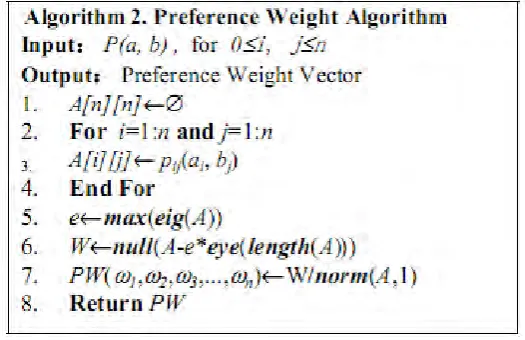
attributes as input parameter, and then uses the judgment matrix calculating method of AHP(Analytic Hierarchy Process), gets the maximum eigenvalue and the corresponding normalized eigenvector of preference relation matrix A as the preference weight output parameter as shown in fig.3. The n-dimensional vector PW is the quantified form of user individual preference. Decision Matrix is used to model the multiple-attribute decision making problems. The element vij of the decision matrix denotes the quantified value of QoS attribute qj according to project si.
Figure 2. User preference based attribute weight algorithm.
After introducing the decision matrix, web services evaluation has been transformed to an optimization problem about matrix computing. All most of the multiple-attribute decision making problem need information about relative importance of each QoS attribute, and commonly used a normalized vector to denote the weight of QoS attributes.
We use information entropy method, that takes the decision matrix S as the input parameter to calculate the information entropy of QoS attributes.
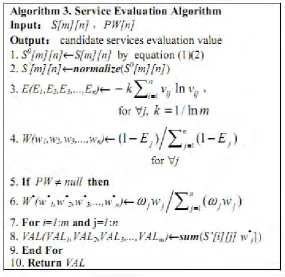
We can compute the objective weight of each QoS attribute according to information entropy. Moreover the preference weight is adopted to modify the objective weight. Finally, we can compute the evaluation value for each candidate web services by applying matrix S and the modified weight. So as to users could get the most matching candidate. The formula of evaluation value is shown below:
'
Figure 4. Service Selection and Scoring algorithm.
If user does not need to configure their preference, the algorithm computes the evaluation value with the objective weight. Based on the evaluation results we perform the procedure of ranking the candidate. To obtain the ranking related to each provider we are appointed the Bayesian ranking approach. This approach takes user preferences and attributes weights as input data and evaluates the ranking related to each provider. The ranking information can be used by our framework to suggest the appropriate and most suitable service provider information. This process not only reduces the selection time burden but also made the successful integration for web services.
IV. EXPERIMENTS
In a previous work [4], simulation experiments were conducted to evaluate the responsiveness of the system to permanent changes in service behavior. The experiments showed that the user ends up selecting the service instance that delivers the highest utility almost 83 percent of the time, and that she/he would not have been more satisfied with a service other than with her/his choice more than 87 percent of the time. Consider a set of 20 software services Si,i=1…20,say, for instance, 20 storage services, with 20 different QoS offers (uptime ranging from 97.99 to 99.99 percent) and different costs (price ranging from70 to 90).All services are assumed to have successfully selected the best service provider among all the relevant service providers.
V. CONCLUSION
In this paper, we have described our motivation and progress in working to develop monitoring system for SLAs with the principal purpose of mitigating outsourcing risks related to software web services (SaaS). The proposed service rating allows feedback to be assigned to a delivered service that objectively reflects the satisfaction or dissatisfaction with the rendered performance and quality. The selection algorithm has been designed to assist customers in selecting the most appropriate service offering considering quality and cost constraints. We used a service ranking algorithm that aggregates the quality, cost, and reputation parameters into a single metric that is used to evaluate service offerings against each other.
VI. REFERENCES
[1] J. Li, R. Conradi, O.P. Slyngstad, M. Torchiano, M. Morisio, and C.Bunse, “A State-of-the-Practice Survey of Risk Management in
Development with Off-the-Shelf Software Components,” IEEE Trans. Software Eng., vol. 34, no. 2, pp. 271-286, Mar./Apr. 2008.
[2] J. Anselmi, D. Ardagna, and P. Cremonesi, “A QoS-Based Selection Approach of Autonomic Grid Services,” Proc. Workshop
Service-Oriented Computing Performance: Aspects, Issues, and Approaches, 2007.
[3] L. Zeng, B. Benatallah, A.H. Ngu, M. Dumas, J. Kalagnanam, and H. Chang, “QoS-Aware Middleware for Web Services Composition,”
IEEE Trans. Software Eng., vol. 30, no. 5, pp. 311-327, May 2004.
[4] L.-H. Vu, M. Hauswirth, and K. Aberer, “QoS-Based Service Selection and Ranking with Trust and Reputation Management,” Proc. 13th
Conf. Cooperative Information Systems, 2005.
[5] J. Skene, F. Raimondi, and W. Emmerich, “Service-Level Agreements for Electronic Services,” IEEE Trans. Software Eng., vol. 36,no. 2,
pp. 288-304, Mar./Apr. 2010, http://doi.ieeecomputer society.org/10.1109/TSE.2009.55.
[6] J.R. Douceur, “The Sybil Attack,” Proc. First Int’l Workshop Peer-to-Peer Systems, 2002.
[7] J. Skene, A. Skene, J. Crampton, and W. Emmerich, “The Monitorability of Service-Level Agreements for Application Service Provision,”
Proc. Sixth Int’l Workshop Software and Performanc, pp. 3-14, 2007.
[8] Y. Wang and J. Vassileva, “A Review on Trust and Reputation for Web Service Selection,” Proc. 27th Int’l Conf. Distributed Computing
Systems Workshops, 2007.
KALAGOTLA SATISH KUMAR has done M.Tech. in Software Engineering from GITAM
UNIVERSITY, Vishakhapatnam, A.P, INDIA. My research areas include Software Reliability, Software Quality, Network Security.
L.R.KRISHNA KOTAPATI has done M.Tech in Software Engineering from GITAM UNIVERSITY,