University of New Hampshire
University of New Hampshire Scholars' Repository
Applied Engineering and Sciences Scholarship
Applied Engineering and Sciences
1-1-2007
Conditional constraint satisfaction and
configuration: A win-win proposition
Esther Gelle
Mihaela C. Sabin
University of New Hampshire, Manchester, [email protected]
Follow this and additional works at:
https://scholars.unh.edu/unhmcis_facpub
This Article is brought to you for free and open access by the Applied Engineering and Sciences at University of New Hampshire Scholars' Repository. It has been accepted for inclusion in Applied Engineering and Sciences Scholarship by an authorized administrator of University of New Hampshire Scholars' Repository. For more information, please [email protected].
Recommended Citation
Conditional Constraint Satisfaction and Configuration – A Win
-
Win Proposition
Esther Gelle, Power Generation, ABB Switzerland Ltd, Bruggerstrasse 72, CH-5400 Baden, Switzerland
Mihaela Sabin, Department of Mathematics and Computer Science, Rivier College, 420 Main Street,
Nashua, NH 03060
Submitted and accepted by IEEE Intelligent Systems (Revised Submission, November 2006)
Product configuration, like design, planning, or hardware test generation, is a real-world,
dynamic task. It supports on-the-fly selection of parts to assemble a large assortment of possible
product variants to satisfy functional specifications and customer choices. The conditional
constraint-satisfaction formalism offers a
natural way of representing these constraints, some of
which model how parts selection changes during the problem-solving
process. Conditional
constraint-satisfaction problems (CondCSPs) extend standard CSPs with a special type of
constraints that can capture changes at solving time
based on predefined conditions.
Recently, researchers have been increasingly
interested
in
modeling dynamic application
problems as CondCSPs. Consequently, they’ve developed specialized algorithms that depart from
standard CSP solving. However, we know little
about these algorithms’
relative performance
because they’ve been
experimental
ly analyzed separately using different test suites. We present a
CondCSP solver that includes two algorithms for direct and reformulated problem-solving
of
CondCSPs. Our analysis uses randomly generated CondCSPs a
nd shows new correlations between
problem topology and algorithm performance. These results shed more light on the CondCSP
problem class while expanding on the configuration problem’s solution.
Why Conditional Constraint Satisfaction?
Sanjay
Mittal and Brian Falkenhainer introduced the dynamic CSP formalism and its original
application domain, product configuration.
1
Sabin and
Eugene C. Freuder further developed this
formalism and renamed it “conditional CSP” to point out that the particular dynamic behavio
r
this
formalism captures consists of conditionally selecting only those variables and constraints that are
relevant to final solutions.
2
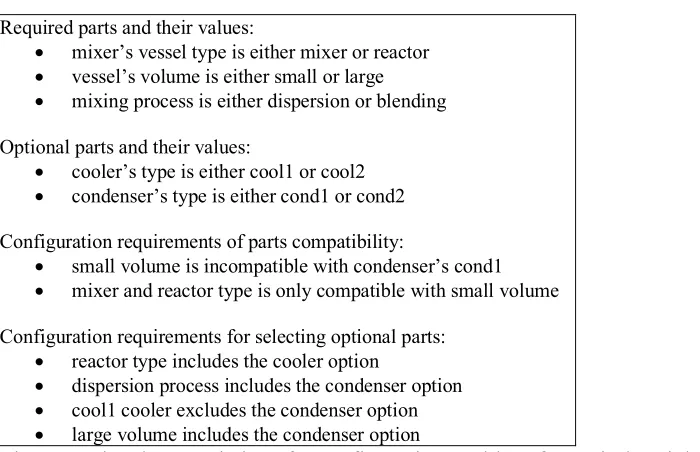
Figure 1
shows a configuration problem’s general characteristics in a
simple example for co
nfiguring an industrial m
ixer.
Required parts
and their values:
•
mixer’
s vessel type is either mixer or reactor
•
vessel
’
s volume is either small or large
•
mixing process is either dispersion or blending
Optional parts
and their values:
•
cooler’
s type is either cool1 or
cool2
•
condenser
’
s type is either
cond1 or cond2
Configuration requirements of parts
compatibility:
•
small volume is incompatible with condenser
’
s cond1
•
mixer and reactor type is only compatible with small volume
Configuration requirements for selecting optional parts:
•
reactor type includes the cooler option
•
dispersion process includes the condenser option
•
cool1 cooler excludes the condenser option
•
large volume includes the condenser option
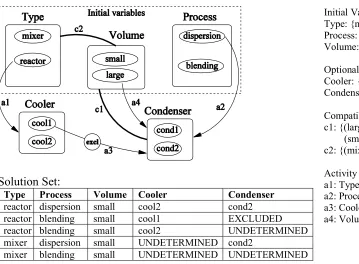
In CondCSP terms (see figure 2), the mixer configuration problem has variables, corresponding
to all the catalog parts, and constraints, corresponding to parts
’
compatibility rules and optional
functional and user selections. A formal description of CondCSPs is available elsewhere.
3
Initial Variables:
Type: {mixer,reactor}
Process: {dispersion,blending}
Volume: {small,large}
Optional Variables:
Cooler: {cool1,cool2}
Condenser: {cond1,cond2}
Compatibility Constraints:
c1: {(large,cond1)(large,cond2)
(small, cond2)}
c2: {(mixer,small)(reactor,sm
all)}
Activity Constraints:
a1: Type=reactor →incl
udes
Cooler
a2: Process=dispersion →incl
udes
Condenser
a3: Cooler=cool1 →incl
udes
Condenser
a4: Volume= large →excl
udes
Condenser
Solution Set:
Type
Process
Volume
Cooler
Condenser
reactor
dispersion
small
cool2
cond2
reactor
blending
small
cool1
EXCLUDED
reactor
blending
small
cool2
UNDETERMINED
mixer
dispersion
small
UNDETERMINED
cond2
mixer
blending
small
UNDETERMINED
UNDETERMINED
Figure 2. Variables and constraints of the industrial mixer example.
Recently, researchers have adapted constraint satisfaction and its conditional variant to the
planning domain
4,
5
and hardware test generation.
6
These application domains have produced
either specialized algorithms for solving CondCSPs or reformulations of CondCSPs into standard
CSPs using the classical CSP-solving arsenal. However, the CondCSP class lacks systematic
findings with regard to relative algorithm performance and how that performance correlates with
problem topology, such as density, satisfiability, and conditionality. CondCSP benchmark
problems are almost nonexistent, compounding this challenge.
Our
Contributions
To
address these challenges, we’
ve developed a CondCSP solver that includes two algorithms,
which we initially introduced and evaluated separately. One algorithm
uses
direct solving methods
that adapt standard consistency checking, such as forward checking and maintaining arc
consistency, to the special constraints that en
force conditionality in a CondCSP
.
7,
8
The second
algorithm reformulates the original problem into intermediate CondCSPs with incrementally lesser
conditionality as they’
re ultimately transformed into standard CSPs. Standard consistency checking
is interlea
ved with problem reformulation to eliminate inconsistent subproblems and solve the
resulting standard CSPs.
9,10
To overcome the lack of publicly available benchmark problems, we’ve used random CondCSPs
and designed test suites for both direct
- and reformul
ation
-solving algorithms. Our initial work is
available elsewhere
.
3
A more extensive evaluation analysis shows that no one method is best.
11
Reformulation
solving in conjunction with forward checking has the advantage of pruning whole subproblems,
so
preferable to direct solving using forward checking
and is more efficient on large, overconstrained
problems.
Solving Methods
for CondCSPs
The large collection of thoroughly tested algorithms for solving standard CSPs
contrasts starkly
with the few existing algorithms for solving CondCSPs. Esther Gelle provides the first complete
description of CondCSP backtrack search, which solves a partially reformulated CondCSP that
rewrites exclusion
activity constraints as compatibility constraints.
9
Sabin proposed CondCSP
analogs to CSP backtrack (CondBt), forward checking (CondFc), and maintaining arc consistency
(CondMac) search algorithms.
7
CondMac interleaves backtrack search with maintaining arc
consistency, which is adapted to propagate consistency checking on both compatibility and activity
constraints in the original CondCSP. Experimental evaluation on random CondCSPs shows up to
two orders of magnitude improved efficiency over plain backtrack search.
A different approach is to successively process activation conditions of inclusion into an
equivalent reformulat
ion.
9,10
The reformulation algorithm, Gt, generates a tree whose internal
nodes are CondCSPs and whose leaves are standard CSPs. Gt reformulates inclusion activity
constraints into compatibility constraints by creating intermediate CondCSPs with lesser
conditionality until it reaches the leaves level.
Standard consistency checking is interleaved with
tree generation to eliminate inconsistent subproblems and to eventually solve the resulting standard
CSPs. The two algorithms implemented are Gt with forward checking (GtFc) and Gt with
maintaining arc consistency (GtMac) algorithms. Experimental evaluation results of GtFc were
reported for solving a bridge design problem
9.//by you? Do you have a reference
?//
To examine these algorithms
’
relative performance, we’ve integrated both implementations
within the same solver framework (written in C++).
Experimental E
valuation
Our experimental analysis used randomly generated CondCSPs. The random CondCSP
generator
extends problem topology parameters, such as density and satisfiability of standard
constraints, with similar parameters that describe problem conditionality. R.J. Wallace, currently at
the Cork Constraint Computation Centre, University College Cork, Ireland, developed the random
CondCSP generator in 1996 when he was affiliated with the University of New Hampshire, U.S.A.
. We designed several test suites for which we varied the number of variables and the density and
satisfiability of both standard and condition-based constraints. We wanted to run experiments for
solving problems of a
solution space
that was large enough to
expose measurable differences in
execution time, but still
manageable.
Our evaluation’s
main goal wa
s to compare performance of
both types of algorithm encoded in the same C++ framework and executed on the same type of
machine (1.86 GHz Intel Pentium M processor).
All test suites show
ed
that all methods
’
time performance improves with increasing
conditionality. With increasing conditionality the problem gets overconstrained and the number of
solution
s decreases dramatically ,so finding all solutions is easier.
In all cases
, CondMac outperformed
CondFc, confirming Gelle and Sabin’s results.
3
CondMac
exploits activity constraints and the tension between inclusion and exclusion activations to prune
variable domains.
Because
the experimental studies use binary constraints, the activity constraints
with unary conditions yield a good pruning effect.
GtFc and GtMac’s relative time performance depends on the
solution
-space
size
. In general,
GtFc solves
underconstrained problems
faster. Gt transforms all exclusion constraints into
compatibility constraints
before generating
the tree.
We know
that Mac’
s performance deteriorates
with increasing problem density. In the case of Gt, the number of different compatibility
constraints of the resulting standard CSPs is larger than the original CondCSP
’
s because
all activity
overhead overcomes Mac’s pruning power, which doesn’t always pay off. Consequently, GtFc
prunes more efficiently at a lower effort cost.
GtFc becomes faster than CondMac when the solution space is large (that is,
in
an
underconstrained problem
), and, within the same parameter setting problem, GtFc runs faster when
the solution space is small (that is,
in
an overconstrained problem).
References
1.
S. Mittal and B. Falkenhainer, “Dynamic Constraint Satisfaction Problems,” Proc. 8th Nat’l
Conf
. Artificial Intelligence
, MIT Press
, 1990, pp. 25–32.
2.
M. Sabin and E.C. Freuder,
“Detecting and Resolving Inconsistency and Redundancy in
Conditional C
onstraint
Satisfaction P
roblems,” Proc.
C
onstraint
P
rogramming (CP
98),
Workshop
on
Constraint Problem Reformulation,
1998.
http://ic-www.arc.nasa.gov/people/frank/workshop.html#pub
3.
E.
Gelle and M. Sabin, “Solving Methods for C
onditional
Constraint Satisfaction,”
Proceedings of the IJCAI
Workshop
on Configuration affiliated with the Eighteenth
International Joint Conference on Artificial Intelligence, 2003;
www2.ilog.com/ijcai-03/Papers/IJCAI03-02.pdf
,
pp 7-12
4.
M. Binh Do and S. Kambhampati,
“Solving Planning-Graph by C
ompiling it into CSP,
” Proc.
5th Int’l Conf. Artificial Intelligence Planning Systems
,
AAAI Press, 2000
, pp. 82
–91.
5.
I. Miguel, P. Jarvis, and Q. Shen, “Flexible Graphplan,” Proc. 14th European Conf. Artificial
Intelligence
,
IOS Press, 2000, pp. 506–510.
6.
F. Geller and M. Veksler, “Assumption-Based Pruning in Conditional CSP,” Proc. 11th Int’l
Conf.
Principles and Prac
tice of Constraint Programming, LNCS 3709, Springer, 2005, pp.
241–255.
7.
M. Sabin, “Towards Improving Solving of Conditional Constraint Satisfaction Problems,”
doctoral dissertation, Computer Science Department, University of New Hampshire, 2003.
8.
M. Sabin, E.C. Freuder, and R.J. Wallace,
“Greater E
fficiency for Conditional Constraint
Satisfaction,” Proc. 9th Int’l Conf. Principles and Practice of Constraint Programming, LNCS
2833, Springer, 2003, pp. 649–663.
9.
E. Gelle, “On the Generation of Locally Consistent Solution Spaces,” doctoral thesis,
Artificial Intelligence Laboratory
,
Ecole Polytechnique Fédérale de Lausanne, 1998.
10.
E. Gelle and B.
Faltings, “Solving Mixed and Conditional Constraint Satisfaction Problems,”
Constraints
,
vol. 8, no. 2, 2003, pp. 107–141.
11.
E. Gelle and M. Sabin, “Solver Framework for Conditional Constraint Satisfaction Problems,”
Papers from the
Proceedings of the ECAI
2006
Workshop on Configuration
affiliated with the
17th European Conference on Artificial Intelligence
,
2006,
pp 14
-19
Esther Gelleis head of R&D power generation at Asea Brown Boveri Switzerland. Contact her at