https://doi.org/10.5194/amt-11-3433-2018 © Author(s) 2018. This work is distributed under the Creative Commons Attribution 4.0 License.
A study of the approaches used to retrieve aerosol extinction, as
applied to limb observations made by OSIRIS and SCIAMACHY
Landon A. Rieger1, Elizaveta P. Malinina2, Alexei V. Rozanov2, John P. Burrows2, Adam E. Bourassa1, and Doug A. Degenstein1
1Institute of Space and Atmospheric Studies, University of Saskatchewan, Saskatoon, Canada 2Institute of Environmental Physics, University of Bremen, Bremen, Germany
Correspondence:Landon A. Rieger ([email protected]) Received: 8 December 2017 – Discussion started: 2 January 2018
Revised: 12 April 2018 – Accepted: 2 May 2018 – Published: 15 June 2018
Abstract. Limb scatter instruments in the UV–vis spec-tral range have provided long-term global records of strato-spheric aerosol extinction important for climate records and modelling. While comparisons with occultation instruments show generally good agreement, the source and magnitude of the biases arising from retrieval assumptions, approximations in the radiative transfer modelling and inversion techniques have not been thoroughly characterized. This paper explores the biases between SCIAMACHY v1.4, OSIRIS v5.07 and SAGE II v7.00 aerosol extinctions through a series of coinci-dent comparisons as well as simulation and retrieval stud-ies to investigate the cause and magnitude of the various systematic differences. The effect of a priori profiles, parti-cle size assumptions, radiative transfer modelling, inversion techniques and the different satellite datasets are explored. It is found that the assumed a priori profile can have a large effect near the normalization point, as well as systematic in-fluence at lower altitudes. The error due to particle size as-sumptions is relatively small when averaged over a range of scattering angles, but individual errors depend on the par-ticular scattering angle, particle size and measurement vec-tor definition. Differences due to radiative transfer modelling introduce differences between the retrieved products of less than 10 % on average, but can introduce vertical structure. The combination of the different scenario simulations and the application of both algorithms to both datasets enable the ori-gin of some of the systematic features such as high-altitude differences when compared to SAGE II to be explained.
1 Introduction
Stratospheric aerosols play an import role in several atmo-spheric processes, including radiative forcing and ozone de-pletion. For decades, monitoring of stratospheric aerosols from satellite observations was largely the domain of oc-cultation instruments such as Stratospheric Aerosol and Gas Experiment (SAGE) II. However, since the 2000s aerosol extinction has been retrieved from limb scatter instruments such as the Optical Spectrograph and InfraRed Imaging Sys-tem (OSIRIS) (Llewellyn et al., 2004; Bourassa et al., 2012, and references therein), the SCanning Imaging Absorp-tion spectroMeter for Atmospheric CHartographY (SCIA-MACHY) (Burrows et al., 1995; Bovensmann et al., 1999; von Savigny et al., 2015, and references therein) and the Ozone Mapping and Profile Suite Limb Profiler (OMPS-LP) (Flynn et al., 2006; Loughman et al., 2018). While limb scatter provides greatly improved global coverage over oc-cultation satellites, it requires additional assumptions and computationally expensive forward models to perform the inversions. Despite the difficulties, comparisons between limb scatter and occultation measurements generally agree favourably with mean biases in the 10–15 % range during volcanically quiescent periods. While this is the average case, biases at certain latitudes and altitudes can be considerably larger. Additionally, biases after 2005 have not been well characterized due to the lack of baseline occultation mea-surements with which to compare.
inver-sion techniques are described in Sect. 2. Also introduced here is the new version 1.4 SCIAMACHY aerosol extinc-tion product used in this work. Initially, a triple compar-ison among OSIRIS, SCIAMACHY and SAGE II is per-formed in Sect. 3. As there was very little volcanic influence on the stratospheric aerosol load during the overlap period, this serves as a baseline for the agreement seen between the limb scatter and occultation aerosol records during volcani-cally quiescent times and motivates the investigation of ror sources. Section 4 discusses the magnitudes of the er-rors that are expected from the assumptions in the OSIRIS and SCIAMACHY retrievals and radiative transfer models through a series of simulation studies. Section 5 applies the IUP and USask retrievals to both datasets to investigate dif-ferences due to the inversion techniques and radiance prod-ucts. Lastly, conclusions and recommendations are discussed in Sect. 6
2 The aerosol retrievals
Generally, aerosol extinction retrievals for OSIRIS, SCIA-MACHY and OMPS-LP limb-scattering instruments pro-ceed in a similar fashion. First, radiance profiles at one or more wavelengths are used to construct a single measure-ment vector as a function of altitude. As this provides only one piece of information at each altitude, aerosol extinction is typically chosen as the retrieved quantity, although this is not the only possibility. However, extinction is the natu-ral quantity retrieved from occultation instruments and al-lows for continuation of this historical record. Ideally, the measurement vector would be dependent only on the desired aerosol extinction parameter, but in practice it is also affected by the surface albedo, atmospheric density and aerosol op-tical properties including particle size, shape and composi-tion. Typically, an effective Lambertian surface reflectivity is retrieved concurrently with the aerosol extinction, while the atmospheric density and optical properties are assumed using external information. Although atmospheric density is provided at high resolution by ECMWF (European Centre for Medium-Range Weather Forecasts) or MERRA, data on aerosol optical properties are much sparser and a notable lim-itation in the current retrievals.
Although particle size information has been retrieved from limb instruments in the past with OMPS-LP and OSIRIS (Rault and Loughman, 2013; Rieger et al., 2014) and more recently with SCIAMACHY (Malinina et al., 2018a), the standard operational products remain as extinction-only for the OSIRIS and OMPS-LP aerosol products. These ex-tinction products have been used in numerous studies and continue to contribute to the stratospheric aerosol record (Kremser et al., 2016; Thomason et al., 2017), highlighting the importance of accurately characterizing not only preci-sion but also biases in the current operational retrievals.
2.1 OSIRIS v5.07
OSIRIS was launched in 2001 aboard the Odin spacecraft (Llewellyn et al., 2004). The spectrograph produces limb-scattered radiance profiles from 280 to 810 nm, with typical sampling every 2 km, a vertical resolution of 1 km and an al-titude range from 7 to 75 km. Odin is in a near-terminator or-bit with an equatorial crossing time of approximately 06:00 on the descending node, providing limb measurements with a limited range of viewing geometries. Typically, solar scat-tering angles vary between 60 and 120◦with the largest val-ues occurring in the tropics, and little correlation between the mean scattering angle and latitude. The OSIRIS measure-ments have been used in the inversions of multiple species with products now spanning over 15 years (McLinden et al., 2012). The inversions use the SASKTRAN radiative trans-fer model (Bourassa et al., 2008; Zawada et al., 2015) and a multiplicative algebraic reconstruction technique (MART) to retrieve ozone, NO2 and aerosol extinction at 750 nm.
This paper uses the OSIRIS v5.07 aerosol data product re-trieved with the algorithm discussed in Bourassa et al. (2007, 2012), which simplifies to the Chahine inversion technique (Chahine, 1970) for the choice of tangent altitude weighting factors in the aerosol-specific portion of the MART retrieval. This algorithm will be referred to as the USask retrieval in this paper. For the radiative transfer modelling, a unimodal lognormal distribution is assumed with median radius,rg of 80 nm and distribution width,σg, of 1.6 as defined in Eq. (5). This distribution is consistent with mid-latitude optical par-ticle counter (OPC) measurements during volcanically qui-escent periods (Deshler et al., 2003), although the variability in the OPC measurements is large, as discussed in Sect. 4.3. Mie theory is used to calculate the aerosol scattering proper-ties with a refractive index from Palmer and Williams (1975) assuming a 75 % concentration of H2SO4 and 25 % H2O.
This produces a refractive index of 1.427+i7.167×10−8at 750 nm and 1.432+i0.0 at 470 nm. The USask measurement vector is defined as
yj k0 =ln
I (λ k, j ) I (λref, j )
− 1
N m+N−1
X
jref=m
ln
I (λ k, jref)
I (λref, jref)
, (1)
where the measurement vector,yj k0 at wavelengthkand al-titudej is the radiance, I, normalized by a reference alti-tude,jref, and shorter wavelength,λref, that is generally less
sensitive to aerosols. To reduce noise at the reference alti-tudeN measurements are used, beginning at tangent height jref=m. To improve the convergence speed of the relaxation
technique (Barcilon, 1975; Chu, 1985), a modelled measure-ment vector assuming a molecular atmosphere is also used as a normalization, yielding the measurement vector
yj k=y0j k−yj kmol, (2)
a constant offset, it does not affect the sensitivity of the mea-surement vector to aerosols. However, in addition to improv-ing convergence, this normalization also helps to identify the region of interest for the aerosol retrieval; after normalization by the molecular signal, the dominant components remain-ing are aerosol at lower altitudes and stray light at higher altitudes. The reference altitudes are chosen as the point, or points, where the measurement vector is at a minimum within the measurement noise, i.e. where both the stray light and aerosol signals are smallest. This produces a normalization that varies scan to scan, but typically produces reference al-titudes between 25 and 40 km with lower alal-titudes near the poles. For the USask retrieval, 750 nm is used as the long wavelength,λk, and 470 nm is used as the reference,λref.
At-mospheric data for pressure and temperature are interpolated to the OSIRIS scan location from the ECMWF operational analysis.
2.2 SCIAMACHY v1.4
SCIAMACHY (Burrows et al., 1995; Bovensmann et al., 1999) was a national contribution to the payload on ESA’s Envisat Satellite, which was launched in March 2002. En-visat was placed in a sun-synchronous orbit at 800 km al-titude with an equatorial crossing time of 10:00 on the de-scending node. In the limb mode the SCIAMACHY instru-ment scans across the flight direction with the total swath of 960 km and the centre of the scan displaced by a few degrees westwards from the flight direction. This results in solar scat-tering angles ranging from 30◦in the high northern latitudes to 150◦in the high southern latitudes with a strong latitudinal dependence. SCIAMACHY operation started in August 2002 and ended with a sudden loss of communication with the En-visat satellite in April 2012. SCIAMACHY performed mea-surements in eight spectral channels covering a wide spec-tral range from 214 to 2380 nm with a resolution varying from 0.2 to 1.5 nm. During its mission, SCIAMACHY mea-sured the solar radiation in nadir, limb scatter and solar–lunar occultation geometries and provided daily measurements of the solar spectral irradiance that have been used to retrieve a variety of species including aerosols, clouds, ozone, BrO, NO2 and water vapour. For this study stratospheric aerosol
retrievals are performed using the data from the limb scat-ter viewing geometry, where measurements are provided ev-ery 3.3 km with a vertical resolution of 2.6 km in the altitude range from approximately 0 to 100 km.
The stratospheric aerosol extinction retrieval algorithm used in this study is an updated version of the algorithm described by von Savigny et al. (2015) and Ernst et al. (2012). The SCIAMACHY v1.4 retrievals, herein referred to as the IUP retrievals, use the newer version 8 SCIAMACHY Level 1 radiance data. Atmospheric pressure and tempera-ture background profiles from ECMWF operational analysis data from the specific date, time and location of each SCIA-MACHY limb measurement are used. In comparison to the
previous version of the algorithm (von Savigny et al., 2015; Ernst et al., 2012) and the USask retrieval algorithm, the up-dated v1.4 algorithm drops the shorter, 470 nm wavelength normalization to reduce the uncertainties related to measure-ment noise and lower sensitivity to aerosols. The new mea-surement vector is given by
yj k=ln(I (λk, j ))−ln(I (λk, jref)). (3)
To reduce noise on the measurements, all measured wave-lengths within ±2 nm of λk are used in the retrieval. For the v1.4 extinction product the aerosol profiles are retrieved at 750 nm. The retrieval uses measurements in the altitude range from around 12 to 35 km (depending on the latitude and season) with a reference tangent altitude of about 38 km. The v1.4 aerosol extinction retrieval is performed on the measurement altitude grid, and the values below and above the retrieval range are fixed to the a priori. Effective Lam-bertian albedo of the underlying surface is concurrently re-trieved based on the limb radiances near the reference tan-gent height to reduce the influence of clouds below the field of view, although clouds within the field of view remain an issue. To reduce their impact, extinction values greater than 0.001 km−1are considered cloud contaminated and filtered after the retrieval is performed. To solve the inverse problem an iterative regularized inversion approach similar to that de-scribed by Rodgers (2000) is used. As in Ernst et al. (2012) it is assumed that the errors are uncorrelated, and the noise co-variance matrix is chosen to be diagonal. The signal-to-noise ratio is set to 200 for all tangent heights. For the a priori covariance matrix the non-diagonal elements drop off expo-nentially with a correlation radius of 3.3 km and the diagonal elements correspond to a relative standard deviation (SD) of 1.
product (rg=80 nm,σg=1.6). While a full validation of the version 1.4 is currently ongoing, initial comparisons with version 1.1 show smaller uncertainty of the individual re-trievals, reduced profile oscillations and better parameterized upwelling radiation (resulting also in less sensitivity to un-derlying clouds) due to the retrieval of albedo.
3 Coincident comparisons with SAGE II
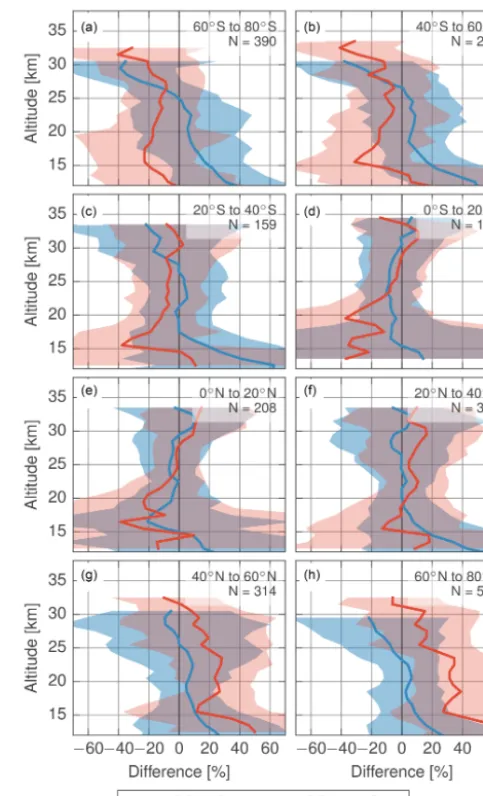
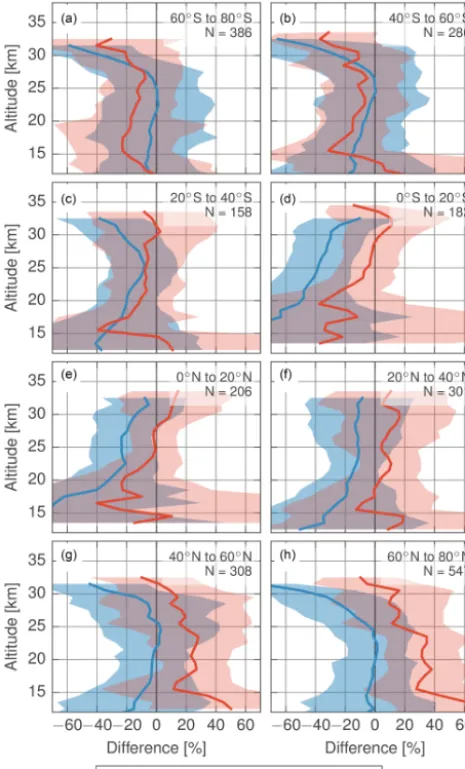
The SAGE II was launched in 1984 and operated until November 2005, providing one of the longest continuous records of stratospheric aerosols. As an occultation instru-ment, the SAGE II aerosol retrieval is insensitive to many of the assumptions required in the limb scatter retrievals, making for a robust, independent comparison. This work uses the version 7.00 SAGE II aerosol extinction data at 525 and 1020 nm (Damadeo et al., 2013). Several improve-ments have been made since version 6.2 that have resulted in aerosol extinction decreasing more quickly at higher alti-tudes. As both the OSIRIS and SCIAMACHY aerosol prod-ucts are produced at 750 nm, the SAGE II data are interpo-lated to this wavelength using the Ångström coefficient de-rived from the 525 and 1020 nm channels. Although this is not a perfect conversion, as the wavelength dependence is not strictly linear in log-wavelength log-extinction space, the error is generally limited to less than 10 % for most parti-cle sizes (Rieger et al., 2015). To test agreement between the three instruments a coincident comparison is performed when all instruments have collocated measurements. Mea-surements are used when OSIRIS and SCIAMACHY obser-vations are within ±5◦latitude,±20◦longitude and±24 h of the SAGE II tangent point. As limb measurements have approximately 200 km path lengths through the atmosphere, and scanning of a vertical profile typically occurs over a few degrees latitude, tightening these criteria does not generally improve agreement. To minimize the impact of clouds in the analysis extinction, values greater than 0.0025 km−1 have been excluded. Due to the relatively eruption-free period of this comparison, this has minimal effect on the comparisons removing approximately 3 % of scans above 15 km and none above 20 km. This criterion provides 2580 coincident mea-surements between 2002 and 2005, when all three instru-ments were operating. The comparison is broken into 20◦ lat-itude bins to better distinguish biases related to latlat-itude and solar geometry conditions. Results are shown in Fig. 1. In general, all instruments agree to within approximately 15 % for most regions. Exceptions to this are at high altitudes and latitudes (such as panels a, b and h) where both OSIRIS and SCIAMACHY retrieve lower values than SAGE II by up to 40 % at 30 km. At latitudes above 40◦N SCIAMACHY shows systematically higher results than SAGE II for all al-titudes below 30 km. This effect increases with latitude up to approximately 40 % at the highest northern latitudes and is visible in panels g and h of Fig. 1. Although the largest
Figure 1. Coincident comparison between OSIRIS and SCIA-MACHY measurements compared to SAGE II. Difference com-puted as (Instrument−SAGE II)/SAGE II×100 %. Shaded regions indicated one SD of the differences from the median.
clouds have been removed, both limb scatter instruments are likely to still contain some cloud contamination near and be-low the tropopause and the differences compared to SAGE II show large SDs in these regions.
Figure 2. Comparisons of the radiative transfer models. Panel (a) shows the differences in radiance computed us-ing SASKTRAN and SCIATRAN. Panel (b) shows the difference in measurement vectors. Panel (c) shows the difference in retrieved profiles. Differences in panels (a) and (b) are computed as (SASKTRAN−SCIATRAN)/ (SASKTRAN+SCIATRAN)×200 %. Extinction error is com-puted as (retrieved−true)/true×100 %.
these effects depends on the viewing geometry of the instru-ment. OSIRIS and SCIAMACHY have significantly different viewing geometries as a result of the Envisat and Odin orbits. The following sections explore the significance of these dif-ferent effects.
4 Simulation study
To test the sensitivity of the retrievals to assumed parameters and retrieval settings, a series of simulation studies is per-formed. The 2580 near-coincident scans from the SAGE II comparison are used as the test cases. These scans cover the full range of OSIRIS and SCIAMACHY geometries. While these scans are limited to pre-2006, the simulations use a range of atmospheric scenarios consistent with both background and volcanically perturbed conditions. Four fac-tors are investigated in this study: the impact of different ra-diative transfer models, a priori extinction profile and particle size assumptions and choice of measurement vectors. 4.1 Radiative transfer modelling
It is difficult to decouple the retrieval algorithms from the radiative transfer models entirely due to differences in lan-guages, input formats, and interfaces. However, differences between the IUP and USask retrievals due to the radiative transfer models can still be estimated by simulating mea-surements using one model and retrieving with the other. For this test, the SASKTRAN radiative transfer model is used to generate radiances that simulate the OSIRIS measurements.
Figure 3.The range of the true state aerosol profiles is shown as the shaded region. The USask a priori is shown in blue and the IUP in red.
error if the radiative transfer model biases change with wave-length.
4.2 A priori profiles
The effect of the a priori profile on the retrieval is an impor-tant consideration and one that has the potential to vary sub-stantially between retrieval methods. Although the MART relaxation used in the USask retrieval has no regularization, and the IUP retrieval is only weakly constrained by the a pri-ori, the effect of the a priori at altitudes above the retrieval range can still play an important role. The aerosol here can couple to the lower altitudes due to the high-altitude normal-ization of the measurement vectors. While this normalnormal-ization has many benefits, it has the drawback of coupling the error at high altitudes to all altitudes below. The USask retrieval scales the a priori above the retrieval range, at each itera-tion of the retrieval to match the top retrieved value and thus avoid sharp discontinuities in the retrieved profile. Therefore, the absolute error above the retrieval range depends on the shape of the a priori profile at and above the normalization and the retrieved aerosol just below the normalization. Con-versely, the IUP extinction is fixed to the a priori value above the retrieval altitudes and so will depend less on the shape of the chosen a priori and more on the absolute value in the normalization range.
The effect of the a priori above the retrieval range is tested through a simulation study where the true high-altitude aerosol profile (i.e. the input profile used to generate the syn-thetic measurements) differs from that assumed in the re-trievals. For this test an exponentially varying aerosol pro-file above 30 km is taken to be the truth. The slope of the exponential profile is then varied for each simulated OSIRIS and SCIAMACHY scan. The range of exponential profiles used as true states in the simulations is shown as the grey
Figure 4.Relative error in the OSIRIS data retrievals at 20 km as a function of the absolute error in the true extinction at the reference point. The solid lines show the least squares fit to the data.
shaded region in Fig. 3. The USask and IUP a priori values are shown as the blue and red lines respectively. The shape of the a priori profile below 30 km, as well as all other aerosol parameters such as particle size, is assumed correctly in the simulated retrievals to avoid introducing errors due to other retrieval parameters. The simulated data were then used to retrieve the extinction profile using the USask and IUP re-trievals under two conditions. First, both rere-trievals are ini-tialized with the USask a priori profile and, second, both are initialized with the IUP a priori profile.
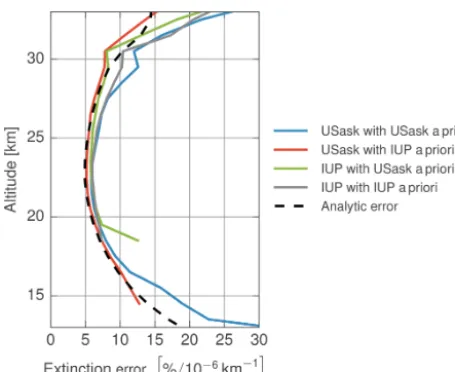
Figure 5.Percent error in the OSIRIS data retrievals as a function of altitude relative to an extinction error of 10−6km−1at 35 km. Solid lines show values computed from the best fit line from the simula-tion studies shown in Fig. 4. Dashed line shows the error expected from the linear error analysis of Eq. (4).
sensitivity to a priori errors in the IUP retrieval, which uses a 38 km reference height, as opposed to the USask retrieval that used 35 km. The same error of 10−6km−1at a normal-ization altitude of 38 km will cause approximately twice the error that it does at 35 km. At low altitudes, less than approx-imately 14 km, the sensitivity to aerosol is very low and the retrievals no longer show a clear relationship between the re-trieval error and the a priori error.
The altitude dependence of the retrieved error, normalized by the error at 35 km is shown in Fig. 5. We note that nor-malizing the IUP retrieval by the error at 35 km is not strictly correct as the reference altitude is at 38 km. However, this allows for a consistent comparison between the two algo-rithms, and due to the relatively linear nature of the error it is not expected to introduce large biases. The retrieval error is smallest at around 22 km, where the aerosol loading is high-est, and the measurement sensitivity is still quite good, with error increasing above and below this altitude. The error can also be estimated without simulating the full retrieval using the equation
δk=Gδy, (4)
whereδkis the error in the retrieved extinction,Gis the gain matrix or the sensitivity of the retrieved extinction to vari-ations in y, andδy is the error in the measurement vector. In this case, δy is the error in the measurement vector due to errors in the assumed aerosol at the normalization altitude and above. As the retrieval error is quite linear with respect to errors in the high-altitude profile,δyin the retrieval range can be calculated directly from the Jacobian matrix,K. This analysis as applied to the USask retrieval is plotted in Fig. 5 as the dashed line. Agreement between the analytic method
and simulation study is excellent over the full range of values tested. AsGandKare typically readily available from the inversion method, this can also be applied on an operational basis if estimates of the extinction error at the normalization point are known.
4.3 Particle size
In the standard extinction retrievals the aerosol optical prop-erties are not retrieved and must therefore be assumed when retrieving extinction. Of primary importance in the IUP, US-ask and OMPS retrievals is the assumption of a fixed particle size. All three retrievals assume lognormal distributions that correspond to typical background conditions as measured by Deshler et al. (2003), albeit with somewhat different lognor-mal parameters. The lognorlognor-mal distribution used in the re-trievals is given by the equation
n(r)=√ N
2πln(σg)r
exp −(ln(rg)−ln(r))
2
2ln2(σg) !
, (5)
where rg is the median radius, σg the distribution width andN the number density. During background conditions the median radius is generally larger than 40 nm but less than 200 nm, depending on altitude. However, after volcanic erup-tions, a second mode of particles with median radii up to a few microns may be present, further complicating the anal-ysis. The effect of this constant unimodal particle size as-sumption was estimated to a degree by Rieger et al. (2015), but a limited number of geometries and cases were tested. More recently, Loughman et al. (2018) estimated the impact of particle size assumptions based on estimates of the phase function, but they did not fully propagate the error through the retrievals. This work extends these previous analyses to additional conditions and geometries and estimates the im-pact on the retrieved extinction.
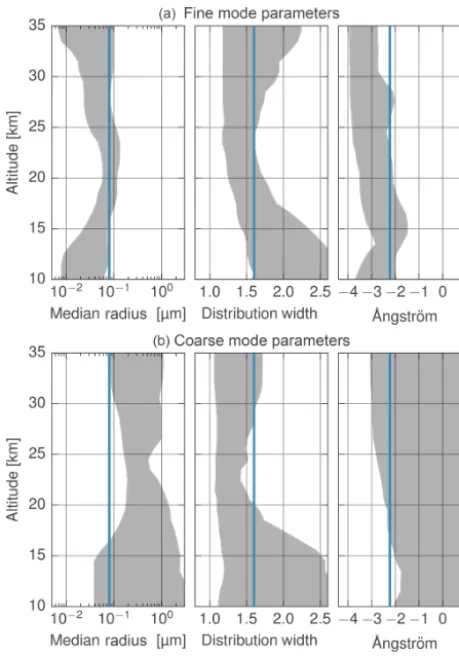
Figure 6.The range of particle sizes tested as a function of altitude. Panel(a)shows the fine-mode parameters and panel(b)the coarse mode. The blue lines show the USask and IUP a priori values as-sumed in the retrievals. The grey shaded region shows the range of values used in the simulations.
the total extinction. In each case, the coincident OSIRIS and SCIAMACHY scans were simulated using a random OPC particle size profile and a random albedo between zero and one as the true state. Figure 6 shows the range of median radii, widths and Ångström exponents (calculated between 525 and 750 nm) used in the simulations, as well as the a pri-ori values.
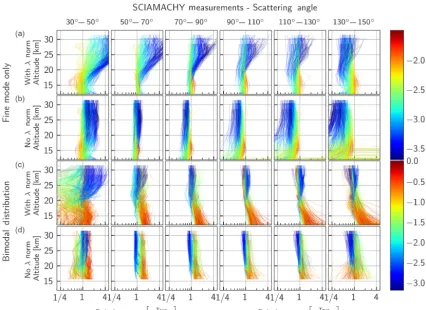
The standard USask algorithm was then used to retrieve extinction with the simulated data. These retrievals were also repeated using the USask algorithm but without the short wavelength normalization to determine its effect. The top row of Fig. 7 shows the relative error in the retrieved ex-tinction for the standard USask retrieval when only a fine mode of particles is present, grouped by scattering angle. The colour of the line indicates the Ångström coefficient. Only the SCIAMACHY geometries are shown here, as the OSIRIS results are very similar, but with a reduced range of scattering angles. Generally, errors are largest in the strongly forward and backscattering cases, with a strong dependence on the Ångström coefficient. The assumed size distribution
has an Ångström coefficient of 2.3, and consequently when the true state is near this value the retrieval has little error. At altitudes above 25 km, however, this assumption is con-sistently too high and leads to large errors, particularly in strongly forward scattering conditions.
The second row of Fig. 7 shows the same, but when the re-trieval does not use a short wavelength normalization. In this case, the error is reduced in forward scattering conditions but increased in backscatter, particularly at lower altitudes, where sensitivity to aerosol is poor. The third row shows re-trievals when the true state includes a second coarse mode of particles. In this case the assumption of an Ångström coef-ficient of 2.3 is generally more accurate at higher altitudes, and so the error above 20 km is reduced compared to the fine-mode-only case. However, the dependence on Ångström co-efficient is weaker for the bimodal distributions, with many different particle sizes producing comparable errors. The ef-fect of normalization is also not as clear under these more volcanic conditions, with only strongly forward scattering geometries showing a clear preference for no wavelength normalization.
Figure 7.Error in the retrieved USask extinction for the simulated SCIAMACHY measurements grouped by the scattering angle for four different cases. The top two rows show results when only a fine mode of aerosols are present; the bottom two rows have both a fine and coarse mode. In both cases retrievals are done with a short wavelength normalization (aandc) and without (bandd). The colour of the lines indicates the Ångström coefficient.
the error is minimized during forward scattering conditions when scattering angles are near 60◦. When short wavelength normalization is used the error is at a minimum near 90◦; subsequently the error for forward scatting geometries is in-creased, while it is decreased for backscattering geometries.
When coarse-mode particles are included, the phase func-tions can vary more widely for a given Ångström coefficient, leading to less of a clear relationship in the retrieved error. This can be seen in panels c and d of Fig. 8, where much weaker correlation between the Ångström coefficient, solar scattering angle and extinction error is visible. Even when the Ångström coefficient is assumed correctly, differences in the lognormal parameters can induce errors of 30 % in the retrieval for OSIRIS geometries and 50 % for SCIAMACHY geometries. While the error is less correlated, errors are not systematically larger than during volcanically quiescent pe-riods, but do have a tendency to introduce low biases in the retrieved results for most geometries and particle sizes. Ad-ditionally, while backscatter can still have large biases, they are not as large at the extreme scattering angles as during fine-mode-only conditions. During bimodal conditions the error in both the normalized and non-normalized retrievals is comparable, except during strongly forward scattering con-ditions when the short wavelength normalization increases the error. In general, this shows that the short wavelength normalization is beneficial during background periods under backscattering conditions, but generally increases the error during forward scatter. Additionally, in forward scatter both the 470 and 750 nm wavelengths are positively sensitive to aerosol, so the wavelength ratio will tend to decrease the sen-sitivity to aerosol and decrease the retrieved precision due to measurement noise as well.
5 Retrieval study
In Sect. 4 the sensitivity to retrieval assumptions and radia-tive transfer modelling was estimated. In this section, we ex-plore the applicability of the USask retrieval to the SCIA-MACHY measurements and vice versa, both to confirm the simulation studies and to better understand the sensitivity of the retrievals to differences in the radiance products. The same set of coincident SAGE II scans is used for this study, with comparisons performed in the same way as those pre-sented in Sect. 3.
Figure 9 shows the USask retrieval applied to both in-struments. Retrievals using the SCIAMACHY measurements agree very well with those using OSIRIS and show many of the same biases with respect to SAGE II. Both instruments show underestimation with respect to SAGE II at high al-titudes and laal-titudes. If this was due to inaccuracies in the assumed particle size the error would be expected to change signs between hemispheres as the SCIAMACHY solar scat-tering angle goes from backscatscat-tering to forward scatscat-tering, which is not the case. Instead, these high-altitude errors are
Figure 9.Coincident comparison with SAGE II when both OSIRIS and SCIAMACHY measurements have been processed with the USask algorithm.
Figure 10. Coincident comparison with SAGE II when both OSIRIS and SCIAMACHY measurements have been processed with the IUP algorithm.
the IUP retrieval in Fig. 1, again suggesting a particle size error. In the USask retrieval this shift is approximately 20– 30 % between hemispheres, which from Fig. 8 would be con-sistent with an overestimation of the Ångström coefficient by approximately 0.3, i.e. an assumption that particles are too large at the high latitudes.
The IUP retrieval applied to both the SCIAMACHY and OSIRIS data is shown in Fig. 10. OSIRIS solar scattering an-gles do not vary as strongly between the northern and south-ern hemispheres, and so the OSIRIS retrievals do not exhibit the same shift from low biases in the south to high biases in the north that are seen in the SCIAMACHY measurements. The impact of the a priori choice can also be seen here. For the OSIRIS retrievals the USask a priori was used without scaling, resulting in low aerosol values in the normalization range and leading to lower aerosol values at all altitudes.
However, if the IUP a priori is used the retrievals are substan-tially higher when compared to SAGE II (not shown). This is consistent with the results from Sect. 4.2, in that larger a pri-ori values in the normalization range lead to larger values at all altitudes.
This highlights the sensitivity to the chosen a priori and reference altitudes and the limitations of both the USask and IUP approaches. The USask technique of scaling an a pri-ori profile that decays rapidly with altitude works with both instruments provided the normalization altitude is chosen to minimize stray light. The variable normalization altitude en-sures there is sufficient aerosol signal to determine the scal-ing, while the quickly decaying profile ensures the measure-ment vector is only weakly dependent on the scaling applied. However, while this provides a relatively robust retrieval it is likely to cause the aerosol to be underestimated at the nor-malization point, leading to low biases in the retrieved ex-tinction, particularly at high altitudes. Conversely, the larger fixed a priori used in the IUP retrieval works well for SCIA-MACHY when an appropriate reference altitude is chosen and can reduce biases at high altitudes. However, it yields poor results when applied to the OSIRIS measurements, il-lustrating the necessity of properly matching the normaliza-tion altitudes with the stray light characteristics and choice of a priori when using a fixed a priori profile. Together, the stray light, choice of normalization altitudes and a priori pro-file in the normalization range have a complex interplay. This can be seen panels a, b, g and h, where the OSIRIS biases at low altitudes are reduced compared to the USask retrieval (Fig. 9), despite not improving the retrievals at high altitudes. Conversely, the biases are increased elsewhere (panels c–f). Unfortunately, without more detailed knowledge of the stray light and error in the extinction in the normalization altitudes, the relative contribution of each cannot be determined.
6 Conclusions
er-rors in the retrieved extinction of 5 % near the aerosol peak and up to 20 % just below the reference altitude. Second, incorrect particle size generally shows a small mean differ-ence when averaged over a range of scattering angles, but can have large differences of 100 % or more for individual cases, particularly for strongly forward and backscattering viewing conditions. This is especially important for orbits that sys-tematically sample solar scattering conditions as a function of latitude. Simulations including a coarse mode of parti-cles suggest a low bias in the retrieved extinctions during volcanically perturbed periods is likely for most geometries. However, the magnitude of the error is not expected to be systematically larger than the during background conditions on a profile-by-profile basis. Additionally, while the USask and IUP retrievals use the same particle size assumptions, the biases are different for both the instruments and retrieval algorithms due to the difference in viewing geometries and definition of the measurement vectors. The error due to parti-cle size can be reduced in backscatter geometries through the short wavelength normalization. However, this normalization has the opposite effect in strongly forward scattering condi-tions, where it makes the retrievals more sensitive to parti-cle size assumptions and measurement noise. Differences in SASKTRAN and SCIATRAN radiative transfer models can cause systematic differences of up to 10 % between the re-trieved products and may explain some of the vertical struc-ture in the comparisons, but they are not expected to be a pri-mary driver of the differences.
Future retrievals would benefit from improved a priori es-timates of the aerosol extinction above 30 km and particle size distributions. In particular, OSIRIS retrievals could ben-efit from larger assumed a priori values at higher latitudes to reduce low biases compared to SAGE II. SCIAMACHY retrievals would benefit most from improved particle size es-timates to reduce north–south biases. However, if this infor-mation remains limited, careful use of wavelength normal-ization (and the lack thereof) for specific viewing geometries has the potential to reduce retrieval biases. Additionally, al-though the USask and IUP approaches to aerosol in the nor-malization range of the measurements are different (scaling vs. fixed to a priori respectively), both show comparable er-rors in the retrieved product for a given error in the normal-ization range. Robust measurements of high-altitude aerosol are therefore needed to establish whether a fixed a priori or a scaled one leads to less error at these altitudes. In sum-mary, this study investigates the retrieval of extinction from the limb viewing observations of scattered solar radiance by the satellite borne instruments OSIRIS and SCIAMACHY. It provides a detailed analysis of our understanding of the sys-tematic errors associated with these data products and biases with respect to the SAGE II measurements of extinction.
Code and data availability. The OSIRIS data can be downloaded
from ftp://odin-osiris.usask.ca, after contacting the authors for
reg-istration. The SCIAMACHY dataset can be downloaded at http: //www.iup.uni-bremen.de/scia-arc/ (Malinina et al., 2018b). SAGE data were obtained from the NASA Langley Research Center EOS-DIS Distributed Active Archive Center. Information on download-ing and usdownload-ing the SASKTRAN radiative transfer model can be found at https://arg.usask.ca/docs/sasktran/ (Zawada et al., 2018) and the SCIATRAN code and documentation is available at http: //www.iup.uni-bremen.de/sciatran/ (Rozanov, 2018).
Competing interests. The authors declare that they have no conflict
of interest.
Acknowledgements. This work was supported by the Natural
Sci-ences and Engineering Research Council (Canada), the Canadian Space Agency, European Space Agency (ESA) through the SQWG and SPIN projects, the German Aerospace Center (DLR) through the SADOS project, the German Federal Ministry of Education and Research (BMBF) through the ROMIC project, the University and State of Bremen and the German Academic Exchange Service (DAAD), which provided a grant for Landon Rieger to visit the University of Bremen. Odin is a Swedish-led satellite project funded jointly by Sweden (SNSB), Canada (CSA), France (CNES), and Finland (Tekes).
Edited by: Omar Torres
Reviewed by: three anonymous referees
References
Barcilon, T. V.: On Chahine’s relaxation method for the radiative transfer equation, J. Atmos. Sci., 32, 1626–1630, 1975. Bourassa, A., Degenstein, D., Gattinger, R., and Llewellyn, E.:
Stratospheric aerosol retrieval with optical spectro-graph and infrared imaging system limb scatter mea-surements, J. Geophys. Res.-Atmos., 112, D102017, https://doi.org/10.1029/2006JD008079, 2007.
Bourassa, A., Degenstein, D., and Llewellyn, E.: SASKTRAN: a spherical geometry radiative transfer code for efficient estima-tion of limb scattered sunlight, J. Quant. Spectrosc. Ra., 109, 52– 73, 2008.
Bourassa, A. E., Rieger, L. A., Lloyd, N. D., and Degen-stein, D. A.: Odin-OSIRIS stratospheric aerosol data product and SAGE III intercomparison, Atmos. Chem. Phys., 12, 605–614, https://doi.org/10.5194/acp-12-605-2012, 2012.
Bovensmann, H., Burrows, J., Buchwitz, M., Frerick, J., Noël, S., Rozanov, V., Chance, K., and Goede, A.: SCIAMACHY: mission objectives and measurement modes, J. Atmos. Sci., 56, 127–150, 1999.
Burrows, J., Hölzle, E., Goede, A., Visser, H., and Fricke, W.: SCIAMACHY – scanning imaging absorption spectrometer for atmospheric chartography, Acta Astronaut., 35, 445–451, 1995. Chahine, M. T.: Inverse problems in radiative transfer:
Chu, W. P.: Convergence of Chahine’s nonlinear relaxation inver-sion method used for limb viewing remote sensing, Appl. Optics, 24, 445–447, 1985.
Damadeo, R. P., Zawodny, J. M., Thomason, L. W., and Iyer, N.: SAGE version 7.0 algorithm: application to SAGE II, Atmos. Meas. Tech., 6, 3539–3561, https://doi.org/10.5194/amt-6-3539-2013, 2013.
Deshler, T., Hervig, M., Hofmann, D., Rosen, J., and Liley, J.: Thirty years of in situ stratospheric aerosol size distribu-tion measurements from Laramie, Wyoming (41◦N), using balloon-borne instruments, J. Geophys. Res.-Atmos., 108, 4167, https://doi.org/10.1029/2002JD002514, 2003.
Ernst, F., von Savigny, C., Rozanov, A., Rozanov, V., Eichmann, K.-U., Brinkhoff, L. A., Bovensmann, H., and Burrows, J. P.: Global stratospheric aerosol extinction profile retrievals from SCIA-MACHY limb-scatter observations, Atmos. Meas. Tech. Dis-cuss., 5, 5993–6035, https://doi.org/10.5194/amtd-5-5993-2012, 2012.
Flynn, L. E., Seftor, C. J., Larsen, J. C., and Xu, P.: The ozone map-ping and profiler suite, in: Earth Science Satellite Remote Sens-ing, Springer, 279–296, 2006.
Hess, M., Koepke, P., and Schult, I.: Optical properties of aerosols and clouds: The software package OPAC, B. Am. Meteorol. Soc., 79, 831–844, 1998.
Kremser, S., Thomason, L. W., von Hobe, M., Hermann, M., Desh-ler, T., Timmreck, C., Toohey, M., Stenke, A., Schwarz, J. P., Weigel, R., Fueglistaler, S., Prata, F. J., Vernier, J.-P., Schlager, H., Barnes, J. E., Antuña-Marrero, J.-C., Fairlie, D., Palm, M., Mahieu, E., Notholt, J., Rex, M., Bingen, C., Vanhellemont, F., Bourassa, A. E., Plane, J. M. C., Klocke, D., Carn, S. A., Clarisse, L. Trickl, T., Neely, R., James, A. D. Rieger, L., C. Wil-son, J. C., and Meland, B.: Stratospheric aerosol – observations, processes, and impact on climate, Rev. Geophys., 54, 278–335, https://doi.org/10.1002/2015RG000511, 2016.
Llewellyn, E. J., Lloyd, N. D., Degenstein, D. A., Gattinger, R. L., Petelina, S. V., Bourassa, A. E., Wiensz, J. T., Ivanov, E. V., McDade, I. C., Solheim, B. H., McConnell, J. C., Haley, C. S., von Savigny, C., Sioris, C. E., McLinden, C. A., Griffioen, E., Kaminski, J., Evans, W. F. J., Puckrin, E., Strong, K., Wehrle, V., Hum, R. H., Kendall, D. J. W., Matsushita, J., Murtagh, D. P., Brohede, S., Stegman, J., Witt, G., Barnes, G., Payne, W. F., Piché, L., Smith, K., Warshaw, G., Deslauniers, D. L., Marc-hand, P., Richardson, E. H., King, R. A., Wevers, I., McCreath, W., Kyrölä, E., Oikarinen, L., Leppelmeier, G. W., Auvinen, H., Mégie, G., Hauchecorne, A., Lefèvre, F., de La Nöe, J., Ricaud, P., Frisk, U., Sjoberg, F., von Schéele, F., and Nordh, L.: The OSIRIS instrument on the Odin spacecraft, Can. J. Phys., 82, 411–422, 2004.
Loughman, R., Bhartia, P. K., Chen, Z., Xu, P., Nyaku, E., and Taha, G.: The Ozone Mapping and Profiler Suite (OMPS) Limb Profiler (LP) Version 1 aerosol extinction retrieval algo-rithm: theoretical basis, Atmos. Meas. Tech., 11, 2633–2651, https://doi.org/10.5194/amt-11-2633-2018, 2018.
Malinina, E., Rozanov, A., Rozanov, V., Liebing, P., Bovens-mann, H., and Burrows, J. P.: Aerosol particle size dis-tribution in the stratosphere retrieved from SCIAMACHY limb measurements, Atmos. Meas. Tech., 11, 2085–2100, https://doi.org/10.5194/amt-11-2085-2018, 2018a.
Malinina, E., Rozanov, A., Vountas, M., and Burrows, J.: Strato-spheric aerosol extinction coefficient, available at: http://www. iup.uni-bremen.de/scia-arc/, last access: 31 May 2018b. McLinden, C. A., Bourassa, A. E., Brohede, S., Cooper, M.,
De-genstein, D. A., Evans, W. J. F., Gattinger, R. L., Haley, C. S., Llewellyn, E. J., Lloyd, N. D., Loewen, P., Martin, R. V., Mc-Connell, J. C., McDade, I. C., Murtagh, D., Rieger, L., von Savi-gny, C., Sheese, P. E., Sioris, C. E., Solheim, B., and Strong, K.: OSIRIS: a decade of scattered light, B. Am. Meteorol. Soc., 93, 1845–1863, 2012.
Palmer, K. F. and Williams, D.: Optical constants of sulfuric acid; application to the clouds of Venus?, Appl. Optics, 14, 208–219, 1975.
Rault, D. F. and Loughman, R. P.: The OMPS Limb Profiler envi-ronmental data record algorithm theoretical basis document and expected performance, IEEE T. Geosci. Remote, 51, 2505–2527, 2013.
Rieger, L. A., Bourassa, A. E., and Degenstein, D. A.: Strato-spheric aerosol particle size information in Odin-OSIRIS limb scatter spectra, Atmos. Meas. Tech., 7, 507–522, https://doi.org/10.5194/amt-7-507-2014, 2014.
Rieger, L., Bourassa, A., and Degenstein, D.: Merging the OSIRIS and SAGE II stratospheric aerosol records, J. Geophys. Res.-Atmos., 120, 8890–8904, 2015.
Rodgers, C. D.: Inverse Methods for Atmospheric Sounding: The-ory and Practice, vol. 2, World Scientific, 2000.
Rozanov, V., Rozanov, A., Kokhanovsky, A., and Burrows, J.: Ra-diative transfer through terrestrial atmosphere and ocean: soft-ware package SCIATRAN, J. Quant. Spectrosc. Ra., 133, 13–71, 2014.
Rozanov, A., Rozanov, V., and Burrows, J. P.: SCIATRAN radia-tive transfer model and retrieval software, University of Bremen, available at: http://www.iup.uni-bremen.de/sciatran/, last access: 30 May 2018.
Thomason, L. W., Ernest, N., Millán, L., Rieger, L., Bourassa, A., Vernier, J.-P., Manney, G., Luo, B., Arfeuille, F., and Pe-ter, T.: A global space-based stratospheric aerosol clima-tology: 1979–2016, Earth Syst. Sci. Data, 10, 469–492, https://doi.org/10.5194/essd-10-469-2018, 2018.
von Savigny, C., Ernst, F., Rozanov, A., Hommel, R., Eichmann, K.-U., Rozanov, V., Burrows, J. P., and Thomason, L. W.: Improved stratospheric aerosol extinction profiles from SCIAMACHY: val-idation and sample results, Atmos. Meas. Tech., 8, 5223–5235, https://doi.org/10.5194/amt-8-5223-2015, 2015.
Zawada, D. J., Bourassa, A. E., Lloyd, N. D., Roth, C. Z., and De-genstein, D. A.: SASKTRAN, available at: https://arg.usask.ca/ docs/sasktran/, last access: 30 May 2018.