IJRAR1903981 International Journal of Research and Analytical Reviews (IJRAR) www.ijrar.org 631
PROBLEMS AND PROSPECTS OF SMALL SCALE INDUSTRIES: A CASE
STUDY OF KARNATAKA
Dr Ravi.B
Asst Professor
Govt First Grade College - Ranebennur
Abstract:h
Industrialization plays a vital role in the economic development and therefore is being considered as a synonymous with economic development. A policy oriented towards balanced regional industrial development is essential to ensure the benefits of industrialization reach almost parts of the economy. The developing countries of the world, like India, are facing several problems, viz., poverty, population explosion, low productivity, low incomes, technical backwardness, etc, .These countries aim at rapid industrialization to overcome such problems. Therefore, industrialization is considered as the appropriate strategy for the development in these economics, and (BrijBhushan (1997) “ it is considered as an effective mechanism of accelerating the tempo of economic development and raising standard of living of the people”. Industrialization has been defined by sutclitte (1971) “as a process which has invariably been the outcome or accompaniment of economic development a set of policies which more than any other set of policies is seen as a means towards economic development.”
“In an under developed country with a backward agriculture and vast population, there is little choice best to give priority to the development of industries. The establishment of new kind of society (industrial) is easier than reformation of old” (Baran P.A.1988)3 “It is hoped that industrialization would bring social transformation, social equality, higher levels of employment, more equitable distribution of income and well balance regional development”4 (UNIDO, 1976). Industrialization has come to be regarded as a panacea for the current economic ills and also for the non-economic ills of the third world.
Key words:- SSI, Economic development, Industries, Technology, Industrialization, Productivity, employment.
Introduction:-
“The key to our success in employment lies in the success of manufacturing in the small scale sector.”
Dr. Manmohan Singh
IJRAR1903981 International Journal of Research and Analytical Reviews (IJRAR) www.ijrar.org 632 Industrialization accelerates economic development through structural transformation. Economic development implies significant changes in the sectoral composition of income and employment. And by definition industrialization involves fundamental changes in the structure of an economy both in terms of output and occupational pattern of work force. As a first step Industrialization initiates shift away from the land- based agriculture and allied activities to the man and machine based secondary and tertiary economic activities. Such a shift, which moves workforce from the relatively low productivity economic activities to the relatively high productivity economic activities, accelerates economic development. Industrial development, which is the major cause of economic development, gets concentrated in some regions and economic development, which is led by industrialization, takes place in the surrounding regions. Before independence the pattern of industrial development in India was marked by a heavy concentration of industries in a few regions. Even after independence, when industrialization was accepted as a means of economic development, industrial investment started to flow towards the existing cities with industrial infrastructure while backward regions of the country continued to lie behind. Industries continued to be concentrated in and around the developed regions by concentrating capital, employment and income.
Development of industries in the backward regions is accepted as a means to reduce regional disparities as it is dynamic, flexible and has better potentiality for generating employment directly and indirectly through their backward and forward linkages with other sectors of the economy. Industrial development would create an impact on income levels and pull the region out of its backwardness and promote regionally balanced development.
“Decentralization of industries is necessary for balanced regional development in a country with several backward areas. Some of them have rich mineral potential or rich forest resources to augment the per capital income of the people. The tendency to set up industries in developed areas is encouraging exodus of rural population resulting in concentration of urban growth and environmental pollution, which needs to be dissipated for creation of new urban centers in under developed areas with a view to achieving better socio economic growth( Mishra 1991).”6 “It (industrialization) is an effort in which the under developed country place a major hope of finding a solution to their problems of poverty, insecurity and over population and ending their newly realized backwardness in the modern world (Bryce, 1960).”7
Four decades of post-independence industrialization has changed the structure and growth pattern of the economy by creating new growth centers and enabling new entrepreneurs to emerge. Both public and private sectors have explained considerably and a comfortable heavy and basic industry base has been created along with the expansion of small scale sector. In the meanwhile, small-scale industries relying on some modern or semi-modern machines also appeared in the cities and also in small and medium towns where the artisan castes began to shift to small-scale industry. Machenics, workshops, manufacture of metal, agricultural tools and electrical appliances, etc. Definition of Small Scale and Cottage Industries
IJRAR1903981 International Journal of Research and Analytical Reviews (IJRAR) www.ijrar.org 633 lakhs. None of these criteria taken singly would be a determining test as they undergo changes over a period of time. The third criterion, namely, the character of organization and management, also cannot be considered a sound basis of classification. Apparently, the standing feature of small scale enterprises seems to be the personal character of its organization and management in contrast with the predominantly impersonal organization and management of large corporations. In small enterprises management is predominantly proprietary with individual ownership or partnership. But the ownership and management may also be identical in some of the large-scale industries. The criterion, therefore, becomes vague and inappropriate.
In 1966, the small-scale enterprises were defined as undertakings with a fixed capital investment of less than Rs. 7.5 lakhs and ancillaries with a fixed capital investment of Rs. 10 lakhs. Investment will imply investment in fixed assets in plant and machinery, whether held in ownership term or by lease or by hire purchase. In 1975 this limit was revised to Rs. 10 lakhs for small-scale enterprises and Rs. 20 lakhs in case of ancillaries. Subsequently, under the Industrial Policy Statement of 1980, this limit was further raised to Rs. 20 lakhs in case of small-scale units and Rs. 25 lakhs in case of ancillary units. Simultaneously, in the case of tiny units, the limit of investment has been raised from Rs. 1 lakh to Rs. 2 lakhs. In March 1985, the Government has again revised the investment limit of small-scale to Rs.35 lakhs and for ancillary units to Rs. 45 lakhs.
Need for the study
In the proceeding discussion, some of the important empirical studies conducted with special reference to the small scale industries in various areas have been reviewed. However, there have been contradictory results that emerged from these studies. For instance some of those studies and in favour of the financial and marketing support given by the government, while some other are against on the other hands certain studies conclude that SSI sector is efficient whereas certain other studies opine that the SSI sector is inefficient.
This section documents the statement of the problem chosen for the present study and lists the main objectives. Hypothesis and key concepts used. Further, it also presents information about methods of data collection and small -scale industrial setting in Karnataka district.
Statement of Problem
The condition of small-scale industries is not so well particularly, one out of every six unit is found to be unhealthy or sick. Chronic shortage of power, raw material constraights working capital hassles owing to in-consistent bank leading, management failures and other problems have been experienced by small scale units.
In spite of provision of several incentives and concessions by the government for promotion of SSI, the growth of SS industrial units Karnataka district is not so satisfactory, and the district is considered as industrially backward. According to government of Karnataka Industrial policy. So for no systematic study has been done on the problems of SSI in the district.
IJRAR1903981 International Journal of Research and Analytical Reviews (IJRAR) www.ijrar.org 634 the Government should very with such an approach only, the balances regional industrial development could be achieved. With this background in mind, the researcher undertook the following investigation, “problems and prospects of small scale industries. A case study of Karnataka district, Karnataka State.
Scope and Limitation of the Study
Considering the time frame and the constraints that come in the way of research due to certain local condition, the researcher has set the following guidelines for the scope of research.
1) The scope of the study is limited to small scale units, where the investment in plant and machinery is Rs. 5.00 Lakhs to Rs. 1 crore. In other words, the study does not cover the tiny and ancillary units.
2) The study considers only registered units with DIC unregistered units do not form part of this study.
3) The study also attempts to examine the entrepreneur’s engaged in the manufacturing and servicing of six product groups to facilitate an in depth study.
4) One of the serious limitations of the present study is that it covers 5 years from 2004-05 to 2008-09 Government of Karnataka.
Objectives
i) To examine shifts in India’s small industry polices and their impact on the growth of small scale industrial sector.
ii) To study different sources of finance and to analyses the impact of interest rates and subsidy on production and profit of small scale industrial unit.
iii) To study price determination practices and to analyses marketing problems of small scale industrial units and
METHODOLOGY KEY CONCEPTS
In this research study, certain key concepts have been used for the purpose of collection and analysis of data such as small scale tiny and ancillary industries.
It is used to classify industrial units on the basis of the investment in terms of tier capital. Thus on this basis, the following types are arrived at.
Industrial undertakings having investment in fixed assets in plant and machinery, not exceeding Rs. 5.00 Lakhs are considered as tiny industries. Industries with an investment not exceeding Rs. 50.00 Lakhs and Rs. 60.00 lakhs respectively are considered as small scale industries and ancillary industries. This definition is based on the norms adopted by the government of India for classifying small scale industries.
TOOLS OF ANALYSIS
IJRAR1903981 International Journal of Research and Analytical Reviews (IJRAR) www.ijrar.org 635 used to make the data easily understandable and in order to test the verified hypothesis was used for the visual representation.
FINANCIAL AND PRODUCTION RELATED PROBLEMS OF SSI UNITS
This chapter is based on the primary data collected during the field investigation. The first section of this chapter attempts to present the production line, type of units, organizational structure, investment in plant and machinery, nature of acquisition, source of finance, cost of loan finance, source of term loans, subsidy of units, subsidy amount financial incentives and financial problems like time gap between sanction and receipts of loan, hire purchase of machinery, delay in obtaining incentives, problems in obtaining loan finance, source of working capital and problems of working capital.
The second section records SSI units’ information pertaining to the industry established. Here an attempt has been made to examine the nature of production, value of production, reasons for decrease in production, source of raw material, raw material purchasing channels, difficulties in obtaining the raw material, total value of required and actual quantity of raw material purchasing channels, difficulties in obtaining the raw material, total value of required and actual quantity of raw material, source of power, regular shortage of power, inadequate supply of power, capacity utilization, reasons for loss of units, reasons for under utilization of capacity and overcoming measures of under utilization of capacity, etc.
General Information about the Units
Totally 97 units have been established throughout the district at the time of the study period. The units selected for study are broadly divided into six categories according to the types of goods they are manufacturing. This categorization is adopted from the classification of khadi and village industries commission. Hence, in accordance with the above mentioned categorization researcher has classified the industries and analysed. This classification is shown in the table No. 5.1
Table-5.1
Product-wise Classification of Units
Category of units Number of Units Percentage
Food Product 41 42.27
Mineral Product 39 40.21
General Engineering 9 9.28
Stone Crushing Product 1 1.03
Wood and Wooden Product 4 4.12
Printing 3 3.09
Total 97 100.00
IJRAR1903981 International Journal of Research and Analytical Reviews (IJRAR) www.ijrar.org 636
The table No. 5.1 shows the product wise classification of units. Out of the total 97 SSI units in Karnataka district 41 (42.27 per cent) were engaged in food products, whereas mineral products with 39 units (i.e., 40.21 per cent) are the secondlargest group among the total number of units, followed by General Engineering 9 units (i.e., 9.28 per cent), Wood and Wooden Product 4 units (i.e., 4.12 per cent) Printing 3 units (i.e., 3.09 per cent) and stone crushing 1 units (i.e., 1.03 per cent).
It is interesting to note that the district is agriculturally dominant and inputs are available adequately for food product industries. Therefore, the food products industries dominate over the other industries. The second major industries are the mineral products, as there is sufficient supply of mineral areas.
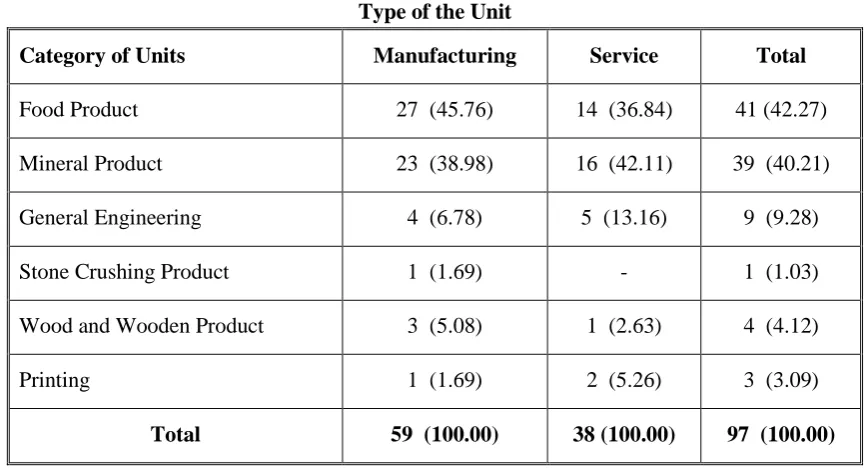
Table -5.2
Type of the Unit
Category of Units Manufacturing Service Total
Food Product 27 (45.76) 14 (36.84) 41 (42.27)
Mineral Product 23 (38.98) 16 (42.11) 39 (40.21)
General Engineering 4 (6.78) 5 (13.16) 9 (9.28)
Stone Crushing Product 1 (1.69) - 1 (1.03)
Wood and Wooden Product 3 (5.08) 1 (2.63) 4 (4.12)
Printing 1 (1.69) 2 (5.26) 3 (3.09)
Total 59 (100.00) 38 (100.00) 97 (100.00)
Source: Field Survey
Note: Figures in parentheses indicate percentages to total.
Diagram No. 5.1
Type of the Unit
0 10 20 30 40 50 60 70
IJRAR1903981 International Journal of Research and Analytical Reviews (IJRAR) www.ijrar.org 637
Table No. 5.2 indicates that as many as 59 units (60.82 per cent) are functioning as manufacturing units and only 38 (39.18 per cent) are functioning as service among total units of the study. According to product categories food products units are functioning as manufacturing units that account for 27 (45.76 per cent) 14 (34.15 per cent), functioning service unit among 39 mineral products, 30 units (39.18 per cent) are functioning as manufacturing and 14 units (36.84 per cent) are functioning as service units. In the case of General Engineering units 4 (6.78 per cent) of total are functioning as manufacturing and only 5 (13.16 per cent) are functioning as service units. While in stone crushing unit 1 (1.69 per cent) is functioning as manufacturing and none of percentage in functioning as service unit. In the case of remaining two categories of wood products and printing products, all the units are as manufacturing units which account for 3 (5.00 per cent) and 1 (2.63 per cent) respectively. It is clear from the above table that manufacturing units dominate over the service units.
Source of Finance
Finance is one of the most important and significant pre requisites to establish an industry. Several economists like Cameron and Patrick (1967) writing on the important of finance hold that finance is the lubricant in the process of production and in turn economic development. An entrepreneur can raise finance from various sources. The small scale industry is considered as one of the priority sectors for the purpose of lending. Bank gives loans for acquiring machinery, equipment and construction of factory as well as required working capital for the SSI units. This credit becomes a pervasive force in today’s modern industrial economy.
Further relatives, friends, money lenders and private financial agencies are called non-institutional sources of finance. There are also the source of finance for many SSI units. Therefore, entrepreneurs are expected to depend on various institutional and non-institutional source of finance either for establishment or for expansion and modernization.
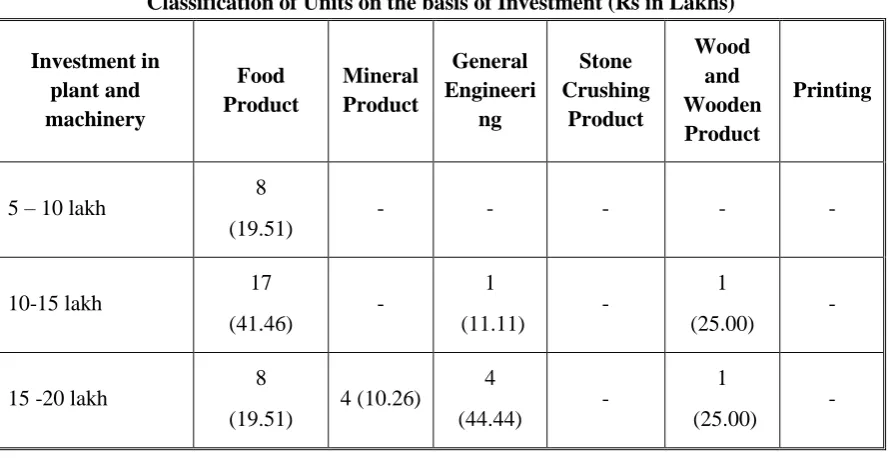
Hence, an attempt has been made to cast light on the investment in plant and machinery, various source of finance, term-loan and their problems at the time of getting loans from their source problem of working capital etc., are all investigated. Table No. 5.4 records the investment made by the respondents in the plant and machinery.
Table- 5.4
Classification of Units on the basis of Investment (Rs in Lakhs)
Investment in plant and machinery
Food Product
Mineral Product
General Engineeri
ng
Stone Crushing
Product
Wood and Wooden Product
Printing
5 – 10 lakh 8
(19.51)
- - - - -
10-15 lakh
17
(41.46) -
1
(11.11) -
1
(25.00) -
15 -20 lakh 8
(19.51)
4 (10.26) 4 (44.44)
- 1
(25.00)
IJRAR1903981 International Journal of Research and Analytical Reviews (IJRAR) www.ijrar.org 638
20 -25 lakh
5
(12.20) -
3
(33.33) -
1
(25.00)
1 (33.33)
25 lakh Above 3 (7.32) 35 (89.74) 1 (11.11) 1 (100.00) 1 (25.00) 2 (66.67)
Total 41
(100.00) 39 (100.00) 9 (100.00) 1
(100.00) 4 (100.00)
3 (100.00)
Source: Field Survey
Note: Figures in parentheses indicate percentages to total.
Classification of Units
As close observation of the table No. 5.4 shows that among 41 food products units, the investment by as many as 8 units, (19.51 per cent) in plant and machinery invested between 5 lakh to 10 lakh whereas that of 17 (41.46 per cent) are between Rs. 10 lakh to 15 lakhs. Each of remaining two units invested Rs. 15 lakhs to 20 lakhs and 20 lakh to 25 lakhs respectively. And above 25 lakhs all units, similarly majority of the food products units 41 (42.27 per cent) invested anywhere between Rs. 5 lakh to Rs. 10 lakh in plant and machinery. Among rest of the units mineral, General Engineering, Stone Crushing, Wood and Wooden and Printing is none.
Rs. 10 lakhs to 15 lakhs the investment of Food Product, General Engineering and Wood and Wooden Product is between 10 lakhs to 15 lakhs. Food product 8 (19.51 per cent) Mineral Product 4 (10.26 per cent), General Engineering 4 (44.44 per cent) and Wood and Wooden Product 1 (25.00 per cent) invested, whereas 20 lakhs to 25 lakhs only few product are Food Product 5 (12.20 per cent) and General Engineering 3 (33.33 per cent) invested.
Table- 5.5
Nature of Acquisition of the Units
Nature of Acquisition Food Product Mineral Product General Enginee ring Stone Crushing Product Wood and Wooden Product
Printing Total
Purchased 6 (14.60)
14
(35.90)
1
(11.10) -
1 (25.00) 1 (33.30) 23 (23.70)
Hired 15 (36.60)
3
(7.70)
4
(44.40) - - -
22
(22.70)
Owned 20
(48.80) 22 (56.40) 4 (44.40) 1 (100.00) 3 (75.00) 2 (66.70) 52 (53.60)
Total 41 (100.00) 39 (100.00) 9 (100.00) 1 (100.00) 4 (100.00) 3 (100.00) 97 (100.00)
IJRAR1903981 International Journal of Research and Analytical Reviews (IJRAR) www.ijrar.org 639
Table No. 5.5 reveals that majority of firms in all the categories owned units rather than purchased and hired. Nearly 22 (56.40 per cent) mineral product units and 20 units (48.80 per cent) food product units following general engineering products 4 (44.40 per cent) and next unit wood and wooden 3 (75.00 per cent) and printing 2 (66.70 per cent) followed least the stone crushing unit 1 (100.00 per cent) of acquisition of the units. Similarly, purchased units have 14 (35.60 per cent) mineral products and 6 units (14.60 per cent) food product units and following general engineering product, wood and wooden and printing products are acquisition of units. So hired is 15 (36.60 per cent) in food product units and general engineering units 4 (44.40 per cent) and the next follows mineral products. Similarly, owned nature of acquisition is dominates the others.
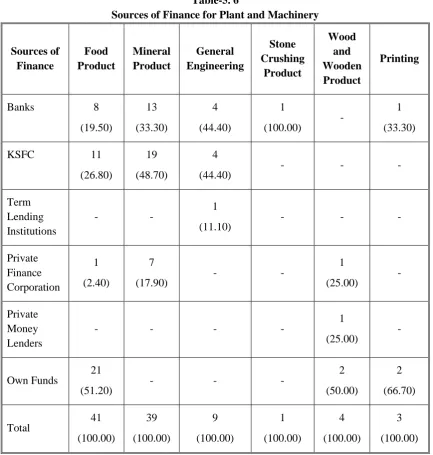
Table-5. 6
Sources of Finance for Plant and Machinery
Sources of Finance Food Product Mineral Product General Engineering Stone Crushing Product Wood and Wooden Product Printing Banks 8 (19.50) 13 (33.30) 4 (44.40) 1
(100.00) -
1 (33.30) KSFC 11 (26.80) 19 (48.70) 4 (44.40) - - - Term Lending Institutions
- - 1
(11.10) - - -
Private Finance Corporation 1 (2.40) 7 (17.90)
- - 1
(25.00)
-
Private Money Lenders
- - - - 1
(25.00)
-
Own Funds 21 (51.20)
- - - 2
(50.00) 2 (66.70) Total 41 (100.00) 39 (100.00) 9 (100.00) 1 (100.00) 4 (100.00) 3 (100.00)
IJRAR1903981 International Journal of Research and Analytical Reviews (IJRAR) www.ijrar.org 640 Subsidy of units
Table- 5.8 Subsidy of Unit
Subsidy
of Unit Food Product Mineral
Product
General Engineering
Stone Crushing
Product
Wood and Wooden Product
Printing
Yes 17 (41.50) 25(64.10) 4(44.40) - 3(75.00) 2(66.70)
No 24 (58.50) 14(35.90) 5(55.60) 1(100.00) 1(25.00) 1(33.30)
Total 41 (100.00) 39(100.00) 9(100.00) 1(100.00) 4(100.00) 3(100.00)
Source: Field Survey
Note: Figures in parentheses indicate percentages to total
When the SSI units were asked as to whether they availed subsidy on the loan, the response of majority of units was positive (Table-5.8). All the units of mineral products, general engineering, stone crushing and printing borrowed government subsidy on the loans. Whereas in the case of mineral products units and general engineering units only (65.00 per cent) and 15.00 per cent obtained subsidy on the finance availed while the remaining did not.
Subsidy given agencies
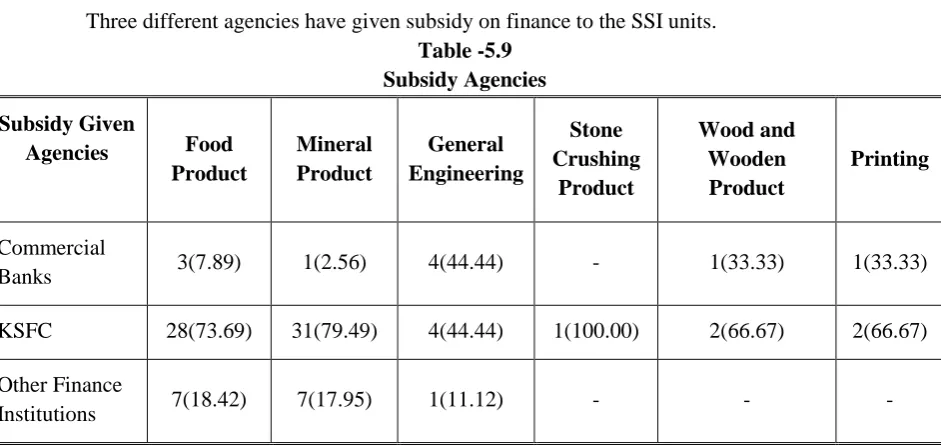
Three different agencies have given subsidy on finance to the SSI units.
Table -5.9 Subsidy Agencies
Subsidy Given
Agencies Food
Product
Mineral Product
General Engineering
Stone Crushing
Product
Wood and Wooden Product
Printing
Commercial
Banks 3(7.89) 1(2.56) 4(44.44) - 1(33.33) 1(33.33)
KSFC 28(73.69) 31(79.49) 4(44.44) 1(100.00) 2(66.67) 2(66.67)
Other Finance
Institutions 7(18.42) 7(17.95) 1(11.12) - - -
Note: Figures in parentheses indicate percentages to total
IJRAR1903981 International Journal of Research and Analytical Reviews (IJRAR) www.ijrar.org 641
and other financial institutions (11.12 per cent) in general engineering product units commercial bank (33.33 per cent) in the case of both wood and wooden and printing units.
Percentage of subsidy loan Table-5.10
Percentage of subsidy loan
Percentage of subsidy loan Food Product Mineral Product General Engineering Stone Crushing Product Wood and Wooden Product
Printing Total
Less than 5 Pc
11 (26.80) 7 (17.90) 5 (55.60) 1 (100.00) 1 (25.00) 1 (33.30) 26 (26.80)
5 Pc -9 Pc 15 (36.60)
12
(30.80)
4
(44.40)
- 2
(50.00)
2
(66.70)
35
(36.10)
10 Pc - 14 Pc 10 (24.40)
9
(23.10)
- - 1
(25.00)
- 20
(20.60)
15 Pc -19Pc
2
(4.90)
8
(20.50) - - - -
10
(10.30)
Above 20 3
(7.30)
3
(7.70)
- - - - 6
(6.20) Total 41 (100.00) 39 (100.00) 9 (100.00) 1 (100.00) 4 (100.00) 3 (100.00) 97 (100.00)
Source: Field Survey
IJRAR1903981 International Journal of Research and Analytical Reviews (IJRAR) www.ijrar.org 642 Diagram No. 5.3
Sources of working capital
Problems of working capital
The problems faced by different SSI units in getting adequate working capital.
Table-5.15
Reasons for facing adequate working capital
Reasons Food
Product
Mineral Product
General Engineering
Stone Crushing
Product
Wood and Wooden Product
Printing
High Interest Rate
10
(34.49)
12
(52.18)
3
(50.00) - -
1
(100.00)
Stringent Credit
3
(10.35)
1
(4.34) - -
1
(50.00) -
Incontinent Repayment Condition
6
(20.69)
5
(21.74)
1
(16.67) -
1
(50.00) -
Policy of Banks
8
(27.58)
5
(21.74)
2
(33.33) - - -
Others 2 - - - -
IJRAR1903981 International Journal of Research and Analytical Reviews (IJRAR) www.ijrar.org 643
(6.89) -
Table No. 5.15 shows that stone crushing unit has not faced any problem. In case of printing units 1 unit opined that the rate of interest charged for the loan was high. Significant credit and inconvenience in repayment were the problem expressed by 50.00 per cent of wood and wooden units.
In case of general engineering units 50.00 per cent of units quoted the problem of high interest rate and 2 units opined that policy of the bank and 1 unit opined inconvenience in repayment. More than 50.00 per cent of mineral product units opined that high interest rate was the major problem followed by policy of bank (21.74 per cent) and stringent credit 4.34 per cent.
Again high interest rate was the major hurdle for about 35.00 per cent of food product units followed by policy of bank (27.58 per cent), in convenient repayment condition (20.69 per cent) and stringent credit (10.35 per cent).
Production Related Problem
The nature of production of different SSI unit.
Table-5.16 Nature of Production
production Food
Product
Mineral Product
General Engineering
Stone Crushing
Product
Wood and Wooden Product
Printing
continuous 5(12.20) 34(87.18) 9(100.00) - 4(100.00) 3(100.00)
seasonal 36(87.80) 5(12.82) - 1(100.00) - -
Total 41(100.00) 39(100.00) 9(100.00) 1(100.00) 4(100.00) 3(100.00)
Source: Field Survey
Table No. 5.16 showed that production of all the general engineering units, wood and wooden units and printing units is continuous, while that of stone crushing units is seasonal in nature. The nature of production of food production units and mineral products units was both continuous and seasonal. Most of the food products units (87.80 per cent) were seasonal in nature. While only about 13 per cent of mineral products units showed seasonality in production.
Table-5.21
Encouraging for the future growth
Future growth
Food Product
Mineral Product
General Engineerin
g
Stone Crushin
g Product
Wood and Wooden Product
Printing Total
Governmen
IJRAR1903981 International Journal of Research and Analytical Reviews (IJRAR) www.ijrar.org 644
General
Incentives
Schemes 13(31.70) 12(30.80) 3(33.30) - 1(25.00) - 29(29.90)
Good Demand for the Product
13(31.70) 26(66.70) 5(55.60) 1(100.00
) 3(75.00) 1(33.30) 49(50.50)
Others 2(4.90) - 1(11.10) - - - 3(3.10)
Total 41(100.00 )
39(100.00
) 9(100.00)
1(100.00 )
4(100.00 )
3(100.00 )
97(100.00 )
Source: Field Survey
Note: Figures in parentheses indicate percentages to total
The table No. 5.21 presents results based on the opinions obtained from the SSI units with respect to the aspects that we more favoring them in their future development.
From the table No. 5.21 it is clear that favorable government polices like capital subsidy, interest rate, margin money subsidy and marketing assistance like product reservation, product purchasing, sales form exemption, etc we the important.
Following future aspects of SSI units as accepted by 13 (31.70 per cent) of food products, 26 (66.70 per cent) mineral products, 5 units (55.60 per cent) general engineering units (75.00 per cent) wood and wooden product 2 units (66.90 per cent) printing units, followed by incentives scheme has opined by 13 (31.70 per cent) food product units, 12 (30.80 per cent) mineral product units, 3 (33.30 per cent) general engineering products, 1 (25.00 per cent) wood and wooden products good demand for the products next important factors favorable for good prospects in future for the SSI units as respondent by 2 units (4.90 per cent), food products, 1 units (4.10 per cent) none from other product units. These for all the categories of units in the study area good demand for more important from the point of view, of the future prospects of the SSI units.
Unfavorable Steps of Government Towards SSI Units
Everything is not well in connection with SSI unit’s development because government has taken several incentives to promote SSI units in a big way. But all these incentives like, financing marketing product reservation purchasing etc., are not favorable to SSI units. So SSI units have no positive attitude about these incentives. Therefore, researcher has made an attempt to find out what are the unfavorable steps taken by govt. towards SSI units during the survey period.
Table-5.28
Unfavorable steps taken by government
Unfavorable
steps
Food
Product
Mineral
Product
General
Engineering
Stone
Crushing
Product
Wood and
Wooden
Product
IJRAR1903981 International Journal of Research and Analytical Reviews (IJRAR) www.ijrar.org 645
Taxation 6(14.60) 13(33.30) 3(33.30) - 2(50.000 - 24(24.70)
High Rate of Interest 26(63.40) 24(61.50) 6(66.70) - 2(50.00) 3(100.00) 61(62.90)
Rigid Regulations 9(22.00) 2(5.10) - 1(100.00) - - 12(12.40)
Total 41(100.00) 39(100.00) 9(100.00) 1(100.00) 4(100.00) 3(100.00) 97(100.00)
Source: Field Survey
Note: Figures in parentheses indicate percentages to total.
Table No. 5.28 presents the unfavorable steps of government toward, SSI units during the study period. Table 5.29 brings clearly the steps taken by government that are unfavorable to SSI development. They are high rate of interest in the government agencies at the time of starting the unit rigid regulation on loan officials information’s, problems collection of subsidy on purchase of raw materials by units higher sales of taxation on SSI products, higher electricity change import of edible oil and rice, rigidity payment undivided finance institution. Further the problem like greater performance given by government to big units environment control notice problems of government agency unlimited finance for new unit for establishment oil purchasing and trademark competition in market yard are also the important unfavorable steps government forward SSI units as reported by the researcher.
Diagram No. 5.10
Unfavorable steps taken by government
Expected Assistance Programmes from Government by SSI Units SSI Units in Study Area
0
10
20
30
40
50
60
70
Taxation
High Rate of
Interest
IJRAR1903981 International Journal of Research and Analytical Reviews (IJRAR) www.ijrar.org 646
SSI units in study area have expected several kinds of assistance, incentives from government for their future prospects. The researcher has made an attempt to find out different kinds of assistance that were expects by SSI units from the government in the study area.
Table-5.29
Kinds of assistance from the government
Assistance Food
Product
Mineral Product
General Engineering
Stone Crushing
Product
Wood and Wooden Product
Printing Total
Subsidy
18(43.90) 17(43.60) 3(33.30) - 4(100.00) 2(66.70) 44(45.40)
Incentives
16(39.00) 22(56.40) 5(55.60) 1(100.00) - 1(33.30) 45(46.40)
others
7(17.10) - 1(11.10) - - - 8(8.20)
Total
41(100.00) 39(100.00) 9(100.00) 1(100.00) 4(100.00) 3(100.00) 97(100.00)
Source: Field Survey
Note: Figures in parentheses indicate percentages to total.
Table No. 5.29 indicates the different kinds of assistance expected by the SSI units from government.
From table No. 29 it is clear that the SSI units have expected assistance from government in the form of easy procedures of govt. agencies, lower selling tax an SSI products, lower rate of interest of finance subsidy on raw materials, official strictures and exclusion of bride in government agencies more subsidy on loan training and seminar centre for SSI entrepreneurs in each taluk place, marketing facilities price fixation for SSI products in domestic market electricity bill exemption and returns in KEB, control in imported policies compulsory education policy for entrepreneurs land for SSI units concessional rate, abolition of chain system of tax and moderate tax should be exempted. For SSI produces and establishing agency. All the above mentioned kinds of assistance from the government to the survey units would promote the development of SSI in future.
Suggestions for the Future Prospects of SSI Units:
IJRAR1903981 International Journal of Research and Analytical Reviews (IJRAR) www.ijrar.org 647 Table-5.30
Suggestions for the future prospects of SSI units
Suggestions Food
Product
Mineral Product
General Engineering
Stone Crushing
Product
Wood and Wooden Product
Printing Total
Liberal credit
policy 18(43.90) 17(43.60) 3(33.30) - 4(100.00) 2(66.70) 44(45.40)
Lower tax burden Moderate Tax should be 4%
16(39.00) 22(56.40) 5(55.60) 1(100.00) - 1(33.30) 45(46.40)
More Subsidy on loan financing
7(17.10) - 1(11.10) - - - 8(8.20)
Total 41(100.00) 39(100.00) 9(100.00) 1(100.00) 4(100.00) 3(100.00) 97(100.00)
Source: Field Survey
Note: Figures in parentheses indicate percentages to total.
SUMMARY AND CONCLUSION
A detailed study of the problems and prospects of the SSI units in the Karnataka district has led to the following major finding and conclusions.
1. The SSI unit in the Karnataka district are mainly sole proprietorship and partnership firms of total 97 SSI units 65 (i.e., 67.01 per cent) are on proprietorship and 32 units (32.99 per cent) are partnership, basis, co-operative and company forms of organizations are conspicuous by their absence in the study units.
2. Average investment in plant and machinery in the units is of a small size. It damages between Rs. 5 lakhs to 10 lakhs and 11 lakhs to 20 lakh of total 97 units, 46 units are of 5 to 10 lakhs and 43 units are of 11 to 20 lakhs, while 7 units are of 21 lakh to 40 lakhs. Remaining only one unit of General Engineering is of high range, which has an investment of Rs. 41 lakhs to 50 lakhs. This suggested that high range investment in existing SSI units in Karnataka district is very loss and much of the investment is in low range. Such small size of investments limits the production capacity of the units and the units fail to realize scale sconomics.
3. 94 SSI units out of 97 existing units have made out right purchase of their plant and machinery and smaller number of trace of them have resorted to hire purchase/lease methods.
IJRAR1903981 International Journal of Research and Analytical Reviews (IJRAR) www.ijrar.org 648
money lenders and own funds are the source of only 4 units. These 4 units are present in General Engineering and wood and wooden product categories. This indicates scarcity of own funds in the district.
5. SSI units in Karnataka district are aware of loan subsidy and other incentives schemes given by the government and all of them have obtained these facilities given by the DIC and KSFC.
6. Maximum number of units in each category, except mineral product units, has borrowed the loan as medium term finance, from KSFC and bank. But large number of units in the mineral products category has borrowed the loan, as long term finance. Thus medium term finance has a key role in promoting the SSI sector in Karnataka district than the long term or short term finance.
7. Being large in their number, majority of the food and mineral products categories units (26 and 24 respectively) face the problem of delay in obtaining incentives, given by the government, due to lack of proper and in time information from the government agencies. Remaining units of these categories and majority units of other categories do not face this problem.
8. The SSI units, in four categories namely food, mineral, General engineering and wood and wooden product, mention “high interest cost” and “inconvenient number of installments”, are their major problem in obtaining their loan finance. Other problems like rigid repayment conditions, inadequate amount of loan etc are mentioned only by food products units. Thus high rate of interest cost and inconvenient number of installments are the major problems of the four categories units, but it is more crucial problem in food product category, as more than 50 percent of its units face this problem. They mainly the food products units are threatened by finance problems.
9. The SSI units covered by the study did not experience shortage of working capital. Majority of the units depend on banks and finance companies for their working capital requirements in addition to their own funds.
10. More than 50 per cent of the SSI units mention high rate of interest of banks and finance cooperation. Except stone crushing category inconvenient repayment conditions, bank policies, stringent credit as the major problems in obtaining working capital in each category units in study area.
SUGGESTIONS
Following suggestions are made to ensure efficient internal management of SSI units and to solve some of the genuine problems confronting the small-scale entrepreneurs’ from Karnataka district. If these recommendations are implemented, it is hoped, the growth of small-scale sector will get about. The suggestions are based on the findings of the study covering the 97 SSI units in the Karnataka district.
1. SSI units are being controlled by a number of acts and laws which consumers a lot of time of entrepreneurs distracting their attention front important activities of the entrepreneur’s time in production and marketing government official procedures should be simplified to reduce unnecessary interferences of bureaucratic controls.
IJRAR1903981 International Journal of Research and Analytical Reviews (IJRAR) www.ijrar.org 649
3. Security to the institutional finance and interest rate should be moderate. Banks and financial institutions should follow a liberal credit policy to meet the working capital requirements of SSI units.
4. The entrepreneurs had to undergo a plethora of complex set of procedures and formalities which delay the sanction and disbursement of assistance as most of the industrial units are one man’s show. If the entrepreneurs devote more time in claiming assistance, their crucial areas will suffer, which will ultimately affect their production sales and repaying capacity. Therefore, the procedure to avail subsidy and other incentives should be made simple and financial institutions be given the responsibility to claim the capital investment subsidy on behalf of the entrepreneurs as KSFC is doing at present. Sanction and disbursement of incentives, particularly investment subsidy should be a time bound programme.
5. Subsidy for finance should be moderate, so that new entrepreneurs are encouraged to establish SSI units in rural and backward areas.
6. Govt. should not encourage the establishment of a large number of industries of same kind of products in the same region. This will increase the severity of competition between the same category units, which will became a reason for sickness in units of these products. Balanced industrial development can be achieved only if government consciously encourages the establishment and development of large number industries, but of different kinds of products units in the same region. This reduce regional imbalance in the industrial development, consequently promoting the overall development of backward regions.
7. Govt. should set-up training and seminar centres for SSIs entrepreneurs in each taluks. The centres will help the existence units to increate their awareness about production, management and marketing. This will enable the entrepreneurs to get more profit, and this profit will plough back in the unit. It will increase the investment in backward regions. Also industrial fair, exhibitions, festivals etc, should be organized at taluka levels, to create awareness about industries. This will help the new entrepreneurs to know and enter into the industries sector.
8. from low profile.
REFERENCE
1. BrijBushan (1997): small scale industries in the new era of economic liberalization. Challenges and priorities for the Ninth plan KurukshetraVol.XLV No. 8 May 1997.
2. Sutcliffe R.B.(1971): Industry and under development. Addition Wesley publishing co., London, 1971. P.3
3. Barn paul: People publications, New Delhi P. 277.
4. UNIDO (1976): Industrial Development strategy: reprinted in Gerald M. Meter (rd), Leading Issues inEconomic Development (3rded) oxford unipress, Newlyork1976 P.659.
5. U.N.committee for Industrial Development (1963): report of the Third session, 13.31 may BCO, S.F.E./3781.
IJRAR1903981 International Journal of Research and Analytical Reviews (IJRAR) www.ijrar.org 650 7. Bryce, bumrry (1960): Industrial Development Mc grew Hill book company, New York, 1960 P.3.