The inscriptions discussed in this article were found at Phlius during the investigations made there in 1924 by Dr. C. W. Blegen of the American School of Classical Studies at Athens, under the direction of Dr. B. H. Hill.2
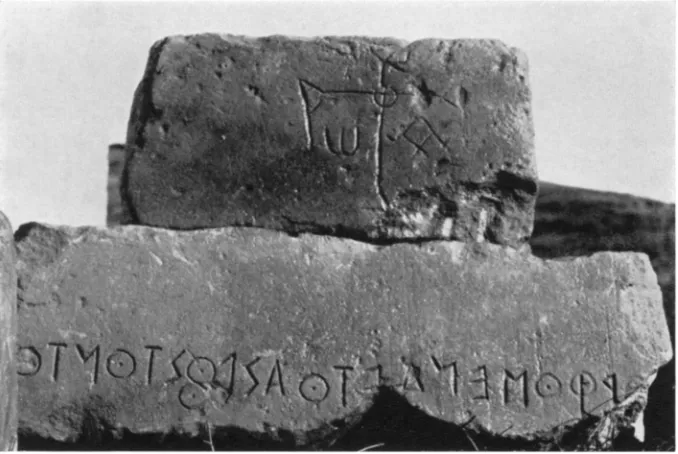
The most important are a group of archaic in- scriptions, now at Herakleion, where a bath of ancient Nemea has been converted into a small museum. They are cut on blocks of poros whose peculiar working is sufficiently significant to merit description (Fig. 1). The face with the inscription is, on the average block, 0.77 m. by 0.265 m.; the third dimension is 0.77 m. The top surface is square, with anathyrosis in front and back, and is otherwise smooth and flat. The left side has anathyrosis on the front, top, and back edges. The right side has a vertical channel, rougrhly cut, about 0.05 m. wide and 0.13 m. to 0.15 m. from the front edge, and a similar one cut at an equal distance from the back edge. A vertical semi-
circular channel 0.12 m. wide, also roughly worked, marks the centre of the surface. On the bottom there are two narrow grooves similar to those on the side and connecting with them, extending parallel to the face of the block. Between them the surface is worked smoothly in a shallow, gently curving, depression. The front and back surfaces are finished smoothly. In addition to the blocks bearing inscriptions, several others of the same description were found built into walls and graves of the Roman period. Those used in graves were generally placed as cover slabs for long, narrow, trench-like crypts, the walls of which were also, in part, built of the same blocks.
1. This inscription appears on a surface 0.81 m. by 0.265 m. The thickness of the block is 0.67 m. The text extends from left to right along the lower edge of the block, the top line
1 This article is the result of study undertaken as a school paper for the American School of Classical
Stuidies at Athens, begun in December, 1934. I wish to express my appreciation to Mr. Richard Stillwell, then Director, for permission to publish it; to Professor C. A. Robinson for his initial suggestion and conI-
stant help; to Professor C. W. Blegen, Professor Oscar Broneer, Professor C. D. Buck, and Mr. Sterling Dow for their bountiful and always kindly offered assistance. Mr. Joseph Shelley I want to thank for the drawings.
2 C. W. Blegen, " Excavations at Phlitus, 1924," Art and Archaeology, XX, pp. 23-35.
Fig. 1. One of the blocks bearing the archaic inscriptions from Phlius
American School of Classical Studies at Athens is collaborating with JSTOR to digitize, preserve, and extend access to Hesperia
236 ROBERT L. SCRANTON
of the letters being about 0.18 mn. from the upper edge of the block. The o)mlicron is a circle inscribecl with a compass, having a diameter of 0.04 m. The other letters average 0.07 m. in height; the lower ends are in many cases obliterated by the mutilation of the lower edge
of the block (Fig. 2, and Fig. 3, top).' The inscription reads: --a-] 'ac hIw7-roxo&d[. t
Fig. 2. A drawing of archaic inscription No. I
The recognized affinity of this alphabet with the Corinthian 2 is the sole basis for the dating of the inscription, whose clarity of cutting, reg,ular arrangement, and beauty of formi make it rank high as an example of archaic writing. rThe three-bar iota, in the Corinthian vase inscriptions, falls in the first half of the sixth century; the four-bar form is characteristic of earlier periods, and the straight iota occurs with increasing frequency after the middle of the century, until at the beginningf of the fifth century it becomes the standard formli.3 Another significant letter is the xi. In this inscription the highest bar crosses the vertical line below its apex. This does not occur, apparently, in the Corinthian inscriptions, and may indicate that the form is early in the evolution of the Phliasian alphabet. The forms of the 7cappa, with hiigh v-ertical bars and rather short arms, are also early.
2. This inscription appears on a surface 0.77 m. by 0.255 in.; the thickness of the block is 0.77 m. Across the lower edgle of the block is the inscription, written retrograde. It is 0.15 m. from the upper edge of the stone. The omicron is a circle inscribed with a compass, havinlg a diameter of about 0.03 in. The 7oppa is 0.055 m. in height; the other letters about 0.04 m. The beginning of the line, at the riglht, is missing (Fig. 4, and Fig. 5, bottom). The line reads: h]o'Qog a't'o X' XCt (X&t) v4 ro---
0Xo
T
10o
T592$
4A
o
art?r1oiy'(
T.4
sFig. 4. A drawving of archlaic inscriptionl No. 2
I No. i and No. 4 are also illustrated by Blegen, loc. cit., p. 27.
2 Roberts, Introduction to Greek EIpigraphy, Cambridge, 1887, p. 137.
3 In view of the scarcity of archlaic inscriptions on stone, most of the information m-ust be drawn
Fig. 3. A photograph of inscriptions Nos. 1, 3, and 4, counting from top to bottom. (Nos. 3 and 4 are also illustrated by Blegen, loc. cit., p. 27)
238 ROBERT L. SCRANTON
The iota again is the only definite clue for dating the inscription, which, like the first, would seem to fall about the middle of the sixth century. The san and the mu, the latter with the fourth bar at an angle, not exteniding to the base line, are early, but the evidence for their disappearance is not definitive.
A consideration of the character resembling the figure 8 leads to interesting results. The symbol consists of a circle inscribed with a compass exactly like the omicron, placed in the direct level of the line, with an exactly similar circle tangent to its lower edg,e but slightly to the left of the central vertical axis. It must be a vowel, following initial lambda, and it is possible that the lower circle is a mistake anid that omicron only is meant.' On the other hand, if the lower circle had been an error, it was a gross one, quite out of keeping with the general care and precision of the other cutting. Moreover, from its position slightly to the left of the upper circle, it would seem naturally to have been cut later in the progression from right to left. Everyone to whom I have shown the stone finds difficulty in believing, that it is a slip on the part of the stone cutter, and I am convinced that this explanation can be used only as a last resort.
The combination of two omtcrons to represent omega occurs to one, but produces no good reading. Furthermore, in 6d.4o, omnega is represented by the simple circle. Eta is the remaining possibility. In the Corinthian alphabet eta and epsilon were normnally B;
R is sometimes epsilon, but more often epsilon-iota.2 The Sicyonian form for epsilon is X. Special symbols for eta are lacking. In the Phliasian alphabet e represents epsilon and possibly the diphthong (cf. ev8Aro). An attempt to distinguish eta might quite plausibly result in a modification of B, X, or even the aspirate, 2, to 8 to represent the required sound. One needs look no farther than Phlius itself to find the origin for this, but the presence at this time of a symbol for eta in Crete, Rhodes, and other islands, where the dialect is Doric,3 points to a parallel. The change in the islands seems to have been due to influence from Ionia, whereas the innovation here, unique to the mainland, seems to develop from the local problems and materials. It is worth pointing out, however, that the Ionic form aeora instead of West Greek varea in No. 8 below may indicate an
Ionic force at work in this reg,ion.
The sense of the line is, in any event, that the oath shall be binding if someone desires or is willing to do something.
3. A third similar block having a surface 0.74 m. by 0.26 m. and a thickness of 0.77 m., bears two inscriptions. Across the top runs a retrograde line of archaic letters, the epi- graphical characteristics of which are exactly those of No. 2. The letters measure 0.04 m.
I In response to a letter from me, Prof. Carl D. Buck, who has seen the inscriptions, and to whom I
sent a small photograph, kindly made an answer in which he inclines to this view. He considers that the lower circle was mistakenly cut first, and that the intention was to write lo/, third person singular optative with early contraction, on the analogy of I.G., IV, 506, ceaaovQy?Jt.
2 Payne, op. cit., p. 158; C. D. Buck, Greek Dialects, ed. 2, 1928, p. 28, sect. 28; I.G., IV, 348, 358; 346.
in height, with the exception of the san, which is 0.045 m. in height, and the kappa, which is 0.05 m. high. The omicron is a circle inscribed with a compass, and has a dia- meter of 0.03 m. (Fig. 6; Fig. 3, top line on bottom block). The line reads: - x-]s al
-a?6q'ea'r0gv deXs[V].
Fig. 6. A drawing of inscription No. 3
The first letter of the preserved text can hardly be anything, but san. The two vertical lines are preserved, and although the V mark at the top which should connect them is not clear in the photograph, it can be detected on the stone. The lambda seems on the illustration to be a nu, but it is too close to the alpha, and the third bar was obviously caused by chipping. Following the alpha are three equidistant parallel vertical lines. The upper edge is so mutilated that the cuttings for the top cannot be determined with certainty, but the only possible restoration is san and tau. The date of this inscription is that of No. 2, and on the same grounds. The name A6arearog is possibly a version
of A,6oe-rarog.
Inscriptions 2 and 3 are similar to I. G., IV, 439, a, b and c. Of these, a and b were discovered by Fourmont, and recorded solely in his uncertain copies; c was found by Ross while looking for a and b (Fig. 7). 1.G., IV, 439 cI is built into the south wall of a church of St. Nicholas, just above the modern town of Nemea, formerly called St. George. The measurements of the letters agree perfectly with those of the inscriptions discussed above. The visible face of the block measures 0.75 m. by 0.26 m. The other dimension is not available, nor is it possible to observe the treatment of the other surfaces, but there can be no doubt that the block is, or originally was, exactly similar to the new blocks. Thie entire church, indeed, is built of such blocks, recut into smaller pieces, but the characteristic cuttings are still visible in several places. The " monastery" mentioned in the note is built in the same way. The text is probably, as in the Corpus: aYT'l ho'fe9ov
ir a co6'XF[Lao. The aspirates of &'rL and i have been lost by psilosis.2
Struiek by the similarity of epigraphical and textual elements of these inscriptions with those fouind at Phlius, I have searched for all of them at modern Nemea, 'but failed to find either a or b. According to Fourmont, the former was fouind in a wall of a monastery of Hagios Nicolaos of the Altar, near Hagios Georgios; the latter, he said, was in a monastery of the same name. 1 could find from the villagers Ilo
information concerning either a monastery or a church of this name. Not far from the church of St. Nicholas found by Ross and others, including myself, are some ruins identified by the villagers as those of a former church of St. Nicholas, but the remains fail to produce any inscription. A building below this ruin, at the edge of the village, is called an old monastery, but this has no inscription that I could find. A church at the peak of the mountain above the town is now known as the Prophet Elias, but is said to be the site of a former chbtrch of St. Nicholas. I could find no inscription here, either. Probably both a and b have disappeared.
240 ROBERT L. SCRANTON
Of a it is said in the Corpus that possibly two blocks are involved, the lower one upside down. Even in Fourmont's time they must have been badly mutilated. One may assume that his copy is fairly accurate, since his copy of b is perfectly reasonable, and his copy of a preserves all the defects that one might expect to find on a stone. In this case, the lower line of a may read, retrograde and inverted: v4]fr roiV ho'oxa (ho'&9ia). The sixth character seems more probably ntu than sant, as in the Corpus, and the other restorations of the Corpus do more violence than is necessary.
The upper line of a is more difficult. The first three characters, if properly re-
corded, may be delta, epsilon, and either omicron, phi or koppa; probably onticron. They must represent the end of a word, and on such uncertain readings it is scarcely worth while to attempt a restoration. The remaining letters may read thus: CailOa Vx[Ea (itvcov? or the like). The problems involved are solved by restoring the normal zeta of this group, I, for the mark like an inverted T, in the fifth and tenth places. The alpha and iota in the eighth and ninth places must be reversed, but suich a correction is common enough in epigraphy, and in this case we have a second hand with whose mental slips to deal. The use of zeta for delta in ;8xoa (dYxa) is not unparalleled in early inscriptions,1 nor can the fact that delta is used elsewhere rule too strongly against this restoration.2 We have here what remains of the statement of the penalty for the violation of the oath.
I.G., IV, 439 b, again on the reasonable assumption that the copy is fairly correct,
reads: dY'e$rat wotg ho'QovQ ('ov ho'o?ov?).
The fact that we have here three archaic inscriptions from Phlius (Nos. 2 and 3, and I.G., IV, 439c), cut on similar uncommon blocks, epigraphically exactly similar, and textually similar in that the two which do not consist only of names concern h6e9ot, is suggestive. The fact that other inscriptions from the same place (I. G., IV, 439 b, and the second line of a) have the same subject matter is also suggestive, although we have no way of comparing the architectural and epigflraphical points. These inscriptions are retrograde. We have also from this same place two inscriptions reading from left to right (No. 1 and I. G., IV, 439 a, first line). Of these, we know that number one is written in larger letters than the retrograde text, but is of the same approximate date, and is cut on the
l Elean inscriptions, Roehl, Imagines, p. 112, nos. 3 and 4; p. 114, no. 9. Buck, op. cit., p. 54, sect. 62, 2.
2 An inscription from Camirus in Rhodes of the sixth century uses both delta and zeta in the same
line. I.G., XII, i, 737. a
.NLIDA14AIAe
iOo$o
VS
O?u',i
b
y
,l
OSP 01fOT17AT313A
Fi 7
43
OA$TO
b.i
c
o
same sort of block. Evidently, then, it was at least on the same building. That there may have been two inscriptions, or many, on one building is indisputable, but it is also possible that all these texts might go together, having to do with the regulation of the conduct of those devoted to a particular sanctuary, thus (perhaps boustrophedon throughout):
-- [- ] xatc h7IroxQaT[rig ---]
- [-i5]i SOiTOV h829tcx [-]___________
- [--]>L- b 'qt(i)at6} x'?[a (--v---v?)----__-______ [---] Yirt tot; hoov (uv ho-9o-) [- ---
[-
--] - - cd'ri ho'o9ov 6Tt a' LWAe[la -F - - atrh ho'e9ov eli - - - -< [----] ho'e9og gvYero at XAl Tov To[--- - - -
[- ]- -c- -]c5 at r rcaTog 6xe [V]
4. About 0.04 m. below the archaic inscription No. 3 are carved four lines of text reading from left to right in much later characters. The preserved text is evidently part of a much larger document, since it is incomplete at both ends, and the scant traces of a fifth line are visible along the bottom edge of the block. The letters are not stoichedon, but are well cut. They are 0.025 in. high, and about 0.0225 m. wide. The omega is almost 0.03 m. wide at the base, with flaring apices. The single example of beta is rather crude, the upper half being much smaller than the lower (Fig. 3, lower part of bottom block).
[E?lt 'COV N] oZorog 6ufue 6tvEl ccbt ',:70'X[wrt - - -]
[- - - - - - - - - - -] oEV To ot iT OTv ro 'QoAOlg t edui[Ou-a- ]
[ -___--] Tv 'voW
t,V XQaTt[a]o18V''?W A *[OC-
[ ----
[-~~~rc) 'v6jot Ode086t
viv 'v6tr ELcx T[u ]urxo~ ] vvES^O' EL j~o[--- -- - -- -]-[ - - - - -]- -
IFP e AI-^ [_ - - - - --
The letters in general exhibit strong influence from the magnificent Roman majuscules, in their squareness and extreme regularity. The tendency towards apices on the ends of all vertical or horizontal bars; the broken cross bar of the alpha; the equal vertical hastae of thepi, and the extension of the top bar beyond the two hastae in that letter; the turn-up at the base of the o)miega; anld the possible, although uncertain, separation of the central horizontal bar of the epsilon: all these indications suggest a date in the time of Augustus.
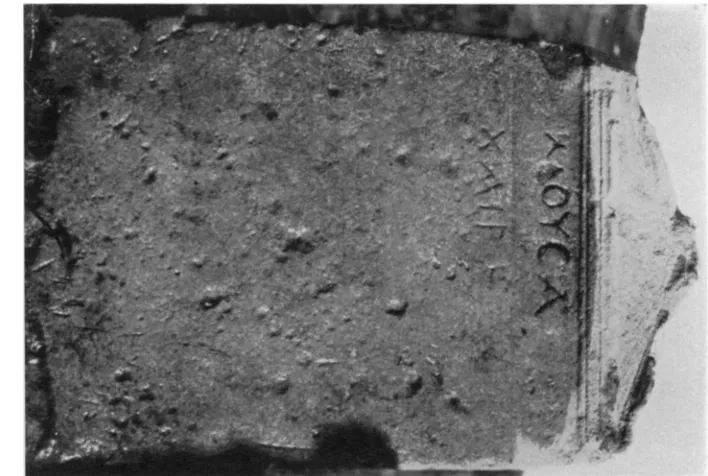
Fig. 8. A photograph of the grave stele, No. 6
Al
JABA1
1A
MATol I1
C.
0
-e
J.
, no ri4cIr
r, x ./v C4770e.
A
A w
v
T
A
Line 2. The letters are easily discerned on the stone or a squeeze. Evidently the sacrifice had reference to something that had been done in forme'r time. Perhaps a rededication of the sanctuary is involved, or a re-institution of former services, or the restatement of the former regulations.
Line 3. The first three words are certain on the stone. The 7cappa is fairly clear; a pock-mark at the juncture of the bars obliterates the cuttings. Rho is fairly certain; the curved portion is poorly cut, and it is perhaps a little smaller than the normal rho, but it could scarcely be anything else. The poor alternative is iota, attributing the loop to weathering. Alpha is certain, though faint; the same is true of tau and iota. The next letter is completely gone; a deep scar marks the stone here. The tau might be taken for an upsilon, but the horizontal cross bar does exist, and the lines which suggest the upsilon are very dim and higher than normal. The rest of the line is clear enough. The word XzactUnevoVrwcv probably refers to the devotees of the sanctuary, or to a particular class of them. ' Perhaps the archon of line 1 and of the archaic text above is their official. After this word come beta and omicron. A trace of a letter may exist at the point where one would expect the lower left hand corner of a letter which would possess such a corner, following the omicron. This trace, if original, is of a line extending diagonally upward, as in alpha, delta, or lambda. At the appropriate distance of two centimetres to the right, there is the barest pock-mark on the stone below the area of defacement, but in the base line of the letters. This may strengthen the case a little. There is no horizontal line, quite evidently, so that delta is eliminated. There are many words beginning /?oa and floX but the most reasonable is something on the root of too0iAo,
to assist. The meaning of the line is not yet clear, but we may have here either an
appellation of Apollo (compare I.G., IV, 357), or the statement that the Yuei5VOPTeg are to assist in some manner.
Line 4. This is fairly straightforward. All the letters are easily visible, except the two which are completely missing in the middle of the line, but these can be restored quite certainly as iota and epsilon. The meaning suggests that the part of the text which precedes recited what had been done in former times, and that the main part of the publication was to follow, concerning the immediate activity in question.
Line S. Fragments of the letters of this line are preserved, but nothing can be made from them.
244 ROBERT L. SCRANTON
5. A Christian monogram is carved on a fragment of one of this series of blocks, which is now at Herakleion. The surface bearing the monogram measures 0.49 m. in width, 0.26 nm. in height, and the thickness of the block is 0.67 m. The grooves witlh the shallow, curving depression appear on the top surface of the block in relation to the monogram. The latter is 0.09 m. from the left end, which is original, and 0.21 m. from the right end, which has been brokenl. It is 0.21 m. high. (Fig. 5.) The graffito can be seen clearly in the photograph, except that above the left arm there is a bird, probably the dove symbolizing the Holy Ghost. Below the arms are the alpha and omega, here reversed. If the date of this monogramn could be established as fairly early, it would be useful in dating the destruction of the archaic building, for the monogram was evidently cut after the block had been taken from its original position. It is probably from the 5th century A.D., being an elaboration of a late type.1 In any case, the fact that it is no more than a graffito would make close dating difficult.
6. A grave stele of calcareous sandstone is also at Herakleion. It is 0.92 m. high, and 0.27 m. wide. The height of the pediment is 0.12 m., and of the nmoulding 0.05 n-. The letters are about 0.04 m. high (Fig. 8). It reads:
MovUa xa@ [Ie]
The mu and sigma are cursive; the alpha has a broken cross bar. The date is therefore
probably in or after the first century A.D., although the letters lack stufficient character
to justify a confident dating in any early post-Christian century.
Movaoa is cut in a shallow band 0.085 m. wide and 0.001 in. deep. Its letter forms are not quite those of the
x"k[81,
and probably it is to be assumed that the stone was reused, the original name having been erased to make way for the extant one. The economical person thus saved himself the expense of carving his own greeting.7. This inscription2 is cut on a block of poros with cuttings similar to those bearing the first five inscriptions. It is possibly part of the same document. It measures 0.32 m. by 0.26 In. by 0.22 in. The height of the letters, as preserved, is respectively 0.035 m. 0.053 i., and 0.033 m., the lower parts of all letters having been broken away a little.
The inscription probably adds theta to the. known Phliasian alphabet of the archaic period. (Fig. 9, a.)
8. This stone is said to have been roughly hewn, and probably not to have been connected with other stones. It measures 0.254 m. in height, 0.499 m. in length, and
Max Stilzbergel, "Le Symbole de la Croix et los Monogrammes de Jesus chez les Premiers Chretienis," Byzantion, Il (1925), pp. 337-440, esp. p. 401, pp. 424ff., and p. 448. F. Cabrol, "AQ.," Dictionnaire d'ArchUo- logie Chrftienne et de Liturgie, Paris, 1924, 1, 1, coll. 1-23; esp. coll. 7-8.
2 This and the following inscriptions have disappeared, for the moment at least. They were stored
0.168 m. in thickness. The letters vary in height from 0.034 m. to 0.088 m. They are said to be well cut, but damaged in places and obscure. The text is retrograde and archaic. (Fig. 9, b.)
The first line defies restoration, but the second line probably reads: - -]v rrosra oj [-]. If this is true, the inscription must be a fragment of a larger one. !-rQ Ea is Ionic;
MrQuTa is the normal West Greek form.'
9. This inscription is cut on a stone 0.26 m. long, 0.145 m. wide, and 0.64 mn. thick.
ET0O- t]AM07
10. This is a grave stele. Its length is 0.245 m.; its height, 0.29 m.; its thickness,
0.165 m. The letters are faint, and vary in height from 0.024 m. to 0.046 m.
AEL&A
ATEOE
11. This is cut on a piece of black limestone 0.147 m. long, 0.11 m. high, and 0.061 m. thick. The nu is 0.027 m. high; the upsilon 0.025 m. high; the omicron 0.028 in. high, and the sigma 0.029 m. high.
eYtv
12. The stone is 0.34 m. by 0.40 ln. The letters are 0.027 m. high. It was not found in the excavations, but brought in by villagers.
vfloYAANQ
13. This is probably from a grave stele. The fraginent is 0.134 m. high, 0.201 m. long, and 0.114 m. thick. The alpha is 0.029 m. high; the sigma 0.034 m. It is said to be Hellenistic.
14. This is another grave stele, of which the preserved fragment measures 0.295 n. in height, 0.197 m. in width, and 0.13 m. in thickness. The letters are well cut, with apices, and vary in height fromi 0.048 m. to 0.049 m. They are cut in a band 0.098 m. broad.
EY g
15. Another fragment of grave stele is of poros, measuring 0.25 m. by 0.335 n. by 0.08 m. The letters are cut in a slightly sunken panel. The original top and right side of the stone is preserved. The letters are 0.041 m. and 0.053 m. in height, respectively.
246 ROBERT L. SCRANTON
16. Another grave stele of fine-grain poros is 0.252 m. in height, 0.195 m. wide at the top and 0.205 m. wide at the bottom, and 0.08 m. thick. The letters are about 0.02 m. high, and bear traces of red paint.
EQ:IKAEO0
17. A fragmentary inscription reads: ZEIO 0 roqila. (Fig. 9, -.)
18. Another fragmentary inscription consists of the letters:
NOC6N ONOMA
19. There is an inscription on a broken piece of marble measurino 0.325 mn. in height, 0.38 m. in length, and 0.023 m. in thickness. The letters are well- cut and set in a band 0.04 m. wide. The average height of the letters is 0.019 m. It is Byzantine. There is a bird on the upper part of the stone. (Fig. 9, d.)
20. Another Byzantine inscription appears on a fragment of coarse grey marble whose greatest height is 0.145 m., greatest width 0.11 m., and thickness 0.025 mn. There is a groove on either side of the inscription. (Fig. 9, e.)