24
Jean Simonneaux and Alain Legardez
The Epistemological and Didactical Challenges Involved in Teaching
Socially Acute Questions. The example of Globalization.
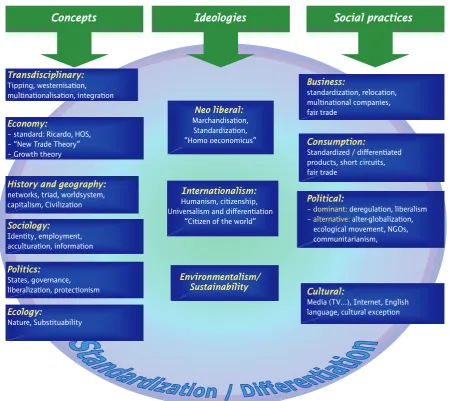
Teachers are being asked to manage a specific didactic situation which falls into the category of what we have proposed to call “socially acute questions (SAQs)”. A SAQ is a question which is acute in society, in background knowledge and in knowledge taught. Thus, teaching SAQs demands socio-epistemological reflexivity in the processes of knowledge production and in the social conditions in which this knowledge emerges; teaching SAQs will give priority to interdisciplinary, scientific and ethical reasoning. The split between ideology and science can certainly be examined when considering a socially acute question which is the subject of debate in society. In the example of the globalization taught: the diversity of analysis in the economic domain gives rise to great uncertainty because it justifies practically opposing policies; within a transdisciplinary framework, the globalization includes concepts, ideologies or social practices in a double movement of standardization and dif-ferentiation. By way of SAQs, we have attempted to show that learning stakes are numerous. However didactic choices must be supported by socio-epistemological survey, the identification of an epistemological posture and the definition of a didactic strategy.
Les enseignants sont appelés à gérer une situation didactique spécifique dans l’enseignement des «questions socialement vives (QSV) ». Les QSV sont des questions qui donnent lieu à débat dans la société, dans les savoirs scientifiques et dans l’enseignement. Ainsi, l‘enseignement des QSV nécessite une réflexivité socio-épistémologique dans le processus de production du savoir et dans les conditions sociales d’émergence de ces savoirs; l’enseignement des QSV donnera la priorité au raisonnement interdisciplinaire, scientifique et éthique. La scission entre l‘idéologie et la science peut être examinée lors de l‘examen d‘une QSV qui fait l‘ob-jet d‘un débat dans la société. Dans l‘exemple de l’enseignement de la mondialisation: la diversité des analyses économiques donne lieu à une grande incertitude en justifiant des politiques quasi-opposées; dans un cadre transdisciplinaire, la mondialisation recouvre des concepts, des idéologies ou des pratiques sociales dans un double mouvement d‘uniformisation et de différenciation. Nous avons tenté de montrer que les enjeux de l‘apprentissage sont nombreux dans les l’enseignement des QSV. Les choix didactiques doivent être soutenues par une enquête socio-épistémologique, l‘identification d’une posture épistémologique et la définition d‘une stratégie didactique.
Keywords
Socially Acute Questions, education, globalization, transdisciplinarity, epistemological posture, didactic strategy
Introduction
Over the years, globalization, has been interpreted in many, sometimes very different, ways and has generated heated debate. Media coverage of socio-political events (the G20, the Annual Meeting of the World Economic Forum in Davos, the World Social Fo-rum, the hunger riots…) or economic events (Chinese imports, factory closures…) rekindle the issues con-nected to globalization. When faced with the current social-economic questions, different groups offer dif-fering opinions and solutions. For example, in France recently, the introduction of a carbon tax caused a huge debate which was relayed by the press. Likewise, and for a lot longer, issues linked with globalization have given rise to many, sometimes very different, in-terpretations and fuelled heated discussions (e.g. on the problems of offshoring or the recent financial cri-sis). When it comes to teaching about these socio-eco-nomic issues, feedback from students can be just as
varied as the reactions observed in society, because they often feel directly concerned. Which educational goals can be pursued by teachers? How can a teach-ing activity, on a subject such as globalization, be analysed? We assume that teachers are being asked to manage a didactic situation which falls into the category of what we have proposed to call “socially acute questions (SAQs)”. Integrating SAQs in educa-tion leads to analyse competencies expected from the citizens in a specific way: to participate into the public debates, to argue an opinion or to take a posi-tion about social issues. The priority is then often given to a literacy in which social science is neces-sary but not sufficient for making choices. Teaching SAQs aims to combine school knowledge with social facts, and thus with the complexity of current events. The issue is to develop a social science literacy to promote competencies to empower students about controversial topics.
25
1. Theoretical issues 1.1 SAQs
In recent years didactic works have appeared grouped together under the term “Socially Acute Questions (SAQs)” (Legardez, Simonneaux, 2006). These ques-tions are defined in reference to an analytical grid for the production of knowledge taught, inspired by the work of Y. Chevallard (1985) on didactic transposition. A “socially acute question (in two senses)” is a question which is adapted (or which is required to be adapted) so as to be taught in school and has the fol-lowing characteristics:
– it is a question which is acute in society: this type of question challenges the social practices of all the ac-tors in the school (inside and outside the institution) and reflect their social representations; society con-siders it to be an important matter (globally or in one of its components) and it stirs up debate (from disputes to conflicts); it often gets media coverage so the majority of the actors in school are familiar with it. Its social production in society renders it an ‘acute’ question in the first sense
– it is a question which is acute in the background knowledge: debate (controversy) exists among spe-cialists in the disciplinary fields or among experts in the professional fields. Within a large proportion of disciplinary knowledge relating to human and social sciences (or even in certain areas of the so-called ex-act sciences), several paradigms are in competition. Moreover, the references are often to be found in social cultural and political practice which are also the subject of debate (often controversy). Some of these practices result in certain explicit or implicit background references in the knowledge taught in school. The social production in scientific or profes-sional spheres, in social, political and cultural move-ments renders this type of question ‘acute’ in the second sense.
– it is an acute question in knowledge taught: the ques-tion becomes all the more “potentially acute” in what is learned in school because it is acute on the other two levels of knowledge (social and back-ground).
SAQs are often “hot questions” because they have not yet been backed up or stabilized from a scientific point of view. They may remain acute for long periods and change intensity over time and in the different parts of society; we describe these questions as “po-tentially socially acute”. “The social question” which runs through modern history, “the question of rev-enue” (distribution and redistribution) the “question of nationality” all fall into this category.
1.2 SAQs and SSIs
Today, SAQ constitute a recognised line of research which is expanding in France in the area of didactics (Legardez, Simonneaux 2006; Simonneaux,
Simon-neaux 2009); it can be linked to what the Anglo-Sax-ons refer to as Socio-Scientific Issues (SSIs).
In science education the notion of ‚socio-scientific issues‘ has been introduced as a way of describing social dilemmas impinging on scientific fields (Kolsto 2001; Sadler, Zeidler 2004; Sadler et al. 2004; Zeidler
et al. 2002).
SAQs may be socio-sociological issues like globaliza-tion, immigraglobaliza-tion, unemployment or socio-scientific issues including genetically modified organisms, clon-ing, and cellular phones. These questions have impli-cations in one or more of the following fields: biology, sociology, ethics, politics, economics or the environ-ment. SAQs are subject to controversies and they are marked by doubts in the scientific knowledge and in the social implications. SAQs are the subject of con-troversies between specialists from the disciplinary fields or between experts from the professional fields. SAQs challenge social practices and reflect social rep-resentations and value systems; they are considered by society to be an issue and give rise to debate; they attract so much media coverage that the majority of students have, at least, a superficial knowledge of them (Legardez 2006). To be able to deal with this type of issue, students have to know how to recognize and interpret data, to understand how different social fac-tors can have different effects and to understand that stakeholders often have diverging opinions (Sadler et al. 2004). There is no single valid and rational solution. This does not mean that all solutions are equal.
1.3 SAQs and teaching
Such questions enter schools in several different ways. Sometimes, current affairs are used as a reference to “motivate’ students: e.g. terrorism, war, social unrest,
the environment…At other times, social demand (coming from politicians, parents, unions, associa-tions, intellectuals and other social groups involved in these matters) leads to the integration of such and such an issue into the school sphere: nationality, re-ligion, sexuality, road safety, the environment, sus-tainable development... Finally, the institution modi-fies the syllabuses, creates new disciplines; society “passes” these questions on to schools, which results
26
(“play down”) the acuteness of the issue. Whenteach-ing issues which generate very cut and dried opin-ions, there lies a risk of losing the real significance of what is learned because of the constant “playing down” or “heating up” of conflicting values in the class. An examination of the “institutionalized knowl-edge taught” (the syllabuses and instructions) and the “knowledge vectors” (the textbooks) allow us to pinpoint and compare the level of problematization offered to teachers for the teaching of these issues… and therefore also issues related to globalization.
Consequently, deciding on the teaching content as far as SAQs are concerned is a particularly delicate task. The goal may be to foster an adherence to cer-tain points of view or simply to encourage future citizens to form informed opinions. For over forty years French agricultural education was used as an instrument for explaining and promoting French and European agricultural policies. The teaching was both “played down” and clearly biased as it was used to
serve a political project. It was not until 2000 that the agricultural policies were called into question. Schools are caught between political instrumentation and their goal of producing free-thinking citizens. Analysis of the references on which the knowledge taught is to be based is essential to understanding the educational project being set up.
When we analyse the teaching of an SAQ we need both to find out the level of the students’ social knowledge, e.g. by carrying out a survey on their rep-resentations-knowledge of the socio-economic issues which have been given an “academic form” (Legardez 2001; Legardez, Simonneaux 2008), and we also need to work on the didactic transposition of knowledge produced within the disciplinary fields of reference and which circulate in society, in particular by carry-ing out a socio-epistemological survey. We will devel-op here, the latter line of analysis.
1.4 From didactic transposition to the socio-epistemological survey
Didactic transposition (Chevallard 1985) allows us to examine the process of constructing knowledge taught; knowledge is thus considered from an anthro-pological point of view, as a subject which is in circula-tion and under construccircula-tion in society. The transposi-tion of knowledge is therefore analysed in different stages taking us from the scholarly body of knowl-edge to the knowlknowl-edge to be taught (in the curricula, the textbooks), then on to the knowledge taught (in practice by the teacher) and finally to the knowledge learned by the students. Martinand (2001) introduced social practices of reference into the process of con-structing knowledge taught because education also has a position in society.
The theoretical framework of SAQs leads us to ac-knowledge the existence of debates in the scientific
spheres, media and more widely in society, and also leads us to consider these debates within the context of school education. SAQs are complex questions which cannot be simplified to the extent that we for-get the uncertainties and controversies. During these debates the different social and economic actors including lobby groups can express their diverging interests.
Teaching SAQs demands socio-epistemological re-flexivity in the construction of the knowledge taught (Simonneaux L.). It is a question of examining the characteristics of the knowledge but also the process-es of knowledge production and the social conditions in which this knowledge emerges. This analysis is not a matter of simple selection; it must also anticipate and clarify the optimum conditions for and the poten-tial barriers to learning, paying particular attention to the coherence and inconsistency that exist between different analytical frameworks. This initial scientific and socio-media-related investigation seems essential to the didactic processing of a socially acute question because it will enable the teacher to put together a (inter)disciplinary and or SAQ specific problematic. When the educational challenge relates to a discipline, what prevails is the way knowledge is structured ac-cording to the logic of that particular discipline and each of the disciplinary concepts is examined in turn, whereas when the challenge is more educational or oriented towards citizenship, the focus of the didactic construction is on the socially acute question which will give priority to interdisciplinary, scientific and ethical reasoning. It seems to us that the latter ap-proach, complementary to the disciplinary apap-proach, is however necessary when teaching complex and controversial topics because it helps to avoid exag-gerated disciplinary reduction since science is the reconstruction of reality. We must not forget that “ scientific research chooses its subjects from the world “artefacts”, that is to say in the artificial world, created in the laboratory precisely because these subjects are easier to study and easier to experiment with” (Larochelle, De-sautels 1992, 112).
Within this socio-epistemological reflexivity, the scientism of human sciences, particularly of the so-cial sciences, is regularly questioned in terms of its methods – between modelling and empiricism – and in terms of the links between economic theory and ideology. Within the teaching of social sciences in high school, the importance placed on an empirical approach has been acknowledged: “theories within the social sciences make use of facts and, in particular, im-portant economic and social events” (Guesnerie 2008, 8).
27
quickly than the tools used to describe it. Presentinga vision of globalization before or after September 11 results in the presentation of two completely differ-ent worlds. The same is true if you presdiffer-ent globaliza-tion before or after the 2008 financial and economic crisis. History deals with world changes in the long term; to be relevant, social sciences have to analyse events in the short term or while they are actually happening. Dealing with social sciences in school means dealing with current affairs while taking into account the interest and risk involved in the immedi-ate processing of events. It also encourages a projec-tion into the future with all its uncertainties. Making use, in the classroom, of documents produced by the media, illustrates this situation very well. What is it, then, that distinguishes the work of the teacher, the scientist and the journalist? The work of the social sci-ence teacher is a cross between the interpretation of current affairs and scientific analysis.
Isabelle Stengers (1993), examines the dialectic be-tween empiricism and theory when studying what she calls “field science”. Field science is not concerned with demonstration or proof but with a continuous con-frontation with the reality, which may possibly contra-dict but more often modify, improve or complete ex-isting theories or models. The “field” has specific and very different characteristics to a theoretical construc-tion; it pre-exists, is only relatively sound and is the support for interdisciplinary practices. “The time for proof, which in the laboratory used to be solely dependant on scientific temporality, is in fact associated here with the very time spent on the diagnostic processes, with the time which will possibly transform a doubtful factor into a quantifiable but perhaps irreversible process. In this respect, for those in power, field scientists are troublemak-ers not allies because they are interested in exactly what, when referring to the theoretical and experimental sci-ences, those in power make us disregard “in the name of science” (Stengers 1993, 164). Since the year 2008, the economic crisis has raised questions about economic theory and policies and offers a perfect illustration of this “field science” that Isabelle Stengers referred to. This invasion by the “field” modifies scientific activity. The intrusion changes the evidence “what one “field”
al-lows us to confirm, another “field” can contradict without the evidence being false and without being able to con-sider the situations as intrinsically different” (ibid, 159). At this point the approach becomes a “narrative” one where the selection and uncertainty of the clues com-bine with the variations in the simulation models used in the construction of controversies. “Scientists are no longer the ones who provide us with sound evidence in-stead they offer us uncertainty”. (ibid, 163).
Moreover, the inconsistencies in analysing social phe-nomena persist according to the paradigms, the emer-gence of a new paradigm does not necessarily lead to
the refutation of a former paradigm as Kuhn (1962) suggests in the so-called “experimental” sciences. Faced with the multiplicity of social science para-digms, knowledge is rebuilt to ensure a coherence in the school discipline (Chatel, 2002). Social science education’s intent to foster critical citizenship con-tributes to this coherence. “Thus not one but a whole range of possible answers are expected, coupled with acceptable and logical reasoning” (Chatel 2002, 43).
We can go one step further with this critical view of the sciences. According to Gérard Fourez (1996) all theories serve an ideology: « Not only do the sciences never completely distinguish themselves from the ideolog-ical, but we can also propound that the statement “such and such a result is scientific” is deeply ideological. In fact the aim is, above all, to render the result in ques-tion socially legitimate by referring to the abstract no-tion of scientism rather than having a specific debate on the matter” (ibid, 82). Using different wording, which implies that the sciences should abandon their preten-sions, Jean-Paul Fitoussi’s position can be considered similar when he states that everything is based on hy-potheses which reflect the convictions of individuals rather than an objective and scientific knowledge of social and economic realities (Fitoussi 2004).
The phenomena linked to globalization can be broached in a scientific manner or through personal value systems. This separation of ideology and sci-ence has not always existed. The so-called human sciences were defined, for many years, as moral sci-ences and the split between ideology and science can certainly be examined when considering a socially acute question which is the subject of debate in soci-ety. Where education is concerned, it is even more im-portant to consider the value systems because school is also a place where values are transmitted (Simon-neaux 2008). Accepting this principle means accept-ing that the references cannot be limited to scientific productions.
28
2. A socio-epistemological approach to globalization
Beyond identifying the heterogeneity of knowledge, there is the matter of qualifying the uncertainties and controversies arising from different theoretical ap-proaches. There is an excess of scientific production on the subject of globalization which encourages us to attempt to offer a global and synthetic vision.
2.1 Globalization: a recent notion with semantic and lexical inaccuracies
The term “international” has been used since the end of the 18th century following the emergence of the
Na-tion-State. However, the term “mondialisation” only made its appearance in France at the beginning of the 60s, a few years after the Anglo-Saxon term « global-ization » (Dagorn 1999). The term, which appeared first in the press, describes the global spread of lo-cal phenomena. The Anglo-Saxon notion of a “global village” was introduced at the end of the 60s to con-jure up the image of a rapid communication system, common to everyone all over the world (Mc Luhan). Twenty years later, the economists were the first to
develop and use the notion, chiefly in an article by Théodore Levitt, now considered to be emblematic (Levitt 1983). The triad concept was first described by a Japanese economist (Kenichi Ohmae) in 1985; it is a concept which was then taken up and widely reused by geographers. The economic dimension continued to be associated to the term and gradually replaced the word “internationalisation”.
The English term “globalization” can be translated into French in several different ways: “la globalisation” refers more to the financial dimension when used in an economic context but in a cultural and sociologi-cal context it has the connotation of unity “global village”. Other terms have also appeared sometimes with a very specific meaning because of the link to a particular author “le mondialisme” (Passet 2001), “l’universalité” (Serres 2001), “la mondialité” (Zarifian
2004)… -or to a socio-historical context (alter-global-ization linked to protest movements – Seattle, Genoa, ATTAC…). This polysemy of the notion of globaliza-tion is without doubt a primary source of confusion. The term can be used (and taught) according to a
vari-ety of different meanings depending on whether the dominant aspect is economic, social or political.
2.2 Multiple references in the social sciences
Several paradigms are at the basis of various “schools of thought” but, to simplify matters, the economic approaches fall into two categories:
– Firstly, the standard theory of international trade (Ricardo’s theory, HOS model – Heckscher, Ohlin, Samuelson) and the “New Trade Theory” for which Paul Krugmann (1998) is recognised as the key fig-ure. These theoretical approaches are based on the
notions of resources, production factors, compara-tive advantage, market, imperfect competition, dif-ferentiated products, externality and development poles.
– Secondly, the development economy. François Per-roux then Amarthya Sen (1992) are considered to be the founders of this category which makes very little use of modelling. They have based themselves on the concepts of unequal trade, international di-vision or again on development analyses which in-tegrate the institutional regulation of the cultural dimensions. The indicators are varied: trade terms, direct foreign investment, human development in-dex…They are interested in the relations between North and South but also in the rise in exclusion and of poverty in the North.
This diversity of analysis in the economic domain gives rise to great uncertainty because it justifies practical-ly opposing policies. From an empirical perspective, studies into the evolution of inequality are contradic-tory or questioned in terms of the indicators or meth-odologies retained (Laïdi 2002). The controversies concern, therefore, both the plurality of the analytical frameworks used and the effects of globalization.
From an historical and geographical perspective, Fernand Braudel and Immanuel Wallerstein’s (2002), « world systems theory” is reinvested. Jacques Le Goff uses an historical approach to demonstrate that glo-balization today is merely a new form of a concept of globalization which dates back to the 16th century to the emergence of capitalism and the pre-eminence of the economy (Le Goff, 2001). Guy Bois (2003) analyses globalization as the result of imposing a neo-liberal « new world vulgate » (a dogmatic ‘pensée unique’ or conformity of thought) referring to a technological utopia and the exaltation of an exacerbated form of individualism. The fact that geographers took up the triad concept has led to an evolution in the way the world is analysed; moving from a dichotomous model (North-South or pre-1989 East-West bloc) to a cluster model (NAFTA, EU, ASIAN, Mercosur…) which links re-gionalisation and globalization in terms of economic flows. Political analysis examines the “governance” as-pect by observing the role and power that has been devolved to the Nation-States in the face of increasing pressure from multinational companies and the pos-sible need for supranational-regional entities. Olivier Dollfus (1998), bases his spatial analysis on the link between networks and territories because the spatial and social distances have been modified resulting in a concentration of power and populations.
29
Huntington (2000) uses a cultural approach throughreligion which defines the civilisations considered as being more relevant than the Nation-States. Recent political events (September 11 2001, the wars in Iraq and Afghanistan) have struck a chord with the theory of an ideological clash between the West and its en-emies (Huntington, 2004) which, however for some people, is drifting dangerously towards a dichoto-mous, or even racist vision.
Within a transdisciplinary framework, globalization is analysed as a breakdown in the ways we function, an upheaval which requires a new mode of regulation (Michel Beaud, 1999) or as the latest embodiment of the age-old process of westernizing the world which is leading to its downfall (Serge Latouche 2000).
2.3 Social practices between neo-liberalism and humanism
In the debate surrounding globalization we can iden-tify two opposing systems of values which serve as a reference: neo-liberalism and “mondialisme” (global-ism) (all the other positions are located somewhere between these two poles). “Neo-liberalism” is the ide-ology underlying market globalization. This ideide-ology is based on the commodification of trade, which it jus-tifies in return, and the standardisation of products while at the same time exploiting the differences. It postulates that the market is the most efficient means regulating trade with the pre-eminence of the individ-ual (or of the individindivid-ual’s theoretical model, the homo economicus). In contrast, “mondialisme” (Passet 2001) refers to a form of humanism. Recognition of the col-lective is complementary to the acknowledgement of its individual members; it is a balance between
uni-versalism –all individuals are equal – with a respect for differences. The reference to global citizenship is in line with this school of thought which can be considered similar to alter-globalization (Simonneaux, Legardez 2006).
Still without claiming to be exhaustive, we can group together the social practices connected to globaliza-tion as follows:
– corporate practices which in the majority take neo-liberal ideology as a reference (offshoring, finan-cial globalization, multi-nationalisation…) or more rarely a “social” ideology (fair trade); the practices of consumption mediated by the market by means of highly standardised and uniform products (Coca-Cola, Nike…) or on the contrary products which dif-fer greatly, short supply chains or fair trade; – political practices whether they are dominant
(de-regulation, opening borders and markets, a global mode of governance –WTO…., neo-imperialism…) or whether they are dissenting or anti-authority like the alter-globalist protesters (Genoa, Porto Alegre…), the activities of associations such as AT-TAC or the actions of NGOs, and also the practice of communautarian withdrawal;
30
2.4 Interpretations of globalization in the light of crises and current affairs
One method of uncovering the problematics linked to globalization is to draw on current socio-economic events which (potentially) debrief controversial situa-tions. These situations may emphasize specific actors and what is at stake but they will also challenge the tools used to analyse the situations thus transcending the usual disciplinary divisions.
Gaining awareness of a global environmental crisis (climate change, pollution, depletion of resources…) only confirms the economic and cultural interdepen-dence traditionally associated with globalization. This environmental crisis justifies the setting up of
new modes of regulation and global governance: not only does the WTO’s mode of economic regulation have to take environmental constraints and resource depletion into account, but the environment also be-comes such a global challenge in itself that specific po-litical regulation (Rio, Kyoto, Copenhagen…) or even regulation by a “scientific governance” (IPPC
pro-moted by the UNO) is required. Many environmental issues are both international and global matters: the effects of Chernobyl were not limited by national bor-ders. It is claimed that anthropogenic global warming (itself a matter of dispute) has an effect on popula-tions which have not necessarily caused it, since it is felt in all the continents and will have an affect on future generations: the top polluters are not the ones who suffer most from the consequences. Realization has perhaps come a bit late but has had a big impact because firstly, the changes are due to human activity and secondly not everyone will suffer the impact and consequences to an equal extent.
The 2006/2008 food crisis occurred at a time when the world believed itself to be protected from famine. It led to a heavy increase in the basic agricultural raw materials (wheat, rice, corn…) on world markets and caused the famous “food riots” in developing coun-tries (The Ivory Coast, Senegal, Haiti…) but also in richer countries (Egypt, Argentina, Mexico…). These events not only raise the economic question of world
Table 1: Concepts, ideologies and social pratices about globalization’s references
!
!
Concepts
Ideologies
Social practices
Transdisciplinary:
Tipping, westernisation, multinationalisation, integration
Business:
standardization, relocation, multinational companies, fair trade
Consumption:
Standardized / differentiated products, short circuits, fair trade
Cultural:
Media (TV…), Internet, English language, cultural exception
Political:
– dominant: deregulation, liberalism – alternative: alter-globalization, ecological movement, NGOs, communitarianism,
Neo liberal:
Marchandisation, Standardization, “Homo oeconomicus”
Internationalism:
Humanism, citizenship, Universalism and differentiation
“Citizen of the world”
Environmentalism/ Sustainability Economy:
– standard: Ricardo, HOS, – “New Trade Theory” – Growth theory
History and geography:
networks, triad, worldsystem, capitalism, Civilization
Sociology:
Identity, employment, acculturation, information
Politics:
States, governance, liberalization, protectionism
Ecology:
31
market regulation, but also provoke questions oneco-nomic development, poverty, North – South relations, the disappearance of food producing crops in favour of a global market system based on export crops…The food crisis raises other more sociological questions like the standardization of eating habits and, more generally, cultural uniformity.
More recently but in a very brutal fashion, the bank-ing crisis, triggered by the collapse of Lehman Brothers, had repercussions on the global banking system and developed into a financial crisis (2008), which in turn contributed, to a large extent, to today’s lasting eco-nomic crisis. This crisis illustrates perfectly the inter-dependence of the world’s different economic systems and shows the changes in the relations between rich nations and emerging markets like China and India.
These different approaches to globalization seen from the angle of the environmental, food or finan-cial crises may constitute a didactic choice in which understanding the world takes precedence over the disciplinary concepts. When we use current issues as a starting point, the disciplinary questions take second place and disciplinary content serves a citizenship goal which is considered to be of greater importance. The three pillars of sustainable development (the economy, society and the environment) are therefore present in the interdisciplinary issue of globalization. This convergence of SAQs and interdisciplinary issues (globalization, sustainable development, the econom-ic and environmental crisis…) must be highlighted be-cause it enables us to introduce into school, the major challenges facing society and current affairs.
3. Didactic perspectives
3.1 The socio-epistemological survey
A “socio-epistemological survey” seems essential and is worth carrying out with the teachers. Indeed it will help define the learning stakes by means of their participation in structuring the references without however defining the teaching goals or methods. This attempted summary will lead to an identification of the learning stakes, both for the institutional heads and the teachers. It is also true that the uncertainty and differing positions circulating on the subject of globalization are not all of the same nature or inten-sity and this leads us to put their “acuteness” into per-spective. Beyond the notions and concepts it seems important to us to identify the elements giving rise to debate, or may even be at the origin of the protests, the controversies.
We must emphasize here, how difficult it is to find consistency in the set of references that can be used to help us describe the globalization aspects of SAQs. Indeed, we cannot avoid handling these debates or controversies as part of our education on globaliza-tion: not only do we find these oppositions outside school, in the media but they also have to be dealt
with by the students. Should ideology be kept out of education because, in principle, it is absent from scientific discourse or on the contrary should it be in-cluded with a view towards citizenship education fol-lowing the line of thought “Science and Techniques in the Experimental Sciences”? (Latour 1987). By examin-ing the ideologies and social practices accordexamin-ing to theoretical approaches, we are able to define teaching SAQs as a method used in citizenship education which associates knowledge acquisition with social and ethi-cal debates. Handling debates and controversies is part of scientific and citizenship training; refutation and reasoning are scientific activities. Furthermore, the analysis raises questions about the message con-veyed to students concerning science, the social sci-ences and the relationship between the scisci-ences and society. Citizenship education involves acquiring cog-nitive, social and ethical abilities (Audigier 1999) and illustrates the sometimes contradictory objectives as-signed to schools concerning knowledge acquisition and the assimilation of a system of values.
3.2. Epistemological postures
An overview of the knowledge, the debates, the uncer-tainty and the actors concerned shows a multiplicity of learning stakes involved with globalization or SAQs in general. We can analyse the didactic choices made by means of the epistemological postures which can be identified and retained. The perception of the sciences will also condition the way in which the teaching is de-signed, whether in respect of the perception possibly encouraged in the syllabus or the teachers’ perception. The epistemological posture reveal the perceptions, an adherence to or a rejection of different values, the va-lidity associated with the sciences. Several epistemo-logical postures are possible regarding SAQs.
The first posture is positivist and scientistic in-spired by Auguste Comte. Science is considered to be an essential element leading to progress. Disciplinary and academic construction is the basis of this pos-ture. The confidence placed in the scientific approach becomes almost a fundamental belief which plays a part in sacralising science; the researcher is the es-sential actor. The didactic choices give priority to an analysis according to the disciplines and their various concepts. The disciplinary content, and the way it is divided up, constitutes the basis of all learning. An ed-ucation in globalization will base itself on the differ-ent economic or sociological theories to explain the globalization phenomenon. The theoretical concepts prevail over the characterization of globalization.
32
on reality. We look upon knowledge as a resourcefrom a productive perspective. The expert, engineer or administrator who makes the right decisions is the emblematic figure targeted by this posture. This utili-tarian posture when it is applied to globalization, will favour using, as a starting point, the opinion of one of the specific actors (the entrepreneur, the consumer, the politician…or even the trader) with his tools and his scope for action in the context of globalization.
Critical realism, which could be linked to the works of Jürgen Habermas (1987) and Ulrich Beck (2001) or to the “Sciences, Techniques and Societies” line of thought, constitutes a third posture which is often proposed in the framework of SAQs. Events, of more or less catastrophic impact, occurring in the 80s (Cher-nobyl, Bhopal, HIV infected blood, BSE…) have shaken our confidence in scientific progress and the gap be-tween scientists and society is widening. The sciences produce breakthroughs but also controversies and risks. It is necessary to develop a “scientific reflexity” (Beck 2001) to confront the risks produced by scientific activity. The scientists’ questions and doubts are no longer confined to research but fuel public debate. On the subject of the economic and financial crises it is not only the speculative practices that are criticised but also the uncertainty and consequences of the use of certain management tools which is under debate, particularly concerning those tools used in sectors of finance management which generated spin-offs and speculative bubbles. The educational goal will be to try to give priority to training citizens to have a criti-cal view of the sciences.
The final epistemological posture concerns rela-tivism. We can refer particularly to the work of Fey-erabend who considers that science cannot proclaim itself as a superior form of knowledge because no universally validated method can be attributed to the sciences. It thus becomes difficult, or even impossible, to distinguish scientific processes from any other be-lief or myth. Although it may be possible to discuss this position from a philosophical perspective, it is very difficult to defend within the context of an edu-cation system which describes itself as scientific. We mention it here for the record.
Each of these epistemological postures has differ-ent educational goals, a specific way of discussing the problems of globalization and a selection of particular references to be used. Choosing an epistemological posture may be explicit but is more often implicit ac-cording to each person’s relation to knowledge (Charlot 1997). In order to pinpoint the different epistemologi-cal postures in education, beyond the declared teach-ing objectives, we propose to identify the diversity of sources and documents used or referenced (research papers, the media, businesses, political or associative institutions…), the categories of actors or referenced in-stitutions (companies, citizens, states, banks, NGOs…),
the importance given to the concepts used, to the empirical data and to opinions. The evaluation of the learners in terms of the teaching objectives is another indicator of the epistemological posture because it highlights what the teachers consider essential.
It seems to us that although the scientistic and utilitarian postures appear to be valid, or at least com-plementary, as is the critical posture on academic uni-versity courses in economics or on vocational courses, the critical stance is most relevant when the social sciences have a citizenship slant. This posture thus becomes, for us, an inevitable step at some stage of the course but not necessarily to the exclusion of the other postures when working towards specific goals.
3.3 From epistemological posture to didactic strategy
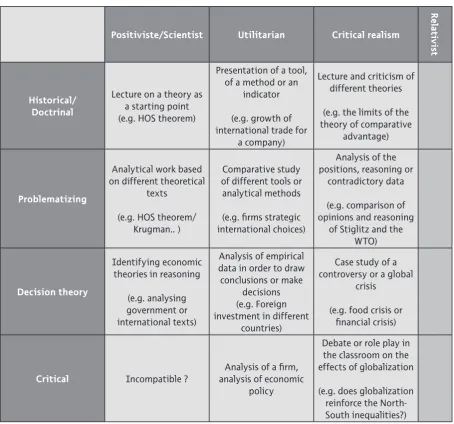
The different epistemological postures we have identi-fied shed light on learning objectives but should not be confused with the didactic strategies which are de-termined by the means and the scenario set up in the class to fulfil an objective. We have identified four pos-sible strategies (Simonneaux 2010): historical or doc-trinal, problematizing, decision theory and critical.
The historical or doctrinal strategy which corre-sponds to a lecturing posture where the “master” de-livers the teaching content leaving very few opportu-nities for communicational interaction. This is done with a view to achieving a clearly defined and identifi-able objective.
The problematizing strategy focuses on the stu-dents’ cognitive activity; the objective is to arrange things so that the students take an active part in the construction of knowledge. Interaction in the class-room is essential and learning how to learn could be the slogan for this strategy.
The decision theory strategy is based on involving the students in an activity. Priority is given to exer-cises, concrete cases, field studies.
The critical strategy tries to develop a critical sense, putting knowledge into perspective by preparing stu-dents to handle complex issues and to call knowledge into question.
33
Conclusion
In the majority of countries, globalization is on the secondary education syllabus where it has replaced trade internationalization by broadening the ques-tion. However, there are variations in the learning stakes depending on the levels and courses of study. In France the citizenship goal of social sciences is ex-plicit in general high schools, the operational goal may prevail on certain vocational courses, particularly business courses. By way of SAQs, we have attempted to show that learning stakes are numerous and that there is no ideal way of teaching globalization how-ever certain didactic choices which can be supported by socio-epistemological surveys, the identification of epistemological postures and the definition of a didactic strategy. Evaluating the efficacy of these choices remains difficult and cannot be compared if the targeted learning objectives are different.
Our proposals relate to high school education, they must allow the distinction between the purposes of literacy whose objectives are firstly to form responsi-ble citizens, aresponsi-ble to understand the current economic and social news, and the purposes of a vocational edu-cation or preparation to pursue graduate studies in social sciences. Within the citizenship education, the analysis of educational activities in terms of the SAQ is intended to link the different cognitive, ethical and social competencies (Audigier, 1999). The analysis of an education in globalization from the perspective of Socially Acute Questions (SAQs) has enabled us to evoke the multiplicity of references and to emphasize the citizenship challenges in learning about uncer-tainty and controversies. There is no perfect teaching solution but there is a process which can help teachers make an enlightened choice depending on the educa-tional aims assigned to them.
Table 2: Examples of teaching activities according to the didactic strategy and the epistemological posture on globalization.
Positiviste/Scientist Utilitarian Critical realism
Re
la
tiv
is
t
Historical/ Doctrinal
Lecture on a theory as a starting point (e.g. HOS theorem)
Presentation of a tool, of a method or an
indicator
(e.g. growth of international trade for
a company)
Lecture and criticism of different theories
(e.g. the limits of the theory of comparative
advantage)
Problematizing
Analytical work based on different theoretical
texts
(e.g. HOS theorem/ Krugman.. )
Comparative study of different tools or analytical methods
(e.g. firms strategic international choices)
Analysis of the positions, reasoning or
contradictory data
(e.g. comparison of opinions and reasoning
of Stiglitz and the WTO)
Decision theory
Identifying economic theories in reasoning
(e.g. analysing government or international texts)
Analysis of empirical data in order to draw conclusions or make
decisions (e.g. Foreign investment in different
countries)
Case study of a controversy or a global
crisis
(e.g. food crisis or financial crisis)
Critical Incompatible ?
Analysis of a firm, analysis of economic
policy
Debate or role play in the classroom on the effects of globalization
34
References
Abric, Jean-Claude. 1994. Pratiques sociales et représenta-tions. Paris: PUF.
Adda, Jacques. 1998. La mondialisation de l’économie. Col-lection Repères, Paris: La Découverte.
Audigier, François. 1999. L’éducation à la citoyenneté. Paris: INRP.
Beaud, Michel. 1999. Préface. In : Mondialisation, les mots et les choses, GEMDE, Paris : Éditions Karthala, 8-14.
Beck, Ulrich. 2001. La société du risque. Paris: Aubier.
Bois, Guy. 2003. Une nouvelle servitude, essai sur la mondi-alisation. Paris: F.-X. de Guibert.
Boyer, Robert. 2000. La Mondialisation au-delà des mythes. Paris: La Découverte.
Charlot, Bernard. 1997. Du Rapport au Savoir, éléments pour une théorie. Paris: Ed. Economica.
Chatel, Élisabeth. 2002. L’action éducative et la logique de la situation. Fondements théoriques d’une approche prag-matique des faits d’enseignement, Revue Française de Péda-gogie, n° 141, 37-46.
Chevallard, Yves. 1985. La transposition didactique – Du savoir savant au savoir enseigné, Grenoble: La Pensée sau-vage.
Dagorn, René. 1999. Une brève histoire du mot «mondialisa-tion». In : Dagorn, René, ed. Mondialisation, les mots et les choses, GEMDE. Paris : Éditions Karthala, 187-204.
Dolfuss, Olivier. 1998. La mondialisation. Paris: Presses de Sciences Politiques.
Durkeim, Emile. 1878. Représentation sociale et représenta-tion collective. Revue métaphysique et sociale. Paris.
Fitoussi, Jean-Paul. 2004. L’idéologie du monde, Chroniques d’économie politique, La Tour-d‘Aigues : L‘Aube et Paris : Le Monde.
Fourez, Gérard. 1996. La construction des sciences : les logiques des inventions scientifiques, introduction à la phi-losophie et à l’éthique des sciences, 3éd. Revue. Bruxelles: De Boeck.
Fourez, Gérard. 1997. Qu’entendre par îlots de rationalité et par îlot interdisciplinaire de rationalité. In : Aster, n°25, 217-225.
Guesnerie, Roger. 2008. Rapport au Ministre de l‘Éducation nationale de la mission d‘audit des manuels et programmes de sciences économiques et sociales du lycée,
Habermas, Jürgen. 1987. Théorie de l’agir communication-Théorie de l’agir communication-nel. Tome 1 : Rationalité de l’agir et rationalisation de la société. Paris: Fayard.
Huntington, Samuel P. 2000. Le Choc des civilisations. Pa-Le Choc des civilisations. Pa-ris: Éditions Odile Jacob.
Huntington, Samuel P. 2004. Qui sommes-nous? Identité nationale et choc des cultures. Paris: Odile Jacob.
Khun, Thomas. 1962. La structure des révolutions scienti-fiques. (traduction de la seconde édition The Structure of Scientific Revolutions, 1983). Paris: Flammarion.
Kolstø, Stein D. 2001. Scientific Literacy for Citizenship: Tools for Dealing with the Science Dimension of
Controver-sial Socioscientific Issues. In: Science Education 85, 291-310.
Krugman, Paul. 1998. L’économie auto-organisatrice. Bruxel-les: De Boeck. (Krugman, Paul. 1996. The Self-Organizing Economy. Cambridge, MA: Blackwell).
Laïdi, Zaki. 2002. Mondialisation : entre réticences et résis-tances. In : Revue du MAUSS, Quelle « Autre mondialisation »?, n°20, 25-42.
Larochelle, Marie; Desautels, Jacques. 1992. Autour de l’idée de science – itinéraire cognitifs d’étudiants. Québec: Les presses de l’Université Laval & Bruxelles: De Boeck Uni-versité.
Latouche, Serge. 2000. La planète uniforme. Castelnau le Lez: Climats.
Le Goff, Jacques. 2001. Heurs et malheurs des mondialisa-tions. In : Cahiers français N°305, nov-déc 2001, Paris: La Documentation Française, 3-6.
Legardez, Alain. 2003. L’enseignement de questions sociales et historiques socialement vives. In: Le Cartable de Clio n°3, Lausanne, 245-253.
Legardez, Alain. 2004. L‘utilisation de l‘analyse des re-, Alain. 2004. L‘utilisation de l‘analyse des re-présentations sociales dans une perspective didactique. L‘exemple des questions économiques et sociales. In: Revue des Sciences de l‘Education, vol. 30 (3), 647-665.
35
Legardez, Alain; Beddock, Dominique; Fontani, Carole;Guidoni, Jean-Pierre; Lebatteux, Nicole; Ludwig-Legardez, Annie; Olivier-Leclaire, Fanny; Ramondetti, Marie-José; Ri-chit, Nathalie; Simonneaux, Jean ; Viguier, Philippe. 2009. Rapport de recherche sur „L’enseignement de la mondialisa-tion“. In : Recherche INRP n°39-127 (2003-2008), Université de Provence et INRP, 187.
Levitt, Theodore. 1983. The Globalization of Markets. In: Harvard Business Review, May-June 1983, 92-102.
Martinand, Jean-Louis. 2001. Pratiques de référence et prob-lématique de la référence curriculaire. In: Terisse, André, ed. Didactique des disciplines. Les références au savoir. Brux-elles: De Boeck.
Moscovici, Serge. 1976. Psychologie des représentations so-ciales. In: Cahiers Vilfredo Pareto, 14, 409-416.
Passet, René. 2001. Eloge du mondialisme par un « anti » présumé. Paris: Fayard.
Perroux, François. 1973. Pouvoir et économie. Paris: Bordas.
Sadler, Troy D.; Chambers, William F.; Zeidler, Dana L. 2004. Student Conceptualisations of The Nature of Science in Re-sponse to a Socio-Scientific Issue. In: International Journal of Science Education, 26(4), 387-410.
Sen, Armatya. 1993. Ethique et économie. Paris; PUF. (Sen, Armataya. 1991. On Ethics and Economics. Blackwell Pub-lishers, Oxford).
Simonneaux, Jean; Legardez, Alain. 2006. L‘enseignement de la mondialisation. In: Legardez, Alain; Simonneaux, Lau-rence, eds. L‘école à l‘épreuve de l‘actualité. Enseigner des questions vives. Paris: ESF, 217-232.
Simonneaux, Jean. 2008. L’éducation aux valeurs fait la valeur de l’éducation : illustration en économie. In: Favre, Daniel ; Hasni, Abdelkrim ; Reynaud Christian, Les valeurs
explicites et implicites dans la formation des enseignants. Bruxelles: De Boeck, 31-140.
Simonneaux, Jean. 2010. (à paraître). Les controverses sur le développement durable à l’épreuve d’une perspective édu-cative In : s/d Bader Barbara, ed. L’éducation au développe- In : s/d Bader Barbara, ed. L’éducation au développe-s/d Bader Barbara, ed. L’éducation au développe-ment durable. Presses Universitaires de Montréal.
Simonneaux, Laurence; Simonneaux, Jean. 2009. Students’ Socio-Scientific Reasoning on Controversies from the View-point of Education for Sustainable Development. In: Cul-ation for Sustainable Development. In: Cul-tural Studies of Science Education, 4, 657-687.
Simonneaux, Laurence. 2001. Role-play or Debate to Pro-mote Students‘ Argumentation and Justification on an Issue in Animal Transgenesis. In : International Journal of Science Education, 23 (9), 903-928.
Stengers, Isabelle. 1993. L’invention des sciences modernes. Paris: La Découverte.
Stiglitz, Joseph. 2002. La grande désillusion. Paris: Fayard, (Stiglitz, Joseph. 2002. Globalization and Its Discontents. Norton).
Wallerstein, Immanuel. 2002. La mondialisation n’est pas nouvelle. Postface à le 2ème édition de Le capitalisme histo-rique. Paris: La Découverte.
Wolton, Dominique. 2003. L’autre mondialisation. Paris: Flammarion.
Zarifian, Philippe. 2004. L‘échelle du monde. Globalisation, altermondialisme, mondialité. Paris: Editions La Dispute.