Sunitha S. et al., J. Sci. Res. Phar. 2014, 3(1), 6 - 11
J
ournal of
S
cientific
R
esearch in
P
harmacy
Research Article
Available online through
ISSN: 2277-9469
www.jsrponl
ine.com
Design, Development and Evaluation of Nanoemulsion and Nanogel of Itraconazole for Transdermal
Delivery
Sunitha S.* Jitendra Wankar, Thirupati Ajimera
*Department of Pharmaceutics, National Institute of Pharmaceutical Education and Research (NIPER-HYD),
Balanagar, Hyderabad, A.P. - 500037, INDIA.
Received on: 16-12-2013; Revised and Accepted on: 23-01-2014
ABSTRACT
T
he aim of the present study is to formulate and evaluate itraconazole loaded nanoemulsions and nanoemulsion based gels for the treatment of fungal infections. The nanoemulsions were formulated using Labrasol as the surfactant and Transcutol p and Lecithin as a cosurfactant. The prepared formulations were evaluated for particle size, zeta potential and in vitro drug release by diffusion studies. The optimized nanoemulsion was incorporated into 2% Carbopol to get a gel for improving convenience in superficial application of the drug. The particle size of the nanoemulsion prepared ranging from 414.3nm-987.3nm. The polydispersibility value was found low indicating uniformity of droplet size of the formulations. In vitro drug release was performed upto 24 hours. Further compatibility studies were performed to confirm any drug polymer interaction. From the FTIR spectra of drug and the formulation it was found that there are no special peaks indicating no drug polymer interaction that is significant. The formulation with F2 is releasing 7.28mg at 24 hours. The release studies of all the formulations werefitted in different kinetic models and found that they are following first order release and stated fickian and diffusion controlled. The results indicated that nanoemulsion based hydrogels as a promising approach for transdermal delivery of itraconazole. Further in vivo studies need to be performed to determine its suitability for topical application.
Key words: Labrasol, lecithin, eugenol, hydrogels, itraconazole, nanoemulsion.
INTRODUCTION
T
he frequency of acquiring bacterial, viral, or fungal infectious diseases increases each year due to the ease of transmission from person to person [1]. Swift and effective treatment options are anecessity to avoid spreading of disease to peripheral organs and potential death [2-3].Of the many forms of infection, fungal infections
can be easily acquired and are known to persist over time, causing great discomfort. Approximately 1.5 million fungal species exist on earth and according to some this number is increasing [4]. A large
number of species exist coming in contact with fungal species can occur from a range of locations, especially moist areas. Some common species known to result in infection are Aspergillus, Candida, Tinea, Pneumocystis, Cryptococcus, and Histoplasma [5]. Superficial
infections, a subset of fungal infections, caused by such species include conditions such as athlete’s foot, finger and toe nail infections, yeast infections, oral thrush, and ringworm. There are also systemic and opportunistic fungal infections which can enter the bloodstream and result in more serious disease, particularly in those with compromised immune systems [6-8].
Onychomycosis is a chronic fungal infection of the nail. It is caused mostly by dermatophytes, particularly Trichophytonrubrum, as well as by nondermatophyte yeasts, of which Candida albicansis the most common, or moulds. Oral antifungals are the most effective agents available to treat onychomycosis [9-11]. Some of the prescribed
drugs for oral therapy are griseofulvin, itraconazole, fluconazole, ketoconazole, and terbinafine, of which griseofulvin is not currently used much. However, oral therapy is followed by some disadvantages such as drug interactions, side effects, high cost of medication, and a long duration of treatment. Moreover, systemic use of azoles can be linked to hepatotoxicity, especially during prolonged use. Another problem which occurs is that drug resistance in fungi has been
*Corresponding author:
Dr. Sunitha Sampathi. M.Pharm., Ph.D. Assistant Professor, Department of Pharmaceutics,National Institute of Pharmaceutical Education and Research (NIPER-HYD), Balanagar, Hyderabad, A.P. - 500037, India.
*E-Mail: [email protected]
evolving and a need for novel antifungal drugs is increasing. Thus, topical therapies are more desirable.
Itracoanzole (ITZ),is an azole antifungal agent. It is widely used clinically for a variety of serious fungal infection in normal and immune-compromised hosts, including Aspergillosis, Cryptococcus, Candida, Blastomyces, disseminated penicillium infection, and Histoplasmum capsulatumvar [12-13]. Itracoanzole acts by impairing the
synthesis of erosterol, essential component of the fungal cell membrane [14]. The log partition coefficient of ITZ is 5.66 in a system of
N-octanol and aqueous buffer solution at pH 8.1, which indicates the hydrobhobicity of the drug. ITZ is a weak base with a pKa 3.7, and relatively insoluble in water [15]. It has been used successfully in the
treatment and prevention of Aspergillus infection with a lower toxicity than amphotericin B, indicating a better therapeutic index [16-19].
However, the bioavailability of ITZ from the existing market formulation like pellet capsule form is very low in neutropenic patients
[20] and inadequate plasma concentration are often found in patient
receiving antineoplastic therapy. Topical drug delivery opens up a number of opportunities with regard to efficient drug therapy for fungal infection and would be more effective in these individuals. A topical application may be helpful for many neutropenic and other immune-compromised patients who have difficulty in swallowing the oral capsule formulation. Potential advantages of topical administration route include site directed delivery, which can obviate the need for oral and other systemic treatment and can reduce the total drug dose, thereby reducing non-target site toxicities [21-22]. A useful
case in point is the treatment of cutaneous fungal infections where many useful agents must be administered orally to achieve clinically reverent cure rates [23-24].
One of the most promising techniques for enhancement of transdermal permeation of drugs is by using nanoemulsion technique. Nanoemulsions are defined as thermodynamically stable transparent and translucent dispersions of oil and water stabilized by an interfacial film of surfactant and co-surfactant molecules having the droplet size less than 140 nm [25, 26].
Many studies proved that nanoemulsion formulations possess improved transdermal and dermal delivery properties both in vitro [27-28] and in vivo [29, 30] over emulsions [31] and gels [32, 33].
Sunitha S. et al., J. Sci. Res. Phar. 2014, 3(1), 6 - 11
the patients via several routes, but the topical application of nanoemulsion has gained increasing interest. The three main factors determining the transdermal permeation of drugs are the mobility of drug in the vehicle, release of drug from the vehicle, and permeation of drug into the skin. Concentration of surfactant must be high enough to provide the number of surfactant molecules needed to stabilize the nano droplets to be produced by an ultra low interfacial tension. This paper highlights the propective of the nanoemulsion system in transdermal delivery of itraconazole consisting of eugenol as oil phase, labrasol as surfactant and lecithin and transcutol p as co-surfactant. Further, the optimized formulations were incorporated into carbopol gel and in vitro studies were performed.
MATERIALS AND METHODS
Materials:
Itraconazole was obtained as gift sample from Dr. Hetero Labs., Pvt. Ltd. (Hyderabad, India). Lecithin and sodium cholate were purchased from Sigma Aldrich, eugenol was purchased from Loba chemicals. Pvt. Ltd. (Mumbai, India). Transcutol P was gifted from BASF, Germany and all other reagents and solvents used were of analytical grades.
Analytical method development for itraconazole:
A spectrophotometric method was developed for analysis of itraconazole. Briefly, the stock solution was prepared by dissolving 100 mg of itraconazole in 100 mL of saline phosphate buffer with 2% SLS. The standard solution of drug was subsequently diluted with saline phosphate buffer with 2% SLS to attain a series of dilutions containing 5, 10, 15, 20 and 25 µg/ml. The absorbance was measured using double beam Jasco UV spectrophotometer at 263 nm using saline phosphate buffer with 2% SLS as blank. A graph was plotted by taking concentration of Itraconazole µg/ml on x-axis and absorbance on y-axis. The calibration curve was used for the estimation of the drug in the test samples.
Preparation of Itraconazole-loaded Nanoemulsions:
Itraconazole nanoemulsion was prepared by adding Itraconazole (1%) to 0.25 ml of eugenol. The oil–drug mixture was stirred for 30 minutes to homogenously distribute the drug. The aqueous phase was prepared by mixing the weighed quantities of labrasol and transcutol P as mentioned in the Table No.1. The oil phase was then gradually added to the aqueous phase with constant stirring on a magnetic stirrer at 900 rpm and the mixture was titrated with deionised distilled water to obtained coarse dispersion .The formed dispersion were thoroughly mixed by ultra-turrax T 25 for 5 min at 20000 rpm to form coarse emulsion. The resultant coarse emulsion containing both oil and aqueous phase was sonicated for 15 min using the Vibra Cell VC 505 probe sonicator (Sonics and Material Inc., Newtown, CT, USA). The probe sonicator was adjusted at 30% amplitude and 50% duty cycle. The stable nanoemulsions thus formed were stored in a refrigerator at approximately 4°C for further study.
Preparation of nanoemulsion based gel:
The best nano emulsion was integrated into 2% of carbopol 940 to prepare nanoemulsion gel. Weighed amount of the carbopol 940 was dissolved in 15ml of distilled water and stirred thoroughly to form homogenous solution. The stable nanoemulsion was added gradually and mixed thoroughly and pH of the nanoemulsion gel was adjusted to neutral pH with triethanolamine.
Evaluation:
Characterization of nanoemulsions: Photon correlation spectroscopy:
The mean particle size and the size distribution of the nanoemulsions were determined by photon correlation spectroscopy. The prepared nanoemulsions were diluted 40 times for the measurement of droplet size. The average diameter and polydispersity index of prepared samples were measured by photon correlation spectroscopy (Nano ZS90, Malvern Instruments, and U.K). The measurements were performed at 25˚ C using a He-Ne laser [34, 35].
Drug content:
The drug content of the prepared nanoemulsion based gel was determined by dissolving an amount of gel containing 5mg of itraconazole. The drug content was determined at 263 nm appropriate dilutions by UV Spectrophotometer.
Zeta potential:
The surface charge was analyzed using a Zeta-sizer at 25˚C by measuring the zeta potential of the prepared formulation. After suitable dilution with distilled water the zeta potential was measured for nanoemulsions formulations.
Scanning electron microscopy (SEM):
Morphological characterization of the nanoemulsion was carried using scanning electron microscopy under reduced pressure (0.001torr). The nanoemulsion were viewed at an accelerating voltage of 15-20kv.
Thermodynamic stability study:
The optimized nanoemulsion was centrifuged at 5000 rpm for 25-30 min and checked for phase separation, creaming, and cracking. The nanoemulsion was also subjected to heating and cooling cycle. Six cycles between the refrigerator temperature 4˚C and 45˚C temperature were performed with storage at each temperature for not less than 48 h. Finally it was subjected to freeze thaw cycle. Formulation were exposed for three freeze thaw cycles between -21˚C and +25˚C with storage at each temperature for not less than 48 h to check the thermodynamic stability of the formulations.
In vitro diffusion studies using dialysis membrane:
The in vitro skin study was performed by using Franz diffusion cells with an effective diffusion area of 2cm2. The dialysis
membrane (12,000 MW) was soaked for 12 h and clamped between the donor and receptor compartment of the cell. The nanoemulsion and the nanoemulsion gel containing itraconazole(10mg) were placed in the donor compartment. The receptor compartment was filled with saline phosphate buffer with 2% SLS as the medium and maintained at 37 ± 0.5 ºC and stirred at 600 rpm and samples were withdrawn from the receptor compartment at regular intervals for a period of 24 h. The samples were analyzed by UV-Spectrophotometer after suitable dilutions. The experiment was conducted in triplicates.
Kinetic analysis of drug release:
To analyze the mechanism of drug release from itraconazole nanoemulsion and nanoemulsion based gel the in vitro
dissolution data were fitted to zero order, first order, Higuchi release model, and Korsemeyer and Peppa’s model and the model with higher correlation coefficient was considered to be the best model.
RESULTS AND DISCUSSION
N
anoemulsions containing eugenol as oil were formulated by using labrasol as the surfactant, lecithin and transcutol P as cosurfactant in different ratio’s as given in the Table No. 1. The surfactant and cosurfactant helps to surround the oil droplet as an interfacial film and helps in reducing the surface tension. The high shear conditions of the ultrasound instrument makes it possible to prepare a stable dispersion of nanoscale oil droplets in aqueous phase so that the mean hydrodynamic diameter of the oil droplets formed will be in nano range for all of the samples. The drug has high solubility in eugenol oil which helped to maintain the high solubility of the drug.The mean particle size of the nanoemulsion formulation of ITZ was found to be in the range of 414.3 to 943.6 nm. The Polydispersity index was found to range from 0.066 to 0.445 which indicates uniformity of droplet size within the formulations with zeta potential values between -10.6 to -24.9 respectively (Table No. 2). The higher the value of the polydispersity the lower is the uniformity of the droplet size within the formulations. The small mean particle size and PdI values below 0.2 (Table No. 2), indicated a narrow droplet size distribution and thus assured better stability of the formulation. The particle size and shape of the nanoemulsion was also confirmed by SEM studies (Fig. 1). Scanning electron microscopy images revealed that the nanoemulsion droplets were non aggregated and almost spherical in shape.
Sunitha S. et al., J. Sci. Res. Phar. 2014, 3(1), 6 - 11
excipient are compatible with each other as there are no addition peaks.
The physicochemical properties of ITZ nanoemulsion suggest that it has good potential for topical drug delivery and thus formulated further as hydrogels. The optimized nanoemulsion was incorporated 2% carbapol 940 as the gelling agent to obtain the desired nanoemulsion gel and evaluated for drug content, which showed uniformity of 5 mg in all the prepared gel formulations, so the data has not been included.
Itraconazole gel with a pH value near to the normal skin showed newtonian flow with good spreadability and may assure the practicability to skin administration in a small but sufficient quantity when administered directly onto skin. Thermodynamic stability studies of prepared formulations including heating, cooling cycles, freeze and thaw cycles showed that all the formulations have good physical stability without any phase separation, creaming and cracking.
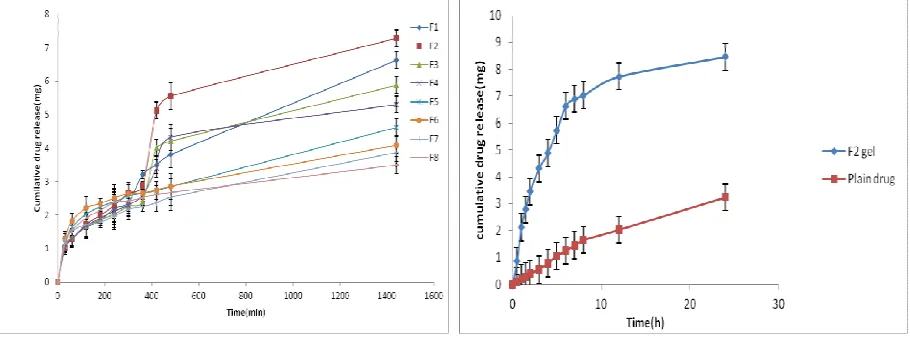
In vitro drug release studies from all the 8 formulations of nanoemulsions were determined. The in vitro release of the drug was higher with the formulation F2 7.28 mg /24 h and lowest with
formulation F8 around 3.50 mg /24 h. The significant difference in
the release between formulations was probably due to the mean size of internal phase droplets. The maximum drug release found with F2 and F1 formulations having least size of internal phase
droplets (Fig. 4, 5).
The in vitro release profile was applied in various kinetic models in order to find out the order and mechanism of drug release. Fitting of the release data into first order, Higuchi´s, and Peppa´s equations were done for formulations. All the formulations were following first order release kinetics by fickian transport (Table No. 4).
Intra cellular and transcellular pathway are the two pathways for drugs to permeate stratum corneum. Of the two mechanism intra cellular pathway plays a major role in percutaneous uptake of drugs. The complex mixtures of essential lipids which are arranged as a bilayer with their hydrophobic chains facing each other form lipophilic bimolecular leaflets. The small droplet size of nanoemulsion helps in providing a very large surface area for drug to transfer through the skin. The nanoemulsions can interact with the lipid bilayers of the stratum corneum and thereby contribute significantly to the penetration enhancing effect. This might be the reason for enhanced permeation with nanoemulsions.
Table. No. 1: Formulae of Itraconazole nanoemulsion with its various compositions
Formulation code Itraconazole ( mg) Eugenol(oil) (ml) Labrasol (ml) Transcutol p (ml) Lecithin (mg) Water in ml
F 1 10 0.25 1 0.5 40 0.12
F 2 20 0.25 1 0.5 40 0.12
F 3 30 0.25 1 0.5 40 0.11
F 4 40 0.25 1 0.5 40 0.10
F 5 10 0.25 1 1 40 0.20
F 6 20 0.25 1 1 40 0.19
F 7 30 0.25 1 1 40 0.19
F 8 40 0.25 1 1 40 0.19
Table.no: 2: Particle size, Polydispersity index and Zeta potential of the nanoemulsion formulations
Formulation code Particle size in nm Polydispersity index(PDI) Zeta potential
F 1 414.3 0.066 -10.6
F 2 465.2 0.192 -18.3
F 3 585.0 0.369 -21.4
F 4 687.2 0.134 -14.4
F 5 443.6 0.196 -23.5
F 6 506.2 0.254 -24.9
F 7 616.5 0.445 -12.0
F 8 987.3± 0.103 -17.0
Table 3: Curve fitting data for all formulations of itraconazole nanoemulsions using labrasol as surfactant and Transcutol P and lecithin as cosurfactants
Nano emulsion Formulation Zero order First order Higuchi Peppa’s
r2 K r2 K r2 K r2 K
F1 0.861 0.004 0.775 0.040 0.740 0.030 0.926 0.444 F2 0.756 0.005 0.722 0.042 0.836 0.039 0.909 0.532 F3 0.799 0.003 0.678 0.039 0.855 0.049 0.912 0.435 F4 0.804 0.003 0.721 0.044 0.753 0.031 0.935 0.424 F5 0.849 0.002 0.706 0.046 0.791 0.033 0.973 0.343 F6 0.751 0.001 0.542 0.058 0.888 0.043 0.964 0.299 F7 0.811 0.001 0.695 0.048 0.804 0.034 0.960 0.278 F8 0.681 0.002 0.707 0.043 0.802 0.033 0.979 0.302
Sunitha S. et al., J. Sci. Res. Phar. 2014, 3(1), 6 - 11
Fig. 2: and 2a. Globule size distribution and Zeta potential curve of the itraconazole nanoemulsion formulation
Sunitha S. et al., J. Sci. Res. Phar. 2014, 3(1), 6 - 11
Fig. 3: In vitro drug release profiles of itraconazole nanoemulsion Fig. 4: In vitro drug release of Itraconazole nanoemulsion gel
formulations F1-F8 in PBS of pH 7.4 and plain drug formulation in PBS of pH 7.4
CONCLUSION
T
he present work shows that nanoemulsions and nanoemulsion based gel containing eugenol, labrasol,transcutol P and lecithin as a suitable carrier system for incorporating itraconazole suitable for transdermal delivery of the drug. As labrasol is compatible with the eugenol and helps in solubilising the drug it has been used in the formulation of the nanoemulsion preparation. Transcutol P helps in the solubilization of the drug and also has the property as permeation enhancer. Nanoemulsion based gels are more acceptable for the transdermal route of administration. The ingredients used in the formulations are highly stable and safe for the transdermal delivery. Various formulations were prepared as per the composition and best nanoemulsion was incorporated into 2% of carbopol 940 and formulated as gel and studied for drug release. The developed system could able to release the drug in sustained pattern and might reduce the frequency of administration and improves the patient compliance.REFERENCES:
1. Pinner, R.w.; Teutsch, S.M.; Simonsen, L. Trends in infectious diseases mortality in the United States. JAMA.,1996; 275: 189-193.
2. Armstrong, G.L.; Conn, L.A.; Pinner, R.W. Trends in infectious disease mortality in the united states during the 20th century. JAMA., 1999; 281: 61-66.
3. Morens, D.M.; Folkers, G. K; Fauci, A.S. The challenge of emerging and re-emerging infectious diseases. Nature 2004;
430: 242-249.
4. Hawksworth, L. D. The magnitude of fungal diversity: The 1· 5 million species estimate revisited. Mycological Research,2001; 105: 1422-1432.
5. Peters Wag, H. M. Colour atlas of tropical medicine and parasitological. Mosby-Wolfe, 1995.
6. Rolando, N.; Harvey, F.; Brahm, J.; et al.: Fungal infection: A common, unrecognised complication of acute liver failure. J. Hepatology, 1991; 12: 1-9.
7. Richardson, M. D. Changing patterns and trends in systemic fungal infections. J. Antimicrob. Chemother., 2005; 56: 15-11 8. Degregorio, M. W., Lee, W.M.F.; Linker, C. A.; Jacobs, R.A, A. Ries, C. Fungal infections in patients with acute leukemia.
Am. J. Med., 1982; 73: 543-548.
9. Drake, L.A.; Scher, R.K.; Smith, E.B.; Faich, G.A.; Smith, S.L.; Hong, J.J.; Stiller, M.J. Effect of onychomycosis on quality of life. J. Am. Acad. Dermatol., 1998; 38: 702-704.
10. Lubeck, D.P. Measuring health-related quality of life in onychomycosis. J. Am. Acad. Dermatol.,1998; 38: 64-68. 11. Ghannoum, M.A.; Hajjeh, R.A.; Scher, R.; Konnikov, N.; Gupta,
A.K.; Summerbell, R.; Sullivan, S.; Daniel, R.; Krusinski, P.; Fleckman, P.; Rich, P.; Odom, R.; Aly, R., Pariser, D.; Zaiac, M.; Rebell, G;, Lesher, J.; Gerlach, B.; Ponce-de-Leon, G.F.; Ghannoum, A.; Warner, J.; Isham, N.; Elwski, B. A large-scale North American study of fungal isolates from nails: the frequency of nychomycosis, fungal distribution, and fungal
susceptibility patterns. J. Am. Acad. Dermatol., 2000; 43: 641-648.
12. Gran, S .M.; Clissold, S.P. Itraconazole: A review of its pharcodynamic and pharmacokinetic properties and therapeutic use in superficial and systemic mycoses. Drug.,
1989; 37: 310-44.
13. Lotholary, O.; Denning, D. W.; Dupont, B. Endemic mycoses :A treatment update. J. Antimicrob. Chemother., 1999; 43: 321-31.
14. Van, C. H.; Heykants, J.; De Coster, R.; Meuldermans, W. Itraconazole :Pharmacologic studies in animals and humans.
Rev. Infect. Dis., 1987; 9: 43-46.
15. Heykants, J.; Van de Velde, V.; Vam Rooy, P.; Meudermans, W.; LAvrijen. K. The clinical pharmacokinetics of itraconazole: An overview . Mycoses,1989; 32: 67-87. 16. Tricot, G.; Joosten, E.; Boogaerts. M.A.; Vande Pitte, J.;
Cauwenbergh, G. Ketoconazole vs itraconazole for antifungal prophylaxis in patients with severe granulocytopenis:\ preliminary results of twononrandomized studies. Rev. Infect. Dis.,1987; 9: 94-99.
17. De Beule, K.; De Doncker, P.; Cauwenbergh, G.; Koster, M. Legndre, R. Blatchford, N. The treatment of aspergillosis and aspergilloma with itraconazole, clinical results of an open international study (1982-1987). Mycoses,1988; 31: 476-85.
18. Dupont, B. Itraconazole therapy in aspergillosis: Study in 49 patients. J. Acad. Dermatol.,1990; 23: 607-14.
19. Como, J.A.; Dismukes, W. E. Oral azole drugs as systemic antifungal therapy.N. Engl. J. Med., 1994; 330: 263-72 20. Bradford, C.R.; Prentice, A.G.; Warnock, D.W; Copplestone, J.
A. Comparision of the multiple dose pharmacokinetics of two formulations of itraconazole during remission induction for acute myeloblastic leukaemia. J. Anitmicrob. Chemother.,
1991; 28: 555-60.
21. Schaefer, H.; Redelmeier, T.E. Prediction and measurement of percuatneous absorption .In: Schafer H, Redelmeirer TE, Editors. Skin Barriers: principles of percuatneous absorption. Basel, Karge, 1996; 118-52.
22. Ghosh, T. K.; Pfister, W. R.; yum, S. I. Transdermal and Topical Drug Delivery Systems, Interpharm Press, Buffalo Grove II. 1997; 33-112.
23. Odds, F. C.; Van, C. Itraconazole :Preclinical data invitro and invivo in cutaneious and other superficial mycoses. Clin. Dermato., 1993; 7: 251-61.
24. Gupta, A. K .; Neil, N. H. A risk benefit assessment of the newer oral antifungal agents used to treat onchomychosis. Drugs. Sas., 2000; 22: 33-52.
25. S. Shafiq, S. Faiyaz, T. Sushma, J. A. Farhan, R. K. Khar and M. Ali, Design and development of ramipril nanoemulsion formulation: In vitro and in vivo assessment, J. Biomed.
Nanotechnol., 2007; 3: 28-44; DOI: 10.1166/jbn.2007.008.
Sunitha S. et al., J. Sci. Res. Phar. 2014, 3(1), 6 - 11
27. M. B. Delgado-Charro, G. Iglesias-Vilas, J. Blanco-Mendez, M. J. Lopez-Quintela, M. A. Martyand J. P. Guy, Delivery of a hydrophilic solute through the skin from novel microemulsion systems, Eur. J. Pharm. Biopharm., 1997; 43: 37–42; DOI:10.1016/S0939 6411(96)00016-1.s
28. M. Kreilgaard, E. J. Pedersen and J. W. Jaroszewski, NMR characterization and transdermal drug delivery potentials of microemulsion systems, J. Control. Rel., 2000; 69: 421-433; DOI:10.1016/ S0168-3659(00)00325-4.
29. P. J. Lee, R. Langer and V. P. Shastri, Novel microemulsion enhancer formulation for simultaneous transdermal delivery of hydrophilic and hydrophobic drugs, Pharm. Res.,
2003; 20: 264-269; DOI:10.1023/A:1022283423116. 30. M. Kreilgaard, Dermal pharmacokinetics of microemulsion
formulations determined by in-vitro microdialysis, Pharm.
Res., 2001; 18: 367-373; DOI:10.1023/A:1011067300397.
31. M. Kreilgaard, M. J. B. Kemme, J. Burggraaf, R. C. Schoemaker and A. F. Cohen, Influence of a microemulsion vehicle on
cutaneous bioequivalence of a lipophilic model drug assessed by microdialysis and pharmacodynamics, Pharm.
Res., 2001;18: 593-599; DOI:10.1023/A:1011068907416.
32. M. R. Gasco, M. Gallarate and F. Pattarino, In-vitro
permeation of zelaic acid from viscosized microemulsions,
Int. J. Pharm., 1991; 69: 193-196; DOI:10.1016/0378-5173 (91)90361-Q.
33. K. Kriwet and C. C. Muller-Goymann, Diclofenac release from phospholipids drug systems and permeation through excised human stratum corneum, Int. J. Pharm., 1995:125: 231-242; DOI:10.1016/0378-5173(95)00130-B.
34. Chen H, Chang X, Du D, Li J, Xu H & Yang X. Microemulsion-based hydrogel formulation of ibuprofen for topical delivery,
Int. J. Pharm.,2006; 315(1-2): 52-58.
35. Robinson JR & Lee VH. Controlled Drug Delivery: Fundamental and Applications; 2nd ed.; (Marcel Dekker: New
York), 1987; 523-552.
Conflict of interest: The authors have declared that no conflict of interest exists.