G. Krishna Reddy et al. J Sci Res Pharm, 2019;8(8):85-91
World Inventia Publishers
J
ournal of
S
cientific
R
esearch in
P
harmacy
http://www.jsrponline.com/
Vol. 8, Issue 8, 2019 ISSN: 2277-9469 USA CODEN: JSRPCJ
Research Article
DESIGN, SYNTHESIS AND BIOLOGICAL CHARACTERIZATION OF 2-SUBSTITUTED THAIZOLIDINE DERIVATIVES
Gayam Krishna Reddy 1 *, Senthilkumar Palaniappan 2
* 1 Junior Research Fellow, Department of Pharmaceutical Chemistry, KMCH College of Pharmacy, Kovai Estate, Kalapatti Road, Coimbatore – 641 048, Tamilnadu, INDIA.
2 Professor, Department of Pharmaceutical Chemistry, J.K.K.Nattraja College of Pharmacy, Natarajapuram, NH-544 (Salem to Coimbatore), Kumarapalayam – 638 183, Namakkal (Dt), Tamilnadu, INDIA.
Received on: 17-07-2019; Revised and Accepted on: 24-08-2019
ABSTRACT
A
series of N-((4,5-dihydro-5-substituted-1-thiocarbamoyl-1-H-pyrazol-3-ylamino)(methylthio)methyl)-2-substituted thiazolidine-4-carboxamide derivative were synthesized. The synthesized compounds were characterized by IR, NMR, and Mass spectral data. The synthesized compounds were screened for their antibacterial and antifungal activity against pathogenic bacteria and fungi. Compounds TP-17, N-((4,5-dihydro-5-(4-methoxyphenyl)-1-thiocarbamoyl-1-H-pyrazol-3-ylamino) (methylthio) methyl) -2-methoxythiazolidine-4-carboxamide and TP-22, N-((4,5-dihydro-5-(4-chlorophenyl)-1-thiocarbamoyl-1-H-pyrazol-3-ylamino) (methylthio)methyl)-2-methoxy thiazolidine-4-carboxamide exhibited good antibacterial and antifungal activity against the tested microorganisms.KEYWORDS: Substituted thiazolidine, Minimum Inhibitory Concentration, Antifungal and Antibacterial.
INTRODUCTION
2
-Substituted thiazolidine derivative compounds play an important position in modern medicinal chemistry, presenting a wide range of bioactivities such as antimicrobial, antitubercular, anticancer, anti-inflammatory, anticonvulsant, antidepressant, hypolipidemic, analgesic, immunotropic activities and NPY receptor ligands. The prevalence of Thiazolidine cores in biologically active molecules has stimulated the need for elegant and efficient ways to make these heterocyclic lead thiazolidine as an important class of compounds for new drug development that attract attention. Over the years, The increase of resistance and rising number of diseases due to attack of pathogenic organisms like bacteria and fungi to particular therapies progressively elevated due to excessive use of antimicrobial drugs has led to a worldwide phenomenon of antibacterial resistance. This has resulted into an increase in morbidity and mortality, and has become a worldwide health issue. As a consequence, the need for the discovery and development of new drug moieties to minimize or to act against anti microbials and development of new antimicrobial agents is in constant demand. Several thiazolidine* Corresponding author:
Gayam Krishna Reddy
Junior Research Fellow,
Department of Pharmaceutical Chemistry,
KMCH College of Pharmacy, Kovai Estate, Kalapatti Road, Coimbatore – 641 048, Tamilnadu, INDIA.
* E-Mail: [email protected]
DOI:https://doi.org/10.5281/zenodo.3383851
derivatives have been synthesized as target structures and evaluated for their biological activities. The cytotoxicity of the reported compounds in the review indicate good safety associated with many of the thiazolidine derivatives [1-4].
Literature review:
Sayed et al [5] prepared a series of
3-(1,5-dimethyl-3-oxo-2-phenyl-2,3-dihydro-1H -pyrazol-4-yl)-2-(2-hydroxy-3,5-diiodophenyl)-thiazolidin -4-one which showed antibacterial activity against E.coli, B.subtillis and S.typhi respectively.
N
N
N S
O
CH3 CH3 O
OH I I
Sharma R et al[6] synthesized a new series of
N-[3-(1H-1,2,3-benzotriazol-1-yl)-propyl]-2-(substituted phenyl)-4-oxo-5-(substituted benzylidene)-1,3-thiazolidine carboxamide and it has shown moderate to good antibacterial and antifungal activity.
N N N
CH2CH2CH3NCO N
S O
CHR1
RH2C
Munendra Mohan et al [7] prepared a series of
5-(substituted amino alkyl)-2-{(1, 3 benzothiazole-2-yl)}-thiazolidine-4-one and tested against various pathogenic fungal and bacterias. Most of the compounds show good to moderate activity.
N S
CONHNHN
S HN
O
CH2NHR
Paola Vicini et al [8] prepared a series of
2-Heteroarylimino-5-benzylidene-4-thiazolidinones analogues of 2-thiazolylimino-5-benzylidene-4-thiazolidinones and analyzed the antimicrobial activity.
N S
N
S HN
O
Meltem Ceylan et al [9] prepared
3-(substituted- benzyl)-5-(4-chloro-2-piperidin-1yl-thiazole-5-ylmethylene)-thiazolidine-2,4-dione derivatives and evaluated their antimicrobial activity against Staphylococcus aureus ATCC 250 and Escherichia coli.
O
S
N N
S
R O
R=C6H5 3-NO2C6H4,
Aim and Objective:
The purpose of the present work was to explore and develop the novel molecule with improved potential for treating microbial infections. In this paper we report the design, synthesis and evaluation of antimicrobial activity of 2-substituted thiazolidine-4-carboxamide derivatives.
MATERIALS AND METHODS
Synthesis of methyl thiourea from thiourea (T1): [10]
Thiourea (10g, 131mmol, 1meq) was dissolved in 100ml of methanol and methyl iodide (8.21ml, 131mmol, 1meq) was added to the reaction mixture and refluxed for 1hr. After completion of the reaction, solvent was evaporated to obtain a crude solid. The crude solid was washed with diethyl ether (10mlx3) to yield the desired product as white powder.
Synthesis of N-tert- butoxycorbonyl methyl thiourea (T2): [10]
A solution of BOC2O (18.65g, 124mmol, 1meq) in 50ml
DCM was slowly added to a solution of methyl thiourea (28g, 128mmol, 1meq) and TEA (17.4ml, 124mmol, 1meq) in 200 ml DCM. Stirred for 20h at room temperature and the reaction mixture was washed with water and brine and the organic phase was dried over magnesium sulphate. The solvent was
evaporated under reduced pressure and crude product was obtained.
Synthesis of 2-Substituted-thiazolidine-4-carboxylic acid (T3): [12]
A mixture of L-cysteine (3.16g, 26.11mmol) and appropriate aldehyde (26.15mmol) in ethanol (300 mL) and water (30mL) was stirred at room temperature for 6-15h, and the solid precipitated out was collected, washed with diethyl ether and dried to afford according (2RS, 4R)-2-aryl-thiazolidine-4-carboxylic acid
Synthesis of N-(amino(methylthio)methyl)-2-substituted thiazolidine-4-carboxamide (T4): [11]
A mixture of 2-substituted-thiazolidine-4-carboxylic acid (T3) (0.3-0.5g), DCC (1.2 equiv) and HOBT (1.05 meq) in DCM (200 mL) was stirred at room temperature for 10 min. To this solution, t-butyl amino(methylthio)methylcarbamate (1.05meq) and TEA (1.2meq) were added and stirring continued at room temperature for 12-16h. The reaction mixture was diluted with DCM (50mL) and sequentially washed with water, satd. Sodium bicarbonate, brine and dried over magnesium sulphate. The solvent was removed under reduced pressure to yield t-butyl(2-substituted thiazolidine-4-carboxamido) (methylthio) methylcarbamate as crude product, which was stirred with TFA (0.6-1mL) in 20mL DCM at room temperature for 1-8h to cleave the BOC group. The reaction mixture was concentrated, washed with satd. sodium bicarbonate and dried over magnesium sulphate. The solvent was removed to yield crude solid.
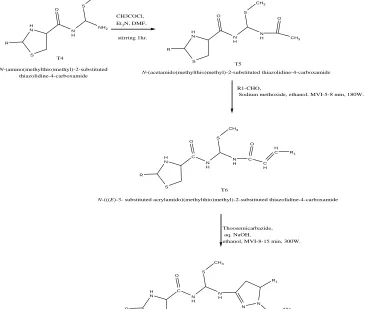
Synthesis of N-(acetamido(methylthio)methyl)-2-substituted thiazolidine-4-carboxamide (T5): [13]
Dissolved N-(amino(methylthio)methyl)-2-substituted thiazolidine-4-carboxamide (T4) (1mmol) in 50ml of Dimethyl formamide and 1mmol of acetyl chloride in presence of triethyl amine at room temperature for 60 min. After completion of reaction, the reaction mixture was poured on to crushed ice and neutralized with dil. HCl. The solid separated was filtered and recrystallized from methanol as yellow powder.
Synthesis of N-(((E)-3- substituted acrylamido)(methylthio) methyl)-2-substituted thiazolidine-4-carboxamide (T6): [14]
a) Conventional Method:
A mixture of N-(acetamido(methylthio)methyl)-2-substituted thiazolidine-4-carboxamide (T5) (0.01mol), appropriate aromatic aldehydes (0.01mol), sodium methoxide (0.04mol) and ethanol (20ml) were stirred for 16h at room temperature. After completion of reaction, the reaction mixture was poured on to crushed ice and neutralized with dil. HCl. The solid separated was filtered and recrystallized from methanol as yellow powder.
b) Microwave Irradiation Method:
Synthesis of N-((4,5-dihydro-5-substituted-1-thiocarbamoyl -1H-pyrazol-3-ylamino)(methylthio)methyl)-2-substituted thiazolidine-4-carboxamide (TP i-xxii): [15]
a) Conventional Heating Method:
A mixture of N-(((E)-3-substituted acrylamido) (methylthio)methyl)-2-substituted thiazolidine-4-carboxamide, thiosemicarbazide (T6) (0.001mol), aq. NaOH (0.08g) in 1ml of water and ethanol (10 ml), was taken in a 25ml round bottomed flask and the reaction mixture was refluxed for 8-10h. The progress of the reaction was monitored by TLC. After completion of the reaction, the reaction mixture was diluted with cold water and neutralized with dil. HCl. The precipitate thus formed was filtered and recrystallized from methanol as yellow powder.
b) Microwave Irradiation Method:
A mixture of N-(((E)-3- substituted acrylamido) (methylthio)methyl)-2-substituted thiazolidine-4-carboxamide, thiosemicarbazide (T6) (0.001mol), aq. NaOH (0.08g) in 1ml of water and ethanol (10 ml), was taken in a quartz tube and inserted into teflon vial with screw cap and subjected to microwave irradiation at the constant temperature 120°C for 5-6min. The progress of the reaction was monitored by TLC. After completion of the reaction, the reaction mixture was diluted with cold water and neutralized with dil. HCl. The precipitate thus formed was filtered and recrystallized from methanol as yellow powder.
RESULTS AND DISCUSSION
I
n the present study, various 2-substituted thiazolidine derivatives were synthesized. The structure of the synthesized compounds was confirmed by IR, NMR, and Mass spectral data. The IR spectrum of all the synthesized compound show bands in the region of 3150-3302 and 1450- 1750 cm-1corresponding to NH and C=O. The IR spectrum of synthesized shows band in the region of 2950 to 3100 cm-1 showing the
presence of C-H in aliphatic and aromatic ring respectively. All the synthesized compound shown bands in the region of 1100 to 1400 cm-1 Showing the presence of C-CH3, ArC=C and mono
substituted phenyl ring. The NMR spectrums of all the compound shows characteristic peak for CH2 from 2 to 3 δ ppm,
the NH2 protons appears at 3 to 4 δ ppm, aromatic protons
appears as multiplet from 1.3 to 7.6 δ ppm. The Mass spectra of all the synthesized compounds were found to be corresponding with the m/z mass. The synthesized compounds were screened for their in-vitro antimicrobial activity against various bacterias like Salmonella paratyphi, Pseudomonas aeruginosa, Escherchia coli, Bacillus subtilis, Micrococcus luteus, Staphylococcus aureus,
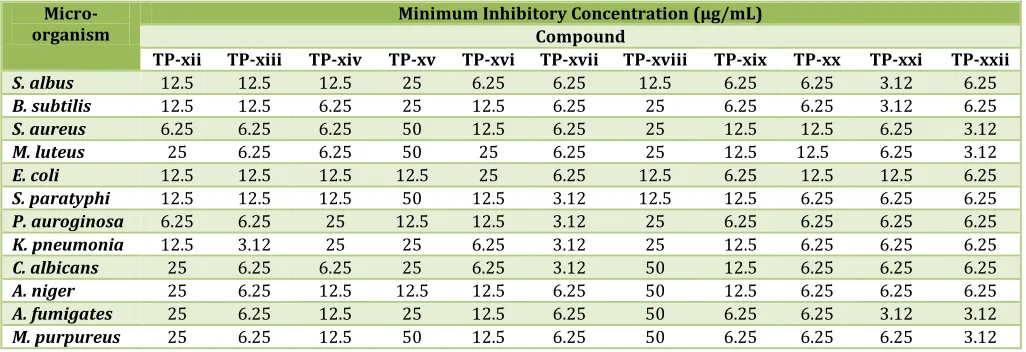
Klebsiella pneumonia, Staphylococcus albus and various fungal organisms like Aspergillus niger, Aspergillus fumigatus, Candida albicans and Monascus purpureus. Among the synthesized 2-aromatic substituted thiazolidine derivatives, compound TP-ii,
TP-v, TP-x, TP-xvii, TP-xxi and TP-xxii shows good activity against both bacterial and fungal organisms with MIC value of 3.12 µg/ml.
TP-i: M.P.(°C): 185-187; IR spectral values (cm-1): 3321.61 (NH2
stretching), 2925.0 (CH3 stretching), 1715.85 (C=N stretching),
1685.0 (C=C stretching), 1626.18 (C=O stretching), 1379.82 (C=S stretching), 1013.8 (C-O-C stretching), 825.38 (C-S stretching), 1312.81 (N-N stretching).
TP-ii: M.P.(°C): 190-193; IR spectral values (cm-1): 3327.5 (NH2
stretching), 2926.93 (CH3 stretching Ali), 1733.2 (C=N
stretching), 1655.5 (C=C stretching), 1585.48 (C=O stretching),
1013.05 (C-O-C stretching), 668.69 (C-C stretching), 854.7 (C-S stretching).
TP-iii: M.P.(°C): 165-167; IR spectral values (cm-1): 3446.17
(NH2 stretching), 2924.52 (CH3 stretching Ali), 1733.12 (C=N
stretching), 1653.48 (C=C stretching), 1537.35 (C=O stretching), 658.2 (C-Cl stretching), 793.0 (disub ring).
TP-iv: M.P.(°C): 169-171; IR spectral values (cm-1): 3546.22
(OH stretching), 3327.09 (NH2 stretching), 2925.97 (CH3
stretching), 1771.7 (C=N stretching), 1685.0 (C=C stretching), 1626.6 (C=O stretching), 854.7 (C-S stretching), 793.79 (disub ring).
TP-v: M.P.(°C): 178-180; IR spectral values (cm-1): 3328.05 (NH2
stretching), 2927.89 (CH3 stretching), 1627.69 (C=N stretching),
1572.49 (C=C stretching), 1426.35 (C=S stretching), 855.7 (C-S stretching), 765.44 (C-Cl stretching).
TP-vi: M.P.(°C): 1171-173; IR spectral values (cm-1): 3328.05
(NH2 stretching), 3051.8 (CH stretching in Ar), 2926.45 (CH3
stretching), 1749.12 (C=N stretching), 1625.7 (C=C stretching), 1566.88 (C=O stretching), 1092.48 (C-O-C stretching), 1424.17 (C=S stretching), 894.80 (C-S stretching), 769.46 (trisub ring).
TP-vii: M.P.(°C): 205-207; IR spectral values (cm-1): 3244.65
(NH2 stretching), 3036.37 (CH stretching in Ar), 2927.86 (CH3
stretching), 1627.14 (C=C stretching), 1573.36 (C=O stretching), 1311.84 (C=S stretching), 1088.14 (C-O-C stretching).
TP-viii: M.P.(°C): 1187-189; IR spectral values (cm-1): 3328.05
(NH2 stretching), 3041.9 (CH stretching in Ar), 2927.89 (CH3
stretching), 1692.2 (C=N stretching), 1576.04 (C=C stretching), 1526.56 (C=O stretching), 1244.8 N stretching), 1088.14 (C-O-C stretching), 641.25 (monosub ring).
TP-ix:M.P.(°C): 211-213; IR spectral values (cm-1): 3328.53 (OH
stretching), 3026.1 (CH stretching in Ar), 2927.8 (CH3
stretching), 1692.23 (C=N stretching), 1628.11 (C=C stretching), 1575.08 (C=O stretching), 1336.1 (C=S stretching), 740.1 ( disub ring).
TP-x: M.P.(°C): 204-206; IR spectral values (cm-1): 3416.28 (NH2
stretching), 3046.98 (CH stretching in Ar), 2927.41 (CH3
stretching), 1718.2 (C=N stretching), 1626.6 (C=C stretching), 1565.52 (C=O stretching), 1422.24 (C=S stretching), 1254.4 (C-N stretching), 884.20 (C-S stretching), 756.86 (disub ring).
TP-xi: M.P.(°C): 216-218; IR spectral values (cm-1): 3413.39 (OH
stretching), 3333.36 (NH2 stretching), 2926.45 (CH3 stretching),
1744.2 (C=N stretching), 1626.84 (C=C stretching), 1563.84 (C=O stretching), 1313.2 (C=S stretching), 1244.8 (C-N stretching), 1040.4 (C-O-C stretching), 754.03 (disub ring), 894.80 (C-S stretching).
TP-xii: M.P.(°C): 218-220; IR spectral values (cm-1): 3327.57
(NH2 stretching), 3041.19 (CH stretching in Ar), 2927.89 (CH3
stretching Ali), 1628.11 (C=N stretching), 1576.04 (C=C stretching), 1528.04 (C=O stretching), 1386.12 (C=S stretching), 1088.14 (C-O-C stretching), 1086.12 (C-S stretching), 916.1(tri-sub ring).
TP-xiii: M.P.(°C): 220-222; IR spectral values (cm-1): 3412.9 (OH
(C-N stretching), 1086.12 ((C-N-(C-N stretching), 837.9 (disub ring), 882.39 (C-S stretching).
TP-xiv: M.P.(°C): 218-220; IR spectral values (cm-1): 3437.13
(OH stretching), 3338.18 (NH2 stretching), 3062.41 (CH
stretching in Ar), 2925.48 (CH3 stretching), 1749.12 (C=N
stretching), 1625.7 (C=C stretching), 1566.38 (C=O stretching), 1383.19 (C=S stretching), 1249.55 (C-N stretching), 1086.12 (N-N stretching), 769.45 (disub ring).
TP-xv:M.P.(°C): 220-222; IR spectral values (cm-1): 3327.57 (OH
stretching), 3114.47 (NH2 stretching), 3041.1 (CH stretching in Ar), 2927.89 (CH3 stretching Ali), 1628.11 (C=N stretching), 1575.6 (C=C stretching), 1522.62 (C=O stretching), 1386.7 (C-N stretching), 1046.13 (N-N stretching), 848.04 (disub ring), 892.3 (C-S stretching).
TP-xvi: M.P.(°C): 222-224; IR spectral values (cm-1): 3177.15
(NH2 stretching), 2923.56 (CH3 stretching), 1646.9 (C=N
stretching), 1516.7 (C=O stretching), 1338.36 (C=S stretching), 1243.86 (C-N stretching), 1105.95 (N-N stretching), 954.31 (C-S stretching).
TP-xvii: M.P.(°C): 230-232; IR spectral values (cm-1): 3329.5
(NH2 stretching), 3091.07 (CH stretching in Ar), 1733.2 (C=N
stretching), 1628.59 (C=C stretching), 1575.56 (C=O stretching), 1312.08 (C=S stretching), 1280.5 (C-N stretching), 769.26 (disub ring).
TP-xviii: M.P.(°C): 222-224; IR spectral values (cm-1): 3343.96
(NH2 stretching), 2926.45 (CH3 stretching Ali), 1705.56 (C=N
stretching), 1627.63 (C=C stretching), 1573.6 (C=O stretching), 1249.65 (C-N stretching), 1040.41 (C-O-C stretching), 769.45 (trisub ring)
TP-xix: M.P.(°C): 218-220; IR spectral values (cm-1): 3239.82 (NH2 stretching), 2923.56 (CH stretching in Ar), 1749.12 (C=N
stretching), 1629.55 (C=O stretching), 1561.09 (C=S stretching), 1117.55 (COC stretching); 1H NMR (δ values): 11.1 (s, 1H, -HN-C=O), 7.5-7.8 (m, 5H), 7.3 - 7.4 (m, 5H, phenyl), 6.8 (d, 1H 4CH=), 3.8 (s, 6H, OCH3), 3.2 (s, 2H, CH3), 1.3 (d, 1H, CH-); Mass (m/z): M+1 = 518.
TP-xx: M.P.(°C): 220-222; IR spectral values (cm-1): 3416.46 (OH
stretching), 3213.79 (NH2 stretching), 3035.4 (CH stretching in
Ar), 1340.28 (C=S stretching), 1399.1 (C-N stretching), 1108.8 (C-O-C stretching), 852.38 (C-S stretching).
TP-xxi: M.P.(°C): 218-220; IR spectral values (cm-1): 3327.57
(NH2 stretching), 2927.41 (CH3 stretching), 1723.09 (C=N
stretching), 1628.5 (C=C stretching), 1572.8 (C=O stretching), 1327.7 (C=S stretching), 1259.2 (C-N stretching), 1040.8 (C-O-C stretching), 756.64 (disub ring), 889.0 (C-S stretching).
TP-xxii: M.P.(°C): 215-217; IR spectral values (cm-1): 3420.14
(NH2 stretching), 3100.0 (CH stretching in Ar), 1629.55 (C=N
stretching), 1541.8 (C=O stretching), 1422.8 (C=S stretching), 1346.05 (C-N stretching), 722.21 (C-Cl in Ar), 851.4 (disub ring), 927 (C-S stretching);1H NMR (δ values): 11.1 (s, 1H, -HN-C=O),
7.5-7.8 (m, 4H, phenyl), 7.3 - 7.4 (m, 4H, Ar), 6.8 (d, 1H CH=), 3.2 (s, 2H, CH pyrazole), 2.4 (s, 3H, -CH3), 1.3 (d, 1H, 4CH-Ar); Mass
(m/z): M+2 = 553.
Scheme: C S NH2 H2N thiourea CH3I iodomethane CH S NH2 H2N H3C (methylthio)methanediamine CH S NH2 N H H3C R-CHO SH O HO L-Cysteine H N S COOH H N S R N H N H S CH3 H N S R N H NH2 S CH3 O O
2- substituted thiazolidine-4-carboxylic acid CH3I
CH3OH,Reflux
BOC2O, Et3N,DCM, stirring
R-CHO,
ethanol,H2O, stirring 7-15 rs
EDC.HCl, HOBT, Et3N, DCM stirring 8- 12hrs.
TFAA,
DCM, stirring 1-8 hrs. R
N-(amino(methylthio)methyl)-2-substituted thiazolidine-4-carboxamide Substituted aldehyde
H2N
O O O
CH3 CH3 H3C CH3 CH3 O O
di-tert-butyl dicarbonate
O O O H3C CH3 CH3
tert-butyl amino(methylthio)methylcarbamate
O
CH3 H3C
CH3
tert-butyl (2-substituted thiazolidine-4-carboxamido)(methylthio)methylcarbamate CH3
T1
T2
T3
H N
S R
N H
NH2 S
CH3
O
H N
S R
N H
N H S
CH3
O
CH3 O
H N
S R
C N H
N H S
CH3
O
C C H O
H C R1
H N
S R
C N H
N H S
CH3
O
N N
R1
NH2
S
TP i-xxii R1-CHO,
Sodium methoxide, ethanol, MVI-5-8 min, 180W.
Thoosemicarbazide, aq. NaOH,
ethanol, MVI-8-15 min, 300W.
N-((4,5-dihydro-5-substituted-1-thiocarbamoyl-1H-pyrazol-3-ylamino)(methylthio)methyl)-2-substituted thiazolidine-4-carboxamide
N-(((E)-3- substituted acrylamido)(methylthio)methyl)-2-substituted thiazolidine-4-carboxamide
N-(acetamido(methylthio)methyl)-2-substituted thiazolidine-4-carboxamide
N-(amino(methylthio)methyl)-2-substituted thiazolidine-4-carboxamide
CH3COCl, Et3N, DMF,
stirring 1hr.
T4
T5
T6
Table No. 1: General structure and physical data of synthesized compounds.
H N
S R
C N H
N H S
CH3
O
N N
R1
NH2
S
Compd R R1 Mol. Formula Mol. Weight cLogP
TP-18 4-OCH3-C6H4- 3,4-di-OCH3-C6H3- C25H32N6O4S3 576.75 2.70 TP-19 4-OCH3-C6H4- C6H5- C23H28N6O2S3 516.70 3.04 TP-20 4-OCH3-C6H4- 2-OH-C6H4- C23H28N6O3S3 532.70 2.32 TP-21 4-OCH3-C6H4- 4-CH3-C6H4- C24H30N6O2S3 530.72 3.54 TP-22 4-OCH3-C6H4- 4Cl-C6H4- C23H27N6O2S3Cl 551.14 3.75
Table No. 2: Minimum Inhibitory Concentration of Compounds
Micro-
organism Minimum Inhibitory Concentration (µg/mL) Compound
TP-i TP-ii TP-iii TP-iv TP-v TP-vi TP-vii TP-viii TP-ix TP-x TP-xi
S. albus 25 6.25 12.5 25 12.5 12.5 12.5 12.5 6.25 6.25 6.25
B. subtilis 25 3.12 12.5 25 6.25 25 25 6.25 12.5 6.25 6.25
S. aureus 12.5 6.25 6.25 25 12.5 5 25 6.25 12.5 12.5 12.5
M. luteus 6.25 12.5 6.25 12.5 6.25 25 25 12.5 6.25 12.5 12.5
E. coli 12.5 12.5 12.5 50 6.25 50 12.5 12.5 6.25 6.25 3.12
S. paratyphi 12.5 6.25 12.5 50 12.5 50 12.5 25 3.12 6.25 6.25
P. auroginosa 12.5 6.25 6.25 12.5 12.5 50 25 12.5 6.25 12.5 12.5
K. pneumonia 25 12.5 6.25 12.5 6.25 12.5 25 25 6.25 12.5 12.5
C. albicans 25 3.12 12.5 25 6.25 25 50 25 6.25 6.25 12.5
A. niger 25 6.25 12.5 25 12.5 25 50 12.5 6.25 6.25 6.25
A. fumigates 25 6.25 12.5 50 12.5 50 50 25 3.12 12.5 12.5
M. purpureus 25 12.5 6.25 50 12.5 25 50 25 6.25 12.5 12.5
Solvent: DMSO; Media: Muller Hinton Broth.
Table No. 3: Minimum Inhibitory Concentration of Compounds
Micro-
organism Minimum Inhibitory Concentration (µg/mL) Compound
TP-xii TP-xiii TP-xiv TP-xv TP-xvi TP-xvii TP-xviii TP-xix TP-xx TP-xxi TP-xxii
S. albus 12.5 12.5 12.5 25 6.25 6.25 12.5 6.25 6.25 3.12 6.25
B. subtilis 12.5 12.5 6.25 25 12.5 6.25 25 6.25 6.25 3.12 6.25
S. aureus 6.25 6.25 6.25 50 12.5 6.25 25 12.5 12.5 6.25 3.12
M. luteus 25 6.25 6.25 50 25 6.25 25 12.5 12.5 6.25 3.12
E. coli 12.5 12.5 12.5 12.5 25 6.25 12.5 6.25 12.5 12.5 6.25
S. paratyphi 12.5 12.5 12.5 50 12.5 3.12 12.5 12.5 6.25 6.25 6.25
P. auroginosa 6.25 6.25 25 12.5 12.5 3.12 25 6.25 6.25 6.25 6.25
K. pneumonia 12.5 3.12 25 25 6.25 3.12 25 12.5 6.25 6.25 6.25
C. albicans 25 6.25 6.25 25 6.25 3.12 50 12.5 6.25 6.25 6.25
A. niger 25 6.25 12.5 12.5 12.5 6.25 50 12.5 6.25 6.25 6.25
A. fumigates 25 6.25 12.5 25 12.5 6.25 50 6.25 6.25 3.12 3.12
M. purpureus 25 6.25 12.5 50 12.5 6.25 50 6.25 6.25 6.25 3.12
Solvent: DMSO; Media: Muller Hinton Broth.
CONCLUSION
S
ome novel 2-substituted thiazolidine derivatives with the aim to get better yield and faster reaction and to get more potent drug for the treatment of microbial infectious diseases.The structure of the compounds was confirmed by spectral analysis. The synthesized 2-substituted thiazolidine derivatives exhibited moderate to good anti-microbial activity. Further studies on its possible mechanism and in vivo trials in experimental animals to broaden their Pharmacological assessment, may provide a new analogue that can overcome drug resistance, prolonged treatment, complex drug regimen and side effects involved in the treatment of infectious diseases.ACKNOWLEDGEMENT
T
he authors are thankful to Dept. of Science and Technology (DST) for funding the research.REFERENCES:
1. Singh SP, Parmar SS, Raman K, Stenberg VI. Chem Rev
1981;81:175.
2. Gududuru V, Hurh E, Dalton JT, Miller DD. Bioorg Med Chem Lett 2004;14:5289.
3. Amin KM, Rahman ADE, Al-Eryani YA. Bioorg Med Chem 2008;16:5377-5388.
4. Shih MH, Ying KF. Bioorg Med Chem 2004 ;12:4633-4643.
5. Sayed M, Mokle S, Bokhare M, Mankar A, Surwase S, Bhusare S, Vibhute Y. ARKIVOC II 2006;187.
6. Sharma. R, P. Samadhiya, SD. Srivastava, SK. Srivastava. Latvian J Chem 2011;3(4):296–307.
7. Munendra Mohan Varshney, Asif Husain, Versha Percha, Neeraj Fuloria. J Appl Pharm Sci 2013;3(04): 135-138.
9. Ceylan M. Turk J Chem 2006;30:355 -360.
10. Kraus A, Ghorai P, Birnkammer T, Schnell D, Elz S, Seifert R, Dove S, Bernhardt G, Buschauer A. Chem Med Chem 2009;4:232‐240.
11. Park JH, Choi JK, Lee E, Lee JK, Rhim H, Seo SH, Kim Y, Doddareddy MR, Pae AN, Kang J, Roh. E J Bioorg Med Chem 2007;15:1409‐1419.
12. Lu Y, Wang Z, Li C-M, Li W, Dalton JT, Miller DD. Abstracts of Papers, 234th ACS National Meeting,
Boston, MA, United States August 19-23; 2007 :MEDI-304.
13. Katritzky AR, He HY, Suzuki K. J Org Chem 2000;65: 8210.
14. Venkateshwara Rao V. and Sundaramurthy V. Proc Ind Acad Sci 1975;81(3):118-123.
15. Varma RS. Green Chem 1999;1:43.
How to cite this article:
Gayam Krishna Reddy, Senthilkumar Palaniappan. DESIGN, SYNTHESIS AND BIOLOGICAL CHARACTERIZATION OF 2-SUBSTITUTED THAIZOLIDINE DERIVATIVES. J Sci Res Pharm 2019;8(8):85-91. DOI:https://doi.org/10.5281/zenodo.3383851