Research Article
1
A Survey on Cognitive computing using Semantic
Technology
Vishal Shah
1and Shridevi S
21VIT University, Chennai. Email: [email protected] 2 VIT University, Chennai. Email: [email protected]
Abstract
The sheer volume of data being generated by the resources is creating a form of cognitive overload for enterprises. The data will be useful to multiple processes in enterprises. Learning and understanding natural language for each process increases computer work in the organization. Enterprise Cognitive Computing (ECC) with the help of Semantic Technology generates structured and organized data for accurate decision making in enterprises. For developing ECC system there are many implementation challenges that need to resolve. ECC comprises Machine Learning, Artificial Intelligence and Question Answering machine that uses natural language processing technologies. These emerging technologies need to customize or combined with complementary solutions as semantic knowledge graphs, depending on the use case. This paper addresses problems of Enterprises that use unstructured data and how this problem can be resolved using semantic technology tools.
Keywords: Enterprise Cognitive Computing (ECC), Semantic Computing, Ontologies, Unstructured Data, Resource Description Framework(RDF), Web Ontology Language(OWL), Natural Language Processing(NLP).
Received on 08 May 2017, accepted on 14 June 2017, published on 28 June 2017
Copyright © 2017Vishal Shah and Shridevi S., licensed to EAI. This is an open access article distributed under the terms of the Creative Commons Attribution licence (http://creativecommons.org/licenses/by/3.0/), which permits unlimited use, distribution and reproduction in any medium so long as the original work is properly cited.
doi: 10.4108/eai.28-6-2017.154389
1. Introduction
In enterprises knowledge of employees and data between machines used to automating business processes and using all data or relevant knowledge, information made actionable that intelligently automate your business process. Multiple processes at one site bring cognitive approaches for decision making. Where Affective Computing used to study and develop systems and devices that can recognize, interpret, process, and simulate human effects, Cognitive Computing uses Affective Computing systems to build an architecture that automates business processes. Cognitive Computing systems are part of broader computing which comprises many system processes and tools together that helps to make enterprise processes more efficient, accurate, relevant and reliable. In an enterprise implement, Cognitive Computing system is not an easy approach, there are many different opportunities and challenges that must be the focus. How unstructured data inside enterprise systems can manage to
be processed between different Cognitive Computing features. Semantic technology can be used to resolve some of the challenges for implementing Enterprise Cognitive Computing (ECC) system. How ECC system minimizes its challenges with Semantic technology tools.
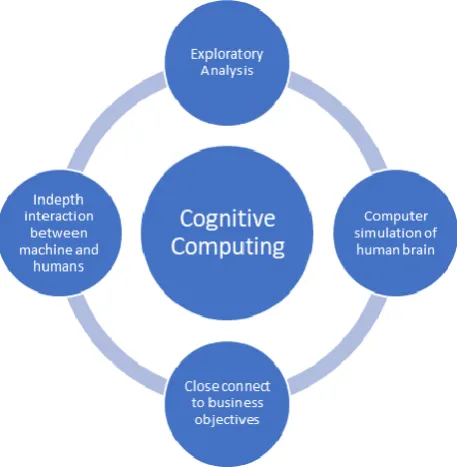
Cognitive Computing: - Cognitive Computing is a technological approach that gives scientific direction for artificial intelligence and signal processing. That basically encompasses machine learning, reasoning, natural language processing, speech recognition and object recognition,
human-computer interaction, dialog and narrative
generation, among other technologies. Cognitive computing system works in the way of a human brain think for any technological approach and it simulates human thought process in a computerized model by using their encompassing technologies.
on
Cloud Systems
EAI Endorsed Transactions on
Cloud Systems
Figure 1. Pictorial representation of Cognitive Computing and its objectives
Cognitive computing is a mashup of cognitive science and computer science that results will impact in our daily lives, healthcare, business and more. Enterprises also adapting Cognitive computing to automate their business processes.
Semantic Technology: - Semantic technology is base computer encoding technology that encodes meaning of data separately from data and content files, and separately from application code. By separate encoding, mechanism enables machine as well as people to understand, share and reason with them.
Figure 2. Semantic Technology
Semantic technology by its phrase also suggests that it uses formal semantics to give meaning to all raw data that surround us. Semantic technology tools and methods provide means for categorizing and processing data. It also
used for discovering relationships within varied data sets. Semantic technology techniques are used in diverse areas like interactive intelligent agents, data lakes, data governance, and emerging cognitive applications. Semantic technology tools are parts of the semantic web. Semantic Web includes Resource Description Framework (RDF), storage scheme, which uses triple style subject-predicate— object structures. It uses a SPARQL as a query language and as an added element Web Ontology Language (OWL).
2. Literature Survey
(i). In this paper [1] authors propose opportunities that enable the organization to develop an Enterprise Cognitive Computing system. That gives an idea to enterprises on which side give more focus while developing cognitive computing system. Authors describe what kind of challenges can occur to implement enterprise cognitive computing system. Cognitive tools effectively increase enterprise efficiency at large scale so it is important to give attention to each tool and other technology used. Issues in this journal are it not elaborates use and implementation of other technology tools that cognitive computing system using and how it will benefit. Challenges are there than resolving solution needed to give a better understanding. A technology that effectively resolves its challenges and gives the better outcome of its use.
3 Figure 3. Cognitive, Semantic and Perceptual computing
process cycle
Semantic computing deals with big-data challenges and cognitive computing provide a collection of applications for computational powers.
(iii). This paper [3] has focused on knowledge sharing and integration in IoT application. IoT application nowadays used in all area where sensing and real-time objects take place to get the data to process. IoT application collects the heterogeneous amount of data by sensing continuously interconnected objects. These sensing objects make the IoT that can improve energy and cost efficiency and automation in many industries. IoT applications collect unstructured data that machine cannot interpret so semantic technology tools provide machine-interpretable data for decision making, and to adapt to different situations and context. Semantic technology provides shared understanding between data and their meaning through ontologies. Semantic web technology tools facilitate context-awareness, interoperability, and reasoning in IoT. Resource Description Framework (RDF) enables linking and merging between entities from multiple resources.
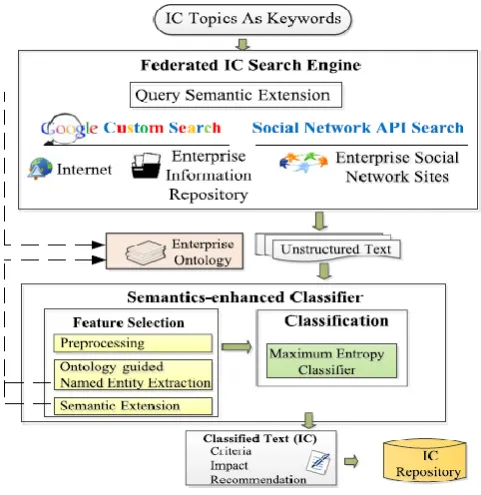
(iv). In [4] Enterprise Customer Centre’s challenges are there but one of them is that their engineers and customers provided with the right information in a timely fashion. This paper describes capital mining system that works as user query and results will be given to that at that time only with a proper hardware solution. To address the previously mentioned issues, it proposes an online learning mining framework, which can help clients find the most up and coming and significant data related to benefit solicitations or client engagement, regardless of the possibility that the clients' solicitations are new to the framework. They have used IC (Intellectual Capital) mining system that consists two major components, namely federated IC search engine and ontology-enhanced classifier. They utilize semantic web technology, in particular to
ontology to enable more accurate and intelligent knowledge management.
Figure 4. IC (Intellectual Capital) mining system
(v). This article [5] shows how data analytics meant to be unchallenging with the use of semantic technology. Semantic technology offers a solution that addresses scalability and usability issues. The problem arises when we trying to perform data-analytics in real-world settings where the unstructured heterogeneous amount of data there. An OBDA (Ontology-Based Data Access) a semantic technology approach offers a possible solution to analytics problem. In OBDA, ontology gives a uniform theoretical outline that portrays the issue area of the basic information autonomously of how and where the information is put away, and explanatory mappings indicate how the ontology is connected to the information.
Figure 5. Optique platform architecture
EAI Endorsed Transactions on
Cloud Systems
Optique is platform includes tools for ontology and mapping management, a tool for formulating queries, and a query transformation and optimization subsystem. The mapping defines the relationship between the data sources and a virtual Resource
Description Framework (RDF). BootOX
bootstrapping component is used for ontology and mapping development in the Optique platform. Since the data variety challenge is too large to solve but Optique platform significantly useful for it.
(vi). In this author describe present IoT development [6] in the market that how it increasing and how connected devices using other technology. Semantic computing solves problems with data variations and cognitive computing provides its machine tools to build technology more powerful and adaptive with other new features. Perceptual computing architecture allows the user to continuously ask a personalized question from the user or another device. It is covering conceptual framework covering semantic, cognitive and perceptual computing with IoT.
(vii). In this article [7] author talks about a set of techniques to discover meaning in unstructured content, and to utilize meaning to discover different texts. Analysing text linguistically is used to finding meaning. Now expression and mapping words mapped onto ConceptNet. Then to join this idea into meaningful entities capable semantic pattern utilized. The essence of this mechanism is to discover paths to accelerate creating ConceptNets and mapping lexicons. The end goal to do this is to enable these ConceptNets on the fly and to utilize machine rendering tools to produce lexicons automatically. The following machine learning techniques are being applied on Automatic
document classification, Automatic vocabulary
extraction, Discovery of distance and similarity between concepts, Parsing of Wikipedia or dictionary articles, Online tools that systematically scan the internet.
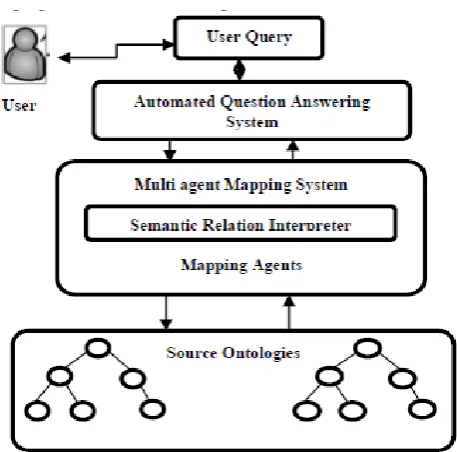
(viii). This paper [8]proposes a framework that intends to display and extend the current techniques and concept. Fundamental target is to give a mapping framework to
Multiagent ontology having heterogeneous
information in semantic web and build up a question answering system from the created system of ontologies. For ontology mapping in the QA system over heterogeneous sources propose a multiagent framework since domains are expansive in size and more convoluted, open and distributed, in order to address the ontology mapping task a set of cooperating agents are necessary. With a huge number of classes and properties of domains, ontology mapping can be carried out in real case scenario.
Figure 6. The proposed system for QA system
When a number of concept to map deceases multiagent framework decrease response time. To solve the different problems of integration an integrated ontology mapping framework provided. A DSSim solution is a prototype for the proposed system. That combined with automated QA system at the moment. Multiagent system with semantic relation interpreter of compound noun integrated into the proposed system with effectively in the multiagent framework.
(ix). This paper [9] suggests having organized and structured data while getting information from web content to improve the search results by increasing the relevancy. For information extraction and knowledge discovery, semantic technology tools and ontologies play a vital role. A model suggested for storing the web content in an organized and structured manner in RDF format. For the domain, the information extraction techniques and the ontologies developed so that it together discovers new knowledge.
5 elements. Cognitive computing which enables AI to take participation in other broadly abbreviated applications in enterprises is also recommended with unstructured data that formed and used by RDF language. AI is transparent to the user but makes enterprise applications work easier and better for them.
(xi). This paper [11] propose to build a semantic-based web mining model under the framework of the Agent which integrates semantic web and web mining. People use semantic information to improve the Internet capacity because at one level when traditional search engines which are based on keywords but not full unstructured query which lead unsatisfactory results for traditional data mining. Web content mining, Web structure mining and Web usage mining are three categories of web mining [12]. An Agent which is intelligent software product effectively
interact with machine-processable semantics
information. The Semantic Web [13] has basic idea to embed machine-readable, on behalf of a certain type of knowledge mark in the Web message. Machine-readable makes data understood by machine so different processing can be done on that and enhance the quality of the information services.
(xii). In [14] authors provide a user-database interaction framework and how human factors influence in organization various dimensions of user-database
interaction. Proposes three cognitive mapping
techniques to reduce some behavioural biases during the user-database interaction. Casual mapping, Semantic mapping, and Concept mapping are three
mapping technique to obtain individual user
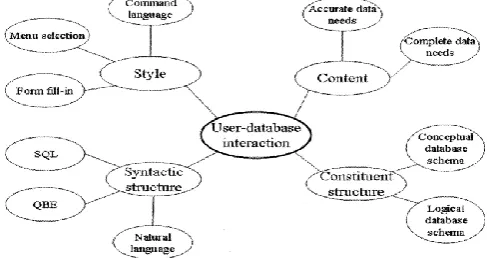
interaction towards system regarding a problem domain. A casual mapping has a casual map that represents a group of the relationship between constructs within the system (there is a cause-effect relationship where one construct is linked to others) [15]. Semantic mapping constructs a semantic map which has concept tree-like branches that depicts the central and main idea. Semantic mapping can be called thought mapping, is utilized to investigate a thought without the imperatives of a superimposed structure [16].
Figure 7. Semantic Map Example
(xiii). Here, Machine learning [17] in cognitive computing contribute to the personalization for retrieving information and presenting it to users. While using cognitive computing Personalization word used because in present time computation on structured data decreasing and user give unstructured data by giving a sentenced type query to retrieve related information. Semantic technology fights with the ambiguity of the language and its interpretation. [18] Cognitive computing solves computation power of machine requests where semantic technology deals with meaning and interpreted code.
(xiv). In this [19] paper proposed work is to obtain image augmented description or related image from given the user. For that, it presents hierarchical tree-structured semantic unit. The framework will work with ontologies that deals with labels that are attached with image and generate semantic descriptions. Then to deal with the question that what entity exist and said to exist and how that entity subdivides according to similarities and related with hierarchy the ontology augment the labels related to the particular domain. The problem mainly solved with augmented structured SVM for prediction of image description. And then compared with their other CRF method and other multi-label algorithms.
(xv). In this paper [20] the framework proposed using the integrating Internet of Things and Semantic Web technologies. The main aim is survey and share vision of semantic web technologies concern to the Internet of Things. A semantic engine which is federated and unified for the Internet of Things for that before analysis was necessary. Propose research challenges
and discuss uses case Machine-to-Machine
Measurement (M3) [21], FIESTA-IoT [22] and VITAL European project [23]. Uses case address challenges for designing workflow to semantically annotate and reason over data by giving service for facilitating the integration of semantic web technology and Internet of Things.
(xvi). Propose a Question Answering [24] system for travellers to obtain answers to the questions regarding their traveling trip or any location. A QA system will fetch the answer to the question asked by the traveler. QA system is divided into two phase question identification (Expected Answer Type(EAT)) and searching the knowledge base (KB) to find an answer to the classified question. Machine learning used for question identification so that trustable output generated. A knowledge base is served by an ontology that provides simple protocol and RDF query language (SPARQL) for traversing in the QA system.
(xvii). Cognitive data analysis systems [25][26][27] are faithful to semantic analysis which conveys the analysed datasets [28]. The procedure of semantic
EAI Endorsed Transactions on
Cloud Systems
analysis often taken as data mining processes. In this paper [29], cognitive financial systems utilized here for semantic analysis methodology so that it embraced for information understanding assignments. Available semantic information used in the enterprise to semantically analyse the financial situation. Semantic algorithms are used for semantic analysis of the financial situation. The principle thought of the cognitive analysis is the semantic interpretation of vital information of enterprises and their significance for the improvement of the organization.
(xviii). In this [30] article, discussion based on rising amount of urban data demand and new methods to overcome management and storage issues. Fuzzy Cognitive Map (FCM) through semantic web technology is one concept to deal with graph database based on shared meaning data. The basic methods and requirement for new concept discussed in this article. A graph database is used to provide a relationship
between data that somehow share common
characteristics. OrientDB is used to proceed with semantic convergence for combine fuzzy cognitive map and graph databases in the cognitive city. The main issue here was to tackle cognitive cities heterogeneous amount of map data.
3. Research Discussion
Comparative analysis of literature survey leads this paper to a new approach that definitely describes how semantic
technology beneficial for cognitive computing in enterprise processes.
While will one read this paper some question arises in mind. Now, we describe such research questions that already eliminate confusion regarding all aspects this paper. The research questions are as follows:
1. Why Cognitive computing apply semantic technology to develop its applications?
Semantic technology provides such an application that deals with unstructured data and other technologies like knowledge graph and ontology
that will helpful to cognitive computing
application. We can see that from survey most of the computing application nowadays deals with
semantic technology to work with the
heterogeneous amount of data.
2. Why more importance is given to only unstructured data and not too structured data? In enterprises nowadays 70-80% data [33] is
unstructured and for computational purpose technologies should be there to retrieve information in different ways.
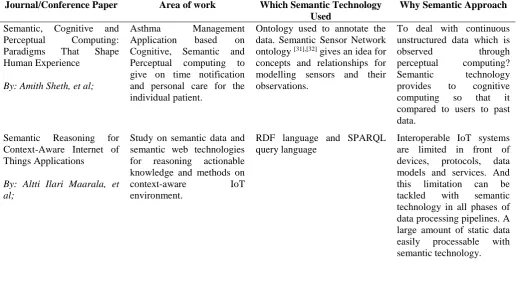
Below Analysis table is as follows which compares current research works and cognitive computing application ideas and how semantic technology is useful and deals with that application:
3.1. Analysis Table
Table 1. An Analysis Table for Surveyed Data
Journal/Conference Paper Area of work Which Semantic Technology Used
Why Semantic Approach
Semantic, Cognitive and
Perceptual Computing:
Paradigms That Shape
Human Experience
By: Amith Sheth, et al;
Asthma Management
Application based on
Cognitive, Semantic and Perceptual computing to give on time notification and personal care for the individual patient.
Ontology used to annotate the data. Semantic Sensor Network ontology [31],[32] gives an idea for concepts and relationships for modelling sensors and their observations.
To deal with continuous unstructured data which is
observed through
perceptual computing?
Semantic technology
provides to cognitive
computing so that it
compared to users to past data.
Semantic Reasoning for
Context-Aware Internet of Things Applications
By: Altti Ilari Maarala, et al;
Study on semantic data and semantic web technologies for reasoning actionable knowledge and methods on
context-aware IoT
environment.
RDF language and SPARQL query language
Interoperable IoT systems are limited in front of devices, protocols, data models and services. And this limitation can be
tackled with semantic
7 Semantics-Enhanced Online
Intellectual Capital Mining
Service for Enterprise
Customer Centers
By: Juan Li, et al;
In this paper, IC(Intellectual
Capital) mining system
proposed to retrieve data which relates to customer query so that company’s
engineer knows about
problem and devices very quickly.
Ontology enhanced classifier The semantic expanded
search engine used to
retrieve a user query related data very quickly that was not possible before. Before approaches were very slow to find what the problem and about which product user talk.
Using Semantic Technology to Tame the Data Variety Challenge
By: Ian Horrocks, et al;
Proposed a semantic
approach real-world
analytics problem. To
perform analytics over the heterogeneous amount of data using OBDA approach.
OBDA (Ontology-Based Data Access) a semantic technology approach
In OBDA, ontology gives a uniform theoretical schema that portrays the issue space of the basic information autonomously of how and where the information is put
away, and definitive
mappings indicate how the ontology is identified with the information.
Internet of Things to Smart
IoT Through Semantic,
Cognitive, and Perceptual Computing
By: Amith Sheth, et al;
Discussion over present IoT development in the market
through Cognitive,
Semantic and Perceptual Computing
Semantic technology data
variations
The discussion over
semantic technology shows that currently, semantic computing deals with data
variations for IoT
development.
A Non-Biological AI
Approach towards Natural Language Understanding
By: Lernout Stephen, et al;
Discussed a set of
techniques to discover
meaning in unstructured
content, and to utilize
meaning to discover
different texts for natural language understanding.
Semantic pattern matching In AI text understanding is important so to overcome a problem like a brute for in NLP with machine learning. Linguistic technique and
semantic techniques
combined to work with ConceptNet.
Mapping of Semantic Web Ontology in User Query System
By: Rupali R. Khune;
The target of this research is to provide a framework for the user-query system.
Multiagent ontology Multiagent ontology is used
to mapping web data to answer user questions.
A semantic Based Approach for knowledge discovery
and acquisition from
multiple web pages using ontologies
By: A.M.Abirami, et al;
Suggest having structured RDF data while collecting
information from web
resources.
Semantic Web, RDF, SPARQL For extraction semantic
technology and ontologies plays a vital to get RDF structured data.
The Problem with AI
By: Seth Earley;
To build AI more
functionalized by its
leveraging technologies like
machine learning
techniques, Big-data.
Deals Big-data issues in AI through Ontologies
Ontologies provide
contextualization to big
data between machine
learning and AI to function more accurate.
Research on Semantic Web Mining
By: Wang Yong-gui, et al;
Propose to build semantic based web mining model under the framework of the agent.
Semantic Web Integrate Semantic web and
web mining so retrieving web data will easy.
EAI Endorsed Transactions on
Cloud Systems
Cognitive Mapping
Techniques for
User-Database Interaction
By: Keng Siau, et al.
This paper worked for mapping technique at the time of user interaction.
That which mapping
technique should be applied at which time to influence
the database user
interaction.
Semantic Mapping Semantic mapping has main
concept a tree-like structure that depicts related query keyword around one – another.
Cognitive Computing,
Analytics, and
Personalization
By: Seth Earley.
Role of cognitive computing is to retrieve information but
how machine learning
participates in that to remove sophistication over unstructured data.
Ontology Cognitive computing and
semantic search have
ambiguous meaning while
structured data being
retrieved. At that time ontology retrieve related data that being searched also.
Augmenting Image
Descriptions Using
Structured Prediction Output
By: Yahong Han, et al.
Obtain augmented image
description and related
image in various
applications
Tree-structured semantic unit While single image label retrieved than obtaining more information for it is kind of tedious work so tree-structured semantic
unit augments the
description of the image by related to that particular domain.
A Unified Semantic Engine for Internet of Things and Smart Cities: From Sensor
Data to End-Users
Applications
By: Amelie Gyrard, et al.
Propose a unified semantic engine for smart cities for
interoperability of IoT
devices.
Semantic Web Technologies As IoT devices increasing
in smart cities operability among them is difficult to maintain so semantic web technologies integrate with the Internet of Things make a framework as a semantic engine.
Question Answering system for the travel domain
By: Hasangi Kahaduwa,et al.
Proposes a Question
Answering system for a user to the particular trip or any location.
RDF language, SPARQL query language, Ontology
To obtain automated
Question Answer system
focusing on traveling
domain ontology retrieves
data using RDF and
SPARQL.
Data Mining and Semantic
Inference in Cognitive
Systems
By: Lidia Ogiela
The semantic analysis was done over the organization’s
financial data so that
financial decision can be taken easily.
Semantic analysis To obtain various ratios for
compare previous and
future financial data
cognitive financial system
consists of semantic
information to complete the semantic analysis.
Striving for semantic
convergence with fuzzy
cognitive maps and graph databases
By: Sara D’onofrio
Discussion over
management and storage issues for rising number of urban data. A new concept or methodology discussed to solve this data management problem.
OrientDB, Semantic Web To overcome the storage
9
4. Conclusion
As now we can say that in enterprise cognitive computing system all kinds of application can work with semantic technology tools and its languages that harness the results and processing techniques. After knowing that semantic technology can eliminate the unstructured data issues in enterprise cognitive computing applications, the future work for this to identify the semantic technology tools for implementing enterprise cognitive computing systems.
References
[1] Monideepa Tarafdar, Cynthia M. Beath, and Jeanne W. Ross, “Enterprise Cognitive Computing Applications Opportunities and Challenges”, IEEE Journal & Magazines, 2017, Vol:1(4), pp:21-27
[2] Amith Sheth, Pramod Anantharam, and Cory Henson, “Semantic, Cognitive and Perceptual Computing: Paradigms That Shape Human Experience”, IEEE Journal & Magazines, 2016, Vol:49(3), pp:64-72
[3] Altti Ilari Maarala, Xiang Su, and Jukka Riekki, “Semantic Reasoning for Context-Aware Internet of Things Applications”, IEEE Internet of Things, 2016, Vol:4(2), pp:461-473
[4] Juan Li, Nazia Zaman, Ammar Rayes and Ernesto Custodio, “Semantics-Enhanced Online Intellectual Capital Mining Service for Enterprise Customer Centers”, IEEE Journal & Magazines, 2017, Vol:10(3), pp:436-447
[5] Ian Horrocks, Martin Giese, Evgeny Kharlamov, and Arild Waaler, “Using Semantic Technology to Tame the Data Variety Challenge”, IEEE Journal & Magazines, 2016, Vol:20(6), pp:62-66
[6] Amith Sheth, “Internet of Things to Smart IoT Through Semantic, Cognitive, and Perceptual Computing”, IEEE Journal & Magazines, 2016, Vol:20(2), pp:62-66
[7] Lernout Stephen, Devos Geert, Kraze Andreas and Platteau Frank, “A non-biological AI approach towards natural language understanding”, IEEE Conference Publications, 2016, pp:1300-1302, 2016 Future Technologies Conference (FTC)
[8] Rupali R. Khune, “Mapping of Semantic Web Ontology in User Query System”, International Journal of Computer Applications, 2015, Vol:111(14)
[9] A.M.Abirami and Dr.A.Askarunisa, “A semantic Based Approach for knowledge discovery and acquisition from multiple web pages using ontologies”, International Journal of Web & Semantic Technology, 2013, Vol:4(3)
[10] Seth Earley, “The Problem with AI”, IEEE Journals & Magazines, 2017, Vol:19(4), pp:63-67
[11] Wang Yong-gui and Jia Zhen, “Research on semantic Web mining”, 2010, IEEE Conference Publications, 2010 International Conference On Computer Design and Applications, Vol:1, pp: V1-67toV1-70
[12] Wen-Wei Chen, “Data Warehouse and Data Mining Tutorial,”[M], Beijing: Tsinghua University Press, 2008, 4
[13] Zhong Xue Ling, “Semantic Web in the core layer of technical analysis,”[M], South China Financial Computer Applications Technology, 2007,10
[14] Keng Siau and Xin Tan, “Cognitive Mapping Techniques for User-Database Interaction”, 2006, IEEE Conference Publications, IEEE Transactions on Professionals Communication, Vol:49(2), pp:96-108
[15] C. Eden, “Cognitive mapping”, Eur. J. Operational Res., Vol:36 ,pp:1-33, 1988
[16] T. Buzan, “TheMind Map Book. London”, UK: BBC Books, 1993
[17] Seth Earley, “Cognitive Computing, Analytics, and Personalization”, IEEE Journals & Magazines, 2015, Vol:17(4), pp:12-18
[18] D.M. Biel et al., “Latent Dirichlet Allocation”, J. Machine Learning Research, Vol:3,2003, pp:993-1022
[19] Yahong Han, Xingxing Wei, Xiaochun Cao, Yi Yang and Xiaofang Zhou, “Augmenting Image Descriptions Using Structured Prediction Output”, IEEE Journals and Magazines, 2014, Vol:16(6), pp:1665-1676
[20] Amelie Gyrard and Martin Serrano,” A Unified Semantic Engine for the Internet of Things and Smart Cities: From Sensor Data to End-Users Applications”, IEEE Conference Publications, 2015, pp:718-725
[21] A. Gyrard, C. Bonnet, and K. Broudaoud,” Domain Knowle20014ge Interoperability to build the semantic web of things”, IEEE Conference Publications, 2015, pp:718
[22] R. Petrolo, V. Loscr`ı, and N. Mitton, “Towards a smart city based on a cloud of things, a survey on the smart city vision and paradigms,”Transactions on Emerging Telecommunications Technologies, 2015.
[23] J. Soldatos, N. Kefalakis, M. Hauswirth, M. Serrano, J.-P. Calbimonte, M. Riahi, K. Aberer, P. P. Jayaraman, A. Zaslavsky, I. P. ˇ Zarko et al.,“Opinion: Open source internet-of-things in the cloud,” in Interoperability and Open-Source Solutions for the Internet of Things. Springer, 2015, pp. 13–25.
[24] Hasangi Kahaduwa, Dilshan Pathirana, Pathum Liyana Arachchi, Vishma Dias, Surangika Ranathunga and Upali Kohomban, “Question Answering system for the travel domain”, IEEE Conference Publications, 2017, 2017 Moratuwa Engineering Research Conference (MERCon), pp:449-454
[25] A. Kornai, Mathematical Linguistics, Springer Verlag Berlin Heidelberg, 2008.
[26] L. Ogiela, “Syntactic Approach to Cognitive Interpretation of Medical Patterns,” in C. Xiong at all (Eds.), Intelligent Robotics and Applications, First International Conference, ICIRA 2008, Wuhan, China, 15-17 October 2008, LNAI 5314, Springer-Verlag Berlin
Heidelberg, 2008, pp. 456-462
EAI Endorsed Transactions on
Cloud Systems
[27] L. Ogiela, “Cognitive Informatics in Automatic Pattern Understanding and Cognitive Information Systems,” in Y. Wang at all (Eds.), Advances in Cognitive Informatics and Cognitive Computing, Studies in Computational Intelligence 323, Springer- Verlag Berlin Heidelberg, 2010, pp. 209–226.
[28] S. Bodzioch, M.R. Ogiela, “New approach to gallbladder ultrasonic images analysis and lesions recognition,” Computerized Medical Imaging and Graphics, vol. 33 (2), 2009, pp. 154-170.
[29] Lidia Ogiela and Marek R. Ogiela, “Data Mining and Semantic Inference in Cognitive Systems”, IEEE Conference Publications, 2014, 2014 International Conference on Intelligent Networking and Collaborative Systems, pp:257-261
[30] Sara D’Onofrio, Marcel Wehrle, Edy Portman, and Thomas Myrach, “Striving for semantic convergence with fuzzy cognitive maps and graph databases”, IEEE Conference Publications, 2017, 2017 IEEE International Conference on Fuzzy Systems (FUZZ-IEEE), pp:1-6
[31] M. Compton et al., “The SSN Ontology of the W3C Semantic Sensor Network Incubator Group,” Web Semantics: Science, Services and Agents on the World Wide Web, Vol: 17, 2012, pp. 25–32
[32] L. Lefort et al., “Semantic Sensor Network XG Final Report,” W3C Incubator Group Report, vol. 28, 2011; www.w3.org/2005/Incubator/ssn/XGR-ssn-20110628