EVALUATION OF WHEAT MUTANT LINES FOR YIELD AND YIELD COMPONENTS UNDER DIFFERENT SOWING DATES
M. A. Sial, M.U.Dahot*, M.A. Arain, Khalil Ahmed Laghari, S.M. Mangrio** and B. Nisa Mangan***
Nuclear Institute of Agriculture, Tando Jam, *Institute of Biotechnology and Genetic
Engineering, and **Institute of Botany, University of Sindh, Jamshoro, Pakistan,
***Sindh Agriculture University, Tando Jam, Pakistan.
ABSTRACT
The affects of sowing time and heat stresses on yield and yield components were evaluated in 21 mutant wheat lines under normal and late sowings. Terminal heat stresses (>30oC) during reproductive phase of the crop from last week of February to end of March, severely affected the physiological maturity of the crop. Reductions in various traits were observed, in general, in most of genotypes at late sowing. Plant height, 1000-grain weight, grain filling period, maturing time and main spike yield were highly affected under late sowings as compared to other traits. At normal sowing, 12 mutant lines showed early maturity than local check, T.J-83, three matured earlier than Kiran-95 and Sarsabz. Seventeen lines took more time to grain filling period than T.J-83, and 12 mutant lines more time than Sarsabz and Kiran-95. Fourteen mutant lines had significantly higher 1000-grain weight (>33g) than T.J-83 and eight had higher weight (>42g) than Sarsabz at normal sowing, whereas sixteen had more 1000-grain weight (>32.4 g) than T.J-83 and four than Sarsabz (>38.4g) at late sowing, indicated more tolerance to high temperature than other genotypes. Mutant lines MASAR99-22, MASAR99-31, MASAR99-37, MASAR99-03 and MASAR99-14 showed less reduction (2.8 to 8.0%) in 1000-grain weight under late sowings, and thus showed tolerance to high temperatures than the other genotypes.
INTRODUCTION
Bread wheat the major food crop of Pakistan is cultivated on an area around 8.33 million ha with the annual production of 21.1 million tones (Anonymous, 2005). The average wheat yields of the country are quite low (2625 kg/ha) as compared to other wheat growing countries of the world such as U.K. (7890 kg/ha), Germany (7190 kg/ha) and France (7091 kg/ha) etc. (Deho
et al., 2006, Khan, 2004). Grain yield
being a polygenic trait is highly influenced by cultivar, environment and cultivar × environment interactions. Mutation breeding is playing an important role in creating genetic variability for the
during wheat growing a season is one of the major environmental constraints in tropical and sub tropical regions of the world including Pakistan (Arain et al., 1999). Temperature encountered by the crops during early development and during grain filling stages may differ markedly in various temperature zones. High temperature during the grain filling period can substantially limit the final grain yield (Tashiro and Wardlaw, 1999, Reynolds 2001). Rise in temperature may increase grain nitrogen and phosphorus concentrations and alter protein and amino acid composition (Ciha, 1983 and Roth, et al. 1984). High temperature may shorten the development period without giving sufficient compensation by faster growth and this effect can be seen in kernel development of wheat if, for example, temperatures are increased above 21/16 0C (Slafer and Whitechurch, 2001). Sowing time is also critical in determining the crop yields, as late start can only be counter-balanced by a prolonged and favorable season (Akdamar et al., 2002).
The higher grain yields in wheat have been obtained by early sowings (Darwinkel
et al., 1977; Blum et al 1986; Arain et al.,
1999; 2001) Genetic diversity for heat tolerance in cultivated wheat is known (Rawson, 1986; Randall et al., 1990). Wardlaw and Wrigley, (1994) explained that the short heat stress ( 35oC) during post-anthesis period could significantly reduce grain weight in wheat and barley and decrease the quality of the grains (Savin et al., 1996). The sowing dates in terms of changed temperatures are critical for obtaining appropriate yields. The favorable temperature for wheat crop is usually 15-250C, however, its growth continues at lower temperature down to 3-40C or at higher temperature up to 30-320C. The lower temperature slows the growth
while the high temperatures speed up the maturity of the crop (Khan 2003; Deho et al., 2006). The lowest temperatures in the months of December and January severely affects the vegetative phase like wise seedling emergence, flag leaf emergence, tillering capacity, spike length, number of grains per spike, while higher temperatures during March and April causes terminal stresses during grain filling period and shorten the reproductive phase (Ortiz-Monasterio et al., 1994; Nicolas et al., 1984; Sial et al., 2006); therefore, the late planting suffers at both the ends. The studies were under taken to observe the effects of different sowing dates and the response of wheat mutant lines for different yield and yield components under heat stress.
MATERIALS AND METHODS
To determine the effects of planting dates and heat stress on bread wheat
(Triticum aestivum L.), 21 mutant lines
developed through intraspecific crosses cum radiation-induced mutagenesis were evaluated in two planting times (normal and late) along with three local check varieties Sarsabz, Kiran-95 and T.J-83. F1
seeds originated from five cross combinations (Sarsabz × Khirman, Sarsabz × Kiran-95, Bhittai × IB-25/99, Khirman × Kiran-95 and Marvi-2000 × Khirman) of wheat varieties were irradiated with 100, 150, 200 and 250 Gy gamma rays at Seibersdorf Laboratories, IAEA, Vienna. Stable mutants possess desired characteristics were selected from advance mutation generation (F5M4) were screened
under field conditions for yield and yield components. The present studies were conducted in F5M4 generation. Normal
experiment was laid out in randomized complete block design (RCBD) with five replicates. Three rows, 3m long of each entry were sown with 0.3m inter-row spacing. The net plot size was 6m2. The seeding rate at each sowing date was 125 kg/ha and the soil was clay loam with a pH value of 7.4. Daily minimum and maximum temperatures were recorded throughout the season at the experimental site. The traits measured from each genotype in each experiment were days to heading, days to maturity, grain filling period, plant height, 1000-grain weight and grain yield/plot. At maturity five random plants from each genotype were selected to study the effects of heat stress on agronomic/morphological parameters i.e. spike length, number of spikelets per spike, number of kernels in a spike, number of grains per spikelet, main spike yield and single grain weight. Data were analyzed using analysis of variance and the means were compared using Duncan’s multiple range test (D’MRT) (Steel and Torrie, 1980). Percent increase and decreases in various traits as affected by varying sowing dates were also recorded.
RESULTS AND DISCUSSION
Minimum and maximum temperature and humidity were recorded everyday during entire crop season at the experimental site (Table 1). The minimum temperature in the month of October remained comparatively favorable (16-220C), while maximum temperature range was 32-33.60C. Favorable temperature (below 150C) for sowing of wheat crop recorded during first three weeks of November, however maximum tempe-ratures were above 300C ranged in between 29-32.30C. Temperatures between 12-150C have been reported favorable for sowing of wheat crop. Below 300C temperature was observed from December to first week of
the entire wheat cycle (Fischer and Byerlee, 1991; Reynolds et al, 2001).
Days to heading: All the genotypes except six genotypes took more days to heading in late sown trial as compared to normal planting (Table.2). Days to heading at normal sown genotypes ranged from 59.8 days to 90.4 days, whereas, it ranged between 59.8 days to 78.4 days in late sowings.
Days to maturity: At normal sowing, 12 mutant lines showed early maturity (115-121 days) than local check T.J-83 (122.8 days), three matured earlier than Kiran-95 and Sarsabz. Maturity period in normal time ranged from 115-128.4 days, while at late sowing it ranged from 108-115.2 days. Two mutant lines (MASR99-03 and MASR99-17) matured earlier in late sown trials; however both were at par with short duration variety T.J-83 (Table. 2). Higher reduction in maturity period (11.6-12 %) observed in four mutant lines and local check T.J-83, which showed that these genotypes could be more sensitive to high temperatures. Less reduction in maturing time was observed in MASR99-09 (0.5%), MASR99-23 (4.5%), MASR99-22 (5.26%), MASR99-72 (4.9%) and Sarsabz (5.6%), which indicated more tolerance to heat stress as compared to other genotypes.
Grain filling period: Fifteen mutant lines utilized more time to grain fill period than Sarsabz (56 days), 13 than Kiran-95 (57.6 days) and T.J-83 (59.6 days) at normal sowing time. Royo et al., (2000) found that the high temperature during grain filling can reduce the duration and rate of grain formation. A mutant line MASR99-31 took significantly less days to grain fill development (35.2 and 36.2 days) at both planting time late as well as normal, which indicated the stability of this genotype for this particular trait at varying sowing dates. The long duration for grain fill was
observed in mutant line MASR99-64 (66.8 days) at normal planting time. However, grain formation time reduced in all wheat genotypes sown late. Seventeen mutant lines took more time (44.6 to 57.6 days) to grain filling period than local check variety T.J-83 (41.4 days), twelve than Sarsabz and Kiran-95. A mutant line MASR99-17 utilized more days (57.6 days) to grain filling period than all other genotypes.
Three mutant lines MASR99-09, MASR99-23, MASR99-31 and a local check Sarsabz showed less reduction (1.7, 4.4, 2.7 and 2.16 % respectively) in grain formation period at both sowing times, which indicated that these mutant lines possess more tolerance to high temperature during grain filling. More decrease percent (29-33 %) for grain filling period observed in three mutant lines (MASR99-06, MASR99-37, MASR99-72) and T.J-83, this reduction suggested that these lines could be more sensitive to high temperature stress (Table. 2).
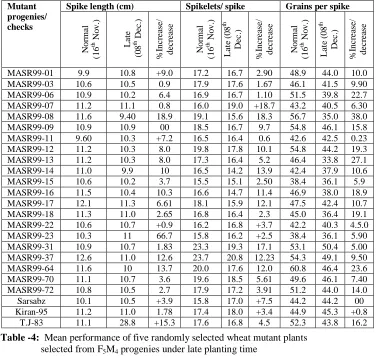
Spike length (cm): The length of spike was measured by selecting five main spikes of 5 randomly selected plants at the time of maturity. Among twenty-one mutant entries, nineteen showed better performance than Sarsabz (10.1cm), six than Kiran-95 (11.2cm) and nine than T.J-83 (11.1cm) at normal sowing (Table.3). Under late sown trial, spike length of wheat mutant lines ranged from 9.4 to 11.3cm and ten lines showed increase in spike length than Sarsabz (10.5cm) and two than Kiran-95 (11cm). Reduction percent was observed from 0-18.9% in mutant lines for spike length trait at late sowing. Whereas, spike length increased in 01, MASR99-11, MASR99-22 and MASR99-23 under late planted trial (9.0, 7.2, 0.9 and 6.7% respectively).
normal sowing ranged from 15.5 to 23.7, while under late sowing it was ranged from 14.7 to 20.8. Entries MASR99-22, MASR99-23 and MASR99-31 had shown better performance under both sowing dates (normal and late) where no any reduction was observed for this trait (Table-3).
Grain per Spike
The number of grains per spike of different wheat mutant lines plated late had also shown significant effects of late planting as compared to normal. Seeds per spike of mutant lines ranged from 33.8 in MASR99-13 to 50.6 in MASR99-31under late sown trial. Five lines produced more number of grains per spike (46.1-50) as compared to other genotypes under late sown trial. Under normal sowing, numbers of grain per spike in mutant lines ranged from 38.4 to 60.8 seeds per ear (Table-3). Sixteen mutant lines showed better tolerance for number of grains per spike than local check varieties under normal sowing.
The reduction percent for number of grains per spike under late sown trial was ranged from 0.23 in MASR99-11 to 38.27% in MASR99-07. Five mutant lines MASR99-11, MASR99-15, MASR99-22, MASR99-23 and MASR99-31 showed less reduction (0.23, 5.98, 4.5, 5.9, 5.08% respectively) for the trait grains per spike as compared to other wheat mutant lines, which indicates that these lines had more adaptability under heat stress.
Grains per spikelet: Grains per spikelet were calculated from 5 random selected spikes. For this character, seven mutant lines had shown better performance than Sarsabz, eleven than Kiran-95 and three than T.J-83 under normal sown trial (Table.5). Under late sowing trial, wheat entries ranged from 2.06 to 2.76 for grains per spikelets, while six lines were better than Sarsbz, ten than Kiran-95 and five
than T.J-83. Five mutant lines 11, 14, 17, MASR99-31 and MASR99-37 had increase in number of grains per spikelet, indicating more tolerance to high temperature as compared to other sixteen entries.
Single grain weight: Single grain
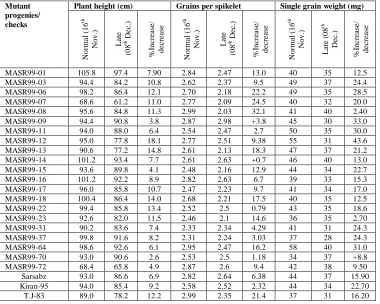
weight was calculated by dividing average main spike yield of 5 randomly selected main spikes by total mean number of grains per spike. Single grain weight of wheat genotypes ranged from 34mg to 58mg under normal sowing and 28-40mg at late sowings. Eight mutant lines MASR99-03, MASR99-06, MASR99-09, MASR99-11, MASR99-12, MASR99-13, MASR99-14 and MASR99- 64 produced bold seeds (49, 45, 50, 55, 47, 46 and 58mg respectively) under normal sowing time. Four entries MASR99-08 MASR99-14, MASR99-64 and MASR99-72 had higher grain weight than Sarsabz under late sowing, (40 and 38mg) respectively, produced more single grain weight as compared to Sarsabz (44mg) under normal and (37mg) under late sowing. With normal sowing, eight lines and with late sown trial thirteen entries produce more single grain weight than Local Check Kiran-95 (in normal 44mg and in late 34mg). While seventeen genotypes produced bold grains than short duration commercial variety T.J-83 under normal as well as late time of planting. At late sowing reduction percent for single grain weight was observed from 2.4% in MASR99-08 to 43.6% in MASR99-12. MASR99-70 showed 8.8% increase in single grain weight at late sowings as compared to normal, while MASR99-12 expressed as more sensitive to heat stresses as its single grain weight significantly reduced 43.6% under late sowing (Table-5).
1.5g (MASR99-23) to 3.18g (MASR99-64) under normal sowing and it was decreased significantly under late sowings 1.25-1.9g. Sarsabz produced 1.79g under normal sowing and fourteen mutant lines compete it under normal sowing, while it gave 1.67g with late sowing and beaten by two entries (Table.4). The another local check Kiran-95 produced 1.99g grain yield per spike and nine entries produced more spike yield as compare to this local check under normal sowing, while under late sowing Kiran-95 produced 1.56 g under late and beaten by four mutant entries. Thirteen mutant lines performed better under normal and late sown trial as compared to short duration local check T.J-83. MASR99-70 showed high adaptability to heat stress and produced more yield under late sowing, however the difference was non significant (1.1% increase over normal) for main spike yield. Eleven mutant lines showed more reduction (>30%) for main spike yield due to late sowing. A genotype MASR99-31 indicated less reduction in main spike yield (3.0%) when compared with both sowing dates.
Plant height: Highly significant effects of high temperature stress and sowing dates were observed on plant height of wheat genotypes. Plant height decreased significantly in most of the genotypes at late sowings. Anderson and Olsen (1992), also observed the significant effects of late planting and heat stress on plant height of wheat genotypes. Four mutant lines (MASR99-12, MASR99-13, MASR99-22 and MASR99-06) proved to be more sensitive to heat stress for plant height trait with less reduction of 18.11, 14.8, 13.4 and 12.02% respectively. Significant less reduction in plant height (3.8 and 4.1%) observed in MASR99-09 and MASR99-15 (Table.5). Plant height ranged from 68.6 cm
to 105.8 cm in normal and 61.2 cm to 97.4 cm in late sown trials.
1000-grain weight: Thousand-grain weight of wheat genotypes had also shown significant effects of heat stress and planting time. Significant increase in 1000-grain weight was observed in all mutants lines and local checks when planted in normal time as compared to late sown, these results were also supported by Chougule., 1993 and Dahlke., 1993. In normal trial it was ranged from 28.2g in MASR99-31 to 48.2 g in MASR99-64. Fourteen mutant lines had increase in 1000-grain weight (>39g) than short duration variety T.J-83 (37.0g), nine than Sarsabz and five than Kiran-95. Garciadel Moral et
al., 1991 reported that the crop can develop
showed less decrease (2.8 to 8%) in 1000-grain weight at late sowing as compared to normal sowing, which indicated that theses lines could be more tolerant to heat stress.
Grain Yield /Plot (g): Grain yield per plot of wheat mutant lines was affected by heat stresses when planted late as compared with normal planting. Smid and Jenkinson, 1979, Witt, 1996 and Anderson and Smith 1990 reported similar findings. Under normal sowing, grain yield per plot of mutant lines ranged from 449.4g/plot in MASR99-70 to 1327g/plot in MASR99-31; while it ranged from 243g to 530g under late sown trial. MASR99-06, MASR99-11, MASR99-14, MASR99-15, MASR99-22 and MASR99-31had potential to produce more grain yield with higher yield (1039.8, 1020, 1102, 1111, 1019.6 and 1327g respectively) than local check varieties Sarsabz, Kiran-95 and T.J-83 under normal sowing. While only five entries had more tolerance to heat stress as compared to all local checks varieties (Table. 4). The maximum reduction % was observed in
eleven mutant lines ranged from 52.7 to 68.8%.
Nine mutant entries showed less reduction in grain yield as compared to local check Sarsabz (54.9) and Kiran-95 (53.6%), while two entries MASR99-37 and MASR99-70 performed well with reduction of 5.7% in yield under heat stress as compared to other entries including local check varieties.
CONCLUSIONS
It was observed from the present findings that various yield and yield associated morphological traits affected due to late planting. The normal sowing time showed increase in grain yield and improvement in different yield components as compared to late sown. However, some test entries showed better performance in both normal as well as late sowing conditions. Twelve mutant lines showed early maturity than all check varieties including short duration variety T.J-83. Sixteen mutant lines had more 1000-grain weight than T.J-83 and four than Sarsabz at late sowing; hence, could be more tolerant to high temperature stress.
Table-1.Meteorological data recorded during wheat crop season 2004-05 at Nuclear Institute of Agriculture, Tando Jam
Month Week Min: Co Max: Co Humidity %
Range Mean Range Mean Range Mean
October-04 1st 21-25 22.8 29-35 33.5 71-92 83.2
2nd 15-17 16.0 31-34 32.0 65-91 80.2
3rd 20-25 21.8 32-35 33.6 81-92 85.8 4th 18-22 19.2 31-35 32.2 64-91 78.4
November-04 1st 12-15 14.4 28-31 29.8 53-78 64.0
2nd 11-15 13.0 31-34 32.4 71-89 79.6 3rd 13-16 14.8
32-33 32.7 64-91 78.8 4th 15-17 15.7 29-32 30.7 82-91 87.5
December-04 1st 11-15 13.0 24-28 25.5 56-79 70.5
2nd 10-12 11.2 24-29 26.5 68-79 75.8 3rd 10-11 10.2 21-30 26.5 74-89 80.5 4th 7-13 10.0 20-23 21.5 66-78 71.5
January-05 1st 6-10 8.4 21-22 21.2 78-89 85.6
2nd 6-10 8.2 21-27 23.4 66-87 77.0
3rd 4-12 6.8 15-25 21.2 74-88 80.0 4th
February-05 1st 6-14 10.2 20-26 24.0 63-91 77.2
2nd
12-15 13.5 20-28 25.0 89-95 91.7 3rd
2-17 8.8 20-27 23.6 54-91 70.0
4th 4-14 10.0 21-28 25.0 78-88 84.4
March-05 1st 14-17 15.3 25-28 26.7 88-90 89.2
2nd 14-16 15.0 26-35 29.5 80-91 86.8 3rd 16-21 18.7 34-37 35.2 82.91 85.0 4th 14-19 16.50 34-37 35.3 58-84 71.8
April-05 1st 14-23 18.5
35-42 39.2 57-93 69.2 2nd 10-19 14.4 32-38 35.2 55-91 69.2
3rd 16-24 20.2
37-41 39.4 50-92 73.0 4th 22-26 24.6
35-40 36.8 70-85 80.2
Table-2:Mean performance of five randomly selected wheat mutant plants selected from F5M4 progenies under late planting time
Mutant progenies/ checks
Days to heading Days to maturity Grain filling period
N
or
m
al
(16
th N
o
v.
)
L
at
e
(
0
8
th D
ec
.)
%
Inc
re
as
es
/
de
cr
ea
se
N
or
m
al
(
1
6
th N
ov
.)
L
at
e
(
0
8
th D
ec
.)
%
Inc
re
as
e/
de
cr
ea
se
N
or
m
al
(16
th N
o
v.
)
L
at
e
(08
th D
ec
.)
%
I
n
cr
ea
se
/
de
cr
ea
se
Table-3:Mean performance of five randomly selected wheat mutant plants selected from F5M4 progenies under late planting time
Mutant progenies/ checks
Spike length (cm) Spikelets/ spike Grains per spike
N
or
m
al
(16
th N
o v. ) L at e ( 0 8
th D
ec .) % Inc re as e/ de cr ea se N or m al (16
th N
o v. ) L at e (08 th D ec .) % Inc re as e/ de cr ea se N or m al (16
th N
o v. ) L at e (08 th D ec .) % Inc re as e/ de cr ea se
MASR99-01 9.9 10.8 +9.0 17.2 16.7 2.90 48.9 44.0 10.0 MASR99-03 10.6 10.5 0.9 17.9 17.6 1.67 46.1 41.5 9.90 MASR99-06 10.9 10.2 6.4 16.9 16.7 1.10 51.5 39.8 22.7 MASR99-07 11.2 11.1 0.8 16.0 19.0 +18.7 43.2 40.5 6.30 MASR99-08 11.6 9.40 18.9 19.1 15.6 18.3 56.7 35.0 38.0 MASR99-09 10.9 10.9 00 18.5 16.7 9.7 54.8 46.1 15.8 MASR99-11 9.60 10.3 +7.2 16.5 16.4 0.6 42.6 42.5 0.23 MASR99-12 11.2 10.3 8.0 19.8 17.8 10.1 54.8 44.2 19.3 MASR99-13 11.2 10.3 8.0 17.3 16.4 5.2 46.4 33.8 27.1 MASR99-14 11.0 9.9 10 16.5 14.2 13.9 42.4 37.9 10.6 MASR99-15 10.6 10.2 3.7 15.5 15.1 2.50 38.4 36.1 5.9 MASR99-16 11.5 10.4 10.3 16.6 14.7 11.4 46.9 38.0 18.9 MASR99-17 12.1 11.3 6.61 18.1 15.9 12.1 47.5 42.4 10.7 MASR99-18 11.3 11.0 2.65 16.8 16.4 2.3 45.0 36.4 19.1 MASR99-22 10.6 10.7 +0.9 16.2 16.8 +3.7 42.2 40.3 4.5.0 MASR99-23 10.3 11 66.7 15.8 16.2 +2.5 38.4 36.1 5.90 MASR99-31 10.9 10.7 1.83 23.3 19.3 17.1 53.1 50.4 5.00 MASR99-37 12.6 11.0 12.6 23.7 20.8 12.23 54.3 49.1 9.50 MASR99-64 11.6 10 13.7 20.0 17.6 12.0 60.8 46.4 23.6 MASR99-70 11.1 10.7 3.6 19.6 18.5 5.61 49.6 46.1 7.40 MASR99-72 10.8 10.5 2.7 17.9 17.2 3.91 51.2 44.0 14.0 Sarsabz 10.1 10.5 +3.9 15.8 17.0 +7.5 44.2 44.2 00 Kiran-95 11.2 11.0 1.78 17.4 18.0 +3.4 44.9 45.3 +0.8
T.J-83 11.1 28.8 +15.3 17.6 16.8 4.5 52.3 43.8 16.2
Table -4: Mean performance of five randomly selected wheat mutant plants selected from F5M4 progenies under late planting time
Mutant progenies/ Checks
Main spike yield (g) 1000-grain weight (g) Grain yield/plot (g)
N o rm a l (1 6 thN o v .) L a te (0 8
th D
e c .) % In c re a se / d e c re a se e N o rm a l (1 6
th N
o v .) L a te (0 8
th D
e c .) % In c re a se /d e c re a se N o rm a l (1 6
th N
o v .) L a te (0 8
th D
e c .) % In c re a se / d e c re a se
MASR99-09 2.48 1.74 29.8 40.8 35.6 12.74 952.2 514.2 45.9 MASR99-11 2.14 1.49 30.3 42.6 36.6 14.0 1020 405.0 60.0 MASR99-12 2.38 1.39 41.5 38.4 31.2 18.7 882.0 435.6 50.6 MASR99-13 2.21 1.28 42.1 45.6 38.4 15.7 1006.0 500.4 52.2 MASR99-14 1.99 1.54 22.6 42.6 39.6 7.04 1102.0 543.8 50.6 MASR99-15 1.72 1.25 27.3 42.2 38.2 9.47 1111.0 484.8 56.3 MASR99-16 1.87 1.27 32.1 38.8 32.4 16.4 930.4 439.2 52.7 MASR99-17 1.94 1.45 25.3 42.2 35.8 15.1 802.8 473.6 41.0 MASR99-18 1.91 1.29 32.5 40.2 35.6 11.4 988.4 460.4 53.4 MASR99-22 1.97 1.44 26.9 35.4 34.4 2.82 1019.6 495.4 51.4 MASR99-23 1.55 1.29 16.7 38.4 29.8 22.3 1001.6 426.0 57.4 MASR99-31 1.62 1.57 3.0 28.2 29.4 4.1 1327.0 441.2 66.7 MASR99-37 1.98 1.39 30 34.8 32.4 6.8 562.8 530.4 5.7 MASR99-64 3.18 1.90 40.2 48.2 42.4 12.0 881.4 519 41.1 MASR99-70 1.73 1.75 +1.1 30.4 30.0 00 449.4 475.0 +5.7 MASR99-72 2.20 1.69 23.1 38.8 33.4 13.9 843.2 262.8 68.6 Sarsabz 1.97 1.67 15.2 40.8 36.8 9.8 1096.8 467.0 57.4 Kiran-95 1.99 1.56 43.0 42.4 40.0 5.6 1027.4 558.2 45.6 T.J-83 1.96 1.40 28.5 37.0 31.2 15.6 1033.8 399.0 61.4
Table -5: Mean performance of five randomly selected wheat mutant plants selected from F5M4 progenies under late planting time
Mutant progenies/ checks
Plant height (cm) Grains per spikelet Single grain weight (mg)
N
o
rm
a
l
(1
6
th
N
o
v
.)
L
a
te
(0
8
th D
e
c
.)
%
In
c
re
a
se
/
d
e
c
re
a
se
N
o
rm
a
l
(1
6
th
N
o
v
.)
L
a
te
(0
8
th D
e
c
.)
%
In
c
re
a
se
/
d
e
c
re
a
se
N
o
rm
a
l
(1
6
th
N
o
v
.)
L
a
te
(0
8
th
D
e
c
.)
%
In
c
re
a
se
/
d
e
c
re
a
se
MASR99-01 105.8 97.4 7.90 2.84 2.47 13.0 40 35 12.5 MASR99-03 94.4 84.2 10.8 2.62 2.37 9.5 49 37 24.4 MASR99-06 98.2 86.4 12.1 2.70 2.18 22.2 49 35 28.5 MASR99-07 68.6 61.2 11.0 2.77 2.09 24.5 40 32 20.0 MASR99-08 95.6 84.8 11.3 2.99 2.03 32.1 41 40 2.40 MASR99-09 94.4 90.8 3.8 2.87 2.98 +3.8 45 30 33.0
MASR99-11 94.0 88.0 6.4 2.54 2.47 2.7 50 35 30.0
MASR99-12 95.0 77.8 18.1 2.77 2.51 9.38 55 31 43.6 MASR99-13 90.6 77.2 14.8 2.61 2.13 18.3 47 37 21.2 MASR99-14 101.2 93.4 7.7 2.61 2.63 +0.7 46 40 13.0 MASR99-15 93.6 89.8 4.1 2.48 2.16 12.9 44 34 22.7 MASR99-16 101.2 92.2 8.9 2.82 2.63 6.7 39 33 15.3 MASR99-17 96.0 85.8 10.7 2.47 2.23 9.7 41 34 17.0 MASR99-18 100.4 86.4 14.0 2.68 2.21 17.5 40 35 12.5 MASR99-22 99.4 85.8 13.4 2.52 2.5 0.79 43 35 18.6 MASR99-23 92.6 82.0 11.5 2.46 2.1 14.6 36 35 2.70 MASR99-31 90.2 83.6 7.4 2.33 2.34 4.29 41 31 24.3 MASR99-37 99.8 91.6 8.2 2.31 2.24 3.03 37 28 24.3 MASR99-64 98.6 92.6 6.1 2.95 2.47 16.2 58 40 31.0
MASR99-70 93.0 90.6 2.6 2.53 2.5 1.18 34 37 +8.8
MASR99-72 68.4 65.8 4.9 2.87 2.6 9.4 42 38 9.50
REFERENCES
Akdamar, M., S. Tayyar and A. Gjkkus. Effects of different sowing times on yield and yield-related traits in bread wheat grown in çanakkal türkiye akdeniz üniversitesi ziraat fakültesi dergisi 15(2): 81-87. (2002)
Anonymous, Agricultural Statistics of Pakistan (2004-05), Government of Pakistan, Ministry of Food, Agriculture and Live Stock (Economic Wing), Islamabad, Pp.3. (2005)
Anderson, A. and C.C. Olsen, Seed time, seed rate and nitrogen fertilization in different varieties of winter wheat. Tidsskr. Planteavl. 96: 441-451. (1992) Anderson, W.K. and W.R. Smith, Yield advantage of two semidwarf compared with two tall wheats depends on sowing time. Aust. J. Agric. Res. 41: 811-826. (1990)
Arain, M. A., M. Ahmad and M.A. Rajput, Evaluation of wheat genotypes under varying environments induced through changing sowing dates. Proc. Symp. New Genetical Approaches to Crop
Improvement-III. Nuclear Institute of
Agriculture, Tando Jam, Pakistan, Pp.163-173. (1999)
Arain, M.A., M.A.Sial and M.A. Javed, Stability analysis of wheat genotypes tested in multi- environmental trials (METs) in Sindh Province. Pak. J. Bot. 33 (special issue):761-765. (2001) Blum, A., The effect of heat stress on wheat
leaf and ear photosynthesis. J. Experimental Botany 37:111-118. (1986).
Bajwa, M.A., J.S. Sawhney and M. Sabeta, The effect of row and plant spacing on yield and yield components of wheat under Kufra environments. Libyan J. of
Agric. 6(l):91-95. (1977)
Garcı´a del Moral, L.F., J.M. Ramos, M.B.
Garcı´a Del Moral, and P.
Jimenez-Tejada, Ontogenetic approach to grain production in spring barley based on path-coefficient analysis. Crop Sci. 31:1179–1185. (1991)
Ciha, A.J. Seeding rate and seeding date effects on spring seeded small grain cultivars. Agron. J. 75: 795-799. (1983).
Darwinkel, A., B.A. Ten Haq and J. Kuizenga, Effect of sowing date and seed rate on crop development and grain production of winter wheat. Neth.
J. Agric. Sci. 25: 83-84. (1977).
Deho, Z.A., M. A. Arain, M.A. Sial and N.A. Nizamani, Agronomic performance of exotic wheat (Triticum
aestivum L.) genotypes evaluated at
different sowing dates. Pakistan
Journal of Seed Technology, 1
(8-9):35-42. (2006)
Fischer, R. A., and D. B. Byerlee, Trends of wheat production in the warmer areas: Major issues and economic considerations. In: D.A. Saunders (ed.). Wheat for Non traditional, Warm Areas. Mexico, D.F.: CIMMYT.Pp 3-27. (1991)
Khan, M. Aqil, In. Wheat Crop Management for Yield Maximization. A Publication of Department of Agriculture, Lahore, Pp.01-94. (2003). Maluszynski, M., K. Nichterlein, L.Van
Zanten and S. M. Jain, FAO/IAEA Mutant Varieties Database Mut. Breed. Rev.12. (2000)
Nicolas, M. E., R.M. Gleadow and M.J. Dalling, (1984). Effects of drought and high temperature on grain growth in wheat. Australian Journal of Plant
Physiology 11:553-66. (1984)
on grain yield and yield components of irrigated spring wheat cultivars and relationship with radiation and temperature in Ludhiana, India. Field
Crop Research, 37: 169-184. (1994)
Randall, P.J; and H. J. Moss, Some effects of temperature regime during grain filling on wheat quality. Aust. J. Agric.
Res. 41: 603-617. (1990)
Roth, G.W., H.G. Marshall, O.E. Hatley and R.R. Hill Jr. Effect of management practices on grain yield, test weight and lodging of soft red winter wheat. Agron. J. 76: 379-383. (1984)
Rawson, H.M., High temperature-tolerant wheat: A description of variation and a search for some limitation to productivity. Wild Crop Res. 14: 197-212. (1986)
Royo, C., M. Abaza, R. Blanco, and L.F.
Garc´ıa del, Triticale grain growth and
morphometry as affected by droughtstress, late sowing and simulated drought stress. Aust. J. Plant
Physiol. 27:1051–1059. (2000)
Reynolds, M. P., S. Nagarajan, M.A. Razzaque and O.A.A. Ageeb, 2001. Heat tolerance. In: Application of
Physiology in Wheat Breeding (Eds.):
Reynolds, M.P., J.I. Ortiz- Monasterio and A. Mc. Nab. Mexico, D.F.: CIMMYT, Pp. 124-135. (2001) Smid, A.E and R.C. Jenkinson, Effect of
rate and date of seeding on yield and yield components of two winter wheat cultivars grown in Ontario. Canadian J. of Plant Sci. 59: 939-943. (1979) Savin, R., P.J. Stone and M. E. Nicolas.
Response of grain growth and malting quality of barley to short periods of high temperature in field studies using
portable chambers. Aust. J. Agric. Res. 47: 465-77. (1996)
Sial, M.A.,M.U. Dahot, M.A. Arain, S.M. Mangrio, M.H. Naqvi, and N.A. Nizamani, Effect of time of planting and heat stresses on wheat advanced genotypes. Pak. J. Biotechnol. 2 (1-2): 13-23. (2005a)
Sial, M.A.,M.A. Arain, S.D. Khanzada, M. H. Naqvi, M. U. Dahot and N. A. Nizamani, Yield and quality parameters of wheat genotypes as affected by sowing dates and high temperature stress. Pak. J. Bot., 37(3): 575-584. (2005)
Sial, M.A., M. A. Arain, S. Memon, B. Nisa Mangan, S.A. Abro and Mazhar H. Naqvi, Sowing date effects on morphological and phenological traits of forthcoming wheat lines. Edit. M. Aquil Khan, In: Proceedings of International Wheat Seminar 20-21 February 2006 at Wheat Research Institute, AARI Faisalabad, Pp. 196-201. (2006)
Slafer, G.A, and E. M. Whitechurch, Manipulating wheat development to improve adaptation. In: Application of
Physiology in Wheat Breeding (Eds.):
Reynolds, M.P., J.I. Ortiz-Monasterio and A. Mc. Nab. Mexico, D.F.: CIMMYT, Pp.160-170.(2001) Tashiro, T. and I.F. Wardlaw, The response
to high temperature shock and humidity changes prior to and during the early stages of grain development in wheat. Aust. J. Plant Physiol. 17: 551-61. (1999)
Wardlaw, I.F. and C.W. Wrigley, Heat tolerance in temperature cereals. An overview. Aust. J. Plant Physiol. 21: 695-703. (1994)