Museum and Art Education as a Response to Place in
Doha, Qatar
1,2Melanie L Buffington
Virginia Commonwealth University Maral Bedoyan
Mathaf: Arab Museum of Modern Art
ABSTRACT
In this article we address the theme of place through the lens of the signifi-cant and recent changes in the nation of Qatar and how a particular museum, Mathaf: Arab Museum of Modern Art, has addressed its geographic location in Doha, Qatar. Through a description of the recent efforts to transform to a knowledge-based economy, focusing on the arts and education in Qatar, we set the stage for how the student art exhibits at Mathaf are responsive to the local area. Through these recent exhibitions, Mathaf is offering opportunities for young people in Qatar to make art in ways that relate to their local context and the rapid changes in the region. Further, by exhibiting student art within the museum galleries, the museum communicates the importance of young people and their art to all Mathaf’s stakeholders.
Many scholars within art and museum education advocate for
education that relates to place and to out-of-school contexts (Blandy & Bolin, 2012; Congdon, 2004; Congdon, Blandy, & Bolin, 2001; Gray & Graham, 2007; London, 1994; Neperud, 1995; Shwartz, 2010; Wickens, 2012). Though these efforts may be published and documented, there are still many art and museum educators developing unique programs related to their environment that may not be widely known. Congdon (2004) identified a shared location as an important aspect of community and noted that when people care about their location, they are willing to work toward the positive future of the place they call home. Because many museums are tasked with creating exhibits of national and international importance, attending to the idea of
1 Melanie Buffington may be contacted at [email protected]; Maral Bedoyan at [email protected]
2 Authors’ Note: This is a collaboratively written article by a museum educator in Qatar and an art educator in the U.S. who has taught numerous art classes to children in Qatar since 2008.
place may not be prominent in their programming. However, as an integral part of culture, the geographic location of people has a profound effect on various aspects of education and expectations of art. Also, in our frenetic contemporary world, finding and
maintaining connections to history, culture, and communities can be a challenge (Gray & Graham, 2007).
In this article, we address the theme of place through the specific example of the nation of Qatar, focusing on a museum in the capital of Doha. Qatar is a rapidly changing country with an overt goal of building a knowledge-based economy (Qatar Foundation, n.d.). This goal is helping to expand its art scene and is creating changes in its educational system. Because of these factors, Mathaf: Arab Museum of Modern Art provides an interesting illustration of a contemporary approach to museum education that addresses the concept of place as related to art education and community-based art education. We provide a brief background about Qatar,3 focusing on Doha, and its growth over the recent past. We pay particular attention to how Qatar created an education system and embraced the arts. After this overview of the arts and education in Qatar, we turn our attention to the specific example of Mathaf: Arab Museum of Modern Art, a modern and contemporary art museum. In the spring of 2013, Mathaf held its first student art competition and exhibition related to the theme Transform. Through the lens of art that students submitted to this exhibit, we analyze how the process of the competition and the exhibition Transform enabled teachers and students to think about the rapid changes in their geographic area and respond through art, significant because strong, “community-based art programming encourages all people to engage in creative experiences as they
relate to the individual’s experience of being human” (Congdon, 2004, p. 11). In conclusion, we encourage museum educators to collaborate with schools in order to foster art appreciation and ways of connecting museum education to the local community.
Doha, Qatar
Doha is a rapidly growing, busy metropolis in which a multitude of cultures intermingle. Situated on the Arabian Gulf (also known as the Persian Gulf), the city has prominent ocean views along an area known as the Corniche, significant skyscrapers and embassies in the West Bay, human-made islands in a new shopping and housing development known as the Pearl, large housing complexes for construction workers in the industrial area, a multitude of shopping malls, a new airport that saw almost 3,000,000 passengers in January of 2014 (Khatri, 2014), several major museums under construction, and frequently has new traffic patterns. Because it is a city in the desert, much of the landscape is the beige color of the sand and most houses are a similar color. However, in some areas, various plants and trees are cultivated and these spots of green punctuate the local area. Because urban development began in the 1950s (Eakin, 2011) and the population is growing rapidly, much of the built environment is new construction. Several times in recent years, the government has significantly revised population growth estimates, with 15% growth in country expected between the end of 2013 and 2015 (Khatri, 2013). The current estimate includes many immigrant construction workers to build the infrastructure for the burgeoning population and the World Cup 2022 stadiums to be built in Doha (Khatri, 2014). Approximately 90% of Doha’s 1.3 million residents are expatriates, with the majority coming from Southeast Asia. As the population of the country has quadrupled since 2000, changes in the physical environment seemingly happen overnight, with cranes and construction sites omnipresent elements in Doha.
Though this rapid change is evident throughout Qatar, and especially in Doha, what has not changed are the Islamic principles of fairness,
honesty, generosity, and mutual respect. Life in Doha is a daily mix of traditional and contemporary elements of culture, with many Qatari people choosing to wear the garments of abayya (women) and thobe (men). It is within the traditional society of Doha that the arts and, in particular, museums and galleries are emerging. Yet, Bouchenaki (2011) wondered about “the degree to which these museums are integrated into the cultural context of these countries” (p. 101). Further, Excell and Rico (2013) noted the complexity of the concept of heritage in Qatar and how it, like other neighboring nations, is engaged in a conscious effort to preserve, represent, and invent an “individual and distinct national culture and heritage” (p. 675).
The Rise of the Arts in Qatar
re-designed by the distinguished French architect Jean-François Bodin. Construction is underway for two additional QM-run museums in Doha, the Qatar National Museum designed by noted French architect Jean Nouvel and the Orientalist Museum designed by Jaques Herzog and Pierre de Meuron, an award-winning team of architects from Switzerland. Through the design of these museums and other buildings, Qatar’s goal of transforming itself into a destination for architectural tourism is apparent (Baker, 2013). Also intentional in the design of these cutting-edge structures are references to the past in the form of architectural elements related to traditional Islamic or Qatari buildings. As Bouchenaki (2011) noted, many earlier iterations of museums in the Gulf seemed to take a modernist approach in that they were looking to modernize and update. More recently built museums reflect recognition of the need to preserve the past, make connections between the past and the present, and look towards the future. Further, the programming of the institutions is also designed to be responsive to local needs, rather than replicating practices of Western museums (Atkinson, 2011). The museums in Doha have been at the forefront of this movement, negotiating both the local context and that of world globalization. In particular, Mathaf has situated itself as being a place for scholarship and discussion about the role of contemporary culture and the arts (Atkinson, 2011).
While the government runs most arts agencies, there are other entities that have recently emerged to support the arts, including the Katara Cultural Village that opened in 2010 in conjunction with the inaugural Doha Tribeca Film Festival. Additionally, Souq Waqif, a central marketplace in Doha, houses multiple arts entities. These include the Souq Waqif Art Center run by the Ministry of Culture as well as the al-Markhiya Gallery, a commercial venture. In other words, the visual arts are backed by the government and private entities and are increasingly prominent throughout the country and especially within the capital city of Doha.
In addition to developing museums and arts organizations, the head of the QM, Her Excellency Sheikha Al Mayassa bint Hamad bin
Khalifa Al-Thani, is the largest collector of modern and contemporary art in the world (Art Review, 2013). In 2011-2012 Sheikha Al Mayassa spent 50 times more on art than the Museum of Modern Art in New York (Arlidge, 2013). Far more than a casual art buyer, she purchases a wide range of art for QM’s many institutions. She explained her desire to change “both Western perceptions of Islam and Islam’s perceptions of the West” (Arlidge, 2013, ¶11). She believes that through viewing works of Arabic art, Westerners will come to see the peaceful message at the heart of Islam, learning from Arabic artworks. At the same time, she hopes that by displaying Western works of art in Qatar that the society will become more accepting of modern art, learning from different cultures. Thus she is employing art as a means of engaging in cultural dialogue, a goal notable in its ambition and its recognition of the importance of art within societies.
Education in Qatar
At the highest levels, the government of Qatar espouses education as important to the strength of the nation and valuable for individual citizens. These efforts further indicate ways the government is overtly working to build a knowledge-based economy. The constitution addresses how education is the foundation of a society (Supreme Education Council, 2013). Though the government began offering public education in the middle of the twentieth century, by 1970 only about one-third of Qataris over the age of 15 could read (Erickson, 2011). Rapid and significant changes began to occur shortly after Sheikh Hamad bin Khalifa Al-Thani came to power in 1995 because of his emphasis on culture and education.
developed national content standards in Arabic, English, math, and science, as well as a rigorous testing regimen, and began implementing this new curriculum in 2004.
According to a Curriculum Specialist in the SEC’s Curriculum
Standard’s Office, art was removed from Qatari public schools several years ago. However, due to the influence of Sheikha Al Mayassa, the SEC is reintroducing visual arts into the schools a few grade levels at a time. The 2013-2014 school year was the pilot year in which visual art was taught in five schools to students in 3rd and 4th grades. The plan for the 2014-2015 school year is to have art in all schools that the SEC oversees in 3rd and 4th grade, thereby significantly increasing the number of students who have access to art in Qatari schools. In the coming years, the SEC plans to add a few grades at a time, with the hope of having art classes widely available in schools in the near future. As art is being reintroduced, the SEC is also drafting a formal curriculum with distinct goals and benchmarks for students at every level. Within this context, there are plans to possibly develop assessments that teachers throughout Qatar could use for their art students, thus allowing significant data collection and analysis. As of the publication of this article, the standards and assessments are not available to the public.
Mathaf and its history
Within the context of a rapidly expanding local and national arts and educational scene, Mathaf emerged. The history of Mathaf: Arab Museum of Modern Art goes back to the grandson of the ruler of Qatar in the 1960s, His Excellency Sheikh Hassan bin Mohammed bin Ali Al-Thani, who became aware the importance of art in his early travels to London. While in London, he noticed the presence of artwork in average homes and the absence of artwork in Qatari life (Al-Khudhairi, Chalabi, & Shabout, 2010). As Sheikh Hassan pursued his studies in history, he often wondered about Arab artists’ contributions to the art world and how he might be able to connect with them. His personal interest and curiosity led him to a course
called “Art of the 20th Century” taught by Qatari artist Yousef Ahmed at Qatar University. This course was the impetus for Sheikh Hassan to investigate Arab artists in the modern era. He developed a vision that focused on four key elements: to have personal contact with the artists; to delve into knowledge, history and the inevitable role of these artists; to examine art as a process that casts its net across identities, causes, principles, and time; and finally, to collect regional works of art from the late 19th century to the early 20th century. Due to the rapid growth of the art collection, in 1995 Sheikh Hassan realized the need to share his collection with the public. Thus, he installed his works in a villa and established it as a private museum to help inform the public about modern Arab art. The museum became a local landmark and also housed an artist residency space where many modern Arab artists took refuge to create their artwork away from the political pressures of their own countries. Over time, he decided that making the museum public, thereby making his collection accessible to a wider audience, would be a more productive route to fulfilling his vision. Thus, he proposed to the major Qatari governmental philanthropic and development wing, Qatar Foundation (QF), that his art collection become a public educational resource (Al-Khudhairi, 2010) and they agreed.
To honor Sheikh Hassan’s vision and emphasis on education, in 2010 QF and QM developed the first public home for Mathaf in a refurbished school building in the midst of Education City, a multi-university complex in Doha (Exell, 2014). This overt choice eschewed traditional ideas of museum exhibition spaces around the world as temple-like buildings. Instead, situating this collection within a renovated school surrounded by universities specifically indicates the importance of education.
Education Department, 2012). The education department intentionally created many programs for school students, knowing that the
children attending public school did not have art in their classrooms. Through interacting with their school visitors, the educators at Mathaf learned the importance of developing programs that foster creativity and critical thinking. The local situation in Qatar, with no public school art education, was the impetus for the education department to launch a nation-wide student art competition in 2012. This initiative provided K-12 students with a platform and encouragement to express their opinions through artmaking.
The idea behind the exhibition was to showcase the curiosity,
enthusiasm, and creativity of the youth who visited the museum. The Mathaf educators chose the theme of Transform due to its presence in many of Mathaf’s exhibitions; how it reflects ways artists “change the ordinary into the extraordinary,” which later became the slogan for the exhibition; and the significant transformations occurring within Doha and Qatar. Using Transform as a starting point, students were asked to think about how they could turn everyday objects into something different. Through school visits, working with teachers, and providing information to youth, the educators at Mathaf helped children in Doha interested in participating in this show by providing them with activities related to the theme and based on artworks from Mathaf’s past exhibitions.
The museum received submissions from nearly 600 students from independent (public) and international (private) schools across Qatar, though the vast majority came from Doha. The judging took place over three phases until the selection was narrowed down to 221 works from 42 schools. Some of the most striking works included
Clothing, an installation piece made of old clothes that were dipped
in mud rock plaster and later painted white and transformed to hanging figures that resembled an abandoned balcony in a haunted place. As Qatar and Doha are rapidly changing and older buildings are demolished for new construction, we interpret this piece as an allusion to the many uninhabited buildings. Further, because
the clothing is so stiff and is the color of plaster, the artist could be commenting on the relationship between humans and the rapidly changing built environment in Doha. However, there could be many other potential interpretations of all of these works of student art.
Figure 1. Malak Zahed, Clothing, Old clothes dipped in mud rock plaster, paint. “I stained clothing items and then applied mudrock/plaster on all clothing items in order to make them sculptures. Once they dried, I restained them and added highlights with coffee and white acrylic paint. I wanted them to look old and evoke emotions.”
Figure 2. Group work, Milk for Children of Somalia, Mixed media – satellite dish, old newspaper, bottle of milk. “We used an old satellite dish with newspapers and turned it into a work of art that includes the idea of humanity to highlight the suffering of the children of Somalia.”
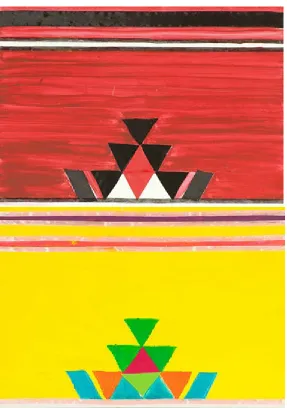
Another artwork, Sedu: Then and Now, involved multiple
reinterpretations of traditional sedu4 designs frequently found on rugs or covers. Created by a group of students with special needs, the work expressed the undeniable rapid cultural changes in the region. This group took an old, traditional sedu pattern and changed its colors and function, making the pattern modern and more vibrant. Another piece they made showed a traditional sedu that was tattered with dim colours that gave the impression of it being forgotten. Yet another iteration of the sedu utilized neon colors, perhaps as a means of updating the sedu to the present day and making connections between the traditional elements of the past and the contemporary world.
4 Sedu is a regional wool craft traditionally practiced in Bedouin desert communities, design elements of which are still widely used in textiles. Al Sedu (in Arabic) indicates the process of weaving and is also the name of the loom. Sedu patterns traditionally involve geometric shapes woven into the textile and frequently use red, black, green, and white, colors common in Arab countries (Mathaf, 2011)
Figure 3. Group work. Sedu: Then and Now. Watercolor on paper.“Sedu is sym-bol of heritage in the Gulf and is one of the oldest traditional crafts in the Arabian Peninsula. And we wanted to show how change can affect tradition.”
museum is an important shift in museum exhibition practice that was well received by the public. The opening of the Transform exhibition had the highest attendance of any opening that Mathaf held up to that point, according to museum records. We believe that the substantial number of entries and the attendance at the opening demonstrate the significant local interest in art education and museum opportunities for youth. Further, through this exhibition Mathaf built connections to students, teachers, and schools throughout Qatar. Thus, this exhibit worked to help further the goals of museum and arts education in Qatar by expanding the reach of the arts and building networks of art and museum educators. This is especially important within the local context of a country that is beginning the reintroduction of art in the schools.
With change and transformation in mind, Mathaf launched its second Student Art Competition under the theme of Black and White. The competition ran during the 2013-2014 academic year, with the display of student work in the galleries held during the summer of 2014. Students were asked to make art related to differing interpretations of Black and White by considering the central question, “What can you learn by looking, thinking, and working through black and white?” The museum educators selected this theme to encourage students to observe and notice what they encounter daily through a specific lens. In the local context of Qatar, the colors black and white carry deep symbolic meaning and cultural significance. These colors are evident in daily interactions with people because of the traditional dress of white (thobe) for men and black (abayya) for women (Mathaf, n.d.). For the Black and White student show, Mathaf received over 300 submissions from 39 schools across Qatar, with the majority coming from Doha. A judging panel included staff from QM, Mathaf, and other personnel from local arts organizations. The judges chose 191 works to be included in the exhibition. While the artworks in this exhibition primarily used black and white, they were not monotonous. Sometimes serious and sometimes joyous, the artworks explored a wide range of materials and subject matter. The students’
artworks were curated and displayed throughout the museum, grouped by the themes that emerged from their responses to the central question.
The exhibition opened on May 24, 2014 with at least 500 students, families, and community members present. The opening also featured performances from student musicians and the Doha Children’s Choir. In addition, attendees were invited to an artmaking workshop that involved the creation of a mural inspired by the students’ artworks. The Chair of QM, Her Excellency Sheikha Al Mayassa, saw the exhibition and recommended that next year’s student exhibition should select a few works that could be converted into public art to further encourage and foster the role of museum and art education in Doha.
Conclusion
As we considered this special issue on place, we were struck by the rapid changes in Qatar and how those changes were manifested in the visual artworks the students created for the Mathaf exhibit. Through exploring how students in this particular place interpreted the theme Transform while living in a rapidly transforming nation, we can gain insight into ways museums can work with students and schools. The idea of exhibiting student art in an art museum gallery, not just in an educational gallery, is an important step in recognizing the importance of education and the arts. In the case of Mathaf, the
Transform exhibit theme intentionally connected to the rapid changes
in the students’ surroundings. This enabled them to participate in the exhibit while thinking through their role in a transforming place. Through connections like this to a community, museums can embrace ideas relevant to their communities and connect with the people and the place in which they operate. This challenge to previous ways of exhibiting embodies what Wickens (2012) posited as a goal for museums, “first to be for someone, and second to be about something” (p. 91).
the educational, artistic, and political climate of their areas and plan programs or art competitions for youth that embrace local issues, ideals, and values. As we live in a postmodern world, considering the context of museum education programs, including place, is an important way to understand the programs and their meaning (Neperud, 1995). Further, building education and exhibition goals around place is another way for museums to fulfill their missions as educational institutions in ways that are relevant for their visitors while challenging past practices. The student art exhibition run by Mathaf is one way that the museum addresses Bouchenaki’s (2011) questions about how contemporary museums are relating to the particular cultural context of their area.
References
Anderson, S. (2012). Lightness and being: The Museum of Islamic Art, Doha, Qatar. Marg: A Magazine of the Arts, 64 (1), 67-77.
Al-Khudhairi, W., Chalabi, D., & Shabout, N. (Eds.). (2010). Sajjil: A century of modern art. Mathaf: Arab Museum of Modern Art, Doha, Qatar. Italy: Skira Editore S.p.A.
Arlidge, J. (2013, October 4).Forget about the price tag. London Evening Standard, ES Magazine. Retrieved from http://www.standard.co.uk/lifestyle/ esmagazine/forget-about-the-price-tag-qatars-sheikha-mayassa-is-outbidding-the-art-world-8856384.html.
Arlidge, J. (2009). Qatar rising. Architects’ Journal, 230(13), 24-31.
Art Review. (2013). Sheikha Al-Mayassa bint Hamad bin Khalifa Al-Thani. Retrieved from http://artreview.com/power_100/sheikha_al-mayassa_bint_hamad_ bin_khalifa_al-thani/
Atkinson, R. (2011). Eastern promise. The Museums Journal, 111(1), 28-31.
Baker, S. (2013, August 11). A small power in the world arena. The Washington Post, pp. G3.
Blandy, D., & Bolin, P. E. (2012). Looking at, engaging more: Approaches for investigating material culture. Art Education, 65(4), 40-46.
Bouchenaki, M. (2011). The extraordinary development of museums in the Gulf states. Museum International, 63(3-4), 93-103.
Central Intelligence Agency (n.d.). The world factbook. Retrieved from: https:// www.cia.gov/library/publications/the-world-factbook/geos/qa.html Congdon, K. G., Blandy, D., & Bolin, P. E. (2001). Histories of community-based art
education. Reston, VA. National Art Education Association. Congdon, K. G. (2004). Community art in action. Worcester, MA: Davis. Eakin, H. (2011, November 20). Defining a culture in Doha’s desert. NYR Blog.
Retrieved from www.nybooks.com/blogs/nyrblog/2011/nov/20/islamic-art-doha/
Erickson, A. (2011, March 28). Saving the stories: Qatar’s disappearing oral tradition has spawned projects to record the storytellers. The Christian Science Monitor. Retrieved from www.csmonitor.com
Excell, K., & Rico, T. (2013). ‘There is no heritage in Qatar’: Orientalism, colonialism and other problematic histories. World Archaeology, 45(4), 670-685.
Exell, K. (2014). Collecting an alternative world: The Sheikh Faisal bin Qassim Al-Thani Museum in Qatar. London, UK: Ashgate.
Gray, S., & Graham, M. (2007). This is the right place: Community-based art education at Utah’s Springville Museum of Art. Journal of Museum Education, 32(3), 301-310.
Guarino, C. M., & Tanner, J. C. (2012). Adequacy, accountability, autonomy and equity in a Middle Eastern school reform: The case of Qatar. International Review of Education, 58(2), 221-245.
Khatri, S. S. (2013). Official: Qatar’s population could grow another 15 percent by 2015. Retrieved from dohanews.co/official-qatars-population-could-grow-another-15-percent-by-2015/
Khatri, S. S. (2014, March 2). Qatar sees population rise to all-time high in February. Doha News. Retrieved from dohanews.co/Qatar-sees-population-rise-time-high-february/
London, P. (1994). Step outside: Community-based art education. Portsmouth, NH: Heinemann.
Mathaf. (n.d.). Theme: “Black and White.” Retrieved from mathaf.org/qa/en/theme Mathaf Education Department. (2012). Values of learning at Mathaf, strategy
document, fall 2012-summer 2013.
Mathaf (2011). Glossary. Unpublished internal document.
Qatar Foundation. (n.d.). Mission. Retrieved from: www.qf.org.qa/about/about Seligson, J. (2008, November/December). Can museums buy happiness? Museum,
87(6),46-53; 83.
Shwartz, D. (2010). Experiments in making history personal: Public discourse, complexity, and community building. Journal of Museum Education, 35(1), 71-81.
Supreme Education Council. (2013). Education and training sector strategy. Retrieved from: http://sec.gov/qa/En/about/Documents/Stratgy2012E. pdf