Investigation on FOG Computing for 5G- Enabled
Software Defined Multicast Networks
N.N. Eya
1,*, G.A Oguntala
1, R.A. Abd-Alhameed
11University of Bradford
Abstract
5G enabling technologies and applications has been proposed in Multicast or group communication to solve the challenge of increasing demand of mobile data traffic. One of the key 5G technologies that would address the increase in mobile traffic is network densification, poses a challenge to group communication. With group communication, several groups are formed into clusters and this technique promises to improve various services in 5G network technology by way of efficient management. As a result, this paper proposes a 5G-enabled software defined multicast networks (5G-SDMNs), where software-defined networking (SDN) is exploited to dynamically manage multicast groups in 5G and mobile multicast environment. Also, mobile edge computing (MEC) is exploited to strengthen network control of 5G-SDMN. The combination of SDN and MEC ensures a flexible, cheap, programmable, and manageable network architecture is proposed for 5G-SDMN. This architecture promises a simplified network management, an improved resource management and a sustainable network development. This article also presents a case study of multicast cloud computing and enumerates the advantages of 5G-SDMN. In the end, open issues in 5G-SDVN are identify and discuss.
Keywords: 5G, software-defined networking (SDN), mobile multicast environment, mobile edge computing.
Received on 12 January 2019, accepted on 28 January 2019, published on 31 January 2019
Copyright © 2019 N.N. Eya et al., licensed to EAI. This is an open access article distributed under the terms of the Creative Commons Attribution licence (http://creativecommons.org/licenses/by/3.0/), which permits unlimited use, distribution and reproduction in any medium so long as the original work is properly cited.
doi: 10.4108/eai.3-9-2019.159948
1. Introduction
According to Cisco Visual Networking Index, mobile data traffic has registered a growth of 18-fold in the past 5 years and almost half a billion mobile devices were added to the existing 7.6 billion in 2016. Various 5G enabled technologies and applications have been proposed to ensure reliability and ubiquitous connection for the ever-increasing mobile users. These technologies introduced to multicast networks give way for 5G-enabled multicast networks [1]. One of the technologies in 5G that promises user throughput and improved traffic capacity is network densification. Network densification is defined as the extreme deployment of wireless infrastructure like cell sites in order to increase capacity [2]. As a result of the increased network capability of 5G, most group members can access the network or services simultaneously. This should have been a challenge with previous technologies due to limited spectrum resources and low spectral efficiency. This article proposes a multicast or group
communication where members would be grouped into clusters for improved quality of service and improved 5G performance with membership grouping, multi-service applications and technologies in multicast technology. Group key management in a dynamic environment would be more challenging in 5G technology due to node mobility.
Software-defined networking (SDN) is of great benefit in the management of multicast groups in 5G networks. 5G-enabled software defined multicast networking (5G-SDMN) where the SDN technology is exploited for the effective and efficient management of the multicast groups and group services. SDN is conceptualised as the technology to support network resilience, flow programmability and to optimize network management of 5G networks by reducing hardware limitation [5]. SDN separates the data plane and the control plane in 5G networks in other to logically centralise the network and intelligence state. This separation technique reduces the overheads in the control plane because it ensures scalability in the case of increase in mobile users as they become independent of resources of the control plane.
∗
Mobile edge computing (MEC) at the time of writing is a new computing concept that increases the processing capabilities at the network edge. The valuable feature and characteristic is the proximity of the MEC servers to the users is close. This feature enables capturing of real-time insight into the context information and this ensures that the users request is processed directly. Hence, the MEC servers are utilised in this case as local controllers in the control plane to invigorate the network control of the 5G-SDMN. This work recommends 5G-SDMN with the integration of the SDN and MEC technology whereby the SDN would be exploited for efficient management of the multicast network groups MNGs with the introduction of network densification. This integration develops a hierarchical architecture for 5G-SDMN. The idea of this architecture is to divide and separate the whole network in three (3) control plane, social plane, and data plane. The social plane is for the multicast network, the control plane is for controlling activities just as the name implies while the data plane is for data transmission. The control plane benefits from the integration of MEC to enable dexterous and optimised decision making by acquiring information of the knowledge of the network states. Network utilisation is optimised and network management is simplified in this architecture and most of all a sustainable network development is achieved.
Structure and Contribution
• 5G-SDMN is proposed with scalable Multicast Network Groups MNGs with also a flexible scheduling of network resources.
• With the integration of SDN with MEC technologies, a flexible, programmable and controllable network architecture is achieved.
• The advantages of 5G-SDMN is highlighted and open issues are identified and discussed.
The rest of the article is organised as follows. Multicast network is examined with the introduction of 5G-SDMN. The architecture that combines SDN and MEC is proposed and the illustration of the Universal Plug and Play (UPnP) for multicast network is presented. Afterwards the article is concluded with research challenges and discussions.
2. O
verview
of
SDN
and
M
ulticast
SDN
As mentioned earlier, SDN is a new network concept or paradigm to cloud computing that facilitates flexible and efficient network management. In SDN all the controllers are centralised logically via a southbound interface or the network is centrally controlled or programmed using software [3]. One of the popular SDN is OpenFlow [4] which contains one or multiple flow and group tables which implements multicast functionality. SDN is expected to be a promising technology in 5G networks following its advantages of scalability and high flexibility which have gained its relevance and adoption in recent mobile network architecture research [5].
3. O
verview
of
SDN
and
M
ulticast
SDN
MEC technology presents new network elements (e.g., MEC servers) which ensures advanced computing and storage capabilities at the network edge. The MEC servers are set up closely to the mobile nodes to directly process requests and also ensure that mobile nodes with less network latency are not left out. For the proposed architecture, the MEC servers are used for managing the MNGs in 5G-SDMN. Some of the management aspects are listed as follows below:
Network state monitor: The position of the MEC servers enables the collection of dynamic status information of mobile nodes. The information could be user requests, resources available to users etc. The collected information is used for efficient and optimised management.
Real-time instruction distribution: Another advantage of the MEC servers in the management of networks is in the real-time dissemination of instruction. The underlying planes where the MEC servers are deployed is physically connected to the networks at the base station and this can transmit management instructions of the MNGs to the mobile nodes in real time.
Local decision making: The MEC servers can make decisions on MNG networking, scheduling of resources and QoS management. Hence, the control logic of the proposed architecture expands the control logic from the network core to the distributed network edges. This boosts the process of local decision making, localisation mobility support and also improved user experience.
Also, the MEC servers can be set up in the control plane to act as local controllers in other to localise the control plane of the 5G-SDMN. The state of the entire network is monitored in real time while managing the dynamic changes of the network topology, functionality and configuration is done by the control plane conveniently. The integration of the MEC into the proposed SDN-based architecture makes the 5G-SDMN programmable and more controllable because the control plane is enhanced.
4. T
he
P
roposed
T
hree
P
lanes
H
ierarchical Architecture
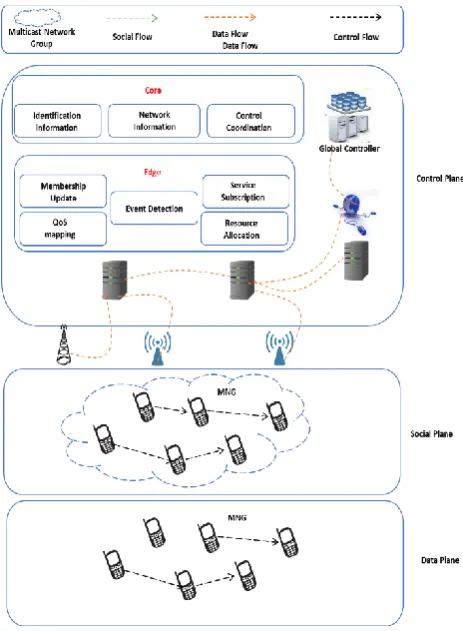
Figure 2 is the illustration of the proposed MEC-supported architecture for 5G-SDMN. The architecture illustrates the separation of control plane, the data plane and the social plane. This architecture enables the controllability and the programmability for MNG networking and data transmission. The control layer is further separated into two sublayers namely the core layer and the edge layer. These two layers represents the network core and the network edge accordingly.
The network core which is the core layer is the global controller. At the edge of the layer, the multiple MEC servers act as the local controllers. The MEC in the control panel takes charge of the real-time decision making and data transmission for the MNG. The social plane’s function is to execute the MNG networking tasks while the data plane controls the data traffic with a set of instructions set up by the control plane. The physical details of various planes are further illustrated below.
Control plane: In the control plane, the control logic is separated from the physical network devices to form a centralised control plane. The network state is viewed by the global controller in the core layer. The network state information includes various status of the mobile nodes, identification of the entities etc. These obtained information would be useful for security management, diagnosing faults and also for efficient networking. The distributed MEC servers coordinates the activities of the MNGs on the directives from the global controller. The MEC servers communicate and cooperate amongst themselves in other to achieve these coordination. Within a cluster, all the MEC servers identifies various events (join, leave and move) that takes place in the edge layer. The MEC servers updates the group membership at each of these events and also carries out the topology estimation of the MNGs. Also, the service provision decisions are handled by the MEC servers in the MNGs. The QoS management and the resource allocation is controlled by the MEC servers for efficient service provision.
Social plane: At the social plane, a request is received from a mobile node to form a group. On authorising the request, packets on the MNGs are transferred for use to selected members. Below is the sociality flow which is also the packet format.
MNG_ID refers to the identity of the new MNG. The service is referred to the services that the mobile node is subscribed to and the size of the MNG. The time indicates the time slot at the moment depending on the instruction on the control plane. New mobile nodes can decide if they would join the group.
Data plane: The separation of the data plane and the social plane in the control plane, makes the entire control
logic concentrating in the network core. The MEC supports the network edge at the network core. However, the mobile nodes in the MNGs act as a simple forwarding devices where mobile node communicate amongst each other. This leads to forwarded data flow in the MNGs.
Figure 2. 5G-SDMN MEC-Supported architecture
A. Advantages of the Proposed Architecture
On the proposed architecture, the configuration in the abstracted control panel of the MNG network is meant to optimise data transmission on a global view point. The software-based control enhances network intelligence by utilising the MEC servers. One of the features of the software-based control is efficient programming which makes it easier to manage network infrastructure and the management of policies and the deployment of new application. The network schedules all the available resources based on the resource requirements and this includes the communication and computing resources. Resource utilisation is improved because of the flexibility of the operation. A dedicated wireless channel can be allocated for the delivery of content with sensitive value, commercial value or content with high priority. This decision is influenced by the local MEC server. This work further looks at the advantages of the proposed architecture in the following elements.
new network features. The proposed architecture acknowledges and guarantees quality of service and mobility support. An advanced network functions, applications and services is sustained and developed due to the centralised and strengthened network control. Simplify network management: The scalability of the proposed architecture is unrivalled and it manages assorted services in the MNGs. This is possible because of the programmability and the reconfigurability of the network devices and new management policies can be assigned by administrators using the controllers. This enables a more efficient simplified network management. Improve resource utilization: Efficient cooperation amongst mobile nodes in the MNGs is improved to facilitate a flexible resource scheduling because of the adoption of global-aware controllers. Based on individual demand, the available recourses are allocated. These resources are allocated to various mobile nodes based on their requirements and capacity. Resource utilisation in the proposed architecture is improved.
5. A K
ey
I
ssue
in
the
Proposed
A
rchitecture
The proposed 5G-SDMN experiences challenges in MNG networking and this challenge is addressed by utilizing the UPnP. The UPnP characterises a rather intelligent peer-to-peer network where devices are configured automatically upon discovery. It is unique with its features since it does not depend on any operating system, programming language or any other platform whatsoever. This technology boosts interoperability of various network technologies, end devices and management policies and this is facilitated by a flexible and open network connectivity. Also, the UPnP depicts how information are exchanged by network devices in a transparent manner to the users. This can be very useful in MNGs in data sharing amongst mobile nodes. Recently the UPnP has been popular in ad hoc networks as it has been used as a robust and simple standard. This successful achievement is the reason why this technology has been adopted for the MNG networking in 5G-SDMN. The UPnP technology comes with two key components which have been adopted here as the mobile nodes and the MEC servers, these key components are the controlled devices and the control points. In the MNG networking, the novel benefit of the UPnP lies in the PnP concept. For the proposed architecture, the moment a target mobile node is approved for a MNG, the UPnP protocol configures the network connection setting automatically for that mobile node. If there is need, any available resources of the newly joined member are scheduled within the VNG for other members. Relevant VNG networking operations like content exchange, service discovery and member selection are facilitated by UPnP and this is achieved by the highly-efficient coordination and automatic discovery that this technology supports. One of the protocols that supports a simple standardised mechanism is the simple service discovery protocol (SSDP). Therefore, processes of discovery, event detection, and control is based on the UPnP in the VNG networking. These illustrations could be described as follows: a mobile node mni can request to setup
a new MNG. There would be various services that the mobile node can subscribe to and this could be noted as,
Servicei = {S1, S2, …, Sn}. The sociality flow is forwarded
to a control point by the mobile node which is the closest MEC server. The MEC server deals with this request by comparing the requesting mobile node with existing MNG to ensure fitting requirements. There is also an existing
MNGj with services = {W1, W2,..., Wn}. Whenever a
mobile node requires to join a group, it compares its intended services with services that each group offers. mni
joins MNGj and the probability is calculated by
𝑃𝑗 𝑖=
∥ 𝑠𝑒𝑟𝑣𝑖𝑐𝑒𝑖 ∩ 𝑠𝑒𝑟𝑣𝑖𝑐𝑒𝑗∥ ∥ 𝑠𝑒𝑟𝑣𝑖𝑐𝑒𝑖 ∥
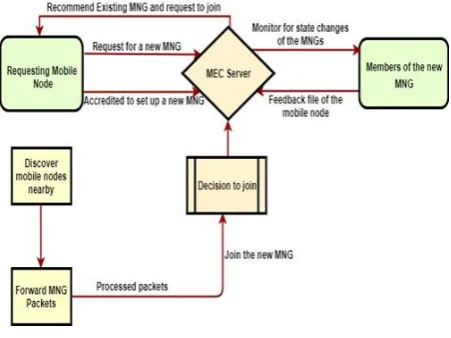
||service|| returns the services provided and ∩ is an operation to select the common services between the two services. With the obvious common service subscription, the mobile nodes are willing to become a member of the recommended MNG. In a case where there are no available or suitable MNGs, the MEC server authorises the mobile node to establish a new MNG. When the authorisation is approved, the mobile node forwards the sociality flow on the new MNG to mobile nodes nearby. The MEC server pays attention to its surroundings for a new MNG. Upon discovery of a suitable mobile node, the MEC server notifies a specified mobile node to form the new MNG to forward the sociality flow. When this is done, the mobile node makes the decision whether to join the MNG corresponding to the probability in the equation above. Upon making a decision to join, the mobile node uploads its response to the MEC server and this increases the packet size. At the point when the size attains the upper bound, that ends the MNG networking. For the existing and the established MNG, the description files for registered members is made known in other to facilitate the services of the MNG. The basic sets of standards and the policies for outlining the services and devices is defined by the UPnP. All the files show a general information of the mobile nodes. The MEC server gathers the description files for all the members in the MNGs to monitor the state changes of the MNG as a control point. This enables the MEC server to take a real-time decision for the services provided in the MNGs. Upon detection of a mobile node requesting for interested content, the MEC server locates the target mobile node conforming to the details in the description files. The target mobile node upon instruction from the MEC server, transfers its content to the requesting mobile node. This is done according to the transmission path which is optimised taking into account the dynamic topology of the MNG.
A. Case Study
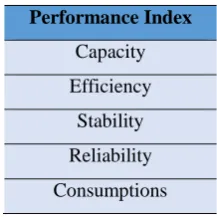
real-time member update and this is common when a mobile node that is requesting to join a multicast cloud group acts as a group leader. In 5G-SDMN, when a mobile node in a MNG sends a request to the local MEC server to establish a cloud multicast, the MEC server would acquire necessary information on the mobile node and more mobile nodes can be elected in other to establish the multicast cloud. This election and selection process is achieved by considering available resources, proximity and workload of the mobile node. Also, the UPnP and the MEC server monitors the various events and operations of the multicast cloud in real-time. Consequently, this is used to improve the overall performance of the multicast could by the optimisation of resource scheduling, and task allocation. These improvements are illustrated in the performance indexes in table 1.
Table 1. Performance index of a multicast cloud computing.
Performance Index
Capacity
Efficiency
Stability
Reliability
Consumptions
Stable construction: The MEC server constructs a stable multicast cloud by selecting the mobile nodes with various similarities and proximity.
Extended capacity: The constructed stable cloud multicast can be increased or extended by adding more suitable mobile nodes.
Reliable resource provision: Due to the selection criteria of the MNG, the event pattern of the members is similar, and this ensures reliable resource provision.
Real-time scheduling: The features and capabilities of MEC which is ubiquitous communications, increased computing capabilities and decision making is useful as this is done in real-time and is sent to the mobile nodes swiftly to accomplish real-time scheduling.
Low communication overheads: High energy consumption is avoided, and communication overhead is reduced because event detection is moved from the request mobile node.
Efficient resource utilization: In other to improve resource utilisation from a global viewpoint, mobile node resource cooperation is under the centralised control.
Research Challenges in 5G-SDMN
The proposed 5G-SDMN exploits the SDN and MEC technology to manage the MNGs for improved QoS. This has also exposed some key research challenges that needs attention. These challenges are discussed below:
A. MNG Management
Figure Labels: Use 8-point Times New Roman for Figure labels. Use words rather than symbols or abbreviations when writing Figure axis labels to avoid confusing the reader. As an example, write the quantity “Magnetization”, or “Magnetization, M”, not just “M”. If
including units in the label, present them within parentheses. Do not label axes only with units. In the example, write “Magnetization (A/m)” or “Magnetization
{A[m(1)]}”, not just “A/m”. Do not label axes with a ratio
of quantities and units. For example, write “Temperature (K)”, not “Temperature/K” As a result of the increased number of connected mobile device, MNG management presents new challenges in 5G-SDMN. This article takes into account the size of a MNG because a large sized MNG is advantageous to improved services on the MNG. This could be in the form of new content being shared although, this would result in high management overhead. Whereas, with a smaller size, the available resources are limited, and the shared content too is also limited, and this will affect user satisfaction and hamper normal services. This text considers that the size of each MNG is determined based on different condition. Also, intercommunication between different MNGs could as well be considered. A single mobile node can be a member of multiple MNGs and this would foster interaction among different MNGs.
B. Resource Allocation
In terms of resource allocation, the integration ofemerging technologies in the proposed 5G-SDMN, approach for resource allocation tends to be inclusive. This could be seen in a case where two mobile nodes are within a proximal distance to each other, for communication they adopt device-to-device (D2D) to communicate with each other to improve high-rate content delivery. This improves spectral reuse, enhances system capacity and acquiring hop gains. One of the challenges of D2D communication is interference in cellular communication and this is due to the reuse of user’s cellular spectrum [6-8]. This challenge has been addressed in a few literatures that shows improved spectrum optimisation and efficient resource allocation [9, 10]. These solutions that have earlier been proposed can be combined with the resource allocation for D2D communication and depending on the conditions relating to decision making, the control plane can choose an optimal solution or strategy in making its decision.
C. Privacy Preservation
6.
C
onclusion
This article explores mobile edge computing in 5G-enabled software defined multicast networks and in order to ensure the benefits, there is need for efficient management of the MNG. This led to the proposal of the 5G-SDMN by exploiting SDN to manage the MNGs with flexibility and scalability in 5G networks. To enable 5G-SDMN, the architecture was designed with MEC and a network separated into control plane, social plane and data plane. The proposed architecture offers a programmable and flexible MNG networking and data transmission. The integration of SDN and MEC signifies a strengthened control plane which offers improved controllability for the proposed 5G-SDMN; hence, the architecture provides a simplified network management which improves resource utilisation and promotes a sustainable network development. UPnP is exploited for the MNG and this article used a case study to outline the advantages of the 5G-SDMN with some research challenges.
References
[1] G. Araniti, M. Condoluci, P. Scopelliti, A. Molinaro, and A. Iera, "Multicasting over emerging 5G networks: Challenges and perspectives," IEEE Network, vol. 31, no. 2, pp. 80-89, 2017. [2] N. Saxena, A. Roy, and H. Kim, "Efficient 5g small cell planning
with embms for optimal demand response in smart grids," IEEE Transactions on Industrial Informatics, vol. 13, no. 3, pp. 1471-1481, 2017.
[3] X. Zhang, M. Yang, Y. Zhao, J. Zhang, and J. Ge, "An SDN-Based Video Multicast Orchestration Scheme for 5G Ultra-Dense Networks," IEEE Communications Magazine, vol. 55, no. 12, pp. 77-83, 2017.
[4] N. McKeown et al., "OpenFlow: enabling innovation in campus networks," ACM SIGCOMM Computer Communication Review, vol. 38, no. 2, pp. 69-74, 2008.
[5] H. Zhang, N. Liu, X. Chu, K. Long, A.-H. Aghvami, and V. C. Leung, "Network slicing based 5G and future mobile networks: mobility, resource management, and challenges," IEEE Communications Magazine, vol. 55, no. 8, pp. 138-145, 2017. [6] G. A. Safdar, M. Ur-Rehman, M. Muhammad, M. A. Imran, and R.
Tafazolli, "Interference mitigation in D2D communication underlaying LTE-A network," IEEE Access, vol. 4, pp. 7967-7987, 2016.
[7] U. N. Kar and D. K. Sanyal, "An overview of device-to-device communication in cellular networks," ICT Express, 2017. [8] L. Song, D. Niyato, Z. Han, and E. Hossain, Wireless
device-to-device communications and networks. Cambridge University Press, 2015.
[9] Y. Cai, F. R. Yu, C. Liang, B. Sun, and Q. Yan, "Software-defined device-to-device (D2D) communications in virtual wireless networks with imperfect network state information (NSI)," IEEE Transactions on Vehicular Technology, vol. 65, no. 9, pp. 7349-7360, 2016.