35
Aladin El-Mafaalani
Do Underachievers Need Sociology?
Abstract
This paper presents a promising model for using sociological learning to support the education of young people who are socially disadvantaged or display behavioral problems. A great many of these students are trapped in patterns of negative behavior. The goal of the model is to enable these young people to think explicitly about the role they are playing and to encourage them to strike out in a new direction. To this end, Erving Goffman’s sociological insights are used to stage a theatrical performance about school. This approach is informed by the microsociological tradition of proceeding from the concrete to the abstract in order to facilitate inductive learning and self-reflection. Goffman’s theory of social action provides the social-theoretical background for the theatrical action, while also serving as a medium of contrast for the analysis of the individual, interaction, and institution in subsequent reflections about school. In this way, sociological theory not only serves as a theoretical foundation for the lesson, but is also explicitly its subject.
Zusammenfassung
Der Aufsatz zeigt eine erfolgversprechende Möglichkeit auf, soziologisches Lernen als Beitrag zur Förderung so-zial benachteiligter und verhaltensauffälliger Jugendlicher in der Schule zu implementieren. Die meisten dieser Schüler sind in ihren Handlungsmustern gefangen. Ziel ist es, diesen Jugendlichen die Möglichkeit zu eröffnen, bewusst über ihre Rolle nachzudenken und einen anderen Weg einzuschlagen. Hierfür werden Erkenntnisse aus Erving Goffman‘s Soziologie für ein schulisches Schauspiel genutzt, um ganz im Sinne der mikrosoziologischen Tradition vom Konkreten auf das Abstrakte zu schließen und damit induktives Lernen sowie Selbstreflexion zu ermöglichen. Goffman‘s Theorie sozialen Handelns bildet für das szenische Spiel zunächst das sozialtheoreti-sche Hintergrundrausozialtheoreti-schen, um schließlich in der Reflexion der sozialen Situation in der Schule als Kontrastmittel für die Analyse von Person, Interaktion und Institution zu dienen. Die soziologische Theorie dient hierbei also nicht nur zur theoretischen Fundierung des Unterrichts, sondern wird auch explizit zum Unterrichtsgegen-stand.
Contents
1. Introduction
2. Underachievement and behavioral problems 3. Goffman in brief
4. Planning, implementation, and analysis of student-organized instruction
5. Experiences and goals 6. Opportunities and risks
Keywords
Promoting underachievers, staging an ordinary school day, reflection and deconstruction, teaching Sociolo-gy, sociological learning, theatrical performance, Erv-ing Goffman
1. Introduction
Over the course of our lives, we obtain implicit knowl-edge about how we are supposed to behave in social situations and which social norms make life possible as we know it. In principle, this socialization process provides every individual with the knowledge re-quired to “find his or her way” in society. This trivial observation is not so obvious at first glance, how-ever: most individuals would freely admit that they lack the medical knowledge to treat themselves when ill; that they do not possess the architectural skill to build their own home; that they do not have the legal knowledge to represent themselves in court – even in
the area of psychology one is more likely to turn to an outside professional than to the field of sociology.
36
2. Underachievement and BehavioralProblems
The German educational system1 has been an object of
criticism for some time. According to official statistics, 20% of students display insufficient mastery of basic skills, 22% of students only obtain the lowest-level degree (Hauptschulabschluss), and another 10% depart without any degree whatsoever (cf. Allmendinger/Hel-big 2008). While the extensive media discussion of in-ternational comparative studies has made the public well aware of such deficits in Germany’s educational system, there is little awareness for the fact that the responsibility for educating underachievers – a risk group composed predominantly of young men – falls for the most part to vocational training schools
(Beruf-skollegs). For a long time, even the field of vocational
pedagogy largely ignored such disadvantaged youths (cf. Bojanowski 2006).
Nationwide there were approximately 400,000 youths in 2004 waiting for a training contract and a seat at a vocational training school – youths with no chance of obtaining a job or traineeship in the la-bor market.2 By 2006, this number had increased to
500,000, despite the overall strength of the economy (cf. Schelten 2006 & 2009). At such vocational schools, courses are offered with the aim of enabling that ever greater number of students to attain professional qualifications. In their mission to educate disadvan-taged students, vocational schools only have a good chance of success if the mechanisms that have previ-ously impaired a student’s academic performance can be identified and diminished as much as possible. In particular, the “support theory” often used to pro-mote the selection and homogenization of learning groups has shown little effectiveness. Early selec-tion systems3 have a particularly negative effect on
1 In Germany’s multi-tiered educational system, Gymnasium is the best class of secondary school, followed by Realschulen and Hauptschulen. Gesamtschulen, by contrast, are composed of stu-dents with mixed academic ability. Sonderschulen (or rather: Förderschulen) are special needs schools.
2 Training carried out at two different places of learning (dual system), i.e. at the workplace in companies and through part-time attendance of a vocational school (Berufsschule). Young people who leave school but are not ready for an apprentice-ship regularly go on to attend Berufsschule, i.e. in the „Vocati-onal preparation year“ (Berufsvorbereitungsjahr) with full-time instruction. For an overview of the German educational system in English, please see KMK 2009.
3 In the German educational system, students are sorted based on performance at nearly all age levels. From the start of school at the age of 6, students can be held back to repeat a grade. Stu-dents begin to receive formal grades at the age of 7 or 8, depen-ding on the region, and with few exceptions are redirected to one of up to five different types of schools in the fifth grade, in which qualitatively different educational goals are set. Appro-ximately 90% of students remain at the type of school selected for them at the end of elementary school, despite the fact that students can formally apply to change schools. In the few
ca-children and young people with immigrant or educa-tionally deprived backgrounds. In a large number of studies it has been shown that the social habitus of the student is a significant factor in the outcome of performance evaluations. Not only cognitive ability, but also good manners, positive social behavior, the ability to express oneself, and discipline are “factored in” when grades are awarded (cf. Ditton 2008). In this way, processes can be identified that may occur with-out any willful intent, but which might well be cat-egorized as institutional discrimination (cf. Gomolla/ Radtke 2002).
Based on these circumstances, the typical com-position of a remedial class for underachievers is perhaps not surprising. In Germany, two groups of underachievers are “Young persons without ap-prenticeship” (Jugendliche ohne
Ausbildungsverhält-nis) and those in the “Vocational preparation year”
(Berufsvorbereitungsjahr).4 These groups are composed
in large part (up to three quarters) of students with im-migrant backgrounds. Their families are mostly from Southern and Eastern Europe, Eurasia and North Africa. Most of them were born in Germany and have German citizenship. The students are between 16 and 24 years old and come mostly from Hauptschulen, Realschulen, or Gesamtschulen – in rare instances have they previ-ously spent time at a Gymnasium or a special needs school (Förderschule). They rarely have a qualifying di-ploma of any kind, typically not even a secondary gen-eral school certificate (Hauptschulabschluss). About a third of the students have previously had to repeat at least one year of school. Their experience with teach-ing staff is quite variable, as is their general attitude toward school. Familial living circumstances are also heterogeneous. While a few students are themselves mothers of young children who have had to interrupt their schooling because of pregnancy, most of them are living with their parents, not infrequently with a single parent. Many families are affected by long-term unemployment. The monthly income available to students is somewhere between 30 and 250 euros (principally from pocket money and side jobs).
To support students it is important to take into ac-count their motive for attending school. Motivations
ses in which students move between levels, students usually drop down to a worse school, i.e. from the Gymnasium (the school for the “best” students) to the Realschule (the school for mid-level performers), or from the Realschule to the Hauptschu-le (another notch down) or SonderschuHauptschu-le (a “special school” for students with learning disabilities). When the discussion turns to the issue of inter-school mobility in Germany, it should be emphasized that, according to official statistics, mobility nor-mally means a “step downward” for students (cf. Bellenberg et al. 2004).
37
range from a desire to receive government aid money to a dedicated commitment to reach a specific profes-sional goal. Accordingly, there is a great deal of diver-gence between the students with regard to work atti-tudes and social behavior, as well as in their readiness to learn. In general, one can distinguish three broad groups of students. The individuals in the first group have adopted a position of protest against school and authority, and convey the impression at first glance that their primary goal is to voice their attitude of resistance as consistently as possible – by means of aggression and disrespect (the “trouble-makers”). The resistance of these youths indicates that they do not view success in school as a realistic option for escap-ing their current situation. This attitude of protest displays recognizable parallels to the “counter-school culture” of working-class students, as Paul Willis de-scribed it in the 1970s (cf. Willis 1977).
The second group has withdrawn and become trapped in a passive role. Passive behavior in partic-ular is often not recognized by the teaching staff as problematic. A large proportion of these students can be assumed to also have a negative self-image (the “withdrawn ones”). The third group consists of
stu-dents whose life circumstances have not permitted them to successfully complete their general school education (for example, because of pregnancy, death in the family or severe illness). These students are es-pecially difficult to describe in a unified way (the “oth-ers”). A striking fact is that additional subgroups are also normally formed at early stage based on sex and ethnic identity. These subgroups regularly transcend the borders of the three types described above.
In general, it is important to note that these three categories of students are not only characterized by cultural heterogeneity, but are also highly diverse in terms age, maturity, competencies, experiences, pre-conceptions, motivation and social life circumstances. Unfortunately, a checkered educational history and problematic behavior are the sole characteristics that unite nearly all of the students – even if a more pre-cise assessment would in fact reveal many subtle dif-ferences.
These circumstances pose a number of special chal-lenges for the design of the classroom lesson. Accord-ingly, every form of remedial education must keep the following in mind:
• Neither the pedagogic nor the disciplinary function of school grading has the desired effect upon prob-lem students. This fact, together with the students’ unruly behavior, leads to great reluctance on the part of many teachers to work in remedial school settings. One should stay away from selection me-chanisms, especially at the beginning, to whatever degree possible.
• Teachers and students must get to know one ano-ther quickly; the teacher must foster good learning
conditions for the students and personal conversa-tions must take place. Experiences, particularly ha-ving to do with school, need to be spoken about and reflected upon. At the same time, attempts must be made to integrate the three groups of stu-dents described above.
• The raised (pedagogical) index finger needs to be avoided. A routine needs to be developed collabo-ratively with the students that is acceptable to the institution and at the same time enables these stu-dents to become participants. In this way, synergy effects can be set in motion, under which rules no longer seem like something external, but rather ap-preciated as bridges between the institution and the individual.
The goal is to facilitate the preconditions necessary for learning. In particular, the third point suggests – as one possible strategy – that one has to first step back significantly from the current practices of the school institution so that something truly “new” can be invented and internalized. To this end, theatrical
dramatization as a collaborative act will be presented
as a potentially helpful method. First, however, we will turn to Goffman’s theoretical perspectives as a point of departure for pedagogical considerations.
3. Goffman in brief
“Not men and their moments, but moments and their men.” – Erving Goffman (1967, 3)
The American sociologist Erving Goffman (1911-1982) did not view individual consciousness as the central point of reference in his microsociological analysis, but rather the collective public practice of interac-tion. His concept of the “frame” makes this focus clear. The term refers to meaningfully “framed” social practices that are anchored in a collective inventory of knowledge and which enable the mastery of day-to-day activities. A frame is thus a set of rules through which situations are signaled and performed by social actors. The actor’s frame knowledge enables the iden-tification of a situation and allows the actor to react appropriately. An otherwise meaningless process only becomes meaningful within the context of a frame (cf. Goffman 1974). In this way, daily rituals and scenarios come into being, which Goffman elucidates by means of analogies to theatrical performances.
38
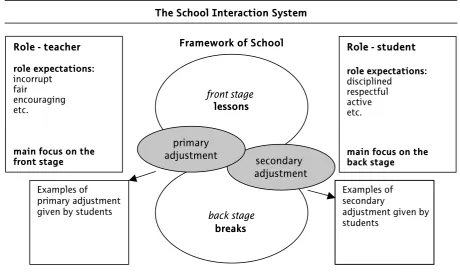
rules. Such strategies for the circumvention of official rules are not typically authored by a single individual, but rather collectively. In Goffman’s terminology, we can speak here of secondary adjustment. Secondary adjustment offers actors the possibility of distanc-ing themselves from prescribed institutional roles (cf. Goffman 1961). This is to be distinguished from
pri-mary adjustment, whereby actors support the
institu-tional process and follow the role expectations placed on them.
Goffman draws an additional distinction between
front and back stages. On the front stage, official rules
are the center of the focus. On the back stage, by con-trast, alternate, unofficial rules are valid (cf. Goffman 1959). The classroom is the point of intersection be-tween students and teachers and constitutes the front stage of the school. Here the students critically ob-serve the actions of the teacher. Conversely, the teach-er evaluates the behavior of the students. As soon as students and teachers retreat to separate domains, they act on the back stage. For the students, the back stages at school are the activities between classes, on the playground, or in the school bathrooms. Exchang-es between teachers in the faculty room, by contrast, constitute the back stage for teachers. While teachers give priority to the interactions that take place on the front stage, the students themselves place con-siderable weight on back-stage events. Now, it can be observed that the role of the teacher is to protect the front stage of classroom learning from incursions originating on the back stage. Students have an inter-est in expanding their back stage activities into the classroom. One must come to grips with this conflict. In his theory, Goffman ascribes dominant signifi-cance to the social situation. Figure 2 illustrates this relationship in the context of the school. In the follow-ing section, a proposed classroom lesson is delineated. With reference to Goffman’s theories, students are en-couraged to analyze the social space of the classroom based on a self-produced portrayal of classroom life.
4. Planning, implementation, and analysis of student-organized instruction
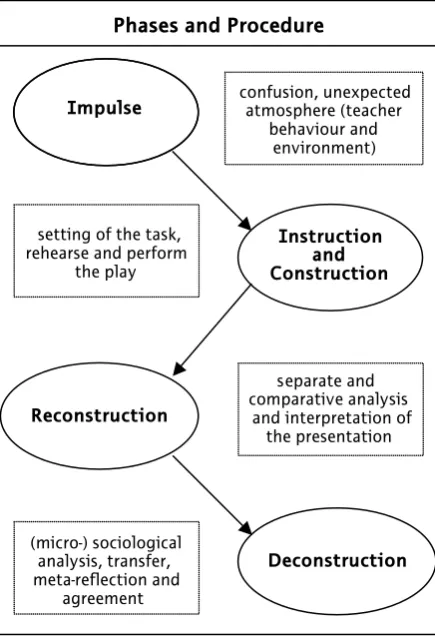
An extremely open teaching-learning design is neces-sary for the planning and implementation of a perfor-mance produced by students. The duration of such a project depends on the learning group and can vary significantly; certainly six to eight hours should be anticipated. It might be best to reserve the first two days of school exclusively for this project. A theatri-cal performance of this nature helps to integrate the experiences and behavior of students. It facilitates an active and creative engagement with strongly interac-tive elements, in turn encouraging the development of self-agency, social skills, and methodological com-petencies (cf. Scholz 2007). The project is divided into four phases (see figure 1). The last phase is devoted to
an explicit analysis of the performance based on Goff-man’s sociological theories.
Figure 1: Chronological plan for the project
First Phase: „Impulse“
The students will be initially confused when they real-ize they will receive no formal instruction during their first day of school. The institutional “frame” of the classroom, so often explicitly rejected by “trouble-makers,” is implicitly experienced as a point of refer-ence for social behavior – including social behavior that presents a disturbance to the lesson. This unex-pected situation will also encourage the “withdrawn ones” to depart from their usual passivity. The signifi-cance of the frame provided by a formalized lesson can be most precisely visualized at that moment when it is absent. Yet how can students be best encouraged to transcend their normal roles? A number of techniques can be imagined. For example, the teacher might not be dressed as expected. He could speak in an unex-pected way to the students, and the appearance of the classroom itself could also challenge expectations. Teacher and students would thereby acquire the same status. This atypical approach could be expected to lead to atypical behavior on the part of the students – a desirable outcome in the context of this project.
Ultimately, in such a new situation, students will be insecure and attentive. The goal is to then draw their attention to the task at hand.
Instruction and Construction Impulse
Reconstruction
Deconstruction
confusion, unexpected atmosphere (teacher
behaviour and environment)
setting of the task, rehearse and perform
the play
separate and comparative analysis
and interpretation of the presentation
(micro-) sociological analysis, transfer, meta-reflection and
agreement
39
Second Phase: „Instruction & Construction“In the second phase, students should be given the task of developing a situational context and determin-ing how each individual is supposed to behave. In a sense their job is to write a script for the school. They must bring to life the roles of teacher and student. Once scripts have been developed, the next step is to perform them. The following guidelines for the per-formance should be used:
• Two groups should be chosen.
• Group A is instructed to model an interesting, un-usually good and useful program of instruction from the perspective of the students.
• Group B is instructed to perform a boring hour of instruction that is of no use to the students. • The subject of instruction in the mock lesson
should be freely selected by the students (alterna-tively, several topics can be offered, from which the students select one);
• Instruction must take place in the school building. • The theater performance is to be videotaped (2-3
students take responsibility for the videotaping). The students should be given sufficient time to
con-struct the lesson, and then to ask questions. If two days are devoted to this project, it makes sense to schedule the performances for the second day.
Third Phase: „Reconstruction“
Group A might decide on a lesson consisting of short musical interludes, or a class with an entirely differ-ent seating plan. Group B, for its part, will be likely to adopt a conservative or even authoritarian teaching style in its presentation. During both performances, anyone who is not directly involved should quietly ob-serve. In order to allow the “actors” to view their own performances, the entire event should be recorded on videotape. This will also help to boost the motiva-tion of the students. Once both performances have been staged, the analysis of what has transpired can begin. Both of the video recordings should be played back for the students. The students should first ana-lyze each performance individually. Questions can be raised and explored regarding the reasons for this par-ticular type of lesson. Afterwards, an in-depth com-parative analysis should follow to examine the differ-ences between the two lesson styles as well as their similarities.
Particular stress should be placed upon the com-parative analysis of the two performances. It is es-pecially important that their resemblances be noted. The students will essentially conduct their first
analy-sis of the “classroom” frame, yet without reference to Goffman’s terminology. These analyses will serve to demonstrate that nearly every student shares a
com-mon contextual understanding.5 They will reveal that
the two lesson performances are marked by large the-matic and didactic differences, but that both lessons also demonstrate fundamental similarities. Ultimately, the teacher and the students will be in a position to confirm the following:
• Details can make a big difference. The students will recognize that a great deal depends upon the or-ganization of the lesson, and thus upon the social situation.
• Everyone will understand what optimal student be-havior should look like in both scenarios.
• Everyone is in the same boat. The teacher has a leadership position, but without the participation of the students, nothing will function.
• Last but not least, the students will come to recog-nize that good instruction places great responsibili-ties upon all participants.
Only after these insights have been achieved will it be possible to engage in a discussion of the students’ pre-vious experiences with school. The students should given the opportunity to speak openly about their personal experiences and to search for possible expla-nations as to why they frequently had not behaved in the ideal ways that they themselves demonstrated in their performances. Experience has shown that this discussion will encourage students to present person-al difficulties as well as past experiences with teach-ers. In this open conversation, students should be en-couraged to speak about past behavior that involved a lack of respect, deceitfulness, or violence, etc. Using this technique, it is possible to purge the past of its highly charged emotions and take a first step toward a potential new beginning. This discussion also lays a foundation for the subsequent analysis of the front and back stages as well as primary and secondary ad-justment.
Fourth Phase: „Deconstruction“
In the final phase of the project, a short text that pres-ents Goffman’s interactional theory in an easily under-stood format should be presented in order to elevate the lesson to an abstract level. It would be expedient to begin with a discussion of the text, and to draw a diagram of the classroom situation on the blackboard. Figure 2 presents an example diagram for this pur-pose. After presenting the diagram, a discussion with the students can begin concerning the problems that stem from the obligation to behave appropriately in certain situations. A central goal of this discussion
40
should be to communicate the insight that unofficial, implicit rules play an important role in understand-ing a situation. The fact that every person feels over-whelmed in certain situations can be brought into the conversation using examples presented by the teacher. Collective strategies can then be explored for coping with challenging situations both inside and outside of school. Putatively gender-specific and/or culture-specific behaviors can also be introduced into discus-sion at this point. Moreover, the groups of students labeled earlier as the “trouble-makers,” “withdrawn ones,” and “others” can be depicted and analyzed. In the course of deconstructing the stage performance, one should seek to actively use certain key concepts (e.g. role, situation, adaptation/adjustment, frame, rules, etc.).
Figure 2: Goffman‘s model applied to the school
At the end of this classroom exercise, a meta-reflec-tion should take place, during which the meaning of concepts such as rules, decorum, and respect are explored. Finally, the students themselves should be asked to present a handful of rules to be followed by both the students and teacher. It should be empha-sized here that the project is not aimed at condition-ing students for better school behavior – the students themselves should be aware of this fact. Rules can and will be broken in the future. The hope is that students will become more aware of their impact upon other people, and learn that it is possible for every person to break free of the roles in which they may have
be-come trapped. At the very least, if the students decide they want to make a change for the better, they will know that they can count on help in doing so.
5. Experience and goals
This project will help students who are disadvantaged or who exhibit behavioral problems to learn funda-mentals of social interaction that are otherwise ob-vious to most persons their age. The realization that the roles of student and teacher are institutionally scripted while remaining open to individual construc-tion will contribute to the establishment of a school atmosphere that facilitates learning. The classroom’s resemblance to the theater highlights the appropriate-ness of Goffman’s work as a theoretical foundation for the design of the lesson. The students are encouraged to reflect upon the class as a two-part stage, with in-struction on the front stage, and the recess between classes on the back stage. The sociological
founda-tions of the project not only provide the point of de-parture for the lesson; they are also explicitly articu-lated, abstracted, and transferred into other contexts. The students are empowered to question why certain circumstances must be the way they are. They will come to recognize that people do not only engage in “social performances” on YouTube or MySpace, but everywhere and always. Most students already know this implicitly, but explicit self-analysis will facilitate deeper reflection on social roles.
Experience shows that this project is especially well suited for the beginning of a new class. With a change of emphasis, this concept can also be implemented
The School Interaction System
Framework of School
front stage
lessons Role - teacher
role expectations: incorrupt
fair
encouraging etc.
main focus on the front stage
back stage
breaks
Role - student
role expectations: disciplined
respectful active etc.
main focus on the back stage
Examples of
primary adjustment given by students
Examples of secondary
adjustment given by students
secondary adjustment primary
41
with more advanced students or teachers (cf. Atkin-son et al. 2009; Preves/StephenAtkin-son 2009).
The described method was carried out for the first time in 2008 (no video recording was made, however). The innovative and challenging lesson format helped students to feel they are being taken seriously, and typically motivates them to be engaged. In addition, the project encouraged the students to reflect on themselves and their actions, to work and participate in discussions more cooperatively, and to bring their emotions and experiences to bear in the classroom set-ting. They themselves acted out the counter-culture of the “classroom trouble-maker”. Fascinating and un-expected conversational situations arose that caused the students to laugh with and about each other. The “withdrawn ones” also profited from this exercise, in
part because the self-assured and offensive behavior of the “trouble-makers” – which tends to intimidate quieter students – was deconstructed. At the same time, the current job market was discussed with a great deal of seriousness and concern. It was possible to set individual goals for each student, goals which the students subsequently pursued and reached over the course of the school year with a remarkable de-gree of consistency. After completing their education at the school, most of the students went on to per-form a vocational traineeship or to another school in order to continue their education. It must be noted that it was not possible to reach all students with this method, however. Individual life circumstances, poor attendance, and a comparatively high dropout rate among these types of students will always remain po-tential hurdles preventing one from adjudging such methods as an unmitigated success.
6. Opportunities and risks
This way of beginning the new school year facilitates productive and mutually respectful learning. It also inspires the rapid formation of a unified class spirit.
The special strength of this project is the opportuni-ty, within the first week of school, to get to know the students and to highlight and apply their experiences and their abilities in diverse areas. By enabling self-re-flection on demanding issues, the project also allows future class lessons to proceed in an action-oriented way. At the same time, students receive help in iden-tifying and formulating their needs and difficulties. A meta-situation is created from the outset in which “I and the others” and “The others and I” as well as “We and the situation” are transformed into consensually specified goals and rules. These rules prove far more stable than a standard roster of prohibitions (such as those posted on a bulletin board). Last but not least, reflections about school, education, and institutional
responsibilities and expectations are important as-pects of civic education.
The project is about both implicit and explicit soci-ological learning. This linkage is guaranteed through the integration of a social pedagogical process with didactic and substantive elements. In the project, Goffman’s sociology constitutes both the subject of study and a reflective foundation for a practice-oriented lesson. For the remainder of the school year, open methods of teaching will reap the benefits of the foundation established in this project in terms of student behavior, class atmosphere, and the basic at-titude of students toward school. Instruction in the fields of politics, English, German and religion can be built thematically upon this foundation (for example, concerning topics such as “Violence in schools,” “How to have a successful job interview,” and “Prejudice/ xenophobia”). Goffman’s situational analysis also pro-vides a fruitful starting point for students to develop an ability to interpret texts.
The advantages of the described project already suggest some of the risks associated with it. It places great demands on the teacher. On the one hand, the teacher must possess the abilities and readiness nec-essary for a project of open instruction that incorpo-rates sociological elements. On the other hand, the teacher must possess and demonstrate a special atti-tude toward the satti-tudents. The satti-tudents must know without question that they are taken seriously and that a new “personal beginning” or “transformation” is possible and will be supported. This also means that the teacher must be willing to critically reex-amine whether behaviors that they might define as “deviant” or “unwanted” actually deserve such a
clas-sification. Thus, the teacher cannot avoid including him/herself in the analysis of instruction, nor avoid reflecting on his/her own behavior in order to learn from it (cf. Eschelmüller 2007). The remaining class les-sons must be aligned with this learning group. Thus, the ideal teacher personality would be characterized by openness, flexibility, and spontaneity, and would place the potentials offered by heterogeneity/diver-sity at the forefront rather than its shortcomings and difficulties (cf. El-Mafaalani 2009).
42
ReferencesAllmendinger, Jutta; Helbig, Marcel. 2008. Zur Notwendig-keit von Bildungsreformen. In: WSI Mitteilungen 61 (2008) 7, 394-399.
Atkinson, Maxine; Buck, Alison R.; Hunt, Andrea. 2009. So-ciology of the College Classroom – Applying Sociological Theory at the Classroom Level. In: Teaching Sociology 37 (2009) 3, 233-244.
Beck, Ulrich. 1992. Risk Society – Towards a new Modernity. London: Sage Publications.
Bellenberg, Gabriele; Hovestadt, Gertrud; Klemm, Klaus. 2004. Selektivität und Durchlässigkeit im allgemein bilden-den Schulsystem – Rechtliche Regelungen und Daten unter besonderer Berücksichtigung der Gleichwertigkeit von Ab-schlüssen. Essen: Universität Duisburg-Essen.
Bojanowski, Arnulf. 2006. Ergebnisse und Desiderata zur Förderung Benachteiligter in der Berufspädagogik. Versuch einer Bilanz. In: Zeitschrift für Berufs- und Wirtschaftspäda-gogik – ZBW 102 (2006) 3, 341-359.
Boudon, Raymond. 1974. Education, Opportunity, and Social Inequality. Changing Prospects in Western Society. New York: Wiley and Sons.
Bude, Heinz. 2008. Die Ausgeschlossenen – Das Ende vom Traum einer gerechten Gesellschaft. Bonn: Bundeszentrale
für politische Bildung.
Ditton, Hartmut. 2008. Der Beitrag von Schule und Lehrern zur Reproduktion von Bildungsungleichheit. In: Becker, Rolf; Lauterbach, Wolfgang, Eds. Bildung als Privileg – Erklärun-gen und Befunde zu den Ursachen der Bildungsungleichheit. Wiesbaden: VS Verlag, 247-275.
El-Mafaalani, Aladin. 2009. Heterogenität als Potenzial nutzen – Möglichkeiten individueller Förderung in der vollzeitschulischen beruflichen Bildung. In: Berufsbildung in Wissenschaft und Praxis – BWP 38 (2009) 1, 11-14.
Eschelmüller, Michele. 2007. Lerncoaching – Vom Wissens-vermittler zum Lernbegleiter – Grundlagen und Praxishil-fen. Mühlheim: Verlag an der Ruhr.
Goffman, Erving. 1959. The Presentation of Self in Everyday Life. New York: Doubleday Anchor.
Goffman, Erving. 1961. Asylums – Essays on the Social Situ-ation of Mental Patients Other Inmates. New York: Double-day Anchor.
Goffman, Erving. 1967. Interaction Ritual – Essays on Face to Face Behaviour. New York: Doubleday Anchor.
Goffman, Erving. 1974. Frame Analysis – An Essay on the Organization of Experience. New York: Harper and Row.
Gomolla, Mechtild; Radtke, Frank-Olaf. 2002. Institutionelle Diskriminierung – Die Herstellung ethnischer Differenz in der Schule. Opladen: Leske und Budrich.
KMK – Kultusminister Konferenz. 2009. The Education Sys-tem in the Federal Republic of Germany. In: http://www. kmk.org/information-in-english/the-education-system-in-the-federal-republic-of-germany.html, September 2009.
Preves, Sharon; Stephenson, Denise. 2009. The Classroom as Stage – Impression Management in Collaborative Teach-ing. In: Teaching Sociology 37 (2009) 3, 245-256.
Schelten, Andreas. 2006. Die Rolle der Jugendlichen ohne Ausbildungsplatz an der Berufsschule. In: Die berufsbil-dende Schule – BbSch 58 (2006) 2, 243-244.
Schelten, Andreas. 2009. Der Übergangssektor – ein großes strukturelles Problem. In: Die berufsbildende Schule – Bb-Sch 61 (2009) 4, 107-108.
Schelten, Andreas; Folgmann, Michael, Eds. 2007. Material-band zum Zwischenbericht der wissenschaftlichen Beglei-tung des Modellversuch Jugendliche ohne Ausbildungsplatz (JoA). München: Technische Universität München.
Scholz, Lothar. 2007. Spielend lernen – Spielformen in der politischen Bildung. In: Sander, Wolfgang, Ed. Handbuch politische Bildung. 2nd edition. Bonn: Bundeszentrale für politische Bildung, 547-564.
Solga, Heike. 2005. Ohne Schulabschluss in die Bildungsge-sellschaft – Die Erwerbschancen gering qualifizierter Per-sonen aus soziologischer und ökonomischer Perspektive. Opladen: Leske und Budrich.
Willis, Paul. 1977. Learning to Labour – How Working Class Kids Get Working Class Jobs. Farnborough: Saxon House.
Zinnecker, Jürgen. 2001. Die Schule als Hinterbühne oder Nachrichten aus dem Unterleben der Schüler. In: Stadtkids – Kinderleben zwischen Straße und Schule. Weinheim: