REPORTING FATWA IN THE MEDIA: RECEPTION AND PERCEPTION
Suria Hani A. Rahmana1, Noor Adzrah Ramlea, Safiyyah Ahmad
Sabria, Nur Kareelawati Abd Karima, Mazni Buyongb
aUniversiti Sains Islam Malaysia
bIslamic International University Malaysia
Abstract
News coverage on Islam in newspaper publications in Malaysia has become part of Malaysian dailies since Islam is the official religion in Malaysia. A special section is allocated for Islamic teaching, forum or letter to Editors for certain days in a week. Perhaps the greatest innovation in coverage on Islam can be seen from how Malaysian reporters frame their stories, which many include the definition of religion, faith and moral choices in the secular world. News on Fatwa has, in short, become a major topic of discussion among Malaysian public once it is highlighted. It became an agenda for a period of time in most of the mainstream newspapers. This paper focuses on how the public perceived the news reporting made on fatwa in the Malaysian newspapers by looking at (i) the source of knowledge of the respondents, (ii) knowledge and understanding on fatwa, and (iii) correlation between level of education and understanding of fatwa news. Random samples of fatwa news on various issues were used as reference for the respondents. Then, a survey on 500 respondents was conducted randomly among Muslim public around Kuala Lumpur and the state of Selangor areas. This has helped in
identifying the level of understanding and reactions of the public
towards Fatwa issued by the National Fatwa Council of Malaysia. The findings also suggested small numbers of the news coverage on Fatwa has emphasized the significance of the Fatwa which, in the opinion of many far exceeds the important of the fatwa itself. This study may help to strategize the Fatwa Council in convincing the general public on Fatwa through news reporting because there had always been questions of reliability since there is no follow-up
by the council to the public regarding Fatwa that has been issued by them.
Keywords: fatwa, framing Islam, Malaysian journalism, reception
Abstrak
Kata kunci: fatwa, pembingkaian Islam, kewartawanan di Malaysia, penerimaan khalayak
INTRODUCTION
News reporting on Islam has always had its cycles of boom and bust, as Islam periodically takes a greater stage in events covered by the Malaysian daily print media. On the whole, the coverage of Islam in the Malaysian media is on an ad hoc basis, as evident in the fact that there are no religious correspondents or reporters who are assigned to the religion beat. One difficulty in covering Islam in Malaysia is the multiethnic, multi-religious nature of the country and its people. One would need to be an expert or at least knowledgeable in Islam to be able to cover them well or accurately. The reality is that those of us who profess a particular religion are not experts in our own religion, what more other religions. Journalists who write on Islam on a regular basis do so because they have a personal interest in it, and there are few of them. The usual practice is for the news desk to assign reporters to cover on Islamic event or news item, and the reporter may have only a cursory knowledge of the religion.
One long-running concern about news on fatwa is whether reporters are up to the task of covering such a complicated beat. News on Fatwa has always become an issue in Malaysia. Fatwas on Yoga, the use of ‘Allah’ in other religion and on pengkid were among issues that being question by many sectors of the Malaysian public.
The presentresearch presents perspective prevailing in Fatwanews
coverage in newspapers. News reporting on Islam sometimes has affected the general public because of the way it has been reported. News worthiness sometimes were misunderstood by certain group in the plural society that would lead to conflict in beliefs especially news on Islam.
by the various public domains. Therefore, this paper will address the findings of the reception among Muslim audiences towards the effectiveness of fatwa news and also the explanation as to why and how the fatwa was made. The study also indicated the news value on reporting of the fatwa and the degree of belief and understands towards the fatwa among Muslim audiences.
LITERATURE REVIEW
A fatwa is an Islamic religious ruling, a scholarly opinion on a matter of Islamic law. A fatwa is issued by a recognized religious authority in Islam. But since there is no hierarchical priesthood or anything on the sort in Islam, a fatwa is not necessarily “binding” on the faithful. The people who pronounce these rulings are supposed to be knowledgeable, and base their rulings in knowledge and wisdom. They need to supply the evidence from Islamic sources for their opinions, and it is not uncommon for scholars to come to different conclusions regarding the same issue.
As Muslims, we look at the opinion, the reputation of the person giving it, the evidence given to support it, and then decide whether to follow it or not. When there are conflicting opinions issued by different scholars, we compare the evidence and then choose the opinion to which our God-given conscience guides us (http://islam. about.com/od/law/g/fatwa. htm). Fatwa covers various fields such as
ͨ
Aqīdah (creed), ͨĪbādah (worship), economic Mu ͨ āmalat, medicine,
Zakāt (almsgiving), munakahāt (marriage related matters), eating/
drinking, clothing, animal related matters, and social/Shari ͨ ah
related matters.
Each issue that is presented for consideration and decision by the
Muzākarah (Conference) of the Fatwa Committee of the National Council for Islamic Religious Affairs Malaysia is preceded by
a study and then deliberated upon by the Panel of ͨAqīdah Study
and the Panel of shari ͨ ah Study before it is discussed and decided
on by the Muzākarah (Conference) of the Fatwa Committee of the
A local study on the reception level of Muslim society in Malaysia on Jawatankuasa Fatwa MKI (the Fatwa Committee of the National Council For Islamic Religious Affairs Malaysia) conducted by
Bahagian Pengurusan Fatwa JAKIM (Fatwa Management Division JAKIM) in 2011 shows that 81.7% of respondents agree that the Fatwa Council plays an important role in discussing, giving out opinions and producing a fatwa at the national level and 84.03% of respondents agree that the Fatwa Council existence helps the research and management of fatwa in Malaysia (Abdul Shukor Husin, 2012).
Abdul Shukor Husin (2012) highlights that in terms of credibility of fatwa; the study also finds 73.58% of respondents agree that the fatwa(s) produced by the Fatwa Council is significantly relevant to the Ummah (society). And 76.57% of respondents believe on the decisions made by the Fatwa Council even though the decisions are not yet legalized as fatwa. Based on the study, it shows that Malaysian Muslim society accepts the Fatwa Council positively for the national level. The uniformity of the fatwa can be made possible if every state in Malaysia accept and implement it in its own state due to positive response from the public.
COUNTRIES THAT ISSUED FATWA ON YOGA
Tracing back the fatwa made on yoga from several countries, the Islamic Religious Council of Singapore had issued a fatwa on yoga which was the first ever to forbid Muslims to practice forms of yoga that contain elements of Hindu ritual such as the canting of mantras. Completely secularized forms of yoga, however, were allowed under the condition that they would only be practiced for health reasons. In other countries, The Grand Mufti of Egypt, Ali Gomaa in 2004, issued a fatwa against yoga for its Hindu provenience (Solomon, 2006).
Four years after the ban on yoga for Muslims in Egypt, the 83rd National Fatwa Council of Malaysia, held in Kota Bharu from 22-24
October 2008, also officially declared the practice of yoga as Ḥarām
The Malaysian Fatwa Council Chairman, Tan Sri Datuk Dr. Abdul Shukor Husin stressed that yoga consists of three elements: physical movements, worshipping, and chanting. While the mere physical movements of yoga might not be wrong, worshipping in form of meditation geared to unifying oneself with God and the chanting of
mantras would definitely “destroy” the Aqīdah or foundation of the
Islamic creed and are hence in opposition to the Shari ͨ ah. Since one thing would usually lead to another, the practice of yoga is not likely to stop at mere physical movements. Muslims should therefore not engage in it at all (Ramstedt, 2010).
The Indonesian fatwa against yoga that soon followed the Malaysian one was issued in a very similar socio-political climate. The Indonesian Council of Muslim Scholars (MUI) met at a closed meeting on the matter of yoga, three days after the Malaysian Fatwa Council’s official press conference issued a fatwa on yoga. Ma’ruf Amin, Head of MUI’s Fatwa Department, stated to the press that in the following two weeks, the Council would inspect several yoga centers in Jakarta, Bandung and Bali, in order to form a legal opinion on whether the activities of yoga would contain elements of Hindu rituals (Ramstedt, 2010).
FATWA IN MALAYSIA
According to the National Fatwa Council (NFC) of Malaysia, fatwa refers to the way and means of providing respond for Islamic inquiry and issue. In further, it provides explanation of Shari ͨ ah laws by the Mufti Department regarding questions and issues relating Islam, and
the respond is based on Al-Qur’ān and Ḥadīth. It will later being
gazette by the State government for the law enforcement processes.
Fatwa is part of important element in Muslim’s life. As the life cycles are challenging and dynamic, there will always be issues and queries being raised, which need in-depth justification and enforcement through fatwa. The State Mufti Department alongside Department of Islamic Development Malaysia (JAKIM) engages a vital role in
imposing fatwa, where meetings and Muzākarah or discussion will
Scope of Fatwa
i. The raise of issues or problem among society which ambiguous in terms of Islamic laws and regulations.
ii. View differences among the Ulama’ that needs a tarjīh or
resolution.
iii. An adaptation of gazette issues from other country to the local situation.
iv. Global issues that connected to the interest of Muslim
Ummah.
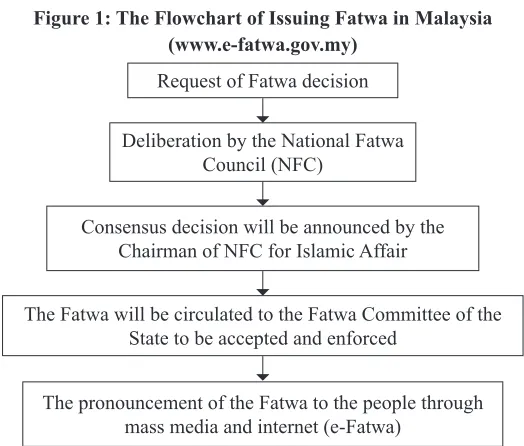
The Flow of Issuing Fatwa by the National Fatwa Council (NFC) of Malaysia
i. Discussion and thorough analysis by the Committee members.
ii. Basis of the Council’s judgment is on Imām Shāfi ͨi of Sunni
Mazhab. Referring to Fiqh Al-Aulawiyyāt method, the issues and matters should be set accordingly, in regard to the law, value and its execution.
iii. The Committee will then refer profoundly to the opinion
and views of Sahābat, Tabīn, Imām of Mazhab, Fuqahāʼ
and the Qurʼān and Ḥadīth.
Figure 1: The Flowchart of Issuing Fatwa in Malaysia (www.e-fatwa.gov.my)
Request of Fatwa decision
The pronouncement of the Fatwa to the people through mass media and internet (e-Fatwa)
The Fatwa will be circulated to the Fatwa Committee of the State to be accepted and enforced
Consensus decision will be announced by the Chairman of NFC for Islamic Affair
NEWS COVERAGE ON FATWA
Islamic reporting has been a part of the Malaysian journalistic landscape since the nation’s birth, and early on newspapers became a vehicle for the viewpoints of the Muslim majority in Malaysia. News coverage in newspapers publications on Islam in Malaysia has become part of Malaysian dailies since Islam is the official religion in Malaysia. Certain days in a week special section is allocated for Islamic teaching, forum or letters to Editors. Perhaps the greatest innovations in coverage on Islam can be seen in how reporters frame their stories, that many include the definition of Islam, faith and moral choices in the secular world.
In most of the major newspaper agencies, the main type of Islamic news coverage is reported in ad hoc basis, whereby the news occurs when there is some significant issues that need to be highlighted. An
example would be apostasy, Shari ͨ ah practices or close proximity
between unmarried male and female among Muslim society that will be highlighted in all major Malay newspaper.
News on fatwa will be treated similar because it also involves the Malay society at large. Despite the issue-oriented based reporting
such as yoga, poco-poco dance, smoking and others, the Fatwa
Committee itself was also reported to strengthen its organization and suggestions to improve the committee such as reported in
Bernama ‘JK Fatwa Kebangsaan perlu proaktif memutuskan hukum
mengenai isu terkini (The National Fatwa Committee needs to be more proactive in providing decisions on the latest issue) – 30 March,
2011’ and ‘Institusi Fatwa perlu diperkukuh: Musa Aman (Fatwa
Institution needs to be strengthen: Musa Aman) – 1 December, 2011’. Such reporting showed that there is a need to emphasize news on fatwa as it can be considered important when the audience gave their unconvincing perceptions on the committee itself when new issues will always show up from time to time.
RECEPTION MODEL AND MEDIA STUDIES
and early 1980s in Germany and US. Reception model emphasizes the audience’s reception of a literary text or media. This approach to textual analysis focuses on the scope for reception on the part of the audience. This means that a “text”—be it a book, movie, news or other creative work is not simply passively accepted by the audience, but interprets the meanings of the text based on their individual cultural background and life experiences.
This would mean that the text is not inherent within the text itself, but is created within the relationship between the text and the audience. A basic acceptance of the meaning of a specific text tends to occur when a group of audience have a shared cultural background and interpret the text in similar ways. It is likely that the less shared background the audience has with the source, the less he/she will be able to recognize the source’s intended meaning, and it follows that if two audiences have vastly different cultural and personal experiences, their reading of a text will vary greatly.
Morley’s analysis on the reception theory on a study of a BBC program by diverse social groups revealed of how social groups responded to the preferred meaning prescribed in the program. The result i.e. the two types of social group showed a different reaction to the favored conceived and structured, underlying the program and presenting an alternative perspective. Here the preferred meaning is looked at as somewhat ordinary, negotiated or resisted. The second group comprised of those who are unable to articulate this ideological theory and accepted the meaning of the program at face value though that was not their original thought. In opposition to the Marxist version of the mass media as perpetuating a dominant ideology, reception theory postulates the notion of resistance audiences. The audiences are no longer viewed as a single homogeneous mass rather seen as a complex collection of overlapping sub cultures (Baran & Davis, 2006).
This study tends to identify how Muslim in Malaysia focuses their attention to Islamic news related to Islamic laws (Fatwa). As we know media audience are not passive and according to reception studies, the focus is how various type of audience members make sense of specific content. In this case is the reporting of fatwa news. Apart from that, the study will also seeks understanding of how audience interpret media content on reporting of fatwa which can provide an analyses of the way media are used in everyday social contexts, since all the respondent were Muslim and assumingly they know about the importance of fatwa.
METHODS
Apart from recognizing the news reporting approach, the main focus is to identify public perception towards the news. The survey was conducted in Selangor and Kuala lumpur. A total of 500 respondents were selected randomly among Muslim public. It is to find out the level of understanding and reactions of the public regarding the fatwa issued by the National Fatwa Council. The respondents were randomly selected in a public area like shopping malls, and the main train stations. A total of 60 percent were female and 40 percent males were selected.
FINDINGS
Findings indicate how the public perceived fatwa news in selected local newspapers. The analysis has been done to evaluate source of knowledge of the respondents as well as the knowledge and understanding of respondents about fatwa. Finally, this study will establish the correlation between level of education and their understanding of fatwa news. Random fatwa news will be used as reference for the respondents.
SOURCE OF KNOWLEDGE ON FATWA
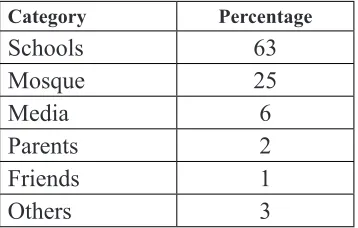
There were several significant findings from the data collected. A high of 63 percent have knowledge on fatwa since they were in schools, 25 percent received their knowledge from talks in mosque, and only six percent obtained their knowledge from the mass media (refer Table 1).
Table 1: Source of knowledge on Fatwa
Category Percentage
Schools
63
Mosque
25
Media
6
Parents
2
Friends
1
As a Muslim country, a subject on Islam has been made compulsory by the education ministry from primary until secondary schools for Muslim students. This study has made an assumption that all Muslim in Malaysia would understand the meaning of fatwa and the importance of fatwa as part of Islamic Laws.
UNDERSTANDING OF FATWA
The study tends to identify the meaning of fatwa as understood by the audience since the entire respondents were Muslim and assumingly they know about the importance of fatwa. There were 10 statements respondents were ask to select whether the statements are true, false or they do not know. Out of the 10 statements, seven were true and three were false (statements in italics are false). Table 2 below indicates that not all of the respondents understood the meaning of fatwa. Though, majority of the respondent answers were correct but statements that were false the percentage was somewhat high. Statement b was supposed to be false but a high of 49 percent answered either true or they do not know. Similarly Statement J, which is false, only 27 percent answered correctly. This indicates that though the respondents were Muslim, their understanding of Fatwa was still vague and ambiguous.
Table 2: Understanding of Fatwa
Statements about Fatwa True(%) False(%) Don’tKnow
(%) a Fatwa is to provide clarification on
problems based on Islamic laws 85 1 14 b Laws created by humans to solve social 27 51 22
c Fatwa is to disseminate God’s (Allah
SWT) laws 71 5 22
d Fatwa is a Islamic laws compulsory to
follow by Muslim 72 5 22
e Fatwa is the answer made by Mufti
regarding the laws in Islam 62 12 25 f Fatwa is not important in solving social
g Fatwa is laws to solve issues pertaining to
al-Qur’ān and Sunnah 80 4 16
h Scope of Fatwa is encompases way of life
in Islam 67 14 19
i Fatwa is important in guiding Muslim
towards a healthy life 82 3 14
j Fatwa is just a law to solve short term
problem in Islam 34 27 29
Respondents were also asked of their understanding of fatwa once a fatwa is being reported in the media. Table 3 indicated that only 55 percent understand the information explained in the news as to why the fatwa was made.
Table 3: Levels of Understanding of Fatwa news
Category Percentage (%)
Highly understand 55
Not Sure 36
Don’t Know 9
EDUCATION AND UNDERSTANDING OF FATWA NEWS
Majority of 63 percent stated that their knowledge on fatwa was obtained since they were in schools and 25 percent from talks from mosque. As we know media audience are not passive and according to reception studies the focus is how various type of audience members make sense of specific content. In this case is the reporting of fatwa news. This means that a “text”—be it a book, movie, news or other creative work is not simply passively accepted by the audience, but interprets the meanings of the text based on their individual cultural background and life experiences. In this study, education has been use to measure the background in relation to fatwa news. There is a
significant relationship (Pearson’s r = 0.7) for both understanding
Figure 2: Education and Understanding of Fatwa News
N = 500 Pearson’s r = 0.7
Figure 3: Education and Satisfied with Fatwa News
In Figure 2 and 3 (above), cross-tabulation was conducted to identify the relation towards education and understanding and satisfaction of fatwa news. A respondent with college or university education has a higher understanding and satisfaction on fatwa news as compared to respondents with lower education. While respondents that stated not sure and do not understand were among the secondary and primary schools were about 45 percent.
An open-ended question was also asked on the enforcement part based on Islamic law for Muslims when a Fatwa has been issued by the Council. This open-ended question is to identify the understanding of how audience interpreted media content on reporting of Fatwa. Majority of the respondent either stated that they are not interested or they do not know. Table 4 indicates 46 percent were not interested or do not know what should be done if ones commit a gazetted fatwa, 28 percent stated that it should be taken seriously and 18 percent stated that there are laws but no action has been taken.
Table 4: No action taken of people
Category Percentage
Not interested or don’t know 46
Should be taken seriously 28
No enforcement 18
In-depth explanations not to confuse audience 2
No action taken 2
Others 4
CONCLUSION
by the council. Perhaps the greatest significant coverage on Fatwa can be seen in how reporters frame their stories, that many include the definition of Islam, faith and moral choices in the secular world.
The findings have indicated that majority agreed upon each Fatwa issued by the council reported in the Malaysian mass media, while there are those who do not care or simply not interested on the Fatwa. This study may help to strategize the Fatwa Council in convincing the general public on Fatwa through news reporting. Small numbers of the news coverage on Fatwa has emphasized the significance of the Fatwa which, in the opinion of many far exceeds the important of the fatwa itself.
REFERENCES
Abdul Rashid Abdul Rahman (2011, December 1). ‘Institusi Fatwa
perlu diperkukuh: Musa Aman (Fatwa Institution needs to be strengthen: Musa Aman). Newspaper article retrieved from Abdul Shukor Hj. Husin (2012). ’Ke Arah Penyelarasan Fatwa di
Malaysia’ in Proceeding: Seminar Kebangsaan Penyelarasan
Penguatkuasaan Fatwa di Malaysia (SKPPF 2012). 12 April 2012. Anjuran Jabatan Kemajuan Islam Malaysia (JAKIM) & Universiti Sains Islam Malaysia (USIM) (ISBN: 978-983-41280-6-7).
Baran, S. & Davis, D.K. (2006). Mass Communication Theory:
Foundations, Ferment, and Future. 4th Ed. Boston: Wadsworth. http://islam.about.com/od/law/g/fatwa.htm. (Retrieved on March
25, 2011).
http://ww1.utusan.com.my/
utusaninfoasp?y=2011&dt=1201&pub=Utusan_Malaysia&sec =Sabah_%26_Sarawak&pg=wb_01.htm.
http://www.e-fatwa.gov.my (Retrieved on April 16, 2011).
Indo-Asian News Service (IANS) (2008, December 15). Malaysian
clerics’ edict on yoga ban needs states’ approval. Newspaper
article retrieved from The News Straits Times.
“JK Fatwa Kebangsaan Perlu Proaktif Memutuskan Hukum Mengenai Isu Terkini” (The National Fatwa Committee Needs to be More Proactive in Providing Decisions on the Latest Issue).
“Malaysian Edict Against Yoga Kicks Up Controversy.” (2008,
November 25). Mstar Online.
“Malaysian Rulers to have Final Say on Yoga Ban.” (2008, November 26). The Star.
“Muslim Practitioners of Yoga Upset Over Ban in Malaysia.” (2008,
November 23). The New Straits Times.
“No Penalty for Malaysia’s Sarawak Muslims Performing Yoga.”
(2008, December 10). The New Straits Times.
Norris, P. et al. (2003). Framing Terrorism: The News Media, the
Government and the Public. Taylor and Francis.
Ramstedt, M. (2010).”A Fatwa against Yoga: Mitigating Conflict in the Face of Increasing Fundamentalism in Indonesia.”
InterreligiousDialogue.
Solomon, E. (2006). It’s not a religion or a weight loss program.