R E S E A R C H
Open Access
Graph matching using conformal module
Jialing Zhang and Kun Qian
*Abstract
Graph matching and classification play fundamental roles in computer vision. The computational complexity of the conventional method based on a spectrum method is high, which prevents it from handling large graphs in practice. This work proposes a novel framework for tackling the challenge by using conformal module. We apply the classical Hodge theory from differential manifold to the graph setting and compute the combinatorial conformal invariant of the graph, called as conformal module, which can be used as the fingerprint for the graph. The method is applicable for viewpoint classification and posture detection. The experimental results demonstrate the efficiency and efficacy of the proposed method.
Keywords:Graph matching, Graph classification, Conformal module
1 Introduction
Graph matching has been widely used to solve a large var-iety of problems in computer vision. Fundamentally, graph matching aims at finding correspondences between two sets of features extracted from images. When matching or recognizing structural objects, graph matching does well on considering the pairwise node interactions [1]. Further-more, when there are correspondences between two im-ages, graph matching can finish many vision tasks such as object categorization [2], feature tracking [3], symmetry analysis [4], and posture recognition [5,6].
In the past thirty years, extensive research has been car-ried out on graphing matching [7], however, there still ex-ists several challenges in current methods. For example, almost all matching algorithms require high time complex-ity, so it is difficult to deal with large graphs. No methods have been provided to deal with graphs in 3D vision field, which means that graphs embedded in high genus surfaces cannot be matched using current approaches. Many tech-niques are proposed to solve graph matching in terms of rigid transformation, which can hardly handle the circum-stance where two graphs to be matched have large non-rigid transformations. Although the third issue is con-sidered in [8], the other two issues are still open. Our main contributions conclude as follows: (1) the proposed method can discover the combinatorial invariant of a given graph, (2) the proposed method can tolerate non-rigid
transformation on a given graph, (3) the proposed method can solve the matching problem in linear time, (4) the pro-posed method can be applied on not only planar graphs, but also those embedded in high genus surfaces.
The main mathematical theory in our method is based on combinatorial Hodge theory. There is some work on surface registration [9,10] and shape analysis [11] by the combinatorial Hodge theory. In the textbook [12], Gu et al. introduced the detailed theoretic treatment on com-binatorial Hodge theory. These works focus on computing the conformal invariants and conformal mappings in-duced by the Riemannian structure of the input surfaces. By contrast, current work focuses on computing the con-formal modules induced solely by the combinatorial struc-ture of the graphs. The process is that we apply combinatorial Hodge theory to compute the combinator-ial harmonic functions on graphs. The solution of har-monic functions is equivalent to solving combinatorial Laplace matrices. The combinatorial harmonic 1-forms can give the combinatorial conformal invariant of a given graph, called as conformal module, which can be used as the fingerprint of a given graph. So the conformal module can be used to deal with some matching problems. In this paper, we compute the conformal modules by the com-binatorial structure of the given graphs for viewpoint clas-sification and posture detection.
2 Previous works
Graph matching problem has been an active field in computer science and mathematics. There is a large * Correspondence:[email protected]
Faculty of Civil Engineering and Mechanics, Kunming University of Science and Technology, 727 South Jingming Road, Chenggong District, China
literature for this topic in the past thirty years, so a thor-ough survey is beyond the scope of the current work. In the following, we only review the most related work. For more detailed treatment, we refer readers to [7]. There usually exists two categories of graph matching methods: exact matching and inexact matching.
Exact matching aims at graph isomorphism, where the interest is in an exact matching between nodes and edges. Most of approaches to find the graph isomorphism are based on Tree Search. Due to the brute Tree Search algo-rithm, some improvements are developed. Ullmann pro-poses one of the most important and popular tree search algorithms [13]. He prunes the unfruitful matches which are not consistent with current partial matching. Cordella suggests another interesting approach based on Tree Search [14,15]. He provides a heuristic based on analysis of the sets of nodes adjacent to the ones already consid-ered in current partial matching. Except for Tree Search, some other techniques are proposed. According to group theory, an approach was proposed by McKay [16]. He de-fines equivalence classes for graphs in terms of isomorph-ism and does the equality verification inO(n2). There are other methods based on machine learning techniques to speed up the matching against a large library of graphs [17,18]. But they are used for filtering out the unmatched candidates not for matching.
Inexact matching focuses on mapping between graphs with weighted attributes on nodes and edges. The solution is a quadratic assignment problem and the optimization is NP-hard [19]. Looking for better optimization strategies is important for major research in graph matching. According to the relaxations of the constraints on a one-to-one map-pingFbetween the nodes in both graphs [8], methods can be generally classified into several categories. The first is to approximate the constraints as an orthogonal one FTF=
I, which is called as spectral method. Under the orthogonal constraint, optimizing graph matching can be solved in closed form as an eigen value problem [20–22]. Further-more, Leordeanu and Hebert relax Fto be of unit length kFk22¼1 for handling more complex problems in com-puter vision [23]. The work in [24,25] proposes a spectral method to decompose the graph into sub-graphs, where the process can be cast into a hierarchical framework and suitable for parallel computation. The second group of methods relaxes F to be a doubly stochastic matrix, the convex hull of F. Under this constraint, optimizing graph matching can be solved as a non-convex quadratic pro-gramming problem and a local optimization could be done within several proposed strategies. For instance, Gold and Rangarajan propose the graduated assignment algorithm for iteratively solving a series of linear approximations of the cost function in the form of Taylor expansion. The work of [26] proposes a path-following algorithm. Besides
the optimization-based work, probabilistic frameworks are also useful for interpreting and solving graph matching [27]. Several work aims at higher-order tensor factorization [8,28,29], where higher order geometrical relations make graph matching invariant to rigid transformation. Due to a small increment in the order of relations induces a combin-ation explosion of data, it is only suitable for very sparse graphs. Furthermore, this method cannot deal with non-rigid transformations.
3 Method
This section briefly introduces the theoretical back-ground for combinatorial conformal module. We apply algebraic topology method to consider our matching problem. Algebraic topology focuses on studying topo-logical problems by algebraic methods and uses simple linear algebraic methods to solve these problems. The detailed description of algebraic topology methodology can be seen in [12], where the authors consider these methods on surfaces with Riemann structure. In this paper, we apply algebraic topology method to the graph setting and consider combinatorial Hodge theory on graphs. Combinatorial Hodge theory can deduce a unique combinatorial conformal module for each graph, so it can be viewed as the fingerprint of a given graph.
We consider all objects on a three-connected planar graph Gwhich is embedded on a topological surface S. A planar graph means that there are no edge crossings onGand different edges of the graph can only intersect at the endpoints. So each face of G can be viewed as a topological disk. We usually use a triple G= (V,E,F) to represent a graph, where V is the vertex set, E is the edge set and Fis the face set. At the first step, we need to introduce some tools about computational topology. These similar concepts are defined on surfaces with Rie-mann structure in [12]. Here we use them on graphs.
The vertex set is denoted as
V¼fv1;v2;⋯;vng: ð1Þ
Each oriented edgeeis denoted as
e¼ vi;vj
ore¼− vj;vi
; ð2Þ
wherevi,vjare its two endpoints. A facefis represented as
f ¼½vi1;vi2;⋯;vik; ð3Þ where vik is its vertex and (i1,i2,⋯,ik) is any cyclic
permutation of (1, 2,⋯,k).
can form a linear chain space. We will give some defini-tions on the chain space of a graph.
Thek-dimensional chain group of a graphG= (V,E,F) is given by
CkðG;ℤÞ ¼
Xnk
i¼1
ξiεik;ξi∈ℤ
( )
; ð4Þ
where εi
k denotes theithk-dimensional cell of G. We call each element ofCk(G,Z) as ak-chain ofG.
Definition 1: The k-dimensional boundary operator
∂k:Ck(G,ℤ)→Ck−1(G,ℤ) on graphGis defined as
∂k
Xnk
i¼1
ξiεik
!
≔X
nk
i¼1
ξi∂k εik : ð5Þ
The boundary operator has the linear property. In this paper, we only consider the low dimensional boundary operator, for instance,
∂0vi¼0;∂1 vi;vj
¼vj−vi;∂2 vi;vj;vk
¼ vi;vj
þ vj;vk
þ vk;vj
: ð6Þ
Thek-chain in the kernel of∂ksatisfies
Ker∂k¼fεk∈CkðG;ℤÞj∂kεk¼0g: ð7Þ
We call each element inKer∂kas a closed chain. The closed chains are closed loops and the boundaries of any 2-dimensional patches are called as boundary loops.
Thek-chain in the image of∂k+ 1satisfies
Img∂kþ1¼ fεk∈CkðG;ZÞj∃εkþ1∈Ckþ1ðG;ZÞ;εk
¼∂kþ1εkþ1g: ð8Þ
Each element ofImg∂k+ 1is called as an exact chain.
Property 1: The boundary of a boundary is empty:
∂k∘∂kþ1≡0: ð9Þ
The proof can be seen in [12].
From the above property, we can easily obtain that
Img∂k+ 1is a sub-linear space ofKer∂k. The complemen-tary space is called as the homology group of the graph.
Definition 2: Suppose∂k:Ck(G,ℤ)→Ck−1(G,ℤ) is the
k-dimensional boundary operator on a graph G. Ker ∂k = {εk∈Ck(G,ℤ)|∂kεk= 0} is the kernel of ∂k. Img ∂k+ 1 = {εk∈Ck|∃εk+ 1∈Ck+ 1,εk=∂k+ 1εk+ 1} is the image of∂k
+ 1. Thek-dimensional homology group of the graphGis defined as the quotient group, satisfying
HkðG;ℤÞ≔
Ker∂k
Img∂kþ1:
ð10Þ
Each element in Hk(G,Z) is called a k-dimensional homologous class. A closedk-chainεk∈ ker∂krepresents a homologous class, denoted as [εk]∈Hk(G,Z). Each element in the homologous class can form the basis of
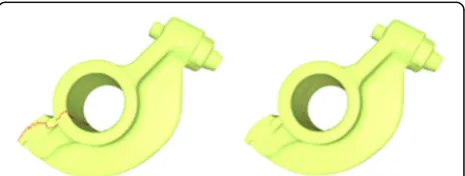
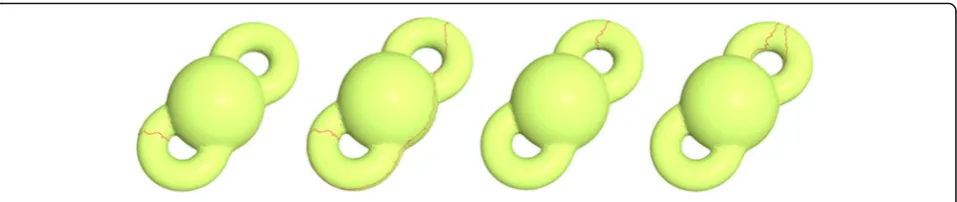
homology group. The similar algorithm in [12] is used to compute the homology basis of a discrete surface. Fig-ures 1 and 2 show the homology basis of two graphs with different topology.
In order to do computation on graphs, we define the cohomology group which is the dual of the homology group. In fact, cohomology group is the space of linear functions defined on homology group. The following discussions are considered in parallel because all the ob-jects are dual of the above counterparts such as co-chain and exterior differential operator.
The k-dimensional co-chain space of the graph Gis a linear function defined on k-dimensional chain space and given by
CkðG;ℝÞ ¼ ωk:CkðG;ZÞ→ℝ
: ð11Þ
We call each element inCk(G,R) as ak-form.
The dual of the boundary operator ∂ is called as the exterior differential operatord.
Definition 3: The exterior differential operator dk:
Ck(G,ℝ)→Ck+ 1(G,ℝ) is defined as follows:
dkωkðεkþ1Þ≔ωkð∂kþ1εkþ1Þ; ð12Þ
whereωk∈Ck(G,R),εk+ 1∈Ck+ 1(G,Z).
Corresponding to closed chain, we have that any
k-form in the kernel ofdksatisfies
Ker dk ¼ ωk∈CkðG;ℝÞjdkωk ¼0
: ð13Þ
We call each element inKer dkas a closedk-form. Similarly, anyk-form in the image ofdksatisfies
Img dk−1¼ ωk∈CkðG;RÞj∃ωk−1∈Ck−1ðG;RÞ;ωk¼dk−1ωk−1
: ð14Þ
We call each element inKer dkas an exactk-form. From Property 1, we obviously obtain the following property.
Property 2: The exterior differential operator dk:
Ck(G,ℝ)→Ck+ 1(G,ℝ) is a linear operator with the property
dk∘dk−1≡0: ð15Þ
According to property 2, we have that exact forms are closed. Therefore, Img dk−1 is a sub-linear space of
Ker dk. The complementary space is defined as the coho-mology group of the graph.
Definition 4: Suppose the linear operator dk:Ck(G,
ℝ)→Ck+ 1(G,ℝ) is the exterior differential operator on a graph G. Ker dk= {ωk∈Ck(G,ℝ)|dkωk= 0} is the kernel of dk. Img dk−1= {ωk∈Ck(G,R)|∃ωk−1∈Ck−1(G,R),ωk =dk−1ωk−1} is the image ofdk−1. Thek-dimensional co-homology group of the graph G is defined as the quo-tient group, satisfying
HkðG;RÞ≔ Ker dk Img dk−1:
ð16Þ
A graph G embedded on a topological surface S can induce a CW-cell decomposition. The Poincare dual of
Gis denoted asG which is also a graph embedded onS
such that each vertexviofGcorresponds to a facevi of Gand each facefjofGcorresponds to a vertex fj ofG.
Furthermore, each oriented edge e of G corresponds to an oriented edge e on Gas follows: if e= [vi,vj], e¼vi∩ vj. Furthermore, if the left face of e is fl and the right face ofeisfr,e¼ ½fr;fl.
Definition 5: Suppose a graph and its dual are de-noted asGand Grespectively. The Hodge star operator
:CkðG;ℝÞ→C2−kðG;ℝÞis a linear operator, satisfying
ω εð Þ≔ω εð Þ; ð17Þ
whereω∈Ck(G,R),ε∈Ck(G,Z),ε∈C2−kðG;ZÞ, andω∈ C2−kðG;RÞ.
Combining definition 3 and definition 5, we can obtain another linear operator σk:Ck(G,R)→Ck−1(G,R), satisfying
σk¼dk: ð18Þ
The operatorσkcan be viewed as the adjoint of the ex-terior differential operator, called as the co-differential operator. Combining operator dk andσk, we can define the Laplace operator.
Definition 6: Suppose dk:Ck(G,ℝ)→Ck+ 1(G,ℝ) is the exterior differential operator on a graph G::CkðG; ℝÞ→C2−kðG;ℝÞ is the Hodge star operator on G. σk
=∗dx∗:Ck(G,R)→Ck−1(G,R) is the co-differential oper-ator on G. The Laplace operatorΔ:Ck(G,R)→Ck(G,R) is defined as
Δ≔σkþ1dkþdk−1σk: ð19Þ
Obviously, the Laplace operator is symmetric, that is, for anyξ,η∈Ck(G,R),
Δζ;η
ð Þ ¼ðζ;ΔηÞ: ð20Þ
Furthermore,
Δζ;ζ
ð Þ≥0: ð21Þ
We mainly consider functions whose values are equal to zero with the action of the Laplace operator. These functions have inspiring mathematical and physical properties. In this paper, we will compute these func-tions on the graph setting. Based on the combinatorial structure of a graph, the solution of harmonic functions is equivalent to solving combinatorial Laplace matrices on the graph. Finally, these combinatorial harmonic functions can give out the combinatorial conformal in-variant of a given graph, called as conformal module, which can be used as the fingerprint of a given graph. So, the conformal module can be applied into matching applications on graphs.
Definition 7: Suppose dk:C k
(G,ℝ)→Ck+ 1(G,ℝ) is the exterior differential operator on a graphG.σk=∗dx∗:
Ck(G,R)→Ck−1(G,R) is the co-differential operator on
G. Δ=σk+ 1dk+dk−1σk:Ck(G,R)→Ck(G,R) is the La-place operator on G. A k-form ω∈Ck(G,ℝ) is called to be harmonic, if
Δω¼0: ð22Þ
Since (Δω,ω) = |dkω|2+ |σkω|2= 0, we can easily have the following property.
Property 3:A harmonick-formω∈Ck(G,ℝ) satisfies
dkω ¼ 0
σkω ¼ 0:
ð23Þ
From the physical viewpoint, the exterior differential operator dk is the curl operator and the co-differential operator σk is the divergence operator. So a harmonic
k-form means that it is both curl-free and divergence-free.
The group of all the harmonic k-forms is denoted as
Hk
ΔðG;ℝÞ, namely
HkΔðG;ℝÞ ¼ Ker dk∩Kerσk: ð24Þ
According to Hodge theory, any a k-form can be decomposed into an exact form, a co-exact form and a harmonic form.
Theorem 1: Suppose ω is a k-form. dk−1:Ck−1(G,
ℝ)→Ck(G,ℝ) is the exterior differential operator on a graph G. σk=∗dx∗:Ck(G,R)→Ck−1(G,R) is the co-differential operator onG. Then there is a unique (k −1)-form α, (k+ 1)-form β and a harmonic k-form γ, such that
ω¼dk−1αþσkþ1βþγ; ð25Þ
moreover, such kind of decomposition is unique. The detailed proof can be checked in [12].
For examplek= 2, supposeGis embedded on a closed surface with genus g.{γ1,γ2,⋯,γ2g} is the generator of 1-dimensional homology group H1(G,Z). Let ω1, ω2 be two harmonic 1-forms with respect to the homology equivalence class, namely
Z
γk
ω1¼ Z
γk
ω2;k¼1;2;⋯;2g: ð26Þ
Due to the linear property, we have
dðω1−ω2Þ ¼ dω1−dω2 ¼ 0;
σ ωð 1−ω2Þ ¼ σω1−σω2 ¼ 0: ð27Þ
So ω1−ω2 is harmonic and
R
γkðω1−ω2Þ ¼
R
γkω1−
R
γk
ω2¼0:ðω1−ω2Þ is exact. There is a function f:G→R
such that ω1−ω2=df. According to the maximum principle and the empty boundary, f has no extremal value and is constant. That means the uniqueness holds: ω1−ω2=df= 0.
Suppose ω∈H1(G,R) is closed and f:G→R is a smooth function. Soω+df and ω lie in the same coho-mology class. The solution of σ(ω+df) = 0 is equivalent to the solution of Poisson equation:
Δf ¼−σω: ð28Þ
In order to compute harmonic functions on a graph, we need define the combinatorial Laplace matrix.
Definition 8: Suppose G= {v1,v2,⋯,vn} is a planar graph. The combinatorial Laplace matrix Δ= (δij) on G
is defined as
ð29Þ
where vi~vjmeans two vertices are adjacent and d(vi) is the degree of viin the graph. According to theorem 1, the following Corollary is straightforward.
Corollary:The group of all harmonick-forms onGis isomorphic to thek-dimensional cohomology group, that is
HkΔðG;ℝÞ≅HkðG;ℝÞ: ð30Þ
Suppose ω1 and ω2 are cohomological k-forms, then there is a (k−1)-formη, such thatω1=ω2+dη. Assume the Hodge decomposition ofω1is
ω1¼dα1þδβ1þγ1¼dα1þγ1: ð31Þ
dω1= 0,dδβ1= 0, soδβ1= 0. Directly, we get
ω2¼dðα1−ηÞ þγ1: ð32Þ
That means two cohomological forms share the same harmonic form. Therefore, each cohomological class in
Hk(G,R) corresponds to a unique harmonic form inHk
Δð
G;RÞ, which establishes the isomorphism.
Combinatorial Conformal Invariants: Suppose a graphGis embedded on a genusgsurfaceS.ωis a com-binatorial harmonic 1-form onGandγis a closed loop. We can choose a tubular neighborhood ofγ,
Nð Þγ ≔fα∈Gjα∩γ≠∅g: ð33Þ
We can periodically embed N(γ) to the plane. Each period is represented as a complex number, denoted as
∫γω.
We can choose a canonical homology group basis in
H1(G,Z) as {a1,b1,a2,b2,⋯,ag,bg}. Namely, they satisfy the following conditions
aibi¼1;aiaj¼0;bibj¼0; ð34Þ
where a⋅b represents the algebraic intersection num-ber. Suppose a closed differential 1-form is ω. The inte-gral ofωonai
Z
a1
ω;Z
a2
ω;⋯;Z
ag
ω ð35Þ
Z b1 ω; Z b2 ω;⋯; Z bg ω ð36Þ
is called theb-period ofω.
For all ai, slicing the surfaceS to getSi, the boundary of Si is ∂Si¼aþi −a−i . We construct a function fi such that
fið Þ ¼vk
1;vk∈aþi
0;vk∈a−i
random;otherwise
8 <
: ; ð37Þ
and denoteαi=dfi.
For all bj, slicing the surface S to getSj, the boundary of Sj is ∂Sj¼bþj−b−j. We construct a function gj such that
gjð Þ ¼vk
1;vk∈bþj
0;vk∈b−j
random;otherwise
8 <
: ; ð38Þ
and denoteβj=dgj.
The combinatorial period matrix ofGis as following:
Mod Gð Þ ¼ Z ai αj 0 @ 1 A
−1 Z
bk βl 0 B @ 1 C A: ð39Þ
For genus one case, the graphGcan be embedded into the plane as a parallelogram. The combinatorial period matrix Mod(G) represents the shape of the parallelo-gram. For high genus graphG, the combinatorial period matrix is the generalization. The combinatorial period matrix can be used as the fingerprint of the embedded graphG.
One face f0 on the graph G is selected as the unique exterior face. Four vertices on the boundary of f0 are chosen, denoted as {v0,v1,v2,v3}, sorted counter clock-wisely. The graphGwith four corner vertices is called as a topological quadrilateral. The corner vertices divide the boundary of the exterior face into four segments, de-noted as left, top, right, and bottom segments, such that
v0is the left lower corner. Then we can compute a har-monic function u:G→ ℝ with Dirichlet boundary con-dition, namely
u vð Þi ¼ 1;vi∈top;
u vð Þi ¼ 0;vi∈bottom;
Δu vð Þ ¼i 0;otherwise:
8 <
: ð40Þ
In fact, the harmonic 1-formωis the exterior differen-tial ofu,ω=du.
Theorem 2: Suppose G is a topological quadrilateral which is a planar graph with an exterior facef0and four corner vertices {v0,v1,v2,v3}. The harmonic 1-form maps the topological quadrilateral to a rectangle with widthw
and height h, then the conformal module of the topo-logical quadrilateral is
Mod Gð ;fv0;v1;v2;v3gÞ≔ h
w: ð41Þ
This theorem can be proven by an extremal length theory. More detailed proof is shown in [30].
So, there is a conformal mapping ϕ which maps a topological quadrilateral into a canonical rectangle and maps four vertices {v0,v1,v2,v3} into four corner vertices of the rectangle. The ratio of width and height is the conformal module. Four vertices {v0,v1,v2,v3} divide the boundary of the topological quadrilateral into four seg-ments, denoted asΓ0,Γ1,Γ2,Γ3and∂Γk=vk+ 1−vk. Solv-ing two Dirichlet equations, there are two harmonic functionsf1,f2:G→Rwhich satisfy the Dirichlet bound-ary and the Neumann boundbound-ary:
Δf1 ¼ 0;
f1jΓ0 ¼ 0;
f1jΓ
2 ¼ 1;
∂f1
∂n Γ
1∪Γ3
¼ 0; 8 > > > > < > > > > : ð42Þ
Δf2 ¼ 0;
f2jΓ3 ¼ 0;
f2jΓ1 ¼ 1; ∂f2
∂n
Γ0∪Γ2
¼ 0:
8 > > > > < > > > > : ð43Þ
where n is the normal vector. The gradient fields ∇f1 and ∇f2are mutually vertical lines but are not conjugate to each other. A constant λ is necessary for the con-formal mapping ϕ with ϕ¼λf2þpffiffiffiffiffiffi−1f1. So λ is the width of the canonical rectangle. Due to the harmonic function with conformal invariant property, there is a mapping energy
E fð Þ ¼1 Z
G
∇f1
j j2
dA¼λ; ð44Þ
and
ϕ¼E fð Þ1 f2þpffiffiffiffiffiffi−1f1: ð45Þ
4 Experimental results and discussions
All experiments are conducted on a Windows 7 plat-form, with a single 2.3-GHz Intel CPU, 16-GB RAM memory. All algorithms have been developed in generic C++, compiled using Visual Studio 2010. The sparse lin-ear systems are solved using the numerical library Eigen [31].
get the combinatorial conformal module of a given graph. The combinatorial conformal module can be viewed as the fingerprint of a graph. For each image, we make a feature graph for it. Based on the combinatorial conformal modules of graphs, matching work can be done by finding correspondences between two sets of features extracted from images. We test the proposed method in the following applications.
4.1 Viewpoint detection
Figure 3 illustrates the experiment for viewpoint detec-tion by the combinatorial conformal modules of graphs. We use the house images with features from CMU house datasets. Although all the images are the same building with the same feature, the combinatorial struc-ture of the Delaunay triangulation varies according to the viewpoint change. If the viewpoints are close to each other, the corresponding combinatorial structure of the feature graph is similar. We expect that the
combinatorial conformal modules of the feature graphs with close viewpoints are close as well. We select four corners which are consistent among all the house images and separate the exterior face boundary into four seg-ments, denoting as left, bottom, right, and top respect-ively. Applying our proposed method into these graphs, we can compute the conformal module of each image. Each image is associated with a conformal module, then the data is cast on the plane as shown in Fig.4. It can be easily seen that there are three clusters of the conformal modules, which correspond to three major view posi-tions. This means that the combinatorial conformal modules of the feature graphs with close viewpoints are close as well.
4.2 Posture detection
Another experiment is that we use CMU Graphics Lab Motion Capture Database for the application of the pos-ture detection. The human actor wears 41 markers and
Fig. 3Viewpoint detection experiment
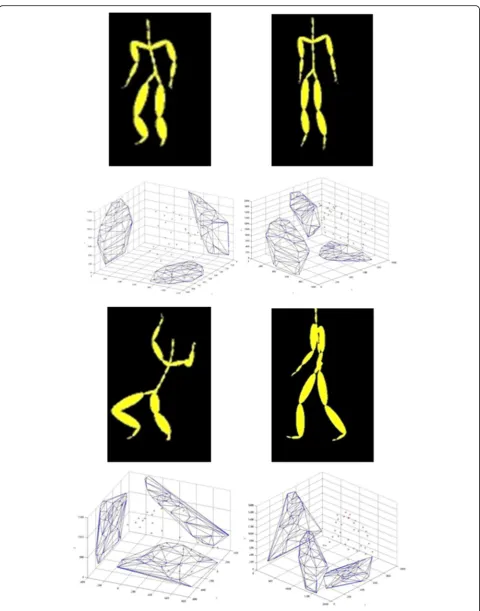
makes a motion sequence. There are devices which cap-ture the 3D position of the markers. In our experiment, we fix a virtual camera and project the markers onto the 2D image plane to analyze the result. Firstly, we use Delaunay triangulation to construct the graph. Then we compute the combinatorial conformal module of the graph. Four canonical postures are selected: standing, jumping, leaning back and walking as shown in Fig. 5. We project the posture onto the XOY,YOZ and ZOX
plane respectively and calculate the corresponding Delaunay triangulation which is showed in the 3D pos-ture scatter figures. We project the 3D pospos-ture onto the plane to find the most left vertex, the most bottom ver-tex, the most right vertex and the most top vertex as the corners. The proposed method is applied to compute the combinatorial conformal module of a posture graph. The combinatorial conformal module can be used to distinguish these postures. We use the proposed method to process the whole video sequence with 2751 frames and use K-nearest neighbor method to classify the pos-tures. The correct rate of posture classification result is nearly 90%.
5 Conclusion
Graph matching has been intensively applied in com-puter vision for finding correspondences between two sets of features extracted from images. Most of the exist-ing graph matchexist-ing methods require high time complex-ity and are not usable to large graphs. Furthermore, these methods can hardly handle the circumstances where two graphs to be matched have large non-rigid transformations. In this work, we propose a novel graph matching and classification method by the combinatorial conformal module.
We generalize the classical Hodge theory to the com-binatorial graph setting. The process is that we apply combinatorial Hodge theory to compute the combina-torial harmonic functions on graphs. By defining com-binatorial Laplace matrices on graphs, the solution of harmonic functions is converted into solving linear La-place matrices. The combinatorial harmonic 1-forms can give the combinatorial conformal invariant of a given graph, called as conformal module. According to the mathematical result, the conformal module can be used as the fingerprint of a given graph. Thus we can use the conformal module to do some matching work. Compar-ing to other graph matchCompar-ing methods, the proposed method can discover the combinatorial invariant of a given graph. Furthermore, the proposed method can tol-erate the non-rigid transformation on a given graph. Due to considering the proposed method from the alge-braic topology viewpoint, the computation of matching problem can be done in linear time. More importantly,
our proposed method is adaptable to not only planar graphs but also graphs embedded in high genus surfaces. In the future work, we purpose to explore the inexact graph matching method based on the conformal module and we hope the proposed method can be used to more applications in computer vision.
Abbreviations GM:Graph matching
Acknowledgements
The authors thank the editor and anonymous reviewers for their helpful comments and valuable suggestions.
Funding Not applicable.
Availability of data and materials Please contact author for data requests.
Authors’contributions
All authors take part in the discussion of the work described in this paper. These authors contributed equally to this work. Both authors read and approved the final manuscript.
Authors’information
Jialing Zhang was born in Yunnan, P.R. China, in 1981. She received her Master of Science degree from Yunnan Normal University in 2006. She has been a faculty in Kunming University of Science and Technology since 2006. Her main research interests focus on Computational Geometry-Theory and Applications.
Kun Qian was born in Yunnan, P.R. China, in 1982. He received his M.S. degree in Mechanical and Electronic Engineering from Xidian University in China in 2009. He was a visiting scholar at the State University of New York at Stony Brook and University of Louisiana at Lafayette, US from January 2015 to January 2016. He is currently pursuing his Ph.D. degree in Kunming University of Science and Technology in China. His research interests are in the area of computational geometry, computer graphics and computer vision.
Competing interests
The authors declare that they have no competing interests.
Publisher’s Note
Springer Nature remains neutral with regard to jurisdictional claims in published maps and institutional affiliations.
Received: 25 September 2018 Accepted: 2 January 2019
References
1. F. Zhou, F. De la Torre, Factorized graph matching. IEEE Conference on Computer Vision and Pattern Recognition.38, 127–134 (2012) 2. O. Duchenne, A. Joulin, J. Ponce, A graph-matching kernel for object
categorization. International Conference on Computer Vision (2011), pp. 1792–1799
3. H. Jiang, S. X. Yu, D. R. Martin, Linear scale and rotation invariant matching. IEEE Trans. Pattern Anal. Mach. Intell.33(7), 1339–1355 (2011)
4. J. Hays, M. Leordeanu, A. A. Efros, Y. Liu, Discovering texture regularity as a higher-order correspondence problem. European Conference on Computer Vision. (Springer, Berlin, Heidelberg, 2006), pp. 522–535.
5. U. Gaur, Y. Zhu, B. Song, A. Roychowdhury, A "string of feature graphs" model for recognition of complex activities in natural videos. IEEE International Conference on Computer Vision (ICCV), (IEEE, 2011), pp. 2595-2602 6. W. Brendel, S. Todorovic, Learning spatiotemporal graphs of human activities.
IEEE International Conference on Computer Vision (2011), pp. 778–785 7. D. Conte, P. Foggia, C. Sansone, M. Vento, Thirty years of graph matching in
8. F. Zhou, F. De la Torre, Deformable graph matching. IEEE Conference on Computer Vision and Pattern Recognition (2013), pp. 2922–2929 9. W. Zeng, J. Marino, K. Chaitanya Gurijala, X. Gu, A. Kaufman, Supine and
prone colon registration using quasi-conformal mapping. IEEE Trans. Vis. Comput. Graph.16(6), 1348–1357 (2010)
10. W. Zeng, Y. Zeng, Y. Wang, X. Yin, X. Gu, D. Samaras, 3d non-rigid surface matching and registration based on holomorphic differentials. European Conference on Computer Vision (Springer, Marseille, France, October 12–18, 2008), pp. 1–14
11. L. Lui, W. Zeng, S. Yau, X. Gu, Shape analysis of planar multiplyconnected objects using conformal welding. IEEE Trans. Pattern Anal. Mach. Intell. 36(7), 1384–1401 (2014)
12. X. D. Gu, S. T. Yau, Computational conformal geometry. (Somerville, Mass, USA: International Press, 2008)
13. J. R. Ullmann, An algorithm for subgraph isomorphism. J. ACM23(1), 31–42 (1976)
14. L. P. Cordella, P. Foggia, C. Sansone, F. Tortorella, M. Vento, Graph matching: a fast algorithm and its evaluation. International Conference on Pattern Recognition.2, 1582–1584 (1998)
15. L. P. Cordella, P. Foggia, C. Sansone, M. Vento, Fast graph matching for detecting cad image components. 15th International Conference on Pattern Recognition.2, 1034–1037 (2000)
16. B. D. McKay, Practical graph isomorphism[J]. J. Symb. Comput.60(1), 94–112 (2014)
17. C. Irniger, H. Bunke, Graph matching: filtering large databases of graphs using decision trees[C]. Graph-Based Representations in Pattern Recognition (2001), pp. 239-249
18. M. Lazarescu, H. Bunke, S. Venkatesh, Graph matching: fast candidate elimination using machine learning techniques. Joint IAPR International Workshops on Statistical Techniques in Pattern Recognition (SPR) and Structural and Syntactic Pattern Recognition (SSPR). (Springer, Berlin, Heidelberg, 2000), pp. 236-245
19. E. M. Loiola, N. M. M. de Abreu, P.O. Boaventura-Netto, P. Hahn, T. Querido, A survey for the quadratic assignment problem. Eur. J. Oper. Res.176(2), 657–690 (2007)
20. S. Umeyama, An eigendecomposition approach to weighted graph matching problems. IEEE Trans. Pattern Anal. Mach. Intell.10(5), 695–703 (1988)
21. L. S. Shapiro, J. Michael Brady, Feature-based correspondence: an eigenvector approach. Image Vis. Comput.10(5), 283–288 (1992) 22. T. Caelli, S. Kosinov, An eigenspace projection clustering method for inexact
graph matching. IEEE Trans. Pattern Anal. Mach. Intell.26(4), 515–519 (2004) 23. M. Leordeanu, M. Hebert, A spectral technique for correspondence
problems using pairwise constraints. Tenth IEEE International Conference on Computer Vision.2, 1482–1489 (2005)
24. H. Qiu, E. R. Hancock, Graph matching and clustering using spectral partitions. Pattern Recogn.39(1), 22–34 (2006)
25. S. Gold, A. Rangarajan, A graduated assignment algorithm for graph matching[J]. IEEE Trans. Pattern Anal. Mach. Intell.18(4), 377–388 (1996) 26. M. Zaslavskiy, F. Bach, J. P. Vert, A path following algorithm for the graph
matching problem. IEEE Trans. Pattern Anal. Mach. Intell.31(12), 2227–2242 (2009)
27. R. Zass, A. Shashua, Probabilistic graph and hypergraph matching. IEEE Conference on Computer Vision and Pattern Recognition(CVPR), (IEEE, 2008), pp. 1–8
28. M. Chertok, Y. Keller, Efficient high order matching. IEEE Transactions on Pattern Analysis and Machine Intelligence.32(12), 2205-2215(2010) 29. O. Duchenne, F. Bach, I. S. Kweon, J. Ponse, A tensor-based algorithm for
high-order graph matching. IEEE transactions on pattern analysis and machine intelligence.33(12), 2383-2395(2011)
30. O. Schramm, Square tilings with prescribed combinatorics[J]. Israel Journal of Mathematics.84(1–2), 97–118 (1993)