O R I G I N A L A R T I C L E
Open Access
REL2
, A Gene Encoding An Unknown
Function Protein which Contains DUF630
and DUF632 Domains Controls Leaf Rolling
in Rice
Shuai-Qi Yang
1†, Wen-Qiang Li
1†, Hai Miao
1, Peng-Fei Gan
1, Lei Qiao
1, Yan-Li Chang
1, Chun-Hai Shi
2*and Kun-Ming Chen
1*Abstract
Background:Rice leaves are important energy source for the whole plant. An optimal structure will be beneficial for rice leaves to capture light energy and exchange gas, thus increasing the yield of rice. Moderate leaf rolling and relatively erect plant architecture may contribute to high yield of rice, but the relevant molecular mechanism remains unclear. Results:In this study, we identified and characterized a rolling and erect leaf mutant in rice and named it asrel2. Histological analysis showed that therel2mutant has increased number of bulliform cells and reduced size of middle bulliform cells. We firstly mappedREL2to a 35-kb physical region of chromosome 10 by map-based cloning strategy. Further analysis revealed thatREL2encodes a protein containing DUF630 and DUF632 domains. Inrel2 mutant, the mutation of two nucleotide substitutions in DUF630 domain led to the loss-of-function ofREL2locus and the function ofREL2could be confirmed by complementary expression ofREL2inrel2mutant. Further studies showed that REL2 protein is mainly distributed along the plasma membrane of cells and theREL2gene is relatively higher expressed in younger leaves of rice. The results from quantitative RT-PCR analysis indicated thatREL2 functioning in the leaf shape formation might have functional linkage with many genes associated with the bulliform cells development, auxin synthesis and transport, etc.
Conclusions:REL2 is the DUF domains contained protein which involves in the control of leaf rolling in rice. It is the plasma membrane localization and its functions in the control of leaf morphology might involve in multiple biological processes such as bulliform cell development and auxin synthesis and transport.
Keywords:Rice (Oryza sativa L.), Rolling and erect leaves,REL2, DUF domains, Bulliform cells
Background
Plant leaves are lateral organs and derived from the per-ipheral zone of the shoot apical meristem (SAM) (Sussex 1995; Bowman et al. 2002). As the leaf grows away from the meristem, its shape is decided by growing in three different axes, which are proximal-distal, abaxial-adaxial
and medial-lateral. Among these three axes, the adaxial-abaxial axis is the foundation of the subsequent asymmetric growth of the leaf and lamina expansion (Waites and Hudson 1995; McConnell and Barton 1998; Moon and Hake 2011). Rice is one of the most import-ant crops in the world and how to increase grain yield has become a focus on rice research. Appropriate leaf shape is an important characteristic to construct the super-high-yield hybrid rice, which means long, narrow, V-shaped (rolling) and thick leaves of the top three leaves (Yuan 1997). Moderate leaf rolling will be bene-ficial to the erectness of leaves, thus minimizing sha-dowing among leaves, which contributes to improving * Correspondence:[email protected];[email protected];
[email protected] †Equal contributors 2
Department of Agronomy, College of Agriculture and Biotechnology, Zhejiang University, Hangzhou 310058, Zhejiang, People’s Republic of China 1State Key Laboratory of Crop Stress Biology in Arid Areas, College of Life
Sciences, Northwest A&F University, Yangling 712100, Shaanxi, People’s Republic of China
photosynthetic efficiency and grain yield (Zhang et al. 2009; Xiang et al. 2012). In order to achieve a break-through of rice yield, isolation and identification of roll-ing leaf genes is a necessary way to construct ideal plant architecture with moderate leaf rolling (Price et al. 1997).
The genetic mechanism behind leaf in adaxial-abaxial
axis development is relatively clear in Arabidopsis
thaliana. Many mutants have been investigated and the results illustrated that HOMEODOMAIN-LEUCINE ZIPPERIII (HD-ZIPIII), KANADI and the small RNA pathway play significant roles to determine the shape in adaxial-abaxial growth (for a review Moon and Hake 2011). However, the mechanism about leaf in adaxial-abaxial axis development in rice is still in exploration and not so clear. Generally, there are two types of leaf rolling in rice, adaxial rolling and abaxial rolling. To date, more than fourteen rolling leaf (rl) mutants in rice were isolated and mapped genetically. Among these mutants, six recessive genes (rl1-rl6) were mapped on rice chromosomes 1, 4, 12, 3, 1 and 7 by morphological markers, respectively (Khush and Kinoshita 1991).rl7to
rl12,rl14andrl(t)were located on chromosomes 2 (rl(t), Shao et al. 2005a), 5 (rl(7), Li et al. 1998;rl(8), Shao et al. 2005b), 7 (rl11, Shi et al. 2009), 9 (rl9, Yan et al. 2008;
rl10, Luo et al. 2007), and 10 (rl12, Luo et al. 2009;rl14, Fang et al. 2012), respectively. However, only rl9 and
rl14were cloned and analyzed in detail.
There are some transcription factors which were dem-onstrated being involved in controlling leaf rolling. RL9, an orthologue ofArabidopsis KANADIs, encodes a Glyco-protein A Repetitions Predominant (GARP) Glyco-protein and mainly expresses in roots, leaves and flowers. Subcellular localization indicated thatRL9acts as a putative transcrip-tion factor due to localizing in the nucleus (Yan et al.
2008). OsMYB103Lencodes an R2R3-MYB transcription
factor and is localized in the nucleus with transactivation activity. Over-expression ofOsMYB103Lresults in a rolled leaf phenotype. In contrast, knockdown of this gene leads to reduced cellulose content and mechanical strength in
leaves (Yang et al. 2014). OsZHD1 is a zinc finger
homeodomain class homeobox transcription factor, which exhibits a constitutive expression pattern in wild type (WT) and accumulates in the developing leaves and
panicles. Over-expression of OsZHD1 and its homolog
OsZHD2 causes the abaxial leaf curling with increased number and abnormal arrangement of bulliform cells (Xu et al. 2014). SHALLOT-LIKE 1(SLL1) encodes a SHAQ-KYF class MYB family transcription factor which belongs to the KANADI family andsll1mutant displays extremely incurved leaves because of the defective development of sclerenchymatous cells on the abaxial side. Further study indicated that SLL1 deficiency leads to abnormal pro-grammed cell death of abaxial mesophyll cells and sup-presses the development of abaxial features. However,
phloem development on the abaxial side is stimulated and bulliform cell and sclerenchyma development on the adaxial side are both suppressed by enhanced SLL1
expression (Zhang et al. 2009).
In addition, some other genes found in rice mutant also play key roles in controlling leaf rolling. For example, nar-row and rolled leaf 1(nrl1) encoding a cellulose synthase-like D4 protein is characterized by a phenotype of narrow and rolled leaves (Wu et al. 2010).ADAXIALIZED LEAF 1
(ADL1) encodes a plant-specific calpain-like cysteine
pro-teinase orthologous to maize DEFECTIVE KERNEL1 and
adl1 mutant shows abaxially rolled leaves (Hibara et al. 2009).OsAGO7including the PAZ (Piwi/Argonaute/Zwille) and Piwi conserved domains belongs to the Argonaute (Ago) family and could be orthologous to theArabidopsis thaliana Ago7gene. Over- expression of this gene leads to upward curling of the leaf blade (Shi et al. 2007). SEMI-ROLLED LEAF 1 (SRL1) is located at plasma membrane and predicted to be a putative glycosylphosphatidylinositol-anchored protein. srl1 mutant exhibits adaxially rolled leaves due to the increased number of bulliform cells at the adaxial cell layers. Further study showed thatSRL1can in-hibit the formation of bulliform cells by regulating the ex-pression of genes encoding vacuolar H+-ATPase subunits and H+-pyrophosphatase negatively (Xiang et al. 2012).
LEAF INCLINATION 2 (LC2) encodes a vernalization in-sensitive 3-like protein which plays an important role in regulating leaf inclination and mediating hormone effects andlc2mutants have enlarged leaf angles and abaxial leaf
curling (Zhao et al. 2010). ABAXIALLY CURLED LEAF 1
(ACL1) encodes a protein containing unknown conserved functional domains and over-expression of ACL1 and its homologACL2induces abaxial leaf curling (Li et al. 2010). Most recently, a new gene calledSRL2has been identified and cloned. This gene encodes a novel plant-specific pro-tein of unknown biochemical function. srl2 mutant has incurved leaves due to the presence of defective sclerenchy-matous cells on the abaxial side of the leaf and displays nar-row leaves and reduced plant height. Double mutant analysis indicated thatSRL2andSLL1/RL9function in dif-ferent ways to regulate abaxial-side leaf development (Liu et al. 2016). At last,ROLLED and ERECT LEAF 1(REL1) encoding a novel no known protein is related to the coordination of brassinosteroid (BR) signaling trans-duction. Also,rel1mutant displays rolled and erect leaf and over-expression ofREL1in WT causes a phenotype similarity to that of the dominant rel1 mutant.
How-ever, down-regulation of the REL1 gene in the rel1
mutant restores the mutant phenotype (Chen et al. 2015). Considering the similar phenotype as torel1, we named our mutant asrel2.
conservation suggested that many DUFs have important functions (Goodacre et al. 2014; Wang et al. 2014). Some “Domains of Unknown Function” (DUFs) or “Uncharac-terized Protein Families” (UPFs) in Pfam database have been analyzed for both structure and function by com-putational structural genomics approach (Betman et al. 2010; Goodacre et al. 2014; Mudgal et al. 2015). How-ever, only few of them were determined in detail.
In the present study, we identified a rolling and erect leaf mutant and isolated the control gene by using map-based cloning strategy. Then, the subcellular localization and expression profiles of the control gene were inves-tigated. The results obtained here provide a new im-portant reference for understanding the mechanism of rolling leaf blades in rice.
Results
Phenotypes ofrel2
The mutant was isolated from M2generation of rice
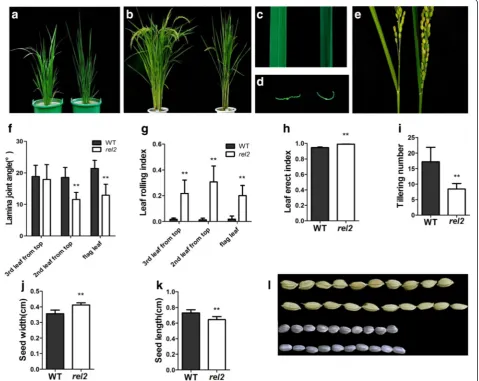
cul-tivar Nipponbare (Oryza sativaL.japonica) by mutagen-esis with ethyl methanesulfonate (EMS), and was named as rolled and erect leaf 2 (rel2) mainly based on its ab-normal phenotypes of leaves. Compared with the WT, the rel2 mutant plants have adaxially rolling and erect leaves which lead to erect architecture of rice plants. During the early seedling stage, the phenotype of rel2
mutant is becoming different from that of WT. As the rice grows, significant phenotypic differences could be distinguished from the two type plants. Figure 1a, b
shows the gross morphology of WT and rel2 mutant at
tillering stage and heading stage, respectively. In contrast
Fig. 1Characterization of WT andrel2mutant.a,bMorphology of WT (left) andrel2mutant (right) at tillering stage and heading stage, respectively. cMorphology of second leaf from the top of WT (left) andrel2mutant (right) at heading stage.dTransverse section of the middle part of the second leaf from the top of WT (left) andrel2mutant (right) at heading stage.eThe display of angle between panicle and the flag leaf of WT (left) andrel2
mutant (right).f-kStatistical analysis of lamina joint angle, LRI, LEI, tillering number, seed length and seed width. At least 20 samples of WT andrel2
to the WT, all leaves of rel2 exhibit adaxial rolling (Fig. 1c, d). Therel2mutant also shows erect growth of two top leaves, owing to reduced lamina joint angle (Fig. 1e, f ). The leaf rolling index (LRI) and the leaf erect index (LEI) are significantly increased in rel2 mutant (Fig. 1g, h). In addition, the rel2 mutant also exhibits other abnormal phenotypes, such as reduced tillering number, round grains, reduced number of grains per main panicle (Fig. 1i to l, Table 1). Since all the leaf blades in
rel2 mutant plants display darker green leaf phenotype during almost all the growth and development stages, the pigment contents in leaves were also investigated here. The results showed that chlorophyll a (Chl a) and chloro-phyll b (Chl b) contents in mutant leaves are obviously higher than those in WT (Fig. 2a). Even more, the mu-tant’s net photosynthetic rate is decreased whereas its transpiration rate is slightly increased compared with the WT (Fig. 2b, c). Also the number of adventitious roots is significantly less than that of WT. Shorter adventitious roots can also be observed in the rel2 mutant plants (Additional file 1: Figure S1). These observations indicated that therel2mutant has multiple morphological defects.
Abnormal Bulliform Cell Number, Size and Arrangement inrel2Leaf Blades
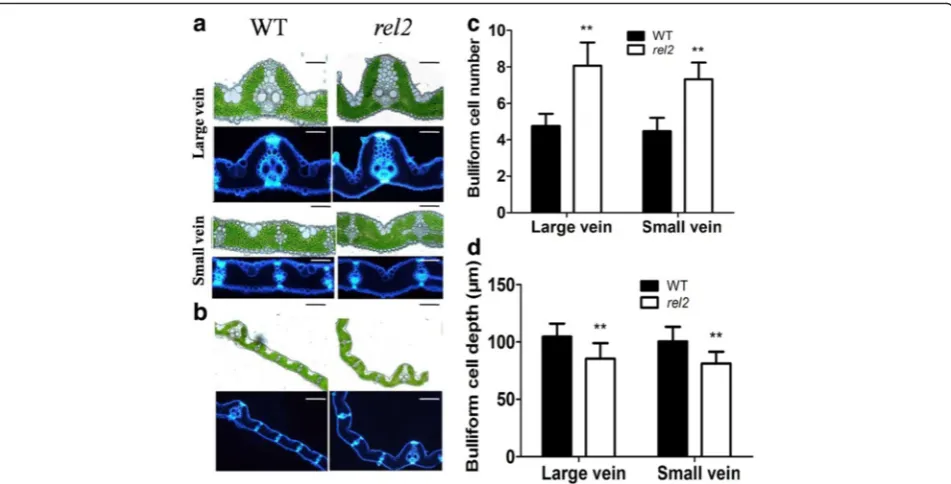
Considering the important roles of bulliform cells in determining leaf flatting in rice (Xiang et al. 2012), an analysis of free-hand cross section was carried out in present study. Compared with that of WT, more bulli-form cells are observed on adaxial epidermis ofrel2leaf blades (Fig. 3a, b). In the WT leaf blades, bulliform cells are arranged in groups of 5 ± 1 cells, with the middle cells larger than those on either side; whereas in therel2
mutant, bulliform cells are arranged in groups of 8 ± 1 cells, with middle cells as small as those of other cells (Fig. 3a, b). Statistical analysis revealed a significant in-crease of bulliform cell number inrel2 mutant (Fig. 3c). Moreover, we found that the bulliform cells are arranged
with “U” shape in WT, whereas the bulliform cells of
rel2mutant are arranged with“V”shape (Fig. 3a, b). The depth of bulliform cells is also decreased in rel2 leaf blade as compared to the WT (Fig. 3d). These results indicated that the rolling leaf phenotype should result from the reduced size of middle bulliform cells and“V” shape arrangement of bulliform cell region.
Map-based Cloning ofREL2Gene
In order to isolate REL2by map-based cloning strategy, a genetic population was constructed by crossing rel2
mutant with an indicarice cultivar, Kasalath. All F1
hy-brids derived from the cross showed normal phenotype, similar to that of Kasalath. In the F2 population, we
planted 200 individuals, and identified 142 normal plants and 58rel2 plants, respectively. The segregation ratio is just fitted to 3:1 (χ2= 0.812 <χ20.05= 2.85), indicating that
the rel2 phenotype is controlled by a single recessive nuclear gene.
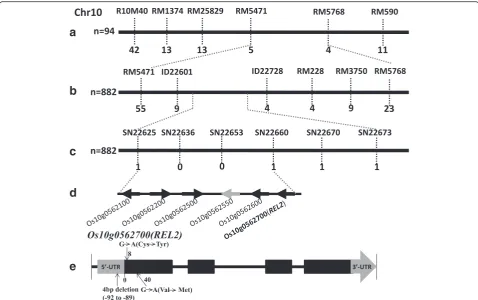
Using bulked segregant analysis (BSA) method (Michelmore et al. 1991), REL2 gene is showed to link with inset and deletion (InDel) marker R10M40 on rice chromosome 10 (data not shown). A preliminary map-ping ofREL2was conducted by genotyping of 94 F2
mu-tant individuals with simple sequence repeat (SSR) markers near R10M40. Genetic mapping of the target gene revealed thatREL2is linked with the SSR markers at the long arm of chromosome 10 (Fig. 4a). For fine mapping ofREL2, a series of InDel and single nucleotide polymorphism (SNP) markers were newly developed based on the genome sequence differences between Nipponbare and Kasalath (Fig. 4b, c). Genotyping of
Table 1Comparison differences of some key agronomic traits
between WT andrel2mutant
Traits NIP rel2
The number of grains per panicle 128 ± 18 58 ± 6* *
Fertility rate (%) 88.3 ± 3.9 69.7 ± 6.2* *
1,000-grain weight (g) 24.8 ± 0.2 26.7 ± 0.4* *
Plant height (cm) 94.5 ± 4.0 72.8 ± 2.7* *
Panicle length (cm) 22.0 ± 1.9 16.9 ± 1.5* *
Flag leaf length (cm) 29.7 ± 4.0 34.8 ± 6.3* *
Second leaf length (cm) 38.3 ± 4.8 46.8 ± 4.9* *
Third leaf length (cm) 37.3 ± 4.8 39.1 ± 4.1
The values were shown as mean ± SD (n≥20). Double asterisk (* *) indicates that the difference between the WT andrel2is statistically significant atP< 0.01
Fig. 2Characterization of pigment content and photosynthetic rate of
882 F2mutant individuals revealed thatREL2is located
between SNP markers SN22625 and SN22660, and co-segregated with SN22636 and SN22653 (Fig. 4c).
There-fore, the REL2was mapped to a 35-kb genomic region
by SN22625 and SN22660. According to the Rice Anno-tation Project Database, there are six genes annotated in the 35-kb region (Fig. 4d). A qRT-PCR analysis of all the genes in this region revealed that there is no difference
at mRNA level between WT and rel2 mutant (data not
shown). We then sequenced all the genes of WT and
rel2 mutant with genomic DNA as template, and only
found thatrel2 mutant has three sequence mutations in locus Os10g0562700, including a 4-bp deletion at
5’-UTR and two nucleotide substitutions at open reading frame (ORF) region (Fig. 4e). In fact, the mRNA level of
Os10g0562700 has no obvious difference between WT andrel2mutant (Additional file 2: Figure S2A, B), indi-cating that the 4-bp deletion in 5’-UTR in rel2 mutant does not affect its transcription expression level. How-ever, the mutation of two nucleotide substitutions in the ORF region causing amino acid substitutions (Cys3 to Tyr3, Val14to Met14) should lead to loss ofREL2function in the mutant. Therefore, the locusOs10g0562700should be the target gene, REL2. To confirm whether the REL2
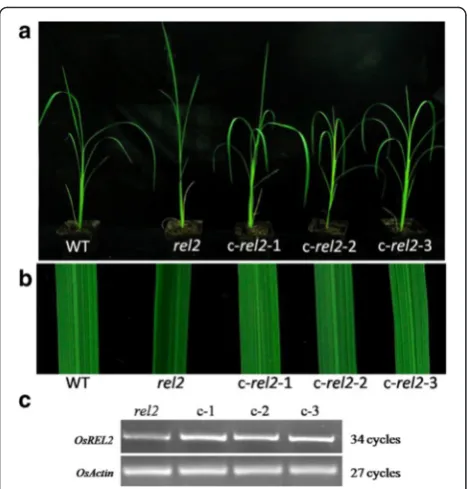
disruption resulted in the abnormal leaves, calli induced fromrel2 mutant seeds were transformed via Agrobacter-ium tumefaciens with p35S-1301-REL2, a construct with
the full length of REL2 ORF driven by a CaMV35S
promoter. The positive plants were detected by GUS array and RT-PCR analysis. In order to know whether the mu-tant phenotype can be rescued, 23 independent transgenic lines were identified by observing the phenotype of leaves at early tillering stage. The results showed that rolling leaves of the transgenic plants are rescued and the pheno-type of the leaves is just as the same to WT (Fig. 5a, b). Also, the results from RT-PCR analysis of transgenic plants showed that the mutant plants could be complemented by the over-expression ofREL2(Fig. 5c), indicating that the normal REL2 protein expression restored the mu-tant phenotype. These results indicated that the mumu-tant phenotype should be caused by the abnormal function of REL2 protein.
In order to get more information about theREL2gene, bioinformatics analysis was carried out. High similarity of protein sequences were selected for bioinformatics analysis. After that, a multiple sequences alignment was carried out and evolutionary tree was constructed. The results showed that the DUF630 and DUF632 domains in rice are highly conservative and always together and exhibit relatively close genetic relationship with the domains from Setaria italic, Sorghum bicolorandZea mayswhile these two DUF domains were not close with those fromArabidopsis thali-ana (Fig. 6a, b). However, all the protein sequences se-lected have not been studied in detail and their functions
are unknown yet, so we concluded that REL2is a DUF
domains contained unknown function protein.
Expression Patterns ofREL2and Subcellular Localization of the Protein
In order to investigate the expression pattern of REL2, total RNA was extracted from various tissues at different stages of wild-type rice. The expression level in roots at heading stage was set to 1. The results showed that the level of REL2 transcription is highest in leaves at seed-ling stage. Also, the transcription level is relatively high in the 1st leaf blades (the top leaf blades) at tillering stage, the 1st leaf blades at booting stage and panicle before flowering at heading stage. However, there is no expression at the 2nd leaf sheaths (the second leaf sheath from the top leaf sheath) at tillering, booting and heading stages. Meanwhile, the transcription level ofREL2 in other tissues is quite low (Fig. 7). These re-sults suggested that REL2 is dominantly expressed in the relatively younger leaf blades.
To investigate the location of REL2 protein in cells,
full length complementary DNA (cDNA) ofREL2
with-out stop condon was introduced into the p35S-GFP
expression vector. To determine the roles of the two DUF domains in the location of REL2 protein, both
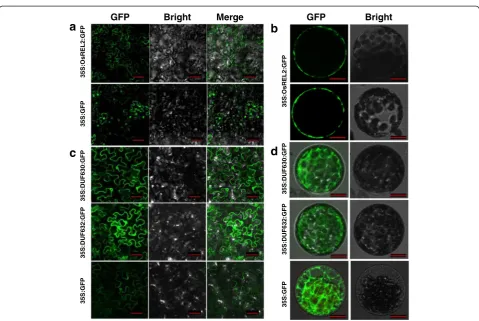
DUF630 and DUF632 domain sequences were cloned into the p35S-GFP expression vector, respectively. The fused genes were injected into tobacco and the fluores-cent signal was detected after transformation. As can be seen, the fluorescent signal from the infection with the
full length cDNA of REL2 was observed in the plasma
membranes of the cells from both tobacco leaves and tobacco protoplasts (Fig. 8a, b), indicating that REL2 is a plasma membrane located protein. However, the two infections with the gene pieces of containing DUF630 and DUF632 domains separately, exhibited no specific localizations in the tobacco leaf cells and protoplasts, implying that both the two domains separated pep-tides have no plasma membrane localization in the cells (Fig. 8c, d).
rel2Mutation Affects the Expression of Several Leaf Shape Regulation Genes
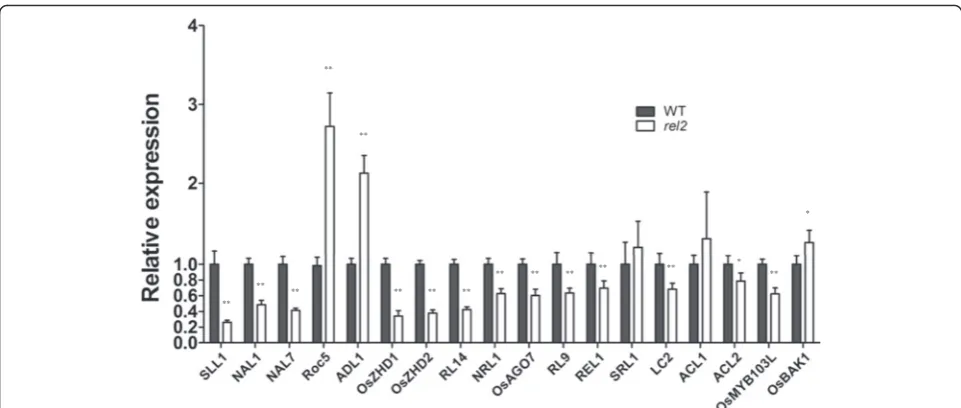
To determine the expression relationship of REL2 with the leaf shape regulation associated genes, a total of eighteen genes were selected to be analyzed by qRT-PCR (Fig. 9). Total RNA was extracted from young leaves of
a
b
c
d
e
Fig. 4Map-based cloning ofREL2.a-cPrimary mapping ofREL2(a) and fine mapping ofREL2(b,c). The genetic linkage map is derived from 94 F2mutant individuals for primary mapping and 882 F2mutant individuals for fine mapping. Markers’names are above thevertical linesand
the number of recombinants is displayed under thevertical lines.dThe six candidate genes between SN22626 and SN22660.eGene structure and mutant sites of candidate geneOs10g0562700 (REL2).Black boxesindicate the exons andgrey boxesrepresent untranslated region (UTR). The
both WT and rel2mutant at seedling stage. The results showed that Rice outermost cell-specific gene 5 (Roc5) (homeodomain leucine zipper class IV gene) (Zou et al. 2011), ADL1 (plant-specific calpain-like cysteine protein-ase gene) (Hibara et al. 2009) andOsBAK1(a BR signaling related gene) (Li et al. 2009) are significantly up-regulated inrel2mutant. In contrast, genes calledSLL1(a KANADI transcription factor) (Zhang et al. 2009),NARROW LEAF 1 (NAL1) (a gene encoding a plant-specific protein af-fecting cell division) (Qi et al. 2008; Jiang et al. 2015),
NARROW LEAF 7 (NAL7) (a flavin-containing mono-oxygenase gene) (Fujino et al. 2008),OsZHD1andOsZHD2
(zinc finger homeodomain class homeobox transcription factors) (Xu et al. 2014),ROLLED LEAF 14(RL14) (a 2OG-Fe (II) oxygenase family protein gene) (Fang et al. 2012),
NRL1(a cellulose synthase-like D4 protein gene) (Wu et al. 2010), OsAGO7 (an Argonatue family gene) (Shi et al.
2007), RL9 (a GARP protein gene) (Yan et al. 2008),
REL1(encoding a novel no known protein) (Chen et al. 2015), LC2 (a vernalization insensitive 3-like protein gene) (Zhao et al. 2010), ACL2 (a gene containing un-known conserved functional domains) (Li et al. 2010) and OsMYB103L (an R2R3-MYB transcription factor gene) (Yang et al. 2014) are down-regulated significantly inrel2mutant. These findings suggested that there might be a functional association between REL2 and those genes in regulating leaf morphological development of
rice. By contrast, SRL1 and ACL1 have no expression
changes inrel2mutant, indicating that the two genes may not have functional relationship withREL2(Fig. 9).
Discussion
The Leaf Rolling Phenotype ofrel2should Result from the Abnormal Development of Bulliform Cells
There are several factors leading to leaf rolling in plants. Generally, leaf rolling is caused by the water loss of bul-liform cells on adaxial epidermis in rice (O’Toole and Cruz 1980). This indicated that the number and area even the phenotype of bulliform cells may have effects on leaf rolling. Also, some other environment factors can affect leaf rolling such as high air temperature and strong sun light (Kidner and Timmermans 2007). Be-cause the large and highly vacuolated vascular bundles bulliform cells on the adaxial epidermis of leaves partici-pate in the regulation of leaf rolling (Xiang et al. 2012), uncovering the genes related to bulliform cells develop-ment is a necessary way to figure out the mechanism of leaf rolling. Until to now, genes associated with the development of bulliform cells have been studied. For example,srl1 is involved in the regulation of leaf rolling and srl1 mutant exhibits adaxially rolled leaves due to the increased numbers of bulliform cells at the adaxial cell layers. Further study showed that SRL1 gene regu-lates leaf rolling by inhibiting the formation of bulliform cells through negatively regulating the expression of genes encoding vacuolar H+-ATPase subunits and H+ -pyropho-sphatase (Xiang et al. 2012). This mechanism is relatively clear and confirms that the number of bulliform cells is indeed to affect the leaf rolling. Also, the mutant ofADL1,
ACL1,NAL1,ROC5andOsZHD1genes could lead to roll-ing leaves by changroll-ing the number and area of bulliform cells in adaxial leaf blades (Fujino et al. 2008; Hibara et al. 2009; Li et al. 2010; Zou et al. 2011; Xu et al. 2014). In the present study, therel2mutant also shows changed pheno-type of bulliform cells. The number of bulliform cells is obviously increased, but the size of middle bulliform cells is significantly decreased in leaf blades of rel2mutant as compared to WT. In addition, therel2mutant leaf blades have reduced depth of bulliform cell region and the plant architecture is more erect by the straight leaves due to the leaf rolling (Fig. 1a, b). Even more, the expression patterns ofREL2indicated thatREL2has relatively higher expres-sion in leaf blades (Fig. 7) which is consistent with therel2
mutant phenotype of leaf blades. The changes of bulliform cells in leaf blades may indicate that REL2might be re-lated with the development of bulliform cells. The higher expression of REL2 in panicle (before flowering) is also consistent with the changed traits such as seed shape, grains number per panicle. Although many studies showed that the leaf rolling can contribute to the photo-synthetic efficiency (Yuan 1997; Zhang et al. 2009), the
Fig. 5Complementary experiment ofrel2mutant.aWT andrel2
mutant and T0transgenic plants c-rel2-1, c-rel2-2 and c-rel2-3.b
net photosynthetic rate of rel2 is actually decreased as compared with that of WT (Fig. 2b), indicating a com-plicated mechanism involves in the functions of REL2. This needs to be further elucidated.
DUF630 and DUF632 Domains may be Together to Implement their Function
As shown in Fig. 6a, the REL2 protein contains a DUF630 do-main at the N-terminus and a DUF632 dodo-main at the C-terminus. The DUF630 domain containing 59 amino acids was annotated that it was sometimes found at the N-terminus of putative plant bZIP protein and structural mod-eling suggested that this domain may bind nucleic acid. Mean-while, the DUF632 domain containing 309 amino acids was described as a leucine zipper even though there was no experi-mental evidence supporting that (http://blast.ncbi.nlm.nih.-gov/). However, the subcellular localization analysis of the entire protein sequence of REL2 in tobacco indicated that this protein is located on plasma membrane (Fig. 8a, b). But since no transmembrane domains were found in its animo acid se-quence, REL2 may encode a plasma membrane anchored
protein. Apart from this, the peptides containing DUF630 or DUF632 alone exhibit no special localization in tobacco cells (Fig. 8c, d). Considering the evolutionary conservation of DUF domains (Goodacre et al. 2014) and the co-evolution of DUF630 and DUF632, the results obtained here clearly indi-cated that the two DUF domains should be together to imple-ment their functions. Since that all the protein sequences from different species were not studied in detail, our current study provides a primary reference for the function of DUF630 and DUF632 domains in plants.
REL2may Regulate Leaf Shape by Coordination with Multiple Biological Factors
Multiple biological factors might participate in REL2
controlled leaf rolling. It has been suggested that plant hormones play important roles in plant growth and development. For example, BR is vital for plant growth and development, especially in the regulation of leaf morphology and a rolled or erect leaf phenotype can always be observed by the BR-deficient mutants (Bishop and Yokoka 2001; Hong et al. 2004). For instance, therel1 Fig. 6Multiple sequences alignment of REL2 with its highly similar protein sequences and phylogenic tree.aMultiple sequences alignment of
Oryza sativa Japonica Group[GenBank accession number: NP_001065395.1,REL2],Oryza sativa Indica Group[GenBank accession number: EAY79532.1],
GFP Bright Merge GFP Bright
35S:GFP
3
5S:DUF632:GFP
3
5S:DUF630:GFP
35S:GFP
35S:OsREL2:GFP
35S:GFP
3
5S:DUF632:GFP
3
5S:DUF630:GFP
35S:OsREL2:GFP
a
d
b
c
Fig. 8Subcellular localization ofREL2.aAnalysis of the subcellular localization ofREL2using a tobacco transient transformation system in the cells of tobacco leaves. Bars = 100μm.bSubcellular localization ofREL2with tobacco protoplasts. Bars = 10μm.cSubcellular localization of DUF630 and DUF632 in the cells of tobacco leaves. Bars = 50μm.dSubcellular localization of DUF630 and DUF632 with tobacco protoplasts. Bars = 100μm
Fig. 7qRT-PCR analysis of the expression pattern ofREL2. Total RNA was extracted from various tissues from callus and WT plants. RiceActin1
gene was used as a control. The expression ofREL2in roots at heading stage was set to 1. The 1stleaf blades or 2ndleaf blade mean the
position of leaf blades or leaf sheaths. From up to down of a rice plant, the first leaf blade or leaf sheath is the 1stleaf blade or leaf sheath
mutant has rolled and erect leaves and a yeast two-hybrid screen experiment proved that REL1 involves in the co-ordination of BR signaling transduction (Chen et al. 2015). However, the results from our leaf inclination experiment with BR showed that there may be no relationship be-tweenREL2gene and BR (data not shown). Another well known hormone which participates in plant growth regu-lation and development is auxin, acting as a signal for cell division, cell elongation and cell differentiation. Auxin also plays a key role in regulating the leaf primordum at the in-determinate SAM and cell growth in the development of leaves (Kepinski 2006; Tax and Durbak 2006; Fujino et al. 2008). In rice,NAL1andNAL7encode a putative trypsin-like serine/cysteine protease and a flavin-containing monooxygenase which displays sequence homology with
YUCCA, respectively. Both of them participate in auxin regulation. NAL1affects vein patterning and polar auxin transport (PAT) andNAL7has an effect on auxin biosyn-thesis (Fujino et al. 2008; Qi et al. 2008; Cho et al. 2014). In the present study, we found that the transcription ex-pression of bothNAL1andNAL7is down-regulated obvi-ously in the rel2 mutant, indicating that the function of
REL2gene in rice leaf rolling may be related to the auxin regulation also (Fig. 9).
Other biological factors might also participate in REL2-controled leaf rolling. It has been suggested that
SLL1is involved in the development of sclerenchymatous cell on the abaxial side of rice leaves andSLL1deficiency leads to increased chlorophyll and photosynthesis (Zhang et al. 2009). Inrel2mutant,SLL1was down-regulated ob-viously, indicating thatREL2may have certain relationship
with the sclerenchymatous development. In addition, the increased chlorophyll contents but decreased net photo-synthetic rate ofrel2mutant further implied that the func-tions of REL2 in leaf rolling might be related to SLL1.
RL14 is a 2OG-Fe (II) oxygenase family protein gene
which affects secondary cell wall formation in rice (Fang et al. 2012). Here, we found that its expression was also obviously down-regulated in the rel2 mutant, suggesting thatREL2may have some relationship with the lignin and cellulose biosynthesis for secondary cell wall formation, also. Moreover, three other genes, ROC5, OsZHD1 and
OsZHD2, were found to be up-regulated or down-reg-ulated apparently inrel2mutant. These three genes were reported affecting the number, size and arrangement of bulliform cells in rice (Zou et al. 2011; Xu et al. 2014). Considering the phenotype of bulliform cells inrel2also changed significantly, it can be suspected that the func-tioning of REL2 gene in the formation of bulliform cells might have somewhat linkages with the three genes.ADL1
is a plant-specific calpain-like cysteine proteinase and was proposed to regulate the pattern formation of leaf and em-bryo in rice (Hibara et al. 2009). Up-regulated ofADL1in
rel2 mutant indicated that REL2 might have function in the pattern formation and embryo, too. Overall, these re-sults suggested that REL2 is a pleiotropic gene and may participate in various biological processes with many other functional genes as discussed above.
To sum up, all of these results suggested that a com-plicated mechanism might be involved in the leaf rolling control in rice. The function of REL2 in this process needs further studies.
** **
** **
**
** ** **
** ** ** **
* **
*
**
Fig. 9qRT-PCR analysis of the expression of genes related to leaf shape regulation inrel2mutant. Total RNA was extracted from leaves of WT andrel2mutant at seedling stage. RiceActin1gene was used as a control. The values are the mean ± SEM with three biological replicates.
Conclusions
A new leaf rolling controlling gene, named REL2, was identified in rice by using the map-based cloning
strategy. This gene encodes a DUF630 and DUF632
domains containing protein and its loss of function led to rolling and erect leaves. The rolling leaves were caused by the abnormal development of bulliform cells and the functions ofREL2might involve in multiple biological processes such as bulliform cell development, auxin synthesis and transport, secondary cell wall for-mation, etc. REL2 is the first discovered DUF domains contained protein which involves in the regulation of leaf morphology in plants.
Methods
Plant Materials and Growth Conditions
The rel2 mutant with rolling leaves was isolated from the M2generation of japonica rice cultivar Nipponbare
by EMS treatment (rice seeds were treated with 0.4 % EMS for 8 h). The F2mapping population was generated
from a cross between mutantrel2and normal indicarice cultivar Kasalath. 882rel2individuals were identified from the F2 mapping population in total. All plant materials
were grown in the paddy field in Hanzhong, Shannxi province, China, in the summer of 2013 and 2014.
Measurement of LEI and LRI
The plants at heading stage were used for the determin-ation of the leaf erect index (LEI) and leaf rolling index (LRI). For testing LEI, Lsl (the distance between lamina joint and the tip of the leaf blade at stretched situation) and Lnl (the distance between lamina joint and the tip of the leaf blade at natural condition) were measured. For testing LRI, Lw (expand the leaf blade and deter-mine the greatest width) and Ln (the natural distance of leaf blade margins at the same position) were measured. Then the LEI and LRI can be calculated by the following formulas (Shi et al. 2007):
LEIð Þ ¼% Lnl=Lsl100
LRIð Þ ¼% ðLw‐LnÞ=Lw100
Pigment and Net Photosynthetic Rate Measurement 0.2 g fresh leaves of rice in tillering stage were harvested to extract pigments and the contents of pigments were measured by a spectrophotometer according to the method described previously (Arnon 1949). Simply, leaves were cut into pieces and marinated in 95 % ethanol for 12 h under dark environment. Then, the pigments were collected by centrifugation and determined with a Spec-trophotometer Evolution 300 (Thermo scientific, US) at 665, 649 nm, respectively. Three independent samples from different plants of WT and rel2 were used for the
analysis. Net photosynthetic rates and transpiration rates were measured at heading stage with the portable photo-synthetic LCPRO+instrument (ADC Bioscientific, UK) in
the morning between 9:00 and 11:00. The measurement of net photosynthetic and transpiration rates of both groups of WT andrel2mutants was repeated at least three times on every different plant and at least five plants of each type plant were investigated.
Histological Analysis
The flag leaves of WT and rel2were fixed in FAA (For-malin-Aceto-Alcohol) solution for 2 h. Leaf pieces with an area approximately 0.5 cm × 0.3 cm of WT and rel2
plants at heading stage were hand-sectioned by using a razor blade. The sections of about 20-40 μm thickness were chosen to be examined by fluorescence microscopy DMIRB (Leica, Germany). Photographs were taken with a Leica light microscope and digital images were cap-tured by using a DFC300 FX camera (Leica, Germany). At least three independent experiments were carried out for each analysis. Adobe photoshop CS4 software was used to calculate the depth and the number of bulliform cells (Bai et al. 2008).
DNA Extraction and PCR Analysis
Rice genomic DNA was extracted from fresh leaves using modified CTAB (Hexadecyltrimethy Ammonium Bro-mide) method (Murray and Thompson 1980) at heading stage when significantly different phenotypes appeared. PCR reaction system was as follows: denaturation at 94 °C for 10 min; then followed by 32-35cycles of 94 °C for 30s, 53–58 °C for 30s, 72 °C for 30s, and the final step was extension for 5 min. After that, the PCR products were separated by 8 % polyacrylamide gel electrophoresis and the amplified bands were detected by silver staining.
Map-based Cloning ofrel2
In order to locate the position of the rel2 on the rice chromosomes, 162 SSR (simple sequence repeat) markers and 37 InDel (insertion and deletion) markers were obtained from the rice GRAMENE database (http:// www.gramene.org/) and (Shen et al. 2004). These markers were distributed evenly on rice 12 chromo-somes and polymorphism between Nipponbare and Kasalath was displayed. Two pools (normal pool and mutant pool) were constructed by using equal amount
of DNA of WT and F2 mutant with 10 individuals for
each. The polymorphic markers screened in bulk segre-gant analysis (BSA) (Michelmore et al. 1991) were used for linkage analysis and molecular mapping. 94 mutant individuals from F2were used for primary mapping. For
fine mapping, a larger population with 882 mutant indi-viduals from F2 was used. All the PCR products were
Phylogenetic Analysis
The full-length amino acid sequence of REL2 was downloaded from National Center for Biotechnology Information (NCBI) and its more than 50 % similarity protein sequences were obtained through a search of NCBI non-redundant protein sequences database (http://blast.ncbi.nlm.nih.gov/Blast.cgi). The alignment of amino acid sequences was carried out by using Clus-talX2.0 (Jeanmougin et al. 1998). A neighbor-joining tree was generated by MEGA5.1 software by the bootstrap method with 1,000 replicates (Tamura et al. 2011).
Development of New InDel and SNP Markers
To confirm therel2at a smaller range on the rice chro-mosomes, new InDel and SNP markers were developed because of the lack of known markers. In order to develop
new markers, the japonica rice cultivar Nipponbare
genome sequences according to IRGSP (2005) were used as a query to do a BLAST against the whole genome se-quences database ofindicarice cultivar Kasalath (http:// blast.ncbi.nlm.nih.gov/). Differences of more than two nucleotides were chosen to design InDel markers and single nucleotide polymorphisms were used to design SNP markers. All the new designed markers were vali-dated by PCR analysis and polyacrylamide or agarose gel electrophoresis to acquire the polymorphic markers be-tween Nipponbare and Kasalath. The new InDel and SNP markers were listed in Additional file 3: Table S1.
Sequencing Analysis of the Candidate Region
To understand the possible functions of candidate genes, the annotation of candidate genes had been referring to the rice GRAMENE database (http://www.gramene.org) and the Rice Annotation Project Database (http://rapdb.d-na.affrc.go.jp/viewer/gbrowse/build4/). Furthermore, six pairs of primers were synthesized to amplify the whole
gene sequences of Os10g0562100, Os10g0562200,
Os10g0562500, Os10g0562550, Os10g0562600 and Os10g05 62700(Additional file 4: Table S2). Specific DNA frag-ments amplified by PCR from genomic DNA of WT andrel2were cloned into pMD19-T vector and then se-quenced by Invitrogen Biotechnology Co., Ltd (Shanghai, China). To determine the mutant sites, the specific se-quences were used to do a BLAST against the whole genome sequences Nipponbare (http://blast.ncbi.nlm. nih.gov/).
Complementation of therel2Mutant
For functional complementation of rel2 mutant, the full length of WT cDNA ofREL2 was cloned into the binary
p35S-1301 vector, which contained a hygromycin resist-ance marker. Calli induced from rel2 mutant seeds was used for transformation with Agrobacterium tumefaciens
EHA105 carrying the p35S-1301-REL2 plasmid. The
positive plants were identified by GUS array. To deter-mine whether the phenotype ofrel2mutant was recovered by the over-expression ofREL2, the leaves and expression ofREL2of T0transgenic lines were investigated.
Subcellular Localization ofREL2
Full length coding sequence of REL2 with eliminated
stop condon was cloned into p35S-GFP vector.
Mean-while, the full length protein sequence of REL2 was di-vided into two parts named DUF630 (1AA-314AA) and DUF632 (315AA-767AA), respectively. Both nucleotide sequences of DUF630 and DUF632 were cloned into
p35S-GFP vector. The vector p35S-GFP without any pieces ofREL2sequence was used as the control. All the
vectors were transformed into Agrobacterium
tumefa-ciens (EHA105). The infected Agrobacterium tumefa-ciens cells were harvested by centrifugation. Then a solution containing 10 mM MES (pH 5.6), 10 mM MgCl2and 200μM acetosyringone was applied to
sus-pend theAgrobacterium tumefaciens cells to an optical density about 0.8–1.0 OD at 600 nm. After that, the 4-week old leaves of Nicotiana benthamiana were
infil-trated with the Agrobacterium tumefaciens cells by
using a needleless syringe. After growing for 3–4 days, the tobacco leaves were detected by a confocal micro-scope (AIR, Nikon, Japan). Also, the protoplasts from tobacco leaves which were infiltrated with the infected
Agrobacterium tumefaciens cells were separated and observed with the same machine.
RNA Isolation and Gene Expression Analysis
To investigate the expression patterns of REL2, total RNA was extracted from various tissues of WT plants at
different developmental stages using RNAiso™ Plus
(TaKaRa, Dalian) according to the manufacturer’s proto-col. For analysis ofREL2cDNA sequence inrel2mutant, total RNA was extracted from young leaves of WT and
rel2mutant respectively. The extracted RNA was treated with RNase-free DNaseI to eliminate genomic DNA contamination. First strand cDNAs were synthesized from 2.5 μg total RNA using the M-MLV reverse tran-scriptase kit (Transgen biotech, Beijing). Both RT-PCR and qRT-PCR were used to analyze the expression level of REL2/Os10g0562700 in WT and rel2 mutant. The primers were listed in additional file 5: Table S3. qRT-PCR was carried out using the real-time qRT-PCR master mix (SYBR green, TaKaRa) with the CFX96 machine (Bio-Rad) following the manufacturer’s instructions. For analysis of REL2 various tissues expression, a specific fragment was amplified by using primers 5’-TGATCAT
CGTGACTTCACAGGC-3’ and 5’-TCTACCAGACCA
CGGACTTGC-3’. Also, to determine the expression levels of some rolling-leaf genes (SLL1, NAL1, NAL7,
RL9, REL1, SRL1, LC2, ACL1, ACL2, OsMYB103L and OsBAK1) in rel2 mutants, qRT-PCR was carried out by using the specific primers listed in Additional file 5:
Table S3. The rice Actin1 gene specific primers
5’-CGTCAGCAACTGGGATGATATG-3’ and 5’-GTGT
GGCTGACACCATCACCAG-3’ were used as an
in-ternal control.
Additional files
Additional file 1: Figure S1.Morphology of roots between WT and
rel2mutant. A Phenotype comparison of roots between WT andrel2
mutant. B Statistical analysis of the number of adventitious roots among WT andrel2mutant. The values are the mean ± SD (n = 10). Single asterisk (*) indicates that the difference between the WT andrel2is statistically significant atP< 0.05. (JPG 150 kb)
Additional file 2: Figure S2.Analysis ofREL2expression level in WT andrel2mutant. A RT-PCR analysis ofREL2transcription expression level. B qRT-PCR analysis ofREL2transcription expression level. The values are the mean ± SEM with three biological replicates. Riceactin1gene was used as a control. (JPG 36 kb)
Additional file 3: Table S1.New developed InDel markers and SNP markers used for mapping. (DOCX 12 kb)
Additional file 4: Table S2.Primers used for amplifying candidate genes. (DOCX 12 kb)
Additional file 5: Table S3.Primers used for RT-PCR and qRT-PCR. (DOCX 14 kb)
Abbreviations
BLAST, basic local alignment search tool; BSA, bulked segregant analysis; cDNA, complementary DNA; CTAB, hexadecyltrimethy ammonium bromide; DUF, domain of unknown function; EMS, ethyl methanesulfonate; FAA, formalin-aceto-alcohol; InDel, insert and deletion; IRGSP, international rice genome sequencing project; LEI, leaf erect index; LRI, leaf rolling index; mRNA, messenger RNA; NCBI, National Center for Biotechnology Information; ORF, open reading frame; REL, rolling and erect leaf; SAM, shoot apical meristem; SNP, single nucleotide polymorphism; SSR, simple sequence repeat
Acknowledgements
We thank the fellows who provided much important advice and help in our lab.
Funding
This study was supported by the National Natural Science Foundation of China (no.31270299 and 31200148), the Program for New Century Excellent Talents in University of China (NCET-11-0440) and Science and Technology Office of Zhejiang Province (2012C12901-2).
Availability of data and materials
The dataset supporting the nucleic acid sequence ofREL2is available in the DNA Data Bank of Japan (DDBJ) repository [Accession number: AK243456. http://getentry.ddbj.nig.ac.jp/getentry/na/AK243456/
?format=flatfile&filetype=html&trace=true&show_suppressed=false&limit=10 ry/ddbj/AK243456?filetype = html].
The dataset supporting the protein sequence of REL2 is available in the Universal Protein Resource (UniProt) repository [Accession number: D9ZIP8. http://www.uniprot.org/unipro t/D9ZIP8].
Authors’contributions
CHS and WQL provided the mutant materials. KMC, WQL and SQY designed the study. SQY carried out all the experiments. HM and YLC participated in the construct of mapping population. PFG participated in the subcellular experiment. LQ involved in the qRT-PCR experiment. SQY wrote the manuscript. KMC and WQL modified the manuscript. KMC gave the final approval of the version to be published. All authors read and approve the final manuscript.
Competing interests
The authors declare that they have no competing interests.
Consent for publication Not applicable.
Ethics approval and consent to participate Not applicable.
Received: 31 January 2016 Accepted: 7 July 2016
References
Arnon DI (1949) Copper enzymes in isolated chloroplasts. Polyphenoloxidase in Beta vulgaris. Plant Physiol 24:1–15
Bai L, Duan ZQ, Wang JM, An LZ, Zhao ZG, Chen KM (2008) Anatomical and chemical characteristics of a rolling leaf mutant of rice and its ecophysiological properties. Rice Sci 15:201–208
Bateman A, Coggill P, Finn RD (2010) DUFs: families in search of function. Acta Cryst F 66:1148–1152
Bishop GJ, Yokota T (2001) Plants steroid hormones, brassinosteroids: current highlights of molecular aspects on their synthesis/metabolism, transport, perception and response. Plant Cell Physiol 42:114–120
Bowman JL, Eshed Y, Baum SF (2002) Establishment of polarity in angiosperm lateral organs. Trends Genet 18:134–141
Chen QL, Xie QJ, Gao J, Wang WY, Sun B, Liu BH, Zhu HT, Peng HF, Zhao HB, Liu CH, Wang J, Zhang JL, Zhang GQ, Zhang ZM (2015) Characterization ofRolled and Erect Leaf 1in regulating leave morphology in rice. J Exp Bot 66:6047–6058
Cho S, Yoo S, Zhang H, Lim J, Paek N (2014) RiceNARROW LEAF1regulates leaf and adventitious root development. Plant Mol Biol Rep 32:270–281 Fang LK, Zhao FM, Cong YF, Sang XC, Du Q, Wang DZ, Li YF, Ling YH, Yang ZL,
He GH (2012) Rolling-leaf14 is a 2OG-Fe (II) oxygenase family protein that modulates rice leaf rolling by affecting secondary cell wall formation in leaves. Plant Biotechnol J 10:524–532
Fujino K, Matsuda Y, Ozawa K, Nishimura T, Koshiba T, Fraaije MW, Sekiguchi H (2008)NARROW LEAF 7controls leaf shape mediated by auxin in rice. Mol Genet Genomics 279:499–507
Goodacre NF, Gerloff DL, Uetzc P (2014) Protein Domains of unknown function are essential in bacteria. mBio 5(1):e00744–13. doi:10.1128/mBio.00744-13 Hibara KI, Obara M, Hayashida E, Abe M, Ishimaru T, Satoh H, Itoh JI, Nagato Y
(2009) TheADAXIALIZED LEAF1gene functions in leaf and embryonic pattern formation in rice. Dev Biol 334:345–354
Hong Z, Ueguchi-Tanaka M, Matsuoka M (2004) Brassinosteroids and rice architecture. J of Pestic Sci 29:184–188
IRGSP (2005) The map-based sequence of the rice genome. Nature 436:793–800 Jeanmougin F, Thompson JD, Gouy M, Higgins DG, Gibson TJ (1998) Multiple
sequence alignment with Clustal X. Trends Biochem Sci 23:403–405 Jiang D, Fang JJ, Lou L, Zhao JF, Yuan SJ, Yin L, Sun W, Peng LX, Guo B, Li XY (2015)
Characterization of a null allelic mutant of the riceNAL1gene reveals its role in regulating cell division. PLOS ONE doi:10.1371/journal.pone.0118169 Kepinski S (2006) Integrating hormone signaling and patterning mechanisms in
plant development. Curr Opin Plant Biol 9:28–34
Khush GS, Kinoshita T (1991) Rice karyotype, marker genes and linkage groups. In: Khush GS, Torenniessen GH (eds) Rice Biotechnology. CAB International, Wallingford, pp 83–108
Kidner CA, Timmermans MC (2007) Mixing and matching pathways in leaf polarity. Curr Opin Plant Biol 10:13–20
Li D, Wang L, Wang M, Xu YY, Luo W, Liu YJ, Xu ZH, Li J, Chong K (2009) EngineeringOsBAK1gene as a molecular tool to improve rice architecture for high yield. Plant Biotechnol J 7:791–806
Li L, Shi ZY, Li L, Shen GZ, Wang XQ, An LS, Zhang JL (2010) Overexpression of
ACL1 (abaxially curled leaf 1)increased bulliform cells and induced abaxial curling of leaf blades in rice. Mol Plant 3:807–817
Li SG, Ma YQ, He P, Li HY, Chen Y, Zhou KD, Zhu LH (1998) Genetics analysis and mapping the flag leaf roll in rice (Oryza sativa L.). J Sichuan Agric Univ 16:391–393
Luo YZ, Zhao FM, Sang XC, Ling YH, Yang ZL, He GH (2009) Genetic analysis and gene mapping of a novel rolled leaf mutantrl12(t)in rice. Acta Agronomica Sinica 35:1967–1972
Luo Z, Yang Z, Zhong B, Li Y, Xie R, Zhao F, Ling Y, He G (2007) Genetic analysis and fine mapping of a dynamic rolled leaf gene,RL10(t), in rice (Oryza sativa L.). Genome 50:811–817
McConnell JR, Barton MK (1998) Leaf polarity and meristem formation inArabidopsis. Development 125:2935–2942
Michelmore RW, Paran I, Kesseli RV (1991) Identification of markers linked to disease-resistance genes by bulked segregation analysis: a rapid method to detect markers in specific genomic regions by using segregation population. Proc Natl Acad Sci U S A 88:9828–9832
Moon J, Hake S (2011) How a leaf gets its shape. Curr Opin Plant Biol 14:24–30 Mudgal R, Sandhya SK, Chandra N, Srinivasan N (2015) De-DUFing the DUFs:
Deciphering distant evolutionary relationships of Domains of Unknown Function using sensitive homology detection methods. Biol Direct 10:38 Murray MG, Thompson WF (1980) Rapid isolation of high molecular weight
plant DNA. Nucleic Acids Res 8:4321–4325
O’Toole JC, Cruz RT (1980) Response of leaf water potential, stomatal resistance, and leaf rolling to water stress. Plant Physiol 65:428–432
Price AH, Young EM, Tomos AD (1997) Quantitative trait loci associated with stomatal conductance, leaf rolling and heading date mapped in upland rice (Oryza sativa L.). New Phytol 137:83–91
Qi J, Qian Q, Bu QY, Li SY, Chen Q, Sun JQ, Liang WX, Zhou YH, Chu CC, Li XG, Ren FG, Palme K, Zhao BR, Chen JF, Chen MS, Li CY (2008) Mutation of the ricenarrow leaf1gene, which encodes a novel protein, affects vein patterning and polar auxin transport. Plant Physiol 147:1947–1959 Shao YJ, Chen ZX, Zhang YF, Chen EH, Qi DC, Miao J, Pan XB (2005a) One major
QTL mapping and physical map construction for rolled leaf in rice. Acta Genetica Sinica 32:501–506
Shao YJ, Pan CH, Chen ZX, Zuo SM, Zhang YF, Pan XB (2005b) Fine mapping of an incomplete recessive gene for leaf rolling in rice (Oryza sativa L.). Chinese Sci Bull 50:2466–2472
Shen YJ, Jiang H, Jin JP, Zhang ZB, Xi B, He YY, Wang G, Wang C, Qian L, Li X, Yu QB, Liu HJ, Chen DH, Gao JH, Huang H, Shi TL, Yang ZN (2004) Development of genome-wide DNA polymorphism database for map-based cloning of rice genes. Plant Physiol 135:1198–1205 Shi Y, Chen J, Liu W, Huang Q, Shen B, Leung H, Wu J (2009) Genetic analysis
and gene mapping of a new rolled-leaf mutant in rice (Oryza sativa L.). Sci China Ser C 52:885–890
Shi ZY, Wang J, Wan XS, Shen GZ, Wang XQ, Zhang JL (2007) Over-expression of riceOsAGO7gene induces upward curling of the leaf blade that enhanced erect-leaf habit. Planta 226:99–108
Sussex IM (1955) Morphogenesis inSolanum tuberosum L.experimental investigation of leaf dorsiventrality and orientation in the juvenile shoot. Phytomorphology 5:286–300
Tamura K, Peterson D, Peterson N, Stecher G, Nei M, Kumar S (2011) MEGA5: molecular evolutionary genetics analysis using maximum likelihood, evolutionary distance, and maximum parsimony methods. Mol Biol Evol 28:2731–2739
Tax FE, Durbak A (2006) Meristems in the movies: live imaging as a tool for decoding intercellular signaling in shoot apical meristems. Plant Cell 18: 1331–1337
Waites R, Hudson A (1995) Phantastica: a gene required for dorsoventrality of leaves inAntirrhinum majus. Development 121:2143–2154
Wang L, Shen RX, Chen LT, Liu YG (2014) Characterization of a novel DUF1618 gene family in rice. J Integr Plant Biol 56:151–158
Wu C, Fu YP, Hu GC, Si HM, Cheng SH, Liu WZ (2010) Isolation and characterization of a rice mutant with narrow and rolled leaves. Planta 232:313–324 Xiang JJ, Zhang GH, Qian Q, Xue HW (2012)SEMI-ROLLED LEAF1encodes a
putative glycosylphosphatidylinositol-anchored protein and modulates rice leaf rolling by regulating the formation of bulliform cells. Plant Physiol 159:1488–1500
Xu Y, Wang YH, Long QZ, Huang JX, Wang YL, Zhou KN, Zheng M, Sun J, Chen H, Chen SH, Jiang L, Wang CM, Wan JM (2014) Overexpression ofOsZHD1, a zinc finger homeodomain class homeobox transcription factor, induces abaxially curled and drooping leaf in rice. Planta 239:803–816
Yang CH, Li DY, Liu X, Ji CJ, Hao LL, Zhao XF, Li XB, Chen CY, Cheng ZK, Zhu LH (2014)OsMYB103L, an R2R3-MYB transcription factor, influences leaf rolling and mechanical strength in rice (Oryza sativa L.). BMC Plant Biol 14:158
Yan S, Yan CJ, Zeng XH, Yang YC, Fang YW, Tian CY, Sun YW, Cheng ZK, Gu MH (2008)ROLLED LEAF 9, encoding a GARP protein, regulates the leaf abaxial cell fate in rice. Plant Mol Biol 68:239–250
Yuan LP (1997) Super-high yield hybrid rice breeding. Hybrid rice 12:1–6 Zhang GH, Xu Q, Zhu XD, Qian Q, Xue HW (2009)SHALLOT-LIKE1is a KANADI
transcription factor that modulates rice leaf rolling by regulating leaf abaxial cell development. Plant Cell 21:719–735
Zhao SQ, Hu J, Guo LB, Qian Q, Xue HW (2010) Riceleaf inclination2, a VIN3-like protein, regulates leaf angle through modulating cell division of the collar. Cell Res 20:935–947
Zou LP, Sun XH, Zhang ZG, Liu P, Wu JX, Tian CJ, Qiu JL, Lu TG (2011) Leaf rolling controlled by the homeodomain leucine zipper class IV geneRoc5in rice. Plant Physiol 156:1589–1602
Submit your manuscript to a
journal and benefi t from:
7Convenient online submission
7Rigorous peer review
7Immediate publication on acceptance
7Open access: articles freely available online
7High visibility within the fi eld
7Retaining the copyright to your article

![Fig. 6 Multiple sequences alignment of REL2 with its highly similar protein sequences and phylogenic tree.accession number: KQK89897.1] and a Multiple sequences alignment ofOryza sativa Japonica Group [GenBank accession number: NP_001065395.1, REL2], Oryza](https://thumb-us.123doks.com/thumbv2/123dok_us/914944.1589347/8.595.59.539.89.390/sequences-alignment-phylogenic-accession-sequences-alignment-japonica-accession.webp)