http://www.sciencepublishinggroup.com/j/awcn doi: 10.11648/j.awcn.20180402.13
ISSN: 2575-5951 (Print); ISSN: 2575-596X (Online)
BER Performance Analysis of an LDPC Coded OFDM
Optical Wireless Communication System with Intensity
Modulation and a Direct Detection Receiver
Bobby Barua
1, *, Satya Prasad Majumder
21Department of EEE, Ahsanullah University of Science and Technology, Dhaka, Bangladesh 2
Department of EEE, Bangladesh University of Engineering and Technology, Dhaka, Bangladesh
Email address:
*
Corresponding author
To cite this article:
Bobby Barua, Satya Prasad Majumder. BER Performance Analysis of an LDPC Coded OFDM Optical Wireless Communication System with Intensity Modulation and a Direct Detection Receiver. Advances in Wireless Communications and Networks.
Vol. 4, No. 2, 2018, pp. 43-48. doi: 10.11648/j.awcn.20180402.13
Received: December 10, 2018; Accepted: December 25, 2018; Published: January 18, 2019
Abstract:
Optical wireless (OW) that is also known as free space optical (FSO) communication system are impaired by adverse weather conditions, such as rain, fog, cloud, snow and atmospheric turbulences. To reduce the destructive effect of atmospheric turbulence, OFDM technique itself have already been reported in several publications which is not sufficient to improve the performance. So channel coding with OFDM in OW havebeen proposed in literature. LDPC-coded OFDM enhances the immunity to the atmospheric turbulence in optical wireless communication systems. In this paper we provide a logical way to evaluate the exhibitions of LDPC coded OFDM OW correspondence framework with the impact of solid air disturbance. The scientific perception demonstrates that the framework endures penalty due to atmospheric turbulence and the degradations of BER are evaluated for several values of system parameters like number of OFDM subcarriers, code word length, interface separate, information rate and quality of the disturbance which is spoken to through refractive list structure parameter. Examination likewise demonstrates that the framework exhibitions enhances due to LDPC code and the coding addition of the LDPC coded OFDM framework with 64 sub-bearers are investigated. It is seen that LDPC coded OFDM OW framework gives 12 to 15 dB improvements over uncoded OFDM OW frame work at a BER of 10-9.Keywords:
Carrier to Noise Ratio (CNR), Direct Detection Receiver, Free Low Density Parity Check (LDPC)Code, Orthogonal Frequency Division Multiplexing (OFDM), Optical Wireless (OW) Communication System1. Introduction
Optical wireless (OW) communication systems are very much popular in recent days for its high speed data rate and bandwidth capacity [1]. However, the performances of OW communication system may seriously affected by the effect of atmospheric turbulence [2]. RF carrier modulation already been proposed in literature to improve the performances of OW communication under strong atmospheric turbulent condition [3-4]. Further, compared to multiple subcarrier modulated system single carrier modulated system suffers more severely due to inter symbol interference (ISI) caused by the dispersive fading of OW channels and thereby needs more complex equalization [5-6].
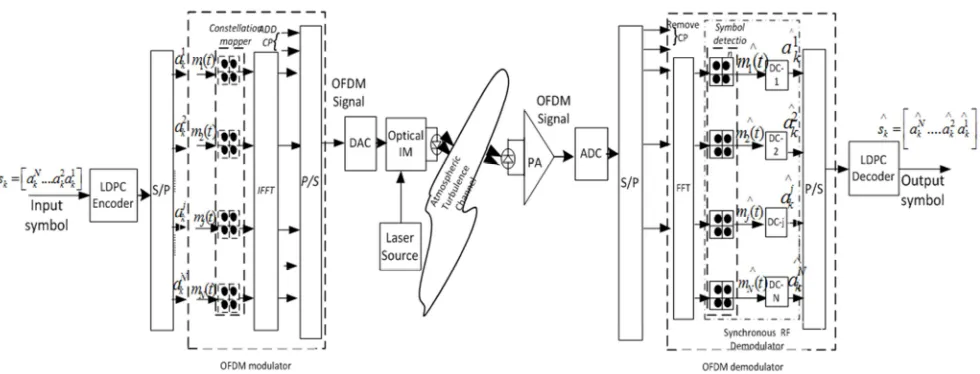
Figure 1. LDPC coded RF OFDM Subcarrier Modulated Optical Wireless Communication System with Optical Direct Detection Receiver followed by RF Synchronous Demodulator.
Most of the researches are performed in computer simulation form so it is difficult to realize the effectiveness of the parameters on the performances of OW communication link.
In this paper, we develop an analytical approach to investigate the performance of an OW communication link using LDPC code on RF OFDM modulation with optical intensity modulation in the presence of strong atmospheric turbulence. Analysis is developed to find the performance results analytically in terms of carrier to noise ratio and optimum number of OFDM subcarriers for a given BER for various link parameters.
2. System Model
The input data stream is paralleled and transmitted using N OFDM subcarriers. The data channels are modulated with PSK modulators and the modulators output are the input to Inverse Fast Fourier Transform (IFFT) block. Cyclic Prefix (CP) is added with the output of the IFFT block to mitigate the ISI effect and the overall output is sent to parallel to serial convertor. The output OFDM signal is encoded through LDPC encoder and the coded output is the given input to an electro optic intensity modulator (EOIM) and the EOIM output is then transmitted over an atmospheric turbulent channel.
At the receiving end the optical signal is detected by a direct detection receiver and the output photo detector current is amplified by a preamplifier. The output of the preamplifier is the LDPC coded OFDM signal with the effect of channel along with receiver noise. The output of the LDPC decoder is the received OFDM signal is passed through a serial to parallel converter. After removing the CP, the received samples are put to a Fast Fourier Transform (FFT) block and the output of the FFT is frequency domain signal of the OFDM subcarriers. Finally, the RF outputs are demodulated using synchronous demodulators followed by decision circuit (DC). The output of the DC is sent to parallel to serial
converter to achieve the original data stream.
3. Theoretical Analysis
The electrical field output of j-th subcarrier modulator is given by:
( )
(
)
j j
k k s j j
s
t
=
a
p t
−
k T
A c o s
ω
t
(1)where ωj is the j-th RF angular frequency. Aj is the amplitude
of the j-th subcarrier.
1
( ) ( )
N j
k k s j j
j
s t a p t k T A c o s
ω
t=
=
∑
− (2)Now the output of the subcarriers, sk are provided to IFFT
block and the output of IFFT can be written as:
{ }
1 20 1
( ) ( ) s
nt
N N j
NT j
IFFT k k s
n j
S t IFFT s a p t kT e
π −
= =
= =
∑∑
− (3)The IFFT block Samples SIFFT(t) at t=lTs which provides
( )
,2 1
0 1
(
)
o l
nl
N N j
j N
IFFT s k s
n j
A
S
lT
a p t
kT e
π
−
= =
=
=
∑ ∑
−
(4)To deal with inter carrier interference, a cyclic extension is added with the output of IFFT block. With the cyclic extension, the actual OFDM symbol duration is increased from Ts to T = Ts+ Tg, where Tg denote the length of a cyclic
extension. The samples are passes through a parallel to serial converter to produce OFDM signal.
The output of the intensity modulate optical carrier can be expressed as:
,
( ) 2 1 j ct
opt T a o l T
e t = P +k A H eω (5)
intensity modulation index and ωc is the optical carrier
angular frequency.
The received optical signal at the input to photodetector can be given as:
2 1
0 1
( ) 2 . ( ) 1 ( ) c ( )
nl
N N j
j t
j N
R a k s T b
n j
r t P I t k a p t kT e H e n t
π ω − = = = + − +
∑∑
(6)where PR=PT e-αLis the received optical power, α is the
attenuation coefficient of the atmospheric channel, L represents the link distance, nb is the background radiation
and I represents the turbulence induced fading. The current idat the output of the PD is given by:
( )
22
2 2
1 1
2 2
0 1 0 1
( )
2 ( ) 2 ( ) ( ) ( ) 2 ( ) ( )
d d
nl nl
N N j N N j
j N j N
d R d R a k s d R T a k s
n j n j
i t R r t
R P I t R P I t k a p t kT e h t R P I t H k a p t kT e
π π − − = = = = = = + × − + × −
∑ ∑
∑ ∑
(7)where Rd is the responsivity of the photodetector.
The received OFDM signal is given by:
2 1 0 1 2 1 0 1
2 ( ) 1 ( ) ( )
2 ( ) ( )
nl
N N j
j N
OFDM d R T a k s
n j
nl
N N j
j N
d R T a k s
n j
S R P I t H k a p t kT e n t
R P I t H k a p t kT e
π π − = = − = = = + − + ≅ −
∑ ∑
∑ ∑
(8)Now the received OFDM signal is put into the serial to parallel converter and removes cyclic extension from the output. Then the output is forwarded to FFT block and the output of the FFT can be expressed as:
{
}
1 1
0 0 1
1
2 ( ) ( )
FFT OFDM
N N N
j
d R T a k s
l n j
S FFT S
R P I t H k a p t kT N
− −
= = =
=
=
∑
∑ ∑
− (9)The output of the FFT is frequency domain signal on the receiving subcarrier. Now the RF outputs are demodulated through synchronous demodulator.
The signal at the output of the RF demodulator is given by:
1 1
0
0 0 1
1
( ) 2 ( ) ( ) ( )
N N N
j
d R a k s
l n j
y t R P I t k a p t k T n t N
− −
= = =
=
∑
∑ ∑
− + (10)The variance of the output noise no(t) is given by:
2 2 2
4
2 [ P . ( ) ]
n s h t h
d r a s c
L
k T
e B R I k A t B
R σ = σ + σ
= × + (11)
Now the Carrier to Noise Power Ratio conditioned on a given turbulence induced fading I can be expressed as:
( )
2
1
2 ( ) ( )
4
2 [ . ]
N j
d R a k s
j
d R a s c
L
R P I t k a p t k T
C N R I
k T
e B R P I k A B
R = − = +
∑
(12)Under LDPC coded condition, the conditional PDF of the channel LLR approaches Gaussian distribution with an increasing number of iterations and is given by [9]:
( )
2 2 2 2 2 2e x p
8 2 2 n n Z n I t P I I I σ σ π σ − = − (13) where
2 2 2
1 2 1 2 1 1 2 3
1
(2 ) (2 ) 4 ( )
2
k nk k nk k k nk n k n R
t
k
− + − + − + + −
= (14)
The unconditional PDF of the channel LLR is obtained by averaging over the PDF of I by applying the integral in equation as [9]:
( )
0(
| , 1)
( )Z Z
p t =
∫
∞ P t I r = + p I d I (15)where p(I) represents the probability density function of the received irradiance is given by: [13]
( ) ( ) /2
1 2
( ) 2( )
( ) (2 ), 0
( ) ( )
p I I K I I
α β α β α β αβ αβ α β + + − − = >
Γ Γ (16)
where α and β are PDF parameters describing the scintillation experienced by plane waves and in the case of zero-inner scale.
The PDF of the check node message is approximated to be Gaussian and is given by:
( )
1(
)
2e x p
4 4 u u u u t m p t m m π − = −
(17)
where is the mean value. The PDF of the bit node message can be obtained by convoluting (15) with (17) [13].
( )
( )
( )
D u z
p t = p t ⊗ p t (18)
The BER per subcarrier is given by [6]:
( ) 1
( )
2 2 2
N
C N R I
B E R I = erfc
(19)
( ) . ( )
A v g L D P C C o d e d D
B E R =
∫
B E R p t d t (20)For Large number of subcarrier, the total average bit error rate is given by:
1
1 N
O F D M n
n
B E R B E R
N =
=
∑
(21)4. Results and Discussion
Following the analytical approach provided in previous section, we evaluate the performance results of an LDPC coded OFDM OW communication link using Matlab. The parameters that are included for computation are listed in table below.
Table 1. System Parameters used for computation.
Parameters Symbol Values
Data rate Rb 10 Gbps
Bandwidth B 20 GHz
Code word length n 1024
Subcarrier number N 4 ~ 64
Laser wavelength λ 1550nm
PIN photo detector Responsivity Rd 0.85
Link distance L 1000 m - 3600 m
Subcarrier amplitude Asc 1
Received power PR -70 to 30 dBm Refractive index structure Parameter 2
n
C 10-14m-2/31& 10-15m-2/3
Figure 2. Plots of BER versus received power for OFDM FSO communication system under uncoded and LDPC coded condition.
The BER performances with respect to the received power for both uncoded and LDPC coded conditions are shown in figure 2. As expected the system performance improves
gradually by increasing the number of subcarrier and it improves further due to LDPC code.For example, the BER performanec shown by 16 RF OFDM subcarriers under uncoded condition are achieved by applying only 4 RF OFDM subcarriers with LDPC code.
Figure 3. Plots of BER versus received power for variable combinations of subcarriers under turbulent condition.
And the improvements in BER performance due to LDPC code with variable combination of subcarriers are shown in figure 3. The analytical observation shows that the system suffers power penalty due to atmospheric turbulence and the system performance gradually improves by increasing the number of subcarriers.
Figure 4. Plots of BER versus received optical power with different refractive index structure parameter.
-70 -60 -50 -40 -30 -20 -10
10-12 10-10 10-8 10-6 10-4 10-2 100
B
E
R
Received optical power, Pr (dBm) N=16 (uncoded)
N=16(LDPC coded) N=4(uncoded) N=4(LDPC coded) Cn2=10-14m-2/3 Code word length, n=1024 Link distance, L=3600 m
-70 -60 -50 -40 -30 -20 -10
10-12 10-10 10-8 10-6 10-4 10-2 100
B
E
R
Received optical power, Pr (dBm) N=16 (uncoded)
N=16(LDPC coded) N=4(uncoded) N=4(LDPC coded) Cn2=10-14m-2/3 Code word length, n=1024 Link distance, L=3600 m
-70 -60 -50 -40 -30 -20 -10
10-12 10-10 10-8 10-6 10-4 10-2 100
Received optical power, Pr (dBm)
B
E
R
64
Cn2=10-15m-2/3 Cn2=10-14m-2/3
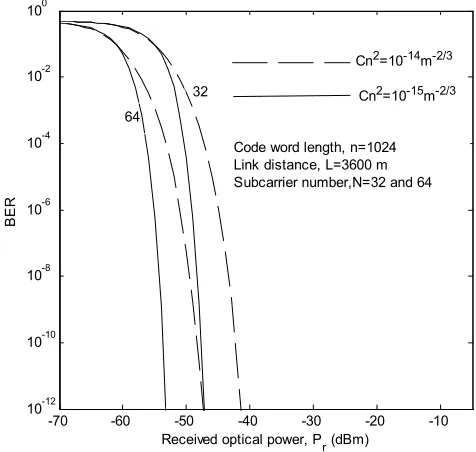
Figure 4 shows the plots of BER versus received optical power with two different refractive index structure parameters. From the figure it is found that the system performance improves by changing the refractive index structure parameter, Cn2 from 10-14 to 10-15.
Figure 5. Plots of BER versus Received optical power with different code word length.
The BER performances with respects to the received optical power for two different code word lengths are shown in figure 5. Figure demonstrates that the changing effect is not impressive on BER performances.
Figure 6. Plots of BER versus received power with variation of link distance (m).
Figure 6 illustrated that the error performance deteriorates as link distance is increasing from 1000m to 3600m.
Moreover, it is evident that the system performance is less dependent on length when it increases from 3000 m to 3600 m compare to L increases from 1000m to 2500m.
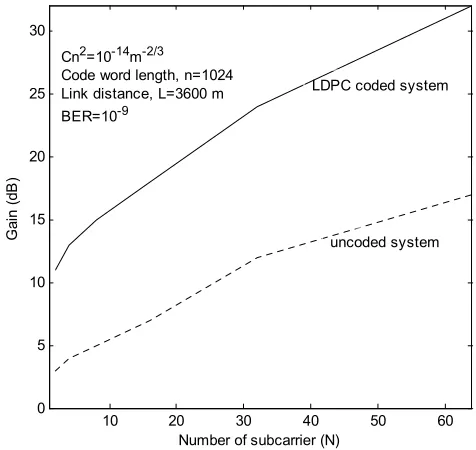
Figure 7. Plots of Gain versus number of subcarrier for both uncoded and LDPC coded system.
Next we compare the performance gain due to LDPC code in OFDM OW system. In figure 7 it is found that LDPC coded system offer a coding gain at a given BER compared to uncoded system. Results show that, coded OFDM in FSO provides 15 dB improvements over uncoded system at a BER of 10-9 for a link distance of 3600 m with 64 OFDM subcarriers.
5. Conclusions
An analytical approach is presented to evaluate the bit error rate performance of an LDPC coded OFDM optical wirelesscommunication system in presence of atmospheric turbulence which is modeled as gamma-gamma distribution. The analysis shows that system suffers severely due to atmospheric turbulence. But the hybrid technology that combines LDPC code with OFDM modulation may be a good candidate for OW communication under turbulent condition. Analysis also show that, OFDM itself provide better performance than FDM condition and LDPC coded OFDM system provides 12 to 15 dB improvements at BER of 10-12 over uncoded OFDM system. So the results of this research will find applications in design of high performance optical wireless link under turbulent condition.
Acknowledgements
The work is carried out as a part of PhD dissertation in the Department of Electrical and Electronic Engineering, Bangladesh University of Engineering and Technology, Dhaka, Bangladesh.
-70 -60 -50 -40 -30 -20 -10
10-12 10-10 10-8 10-6 10-4 10-2 100
Received optical power, P
r (dBm)
B
E
R
64
Cn2=10-15m-2/3 Cn2=10-14m-2/3
Code word length, n=1024 Link distance, L=3600 m Subcarrier number,N=32 and 64 32
-70 -65 -60 -55 -50 -45 -40 -35 -30 -25
10-12 10-10 10-8 10-6 10-4 10-2 100
B
E
R
Received optical power, Pr (dBm)
L=1000 m 1500 m 2000 m 2500 m 3000 m 3500 m
Code word length, n=1024 Link distance, L=3600 m Subcarrier number,N=64
10 20 30 40 50 60
0 5 10 15 20 25 30
Number of subcarrier (N)
G
a
in
(
d
B
)
Cn2=10-14m-2/3
Code word length, n=1024 Link distance, L=3600 m BER=10-9
LDPC coded system
References
[1] M. N. O. Sadiku and S. M.Musa, “Free Space Optical Communications: An Overview” European Scientific Journal vol. 12, no. 9 pp-55-68, 2016.
[2] H. Kaushal Viswanath, , V. K. Jain and S. Kar, “Evaluation of performance of ground to satellite free space optical link under turbulence conditions for different intensity modulation schemes,” Proc. SPIE, Free Space Laser Comm. and Atmosph. Prop. (XXVI), vol. 8971, 2014.
[3] W.O. Popoola and Z. Ghassemlooy, “BPSK subcarrier intensity modulated free-space optical communications in atmospheric turbulence” J. Light wave Technology, pp. 967– 973, 2009.
[4] B. Barua and S. P. Majumder, “Analytical Performance Evaluation of a Multiple Subcarrier Modulated FSO Communication System with Coherent Optical Receiver under Strong Atmospheric Turbulence” 2017 IEEE International Conference on Telecommunications and Photonics (ICTP), Dhaka, Bangladesh , 2017.
[5] X. Tang, S. Rajbhandari, W. O. Popoola, Z. Ghassemlooy, S. S. Muhammad, E. Leitgeb and G. Kandus, “Performance of BPSK Subcarrier Intensity modulation Free-space optical communications using a Lognormal Atmospheric Turbulence Model” IEEE Conference , pp. 17 - 20, 2010.
[6] B. Barua and S. P. Majumder, “Performance Analysis of a Multiple Subcarrier Modulated FSO Communication System using Direct Detection Optical Receiver under the Effect of Weak Atmospheric Turbulence,”J. Opt. Communications 2 1-9, 2018.
[7] Armstrong, “OFDM for optical communications,” IEEE/OSA Journal of Lightwave Technology, vol. 27, no. 3, pp. 189-204, 2009.
[8] Bekkali, C. B. Naila, K. Kazaura, K. Wakamori and M. Matsumoto, “Transmission analysis of OFDM based wireless services over turbulent radio-on-FSO links modeled by Gamma⁃Gamma distribution,” IEEE Photonics Journal, vol. 2, no. 3, pp. 509-520, 2010.
[9] S. Zhao, X. Ma, X. Zhang and B. Bai, “A class of non binary LDPC codes with fast encoding and decoding algorithms,” IEEE Trans. Commun., vol. 61, no. 1, pp. 1–6, 2013.
[10] B. Djordjevic, B. Vasic and M. A. Neifeld, “LDPC coded OFDM over the atmospheric turbulence channel,” Optics Express, vol. 15, no. 10, pp. 6337-6350, 2007.
[11] X. Liu, P. Wang, T. Liu, Y. Li, L. Guo and H. Tian, “ABER Performance of LDPC-Coded OFDM Free-Space Optical Communication System Over Exponentiated Weibull Fading Channels With Pointing Errors”, IEEE Photonics Journal, vol. 9, no. 4, pp. 1-14, 2017.
[12] E. T. Scharlemann, E. F. Breitfeller, J. R. Henderson, J. S. Kallman, J. R. Morris andA. J. Ruggiero, “Modeling of long-range atmospheric laser com links between static and mobile platforms,” in SPIE's 48th Annual Meeting Optical Science and Technology, pp. 272-279, 2004.
[13] M. A. Kashani, M. Uysal and M. Kavehrad, “An ovel statistical channel model of turbulence Induced fading in free space optical systems,” IEEE/OSA Journal of Lightwave Technology, vol. 33, no. 11, 2303-2312, 2015.
[14] J. Navas, G. Balsells, J. M. Paris and J. F. A. Puerta Notario, “A unifying statistical model for atmospheric optical scintillation,” invited chapter in Numerical Simulations of Physical and Engineering Processes. Rijeka, 2011.