http://www.sciencepublishinggroup.com/j/cm doi: 10.11648/j.cm.20190301.13
Development and Characterization (Thermo-Mechanical
and Morphological) of Completely Biodegradable
Composites of Polypropylene (PP) Reinforced Short
Natural Fiber Jute
Md. Nazrul Islam
1, *, M. A. Gafur
2, Md. Sahadat Hossain
31
Department of Physics, Primeasia University, Banani Dhaka, Bangladesh 2
PP and PDC, BCSIR, Dhaka, Bangladesh 3
Department of Chemistry, Primeasia University, Banani Dhaka, Bangladesh
Email address:
*
Corresponding author
To cite this article:
Md. Nazrul Islam, M. A. Gafur, Md. Sahadat Hossain. Development and Characterization (Thermo-Mechanical and Morphological) of Completely Biodegradable Composites of Polypropylene (PP) Reinforced Short Natural Fiber Jute. Composite Materials.
Vol. 3, No. 1, 2019, pp. 22-29. doi: 10.11648/j.cm.20190301.13
Received: October 17, 2018; Accepted: November 9, 2018; Published: April 12, 2019
Abstract:
The composites of biodegradable Polypropylene (PP) reinforced with short jute fiber were prepared by melt mixing followed by hot press molding. The composites were prepared with the aim to develop new biodegradable materials for different applications. Jute fiber is well known for its biodegradable properties but PP is not biodegradable material. The combination of the two materials will lead to the biodegradable properties in some extent as well as higher mechanical properties. The mechanical properties, thermal properties, micro structural analysis and morphologies of the composites were studied via UTM (Universal Testing Machine), Thermo gravimetric analysis (TGA) and Scanning electron microscopy (SEM) respectively. The mechanical properties like tensile strength (TS), tensile modulus (TM), flexural strengths (FS) and flexural modulus (FM) were measured for both treated and untreated specimens and compared. The results show that alkali treated jute reinforced composites have much better properties than the untreated one. The TS, TM, FS and FMwere decreased with increasing of untreated fiber and increased with the increasing of treated fiber in PP-Jute composites (PPJC). The changes in the mechanical properties were broadly related to the accompanying modifications and interfacial bonding of PPJC. Scanning Electron Microscopic image observations indicated good interfacial contact between the short jute fiber and PP matrix. Thermal analysis (TG /DTG) revealed that the introduction of short jute fiber led to a slightly improved thermo oxidative stability of PP-Jute composites.Keywords:
Mechanical Properties, Thermal Properties, Composites, Jute Fiber, Biodegradable1. Introduction
There are currently many types of reinforcing fibers used in composite materials. The low cost glass fibers reinforcing with polymer matrix are the common polymer composites and are used in many high volume applications. The disadvantages of glass fibers are that they have a relatively low modulus and poor abrasion resistance, which decreases its potential strength [1]. Jute fiber has received considerable attention for its diversified use both in academic and industrial research. Biodegradable plastics such as
thermoplastics. Natural plant based lingo-cellulosic fibers are attractive reinforcing materials than the non degradable fibers like glass fiber, carbon fiber and aramid fiber etc. A number of studies have been carried out on biodegradable thermoplastics reinforced with the fibers have been reported. The presence of hydroxyl and polar groups in various constituents of jute accounts for its high moisture region value leading to poor adhesion with the polypropylene [4]. Therefore to develop jute composites with better environmental performance under different temperature conditions, it is necessary to decrease the hydrophilicity of the fibers by chemical treatments like bleaching, alkali treatment or grafting with radiation or with various organic polymeric materials and surface coating. Such modifications of jute fiber not only are expected to decrease water absorption but also to improve interfacial bond strength as well as to improve mechanical properties. Bleaching if jute fiber with sodium chloride has been carried out to decrease its hydrophilicity [5-6]. A Study has been carried out on the moisture-absorption characteristics of jute composites based on polyester and epoxy resin systems by Rao et al [7], who reported that the rate of moisture absorption increased with increase in the fiber volume fraction. Surface modification of jute fiber has also been achieved with phenol- formaldehyde resin and this modified jute has been used for preparing composites with polyester resin by Ghosh and Ganguly [8]. Such composites were found to exhibit greater weathering resistance as they could retain better mechanical properties after exposure to water and moisture for different periods. Very recently, Rajulu et al [9], examined the properties of the natural, lignocellulose fabric known as Hildegardia. This natural fabric is available with fibers in the uniaxial direction that are slightly interwoven and loosely bound with one another. This fiber possesses good mechanical properties with low density and can be used as reinforcement in polymer composites. Some modification of these fibers has been carried out to further improve the fibers mechanical properties [10].
In this article, we report the PPJC composites, prepared in a very typical method developed by us. Besides this, we also report the thermal properties of the composites. Very little work has been reported on the thermal stability of jute based composites in the literature. Rana et al [11] investigated the thermal analysis of untreated and chemically treated jute fibers, while thermal characterization of jute composites was studied by Mitra et al [12].
In this work, attempt was made to study the water–uptake capacity, to develop completely biodegradable composites with applicable mechanical properties and thermal stability of a polypropylene composites reinforced with untreated and alkali treated jute fibers designated as PPJC.
The principal factors which affect various properties are matrix structure, processing and use of fillers or reinforcements [13]. The extent of water absorption, tensile strength and flexural modulus and thermal properties (TG/DTA), structural properties (SEM) of both types of composites were analyzed and compared. The successful
blending between PP and natural fibers provided an easier way both to upgrade the PPJC’s mechanical and thermal properties and to prepare completely biodegradable material.
2. Experimental
2.1. Materials
Polypropylene (PP T101) used in this work had a specific gravity of 0.9. Jute fibers (Bangla Tossa-B) were collected from PP and PDC, BCSIR, Dhaka, Bangladesh. Fibers were chopped and kept at 110°C for 24 hours to remove moisture. The length of the fibers was approximately 2-3 mm and sieved with 2 mm sieve (DIN IS03310/1, w=2mm, FRITSCH). Same procedure was also applied to remove moisture from PP granules. Sufficient amount of fibers was placed in to RB flask container with a 20% NaOH solution at room temperature for 15 minutes. After that the fibers were taken into another container and washed thoroughly by distilled water several times. Alkali treated fibers were again neutralized with dilute sulfuric acid solution and rinsing them for several minutes and again washed with distilled water following the method of Guha Roy et al [14]. After treatment, the fibers were naturally dried for 48 hours.
2.2. Composites Fabrication
PP and chopped fibers (both untreated and treated) were oven-dried at 110°C for 1 hour for drying. A blender (Philips, India) was used to mix the fiber and PP at room temperature for a period of 2 minutes at 400 rpm. The mixtures are taken in a die or mold after using a little amount of mold releasing agent. An initial of 50 KN load was given to top of the mold area then the mold (6"×6") was kept in a Paul-Otto-Weber Press machine. The total heating system was controlled by microprocessor. Heating was done electrically and the temperature was set at 180°C. Only 25–30 minutes were required to reach the temperature at 180°C. The temperature was kept at that temperature for 20 minutes. After reaching the temperature the final load of 50 KN over the sample area was set to avoid the kind of voids and to have a required thickness. Then pressure was increased up to 100KN and stopped the heating system. Cooling was done by water flow through the outer area of the heating plates. After cooling the specimens were separated from the mold. From these specimens, the samples of different size were cut as per requirement for different tests. All these specimens were collected into ASTM standard.
2.3. Water Absorption
Water absorption test was carried out as per the ASTM D570-81 (Reapproved1980). Rectangular bars of length 75-76 2mm of length and width of 25.4 mm were cut from the prepared samples. A protective gel coat (araldite) was applied on the cut sides to prevent penetration of water from the cut sides. The samples were conditioned for 24 h at 50± 3°C and then cooled in a desiccator. The weights of the samples (w1)
immersed in distilled water for 24 h at 24°C. The samples were then removed from the water, dried by presenting in a cotton cloth, and weighed. This gave the wet weight of the sample (w2). The samples were reconditioned again for 24 h
at 50± 3°C in a dried condition and reimmersed in distilled water again. The samples were taken out of the water after the test period, dried, and reweighed (w3). This gave the final
weight of the sample after the removal of soluble matter, if any, in the composite. The following relations were used:
Present increase in weight due to water absorption = (w2 –
w1)/ w1 x 100
Percent of soluble matter lost = (w1 – w3)/ w1 x 100
Percent of water absorption = [w2 – w1)+ (w1 – w3)]/ w3 x
100 =(w2 – w3)/ w3 x 100.
2.4. Mechanical Properties (Tensile/Flexural)
According to ASTM D 638-98 and ASTM D 790-98 both tensiletest flexural test were done respectively. Specimens were placed in a chamber at 25°C ± 3°C and 50% ± 6% relative humidity for 24 hours. The specimens were then tested using a HOUNSFIELD–H10KS machine fitted with a 10KN load cell and operating at a cross-head speed of 1 mm/min.
2.5. Morphology Observation
The fractured surfaces of the tensile test specimen’s sample with dimensions of 5x5 mm2 were examined using Hitachi S-2600N Field Emission Scanning Electron Microscope, operated at 25 KV. Samples were mounted with carbon tape aluminum stubs and then sputter coated with platinum and paladium to make them conductive prior to SEM observation.
2.6. Thermogravimetric Analysis (TGA)
Thermal stability of the composites was examined with a SEIKO EXTAR 6000 (TG/DTA 6300) under a nitrogen protective atmosphere. Temperature profile was from 30-600°C at a heating rate of 200 C/min.
3. Result and Discussion
3.1. Water Absorption Report
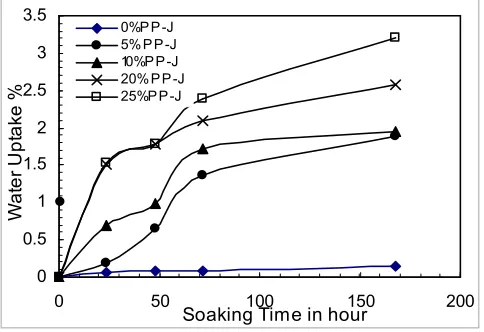
The effect of water absorption on soaking time is shown in figure 1for PPand PP-J composites. This observation revealed that water absorption depends on the fiber addition and soaking time. For all the composites the water absorption increased with the increase of fiber addition and soaking time. With the addition of treated fiber in pp this absorption rate decreases. The water uptake ability of these composites was measured by socking the composites in water contained in a static bath for different period of 24, 48, 72 and 168 hours and are shown in Figure 1. The water absorption by both composites was very fast within the initial 24 hours, and then the socking rate decreases. Water absorption results for both the composites are presented in Table 1. It was also seen
that the composites without alkali treated fiber show substantially higher water absorption than the composites with alkali treated fibers. This might due to the presence of lower water absorption rate in the treated fiber composites due to absence of cellulose and void space in the composites. Similar result was observed by Andrzejet al [14] due to absence of cellulose and void space in the Wood Fiber Reinforced Composites. It was interesting to note that the bulk density increased with the addition of fiber in the composite and follows the mixture rule (Table 2). Similar result was observed by Kuriger Alam [15]. The slope of the density curve of untreated fiber reinforced composite was higher than that of treated fiber composite.
Figure 1. Effect of water uptake of PP and PPJC.
Table 1. Water uptake result for PP-J Composites at 30°C & R.H65%.
Fiber wt.%
Water uptake%
0 Hour 24 Hours 48 Hours 72 Hours 168Hours
0% 0 0.069955 0.03497 0.03497 0.139909
10% PP-J 0.157874 0.193502 0.6527 01.1055 1.58
15% PP-J 0.297619 0.696958 0.9777 1.723658 1.9504
20% PP-J 0.554871 1.511099 1.785714 2.088141 2.5801
25% PP-J 0.582098 1.58113 1.9779 2.395697 2.4405
3.2. Mechanical Properties of PP-Jute Fiber Composites
Figure 2. Effect of fiber addition on Tensile strength for both untreated and
treated PPJC.
0 0.5 1 1.5 2 2.5 3 3.5
0 50 100 150 200
Soaking Time in hour
W
a
te
r
U
p
ta
k
e
%
The results of tensile and flexural strength for both untreated and treated PP with the addition of jute fibers are presented in Figure 2 and figure 3. It revealed that the tensile strength of the fabricated product reached to a maximum at 10% fiber (by weight) and then decreased. Flexural strength increased rapidly up to 10% of the composites and after that it increased slowly. The ultimate tensile strength (UTM) for both untreated and treated PPJC tends to steady at the higher percentage of PPJC. Up to 10% the fibers and polymer were well distributed in PPJC and within these compositions addition of the fiber and matrix bear the load and fibers made resistance to slip as in the case of age hardening of metals. After that, fibers were present as bundle of fibers and fiber-fiber bonding strength was laser. However, in the case of
treated PPJC, the tensile strength was higher at all the weight percentages offibers than that of untreated composites. By using the alkali treated fiber composite, tensile strength increased with the increasing of fiber volume fraction in the composites.
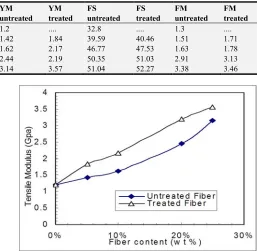
Figure 4 and figure 5 shows the effect of tensile and flexural modulus on fiber content wt.% curve respectively. It revealed that the tensile modulus of treated fiber in PPJC was faster but the increasing rate of tensile modulus of untreated PPJC was slower. This might be because of the alkali reacted with the cementing hemicelluloses [17]. This led to the destruction of the mesh structure of the fiber and splitting of the fibers into fiber filaments [14].
Table 2. Static Mechanical Properties of PP Composites Reinforced with Untreated and Treated Jute Fibe.
Sample Density untreated
Density treated
TS untreated
TS treated
YM untreated
YM treated
FS untreated
FS treated
FM untreated
FM treated
PP 0.934 ... 28 .... 1.2 .... 32.8 .... 1.3 ....
PP/5%fiber 0.95 0.964 29.28 30 1.42 1.84 39.59 40.46 1.51 1.71
PP/10%fiber 0.96 0.975 30.53 32.08 1.62 2.17 46.77 47.53 1.63 1.78
PP/20%fiber 0.98 1.01 24.56 25.49 2.44 2.19 50.35 51.03 2.91 3.13
PP/25%fiber 0.99 1.03 23.99 24.90 3.14 3.57 51.04 52.27 3.38 3.46
The elastic moduli of fiber for instance were expected to increase with increasing degree of molecular orientation. It was obvious that the alkali treatment results in an improvement in the interfacial bonding by giving rise to additional sites for mechanical inter locking, hence promoting more matrix-fiber inter penetration and the interface. The elastic and bending moduli were remarkably higher than those of virgin PP and they were almost independent of whether treated fiber was added or not as shown in Table 2. The moduli were determined from the initial slope of the stress-strain curve. At the initial slope, only a very small strain region could be considered, which was practically not influenced by the interface between fiber and matrix. The fracture modes predominantly consisted of weft fiber–matrix interfacial debonding and matrix fracture followed by fiber breakage and pull out in the fiber bonding [18-20].
Figure 3. Effect of the fiber addition on Flexural Strength for treated and
untreated PPJC.
Figure 4. Effect of fiber addition on tensile modulus for both treated and
untreated PPJC.
Figure 5. Effect of fiber addition on Flexural modulus for both treated and
3.3. The Effect of Fiber Pre-treatment on Composite Properties
Alkali treatment has been successfully used toremove lignin, hemicelluloses and other alkali soluble compounds from the surface of the fiber, thus increasing the number of reactive hydroxyl groups on the fiber surface available for chemical bonding. Alkali treatments in PPJC improved interfacial bonding and strength properties in the composites due to complete removal of natural and artificial impurities [11]. Alkali treatment also have the effect of separating the individual fibers from their bundles as well as roughening up the fiber surface to aid mechanical interlocking between the fiber and the matrix. Thus bonding between the fiber and the matrix at the interface may be improved. The increase in stiffness was thought to be due to an increase in crystalline of the fiber cellulose making the fiber more rigid and brittle. When stress was applied, these fibers suffered breakage due to increased brittleness.
3.4. Morphology
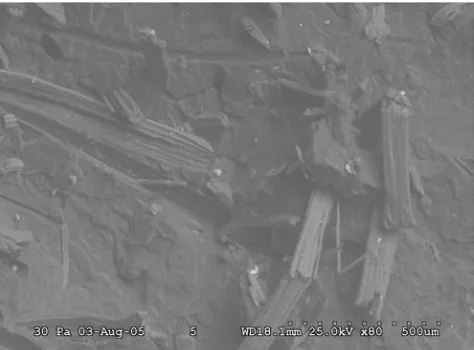
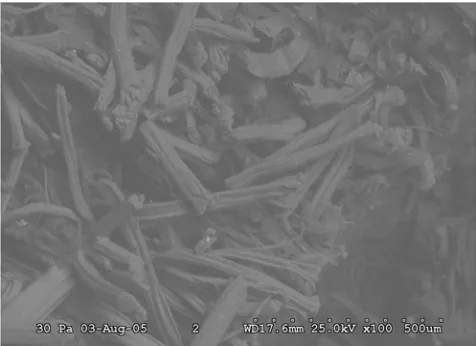
The main reason for the mechanical properties in jute fiber composites was poor bonding between the fiber and matrix. This was evident in the micrographs obtained from Scanning Electron Microscopy. Figure 6. illustrates the SEM of fracture surface of PPJC. Figure 6 shows that untreated fiber surface was recognizable in its virgin state. In this case, a gape between untreated jute fiber and PP matrix was found, caused supposedly by the thermal shrinkage of PP melt [17]. Figure 7 shows that treated fiber surface was covered by thin layer of matrixpolymer. This indicated a good adhesion between jute fiber and PP.It was observed from the Figure 6 that there were some void spaces around the jute fibers and also there were some spaces where jute fibers had been pulled out. These might be due to the poor adhesion between jute fibers and polymer matrix in the absence of alkali treated fibers. However relatively less void spaces and lower proportion of pulled out jute fibers were observed in Figure 7. This represents the microstructure of treated 10% PPJC. These indicated that there were some kinds of interfacial contact between fiber and pp matrix due to fiber treatment. It meat that alkali treated PPJC produced good adhesion between jute fiber and polymer matrix. This was expected from the increased tensile strength. This fiberdebonding was also observed in Figure 8 for untreated 25% fiber pp matrix composite, where as in Figure 9, it revealed that bonding between the fiber and the matrix at the interface might be improved. The increased stiffness in spaces were thought to be due to the increase in crystallinity of the fiber cellulose making the fiber more rigid and brittle.
Figure 6. SEM of fracture surface of 5% untreated PPJC.
Figure 7. SEM of fracture surface of 5% treated PPJC.
Figure 9. SEM of fracture surface of 25% Untreated PPJC.
3.5. Thermal Behavior
Figure 10 and 11 show the TGA curves for jute fibers and pp, pp-jute fiber composite and untreated and treated JPCS. From figures 10, it was clear that the top one was for PP, bottom one was for fiber and middle one was for composite. These figures revealed that the TG of composites was the average of the two curves of fiber and PP. As the composites contained only 10% fiber, the wt. loss due to moisture of composite was lesser than that of fiber. These figures showed that major degradation occurs at one stage for both the fiber and PP at a single stage, but it occured at two for the composite. The initial stage/1st stage was related to fiber, whereas the 2nd stage was related to PP. The 5% weight loss temperature (T 5%) and maximum weight- loss temperature
(Max’s) were listed in Table 4 for the fiber and composite. In
fig. 11, both T 5% and Tmaxof thefibers increased steadily with
the adding of PP for both treated and untreated fibers. Because PP possesses higher T 5% and Tmax than thatof fibers.
Thus the introduction of this fiber in to the PP-matrix could improve the thermal stability of the composites. The major weight losses, under nitrogen, for treated and untreated PP-J composites, occured at 489.1710°C and 475.10°C. The weight% remaining at 600°C was 24.5%. The results shown
in table 4 indicated that initial decomposition temperature of the pure PP was higher than that of both the PP-J composites and had a higher weight% of residue at 600°C at the heating rate of 20°C /min. This thermal behavior was also observed in previous paper [18-30]. We could also see that the PP-J composites containing alkali treated fibers exhibit a higher thermal stability than those containing untreated jute fibers. A strong NaOH treatment had been successfully used to remove lignin, hemi- cellulose and other alkali soluble compounds from the surface of the fiber, thus increasing the number of reactive hydroxyl groups on the fiber surface available for chemical bonding [14].
Table 3. Thermal proper of jute fiber, PP and PP, PP-J composites.
Specimen Tmax 1 (°C) Tmax 1 (°C) Tmax (°C)
Untreated fiber 281.94 380.63 209.72
Treated fiber 285.65 378.394 241.814
PP 386.638 466.456 380.508
PP-J (untreated) 351.348 475.13 313.56
PP-J (treated) 405.338 489.171 320.311
The TGA data and differential thermogravimetric curves for the PPJCS with untreated and treated fibers were shown in Figures 12 and 13, respectively and tabulated in Table 4. We can see that the major weight loss peak at 489.1710°C - 475.10°C is the fiber component of the PP-J composites. It could be seen that the thermal degradation of such composites occurs at two stages under a nitrogen atmosphere and are shown in Table 5. Increase of untreated PP-J composite, the first stage, weight loss started at 351.348°C with 21.564% weight loss. The second stage 94.25% was completed by 475.13°C. The weight percentage remaining at 500°C is 5.12%. It could also be seen that the thermal degradation of treated PP-J composite occurs at two stages under a nitrogen atmosphere. In the first stage, weight loss started at 405.338°C with 20.876% weight loss. The second stage 95.422% was completed by 489.171°C. The weight percentage remaining at 500°C is 5.12%. Thus, it might be attributed that composites were thermally stable up to 500°C. Similar thermal behavior was also observed in previous reports [22-24].
Table 4. Weight loss of PP, Untreated and Alkali treated Jute fiber Composites.
Specimen First stage temperature
First stage weight loss (%)
Second stage temperature
Second stage weight loss
Weight remaining at 500 °C
PP 386.638 4.52 466.456 99.960 0.1
PP-J (untreated) 351.348 21.564 475.13 94.25 5.12
PP-J (treated) 405.338 30.876 489.171 95.43 4.4
It was clear for all the composites that in the first region the weight loss may be due to the removal of moisture or water content and some unreacted or loosely bound elements in the main chain, which was not necessarily associated with any change in the structure. The second region might be attributed to the loss of non-constitutional or due to evolution of hydrogen and low molecular hydrocarbon and some oxygen containing compounds. The maximum loss was at Tmaxfor char formation in the noncompatibilized composite.
In this region the weight loss might be caused by the oxidative thermal breakdown of the composite structure and expulsion of higher molecular mass hydrocarbons, oxygen containing compounds (CO2, CO etc.). It was thus seen that
Figure 10. TG profile of jute fiber, PPand PPJC.
Figure 11. TG Profile of trt. and untrt. fiber.
Figure 12. TG profile of untreated PPJC. Figure 13. TG profile of treated PPJC.
0 20 40 60 80 100 120
0 200 400 600
Tem perature (oC)
T
G
%
-500 0 500 1000 1500 2000
D
T
G
TG (%) DTG [ug/min]
0 20 40 60 80 100 120
0 200 400 600 800
Tem perature 0C
T
G
%
-500 0 500 1000 1500 2000 2500
D
T
G
(
m
ic
ro
g
ra
m
/m
in
)
TG [%]
4. Conclusion
Alkali treated fiber composites improved interfacial bonding and strength of the JPC due to removed of natural and artificial impurities. NaOH in JPCs played a very important role in improving the adhesion between jute fiber and polypropylene matrix. Fiber volume percentage in the composites might have contributed to their superior strengths and moduli. Tensile and bending strength of treated JPCs were improved than the untreated JPCs. In the case of 10% fiber (by weight) composites have better flexural strength compared to other percentages of PP-J composites. These improvement in the mechanical properties was broadly related to the state of polypropylene impregnation into the fiber-matrix. Scanning electron microscopy of fracture surfaces indicated that the fracture behavior was brittle. The thermo gravimetric measurements also revealed that the introduction of jute fibers into PP lead to an increased in the decomposition and the thermal stability of composites with treated fibers was improved as compared with that of untreated fiber. We could also see that the PP composites containing alkali treated fiber exhibit a higher stability (T-5%) than containing un-treated
fibers which indicated that PP was less hydrophilic than are PP-J composites. It was clear that the overall thermal stability of PP-J untreated composites was greater than that of treated PPJC which may be due to the presence of lignin and other constituents in the fiber which are acting as a thermal stabilizer in the composites. FTIR report clearly indicates that no structural change for the lignin in the jute fabric was observed upon alkali treatment. The usual C-OH stretching was characterized through the C-OH stretching.
Declaration
There is no conflict of interest regarding this manuscript.
Acknowledgements
The authors are grateful to the BCSIR Dhaka, Bangladesh for supporting all kinds of fabrication, mechanical test and other testing facilities of jute-polypropylene composites.
Funding of This Manuscript
There is no funding related to the research work.
References
[1] Natural Science Foundation of China (NSFC) (Key project, Grunt 29734120), the Natural Science Foundation Guangdong province (Team project, grunt 015007), the key strategic project of Chiness Academy of Science (grunt KJCX2-206B). [2] Doi, Y.; Fukuda, K. In Biodegradable, Plastics and Polymers.
Proceedings of the Third International Scientific Workshop on Biodegradable Plastics and Polymers, Osaka, Japan, November 9-11, 1993, Elsevier; Amsterdam, 1994.
[3] Vert, M,; Feijen, J,; Albertsson, A.; Choellini, E.
Biodegradable Polymers and Plastics; The Royal Society of Chemistry, London, 1992.
[4] Ranna, A. K.; Basak, R. K.; Mitra, B. C.; M.; Banerjee, A. N. J ApplPolymSci 1517.
[5] Phillip, A. R. ReinfPlast 1964, 8, 306. [6] Phillip, A. R. Eng. Mater 1965, 8, 475.
[7] Rao, A. N.; Lakkad, S. C. FibreSciTechnol 1981, 15, 41. [8] Ghosh, P. J. Ganguly, P. K. Plast. Rubb ComposProcAppl
1993, 20, 171.
[9] Rajula, A. V,; Babu, Rao, G.; Ravi. Prasad Rao, B, J ApplPolymSci 2002, 84, 2216.
[10] Rajulu, A. V,; Li, X. H; Meng, Y. Z. Babu, Rao, G,; Ganga Devi, L, Raju, K,; Raju, K,; Ramakrishna Reddy, R. J ApplPolymSci 2003, 90, 1604-1608.
[11] Ranna, A. K.; Basak, R. K.; Mitra, Banerjee, A. N. J Appl Poly Sci 1997, 1517.
[12] Mitra, B. C.; Basak, R. K.; Sarkar, M. J ApplPolymSci 1998, 67, 1093.
[13] Guha Roy, T. K.; Chatterjee, S. K.;. Adhikari, D.: Mukherjee, A. K. J. Text Inst. 1988, 79, 108.
[14] Andrzej K. Bledzki, Omar Faruk, MominulHuque. Phico – mechanical studies of wood fiber reinforced composites. International conference Thermal Engineering 2001–2002, Dhaka, Bangladesh.
[15] R. JKuriger, MkhirulAlam, Thermal Properties of Carbon Fiber Reinforced Polypropylene, Bsme-Asme Int. Conf. on Thermal Engineering, 31Dec 2001-2 Jan - 2002.
[16] M. D. H Beg and K. L. Picking, The 2ndInternational Conference on structure, Processing and properties of materials SPPM 2004, 25-77 Feb, 2004, Dhaka, Bangladesh pp 24-27.
[17] D. Ray, BK Sarkar, AK Rana and N R Bose (2001). “The mechanical properties of vinylester resin matrix composites reinforced with alkali–treated jute fibers Composite”. Part A. Applied Science and Manufacturing vol.32 (1). pp 119 – 127. [18] O. A. Khondker& US Ishiaku, ANakai. H Hamada.
“Processing and Mechanical properties of jute thermosetting composites reinforced with Waves and Flat Braided Fabrics”. The 2nd international conference on structure processing and properties of materials, SPPM 2004, 25-27 Feb pp 224 – 231. Dhaka, Bangladesh.
[19] D S Varma, M Vera, I K Varma (1984) Textile Research Institute 54. pp 349.
[20] Mohanty M. Misra and G. Hinrichsen, “Biofibers, bio degradable polymers and biocomposites’’. An over view Macromol, Master Eng (India) 2000. 276/277, 1-24
[21] Andrzej K. Bledzki, Omar FarukMominulHaque, BSME-ASME Conference On Thermal Engineering-31 Dec.2001-2, January-2002, pp 746-750, Dhaka, Bangladesh.
[22] D. J. Liaw and W. F. Lee, J, J Appl. Polym. Sci, 30, 4697 (1958). [23] W. F. Lee, J, J. Appl. Polym. Sci, 37, 3263 (1989).