R E S E A R C H
Open Access
Towards a paradigmatic description of context:
systems, metafunctions, and semantics
Ruqaiya Hasan
Correspondence: [email protected] Department of Linguistics, Macquarie University, New South Wales 2109, Australia
Abstract
This article hopes to make a contribution to the growing body of work on the paradigmatic description of context of situation. Having considered the limited achievements of earlier work on context, I offer a fairly detailed account of what is entailed in producing a consistent and precise description of a linguistic category by using the principles and methods of the paradigmatic mode of description devised by the systemic functional linguistics. The system network is a powerful device for an accurate and orderly representation of such a description. The paper will close with remarks on the importance of a scientific analysis of language use (parole) in developing a comprehensive post-Saussurean linguistic theory.
Keywords:Context-metafunction resonance; System networks (sys-net); Individual system; Siultaneous sets; Options; Choice; Entry point; Realisation; Selection expression (SE); Accuracy; Consistency
Background
The main aim of this paper is to contribute to the description of the contextual parameters of field, tenor and mode by focussing on what part each parameter plays in the production of a text, which, in fact, is nothing more than the meaning-wording produced by the interactants as they speak with reference to some social practice. Given that these parameters were first introduced nearly half a century ago (Halliday et al., 1964), and that they have been in use over this long period, one might wonder why the issue has arisen now. The significant factor is the move in the last couple of decades to produce paradigmatic accounts of field, tenor and mode; and these accounts are now becoming more widely available (Bowcher 2007; 2014; Butt 2004 mimeo; Hasan 1999; 2009a; 2013; 2014; in press a). There are suggestions for the‘unification’of options from distinct system networks, and some evidence of disagreement as to the task that may be assigned to each of the three parameters. I hope to contribute to these debates (i) by presenting a brief history of the description of context from the inception of the idea to date; (ii) by exploring the bases of accuracy and consistency in paradigmatic linguistic descriptions represented by the use of the precise conventions of the system networks; and (iii) by pointing to the significant part played by the description of context, carried out in keeping with the architecture of the Systemic Functional Linguistics (SFL): I see this model as a post-Saussurean theory whose aim is to provide a scientific account of both the system (langue) and the use of language (parole)a.
To this end, the next section on register variation and context of culture and situation will provide relevant background information about the contextual parameters. The focus here will be on certain problems in the identification of the contextual features which finally provided the impetus for the application of the paradigmatic description to their study: I will argue that the roots of these problems go far back into the history of context-ual description. The account will begin by relating the concept of context to that of regis-ter; it was the classification of register that led to the introduction of the three parameters of field, tenor and mode. Some problems in conceptualising their role will be brought to attention together with steps to specifically address those issues. In the following sections, the formal conventions and the semantics of the language of paradigmatic description will be discussed. Some important questions here are: how the domain of description is identi-fied and how its integrity is maintained throughout the representation of its description presented as system networks; how the relevance and the validity of systemic options may be established. Representing description in the form of system networks enforces order: the method is designed to create explicit and non-ambiguous relations across the options. Their validation is tested by their realisational relations to language, which guards against contradictions within the description. This constitutes the heart of my argument: it presents my understanding of what doing paradigmatic description means in practice. Implicit in those statements are the reservations against some of the actual systemic contextual representations as well as the proposals for future directions. By way of conclud-ing remarks: the value of a scientific study of context closes the discussion by explicitly indi-cating the role of a scientific description of context in the ecology of SFL theory. Treating that theory as a post-Saussurean version of Saussure’s ‘linguistics of langue’, I present arguments for the inclusion of parole: I will argue that variation cannot be ignored because even within a synchronic état de langue it could affect the‘system’, i.e., langue; and without the support of a competent scientific theory of parole neither the fallout from linguistic variation can be adequately handled, nor can Saussure’s‘associative bonds’receive the validation they re-quire to fulfil the role he assigned them as the most important methodological instrument in his ‘morphology of meaning’. In fact the method for studying Saussure’s‘associative bonds’is best developed in SFL in the shape of paradigmatic linguistic description, as section The para-digmatic description of contextual parameters demonstrates. Apart from this, there is a signifi-cant hypothesis in the systemic functional model, namely that, there is a systematic prehension between the linguistic metafunctions and the internal organisation of natural language, the basis of which lies in how speakers use language as needed in the performance of social practices.
Register variation and context of culture and situation
The first linguist to appreciate the rich implications of Malinowski’s context of situation (1923; 1935) was Firth (1957; 1968), though he was also quick to note its‘instance based’ view of ‘situation’as simply‘events consideredin rebus’(1957: 182). Halliday appreciated not only Firth’s insights into the relations of context and language, but also his efforts to transform context from ‘a bit of the social process’to a viable‘schematic construct’ suit-able for applying to the analysis of ‘language events’(Firth, 1957: 182). This understanding was injected into SFL by Halliday, who positioned ‘text’as language event, relating the variations of text in context to inherent linguistic phenomenon.
the drive towards the multimodal ‘text’analyses highly popular. Halliday’s method for bringing order to the chaos of situation was to focus on the ‘speech event’ without either ignoring or privileging the extra-linguistic information. SFL is widely viewed today as friendly to text analysis, especially where the concern is with linguistic meaning-wording. In contrast to these two frames, Firth’s account falls in the middle: it rejects Malinowski’s ‘instance-based’ ‘holistic’ view of the context of situation, and it fails to foreground the specificity of the linguistic analysis of ‘speechevents’. Not many practitioners of SFL use Firth’s inspiringly rich but sprawling and sometimes contradictory framework for the contextual analysis of meaning either as instance or as systemb. Often, even linguists announcing a Firthian orientation, will‘elaborate’Firth’s ideastypicallyin terms of Halliday’s methods for register analysis.
The commitment of SFL to language as thecentralobject of enquiry is evident in the claim that the goal of linguistics is to provide ‘a theory of how language works’ (Halliday, 1961: 241); and later (Halliday, et al. 1964: 5),‘To study language scientifically means to construct a …theory of how language works, and to derive from it certain exact methods for describing language.’It is obvious that language works in time and space; but the essence of ‘situation’ as in ‘context of situation’ does not lie in the situation’s spatio-temporal dimensions per se: what imbues it with relevance for the linguist is the function of talk in the performance of social practices. Entry in the world of extra-linguistic phenomena has value for the linguist in as much as it helps explain the ‘how’ and ‘why’of language: after all, that is where the data of experience will be found. The issue is not a choice between ‘inside’and‘outside’; rather, it is the question of maintaining a balance in their relations while keeping the goal of the theory in view. The analysis of ‘discourse’acts as the measure of the analyst’s success in maintaining this balance.
Register as a linguistic variety and text as instance
Responding to this focus on language, the category of ‘register’emerged from a concern with the inherently variable nature of language. According to Halliday et al. (1964) this inherent variation in language is best viewed in relation to language use and language user:
[there are, RH] varieties according to users (that is, varieties in the sense that each speaker uses one variety and uses it all the time) and varieties according to use (that is, in the sense that each speaker has a range of varieties and chooses between them at different times). The variety according to user is a DIALECT; the variety according to use is a REGISTER. (Halliday et al., 1964:77).
The concept of register as a ‘variety according to use’ was developed further (e.g., 1964: 87–89):
As their text shows, despite the ‘or’above, the authors thought of the two varieties as cutting across each other: a speaker positioned in a specific context of situation would in all likelihood speak with relevance to it; in other words, he would speak ‘in’ register. At the same time, speaking has also to be done ‘in’ dialect, whether standard or not is immaterial from the perspective of linguistic variation. Besides this, each act of speaking displays also some indication of the syndrome of linguistic features unique to an individual speaker’s ways of speaking: every feature in the syndrome is part of the system; what belongs uniquely to the speaker is its formation as a particular syndrome. Linguists recognise this category as‘idiolect’, though sometimes today its description is presented as the study of a speaker’sidentity. By definition, idiolects cannot be recognised in any segment of the community as a linguistic variety (Hasan, 1973).
Each of these categories represents a distinct aspect of the naturally occurring text: each text indicates some register, some dialect, and idiolectal syndromec. In the early 1960’s, the term‘text’had been much the same in Halliday’s writing as in the other models of general linguistics. To quote,‘The data to be accounted for are observed language events, observed as spoken or as codified in writing,any corpus of which, when used as material for linguistic description, is a“text”.’(Halliday 1961: 243;emphasis introduced).‘Text’now represents a qualitatively different, more mature, concept though retaining the same name: today in SFL, we see ‘text’as naturally occurring language use, therefore having a social function, and possessing the attributes of texture and structure (Halliday and Hasan, 1976; 1985; Hasan, 1978); as an instance of register, the text may be simple or complex (Hasan, 1999); and, most importantly, in instantiating the linguistic system, this is where every form of linguistic regularity as also every move in innovation will manifest itself (Halliday, 1991/2007b)d. The text, thus, represents a measure of what language is able to do: it is a reliable source of insight into the power of the language system (Matthiessen, 2009).
Contextual parameters and the classification of register
The genesis of contextual parameters too lies in register variation. They were assigned the task of furnishing linguistic evidence for classifying registers (Halliday et al. 1964: 90;
original emphasis):
There is enough evidence for us to be able to recognize the major situation types to which formally distinct registers correspond; others can be predicted and defined from outside language. A number of different lines of demarcation have been suggested for this purpose. It seems most useful to introduce a classification along three dimensions, each representing an aspect of the situation in which language operates and the part played by language in them. Registers, in this view, may be distinguished according to
field of discourse, mode of discourseandstyle of discourse…
From the ordinary speaker’s perspective, register is perhaps as remote a concept as language system: in everyday life we encounter neither system nor register but text. Concepts such as language system, register, register variety (I believe‘register variety’was renamed as ‘text type’ by Halliday 1991/2007b) are abstractions. Text is where the journey towards system begins; and the concept of text is pivotal to validating the categories of register.
‘Field of discourse’refers to what is going on: to the area of the operation of the language activity. Under this heading, registers are classified according to the nature of the whole event of which language activity forms a part. In the type of the situation in which the language activity accounts for practically the whole of the relevant activity, such as an essay, a discussion, or an academic seminar, the field of discourse is the subject matter. On this dimension of classification we can recognize registers such as politics and personal relations, and technical registers like biology and mathematics.’
‘Mode of discourse’is the next parameter to be discussed (Halliday et al., 1964: 91):
‘…this [i.e.,‘mode of discourse’,RH] refers to the medium or mode of the language activity, and it is this that determines, or rather correlates with, the role played by the language activity in the situation. The primary distinction on this dimension is that into spoken and written language, the two having, by and large, different situational roles…’
Last mentioned was the parameter called then the‘style of discourse’(Halliday et al., 92–93):
Third and last of the dimensions of register classification is‘style of discourse’, which refers to the relations among the participants. To the extent that these affect and determine features of language, they suggest a primary distinction into colloquial and polite (‘formal’, which is sometimes used for the latter, is here avoided because of its technical sense in description). This dimension is unlikely ever to yield clearly defined, discrete registers.
The meaning of the word ‘style’ varies a good deal, especially in the field of literary criticism. It was Gregory (1967) who offered‘tenor of discourse’as a replacement for this ‘undesirable’term, and the label has prevailed. Halliday et al.’s three parameters resemble Firth’s‘categories’for use in‘linguistic work’(1957: 182); the differences between the two frames are as significant as their similarities (Hasan 1995). I close this discussion with a remark by the authors (1964: 93):
It is as the product of these three dimensions of classification that we can best define and identify register.…The formal properties of any given language event will be those associated with the intersection of the appropriate field, mode and style.
Parameters evolving: major developments and major problems
Developments and outcomes in text-context studies: (1) early FTM
The first development in this pursuit was the hypotheses as presented above. As Halliday et al. (1964: 90) acknowledge, other lines of demarcation for context of situation had been introduced, the most important being Firth’s (Butt, 2001; Hasan, 1995). However, the parameters of discourse presented by Halliday et al. (1964: 89–94) do differ significantly from the earlier discussions: here, for the first time, each parameter was conceptualised as facing both in the direction of the context of situation, representing ‘an aspect of the situation in which language is operating’ and also in the direction of the text, by representing‘an aspect of the part played by language’. I see this as an early form of using realisation as a means of bringing context and text together.
The requirement of correlation between linguistic and situational features imposed a grid on both context and text by using that theoretical concept of ‘realisation’: without this relation register classification could not get off the ground. Once the fact of correl-ation is accepted, all that the analyst need to do is to find some reliable recognition criteria either for the features relevant to each contextual parameteror for its linguistic correlates; either identified correctlywould have led to the other. In fact, things did not work out this way. Below I suggest an explanation why, half a century later, SFL has still not established viable principles for the recognition of either the situational or the linguistic features, thus leaving register classification in limbo.
Eirian Davies (2014) has commented on the paucity of viable information on registers prior to the research at University College London in the second half of the 1960s. The Hallidayan conception of register required a fairly precise understanding of both situational and linguistic facts. But in the words of Bernstein, the ‘language of description’ had not developed as yet to enable an adequate conceptualisation of either of the two unknowns. The words that named the important concepts were new arrivals in a nascent theory. It is not that words such as ‘situation’ ‘field’ and ‘mode’ were too exotic; their meaning in ‘ordinary language’ hardly seems problematic. But as Firth had warned, ordinary words, when used to construe‘schematic constructs’, tend to acquire a somewhat different value and identity. They begin to act just like words that name‘grammatical categories’such as, the‘simple present’which is neither ‘simple’nor necessarily‘present’. Similarly, the terms being used to identify linguistic features proved not quite up to the task.
consist of subject matter. If something is going on, then some action seems to be required somewhere; and in the nature of things, the domain of activity is defined by the classification of goings on. Where did‘subject matter’fit?
The problem of the meaning of ‘activity’ in field was not made any easier by the account associated with the mode of discourse: this was characterised as‘refer[ring] to the medium or mode of the language activity’;‘it (i.e., mode)…correlates withthe role played by the language activity in the situation’(1964: 91). One possible interpretation of mode is that it was a means of content relay, obviously needed in‘concerted action’; but‘phonic’ is not identical in meaning to ‘spoken’as in ‘spoken style’, nor does the spoken style become‘graphic’when written down. How did the role of language clarify this situation? As for ‘language activity’, was it part of field, or of mode? What would be the‘language activity’in field, when‘interviewing’is the‘role of language’?
To my mind, the entanglement of field and mode is not new; it dates back to this early stage. By contrast, tenor, a more ‘exotic’ term, escaped this fate, though it too was distorted in other ways (Hasan in press a); it began to be treated like a thing apart from field and mode. And yet, features of style/tenor do clearly correlate with interactant relations, as well as the kind of linguistic activity, and/or mode. In early SFL, some evidence of discussion about the scope of the parameters among interested scholars can certainly be found, but solutions usually took the form of suggesting a greater number of parameters (for example, Fawcett, 1980; Gregory and Carroll, 1978; Ure and Ellis, 1977; Hasan, 1973). And those suggestions appear not to have had much impact except locally; the uptake in the SFL community suggests the original three parameters are more widely used–but what the different users mean by them is not necessarily the same thing.
Could one not have used language patterns as the first step in the search for correlates? When the parameters were first introduced, the register specific linguistic patterns were stated in terms of grammatical and lexical patterns, including a selection of idiomatic expressions ‘strongly marked as register specific’, e.g.,‘how are we today?’ as indicating ‘a doctor-patient style’; and‘denture’as part of the language of advertise-ment. Hasan (1973) drew attention to the serious drawbacks in this itemising approach restricted to ‘wording’alonee. But by this time, Halliday had moved to a more abstract means of classifying linguistic form. This was an outcome of the paradigmatically oriented description of lexicogrammar. Specifically, when the system networks pertain-ing to the various lpertain-inguistic patterns were examined, this revealed a grouppertain-ing of options organised fairly systematically with reference to generally recognisable semantic domains, i.e., linguistic meaning. This led to the recognition of ‘metafunctions’ pertaining to language, which soon became a hallmark of SFL (Halliday, 1967–68; 1969; 1970a; 1970b; 1973; 1979). It revolutionised the SFL view of language, with significant consequences for the realisation of contextual features. That story merges with the second development in language-context relations.
Developments and outcomes in text-context studies: (2) CMR hypothesis
SFL recognises four metafunctions: (i) The ‘experiential’concerns the resources for the exchange of experience: the lexicogrammar of languages encodes human experience of the external and internal world as processes of various kinds occurring in time and entailing entities as participants, as well as specifying circumstances that elaborate aspects of process-participant configurations. (ii) The ‘logical’ metafunction concerns the relations between the various individual process-participant configurations; it also elaborates on the nature of entities, processes and circumstances by relating them in different ways to a set of properties. According to Halliday (1973), these two metafunctions are closely related and together they have been referred to as ‘ideational’f. (iii) The ‘interpersonal’ metafunction enacts social relations, including the speaker’s assessments of possibilities, the evaluation of phenomena, attitude to self and others as well as commitment to the interactive process. Finally (iv) the textual metafunction contributes to‘the creation of text’(Halliday, 1973: 99): the meaning wording patterns oriented to the textual metafunction encode‘the structure of information, and the relation of each part of the discourse to the whole and to the setting’ (Halliday, ibid.). Unlike other functional theories, in SFL, the metafunctions work simultan-eously and no metafunction is more powerful, more authentic than the others; there is no hierarchic order. According to Halliday (1973: 100):
With only minor exceptions, whatever the speaker is doing with language he will draw on all three components of grammar. He will need to make some reference to the categories of his own experience–in other words, the language will beaboutsomething. He will need to take up some position in the speech situation; at the very least he will specify his own communication role and (will) set up expectations for that of the hearer–in terms of statements, questions, response and the like. And what he says will be structured as‘text’ –that is to say, it will be operational in the given context.
Halliday has often suggested that metafunctions resonate systematically with the three contextual parameters, which are realised as the relevant meaning-wording that is equal to producing the texts. Thus (i) the linguistic patterns oriented to the experiential meta-function wouldtypicallycorrelate with the features in the system of field; (ii) those deriving from the interpersonal metafunction wouldtypicallycorrelate with the features in the tenor of discourse, and (iii) the textural and organisational resources of the textual metafunction would typically correlate with the mode of discourse. In short, the ‘default’ linguistic realisation of the features pertaining to the three parameters are predicted by reference to the metafunctional orientation of the lexicogrammar and semantics: the formulation leaves open the possibility of departures from the highly probableg. This probabilistic formulation of the context-metafunction resonance (CMR) was greeted with a lively controversy (for some detail, Hasan, 1995). Those expressing objections never took any notice of the fact that in the study of sociolinguistic variation, predictions about linguistic features correlating with situational ones such as age, gender, geographical and/or social provenance, have typically been stated in probabilistic terms, and continue to do so even today.
the potential for providing more specific guidance for recognizing the formal linguistic features capable of acting as the typical correlates of the features pertaining to each situational parameter; rather than citing items, it became possible to identify them as patterns of transitivity, mood, aspects of modality, modulation, or the categories of cohe-sion. Second, the postulate of the specific contextual parameters raises a pertinent question about the proposed number of parameters as well as the linguistic metafunctions: why this number of parameters/metafunctions, and not any other? The CMR hypothesis offered the possibility of treating the nature of human interaction as the origin of both, the parameters and the metafunctions, resolving both issues with one stroke. According to Halliday (1973) the proposal had been based on a pilot research; that, for him, was reason enough for a cautious probabilistic formulation of the hypothesis. It naturally called for searching ways of checking on its validity. Surprisingly, instead of debating the original probabilistic hypoth-esis, the view among the SFL scholars was that the hypothesis had failed to provide a ‘context metafunction hook up device’that could hang the three specific metafunctions, one on each of the three contextual pegs, thus resulting in making absolute statements, not probabilistic ones. The more relevant need had been to search for ways of testing the valid-ity of the probabilistic CMR hypothesis, i.e., the one that the authors had actually formula-tedh. In the event, no aspect of the hypothesis received careful scrutiny: the outcome was to follow the same rather intuitive style of contextual description which had been in vogue since Halliday et al. (1964). The problem of register classification has naturally remained un-resolved: lacking serious enquiries, the conceptual visibility of register has been jeopardised.
Developments and outcomes in text-context studies: (3) GSP hypothesis
The third move was a conscious attempt to provide a viable criterion for register classification. The approach required treating each parameter as a resource that offered choices from a large set of contextual options: the total set of options chosen from the three parameters would together count as the contextual configuration (CC) of the text. The CC would represent an occasion of talk (aka context of situation) as a particular instance of some situation type (for discussion, see Halliday and Hasan, 1985).
Hasan (1978) was an attempt to demonstrate that a specifiable class of choices in a CC motivates the over-all structural shape of the text type. Predictive claims of this kind are based on an examination of the data of language use, whose systematic analysis must focus on the shared dis/similarities across the many events. The distinction between atext
and a text type becomes critical. Every naturally occurring text is an individual; it will display some features specific to it, even if just those correlating with its material situational setting (Hasan, 1985). The study of a unique occurrence has, no doubt, a value. But so far as the study of register variation is concerned, this is less significant than those properties shared by a number of instances: the latter alone can lead to viable statements of correlation between texts and contexts. This was the perspective adopted in the study of correlation between textual structure and the features of the CC.
none will be entirely different. The entire range of such text types will constitute a single register family. The variations across text types are clearly not accidental. They are based on the text-context relations: underlying these similarities and differences in the structural shapes of the members of a register family there will be specifiable similarities and differences in the selection of features from the dimension of field and/ or tenor and/or mode of discourse. The actual structural shape of a text is not the achievement of that particular text: despite its uniqueness, it is recognised by its regularities which arise from the speaker’s meaning-wording as a response to the context of situation: the text is realising in a specific type of CC. The study of register is a study of the regularities between the features of CC and their realisation as text.
This generalised structural formula eventually got labelled as the‘Generalized Structure Potential’(GSP)i. And from the above perspective, the GSP is clearly relevant to register classification. I would go so far as to claim that it is, in some ways, analogous to the system network. For example, a system network treats its point of origin as its ultimate‘ descrip-tum’, i.e., its object of enquiry. And in the course of this enquiry, it creates a number of‘ se-lection expressions’each of which represents the properties of one specific sub-category of the descriptum; these sub-categories are closely related to each other in explicitly specifi-able ways. The GSP resembles the system network in these respects: it too describes the structure of a specific register family. In the course of doing this, it produces a range of ‘derived structures’ each of which pertains to one and only one register variety (aka text type). It is these various text types that together represent one specific register family identified by the GSP. This allows a specific derivation of structural shape as pertaining to one particular register variety; and the register varieties, sys-tematically related to each other, represent a register family. The system network creates many visibly laid out paths each of which can be represented as a ‘selection expression’, each specifying one sub-category of the ultimate descriptum. The GSP does not produce visibly laid out choice paths, but it explicitly signals those fea-tures whose selection would be the realisation of some systematic variation across the derived structures: the derived structures do not vary accidentally; they vary with predictable perturbations in the configuration of the underlying context. In all, the GSP visibly indicates three classes of phenomena:
the status of its functional elements is visibly indicated: an element is either obligatory, i.e., it defines the nature of that register family, or it is optional, i.e., the appearance of the elements is subject to specifiable variation in the underlying CC;
the order in sequence of the functional elements that can relate to each other is visibly indicated, some being fixed vis a vis others, and some free within specifiable limits;
the possibility of recursion/reiteration for some element is visibly indicated.
This third development had been directly focussed on register classification, the quest for which had led to the postulate of the three contextual parameters. It invited research on closely related fronts, namely: (a) the derived structure pertaining to register varieties; (b) the CC features underlying its functional elements; (c) the environmental conditions for the operation of the obligatory and optional elements; and (d) their modes of realisation by semantic categories which are themselves realized as lexicogrammatical patterns. The payback from the uniqueness of each GSP and its battery of derived structures would have been significant for attempting register classification both at lower and higher degrees of delicacy: being unique, particular derived structures could have been tested as recognition criterion for the specific register variety, and by implication, also for the related register family. Underlying the obligatory elements of each derived structure of a GSP is a set of the CC features (a ‘syndrome’), and realisational pairing with meaning-wording is a critical means of testing the 1973 CMR hypothesis. So it had seemed that attention to issues raised by the GSP analysis of texts could have been valuable for testing CMR hypothesis. However, the preoccupation with mistaken ideas of ‘science’, and the attraction of the ‘dynamic’were then the focus of attention. Register classification remained an obscure problem. The SFL research on both context and register has suffered in consequence.
Developments and outcomes in text-context relations: (4) ARC hypothesis
The fourth relevant move came some eight years later in exploring Vygotsky’s concept of ‘semiotic mediation’(Vygotsky, 1978). The questions were: how is culture mediated to the neonate? when does the ontogenesis of semiotic, as opposed to linguistic, mediation begin, and how? Halliday’s account of protolinguistic communication between the infant and the care-givers (Halliday, 1973; 1975; 1994) had already highlighted the central role of context in the exchange of meaning. Soon scholarly research was to focus on the communication of only weeks old neonates with their care-givers (Brazelton et al., 1974; Trevarthen, 1974; Lock, 1978). The concept of
meaning exchange had to be reinterpreted in this context: semantic phenomena, i.e., mediation by means of linguistic meanings was obviously out of question at this stage. Even those linguistic items uttered by the adult care-giver could hardly be taken as conveying thesemantic value of the utterance to the infant. What was it that was being communicated by the communication, and how? Halliday had suggested it was an exchange of personal affect and attention –a classic ‘inception of reciprocity’in terms of Brazelton et al. (1974). The research led to the conclusion that the ontogenesis of ‘semiotic mediation’could not begin with language – what is needed is an embodied affordance for producing/recognising ‘meaning, or significance’, perhaps independent of the conventional semiological systems, a kind of direct move from sensation to the internalisation of ‘meaning’ as significance and relevance – we just do not have the word for that ‘meaning-like-thing-which-is-not-quite-like-linguistic-meaning-yet’. This obviously raises the question: is this communication without any context? If not, then how to outline the frame for the contexts pertaining to neonate communication – which, as Brazelton et al. emphasise, can and do vary significantly within and across communities, if only because the adults are‘acculturated’.
heavily dependent on ‘social conventions’? Here it is relevant that social practice covers a much wider domain of human experiences than does register, simply because the latter consists of language entrained apropos some social practice. So, the ‘context of
discourse’, specific to register, could not be taken as a viable frame for social practices of all and any kind for all normal human beings. On the basis of an informal survey of a variety of social practices, it appeared very probable that the undertaking of any must entrain three domains of human experience, namely, Action, Relation and Contact (ARC) (Hasan, 2001:6). A social practice entails some action (activity/doing/act), significant enough to attract the co-engagementk. Being social, some relation is implied between the doers even if just that arising from doing something together (c.f.,‘agentive role’, and ‘social distance’, Hasan 1978): in the nature of things each participant is socially positioned (Bernstein 1990); they cannot but be ‘related’. And there has to be some way of establishing contact between the actors of those actions, i.e., some means of enabling access to what is going on; without this, both the initiation and the pursuit of the shared activity would be jeopardised. The concept of ARC is relevant to this discussion since it can be used as a template specifying the triadic ‘situational’support that every social practice requires. Using language to perform an action with an‘other’ is clearly a variety of such activity: the dimensions of the context of situation, Field, Tenor and Mode (FTM), pertaining only to linguistic social practices, can therefore be viewed as a specific case of the ARC template. This mode of validating contextual parameters by reference to ARC has significant implications.
First, taking FTM as a more specific instance of ARC provides a clearer guide to the concerns of each contextual parameter: there is a basis in the ARC frame for identifying certain features of the context of situation as belonging to one parameter rather than another. For example, if field is taken as pertaining to Action, then sphere clearly belongs to field; mode as Contact is a way of facilitating communication, materially, i.e., by embodied means and/or‘virtually’by semantic means; and tenor as Relation concerns speaker/addressee as socially positioned, culturally specific co-actors in an activity that requires linguistic acts either with or without the physical ones.
Second, and following from the above, this conceptualisation of FTM should provide a comprehensive account of the situational features relevant to the exchange of the meaning-wording by the speaker-addressee: therefore, logically, it should include the valid features of other variant models such as Hymes’SPEAKING (1986: 59–65) or Gregory’s ‘functional tenor’. The latter for example is implicit in the choices from type of action and sphere of action from the system of field; thus, if the action is consultation with a doctor, you could hardly have a‘functional tenor’such as exchanging goods for money.
happens as part of speaking (parole) might end up as a feature of the system of language (langue).
Fourth, the significance of the context ofsituation cannot be explained in terms of the material situation as such: the identity of the situation is created by its association with specific types of social practices. The material units of space and time are specialised by the ARC properties of types of social practice, giving them their identity; so ‘classrooms’are rooms for teaching, the courts for dispensing justice, the shops for shopping, the banks for a variety of financial transactions, and so on. Nonetheless, the identifications of material spaces/moments are seldom completely‘binding’; other things can and do regularly happen in most locations: so the places mentioned witness the social practice of maintenance – being cleaned and tidied up; and‘hold ups’sometimes occur in a‘bank’, as do friendly chats.
Finally, social practice is as central to the development of culture as speaking is to that of language. Language is directly experienced only through its instantiations in texts; simi-larly, the working of culture becomes tangible to the social subject through involvement with the features of the social practices. Just as language is created, maintained and/or changed by social subjects participating in texts, so also are cultural institutions and do-mains, by the social subjects’participation in social practices. No wonder, the relations of language and culture and of text and situation as well as those of language and text and of culture and situation are so closely interwoven: deliberate and conscious enquiry is needed to understand these dense relations. Taking all this in consideration, the ARC hypothesis seems significant. But unlike the other three moves, this one, I believe, never came centre stage to be noticed by the SFL community in general: the publication (Hasan 2001) was not widely disseminated, and nothing incited me to actively try to foreground its potential. So, playing on the wording of a title by Goffman (1964) the ARC hypothesis, in fact, made no difference to the‘neglected context of situation’.
As I remarked earlier, one might wonder if context of situation is important enough to deserve such detailed attention. I believe it is, and I will return to this issue later (section Concluding remarks: the value of a scientific study of con/text). What the discussion shows is that underlying each move is one single issue, namely, that of preci-sion –precision in the conceptualisation of the parameters, in the specification of their features,andprecision in identifying their linguistic correlates. My serious move towards the paradigmatic description of context occurred in search of precision and accuracy: if the aim of the activity is the classification of register, and the success of that enterprise de-pends on achieving a precise means of identifying the correlates underlying that variation, then to me it was clear that the system based approach was required.
The paradigmatic description of contextual parameters
moved a fair way –its representation in the form of sys-nets began in the early 1960’s with Halliday. First applied successfully to the analysis of lexicogrammar (Halliday 1967– 68; 1969), the method led to the metafunctional hypothesis in SFL (Halliday 1970a; 1973). Following the efforts by Halliday, the same descriptive orientation and mode of represen-tation were further developed to describe the semantic unit ‘message’in the early 1980s (Hasan, 1983, mimeo) which led to the development of other sys-nets, e.g., that of ‘rhetorical unit’at the semantic stratum (Cloran 1994). These were employed successfully as research tools for the study of semantic variation (Cloran 1994; 1995; 1999; 2000; Williams, 1995; Hasan 2009b). To ignore the paradigmatic method in the description of context of situation would have been careless, particularly since the design of the system network is well suited to contextual parameters.
Each contextual parameter, representing a distinct area of human experience, is a vari-able that offers its own set of variant possibilities. And I hope to demonstrate below that the system network is an excellent resource for representing these possibilities in detail, thus maximising the chances of order and precision, qualities that the study of context is certainly in need of even today. Although the systemic description of contextual pa-rametersper seis a nascent enterprise, a good deal of information is available in SFL on sys-nets in the domain of lexicogrammar and semantics and also in the domain of con-text (Butt 2004; Bowcher 2007; 2014; Cloran, 1994; 1995; 2000; Fontaine et al. 2013; Halliday, 1975; 1976; 2009; 2014, 2013; Hasan, 1983 mimeo; 1987; 1999; 2009b; 2013; Matthiessen, 1995; 2007; 2009; in press; Martin, 1992; 2013; Williams 1995).
System networks as a language of description
The sys-net conventions that help in producing systemic descriptions are dedicated to one specific goal, that of representing the analysis of semiological phenomena, but it is not easy to divide any units of the sys-net itself into two parts, i.e.,‘the content’, and‘its expression’. Options are perhaps the clearest example of content: presented in words, they can be interpreted as meta-linguistic terms naming elements of the description. But the system network has other resources for making descriptive meanings; its conventions – the lines, arrows, brackets, and braces whose arrangements constitute the material appearance of the sys-net – express meanings, since they stand for the relations of the descriptive categories.
The technique of the system network: some basic concepts
This section concerns some ‘basic concept’for producing a sys-net. I would have much preferred to use throughout this section only the contextual sys-nets for illustrating the systemic notations. But the first figure, an exception, seems better suited as an opening.
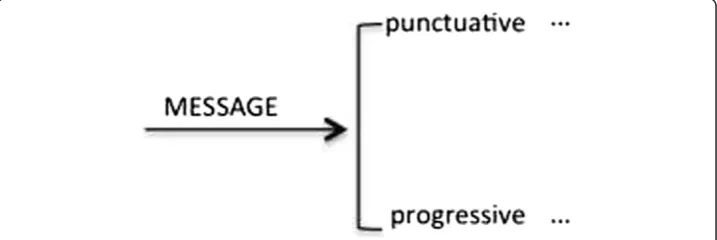
the identity of the semantic unit MESSAGE is fixed by what it relates to on the semantic stratum. The relation amongst the units on the rank scale of any language-internal stratum is that of constituency: following from this, MESSAGE as a unit is made up of ‘semes’, and itself enters into the structure of a ‘rhetorical unit’ (Cloran, 1994). As a category at the semantic stratum it is itself construed by some categories of the lexicogrammatical stratum which lies immediately below it: the lexicogrammatical category, that typically realises the semantic unit message, is the unit ‘clause’. At the same time, message as a semantic unit will itself realise certain features of the context of situation, which lies ‘above’ the semantic stratum. I will return to this discussion later to elaborate on ‘realisation’ in ‘trinocular perspective’.
A quality of the point of origin is that as a term in a sys-net, its embrace, for want of a better term, is ‘comprehensive’; it covers as much ground as may be necessary to describe the ultimate descriptum exhaustively. So, although Figure 1 presents only the initial system, the fact that the point of origin is MESSAGE implies that any sys-net describing any category of MESSAGE would be seen as relevant to it, either as (potentially) complementing it or as a critique or modification of the original. This is implicit in the fact that MESSAGE is a category in the theory. Point of origin thus announces a domain of relevant theoretical discussion: needless to say that the possibility of useful discourse will depend on the use of shared language. All the sys-nets pertaining to the same point of origin and considered valid in the theory are logically part of the same ‘comprehensive sys-net’. This concept, like other theoretical categories, has ‘no ontological status’ (Firth, 1957: 181): most probably, it would be impossible to even display an image of a comprehensive sys-net exhaustively representing the description of its point of origin. It is conceivable that the digital media might provide an extensive and/or mobile surface for a display of the exhaustive representation, but even so the limits of human vision might restrict its perception as one single complete visual percept as one whole. SFL has always maintained that language is big, and it appears natural that linguistics, which describes language, should be bigger still.
Theopening square bracketdisplaying the‘options’ ‘punctuative’or‘progressive’in Fig-ure 1 signals a‘simple system’. The simple system can appear in two guises: it may have no company whatever, appearing alone, as does the system in Figure 1: these are known as‘individual systems’. By contrast, a simple system may appear together with at least one other simple system. This will be referred to as a‘simultaneous set’, and each system of
the simultaneous set will be called a ‘member system’ (=m-system). A simple system, whether acting as an m-system or an individual one, must display more than one option. If only one option is shown in a system, the other being a zero or its equivalent, the sys-tem would be void: this is because an option is an option only if it is subject to true choice. The initial system of a sys-net, i.e.,the first one to appear after the point of origin, is known as the‘primary system’of the sys-net, and will have the lowest degree (or‘level’) of delicacy, which is to say that the information about the descriptum offered by the pri-mary systemic options is at the lowest degree of detail. The last statements imply that the systemic options are able to‘offer’information of some kind. But where does this infor-mation come from and how did it get into the systemic option? The answer to this ques-tion unmasks the apparently inscrutable nature of the sys-net: I will describe this process briefly here, using as example only a succession of individual systems; later the description will be extended to more complex patterns of the sys-net.
The sys-net’sprocessis‘declared open’with the display of its first system of options: in other words, nothing is given before that except the point of origin. The selection of the point of origin announces what the concern of that sys-net is, and the description will, in fact,‘reappear’as systems of related options, each system representing some property of the descriptum. For example, the information in the options of the primary system of Figure 1, ‘punctuative’ v. ‘progressive’, is nothing else than the possible
properties of MESSAGE that the description has established at this early point. And the appearance of the first system with options is what constitutes the primary system. The two properties are mutually exclusive and together they are exhaustive of what can be said at this level of delicacy about the category MESSAGE: it will either be ‘punctuative’(e.g.,Hi!, you know what?, pardon! Wow!), or‘progressive’(e.g.,didn’t you talk to him? well, I wanted to, but I don’t know where he hangs out and every time I go to his office he just isn’t there…); and there will be no third category of MESSAGE at this level of delicacy. This may or may not be factually correct, but this is what the conventions of the sys-net are presenting as the analyst’s analysis.
Two related comments will complete this account:first, each simple system has two or more mutually exclusive options, each representing information specific to it but at the same time related to that of the other options in the same system. Typically all the options of one system bear some semantic affinity to the other(s), as evident from such examples as either‘private’or‘public’, either‘masculine’or‘feminine’, either‘graphic’or‘phonic’, ei-ther ‘negative’or‘positive’, and so on.Secondly, for the description to be complete, every option of the said system must, in its turn, be chosen for analysis: no systemic option can be abandoned so long as there is anything to be said about it. As these‘coeval’i.e., belong-ing to same generation, options are analysed, the description is extended in the breadth of coverage, not in the depth/degree of delicacy. Of course, a stage can arrive in any network where an option might fail to follow the above ‘cycle of birth and re-birth’; an option might simply terminate, while others are being further described. This can happen either because the‘terminal option’has reached the limit of its description: i.e., in the analyst’s view no more need be said about it, or for some reason the analyst might suspend the ana-lysis at that point. For example, the systemic options in Figure 1 are made only at the pri-mary degree of delicacy, so it is not very likely that their description has been exhausted; their progress has been suspended here as of no further relevance. The measure of a sys-net’s success is the extent to which it produces information in the shape of new options specifying greater descriptive delicacy at each new step, until the sum of these related choices has arrived at an adequate, explicit and explanatory account of the descriptum. Throughout, the conventions of the sys-net guard the transparency, orderliness and clarity of a process that has moved option by option, relation by relation, and system by system.
A few words on some terms as used here in talking of some sys-net relations. The term ‘option’refers to the as-yet-unexplored property of a potential presented in the system: it is potentially‘choose-able’.‘Choice’is option selected for further exploration of a particu-lar property; the analysis will develop by each choice used as an entry point into the next systeml. And‘features’are properties of the unit under description, i.e., the sys-net’s point of origin. These descriptive categories do not name ‘entities’: they actually refer to relations. For example, the point of origin has at least three kinds of relations: (i) as used so far, it is a unit at some stratum; (ii) it is an‘initial entry point’on which the first move in a sys-net depends; and (iii) it is the ultimate descriptum whose potential is to be presented in the sys-net as a continuous set of relations from the options of the system.
The technique of the system network: the individual system
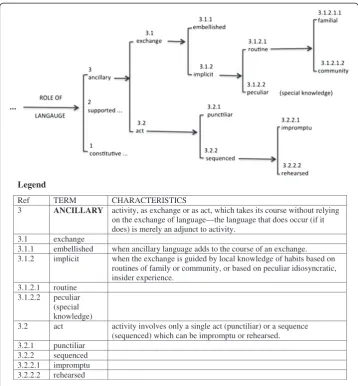
In describing the mechanism of the sys-net development above, I focussed deliberately on the individual system in terms of the choice of simply one of its options at a time; being chosen enabled it to act as an entry point into the next individual system: this was referred to as the cycle of a system’s birth and birth, leading to a new system. But the mutual re-lations of the entire set of choices from an individual system were not brought to attention. Figure 2 will repair this shortcoming, showing how the sys-net records derivations in full.
‘ancillary’(p 38)m. I have included, with apologies to Butt, this primary system of ROLE OF LANGUAGE in Figure 2 as presented here so as to indicate the dependency rela-tions beginning with the primary option‘ancillary’; in other words Figure 2 as presented here is a combination of Butt (2004: 38and42). The fact that it is an individual system is signalled by the entry indicator, which is the arrow under the label ROLE OF LANGUAGE (Butt, 2004:38). The choice of the option ‘ancillary’ permits entry into the next individual system with two options of its own, namely,‘exchange’ or ‘act’. As Figure 2 stands, it signals that the options ‘exchange’ or ‘act’are more delicate than ‘ancillary’. The choice of the option‘exchange’in its turn acts as an entry point for a new individual simple system with two options‘embellished’or‘implicit’. Option‘embellished’ is not chosen for further exploration; in the terminology used above, it is a terminal option. The choice of ‘implicit’is the entry point for the next new individual system, and so on to the last systems. Figure 2 illustrates one method for charting paths in a sys-net which can be summed up as follows: so long as each system is individual and the relation is that of dependency, the cycle will take the form:
Option = choice = entry point→next systemised options→option = choice = entry point→option.
Legend
Ref TERM CHARACTERISTICS
3 ANCILLARY activity, as exchange or as act, which takes its course without relying on the exchange of language—the language that does occur (if it does) is merely an adjunct to activity.
3.1 exchange
3.1.1 embellished when ancillary language adds to the course of an exchange. 3.1.2 implicit when the exchange is guided by local knowledge of habits based on
routines of family or community, or based on peculiar idiosyncratic, insider experience.
3.1.2.1 routine 3.1.2.2 peculiar
(special knowledge)
3.2 act activity involves only a single act (punctiliar) or a sequence (sequenced) which can be impromptu or rehearsed. 3.2.1 punctiliar
3.2.2 sequenced
3.2.2.1 impromptu 3.2.2.2 rehearsed
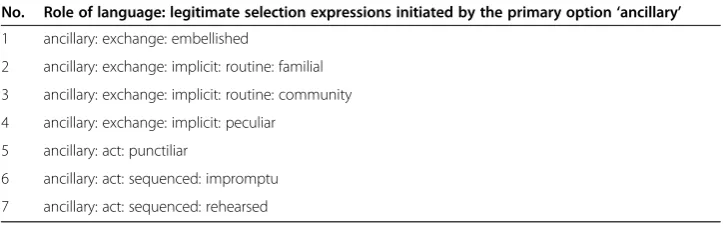
When a sys-net begins life at a primary option as‘ancillary’did in Figure 2, and moves system by system right through to the end, the traversal of the entire path formed by its relations is known as a‘selection expression’(SE); and each SE is a formulaic account of the properties of one sub-category of the descriptum, even though the name of the point of origin or its‘dimensions’may not be included in the SE itselfn. Obviously the lowest number of options in a simple system is two, and while there is no upper limit, typically simple systems are not found to go above four options. Further, the longer the paths, the greater the degree of delicacy: in principle, then, the maximum number of SEs can run to hundreds depending on how many option are found per system on average and how deli-cate the description is. So long as the relation is one of dependency throughout the sys-net, the‘legitimate’shape of the path will be as shown above. Though the SEs from the same sys-net may share some choices in common, as a whole, each SE will be unique. Table 1 presents the details of the legitimate SEs for Figure 2 depending on the primary option‘ancillary’. The colon between the two options signals the relation of dependency, i.e., in SE 1‘exchange’depends on‘ancillary’and‘embellished’on‘exchange’.
A system developed entirely by a cycle of dependence relation between individual systems, as here, resembles a simple taxonomy, with one notational difference that its branches move sideways. This mode of sys-net derivation is quite the commonest: in fact, most developed sys-nets will display a number of SEs built only or mainly by the relation of dependence. This type of system derivation is like simple taxonomies, which like the sys-nets can represent moves in delicacy. But sys-nets are also capable of representing more complex relations such as those of simultaneity.
Complexity in systemic relations: simultaneous systems
Systems occurring as members of a simultaneous set are probably not as frequent overall as systems occurring individually; but when they occur, they bring a multi-faceted perspective to that chosen option which acts as their entry point, and they are also capable of forming the environment for complex entry conditions for new systems. I will discuss the latter relation below, using other examples of simultaneous sets, but on the following page I am going to begin with Figure 3, particularly because it raises certain issues, the exploration of which will allow some necessary elaborations.
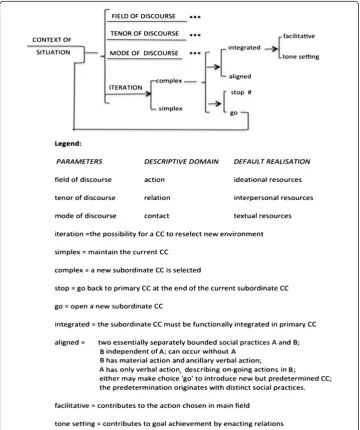
As I see it, the issues here are: (i) the fourth primary system: what is it and why is it rele-vant in Figure 3? (ii) the first three primary labels listed as simultaneous truly speaking are not systemsof FIELD, TENOR and MODE, since they have no options; what is their function here? (iii) The point of origin for Figure 3: context of situation (=CS) is not a unit; so how is its identity established? On what ground can it be assumed that CS can be ana-lysed in terms of the categories designed initially for the analysis of linguistic phenomena?
Table 1 Legitimate selection expressions in Figure 2
No. Role of language: legitimate selection expressions initiated by the primary option‘ancillary’ 1 ancillary: exchange: embellished
2 ancillary: exchange: implicit: routine: familial 3 ancillary: exchange: implicit: routine: community 4 ancillary: exchange: implicit: peculiar
5 ancillary: act: punctiliar
I will address these issues below; but first a few words on how simultaneity of systems is signalled and other systems are derived from the options of the set of m-systems.
The simultaneous set in Figure 3 is signalled by an opening brace; here it holds four member systems; but any number greater than one may occur. The entry indicator for the simultaneous set is not an arrow but a plain line, linking the entry point and the brace of simultaneity. Simultaneity modifies the relation of the options across the m-systems: at any point only one option from each member system must be chosen simultaneously. All the options of the member systems in a simultaneous set must combine freely while main-taining the principle just described. If one single option depending on one m-system is chosen to act as the entry condition to the next system, the SEs should show not only that relation but the simultaneity relation to one option from each of the other member sys-tems. This can be exemplified with the simultaneous set found in the system of
ITERATION in Figure 3, where the choice of ‘complex’ acts as the entry point to a simultaneous set consisting of two member systems, one with the options ‘integrated’or ‘aligned’, the other with‘stop#’or ‘go’. Table 2 presents the selection expressions of the systemic paths as just described.
As before, the colon indicates a dependency relation, and the semi-colon, that of simultaneity of choices. If the option ‘integrated’ is chosen, allowing entry to options ‘facilitating’or‘tone setting’, the choices in the SEs will be as in Table 3.
As Figure 3 shows,‘integrated’or ‘aligned’are options of the same individual system: so they can never combine legitimately. The options ‘facilitative’ or ‘tone setting’ depend on‘integrated’; so they can combine as shown in SEs 2—5 in Table 3. Had any options been shown for field, tenor or mode, they would be required to appear here as part of Figure 3.
I turn now to issue 1: what is the justification for including the system of ITERATION as a member of the simultaneous set in Figure 3? The less important reason is that it was con-venient to use a small set of m-systems to demonstrate the ‘combination’of m-systems. The more important reason is the function of this system in con/text description. Such an iteration system or something very much like it, was introduced as a systemic functional ex-planation of the difference between the concept of ‘text complex’(Hasan, 1999: 246–273; 2000: 28–47) and Martin’s‘genre combination’. The thesis is that a text complex is based on certain functional relations between the main text and the subordinate ones: the co-selection of the latter accounts for the text’s complexity. Unlike combinations based on con-tiguity, accidental or spatio-temporal, text complexity is not a happenstance: its explanation is in context, i.e., in the possibilities open to social practice. The primary system of ITER-ATION has two options here: ‘complex’or ‘simplex’. The choice of ‘simplex’calls for‘no change’in the contextual configuration (CC) current at that point; the text no matter how long is a text simplex, as evident from the consistency of its registerial status. By contrast, the choice ‘complex’ implies some ‘contextual shift’. I prefer to write ‘con/textual’for the simple reason that there exists a‘solidary’relation between context and text. The choice of the option ‘complex’ acts as an entry point to a simultaneous set with two m-systems. The first m-system from this brace specifies the function of the
Table 2 Choice paths combining m-systems in ITERATION in Figure 3
1 simplex
2 complex: integrated; stop# 3 complex: integrated; go 4 complex: aligned; stop# 5 complex: aligned; go
Table 3 Selection expressions in ITERATION in Figure 3
1 simplex
2 complex: integrated: facilitating; stop# 3 complex: integrated: facilitating; go 4 complex: integrated: tone setting; stop# 5 complex: integrated: tone setting; go 6 complex: aligned; stop#
subordinate CC, which may be either ‘integrated’ into the main CC or be ‘aligned’ with it (other possibilities might be open, c.f. Hasan, 1999: 269). The options of the second m-system,‘stop#’ or ‘go’, specify whether iterative choice from the con-text of situation is to be made or not: if option ‘stop#’ is chosen, the primary con-textual configuration will be resumed putting an end to the sub-context; the option ‘go’ will imply that a con/textual shift is called for. The nature of this will be specified by the first m-system options. The choice leading to the selection of a sub-context would obviously mean re-entry into the systems pertaining to all three con/textual dimensions so as to access the necessary options relevant to the pro-duction of the new subordinate CC (for more detailed discussions, Hasan 1999). The signal indicating iteration of CS is the option ‘go’. The line beginning at op-tion ‘go’ makes its way to the point of origin, CONTEXT OF SITUATION. The left facing elongated or-bracket that reaches the point of origin is an iconic symbol permitting re-entry here via the point of origin into the simultaneous set.
I believe viable realisational statements relevant to the option ‘integrated’have been presented in Hasan (1999: 246–273) and Cloran (1999). The option‘aligned’refers to paired social practice each pertaining to distinct domains which are systematically coupled as part of the realisation of the choice‘aligned’. This pairing is not an accidental co-occurrence, like washing up while discussing politics. Instead, it is culturally deliberate: one of the two social practices has the aim of describing what is going on in the other. Call the texts realising the two A and B. Given that the aim of A is torelay an accountof the process of B (rather than‘replicate/summarise’it as might happen in‘note-taking’at a meeting), a syndrome of contextual features can be predicted in its CC. Thus in the FIELD of A the main action will be verbal ‘constitutive’; any material action will be peripheral; the sphere of the FIELD will be ‘specialised; institutional’; in TENOR, addressee will be ‘absent: category: imaginary’; social distance between the speaker and addressee would be close to ‘normal’degree; and in MODE material contact would be ‘phonic, mediated, congruent: synchronic: single; public’ –these choices together de-scribe the register known as a‘sports radio commentary’.
B’s contextual configuration will display considerably different choices: its FIELD will have ‘focal’ material action i.e., the action would be the centre of the social practice, largely involving physical expertise, and the sphere would be‘specialised;…institutional’ entertainment, and if there is any verbal action pertinent to the FIELD, it will be‘ancillary’; in TENOR social distance is likely to be‘close’and‘normal’with status as‘equal’; and in MODE material contact will be ‘phonic; direct’o. The social practice of sports, per se, is likely to be relatively independent and could occur in the absence of A: it does not have to be aligned; it is the choice ‘aligned’ that calls for the feature ‘institutionalised’. However, if field sphere is ‘institutionalised’, as would be the case with (inter-)national sports, and other such public events, it is highly likely to be accompanied by the activity A.
contribution, i.e., integration and alignment lead to different kinds of textual complexity. The system of ITERATION appears to have a fairly wide range of application in SFL: it needs to be actually used to learn what other features might be relevant where and why. Finally, iteration is not specific only to complexity in con/texts; all language internal units at the content plane manifest the possibility of appearing as simplex or complex. However, the same symbol as presented in Figure 3 is used in all cases to represent iteration: the details referring to the other options will vary from those shown in Figure 3, but the actual iteration system with the options‘stop#’or‘go’together with the symbol for iteration will be the same at all the other strata. In further discussions of Figure 3, the system of ITERATION will be largely ignored.
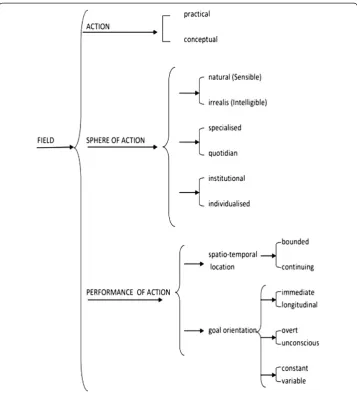
The second issue arising from Figure 3 is the absence of systems for three of the entries: the entries simply indicate that apart from the iteration system, three other m-systems will form part of the displayed simultaneous set. The lines below the label indicate that the anticipated systems will themselves be m-systems; but no systems of options are presented. Let us imagine now that Figure 4 joins Figure 3 just where FIELD OF DISCOURSE is forecast.
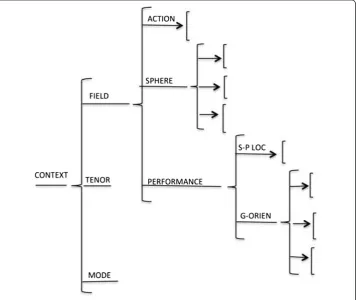
Positioned thus in Figure 3, Figure 4 will display the initial steps missing from it: it now has a point of origin and it is clearly an m-system in a simultaneous set where two others systems – tenor and mode – are also anticipated. At the same time Figure 4 brings the gift of primary systemic options to Figure 3, confirming that the primary system of FIELD is indeed complex. According to Figure 4, the primary system of FIELD consists of (i) ACTION, (ii) SPHERE OF ACTION, and (iii) PERFORMANCE OF ACTIONp. The complexity of FIELD is indicated by the form taken by these three primary systems, each of which is in the last analysis a member of one simultaneous set. The simplest to interpret is the system of ACTION with just one individual system with two options. The second system, called SPHERE OF ACTION, consists of a simul-taneous set with three m-systems. The third primary system, called PERFORMANCE OF ACTION, is also shown as a simultaneous set with one of its member systems, called SPATIO-TEMPORAL LOCATION, appearing as an individual system while the other three make up a simultaneous set called, GOAL ORIENTATION. We thus have two layers of simultaneity. Figure 5 schematically represents the union of Figure 4 with Figure 3.
This description of field is formally equivalent to a set of eight simultaneous systems, each consisting of two options. So, notwithstanding the repeated nesting of simultaneous sets, all these systems would be treated by the conventions of the sys-net as mutually combinable. It is possible to preclude free combination, for example by using the‘if-then’ relation indicated by what is referred to as the ‘arrow diacritic’ below (section Cross-referencing in sys-nets: relation based diacritics). In the absence of that preclusion, the
number of selection expressions produced by the concurrent systems of field will be 28, or 256, each describing one particular primary sub-category of FIELD.
Turning now to the third issue: there is no doubt that context of situation is a descrip-tum in search of a description; but it is also true that context is not aunitof any kind in languageq. For linguists to explore this domain might smack of doing ‘spontaneous sociology’(a practice Bourdieu, 1991: 37–38 criticised while himself presenting a case of ‘spontaneous linguistics’). It is worth pointing out, though, that the linguists’context is neither the physicists’ ‘real’world, nor the geographer’s, nor yet the sociologists’; it is quite a different abstraction from that same‘reality’. And there exists a valid basis for linguists to attempt this abstraction, since it constitutes the context relevant to human verbal inter-actions. Members of a speech community act and interact with each otherinsome envir-onment concerning some aspect(s) of that environment. Although there is a good deal more to the vast universe of social and material‘reality’, linguists need to understand as-pects of that human environment, summed up as ‘who says what to whom where when and why’. The linguistic interactions we engage in do, however, bring changes to aspects of non-linguistic reality, which suggests that the boundaries between language and social reality are, in effect, not water-tight: there must exist some way for social reality to pene-trate into language, and vice versa–our locutions change the material, whether temporar-ily or otherwise, and the concept of metafunction shows how the outside enters the inside of language.
In SFL the reciprocal nature of this relationship has been recognised at least since Firth. Halliday (1991/2007b) used the concept of realisation in modelling the symbiotic relation: he suggested that language and culture are analogous human resources: and the system of language is related realisationally to the context of culture just as text as language use is related to context of situation. Moreover just as the system of language is instantiated by the various text types of a community so also culture is instantiated as situation types. An adequate model of language needs to explain the nature of language both as system/langue, i.e., as a web of associative bonds, and as language use/parole, i.e., as a form of interrelated linguistic acts. Such a model must probe the systemic nature both of language as a semiological system and of cultural practices as the impetus that has lead to relevant, context based, text production. The per-spective adopted in SFL on the text’s context has demonstrated that far from being un-generalizable,parole, so viewed, presents a functional and orderly heterogeneity; and the SFL view of their relations has led to better understanding of the centrality of cultural environment in the formation of individuals. The interactants as the producers of the community’s texts are persons who, throughout life, continue to internalize ways of saying and meaning that are specific to occasions of talk recog-nized in their culture. The strength of SFL’s reasoning is based on its analysis of lin-guistic and cultural processes: so, for example, the hypothesis of context metafunction resonance (CMR) shows a more robust understanding of the mutual relations of language and reality than the established notions of truth, reference and correspondence. The con-cept of realisation as developed in SFL has demonstrated the reach and efficacy of lan-guage events, thus justifying the recognition of context as a lanlan-guage external stratum of the linguistic theory.
for the recognition of the three parameters whose linguistic character was made more specific in the CMR hypothesis: now field, tenor and mode could be viewed as realisation-ally oriented respectively to the ideational, interpersonal and textual meaning-wording. And this can be interpreted as assigning each parameter a ‘default realisation’ thus granting the possibility of ‘variant’ realistions under specifiable conditions. The ARC hypothesis strengthens the basis of the parameters by a systematic correspondence: for example, field concerns what concerns Action, so it should subsume aspects of Action, e.g., its types, circumstances and participants as recognized within the culture; and of course these are exactly the phenomena, realised ‘more often than not’ as meaning-wording derived from the experiential metafunction. The same applies
mutatis mutandisto the other two parameters.
Yes, context of situation as point of origin differs from ‘message’ or ‘clause’: but, perhaps with ARC in view, the unity of context is not subject to doubt, nor is the identity of three parameters that underlie the metafunctional hypothesis. The parameters are not like the units on a rank scale, but, significantly, they share some characteristics of meta-functions. In SFL, there is no metafunctional hierarchy, whereby the ideational is‘raised’ to the status of semantics as in many linguistic models, while the other metafunctions constitute the subject matter of ‘pragmatics’: the latter had begun its life as the study of some language patterns but somehow those language patterns seem to have fallen outside ‘linguistics proper’. By contrast, in SFL, the three metafunctions are alike and contribute jointly to the description of linguistic units. This, however, does not mean that some particular segment of the units can be isolated as realising one particular metafunction. Similarly the text’s meaning-wording realises all three aspects of the context, but no specific part of the text can be singled out as realising just field and nothing but field; and the same applies to tenor and mode as well.