http://www.sciencepublishinggroup.com/j/ns doi: 10.11648/j.ns.20190402.11
ISSN: 2640-4338 (Print); ISSN: 2640-4346 (Online)
Improved Numerical Generalization of the
Bethe-Weizsäcker Mass Formula for Prediction the Isotope
Nuclear Mass, the Mass Excess Including of Artificial
Elements 119 and 120
Mavrodiev Strachimir Chterev
1, Vol Alexander
2, *1
Department of the Theoretical Physics Institute for Nuclear Research and Nuclear Energy, Bulgarian Academy of Sciences, Sofia, Bulgaria
2
Department of the Applied Physics, Hebrew University of Jerusalem, Jerusalem, Israel
Email address:
*Corresponding author
To cite this article:
Mavrodiev Strachimir Chterev, Vol Alexander. Improved Numerical Generalization of the Bethe-Weizsäcker Mass Formula for Prediction the Isotope Nuclear Mass, the Mass Excess Including of Artificial Elements 119 and 120. Nuclear Science. Vol. 4, No. 2, 2019, pp. 11-22. doi: 10.11648/j.ns.20190402.11
Received: June 5, 2019; Accepted: July 15, 2019; Published: July 26, 2019
Abstract:
George Gamow’s liquid drop model of the nucleus can account for most of the terms in the formula and gives rough estimates for the values of the coefficients. Its semi-numerical equation was first formulated in 1935 by Weizsäcker and in 1936 Bethe [1, 2], and although refinements have been made to the coefficients over the years, the structure of the formula remains the same today. Their formula gives a good approximation for atomic masses and several other effects, but does not explain the appearance of magic numbers of protons and neutrons, and the extra binding-energy and measure of stability that are associated with these numbers of nucleons. Mavrodiev and Deliyergiyev [3] formalized the nuclear mass problem in the inverse problem framework. This approach allowed them to infer the underlying model parameters from experimental observation, rather than to predict the observations from the model parameters. They formulated the inverse problem for the numerically generalized semi-empirical mass formula of Bethe and von Weizsäcker going step-by-step through the AME2012 [4] nuclear database. The resulting parameterization described the measured nuclear masses of 2564 isotopes with a maximal deviation of less than 2.6 MeV, starting from the number of protons and number of neutrons equal to 1. The unknown functions in the generalized mass formula was discovered in a step-by-step way using the modified procedure realized in the algorithms developed by Aleksandrov [5-7] to solve nonlinear systems of equations via the Gauss-Newton method. In the presented herein article we describe a further development of the obtained by [3] formula by including additional factors,- magic numbers of protons, neutrons and electrons. This inclusion is based the well-known experimental data on the chemically induced polarization of nuclei and the effect of such this polarization on the rate of isotope decay. It allowed taking into account resonant interaction of the spins of nuclei and electron shells. As a result the maximal deviation from the measured nuclear masses of less than 1.9 MeV was reached. This improvement allowed prediction of the nuclear characteristics of the artificial elements 119 and 120.Keywords:
Bethe-Weizsäcker Mass Formula, Magic Numbers, Binding Energy, Wigner Term, Inverse Problem, Electrons-Nucleus Interaction, Chemical Polarization, Isotopes1. Introduction
In the last few years there has appeared new experimental data which demonstrated the dramatic change of decay rate due to the ionization of an atom and due to the resonant interaction between the electron shells and the nuclei [8-14].
interaction of nuclei and the electron shell for accuracy of a well-known formula expands our understanding of the structure of atoms and the possible contribution of nucleus interaction to the formation of compounds and biological structures. Deepening our understanding of the nature of the interaction of nuclear and chemical processes can be very important both in solving the problem of radioactive waste and in solving a number of problems in biology and medicine [15].
Following are the steps involved in the generalization of the BW mass formula.
2. Bethe-Weizsäcker Mass Formula
Digital Generalization
2.1. Original Bethe-Weizsäcker Mass Formula [1, 2]
Let A be the total number of nucleons, Z the number of protons, and N the number of neutrons, so that A = Z + N. The mass of an atomic nucleus will be
m = Z mp + N mn – Be,
{\displaystyle m=Zm_{p}+Nm_{n}-{\frac
{E_{B}}{c^{2}}}}where {\displaystyle m_{p}} mp and mn {\displaystyle m_{n}} are the rest mass of proton and neutron, respectively, and Be {\displaystyle E_{B}} is the binding energy of the nucleus. The semi-empirical mass formula states that the binding energy Be per nucleon will take the following form:
BE = Vol - Sur - Cha - Sym + Wig.
In this paper we use the connections between atomic masses, nuclear masses, and mass excess as follows:
AtMass = Z mp +N mn – Be (1)
NuclMass = AtMass - (mE E + Ael E2.39 + Bel E5.35) (2)
MassExc = AtMass – Au (3)
where mn = 939.565301, mp = 938.2719982, ME = 0.510998902, 1u = 931.494028 MeV/c2 (2006, CODATA) correspondingly with fit parameters
Ael = 1.44381E-05, Bel = 1.554680E-12, where E is the number of electrons in a shell.
2.2. Hypothesis for Digital Generalization of Bethe-Weizsäcker Mass Formula with the Influence of Magic Numbers [3, 16-20]
, , = , , − , , 1, , − ℎ , , − 1, , − , , − ,
+ !"# , , $ ,
% , , + &' , , ,
Where the function &' , , depends on the proton and neutron magic numbers and where the frontier between their influence and a is a set of unknown digital parameters. The function δ is defined as:
δ(N,Z) = +1 for even N,Z, δ(Z,N) = −1 for odd N, Z and δ(Z,N) = 0 for odd A = Z + N
2.3 Hypothesis for Digital Generalization of
Bethe-Weizsäcker Mass Formula with the Influence of the Magic Numbers and the Influence of the Electron Shell
Here , , Is Defined as
, , = , , − , , 1
, , − ℎ , ,
− 1 , ,
− , , )
*+ ,-.,/ + !"# , ,
0 , *+% ,,.,/ +
1234 , ,
*+5 ,,.,/ + &' , , (4)
Where: E is the number of electrons in a shell.
Eight electron magic numbers (2, 10, 18, 36, 54, 86, 118 140) - from the periodic Mendeleev table of elements.
The method of discovering the explicit form of the
functions , , , , , , ℎ , , ,
, , , !"# , , , , , 6 , &' , , ,
78 , , , 7 , , , 79 , , , 7: , , , 7; , ,
and the calculated values of a set of unknown digital parameters is described in papers [3, 5-7, 16-20] using the 3 overdetermined algebraic system of the equality of experimental values of equations (1, 2, 3) and their model,
calculated from equation (4). The number of the experimental data from the data base [21, 22] is M = 2536.
2.4. About the Choice of Arguments for Solving the Inverse Problem
Concerning the possibilities of REGN code, it is very convenient to choose the arguments which are linearly independent as well as with a variation near to zero. In our case we chose the arguments as follow:
V1 =
* , V2 = V12, V3 = V13, V4= * , V5 = V42, V6= V43, V7= )
V10=
<8 , V11 = V102, V12= V103, V13= 8
=> *<8 , V14= ) ? < ? , V15=
) ? < ? , V16=
) ? < ? ,
V17 = V142, V18 = V152, V19 = V162, V20 = 8
* if A is even, and -8
* if A is odd,
V21 = ±8
<8 and V22 = ±8
<8 correspondingly.
3. The Explicit Form of Unknown Functions
These forms are as follows:
, , , " = exp (a1 + CorPow(a,N,isp)) ) + CorS(a,N,N0+6),
, , , " = exp (a2 + CorPow(a,N,isp+nPow)) ) + CorS (a,N,N0+12),
ℎ , , , " = exp (a3 + CorPow (a,N,isp+2 nPow)) ) + CorS(a,N,N0+18),
, , , " = exp (a4 + CorPow (a,N,isp+3 nPow)) ) + CorS(a,N,N0+24),
!"# , , , " = exp (a5 + CorPow (a,N,isp+4 nPow)) ) + CorS (a,N,N0+30),
, , , " = aN0+6 (exp (a6 +CorPow (a,N,isp+5 nPow))) + CorS (a,N,N0+36) ) v19,
78 , , , " = exp (a7 + CorPow (a,N,isp+6 nPow)) ) + CorS(a,N,N0+42),
7 , , , " = exp (a8 + CorPow (a,N,isp+7 nPow)) ) + CorS(a,N,N0+48),
79 , , , " = exp (a9 + CorPow (a,N,isp+8 nPow)) ) + CorS(a,N,N0+54),
7: , , , " = exp (a10 + CorPow (a,N,isp+9 nPow)) ) + CorS(a,N,N0+60),
7; , , , " = exp (a11 + CorPow (a,N,isp+10 nPow)) ) + CorS (a,N,N0+66),
Where:
CorPow(a,N,i) = exp (- ∑8D B<C CE8 FC ),
CorS(a,N,i) = exp(- B<8F8:+ B< F8;+ B<9F8G+ B<:F ?+ B<;F 8+ B<GF )
and
&' , 0, ! , , 0, ! , , i = & , 0, ! , , 0, ! , , isp + 11 nPow 1 + P?<; F9 ),
Where:
& , 0, ! , , 0, ! , , isp + 11 nPow = , 0, ! , , isp + 11 nPow 1 + exp − ?<8 F8 + ?<9 F8
+ , 0, ! , , isp + 11 nPow 1 + exp − ?< F + ?<: F: ,
, 0, ! , , 0, ! , , i = S , 0, , 0, , i exp(- ) ?
TU , ?,V , , ?, ,W)/( − 0 + XS , 0, ! , , 0, , i),
, 0, ! , , 0, ! , , i = Y , 0, ! , , 0, , i exp(- ) ?
TZ , ?, , ?,V , ,W)/
( − 0 + XY , 0, , 0, ! , , i ),
S , 0, , 0, , i = CorAmp(a,n,i), Y , 0, , 0, , i = CorAmp(a,n,i + nBWA),
XS , 0, ! , , 0, , i = WZ + CorAmp (a, n, i + 2 nBWA ),
XY , 0, , 0, ! , , i = WZ + CorAmp(a,n,i + 3 nBWA ),
CorAmp(a,n,i) = exp ( W< ? - ∑8DCE8 B<C FC ),
Where the values of integer numbers are as follows:
nPow)+nBW, N = N0 + Dop + 2 MnZ + 2 MnN.
Z0 is the nearest of a set of proton magic numbers: 2, 8, 14, 20, 28, 50, 82, 98, 108, 124,
N0 is the nearest of a set of neutron magic numbers: 2, 8, 14, 20, 28, 50, 82, 124, 152, 184, 202.
The values of magic numbers Z0, N0 as well as the boundaries between them WN, WN, (half sum of consequently magic numbers) are the result of a fit procedure.
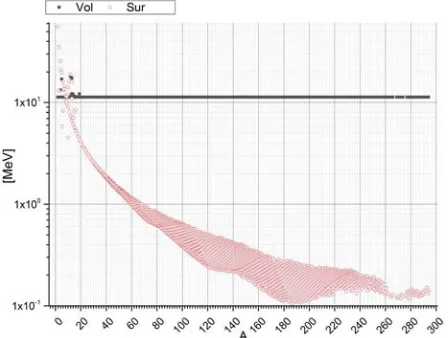
Figure 1. The behaviour of volume and surface terms.
Figure 2. The behaviour of charge and symmetry terms.
Figure 3. The behaviour of Wigner term.
Figure 4. The behaviour of proton magic number influence.
Figure 5. The behaviour of neutron magic number influence.
4. Description of Data
The following figures are a description of the data calculated.
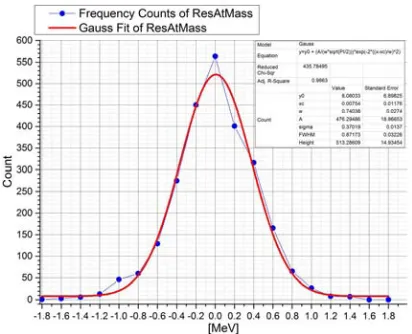
Figure 7. The behaviour of atomic masses residuals. Figure 8. Gauss fit of atomic masses residuals (w = 0.740 +/- 0.027 MeV).
Table 1. Illustrates the quality of description for Binding Energy, Nuclear Mass, Mass Excess and Atomic Masses as function of Z, N and A.
Parameter N total Mean SD Variance RMS MAD Minimum Median Maximum
Residual Binding energy 2536 -2.54E-05 0.00688 4.74E-05 0.008 0.00369 -0.06291 3.49E-06 0.06791
Residual Nuclear mass 2536 -1.03E-05 0.41962 0.17608 0.46 0.3207 -1.94926 -0.0023 1.47267
Residual Mass excess 2536 0.00179 0.41965 0.1761 0.46 0.32069 -1.94846 -0.0014 1.47305
Residual Atomic mass 2536 -1.04E-05 0.41962 0.17608 0.46 0.3207 -1.94926 -0.0023 1.47267
Where the abbreviations are as follows: SD = Standard Deviation, RMS = Root Mean Square and MAD = Mean Absolute Deviation.
Table 2. Comparison experimental and calculated data of the elements, which have a residual energy greater than module 1.5 MeV.
El Name A Z N Be ResBe AtMass ResAtMass
Ca 53 20 33 8.33 3.69 E-02 49339.795 -1.96
Pb 208 82 126 7.87 9.04 E-03 193729.006 -1.89
Sn 132 50 82 8.35 1.23 E-02 122880.663 -1.63
Nh 278 113 165 7.18 5.74 E-03 259114.241 -1.52
No 259 102 157 7.40 5.80 E-03 241351.028 -1.51
Where the abbreviations are as follows: Be – Experimental Binding energy; ResBe – Difference of the calculated and experimental binding energy; AtMas – Experimental Atomic Mass
ResAtMass- Difference of the calculated and experimental atomic mass
5. Proton and Neutron Drip Lines and Predictions
The definition of two proton and two neutron drip lines as a boundary of existing nuclear matter is as follow:
(Z+N) , , [ (Z+N-2) 2, , , ] ^ _ Y` (5) and
Figure 9. Two proton and neutron drip lines.
Figure 10. Asymptotic of two proton and neutron drip lines- Z = 134, N = 206.
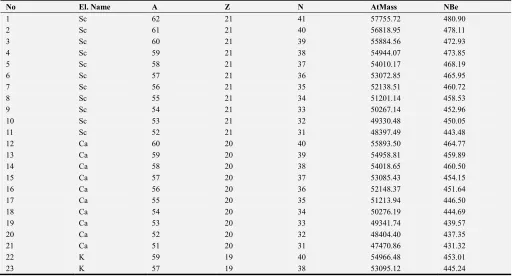
Figure 11. The comparison of our model with the 60Ca20 RIKEN experiment [23] (PHYSICAL REVIEW LETTERS 121, 022501 (2018).
Table 3. Presents the Atomic Masses and Nuclear Binding Energies [MeV] for comparison with the data for discovered isotopes from the 60Ca20 RIKEN experiment [23].
No El. Name A Z N AtMass NBe
1 Sc 62 21 41 57755.72 480.90
2 Sc 61 21 40 56818.95 478.11
3 Sc 60 21 39 55884.56 472.93
4 Sc 59 21 38 54944.07 473.85
5 Sc 58 21 37 54010.17 468.19
6 Sc 57 21 36 53072.85 465.95
7 Sc 56 21 35 52138.51 460.72
8 Sc 55 21 34 51201.14 458.53
9 Sc 54 21 33 50267.14 452.96
10 Sc 53 21 32 49330.48 450.05
11 Sc 52 21 31 48397.49 443.48
12 Ca 60 20 40 55893.50 464.77
13 Ca 59 20 39 54958.81 459.89
14 Ca 58 20 38 54018.65 460.50
15 Ca 57 20 37 53085.43 454.15
16 Ca 56 20 36 52148.37 451.64
17 Ca 55 20 35 51213.94 446.50
18 Ca 54 20 34 50276.19 444.69
19 Ca 53 20 33 49341.74 439.57
20 Ca 52 20 32 48404.40 437.35
21 Ca 51 20 31 47470.86 431.32
22 K 59 19 40 54966.48 453.01
No El. Name A Z N AtMass NBe
24 K 56 19 37 52163.60 437.19
25 K 55 19 36 51227.39 433.84
26 K 54 19 35 50293.77 427.90
27 K 53 19 34 49355.96 426.13
28 K 52 19 33 48421.41 421.12
29 K 51 19 32 47483.59 419.38
30 K 50 19 31 46549.55 413.85
31 Ar 54 18 36 50302.71 419.73
32 Ar 53 18 35 49369.29 413.59
33 Ar 52 18 34 48433.27 410.05
34 Ar 51 18 33 47498.22 405.53
35 Ar 50 18 32 46561.05 403.13
36 Ar 49 18 31 45625.96 398.66
37 Cl 52 17 35 48447.80 396.30
38 Cl 51 17 34 47512.47 392.06
39 Cl 50 17 33 46578.79 386.17
40 Cl 49 17 32 45641.77 383.63
41 Cl 48 17 31 44706.83 379.01
42 S 49 16 33 45655.56 370.62
43 S 48 16 32 44719.28 367.34
44 S 47 16 31 43785.70 361.35
45 S 46 16 30 42848.27 359.22
46 S 45 16 29 41913.87 354.05
47 S 44 16 28 40976.20 352.15
48 S 43 16 27 40042.19 346.60
49 S 42 16 26 39105.51 343.72
50 S 41 16 25 38172.97 336.69
51 S 40 16 24 37237.38 332.71
52 p 47 15 32 43796.90 350.93
53 p 46 15 31 42864.37 343.90
54 p 45 15 30 41928.20 340.51
55 p 44 15 29 40994.83 334.30
56 p 43 15 28 40058.12 331.45
57 p 42 15 27 39123.64 326.36
58 p 41 15 26 38185.58 324.86
59 p 40 15 25 37251.61 319.27
60 p 39 15 24 36314.73 316.58
61 Si 44 14 30 41007.40 322.53
62 Si 43 14 29 40073.00 317.35
63 Si 42 14 28 39136.70 314.09
64 Si 41 14 27 38203.07 308.16
65 Si 40 14 26 37265.56 306.10
66 Si 39 14 25 36331.28 300.81
67 Si 38 14 24 35393.10 299.43
68 Al 43 13 30 40098.72 292.41
69 Al 42 13 29 39160.50 291.08
70 Al 41 13 28 38220.57 291.44
71 Al 40 13 27 37284.99 287.46
72 Al 39 13 26 36347.01 285.86
73 Al 38 13 25 35413.08 280.23
74 Al 37 13 24 34475.37 278.38
75 Mg 40 12 28 37309.14 264.09
76 Mg 38 12 26 35429.05 265.04
77 Mg 37 12 25 34493.25 261.28
78 Mg 36 12 24 33554.40 260.56
79 Na 37 11 26 34521.74 233.57
80 Na 35 11 24 32641.30 234.88
Figure 12. The ZN coordinates for which we will present the values of the Nuclear Binding Energy and Atomic Mass [MeV].
Figure 13. The values of Predicted Nuclear Binding Energies and Atomic Masses [MeV], Z in the interval 98-110 and N in the interval 154-167.
Figure 15. The values of Predicted Nuclear Binding Energies and Atomic Masses [MeV] Z in the interval 120-133 and N in the interval 185-205.
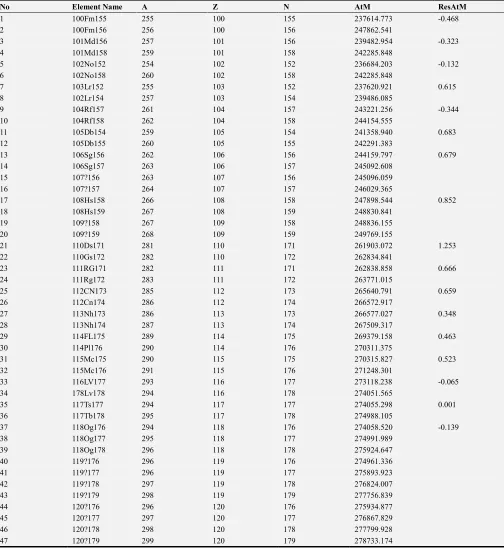
Table 4. Presents the values of elements 119 and 120 atomic masses compared with the values calculated from our model and their residuals in MeV. The lines in bold present the data for predicted isotopes.
No Element Name A Z N AtM ResAtM
1 100Fm155 255 100 155 237614.773 -0.468
2 100Fm156 256 100 156 247862.541
3 101Md156 257 101 156 239482.954 -0.323
4 101Md158 259 101 158 242285.848
5 102No152 254 102 152 236684.203 -0.132
6 102No158 260 102 158 242285.848
7 103Lr152 255 103 152 237620.921 0.615
8 102Lr154 257 103 154 239486.085
9 104Rf157 261 104 157 243221.256 -0.344
10 104Rf158 262 104 158 244154.555
11 105Db154 259 105 154 241358.940 0.683
12 105Db155 260 105 155 242291.383
13 106Sg156 262 106 156 244159.797 0.679
14 106Sg157 263 106 157 245092.608
15 107?156 263 107 156 245096.059
16 107?157 264 107 157 246029.365
17 108Hs158 266 108 158 247898.544 0.852
18 108Hs159 267 108 159 248830.841
19 109?158 267 109 158 248836.155
20 109?159 268 109 159 249769.155
21 110Ds171 281 110 171 261903.072 1.253
22 110Gs172 282 110 172 262834.841
23 111RG171 282 111 171 262838.858 0.666
24 111Rg172 283 111 172 263771.015
25 112CN173 285 112 173 265640.791 0.659
26 112Cn174 286 112 174 266572.917
27 113Nh173 286 113 173 266577.027 0.348
28 113Nh174 287 113 174 267509.317
29 114FL175 289 114 175 269379.158 0.463
30 114Pl176 290 114 176 270311.375
31 115Mc175 290 115 175 270315.827 0.523
32 115Mc176 291 115 176 271248.301
33 116LV177 293 116 177 273118.238 -0.065
34 178Lv178 294 116 178 274051.565
35 117Ts177 294 117 177 274055.298 0.001
36 117Tb178 295 117 178 274988.105
37 118Og176 294 118 176 274058.520 -0.139
38 118Og177 295 118 177 274991.989
39 118Og178 296 118 178 275924.647
40 119?176 296 119 176 274961.336
41 119?177 296 119 177 275893.923
42 119?178 297 119 178 276824.007
43 119?179 298 119 179 277756.839
44 120?176 296 120 176 275934.877
45 120?177 297 120 177 276867.829
46 120?178 298 120 178 277799.928
47 120?179 299 120 179 278733.174
6. Discussion
Ormula terms describing the dependence of electron shells on nuclear mass.
The linear independence of the used arguments and value of their modules always were less than 1, provided simplification of calculations. The solution of the overdetermined system of
nonlinear equations has been obtained with the help of the Lubomir Aleksandrov's auto-regularization method of the Gauss-Newton type for ill-posed problems.
The impact of the electron shell was determined as a nonmonotonic parabolic function which is equal to zero at the magic number of electrons (E=Em).
and 2.2MeV [17] to 1.8 MeV using an improved numerical generalization of the Bethe-Weizsäcker Mass Formula.
The development of this work may include a calculation of the full and kinetic energy of decay as well as an estimation of nuclei lifetime.
7. Conclusion
The generalization of the Bethe –Weizsäcker formulae was approached by insertion of additional terms estimating the influence of proton, neutron and electron magic numbers on the nuclear mass and binding energy. This approach allows the describing of atomic masses starting from 2H1 to 294Og118 with RMS=0.46 MeV and with residuals of less than or equal to 1.9 MeV.
For only five elements the residuals are greater than 1.5 MeV.
The resulting agreement with the experimental data permits us to calculate realistic two proton and neutron drip lines with an asymptotic point at Z=132, N=212.
There is an accordance of received model of nuclear and atomic masses with RICKEN experiment for creating of new 20Ca20 Isotopes [20].
The prediction for the masses of 295Og118 (118?177), 296Og118 (118?178), 119?176, 120?176 and some their isotopes are presented.
The like linear dependences discovered in Z, N plane for all elements in Mendeleev table are illustrated.
Recent published [3, 8-14, 16-20] and presented herein results allow the suggestion that the resonant interaction of the electron shell and the nuclei causes the existence of the magic numbers.
The existence of proton and neutron magic numbers is a result of the unknown strong nuclear interactions in the effective field of electron shell. Probably, the electron shell field effects the nucleon run length [24], nuclei volume, rate of decay, and difference of the nuclei shape from a sphere. Thus, the nuclei interaction with the electron shell may switch on/off the strong interaction between neutrons and protons.
The other possible mechanism of such resonant interaction is inner oscillations of the protons and neutrons, which were proposed by M. Gryzinski (1959) [24] and N. Chetaev (1931-1962) [25]. The conjugated oscillations of the
neutrons and protons may lead to Hopf
(Poincaré-Andronov-Hopf) bifurcations in
three-dimensional nuclear structures. Such bifurcations may correspond to periodic solutions and low frequency oscillations providing a breaking of nuclei symmetry and its interaction with electrons shells or decay.
The neutron and proton pair’s spin (Gryzinski) interactions as proton oscillations are possible through nuclei - electrons resonance. The resonance and/or coherence may form an electronic bridge with resonant interactions between the nuclei of the atoms of most biological molecules, including H, C, N, P, etc. The totality of these molecules is the basis of the biosphere.
References
[1] Weizsäcker, C. F. von. Z. Phys. 96 (1935) 431.
[2] Bethe, H. A. and Bacher, R. F. Rev. Mod. Phys. 8 (1936) 82. [3] S. C. Mavrodiev and M. A. Deliyergiyev, Modification of the
Nuclear Landscape in the Inverse Problem Framework using the Generalized Bethe-Weizsäcker Mass Formula (2016), [arXiv: nucl-th/1602. 06777].
[4] W. J. Huang et al., The AME2016 atomic mass evaluation (I). Evaluation of input data; And adjustment procedures, Chin. Phys. C41 (3) (2017) 030002.
[5] L. Aleksandrov, Program AFXY (Analyze FX=Y) for Investigation of Nonlinear Systems, Private communications.
[6] L. Aleksandrov, On Numerical Solution on Computer of the Nonlinear Ill-posed Problems, Comm. JINR P5-10366 (Dubna, 1977), [in Russian].
[7] L. Aleksandrov, M. Drenska, D. Karadjov, Program code REGN (Code System for Solving Nonlinear Systems of Equations via the Gauss-Newton Method), RSIC-PSR-165, JINR 61-11-82-767 (Dubna, 1982). URL: https: //rsicc. ornl. gov/codes/psr/psr1/psr-165. html
[8] G. T. Emery, Perturbation of Nuclear Decay Rates, Annual Review of Nuclear Science 22, pg 165 (1972).
[9] D. Atanasov et al. Studies at the border between nuclear and atomic physics: Weak decays of highly charged ions. IOP Conf. Series: Journal of Physics: Conf. Series 875 (2017) 012008 doi: 10.1088/1742-6596/875/2/012008.
[10] M. Jung, F. Bosch, K. Beckert, H. Eickhoff, H. Folger, B. Franzke, A. Gruber, P. Kienle, O. Klepper, W. Koenig, C. Kozhuharov, R. Mann, R. Moshammer, F. Nolden, U. Schaaf, G. Soff, P. Spädtke, M. Steck, Th. Stöhlker, and K. Sümmerer. (1992) First observation of bound-state β− decay. Phys. Rev. Lett. 69, 2164 – Published 12 October 1992.
[11] F. Bosch, T. Faestermann, J. Friese, F. Heine, P. Kienle, E. Wefers, K. Zeitelhack, K. Beckert, B. Franzke, O. Klepper, C. Kozhuharov, G. Menzel, R. Moshammer, F. Nolden, H. Reich, B. Schlitt, M. Steck, T. Stöhlker, T. Winkler, and K. Takahashi. (1996), Observation of Bound-State β− Decay of Fully Ionized 187Re: 187Re−187Os Cosmochronometry, Phys. Rev. Lett. 77, 5190 – Published 23 December 1996.
[12] Yu. A Litvinov (Darmstadt, GSI & Giessen U. ), F. Bosch (Darmstadt, GSI), N. Winckler (Darmstadt, GSI & Giessen U. ), D. Boutin (Giessen U. ), H. G. Essel (Darmstadt, GSI), T. Faestermann (Stefan Meyer Inst. Subatomare Phys. ), H. Geissel (Darmstadt, GSI & Giessen U. ), S. Hess (Giessen U. ), P. Kienle (Stefan Meyer Inst. Subatomare Phys. & Michigan State U.), R. Knobel (Darmstadt, GSI & Giessen U. ) et al. 2008, Observation of Non-Exponential Orbital Electron Capture Decays of Hydrogen-Like 140Pr and 142Pm Ions. Phys. Lett. B664 (2008).
[13] Karpeshin F. F., Trzhaskovskaya M. B. Triggering the 178mHf isomer and resonance conversion: contemporary problems.
www. kinr. kiev.
[14] Karpeshin F. F., Trzhaskovskaya M. B. Impact of the ionization of the atomic shell on the lifetime of the 229mTh isomer. J. Nuclear Physics A 969 (2018) 173–183. https://doi.org/10.1016/j. nuclphysa.2017. 0.0030375-9474. [15] Vol A. A. (2018) The Role of the Chemically Induced
Polarization of Nuclei in Biology SPG, DOI: 10. 32392/biomed. 26.
[16] M. A. Deliyergiyev, D. S. Vlasenko, Quantization in Classical Mechanics and Diffusion Mechanism of Alpha Decay, Proton and Cluster Radioactivity, Spontaneous Fission, Proceedings of the 4th Gamow International Conference on Astrophysics and Cosmology after Gamow and The 9th Gamow Summer School, Odessa, Ukraine, 17-23 August 2009, AIP Melville, New York, AIP Conf. Proc. 1206 (2009) 208-218; V. D. Rusov, S. Cht. Mavrodiev, M. A. Deliyergiyev, D. A. Vlasenko, In: “Quantum theory. Reconsideration of foundations” (New York, 2010) Vol. 1232, pp. 213-221.
[17] S. Cht. Mavrodiev, and M. A. Deliyergiyev. 2017, Computation of the Binding Energies in the Inverse Problem Framework, DOI: 10. 1142/9789813226548_0050, Conference: C16-09-04. 6 (Exotic Nuclei, p. 330-337 (2017)), p. 330-337 Proceedings, https://arxiv.org/pdf/1708.07966. pdf
[18] S. Cht. Mavrodiev1, M. A. Deliyergiyev, Decay Half-Life of Nuclei-Proton, Alpha, Cluster Decays and Spontaneous Fissions, NUCLEAR THEORY, Vol. 36 (2017) eds. M. Gaidarov, N. Minkov, Heron Press, Sofia.
[19] Cht. Mavrodiev, Numerical Generalization of Bethe- Weizsäcker Mass Formula, Proceedings of the 35-th
International Workshop on Nuclear Theory (IWNT-35), Rila Mountains, 2016, Editors: M. Gaidarov and N. Minkov, Nuclear Theory, Vol. 35 (2016), ISSN 1313-2822.
[20] S. Cht. Mavrodiev, Improved generalization of Bethe-Weizsäcker mass formula, Probl. Nonlin. An. Eng. Syst, Vol. 23 (2 (48)) (2017) 46–69 PNAES ISSN 1727-687 X. [21] Audi et al., The AME2012 atomic mass evaluation, Chin. Phys.
C36 (2012) 1287.
[22] Audi et al., The NUBASE2012 evaluation of nuclear properties, Chin. Phys. C36 (2012) 1157.
[23] O. B. Tarasov, Discovery of 60Ca and Implications for the Stability of 70Ca, Phys. Rev. Lett. 121, 022501 – Published 11 July 2018.
[24] M. Gryzinski, Phys. Rev. 115 (1959) 374-383; Phys. Rev. 138 (1965) A322-A335; Chem. Phys. 62 (1975) 2610, 2620, 2629; Int. J. Theor. Phys. 26 (1987) 967980; http: //dx. doi. org/10. 1007/BF00670821; “On atom exactly: Seven lectures on the atomic physics”, ed. by M. M. Lavrentiev (Novosibirsk: IM SF RAS, (Ser. Conferences Library, No 1, 2004); http://www.gryzinski.com
![Figure 12. The ZN coordinates for which we will present the values of the Nuclear Binding Energy and Atomic Mass [MeV]](https://thumb-us.123doks.com/thumbv2/123dok_us/970196.1596469/8.595.68.524.551.744/figure-coordinates-present-values-nuclear-binding-energy-atomic.webp)
![Figure 15. The values of Predicted Nuclear Binding Energies and Atomic Masses [MeV] Z in the interval 120-133 and N in the interval 185-205](https://thumb-us.123doks.com/thumbv2/123dok_us/970196.1596469/9.595.65.533.331.733/figure-predicted-nuclear-binding-energies-atomic-interval-interval.webp)