Constructing Continuities in Virtual
Work Environments: A Multiple
Case Study of Two Firms with
Differing Degrees of Virtuality
Abstract
In this paper, we study how continuities are constructed in virtual work environments by comparing two firms with differing degrees of virtuality. Using Organizational Discontinuity Theory (ODT) and drawing on a qualitative study of two accounting firms operating in Finland, we observe virtual work discontinuities in the two firms and identify constructed continuities. We find that in constructing continuities, virtual organizations need to balance rigid and flexible approaches in regard to governance structure, the role of technology, communication management, and workflow management. Our main contributions are an empirical application of ODT to the comparison of virtual work environments and a set of propositions regarding how firms approach continuity construction in different virtuality contexts.
Keywords: virtual work, virtuality, remote work, discontinuities, continuities, boundaries, case study
1 Introduction
equipped with such AIS could organize their work completely virtually. In practice, however, many firms still offer their employees physical office space.
Managing virtual work represents one of the key challenges of management in contemporary organizations (Wiesenfeld et al., 2001). These challenges include management and supervision of virtual workers, mitigation of feelings of isolation among employees, and cultivation of a proactive culture (Kirkman et al., 2002; Wiesenfeld et al., 2001).
Although the body of research on virtual work is expanding, possibilities for comparative and cumulative studies are limited (Schweitzer and Duxbury, 2010), mainly due to challenges related to defining and measuring virtual work environments. Today, the majority of organizations involved in knowledge work are not purely virtual or purely physical; they are hybrids (Gibbs et al., 2017; Gibbs and Boyraz, 2015; Schweitzer and Duxbury, 2010). It is essential to recognize that the boundaries of virtual work have varying effects on virtual workers in different contexts (Sivunen et al., 2016; Watson-Manheim et al., 2012), further complicating the comparison of virtual environments.
Based on earlier research on discontinuities and continuities in virtual work (Chudoba et al., 2005; Watson-Manheim et al., 2002), Organizational Discontinuity Theory (ODT) (Crowston et al., 2015; Watson-Manheim et al., 2012) was introduced to address the challenges of defining and measuring virtuality. ODT proposes to separate the boundaries of virtual environments from their effects on virtual work. According to ODT, discontinuities are negative effects that individuals perceive at various boundaries (e.g., geography, time, culture, organization, work practices, and technology) and that organizations recognize. Actions taken by the organization to address these discontinuities or prevent discontinuities from emerging in the first place are labelled continuities. Thus, continuity-building can be either reactive or proactive in nature. ODT allows for efficient analysis of various hybrid work environments. At the same time, there is a lack of studies that address the underlying principles of constructing continuities in organizations characterized by varying degrees of virtuality. To address these gaps in prior literature, in this article, we seek to answer the following research question: How do firms construct continuities in work environments with differing degrees of virtuality?
of continuities in order to overcome or prevent discontinuities. Here, we seek to understand what type of principles they used to construct continuities in virtual work.
We make two main contributions. First, we present a set of propositions for continuity-building, thus contributing to ODT by explicating concrete actions that can be taken to construct continuities in virtual work. Second, we reflect on the use of ODT in comparing virtual work environments. We offer critical observations on the use of discontinuities and continuities for comparing virtual work environments.
After this introduction, we proceed to a literature review on virtual organizations and associated boundaries, discontinuities, and continuities. Then, we explain our methodological choices. In the fourth section, we present the findings of the two case studies. In the remaining sections, we discuss the implications for theory and practice.
2 Literature review
2.1 Virtual organizations
Ever since ICT became commonplace in business, practitioners and researchers envisioned work being liberated from its physical environment, allowing people to work virtually, independent of location and office hours (Nilles, 1975; Toffler, 1981). Long before the Internet became an essential part of work, academics discussed the use of telecommunication technologies to allow employees to work virtually from a remote location (Nilles, 1975). Ubiquitous access to fast and reliable Internet connections, availability of low-cost computing, and increasing acceptance of virtual work in organizations have brought visions of the virtual workplace closer to reality than ever. The trend is particularly noticeable in jobs related to knowledge work and information processing, as the share of virtual workers involved in these two domains is growing quickly (Chudoba et al., 2005; Johns and Gratton, 2013).
entity that relies on a network of geographically dispersed virtual teams and/or teleworking individuals who organize internally (Moller, 1997; Riemer and Vehring, 2012). These virtual organizations rely on ICT to communicate and exchange information (Breu and Hemingway, 2004; Riemer and Vehring, 2012).
Measuring the virtuality of any given work environment is a challenge. The divide between traditional and virtual teams has shifted from a dichotomous view, where a virtual team was defined by the absence of all face-to-face contact (e.g., Jarvenpaa and Leidner, 1999), to a continuum view, where the majority of teams operate in a hybrid environment combining varying degrees of face-to-face contact and virtual work (Griffith et al., 2003; Schweitzer and Duxbury, 2010). Furthermore, researchers have proposed to measure the virtuality of organizations through boundaries and boundary effects (Orlikowski, 2002; Watson-Manheim et al., 2002, 2012) in order to provide greater insight into the issue. Next, we discuss boundaries and boundary effects in virtual organizations in greater detail.
2.2 Boundaries, discontinuities and continuities
Individuals working in virtual environments routinely traverse boundaries such as geography and culture. Once it became evident that many modern work environments were hybrid rather than strictly virtual or strictly collocated (Griffith et al., 2003; Mortensen et al., 2009), researchers recognized the importance of understanding how boundaries shape virtual work (Orlikowski, 2002; Watson-Manheim et al., 2012).
However, merely analysing boundaries proved to be unreliable, as conflicting empirical evidence emerged on key issues. Two specific problems are highlighted in previous works. First, the concept of boundaries is too static for changing work environments, where employees constantly adapt to changes in work practices (Levina et al., 2006) and technology use (Majchrzak et al., 2000). Second, boundary effects are not universal; instead, the effects appear to be specific to individuals and are highly contextual (Watson-Manheim et al., 2012).
as a negative effect of crossing a boundary, where an individual in an organization experiences problems in performing their work duties.
Continuities, on the other hand, are constructed to mitigate, minimize or prevent the negative effects of crossing the boundary (Watson-Manheim et al., 2012). Continuities can take the form of a top-down deliberate management action or a bottom-up initiative coming from employees (Crowston et al., 2015). However, in this study, we do not consider isolated individual actions implemented to cope with immediate negative effects of boundary crossing to be continuities.
Continuity can be constructed as a reaction to a discontinuity experienced by an individual(s) or as a precaution to potential negative effects from boundary changes. In the former case, continuities are constructed as a response after the discontinuity has emerged, has been perceived by an employee(s), and has been recognized by the organization (here, the discontinuity may still coexist with the continuity until the continuity is propagated across the organization). In the latter case, a continuity prevents a discontinuity from occurring in the first place. Therefore, discontinuity is not a pre-requisite for a planned continuity. This type of pre-emptive continuity that is constructed prior to the experience of discontinuities is labelled planned continuity (Watson-Manheim et al., 2012). An example of such a planned continuity would be a project leadership practice of organizing a series of face-to-face meetings before a new team starts to work in a virtual environment.
ODT enables comparison between different virtual organizations in different contexts. The theory has been successfully applied to measure the virtuality of work environments. Crowston et al., (2015) used the notion of organizational discontinuities to observe difficulties in the work of distributed transdisciplinary scientific working groups and to devise a set of recommendations to overcome typical discontinuities in such environments. To overcome discontinuities, Crowston et al. (2015) advised organizations to recognize potential discontinuities, create effective communication practices and organize regular face-to-face meetings. Chudoba et al. (2005) developed a virtuality index to study employees at the Intel Corporation. The index measures virtuality across six boundaries that commonly function as sources of discontinuity in virtual work environments. These boundaries are geography, time zone, culture, work practices, organization, and technology (Chudoba et al., 2005).
not undermine the importance of identifying discontinuities but rather offers a different angle on defining virtuality.
The terms discontinuity and continuity have great analytical utility. These terms allow one to identify the context-specific challenges of virtual work that are tied to the effects of crossing boundaries and to observe deliberate actions that organizations take to address or prevent these challenges. At the same time, these terms allow the researcher to elevate her analysis above the specific context and to compare different virtual work environments. Discontinuities and continuities enable one to discuss boundaries while accepting the fact that the effects of boundary crossing could be completely different from case to case.
Dubé and Robey (2009) observed that most virtual work environments rely on the physical co-presence of their members to cope with issues arising from virtual work. In other words, physical co-presence in a shared space is often used to construct continuities. In this study, we use ODT to compare two organizations with varying degrees of virtuality. Our objective is to understand how virtual organizations with varying degrees of virtuality approach the construction of continuity. We use the boundaries included in the virtuality index (Chudoba et al., 2005) as a basis for categorizing discontinuities in the two organizations.
3 Methods
To understand the construction of continuities in virtual work environments, we conducted two case studies in accounting firms with differing degrees of virtuality. We took an interpretive approach, using elements of grounded theory to analyse our research data. As preordained theoretical perspectives or propositions may bias and limit the findings of qualitative research, and due to the exploratory nature of our RQs, the study was inductive, it was driven by contextual and qualitative data, and it utilized comparative methods to generate theory (Glaser and Strauss, 1967). In accordance with the guidelines of grounded theory (Charmaz, 2006; Glaser, 1978), the research process integrated data collection and analysis. We used multiple sources of data, including interviews, observations and photographs, to gather empirical evidence (Charmaz, 2006).
3.1 Case selection
When choosing the case companies, our goal was to study two comparable, representative organizations that have similar virtual work capabilities but different degrees of virtuality. We used intensity sampling (Patton, 2001) to select rich – yet non-extreme – examples of the phenomenon. At the time of data collection, the two authors were participating in a development project related to digitalization initiatives for financial administration in public and private sectors in Finland. The project involved government organizations, private companies and the Association of Finnish Accounting Firms. This project gave the two researchers access to a wide range of accounting firms. As suggested by Patton (2001), we conducted preliminary exploratory work – including interviews, meetings, and reviews of secondary data – for intensity sampling before choosing the two case firms.
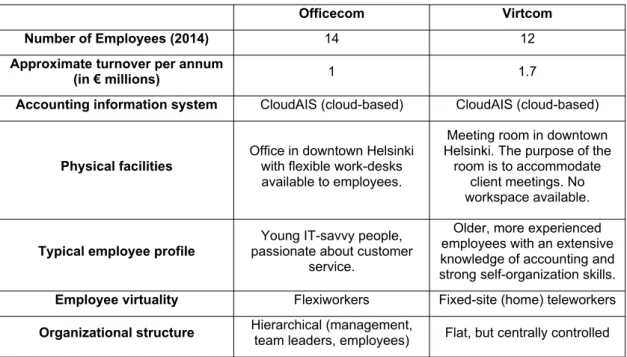
The two firms selected for this study operate in the same industry (accounting) and use the same cloud-based information system, CloudAIS (a pseudonym). Both firms are based in Helsinki, Finland. The similarity of tasks and the cloud-based system in the two case firms allowed us to focus on the salient organization-level differences in how the two firms approach virtualization. To preserve organizational anonymity, we assigned these firms the pseudonyms Officecom and Virtcom (see Table 1 for basic case information). Officecom operates through a central office in which the majority of employees work on a regular (collocated) basis, but they also have the option to work remotely. Since its launch, Virtcom has not offered office space to its employees. As a result, all Virtcom employees work from remote locations. Officecom and Virtcom were selected as the two case firms because they are comparable, but they have contrasting approaches to the use of physical workspace.
Table 1. Background information on the case firms
Officecom Virtcom Number of Employees (2014) 14 12
Approximate turnover per annum
(in € millions) 1 1.7
Accounting information system CloudAIS (cloud-based) CloudAIS (cloud-based)
Physical facilities
Office in downtown Helsinki with flexible work-desks available to employees.
Meeting room in downtown Helsinki. The purpose of the
room is to accommodate client meetings. No workspace available.
Typical employee profile
Young IT-savvy people, passionate about customer
service.
Older, more experienced employees with an extensive knowledge of accounting and strong self-organization skills.
Employee virtuality Flexiworkers Fixed-site (home) teleworkers
3.2 Data collection
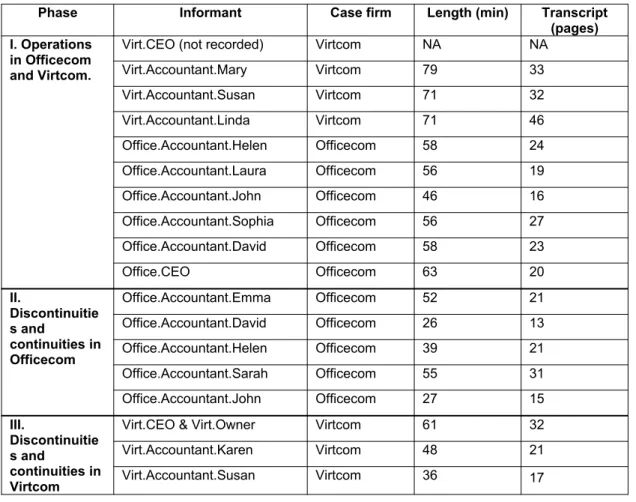
We conducted 18 semi-structured interviews in the two case firms (see Appendix I for the interview guide). The interviews were done in Finnish. We audio-recorded and transcribed all the interviews except one. This process resulted in 411 pages of transcribed material (double-spaced). We made handwritten notes during and after the one unrecorded interview. All observations by researchers during the interviews were recorded immediately after the interviews. Date, location and other relevant circumstances of interviews were also noted. The average duration of the interviews was 53 minutes. In addition to transcripts and interview notes, we took photographs of the interviewees’ workplaces (with their explicit permission). The interviews were conducted between November 2014 and January 2016.
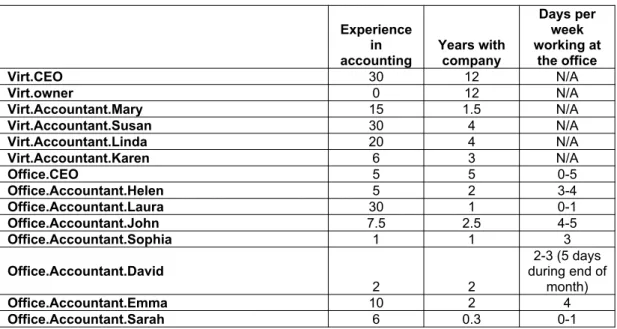
We used the known sponsor approach (Patton, 2001) to organize the interviews. We had direct access to the CEOs of both firms, who introduced the research project to their employees and helped us organize the initial interviews. This approach aided us in establishing legitimacy and credibility within the case firms from the start. To avoid elite bias (Miles et al., 2014; Myers and Newman, 2007), we sought to interview a wide range of employees at all levels – from management to entry-level accountants. Initially, we interviewed key informants (CEOs and the senior employees initially suggested by the two CEOs), however, as we progressed with our data collection, we also included recent recruits and junior employees to ensure a variety of viewpoints. Table 2 provides a short summary of the informant profiles. We were interested in interviewing employees with a variety of work arrangements, life situations, and attitudes towards remote work. We conducted repeated interviews with a number of informants to clarify particular views and to acquire in-depth information on the cases.
Table 2. Informant profiles
Experience in
accounting Years withcompany
Days per week working at
the office
Virt.CEO 30 12 N/A
Virt.owner 0 12 N/A
Virt.Accountant.Mary 15 1.5 N/A
Virt.Accountant.Susan 30 4 N/A
Virt.Accountant.Linda 20 4 N/A
Virt.Accountant.Karen 6 3 N/A
Office.CEO 5 5 0-5
Office.Accountant.Helen 5 2 3-4
Office.Accountant.Laura 30 1 0-1
Office.Accountant.John 7.5 2.5 4-5
Office.Accountant.Sophia 1 1 3
Office.Accountant.David
2 2
2-3 (5 days during end of
month)
Office.Accountant.Emma 10 2 4
Myers and Newman (2007) note that to establish mutual trust, it is important to make a good initial impression on informants. We maintained professional conduct and always presented ourselves as neutral academic researchers interested in gaining knowledge of phenomena rather than, for example, collecting insights for top management. We promised anonymity and confidentiality to our informants. We briefly introduced our research project and its objectives. At the outset, we also addressed any concerns the informants had regarding the procedure and answered any questions. At the same time, we sought to create a relaxed environment so as to not intimidate the informants. For example, we avoided overdressing for the interviews or using overly formal language and academic jargon.
We sought to maintain a neutral, non-directive style in the interviews, leaving enough space for the informants to formulate their responses. We were flexible with our interview schedules in order to accommodate the needs of the informants. We allowed the informants to freely choose the time and location for their interviews. To minimize time-related pressure, we clearly communicated that interview time would not be constrained by our schedule.
We utilized retrospective inspection (Flick, 2009) in our interviews to aid informants in recalling particular experiences in-depth. For example, we asked our informants to recall concrete examples of virtual interactions with colleagues and to reflect on the experience. Our semi-structured interview protocol (see Appendix I) helped us to focus on relevant issues during each interview. At the same time, we were aware of the context of the informant, and we adapted the interview to their expertise and experience profile (Myers and Newman, 2007). Where appropriate, we restated and summarized the implied and expressed feelings to informants to ensure that we correctly understood them.
Our data collection process was divided into three phases (see Appendix II, Table A1). During Phase I, we collected a broad range of information to obtain insights into how the two firms operate and to gather evidence regarding virtual work discontinuities and strategies for overcoming them. During this phase, we wrote notes and took photographs of the Officecom and Virtcom work environments. We noted several considerable differences in how the two firms operated (e.g., work processes, recruiting practices, client interaction).
discontinuities and continuities of virtual work. We stopped conducting interviews when we reached a saturation point at which each new interview yielded little new information.
3.3 Data analysis
To analyse our interview data, we adopted techniques from less procedural versions of grounded theory (Charmaz, 2006). We transcribed the audio recordings and performed initial coding of the transcripts while conducting additional interviews. We used the photographs of the informants’ work environments and the observation notes to aid us in recalling and understanding the context of each informant. We conducted more thorough analyses between each of the three stages of data collection. Thus, we constantly moved between the specific interview and the larger context to extract and refine the meaning of our data (Klein and Myers, 1999). Our coding procedure included three major stages. In the first stage, we openly coded the data to learn the views of our informants (Charmaz, 2006). At this stage, the coding was fully based on the data rather than on predefined theoretical categories. The two authors coded the transcripts. We used in vivo codes taken directly from informants’ discourse (Charmaz, 2006) to tag our data. As data collection progressed, we revisited, refined and compared the codes between the two authors. After initial coding, we proceeded to the axial coding stage (Charmaz, 2006; Strauss and Corbin, 1998). At this stage, our aim was to identify and relate categories and subcategories within the initial codes. The purpose of axial coding was to sort and organize a large number of codes from the initial coding stage and to create axes around which we could gather conceptually connected codes from the initial coding process. As we performed axial coding, clear concepts gradually emerged, which we connected to theory in the next stage of analysis.
4 Results
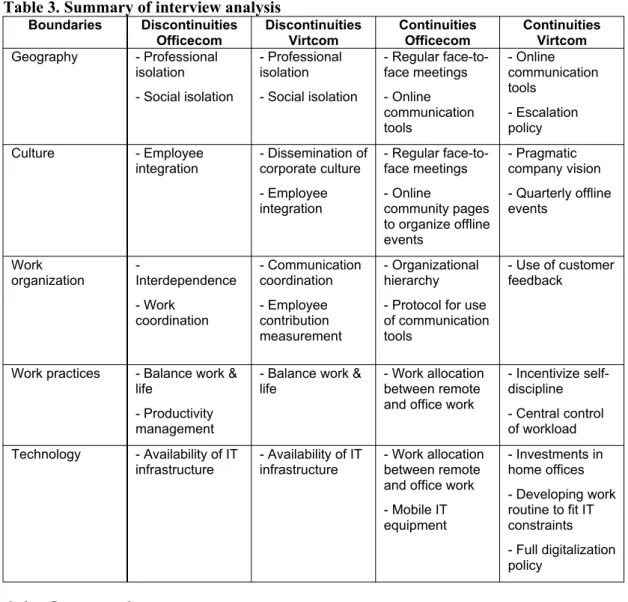
Based on our analysis of the empirical data, we were able to identify several discontinuities in both cases (Table 3). For some boundaries, both firms experienced similar discontinuities with virtual work, while for other boundaries, the perceived discontinuities differed. In the two case firms, some of the continuities had emerged in reaction to the perceived discontinuities, while other continuities were emerging during the period when data collection took place, thus co-existing with the discontinuities. As some continuities emerge gradually within an organization (rather than as a result of a one-time action/decision), it was not always possible to restore a precise timeline of the emergence of the discontinuity/continuity. Understandably, the continuities constructed were quite different across the two case firms, owing to their differing degrees of virtuality.
We identified discontinuities across five boundaries. Four of the boundaries have been discussed in earlier literature (Chudoba et al., 2005), while one, work organization, emerged from our data. Below, we provide brief definitions of each of the boundaries employed in the analysis:
Geography is a boundary created by physical distance between the dispersed geographical locations of employees working in a virtual team.
Culture is a boundary that emerges between employees from different cultural backgrounds. The culture boundary is often manifested by – but is not limited to – different national cultures. Employees with distinct working cultures or educational backgrounds working in a virtual team can experience discontinuities even if they belong to the same nationality or ethnic group.
Work organization refers to a boundary between individual employees and the distribution of work tasks across the organizational hierarchy. When crossing this boundary, employees need to adjust to a work process and consider the movement of work throughout the organization.
Work practices form a shared understanding within an organization. Developing common work practices helps organizations to be efficient; however, such practices could be a source of discontinuity in a virtual organization where employees have fewer cues regarding what is expected of them.
Technology is a boundary created by ICT and information systems that are used to operate in virtual work environments. Lack of access to or deficiencies in such technologies and systems are potential sources of discontinuities.
Table 3. Summary of interview analysis Boundaries Discontinuities Officecom Discontinuities Virtcom Continuities Officecom Continuities Virtcom
Geography - Professional isolation - Social isolation
- Professional isolation - Social isolation
- Regular face-to-face meetings - Online communication tools - Online communication tools - Escalation policy Culture - Employee
integration
- Dissemination of corporate culture - Employee integration
- Regular face-to-face meetings - Online
community pages to organize offline events
- Pragmatic company vision - Quarterly offline events Work organization - Interdependence - Work coordination - Communication coordination - Employee contribution measurement - Organizational hierarchy - Protocol for use of communication tools
- Use of customer feedback
Work practices - Balance work & life
- Productivity management
- Balance work &
life - Work allocation between remote and office work
- Incentivize self-discipline - Central control of workload Technology - Availability of IT
infrastructure - Availability of IT infrastructure - Work allocation between remote and office work - Mobile IT equipment
- Investments in home offices - Developing work routine to fit IT constraints - Full digitalization policy
4.1 Geography
Discontinuities
Employees of both Officecom and Virtcom have experienced two discontinuities while working from dispersed geographical locations: professional isolation and social isolation. The extent of the negative effects on work and their manifestation varied across Officecom and Virtcom. Nevertheless, the core problems were very similar.
There is a gap, I am not here on Mondays, and that is when we have the weekly company meeting, so I do not really know everything that is going on there. Of course I read the notes from meetings, but I still do not know everything that is going on there and what people are doing. I am not sure how aware people are about what’s coming.
Some of the accountants at Officecom had additional duties in management or employee representation. They experienced discontinuity when performing their duties in the virtual environment, as these duties required constant professional feedback from peers. Office.Accountant.Helen described her case:
At the moment [I am] a worker safety representative. It's like a representation for employees in questions between employees and an employer. So I need to be here to check things out if there is something that people need help with. I need to be on top of things. If I am here, people talk to me, and if they talk to me, I have the information.
At Virtcom, professional isolation was also brought up as a cause of disruptions at work. However, due to the decentralized structure of Virtcom, professional isolation mostly manifested itself in lack of professional advice on concrete issues rather than lack of information on overall developments in the company. Whereas finding the right person to answer an urgent question is relatively easy in an office environment, Virtcom accountants found it challenging and time consuming to do the same in a virtual organization. Virt.Accountant.Karen shared her experience:
If I were working in a normal accounting firm and I had a problem, then I could go and ask a colleague. But now that I do only remote work, it is more difficult to ask for advice. Or I don’t know if it is more difficult, but it would be easier to go and ask for advice in person than by calling someone. I feel like when calling a colleague, I am disturbing his/her work at that time.
Employees of both firms also experienced social isolation as another aspect of working from dispersed geographical locations. Unlike professional isolation, social isolation did not affect their performance of concrete work duties, however, respondents from both firms reported an overall impact on work morale. Officecom accountants shared their experiences of prolonged remote work:
remote work at home, alone. You need the social environment. That is why I changed from three remote workdays per week, to one to two days per week.
Office.Accountant.Sarah: The bonus [of coming to the office] is that it’s nice to see people. Otherwise, I am at home 5 days a week and don’t see any people, and become “mökkihöperö” [stir crazy] […] I like being with people. […] The social aspect would be the biggest [reason to come to office].
Moreover, Officecom employees considered their colleagues a major part of their social life. Office.Accountant.David explained:
I like to think that people here are not just my working friends. We share a lot of things outside work. We talk about a lot of stuff, and when I'm at home I’m usually alone and it can be a little bit boring to be at home all day.
At Virtcom, employees reported a similar feeling of social isolation, which negatively affected their attitude towards work. Compared to Officecom employees, however, Virtcom employees perceived it differently. Due to the lack of face-to-face contact from the start, Virtcom employees did not consider their colleagues to be a part of their regular social circle. As a result, they expressed their desire to overcome social isolation in more abstract terms, without referencing any interaction with particular people or participation in particular activities. Stories of Karen and Mary point to the feeling of social isolation:
Virt.Accountant.Karen: It is quite lonely sometimes. I cannot deny it. I miss the work community. I feel that the benefits of remote work are greater for me than missing the feeling of the work community. Only if my situation changes so that I settle to live in one place and be only there, then normal [non-remote] work might fit me better.
Virt.Accountant.Mary: Ideal would be half-way. That I could keep remote work days but could have the physical side as well. I don’t know. […] I am quite social anyways. I like seeing people, communicating with them. I consider myself to have good work morale, I don’t chat about nonsense too much.
Continuities
Officecom recognized the problem of employee isolation (both professional and social). To address these issues, Officecom has been constructing continuities by establishing regular face-to-face meetings and by facilitating extensive use of online communication. Office.Accountant.Helen described face-to-face meetings at Officecom:
going and whether there are some changes in the client list. Whether someone is sick, or whether a big consulting gig is coming, or whether there is a new client that you need to divide among several people.
One of the arguments for Officecom’s maintaining an office and a relatively lower degree of virtuality is that these measures mitigate the deficiencies of online communication and alleviate feelings of isolation. At the same time, online communication tools are actively implemented and employees are encouraged to use them to create continuity of work. Office.CEO explained:
We are trying to encourage [the use of various] communications [tools], let’s say, Google Hangouts, chats, group chats, private chats. So people can actually communicate pretty easily. There are also frequent team meetings. Of course, it might hurt a team a little bit if everybody is located in different places all the time. […] In the end, nothing is ever going to replace the need for human interaction between the people. I would say that we have a nice office, a good office, where people can meet and also have fun.
Virtcom’s response to geographical discontinuities was to institute the regular use of online communication tools and a clear escalation policy to resolve issues that require a second opinion. In cases where an accountant requires professional advice, the accountant first seeks the information from online resources and only then contacts others within the firm. Virt.Accountant.Karen described the process:
We have Microsoft Lync at our disposal. Either I send out a group message to all my colleagues or I target the message to a specific colleague – either one of these two alternatives. It depends a bit on what type of problem it is. I have a dedicated contact person [within the firm]. […] It depends [which channel I use]. If it is a very specific issue, in a way, a broader thing, nothing that has a unique solution that can be found on the Internet, [then I send out a specific message]. But if it is a larger issue, then I talk with [a contact person] or Virt.CEO. If it is something minor, related to the software or something that a colleague might know, then I send a group message. And then someone responds, whoever has time. I am one of the few in our firm who sends out group messages. I don’t know if others like it. I always send them out and no one has complained.
I think there are two things. First, we think that we have fewer issues to resolve than traditional accounting firms with office space. This is because we recruit accountants who are more experienced than the average accountant [so there is less need to ask questions]. Second, we are, depending on the situation, connected to each other using MS Lync or phone. Our employees know who is an expert on VAT or payroll or some other domain. […]
We know this quite well and we go through this in internal training sessions. We don’t want everyone to contact us [Virt.Owner and Virt.CEO] on all issues … it requires a certain personality. In recruiting, we emphasize that there will be no one next to you to turn for guidance. An employee always gets help, but we seek people who have good self-esteem and are active, meaning that they first search our online data repositories for an answer to their problem and only afterwards turn to others for help [by sending, e.g., MS Lync messages].
Virtcom has not taken a centralized approach to addressing the discontinuity of social isolation. However, as Virtcom management does not prohibit the use of the firm’s online communication tools for non-work-related communication, many of the Virtcom accountants use these tools for personal communication. For example, Virt.Accountant.Susan describes using MS Lync and her phone to create a feeling of being a part of a community:
I do not consider that a problem. We can exchange greetings using MS Lync as well. It works equally well. Some people miss having colleagues around themselves, but for me it is enough to see that my colleagues are online on MS Lync. That is enough for me. I feel that I have colleagues around me.
4.2 Culture
Discontinuities
Operating in the virtual environment, both firms faced the challenges of integrating new employees and of propagating their corporate culture equally to all employees. New employee integration is also a major challenge for collocated firms. However, the effect seems to be amplified in virtual work environments, where employees are less immersed in the culture.
At Officecom, the firm was initially started by a group of like-minded people who knew each other well. However, as Officecom is expanding in size and the top management is pushing for a greater degree of virtuality, the challenge of integrating new workers is becoming more apparent. Office.CEO explained:
recruiting more experienced people, and there is a pretty big gap there in terms of age, how they adapt, and how much our social life differs.
Our interviews at Officecom revealed that, presently, the firm is facing a problem where tacit cultural norms developed during the company’s early stages need to be turned into explicit rules while also integrating the cultural traits of newcomers.
At Virtcom, which has a higher degree of virtual work, the integration of new employees is just as problematic. Virt.owner noted that:
It is more difficult and time-consuming to introduce some new issue or some person to Virtcom. Or then that person must travel some place [to meet people face-to-face].
Not only the introduction and integration of new employees but also the propagation of corporate culture to existing employees and the cultivation of a sense of belonging is very time-consuming at Virtcom. Virtcom employees reported that they require a very long time to feel that they are a part of the organization. Virt.Accountant.Linda, who has been with Virtcom for four years, replied when asked about her attachment to Virtcom:
That is a good question; I am [only now] beginning to [feel part of Virtcom]. But that is what this way of work does to you. I was in that other accounting firm for a long time [prior to joining Virtcom] and Virt.owner has had to correct me when I have been saying that “we do this and we do that” [when referring to the previous job] [laughs]. […] For a long time, I felt a bit detached here. I was a bit embarrassed when I slipped [mistakenly using “we” when talking about the previous job]. So it takes a while to understand that you are not a detached “freak” here.
In some cases, respondents questioned whether there was an identifiable corporate culture at Virtcom. This resulted in employees feeling more like freelancers than employees. Virt.Accountant.Karen described her experience:
Among the Virtcom employees, the feelings of detachment from the corporate culture created challenges related to long-term commitment to the firm. In addition, these feelings contributed to the intensifying feeling of social isolation among some of the employees.
Continuities
To address the discontinuities of working across different cultures, Officecom again relies on a mix of regular face-to-face meetings to discuss various firm-related issues at different levels (firm, team, individual). One of the goals of such meetings is to propagate the values of the firm and familiarize new and existing employees with Officecom’s vision. Additionally, Officecom creates online communities for employees where any employee can propose and host an offline event supported by the firm’s resources. Office.CEO explained:
We have formal weekly meetings of course, we have team meetings, we have monthly meetings. Then, we have quarterly meetings, which have a different agenda, where we share formal information, or work-related information. We also have Google+ communities, where we share formal and informal information, it depends. We also focus on the fact that we enjoy hanging out with each other, so we have a theme, that at least once a month we set up some kind of a bigger event, somebody organizes something, it might be more party related, or it might be more sports related, but something. That is also where people meet in an informal setting.
Virtcom takes a different approach to employee integration and the propagation of corporate culture to employees. Virt.owner and Virt.CEO organize an orientation session for new employees to familiarize them with information systems and methods of work at Virtcom. Virt.owner described:
If he/she [new employee] does not know how to use CloudAIS then he/she sits together with Virt.CEO for a couple of days and [after that] we can also use a shared screen so that he/she can show what he/she is about to do and [Virt.CEO] can say that “no, instead, do this and that”.
To ensure the propagation of corporate culture, Virtcom organizes quarterly face-to-face events. However, according to Virt.owner, the key to ensuring that corporate values are shared among all employees is a pragmatic approach and a certain simplicity of values. Virt.owner elaborated:
We have these quarterly meetings where all employees meet and we have fun together. Of course, we give feedback to the employees. We emphasize that we have a unique way of doing things. From the start, we teach our way of work so that the employee understands it, the Virtcom way of work. Or my way of working, I’ve thought about the way of work, monthly inspections. We always talk about the Virt.CEO way of work. We do it our way.
Accountants at Virtcom largely agreed that the firm’s core corporate values are simple and common-sense, which makes it easy to implement them in daily work. However, some other aspects of “we-spirit“ related to belongingness seem to be neglected at present. While quarterly meetings and joint activities seem to achieve the goal of propagating the core values of the company, they fall short in strengthening the bonds between employees and the company. Thus, this continuity could be viewed as partially successfully constructed.
4.3 Work organization
Discontinuities
When working remotely, Officecom accountants experienced discontinuity due to interdependencies in their work. While the routine core of accounting work is performed independently, there are particular tasks that require specific skills. Office.Accountant.Sophia provides an example:
Yes [I work independently]. Except for the period when the financial statements are prepared. I am not experienced enough to do all the [tasks in a] financial statement. I think [a colleague] takes care of payroll staff in most of these cases. And then there is another accountant who takes care of everything else.
While some of the interdependent tasks could be organized virtually through online tools, in most cases, Officecom accountants perceived that doing so would impact the efficiency of their work. Office.Accountant.Sarah shared her experience:
[Last] Friday there was one bigger association that will be our customer, and [my colleague] will be doing bookkeeping for them, but she doesn’t know CloudAIS, so I am helping her put information into CloudAIS […] [I am here today to] mostly to help [my colleague]. […] [I need to be here as] it’s easier to show that that goes there [pointing finger]. If I did this online, it would be harder if I just said [for example] go to the accounts receivable [without being able to show where it is].
considered organization and coordination costs a significant burden. Office.Accountant.Helen’s account describes a discontinuity:
We need to be in the same place. We could do that of course via video chat but then someone needs to organize it. And usually we don't have a person who would do organizing stuff one hundred percent, so we need to sit down and organize it as a team. Then, I can't imagine having a video chat with seven people, everybody talking all the time. I could imagine that it’s difficult to control: Who is talking next and what subject is talked about via video chat. But at the table, we have body language, some authority, and someone is responsible for controlling the discussion.
Office.Accountant.Emma observed that rules of online communication are not observed or enforced, leading to asynchrony in virtual teamwork:
I think many people are not like me. They do not update their Gmail chat status online. When I open Gmail, I am online, always. Yes, I am always visible but not all people do that. I am maybe the only one who is always online because… well, it doesn't bother me. I don't get so many chats, so it is not a problem. I think.
The experience of interacting with the work organization and hierarchy was different for Virtcom accountants. Partially due to the flat organizational structure and emphasis on employee independence, Virtcom accountants did not perceive interdependence and work coordination problematic in the same way that Officecom accountants did. However, Virtcom employees encountered a unique set of discontinuities related to measuring employee contributions. Virtcom employees had difficulties understanding whether there was a feedback loop between a work process at large, and their personal contribution.
Virt.Accountant.Mary said of performance appraisal meetings:
I don’t know much about those. I had one a year ago but not this year. I have not asked if that one was a random one or not.
Virt.Accountant.Linda said of employee evaluation:
Virt.CEO and Virt.owner have sometimes used that kind of customer satisfaction survey done by an outside expert. I don’t remember, wait, it might be that if you have a significant improvement in your score in that survey then you get a bonus, but I don’t remember that well.
Continuities
clear boundaries among employees and organizational units. The objective of this reorganization is to make working within the organizational hierarchy seamless. Office.CEO explained:
We made really a big organizational change a few weeks ago. Now, we have a management team; our HR people, marketing and sales are there, COO is there, I am there. Now we also made teams, we have two teams now, and then the teams also have a manager. Now we are also starting to build the law service field, and also HR services, and additional CFO services. We have actually a pretty weird matrix organization. Well, in practice, it does not show too much. So we have created some kind of hierarchy now, where there was, three weeks ago, none. But now we have clearer responsibilities and functions, who is reporting to whom and where.
The abovementioned improvements in organizational structure were aimed at streamlining communication flows and at allowing accountants to either work independently or interact only within their team (1-2 people) as opposed to communicating with the whole organization.
At Virtcom, customer feedback played a key role in measuring employee contributions. The company has been implementing a clear process for employee evaluation Virt.Accountant.Susan described the process:
It relies very much on customer feedback. Now I don’t remember when was the last time, but Virt.owner has done customer satisfaction surveys. We have gone through the results of the survey individually and overall with our colleagues. That is one measure of employee evaluation. Then, we have compensation based on seniority, which is combined with customer satisfaction ratings. So, you don’t automatically get a bonus after some years of service, but you need to have a certain customer satisfaction rating also. Then, you get extra if you have accountant certification [given by the association of accounting firms] but that is another thing. Much of the evaluation is done through customer satisfaction. Virt.owner is actively communicating with the customers.
4.4 Work practices
Discontinuities
employees reported that typically they would only concentrate on tasks with the closest deadlines when working from home, where distractions were present. An account from Office.Accountant.Helen represents a typical scenario:
[I’m] working [from home], but if I have people there, for example I have some friends over the weekend, and Monday I am working at home, I need to put my music on and tell people to shut up and don't do anything that would disturb me. It needs to be a business environment, a working environment, and if there are free time activities going on and I am not able to participate in that, it feels bad of course. But at those times I don't usually work a full day, just meet my deadlines, then switch to free. […]
During the day there might be [distractions], mail is here let's check it out, a cat is crying for something and wants to play, maybe I should have a break and play with the cat for a while, and then go back to work. People go to do something more fun, but deadlines are there. It would be nonsense to put the hours and not work.
Officecom accountants observed that, compared to working remotely, working at the office prevents employees from “being lazy“ (Office.Accountant.Emma). While working from home enables better focus for most Officecom employees, virtual work does not provide peer pressure, nor does it provide a work-like environment.
Virtcom employees, on the other hand, had the opposite problem. Virtcom accountants reported that it was difficult to prevent themselves from working overtime in the virtual work environment. The feeling of “work is always there with you “ (Virt.Accountant.Karen) pushed Virtcom accountants to work almost constantly, throughout the day. As Virtcom does not require employees to work particular hours (e.g., nine-to-five) many employees feel that they fall behind others when not working. Virtcom accountants perceived this to be a discontinuity of virtual work, especially in the long term, as the risk of burnout increased. Virt.Accountant.Mary shared her story of work-life balance:
then I just continue the next day. I need to draw the line because the management will not do it for sure.
Continuities
To address work/life balance and productivity management issues, Officecom has been developing a system of dividing work into tasks suitable for virtual work and tasks suitable for collocated work. Office.CEO, who has solid experience in accounting, shared his views:
I think nowadays in this kind of knowledge work, there are different kinds of tasks you have to do, you have a lot of micro tasks on daily basis, which comes ad hoc. And then we have a lot of routine work, which maybe does not take much effort from you, but you do it and you have to be on schedule. And then you might have bigger projects or harder things that you really have to concentrate on, push yourself to do those. I’d like to think that you should come to your office if you have to work together with somebody, or ask something if you have to, or you need some kind of support, and you can operate easily there with this daily stuff, you can do it with a coffee mug in your hand. […] I encourage that when you have to really focus, and want to push yourself to a new level, then you might have to have your own space, where you can really concentrate.
To address work overload at Virtcom, management and employees are implementing two types of continuities. First, Virt.Owner and Virt.CEO have taken on the responsibility to centrally manage the workload by distributing new customers among accountants based on their existing workload and recent track record. Virtcom also facilitates the development of self-discipline among accountants by tying their compensation to processing a certain number of invoices, and the accountants’ evaluations are tied to customer feedback. Virt.Accountant.Susan described her experience:
That is very individual. I think that this kind of work mode requires the employee to “have a spine”, that is, in a self-imposed manner, you have to maintain agreed-upon schedules and systems. I don’t need the [pressure] of physical office surroundings for it, but I know that many people do need that.
Interviewer: How do you do it in practice? Any routines?
When asked about how her work is reviewed by management, Virt.Accountant.Susan continued:
It is very much based on customer feedback […] Virtcom conducts these larger external customer feedback surveys and we go through them [in detail] with Virt.CEO, or then on a general level among a larger group of employees. That is of course one measure […] we have this employee age bonus and customer feedback has an impact on that. The employee age bonus does not come automatically, for example after four years, you need to get good enough feedback from customers as well.
4.5 Technology
Discontinuities
Employees of both case firms regularly interacted with technology while working remotely. Both Officecom and Virtcom employees experienced discontinuities while working with technology. As individuals working remotely tend to work in multiple locations, it is difficult to build a comprehensive IT infrastructure to address all the requirements of the job. At Officecom, a common complaint was related to the suitability of the employed IT infrastructure available in remote locations. Office.Accountant.Emma’s story describes a common sentiment at Officecom:
There might be some tasks that I can't handle from there [home]… I need the computer as a base. For example, when I have to send some documents to customers and then I have to save them to my own computer, I am not sure if that's secure.
[…]
I think it's [video meeting] difficult, because when we have tested it [video meetings], always the speech it not coming directly and the picture can be… not very good. And it's not the same still. If the connection would be better, then it would be [possible].
number of days employees work at the office. This could also interact with how Officecom employees experience working in remote locations and interacting with their colleagues.
The perceptions of technology-related discontinuities may have also been influenced by the fact that Officecom invested heavily in the workstations at their office. At the office, desks are equipped with 3-4 large screens, fast PCs, and quality office furniture. Therefore, Officecom accountants may compare their office facilities with their workspaces at home. Office.CEO’s comment supports this idea:
As you saw, we have three screens, so it is actually kind of funny, that when you learn to work on three screens, then when you have only two screens, it is a pain, so we have had to invest a lot in those screens that we have, and actually people need the same kind of working space at home.
Technology-related discontinuities were less pronounced at Virtcom. This can be partially explained by the continuities discussed below, some of which could be considered to have been planned. Virtcom accountants shared the sentiment that the availability of IT infrastructure in remote locations may affect their productivity. However, overall at Virtcom, accountants believed that the trade-off between decreased efficiency and increased mobility was acceptable. Virt.Accountant.Karen shared her perspective:
I usually work at home sitting on my couch, using my laptop. I think if I had multiple screens, that would speed up my work processes, but it just does not fit with my life style at the moment. I don’t want to take my computer screens here [remote location where the accountant spends 6 months a year]. In the city I live, I have a small studio, which does not accommodate several screens. […] I have got used to this, Internet functions well in this remote location. Only with Skype it might have problems, CloudAIS works fine here.
Continuities
Officecom employees have the option to take a work laptop home and to buy additional screens. However, these options are not always viable, as some employees do not have sufficient space at home for additional IT equipment. Most of the Officecom accountants we interviewed had not chosen to purchase additional screens for their homes. This situation is arguably an example of a failed continuity, as the attempt to fix a discontinuity (providing the option to purchase IT equipment for home use) was rejected by most of the employees experiencing the discontinuity.
discontinuities related to work practices. Officecom encourages employees to split their work between home and office depending on the technology requirements of the task. As a result, Officecom accountants tend to consider the IT infrastructure requirements of a task when dividing their work between the remote and office environments. Office.Accountant.David shared a typical case:
It depends. At the end of the month I'm usually here every day. It's very busy, and you have to get everything done. But in the middle of the month I am here maybe two or three days. […] Usually, if I think it's a lot more efficient to work with the 3 displays then I don't do it at home. Unless, it's something super urgent.
[…] A lot of the accounting requires three displays. There might be some instructions in the email, then I keep the CloudAIS on one display and then some sheets or something on the third. It's more efficient when I see them at once.
Virtcom has created an environment where the absence of a fixed workplace is emphasized starting at the recruitment stage, thus attracting people who value mobility. At the same time, Virtcom provides an option to set up an appropriate workspace at home. As a result, at Virtcom, accountants value the fact that laptops can be taken anywhere, and they have therefore learnt to work with just one screen. Virt.Accountant.Susan describes:
You can build that at home as well. I do have an office room here at home but I don’t use it unless I have to print something, then I go there. I could build that kind of environment at home but freedom is more important. I work just on my laptop here at home as well. I don’t use multiple screens because we travel a lot, it is easier for me to take my laptop with me and work in the car when we travel some place. […] This is a very personal issue. I know we have employees who have two big screens at home. Nobody prevents you from doing that. I don’t miss that.
Virt.Accountant.Karen shared her perspective:
[talking about using laptop to do accounting tasks] Interviewer: How do you manage with one screen?
I have multiple windows open simultaneously. I can have Excel and CloudAIS side by side. Someone else would have those two applications open in separate screens. I have a laptop with a 17-inch screen. I think that is fine.
accountants’ work. Virtcom accountants are instructed to use only accounting data entered into the CloudAIS as well as digital documents coming from other systems (e.g., online banking). They must ignore any requests from customers to process paper-based invoices or receipts. Virtcom’s customers are also informed at the outset that all accounting data needs to be delivered in a digital format (ideally directly entered into CloudAIS). This requirement allows Virtcom accountants to work from any location and regardless of the technology available to them, provided they have a basic, internet-connected PC. Virt.Accountant.Susan explains:
We want to be the best, specifically, in electronic financial administration. […] We don’t make compromises on [digitalization of the process] at all. If the customer wants to use some other system than CloudAIS or deviate from fully electronic [processes], we don’t accept them as clients. […] I think that’s a positive thing.
5 Constructing continuities in virtual work
In both Officecom and Virtcom, we observed discontinuities across four boundaries out of the six proposed by Chudoba et al. (2005). The time boundary was omitted because neither of the two case firms perceived any discontinuities at this boundary, which is not surprising given that all employees at both firms operate within the same time zone. Despite having flexible working schedules, most of the employees worked more or less during regular working hours (e.g., no shifts). Similarly, we omitted the organization boundary simply because employees of both Officecom and Virtcom worked within the boundaries of a single organization. Instead, we observed discontinuities related to work organization and hierarchy, where employees interacted with existing organizational structure. As this does not match the definition of the organization boundary envisioned by Chudoba et al. (2005), we view it as a separate boundary.
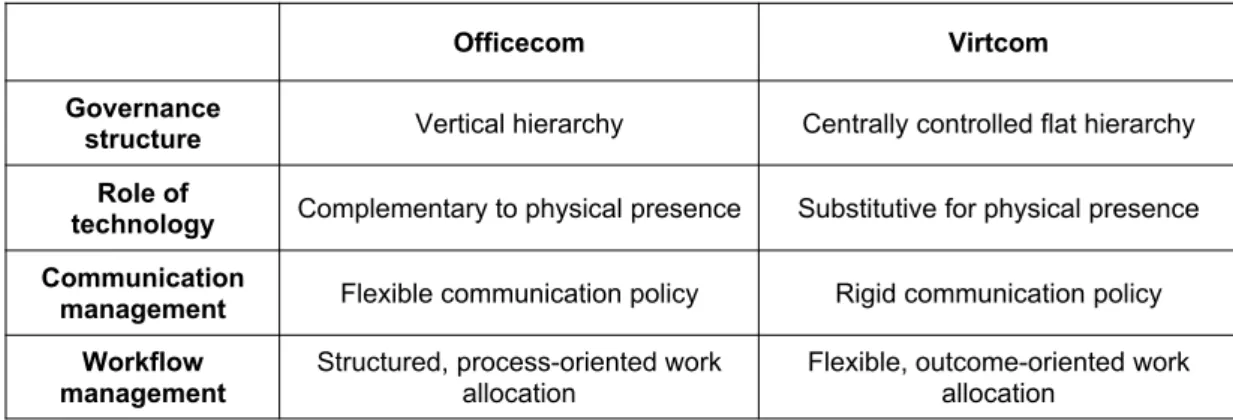
controlled horizontal hierarchy, 2) digitalization and heavy use of technology, 3) strict protocol for online communication, and 4) extreme flexibility in the work process.
Table 4. Continuity construction approaches in the two case companies
Officecom Virtcom
Governance
structure Vertical hierarchy Centrally controlled flat hierarchy Role of
technology Complementary to physical presence Substitutive for physical presence Communication
management Flexible communication policy Rigid communication policy Workflow
management
Structured, process-oriented work allocation
Flexible, outcome-oriented work allocation
Organizational hierarchy allows an organization to structure people within the virtual work environment to fit the work process. Options range from a strong vertical hierarchy to a completely flat horizontal hierarchy. Our findings suggest that organizational hierarchy is useful in addressing discontinuities related to, for example, interdependence, professional isolation, and employee integration in virtual organizations. In this study, we observe both ends of the spectrum, where Officecom has set up a vertical hierarchy (e.g., management group, senior experts, working teams) to address discontinuities, while highly virtual Virtcom relies on a flat hierarchy that is centrally controlled by Virt.CEO and Virt.Owner. We interpret these results as suggesting that a flat hierarchy provides individual employees with more decision-making power and responsibility, resulting in decreased interdependence among employees as well as their increased sense of ownership over the process and operations of the firm. The single step between the company’s top management and employees creates a support structure wherein employees do not feel excessively distanced from the core of the firm. These features of the flat hierarchy are well suited to a highly virtual organization where conventional approaches to employee management may be perceived as inappropriate. Findings from earlier research in the field of psychology support this view. Hoch and Kozlowski (2014) observed the weakened relationship between hierarchical leadership and team performance in highly virtual organizations, whereas shared leadership and structural support had a positive impact on performance in such organizations. Based on this discussion, we make the following propositions:
Proposition 1a: Organizations with a high degree of virtuality will be more likely to adopt a flat organizational hierarchy to overcome or prevent virtual work discontinuities.
Technology is a key enabler of virtual work, capable of increasing work efficiency and alleviating issues related to cultural, geographical and temporal differences within virtual organizations (Shachaf, 2008). At the same time, discontinuities experienced at technological boundaries could amplify the potential negative effects of other boundaries. Therefore, it is important to ensure the fit between technology use and the characteristics of a virtual organization. As a result, the role of technology in managing virtual work can vary from case to case. For example, organizations may use technology as a complement to regular face-to-face interaction or as a full substitute for such interaction. Officecom advocates for a complementary use of ICT to assist with work done within the framework of joint physical space. Officecom thus aims to benefit from the flexibility of technology-enabled virtual work while solving discontinuities arising from it with face-to-face interaction in the physical office. Virtcom, on the other hand, uses technology as a substitute for face-to-face interaction. In this case, ICT is used to address the deficiencies of virtual work and to enable the firm to overcome virtual work discontinuities. Organizations may also take a complementary or substitutive approach to technology use in data flow management. Virtcom used a substitutive approach, where all data had to be delivered from the client company to Virtcom digitally. This was contrary to the practices at Officecom, which used ICT and digital data to complement paper-based documents sent by the customers. Based on the above, we propose the following:
Proposition 2a: Organizations with a high degree of virtuality will be more likely to use technology as a substitute to overcome or prevent virtual work discontinuities.
Proposition 2b: Organizations with a low degree of virtuality will be more likely to use technology as a complement to overcome or prevent virtual work discontinuities.
Communication management regulates the communication flows within an organization. Virtual organizations may introduce strict communication protocols (Virtcom) or employ more natural and less regulated rules of communication between employees (Officecom). Highly virtual work environments often lack the means for natural communication and therefore engage in asynchronous communication (Bergiel et al., 2008) supported by ICT. As a result, a highly virtual organization would benefit from clear communication rules regarding what, when and how to communicate (Bergiel et al., 2008). This observation would explain the more relaxed communication policy at Officecom, where the majority of employees still have more opportunities for natural, face-to-face communication. Based on the above, we propose:
Proposition 3b: Organizations with a low degree of virtuality will be more likely to adopt flexible communication policies to overcome or prevent virtual work discontinuities.
Workflow management enables virtual organizations to regulate workflow to ensure efficient, uninterrupted work processes across boundaries. Based on our study, Virtcom takes a flexible, outcome-oriented approach to workflow management. A Virtcom employee is able to organize her workflow independently, completely based on her personal preferences, while also taking into account the environment she needs to operate in. The only requirement is that she delivers the predefined results according to the agreed-upon schedule. On the other hand, at Officecom, the workflow is structured in a process-oriented manner. Factors such as meetings, team dynamics and ICT infrastructure in the office and at home strongly encourage Officecom employees to allocate their work tasks around the process descriptions developed within the firm. We propose the following:
Proposition 4a: Organizations with a high degree of virtuality will be more likely to encourage a flexible, outcome-oriented work allocation to overcome or prevent virtual work discontinuities.
Proposition 4b: Organizations with a low degree of virtuality will be more likely to encourage a structured, process-oriented work allocation to overcome or prevent virtual work discontinuities.
6 Discussion
6.1 Implications for theory
In this paper, we sought to answer the question: How do firms construct continuities in work environments with differing degrees of virtuality? We compared two case organizations with differing degrees of virtuality, but they operate in otherwise very similar contexts. This approach allowed us to focus on differences in organizing, thus minimizing the effect and interference of contextual factors in our analysis. We used Organizational Discontinuity Theory (ODT) (Watson-Manheim et al., 2012) and the virtuality index (Chudoba et al., 2005) to identify virtual work boundaries and their effects. We observed discontinuities experienced within both organizations and investigated the approaches used to construct continuities.
6.1.1 Reflection on ODT
Based on our results, we find that ODT does provide a useful framework for a nuanced analysis of boundaries in virtual work. As suggested by Watson-Manheim et al. (2012), boundaries can have drastically different effects, even in two fairly similar environments. For example, we observed that certain work practices could lead to procrastination in one case, while creating issues with overwork in the other. These details would be lost without a clear distinction between boundaries and their effects.
Identifying the perceived discontinuities enabled comparison across the two work environments, as we observed similarities and differences. In this study, we compared two very similar contexts, and the only major difference between the two work environments was the availability of joint office space. This research design helped us separate the effects of virtuality from the effects of the contexts. Therefore, we can attribute the differences across the perceived discontinuities and continuities to the firms’ differing degrees of virtuality, at least to some extent. That said, ODT is not equipped with a mechanism for comparing virtual environments in highly varying contexts. When applying ODT to measuring a particular virtual work environment, one faces a major challenge: discontinuities are based on individual perceptions (even when recognized by a team or an organization). Thus, discontinuities are highly context- and time-specific, and they could be influenced by the subjective judgements of influential individuals within the virtual work environment. As a consequence, observing discontinuities only allows one to measure virtuality at a given moment. Discontinuities do not reveal either past negative effects perceived at boundaries (that are no longer perceived) or potential effects not yet perceived.