Addressing the risk factors and prevention of
Sudden Cardiac Death in young athletes:
a case report
Steven Piper,
BSc (Hons), DC*Brynne Stainsby,
BA, DC, FCCS(C)*** Corresponding author
Sports Sciences Residency Program Canadian Memorial Chiropractic College 6100 Leslie St, Toronto, ON, M2H 3J1 416.482.2340
** Faculty – Undergraduate Education Canadian Memorial Chiropractic College 6100 Leslie St, Toronto, ON M2H 3J1 ©JCCA 2013
Conflict of Interest: none Sources of Funding: none
The patient has provided written consent for publication. This case received REB approval from CMCC.
Background: Mandatory prescreening for the identification of risk factors and prevention of sudden cardiac death (SCD) is a widely debated topic within academic literature. In addition, the effective emergency management of sudden cardiac arrest (SCA) has reported lower survival outcomes (9% with bystander CPR, 24% with AED application) although improvements, such as strategic placements of AED units and Hands-Only (compression only) CPR, are being made.
Purpose: This case will outline the importance of establishing a true SCD incidence rate and the increased need for trained personal with proper equipment available to deliver immediate emergency cardiac management.
Conclusion: Given the lack of overall expert consensus and the low survival outcomes associated with SCD, a true incidence rate will need to be determined prior to developing a widely accepted policy. Since pre-screening all young athletes does not
Contexte : le dépistage obligatoire pour l’identification
des facteurs de risque et la prévention de la mort subite par arrêt cardiaque est un sujet largement débattu dans la documentation spécialisée. En outre, la gestion efficace des urgences d’un arrêt cardiaque soudain s’est traduite par des taux de survie plus faibles (9 % avec les RCP de spectateurs, 24 % à l’aide de DEA) bien que des améliorations, comme les placements stratégiques des unités DEA et des RCP manuelles (pression uniquement), soient effectuées.
Objectif : ce cas va souligner l’importance d’établir un taux d’incidence réel des morts subites par arrêt cardiaque et le besoin accru de personnel qualifié doté d’équipement adéquat accessible pour assurer une gestion d’urgence immédiate des arrêts cardiaques.
Conclusion : compte tenu de l’absence de consensus
appear to prevent all SCD’s, having properly trained personnel and easily accessible equipment at sporting venues, especially in remote locations, appears to be key.
(JCCA 2013;57(4):350-355)
k e y w o r d s: Sudden cardiac death, prevention, athletes
préliminaire de tous les jeunes athlètes ne semble pas empêcher toutes les morts subites par arrêt cardiaque, il semble qu’avoir un personnel bien formé et du matériel facilement accessible sur les sites sportifs, en particulier dans les régions éloignées, est essentiel.
(JCCA 2013;57(4):350-355)
m o t s c l é s : mort subite par arrêt cardiaque, prévention, athlètes
Introduction
Sudden cardiac death (SCD), a manifestation of electrical instability resulting in ventricular fibrillation or tachy-cardia, is defined as death occurring within 1 hour of symptoms.1 Prescreening, a form of primary prevention of SCD, has been highly debated. In addition, secondary management through the use of cardiopulmonary resusci-tation (CPR) and automated external defibrillator (AED) to improve survival outcomes reports low success rates.2 Regardless of whether any and/or all athletes receive pre-screening for cardiovascular risk factors, the necessary emergency training and equipment will need to be pro-vided immediately if a life is to be saved.
Case Report
A 23-year-old professional hockey player collapsed dur-ing a recreational hockey game. There were no previous symptoms, contact or trauma reported with the collapse. Two other players began first aid. Due to the absence of pulses, they immediately began CPR, instructed bystand-ers to contact emergency medical services (EMS) while another player brought an AED to the scene. The AED was applied and discharged three times. The paramedics arrived 12 minutes after the onset of CPR and immedi-ately transferred the patient to the local hospital. Follow-ing assessment, he was air transported to a major cardiac centre.
Upon admission to the intensive care unit (ICU), he was intubated and underwent hypothermic protocol. He had excellent recovery in the ICU and was subsequently transferred to the critical care unit for further monitoring. He underwent two echocardiograms; the first was
per-formed almost immediately post-arrest and demonstrated decreased left ventricular function. The second however, demonstrated a normal left ventricular ejection fraction with moderate dilation of the right ventricle. Magnetic resonance imaging revealed some dilation of both ven-tricles, however, this may be secondary to his career as a professional athlete. According to the 2010 Revised Inter-national Task Force Criteria,3 there was no evidence of arrhythmogenic right ventricular dysplasia/cardiomyop-athy (ARVD/C). Additionally, there was no evidence of myocardial infarction, fibrosis, or scarring. Finally, angi-ography revealed normal coronary arteries.
activity was to be avoided. It is not known to the authors whether this hockey player will ever return to the com-petitive level.
Discussion
The incidence rates of SCD in athletes from the ages 12-30 years old vary in the literature with a range of 1-3.6 per 100,000 athletes per year.1,4 In a major prospective study conducted in the Veneto region of Italy, the incidence rate of SCD in athletes was 1.9:100,000.4 The Corrado et al. study was significant as it was the first to observe a nation wide, mandatory reporting of sudden death. The study confirmed the cases of SCD using autopsy, considered the gold standard of SCD diagnosis.4 North American sport-ing bodies have yet to implement a mandatory reportsport-ing database although the National Collegiate Athletic Asso-ciation (NCAA) does collect information as part of health and safety reports.6 Although SCD appears rare, the true incidence rates of SCD in athletes will remain elusive so long as sporting bodies do not have a national database to report confirmed cases of SCD. The current case presents the difficulties in reporting for sport governing bodies. The incident did not occur during an official team practice or game; therefore recording the incident in an official sport registry would prove difficult.
Given the reported rarity of the event and the public attention received from high profile cases, improved re-porting will be necessary before any conclusions on the risk of SCD in young athletes can be made. In addition, since a true measure of risk has yet to be ascertained and the events often appear spontaneous, the focus on second-ary prevention through emergency management is para-mount.
The survival rates of children and young adults under the age of 35 years old experiencing sudden cardiac arrest (SCA), considered to be cardiac arrest without progress-ing to sudden death, are reportedly low.5 In a long term retrospective study, the overall survival rates of SCA in the general population under the age of 35 was 40.2%.2 The main factors associated with improved survival rates were: witnessed arrest, initial rhythm of ventricular fibril-lation or tachycardia, bystander CPR, and a public loca-tion of the event.2 When an AED is used conjunction with CPR the survival rates improve significantly. In a large heterogenous population based study, the survival rates improved from 9% with just CPR alone to 38% with the
use of an AED.2 It should be noted that the study involved the entire population and one could speculate that the survival rates would be significantly higher at a sporting event where a trained individual with access to an AED unit is on site for the sole purpose of providing emergency management. Secondary prevention or emergency man-agement within the sporting environment and academic literature has received much less attention than the role of primary prevention or prescreening. The importance of beginning secondary management immediately is re-flected in the recent changes to CPR protocols. The Amer-ican Heart Association (AHA) guideline on CPR and emergency cardiovascular care now recommends chest compressions to begin immediately.6 Instead of proceed-ing with ABC’s (Airway, Breathproceed-ing, Chest compressions) assessment the new guidelines suggest C-A-B (Chest compressions, Airway, Breathing).6
The current case is an example of how effective prop-erly trained individuals providing immediate emergency management can help save lives regardless of whether the athlete has been prescreened several times. It is also an indication of how remote environments such as recrea-tional ice hockey games can increase the risk of SCD if a trained provider and AED is not available.
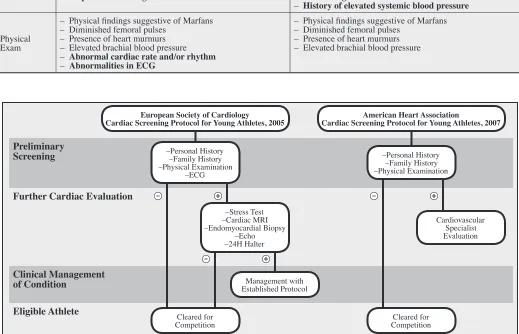
Table 1:
Detailed pre-participation cardiovascular screening protocols in athletes, of the European Society of Cardiology (2005) and the American Heart Association (2007). A positive finding in any of the screening criteria, as judged at the
discretion of the examiner, clinically warrants further evaluation. Differences are denoted in bold font.
Preliminary Examinations
European Society of Cardiology American Heart Association
Family History
– Premature cardiac death of any close family member (<50
for males, <65 for females) – Premature cardiac death of any close family member <50 years
– Heart disease disability of any close family member (<50
for males, <65 for females) – Heart disease disability of any close family member <50 years
– Knowledge of cardiac conditions of family members: cardiomyopathy, Marfan syndrome, arrhythmia, long QT syndrome, Brugada syndrome
– Knowledge of cardiac conditions of family members: cardiomyopathy, Marfan syndrome, arrhythmia, long QT syndrome
Personal History
– Chest Pain
– Unexplained syncope or near-syncope
– Unexplained dyspnea/fatigue out of proportion with exertion
– Palpitations or irregular heart beat
– Chest Pain
– Unexplained syncope or near-syncope
– Unexplained dyspnea/fatigue out of proportion with exertion
– Prior recognition of murmur
– History of elevated systemic blood pressure
Physical Exam
– Physical findings suggestive of Marfans – Diminished femoral pulses
– Presence of heart murmurs – Elevated brachial blood pressure – Abnormal cardiac rate and/or rhythm – Abnormalities in ECG
– Physical findings suggestive of Marfans – Diminished femoral pulses
– Presence of heart murmurs – Elevated brachial blood pressure
Preliminary Screening
Further Cardiac Evaluation
Clinical Management of Condition
Eligible Athlete
European Society of Cardiology
Cardiac Screening Protocol for Young Athletes, 2005 Cardiac Screening Protocol for Young Athletes, 2007American Heart Association
–Personal History –Family History –Physical Examination
–ECG
–Stress Test –Cardiac MRI –Endomyocardial Biopsy
–Echo –24H Halter
Management with Established Protocol
Cleared for Competition
–Personal History –Family History –Physical Examination
Cardiovascular Specialist Evaluation
Cleared for Competition
Figure 1
offered by governing bodies in sport indicates the import-ance of the issue. The American College of Sports Medi-cine (ACSM) currently recommends following the pre-participation screening supported by the AHA, although the ACSM also acknowledges that rigorous testing on pre-screening has yet to be completed.9 The Canadian Academy of Sports Medicine (CASM) does not currently offer a position statement with respect to pre-participation cardiovascular prescreening. In the current case report it is possible that the athlete may not have been identified as ‘at risk’ for a cardiac abnormality using the above con-sensus statements. Prior to the cardiac emergency, the athlete participated in mandatory pre-screening each year provided by the league that included a cardiac pre-screen. He reported the pre-season screening involved a 12-lead ECG, history and physical for which he passed. Further-more, after the incident occurred, the athlete’s diagnosis was officially SCA of idiopathic origin.
Currently, the academic debate on mandatory pre-screening continues while the focus on secondary care survival outcomes involving CPR and AED within litera-ture involving cardiovascular emergencies in young ath-letes at sporting events appears to be limited. As health-care providers begin to participate more and more in on-field care and acute emergency management, they will need to be prepared for SCA with possible progression to SCD. Advanced training in emergency first responder and the purchase of an AED unit is highly recommended and often a mandatory requirement of sport specialty fellow-ships.
Future studies need to identify the true incidence of SCD in athletes. A mandatory national-based reporting system that does not use media reports and are confirmed by autopsy needs to be established. Long-term athlete fol-low up is also necessary. Future studies will also need to address varying degrees of risk factors involved in SCD. For example, a case-control study may wish to examine the level of vigorous physical activity in individual sport. The amount of physical exertion required to participate may identify higher risk groups, however an absolute risk will be more difficult to elucidate.
Conclusion
In conclusion, SCD is a rare, however tragic, event that affects young, otherwise healthy, athletes. Given the low incidence rates of SCD in North America and the lack of
clear supportive evidence in the role of primary preven-tion of SCD, secondary management with CPR and AED appears critical.1 As observed in the current case, cardiac pre-screening did not prevent the cardiac emergency from occurring however the emergency on-site management may have effectively saved the athlete’s life.
References
1. Kaltman JR, Thompson PD, Lantos J, Berul CI, Botkin J, Cohen JT, et al. Screening for Sudden Cardiac Death in the young: Report from a National Heart, Lung, and Blood Institute Working Group. Circulation. 2011 May 2;123(17):1911–8.
2. Weisfeldt ML, Sitlani CM, Ornato JP, Rea T, Aufderheide TP, Davis D, et al. Survival after application of
Automatic External Defibrillators before arrival of the Emergency Medical System. J Am Coll Cardiol. 2010 Apr;55(16):1713–20.
3. Marcus FI, McKenna WJ, Sherrill D, Basso C, Bauce B, Bluemke DA, et al. Diagnosis of arrhythmogenic right ventricular cardiomyopathy/dysplasia: Proposed Modification of the Task Force Criteria. Eur Heart J. 2010 Apr 1;31(7):806–14.
4. Corrado DD, Basso CC, Pavei AA, Michieli PP, Schiavon MM, Thiene GG. Trends in sudden cardiovascular death in young competitive athletes after implementation of a preparticipation screening program. CORD Conference Proceedings. 2006 Oct 4;296(13):1593–601.
5. Meyer L, Stubbs B, Fahrenbruch C, Maeda C, Harmon K, Eisenberg M, et al. Incidence, causes, and survival trends from cardiovascular-related Sudden Cardiac Arrest in children and young adults 0 to 35 Years of Age: A 30-year review. Circulation. 2012 Sep 10;126(11):1363–72. 6. Field JM, Hazinski MF, Sayre MR, Chameides L,
Schexnayder SM, Hemphill R, et al. Part 1: Executive Summary: 2010 American Heart Association Guidelines for Cardiopulmonary Resuscitation and Emergency Cardiovascular Care. Circulation. 2010 Oct 17;122(18_ suppl_3):S640–56.
7. Corrado D. Cardiovascular pre-participation screening of young competitive athletes for prevention of sudden death: proposal for a common European protocol: Consensus Statement of the Study Group of Sport Cardiology of the Working Group of Cardiac Rehabilitation and Exercise Physiology and the Working Group of Myocardial and Pericardial Diseases of the European Society of Cardiology. Eur Heart J. 2004 Dec 14;26(5):516–24. 8. Maron BJ, Thompson PD, Ackerman MJ, Balady
Activity, and Metabolism: Endorsed by the American College of Cardiology Foundation. Circulation. 2007 Mar 27;115(12):1643–1455.
9. Thompson PD, Franklin BA, Balady GJ, Blair SN, Corrado D, Estes NAM, et al. Exercise and acute