R E V I E W
Open Access
Microsatellite resources of
Eucalyptus
: current
status and future perspectives
Murugan Sumathi and Ramasamy Yasodha
*Abstract
Eucalyptusis the premier paper pulp, short rotation plantation species grown all over the world. Genetic improvement programs integrating molecular marker tools are in progress in many parts of the globe to increase the productivity. Whole genome sequence and expressed sequence tags (ESTs) of the eucalypts paved way for introduction of molecular genetics and breeding in this genus. Different molecular characterization approaches have been used simultaneously in eucalypts, however, microsatellites or simple sequence repeats (SSRs) with their prolific characteristics could occupy a special niche inEucalyptusgenetic improvement. Further, highly informative SSRs were used for the clonal identity, genetic fidelity and in certification of breeder’s rights.Eucalyptusgenetic linkage maps generated with microsatellite loci were used successfully to identify quantitative trait loci (QTLs) for various economically important traits. Progressively more numbers of microsatellites are being linked to genes associated with adaptive and functional variations, therefore making their utility broader in genetic applications. Availability of common SSR markers across the species provides an opportunity to validate the expression of QTLs across variable genetic backgrounds and accurately compare the position of QTLs in other species. Recent evidences suggest that the presence of SSRs in micro RNAs of plant species play a role in the quantitative trait expression. Similar studies in eucalypts may provide new insights into the genetic architecture of transcript-level variations and post transcriptional gene regulation. This review on eucalypts microsatellites, highlights the availability and characteristics of genomic and eSSRs and their potential in genetic analysis of natural and breeding populations and also discusses the future prospects in population genetics and marker assisted selection.
Keywords:Eucalyptus; Microsatellites; EST-SSRs; miRNA-SSRs; Genotyping; Population genetics; Marker assisted selection
Review
Introduction
Eucalyptus is the world’s leading industrial plantation species due to its fast growth, wider adaptability and multipurpose utility. Until lately, most of theEucalyptus plantations all over the world were destined for paper production, however, presently these plantations are looking forth to support solid wood industry including veneer production (Luo et al. 2013). Research and devel-opment inputs on eucalypts have quadrupled the planta-tion productivity with the current norm of 40 m3/ha/yr (ABRAF 2013), and unleashed possibilities up to 100 m3/ ha/yr with intensive management (Evans and Turnbull 2004). Efficient breeding and clonal deployment strategies
have been employed for improved planting stock develop-ment. Efforts on molecular breeding and molecular genetic analysis are underway in eucalypts to accelerate breeding and conservation. Different kinds of DNA markers have been employed for a variety of purposes, in-cluding population genetics and marker assisted selection (MAS). One of the most frequently used DNA markers in eucalypts since 1996 are microsatellites or simple se-quence repeats (SSRs) (Byrne et al. 1996). SSRs possess characteristics such as ubiquitous distribution in genome, locus specificity, co-dominance, multi allelism, high mutation rate, heterozygous, transferability across spe-cies and associated with the gene expression and func-tion. Hence, these markers are considered to be ideal for conservation genetics, genetic diversity assessment, variety protection, and construction of high-resolution gen-etic maps to link phenotypic and genotypic variation. The importance of microsatellites for plant genome analysis has * Correspondence:[email protected]
Division of Plant Biotechnology, Institute of Forest Genetics and Tree Breeding, Coimbatore 641 002, India
been highlighted on several occasions (Varshney et al. 2005; Kalia et al. 2011). Earlier, genomic SSRs (gSSRs) were developed by isolating and sequencing clones con-taining putative SSR regions, which are costly and time consuming. Subsequently, development of online data-bases like GenBank led to the generation of Expressed Sequence Tag (EST) derived-SSRs (eSSRs) which are present in transcribed regions of the genome. However, in recent times, tremendous data on gSSRs and eSSRs are made available through next generation sequencing (NGS) methods (Zalapa et al. 2012; Kudapa et al. 2014) which can readily be used in population genetics and breeding applications.
In eucalypts, primarily genomic SSRs were developed for very few commercially important species like E. uro-phylla, E. grandis, E. globulus and E. nitens. However, high synteny of genome existing across eucalypt species has benefited many DNA data deficient eucalypts taxa, thus excellent SSR transferability was witnessed across species (da Silva et al. 2009; Acuna et al. 2012a). SSRs were used in eucalypts for multiple purposes such as species identification, phylogeny, hybrid authenticity, genetic diversity studies, genetic mapping and Quantita-tive trait loci (QTL) localization (Myburg et al. 2007; Grattapaglia et al. 2012). SSRs also offer a much higher level of automation which is crucial to manage with the great number of individuals generally handled in euca-lypt breeding. These markers have advantages over high throughput SNP markers, because the majority of SNPs is bi-allelic and information (heterozygosity) generated is low, whereas SSR mutational rates are a lot higher and the DNA slippage process creates a number of new al-leles leading to the generation of maximal information
(Ellegren 2004). Many studies on the comparison be-tween SSRs and SNPs have proven that large numbers of SNP loci were required to replace highly polymorphic SSRs in studies of diversity and relatedness (Hamblin et al. 2007; Yang et al. 2011). Further, SSR markers were always preferred as framework markers for developing consensus linkage map, composite integrated linkage map and comparative map between the species (Garcia et al. 2011; Hudson et al. 2012).
Microsatellite resources in eucalypts
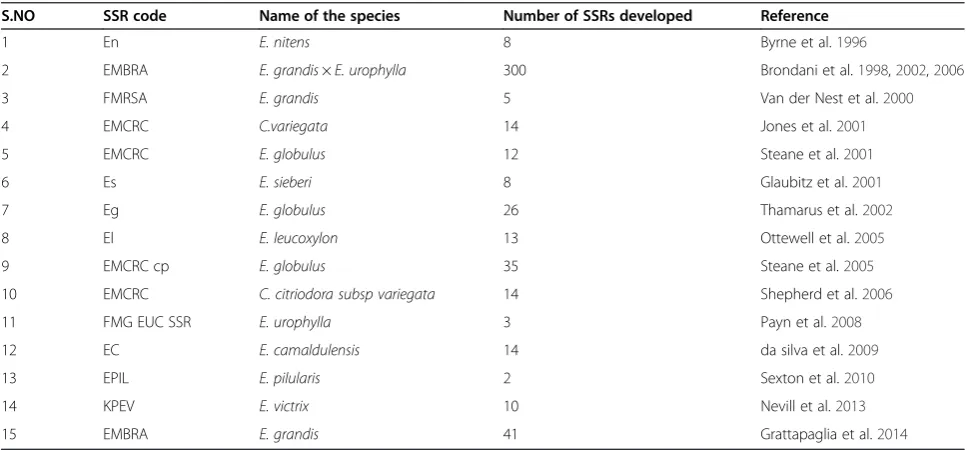
Based on the published literature, till date, a total of 505 genomic SSRs (gSSRs) and 758 validated EST-SSRs (eSSRs), 35 chloroplast SSRs (cpSSRS) and 8 gene based SSRs (CG-SS1Rs) have been applied in different species of Eu-calyptus. The details on SSR marker code, source species and number of SSRs developed are given in the Table 1. A largest collection of both gSSRs and eSSRs (~300 SSRs) was developed fromE. grandisand E. urophyllawith the prefix as Embra (Brondani et al. 1998, 2002, 2006; Faria et al. 2010, 2011). Other major resources include the SSRs with the prefix Emcrc (40 SSRs) developed fromE. globu-lus (12 loci; Steane et al. 2001), Corymbia variegata (14 loci; Jones et al. 2001) andCorymbia citriodorasubsp var-iegata(14 loci; Shepherd et al. 2006). The SSRs with pre-fixes En, Es, Eg and El were developed from species such as E. nitens (8 SSRs), E. sieberi (8 SSRs),E. globulus (26 SSRs) and E. leucoxylon (13 SSRs) respectively (Byrne et al. 1996; Glaubitz et al. 2001; Ottewell et al. 2005). A set of 35 chloroplast DNA microsatellites was developed based on the full cp-DNA sequence ofE. globulus(Steane et al. 2005). The ISSR-enrichment technique was exploited for the development of five SSR loci inE. grandis(Van der
Table 1 List of genomic and chloroplast SSRs developed inEucalyptus
S.NO SSR code Name of the species Number of SSRs developed Reference
1 En E. nitens 8 Byrne et al.1996
2 EMBRA E. grandis×E. urophylla 300 Brondani et al.1998,2002,2006
3 FMRSA E. grandis 5 Van der Nest et al.2000
4 EMCRC C.variegata 14 Jones et al.2001
5 EMCRC E. globulus 12 Steane et al.2001
6 Es E. sieberi 8 Glaubitz et al.2001
7 Eg E. globulus 26 Thamarus et al.2002
8 El E. leucoxylon 13 Ottewell et al.2005
9 EMCRC cp E. globulus 35 Steane et al.2005
10 EMCRC C. citriodora subsp variegata 14 Shepherd et al.2006
11 FMG EUC SSR E. urophylla 3 Payn et al.2008
12 EC E. camaldulensis 14 da silva et al.2009
13 EPIL E. pilularis 2 Sexton et al.2010
14 KPEV E. victrix 10 Nevill et al.2013
Nest et al. 2000). Very few SSR loci were developed from E. urophyllaandE. pilularis(Payn et al. 2008; Sexton et al. 2010). NGS methods such as 454 sequencing was applied to isolate ten SSRs fromE. victrix(Nevill et al. 2013). A re-cent study inEucalyptusfound that microsatellites occupy approximately 0.6 percent of the overall genome (Ranade et al. 2014).
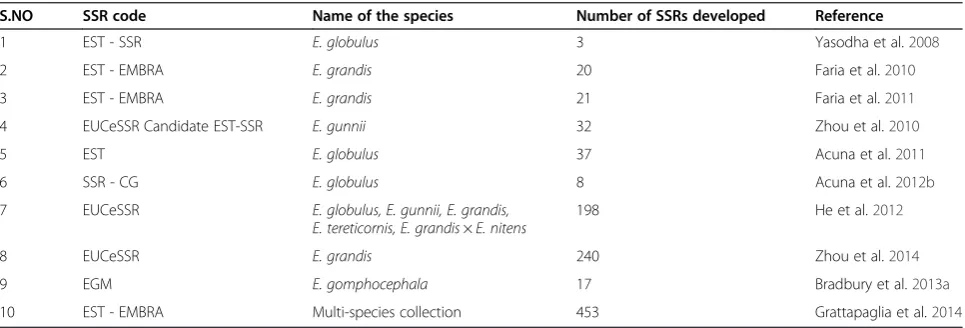
Whole-genome sequencing of E. camaldulensis andE. grandis have been completed by the Kazusa DNA Re-search Institute, Japan and DOE Joint Genome Institute (JGI), USA in collaboration with members of the Eucalyp-tusGenome Network (EUCAGEN) respectively (Hirakawa et al. 2011; Myburg et al. 2014). Additionally, transcrip-tome resources were generated from various tissues in-cluding xylem, phloem, root, shoot, leaf and reproductive tissues from species such asE. grandis,E. gunnii,E. globu-lus, E. camaldulensis and E. tereticornis (Mizrachi et al. 2010; http://web.up.ac.za/eucagen/; http://eucgenie.org/; Healey et al. 2014). All these transcriptome resources have promoted the development of SSR markers in silico and many of which were used for diverse purposes across eu-calypt species (Ceresini et al. 2005; Rabello et al. 2005; Yasodha et al. 2008; Rengel et al. 2009; He et al. 2012; Zhou et al. 2014). Recently, gene specific microsatellites were developed from E. grandis, E. globulusand E. gom-phocephala (Acuna et al. 2012b; Bradbury et al. 2013a). Table 2 provides the list of EST-SSRs developed in various species of eucalypts.
The frequency of occurrence of microsatellites had varied in different databases of Eucalyptusfor example, 12.9% in NCBI database (Yasodha et al. 2008) 13.3% in EUCAWOOD (Rengel et al. 2009), 25.5% and 29% in FORESTs database (Rabello et al. 2005; Ceresini et al. 2005). The type of SSRs found in the ESTs varied among the transcriptome analyzed. In general, amongst the SSR motifs, the dimeric and trimeric were most abundant followed by other types. This is in consonance with many other plant species belonging to monocots as well
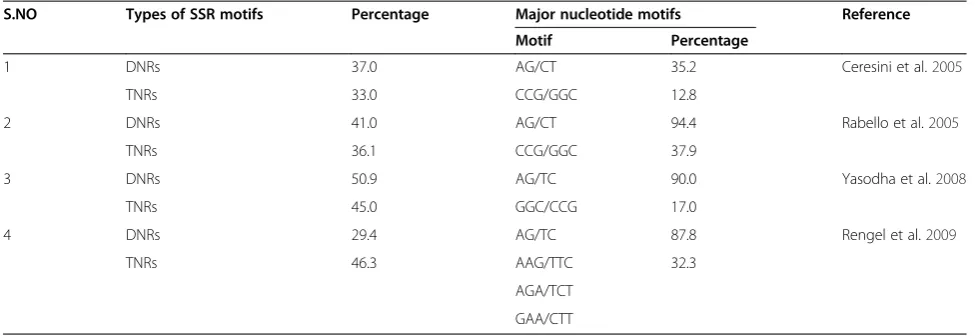
as dicots. The most represented di-nucleotide was AG/ TC (72.5%) motif followed by the trimeric CCG/GGC, AAG/TTC, and AGA/TCT (12.81%) (Ceresini et al. 2005; Rabello et al. 2005; Yasodha et al. 2008; Rengel et al. 2009; Ranade et al. 2014). The details on different types of motifs are shown in Table 3. These motifs have also been found to be predominant dinucleotide repeats and trinucleotide repeats respectively in many plant spe-cies (Zhou et al. 2014). The BAC clones of eucalypts had comparatively less numbers of SSR frequency (Paiva et al. 2011). Most of the SSRs isolated from genomic li-braries were targeted for simple dinucleotide repeats, particularly AG/TC motifs except a few had compound, interrupted and trinucleotide motifs (Glaubitz et al. 2001; Ottewell et al. 2005; Brondani et al. 2006). Unique in silicomethods were developed to extract and transfer the highly conserved orthologus genic SSR regions from E. globulus to E. camaldulensis, a species with less gen-omic information, and such novel SSRs were useful for parentage analysis, confirmation of interspecific hybrid and genotyping of seedling seed orchard (Nagabhushana et al. 2011). A study to mine SSRs in silico from 22298 EST sequences of eucalypts revealed that primers could be designed for 1244 microsatellites, of which 182 were selected for characterization based on polymorphism status among species (Grattapaglia et al. 2014).
Cross-species transferability
Microsatellite markers are generally transferable across related genera and the genetic distance among the spe-cies limits the percent transferability. The cross spespe-cies transferability provides a potential source of codominant markers for many related species and facilitates evolu-tionary, ecological, and conservation studies across the species. Since the display of cross-species transferability of microsatellite markers is high in eucalypts, attempts have been made to identify a useful number of primer sets of high utility in a wide range of species. Details of
Table 2 List of EST- SSRs developed inEucalyptus
S.NO SSR code Name of the species Number of SSRs developed Reference
1 EST - SSR E. globulus 3 Yasodha et al.2008
2 EST - EMBRA E. grandis 20 Faria et al.2010
3 EST - EMBRA E. grandis 21 Faria et al.2011
4 EUCeSSR Candidate EST-SSR E. gunnii 32 Zhou et al.2010
5 EST E. globulus 37 Acuna et al.2011
6 SSR - CG E. globulus 8 Acuna et al.2012b
7 EUCeSSR E. globulus, E. gunnii, E. grandis, E. tereticornis, E. grandis×E. nitens
198 He et al.2012
8 EUCeSSR E. grandis 240 Zhou et al.2014
9 EGM E. gomphocephala 17 Bradbury et al.2013a
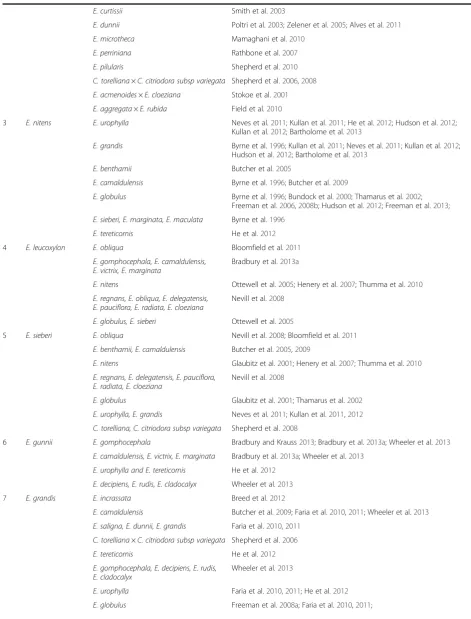
the SSR source species and the species in which the SSRs cross amplified are given in the Table 4. The cross species transferability of genomic SSR markers was com-paratively higher among the species of Eucalyptus and the transferability rate dropped down in the species of Corymbia and Angophora (Steane et al. 2001). Initially, Byrne et al. (1996) tested transferability of four nuclear microsatellite markers from E. nitens and found that they were transferable (50%) to sub genera Symphyomyr-tus and Monocalyptus but not to the genus Corymbia. However, modifications in the PCR amplification proto-cols could improve the transfer rate across genera (Shepherd et al. 2006). Many of the SSR loci isolated fromE. grandisand E. urophyllawere cross amplified in different species likeE. globulus,E. nitens,E. pilularis,E. urophylla, E. pyrocarpa, E. camaldulensis and E. tereti-cornis(Bundock et al. 2000; Glaubitz et al. 2001; Steane et al. 2001; Agrama et al. 2002; Ottewell et al. 2005; Arumugasundaram et al. 2011; Subashini et al. 2013). Similarly, the eSSRs were successfully cross amplified in several species like E. grandis, E. saligna, E. dunnii, E. viminalis,E. camaldulensis,E. urophyllaandE. tereticor-nis (Neves et al. 2011; Faria et al. 2010, 2011; Acuna et al. 2012b; Hudson et al. 2012; Petroli et al. 2012; Breed et al. 2012; He et al. 2012; Bradbury et al. 2013a, b; Bradbury and Krauss 2013). Recently, gene-homologous eSSRs designed forE. gomphocephala were transferred to E. marginata, E. camaldulensis, and E. victrix (Bradbury et al. 2013a).
Genotyping of SSRs and allele variations in eucalypts
Genotyping studies with microsatellites generally pre-ferred dinucleotide repeats because they bring off high polymorphism and display more variation among indi-viduals. In certain occasions the dinucleotide repeats based allelic variation results in shadow bands or stutter bands during electrophoresis thus leading to genotyping errors (Hoffman and Amos 2005). Hence, the genotyping
applications requiring high precision like clonal certifica-tion, microsatellite markers with tetra and penta nucleo-tide motifs were recommended (Faria et al. 2010). Loci with higher length repeats provided an advantage of accur-ate allele calling due to their larger allele size difference. In eucalypts, presence of tetra, penta and hexanucleotide allowed easy allele calling which was challenging when di and trinucleotide motif SSRs were used (Faria et al. 2010). Presence of null allele, i.e., a microsatellite locus that con-sistently fails to amplify to detected levels via the polymer-ase chain reaction (PCR) is not uncommon in eucalypts (Glaubitz et al. 2001). In general, microsatellite null alleles at low frequencies are unlikely to introduce serious biases into population genetic analysis (Dakin and Avise 2004). Nevertheless, microsatellite null alleles can cause egre-gious errors when they are used for genetic mapping ex-periments at family level. There are methods and software packages available to handle the null alleles and heterozy-gote deficiency in various genetic analyses (Chapuis and Estoup 2007; Chybicki and Burczyk 2009). In a genetic mapping study, it was found that 20 out of 241 segregating SSR loci were observed to have null alleles (Brondani et al. 2006). Increased occurrence of null alleles have been ob-served when attempting to transfer microsatellites across related species (Faria et al. 2010; Bradbury et al. 2013a, b; Bradbury and Krauss 2013) and appropriate strategies need to be used in handling such data. Genotyping with microsatellites markers on large scale using DNA sequen-cing instruments demonstrated very high accuracy of allele sizing and binning to avoid the scoring errors. Al-though various methods of primer labeling and SSR allele detection in eucalypts was reported (Ottewell et al. 2005; Missiaggia and Grattapaglia 2006; Faria et al. 2011; Subashini et al. 2013), difficulties in accuracy of allele siz-ing continue to exist.
Allele sizes generated by the microsatellites loci have larger implications on genotyping of the individuals. Al-lele sizes generated by the eucalypt microsatellite loci Table 3 Types of SSR motifs inEucalyptusspecies
S.NO Types of SSR motifs Percentage Major nucleotide motifs Reference
Motif Percentage
1 DNRs 37.0 AG/CT 35.2 Ceresini et al.2005
TNRs 33.0 CCG/GGC 12.8
2 DNRs 41.0 AG/CT 94.4 Rabello et al.2005
TNRs 36.1 CCG/GGC 37.9
3 DNRs 50.9 AG/TC 90.0 Yasodha et al.2008
TNRs 45.0 GGC/CCG 17.0
4 DNRs 29.4 AG/TC 87.8 Rengel et al.2009
TNRs 46.3 AAG/TTC 32.3
AGA/TCT
Table 4 Details on theEucalyptusspecies used for SSR development and species showed cross transferability
S.No Species used for SSR development
Species transferred Reference
1 E. globulus E. grandis Neves et al.2011; Alves et al.2011; Kullan et al.2011,2012; Acuna et al.2012a; Hudson et al.2012; Bartholome et al.2013
E. saligna, E. dunnii Alves et al.2011; Acuna et al.2012a
E. viminalis Acuna et al.2012a
E. camaldulensis Butcher et al.2009; Alves et al.2011; Acuna et al.2012a; Bradbury et al.2013a; Subashini et al.2013; Wheeler et al.2013
E. tereticornis Alves et al.2011; He et al.2012; Acuna et al.2012a; Subashini et al.2013
E. urophylla Alves et al.2011; Neves et al.2011; Kullan et al.2011,2012; Hudson et al.2012; He et al.2012; Bartholome et al.2013
E. obliqua Nevill et al.2008,2010; Bloomfield et al.2011
E. gomphocephala Bradbury and Krauss2013; Bradbury et al.2013a; Wheeler et al.2013
E. victrix, E. marginata Bradbury et al.2013a
E. benthamii Butcher et al.2005
E. nitens Steane et al.2001; Henery et al.2007; Grosser et al.2008; Barbour et al.2010; Thumma et al.2010
E. regnans, E. delegatensis, E. pauciflora, E. radiata, E. cloeziana
Nevill et al.2008,2010
E. bicostata, E. maidenii Steane et al.2001
E. perriniana×E. nitens Barbour et al.2010
E. aggregata, E. rubida, Field et al.2010
E. microtheca Mamaghani et al.2010
E. decipiens, E. rudis, E. caladocalyx Wheeler et al.2013
2 E. grandis and E. urophylla
E. camaldulensis Agrama et al.2002; Arumugasundaram et al.2011; Alves et al.2011; Bradbury et al.2013a; Subashini et al.2013
E. obliqua Nevill et al.2008; Bloomfield et al.2011;
E. gomphocephala Bradbury and Krauss2013; Bradbury et al.2013a
E. victrix, E. marginata Bradbury et al.2013a
E. globulus Bundock et al.2000; Glaubitz et al.2001; Marques et al.2002; Thamarus et al.2002; Patterson et al.2004; Freeman et al.2006;
Foster et al.2007; Jones et al.2007; Nevill et al.2008; Freeman et al.2008a,b; Rao et al.2008; Freeman et al.2009; Alves et al.2011; Ribeiro et al.2011; Hudson et al.2012; Freeman et al.2013; Jones et al.2013
E. benthamii Butcher et al.2005
E. grandis Chaix et al.2003; Missiaggia et al.2005; Kirst et al.2005b; Jones et al.2008; Rosado et al.2010; Alves et al.2011; Gion et al.2011; Kullan et al.2011; Neves et al.2011; Kullan et al.2012; Hudson et al.2012; Petroli et al.2012; Bartholome et al.2013
E. consideniana, E. sieberi Glaubitz et al.2001,2003
E. nitens Glaubitz et al.2001; Grosser et al.2008
E. brownii, E. populnea Holman et al.2003
E. urophylla Tripiana et al.2007; Payn et al.2008; Rosado et al.2010; Gion et al.2011; Kullan et al.2011; Neves et al.2011; Alves et al.2011; Kullan et al.2012; Hudson et al.2012; Petroli et al.2012; Bartholome et al.2013
E. regnans, E. radiata, E. delegatensis, E. pauciflora
Nevill et al.2008,2010
E. cloeziana Stokoe et al.2001; Nevill et al.2008
E. loxophleba Sampson and Byrne2008
Table 4 Details on theEucalyptusspecies used for SSR development and species showed cross transferability (Continued)
E. curtissii Smith et al.2003
E. dunnii Poltri et al.2003; Zelener et al.2005; Alves et al.2011
E. microtheca Mamaghani et al.2010
E. perriniana Rathbone et al.2007
E. pilularis Shepherd et al.2010
C. torelliana×C. citriodora subsp variegata Shepherd et al.2006,2008
E. acmenoides×E. cloeziana Stokoe et al.2001
E. aggregata×E. rubida Field et al.2010
3 E. nitens E. urophylla Neves et al.2011; Kullan et al.2011; He et al.2012; Hudson et al.2012; Kullan et al.2012; Bartholome et al.2013
E. grandis Byrne et al.1996; Kullan et al.2011; Neves et al.2011; Kullan et al.2012; Hudson et al.2012; Bartholome et al.2013
E. benthamii Butcher et al.2005
E. camaldulensis Byrne et al.1996; Butcher et al.2009
E. globulus Byrne et al.1996; Bundock et al.2000; Thamarus et al.2002; Freeman et al.2006,2008b; Hudson et al.2012; Freeman et al.2013;
E. sieberi, E. marginata, E. maculata Byrne et al.1996
E. tereticornis He et al.2012
4 E. leucoxylon E. obliqua Bloomfield et al.2011
E. gomphocephala, E. camaldulensis, E. victrix, E. marginata
Bradbury et al.2013a
E. nitens Ottewell et al.2005; Henery et al.2007; Thumma et al.2010
E. regnans, E. obliqua, E. delegatensis, E. pauciflora, E. radiata, E. cloeziana
Nevill et al.2008
E. globulus, E. sieberi Ottewell et al.2005
5 E. sieberi E. obliqua Nevill et al.2008; Bloomfield et al.2011
E. benthamii, E. camaldulensis Butcher et al.2005,2009
E. nitens Glaubitz et al.2001; Henery et al.2007; Thumma et al.2010
E. regnans, E. delegatensis, E. pauciflora, E. radiata, E. cloeziana
Nevill et al.2008
E. globulus Glaubitz et al.2001; Thamarus et al.2002
E. urophylla, E. grandis Neves et al.2011; Kullan et al.2011,2012
C. torelliana, C. citriodora subsp variegata Shepherd et al.2008
6 E. gunnii E. gomphocephala Bradbury and Krauss2013; Bradbury et al.2013a; Wheeler et al.2013
E. camaldulensis, E. victrix, E. marginata Bradbury et al.2013a; Wheeler et al.2013
E. urophylla and E. tereticornis He et al.2012
E. decipiens, E. rudis, E. cladocalyx Wheeler et al.2013
7 E. grandis E. incrassata Breed et al.2012
E. camaldulensis Butcher et al.2009; Faria et al.2010,2011; Wheeler et al.2013
E. saligna, E. dunnii, E. grandis Faria et al.2010,2011
C. torelliana×C. citriodora subsp variegata Shepherd et al.2006
E. tereticornis He et al.2012
E. gomphocephala, E. decipiens, E. rudis, E. cladocalyx
Wheeler et al.2013
E. urophylla Faria et al.2010,2011; He et al.2012
were highly varying, as low as 50 bp was detected inE. camaldulensis (da Silva et al. 2009). Very high levels of allelic variability were observed at different levels of pop-ulations. A pioneering study on analysis of 15 SSR loci in 32 F1 individuals of E. grandis×E. urophylla gener-ated 9 to 26 alleles per locus with an average of 16.3 ± 4.8 (Brondani et al. 1998). Similarly, a breeding popula-tion ofE. grandiswith 192 selected individuals produced a total of 119 alleles with 6 SSR loci, yielding a minimum of 6 (Embra11) and a maximum of 33 alleles (Embra16), with an average of 19.8 ± 9.2 alleles per locus (Kirst et al. 2005a).
Compared to gSSRs, eSSR loci were known for low levels of polymorphism, Faria et al. (2010) analyzed 10 eSSRs in 6 eucalypt species wherein the number of alleles were in the range of 7–15 (E. grandis), 5–12 (E. globulus), 4–10 (E. urophylla), 6–14 (E. camaldulensis), 5–9 (E. dun-nii) and 4–14 (E. saligna). Allele size variations favored multiplexing of fluorescent based automated DNA geno-typing applications, wherein upto 18 loci were analyzed in a single run with 5 dye format (Faria et al. 2010).
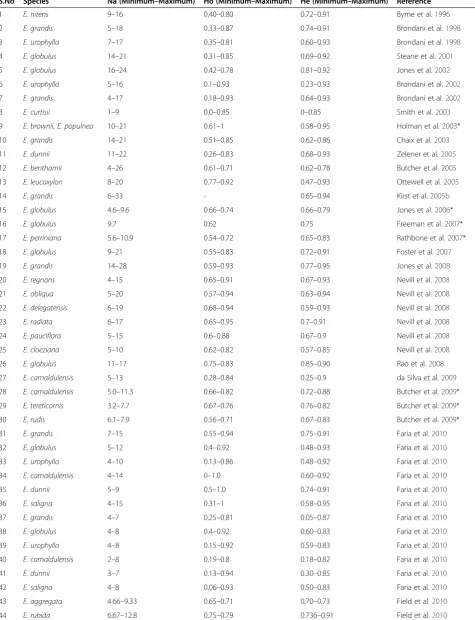
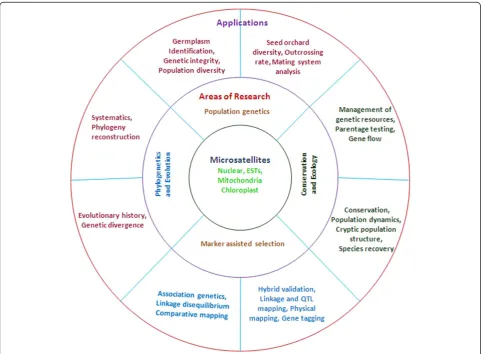
Eucalyptusmicrosatellites are usually highly informative as revealed through the statistics of polymorphic informa-tion content (PIC) and heterozygosity (He) (Table 5). The most widely used SSRs such as Embra, generated max-imum heterozygosity value of 0.95 (Holman et al. 2003; Jones et al. 2008), Emcrc markers showed highest hetero-zygosity of 0.92, Es, En and El series loci produced 0.95, 0.91 and 0.93 (Byrne and Hines 2004; Glaubitz et al. 2001; Ottewell et al. 2005). Accordingly the PIC values were also very high (0.933) in most of the studies so far reported (Kirst et al. 2004). Because of these characteristics of microsatellites, they were used for various purposes in plant genome analysis (Figure 1).
Applications of microsatellite markers in eucalypts
The stupendous and multifaceted applications of microsa-tellites in tree genome analysis are shown in the Figure 1. The ubiquitous nature of microsatellites in tree genome (present in nuclear, EST, mitochondria and chloroplast genome sequences) make them the most suitable DNA markers for analysis of population genetics, phylogeny and species evolution, studies on conservation and ecology and marker assisted selection/breeding (Porth and El-Kassaby 2014). Highly informative SSR markers generate multiple alleles, thus favoring germplasm/clonal identifica-tion, genetic integrity determination during propagation
and controlled breeding, seed orchard diversity, mating system and outcrossing rate analysis (Falahati-Anbaran et al. 2007). The multilocus nature and even distribution of microsatellites over the plant genome benefit the estab-lishment of taxonomic identity of species and phylogeny reconstruction (Ochieng et al. 2007). Microsatellites are ideal for conservation genetics and genetic resource man-agement because of their selectively neutral characteristics (van Zonneveld et al. 2014) and evolutionary processes of interest to conservation geneticists (Wang et al. 2009).
Characterization of germplasm and individual identification
Microsatellites information on genotype is essential for effective utilization of germplasm accessions for genetic improvement for pulp yield, adventitious rooting, frost and salt tolerance, resistance to pests and diseases, ef-forts have continuously been made to characterize and evaluate germplasm accessions. Large amount of such germplasm and clonal accessions are maintained in tree breeding programs and clonal deployment activities of eucalypts. The high degree of polymorphism and the clear and simple co-dominant Mendelian inheritance of the SSRs has proven to be an extremely powerful system for the unique identification of Eucalyptus individuals for fingerprinting purposes and parentage testing (Kirst et al. 2005b). Accordingly, SSR markers have been widely used for characterization of germplasm resources includ-ing clone finclud-ingerprintinclud-ing, hybrid validation in controlled crosses, inter-individual genetic distance estimation, spe-cies distinction, and assignment of hybrid individuals to their most likely parent species (Stokoe et al. 2001; Smith et al. 2003; Grattapaglia et al. 2004a; Kirst et al. 2005b; Ochieng et al. 2007; Grosser et al. 2008; Jones et al. 2008; Payn et al. 2008; Rao et al. 2008; Sampson and Byrne 2008; Butcher et al. 2009; Barbour et al. 2010; Faria et al. 2010; Shepherd et al. 2010; Ribeiro et al. 2011; Arumugasundaram et al. 2011; Subashini et al. 2013; Wheeler et al. 2013) Clonal fingerprinting gener-ally requires larger allele size differences for multiplex-ing, precise and stable allele sizing for deployment across laboratories. Hence, SSR markers with high motif length provided possibilities for greater utilization to-wards individual identification (Faria et al. 2011). SSR markers play an important role in designing breeding populations and function as decision support tool in genetic conservation programs. Use of SSR markers in Table 4 Details on theEucalyptusspecies used for SSR development and species showed cross transferability
(Continued)
8 E. camaldulensis cross ampliefied in 25 different species da Silva et al.2009
9 Eucalyptus E. tessellarii, E. curtisii, E. citriodora, E. tetrodonta, E. cloeziana, E. regnans, E. grandis
Table 5 Characteristics of major eucalypt SSR loci applied in population genetic studies
S.No Species Na (Minimum–Maximum) Ho (Minimum–Maximum) He (Minimum–Maximum) Reference
1 E. nitens 9–16 0.40–0.80 0.72–0.91 Byrne et al.1996
2 E. grandis 5–18 0.33–0.87 0.74–0.91 Brondani et al.1998
3 E. urophylla 7–17 0.35–0.81 0.60–0.93 Brondani et al.1998
4 E. globulus 14–21 0.31–0.85 0.69–0.92 Steane et al.2001
5 E. globulus 16–24 0.42–0.78 0.81–0.92 Jones et al.2002
6 E. urophylla 5–16 0.1–0.93 0.23–0.93 Brondani et al.2002
7 E. grandis 4–17 0.18–0.93 0.64–0.93 Brondani et al.2002
8 E. curtisii 1–9 0.0–0.85 0–0.85 Smith et al.2003
9 E. brownii, E. populnea 10–21 0.61–1 0.58–0.95 Holman et al.2003*
10 E. grandis 14–21 0.51–0.85 0.62–0.86 Chaix et al.2003
11 E. dunnii 11–22 0.26–0.83 0.68–0.93 Zelener et al.2005
12 E. benthamii 4–26 0.61–0.71 0.62–0.78 Butcher et al.2005
13 E. leucoxylon 8–20 0.77–0.92 0.47–0.93 Ottewell et al.2005
14 E. grandis 6–33 - 0.65–0.94 Kirst et al.2005b
15 E. globulus 4.6–9.6 0.66–0.74 0.66–0.79 Jones et al.2006*
16 E. globulus 9.7 0.62 0.75 Freeman et al.2007*
17 E. perriniana 5.6–10.9 0.54–0.72 0.65–0.83 Rathbone et al.2007*
18 E. globulus 9–21 0.55–0.83 0.72–0.91 Foster et al.2007
19 E. grandis 14–28 0.59–0.93 0.77–0.95 Jones et al.2008
20 E. regnans 4–15 0.65–0.91 0.67–0.93 Nevill et al.2008
21 E. obliqua 5–20 0.57–0.94 0.63–0.94 Nevill et al.2008
22 E. delegatensis 6–19 0.68–0.94 0.59–0.93 Nevill et al.2008
23 E. radiata 6–17 0.65–0.95 0.7–0.91 Nevill et al.2008
24 E. pauciflora 5–15 0.6–0.88 0.67–0.9 Nevill et al.2008
25 E. cloeziana 5–10 0.62–0.82 0.57–0.85 Nevill et al.2008
26 E. globulus 11–17 0.75–0.83 0.85–0.90 Rao et al.2008
27 E. camaldulensis 5–13 0.28–0.84 0.25–0.9 da Silva et al.2009
28 E. camaldulensis 5.0–11.3 0.66–0.82 0.72–0.88 Butcher et al.2009*
29 E. tereticornis 3.2–7.7 0.67–0.76 0.76–0.82 Butcher et al.2009*
30 E. rudis 6.1–7.9 0.56–0.71 0.67–0.83 Butcher et al.2009*
31 E. grandis 7–15 0.55–0.94 0.75–0.91 Faria et al.2010
32 E. globulus 5–12 0.4–0.92 0.48–0.93 Faria et al.2010
33 E. urophylla 4–10 0.13–0.86 0.48–0.92 Faria et al.2010
34 E. camaldulensis 4–14 0–1.0 0.60–0.92 Faria et al.2010
35 E. dunnii 5–9 0.5–1.0 0.74–0.91 Faria et al.2010
36 E. saligna 4–15 0.31–1 0.58–0.95 Faria et al.2010
37 E. grandis 4–7 0.25–0.81 0.05–0.87 Faria et al.2010
38 E. globulus 4–8 0.4–0.92 0.60–0.83 Faria et al.2010
39 E. urophylla 4–8 0.15–0.92 0.59–0.83 Faria et al.2010
40 E. camaldulensis 2–8 0.19–0.8 0.18–0.82 Faria et al.2010
41 E. dunnii 3–7 0.13–0.94 0.30–0.85 Faria et al.2010
42 E. saligna 4–8 0.06–0.93 0.50–0.83 Faria et al.2010
43 E. aggregata 4.66–9.33 0.65–0.71 0.70–0.73 Field et al.2010
Table 5 Characteristics of major eucalypt SSR loci applied in population genetic studies(Continued)
45 E. grandis 2–7 0.06–1.0 0.18–0.77 Faria et al.2011
46 E. urophylla 1–7 0.0–0.93 0.0–0.81 Faria et al.2011
47 E. globulus 2–8 0.14–0.94 0.23–0.82 Faria et al.2011
48 E. camaldulensis 2–10 0.07–0.93 0.07–0.90 Faria et al.2011
49 E. aggregata × E. rubida 5.67–14.2 0.77–0.86 0.83–0.89 Field et al.2010
50 E. pilularis 12.6 0.78 0.75 Shepherd et al.2010*
51 E. globulus 6–21 0.71–0.93 0.5–0.9 Ribeiro et al.2011
52 E. obliqua 11–32 0.71–0.91 0.75–0.94 Bloomfield et al.2011
53 E. incrassata - 0.61–0.92 0.76–0.80 Breed et al.2012
54 E. gomphocephala 27–60 0.58–0.73 0.6–0.69 Bradbury and Krauss2013
55 E. gomphocephala 8–27 0.52–0.87 0.51–0.84 Bradbury et al.2013b
56 E. gomphocephala 2–12 0.17–0.87 0.24–0.86 Bradbury et al.2013a
57 E. victrix 5–25 0.52–0.91 0.48–0.93 Nevill et al.2013
58 E. grandis 1–14 0–1 0.08–0.96 Zhou et al.2014
*Indicates the mean values; Na- Number of alleles; Ho- Observed Heterozygosity; He- Expected Heterozygosity.
germplasm characterization of Jatropha curcus showed that the germplasm has limited diversity and the neces-sity of additional collections for species improvement (Alves et al. 2011). Similarly, SSRs are the most sought after DNA markers for germplasm characterization in several tree species like avocado (Gross-German and Viruel 2013),Psidium guajava(Sitther et al. 2014), Olive (Trujillo et al. 2014),Tamarix (Terzoli et al. 2014) and Prunus(Khadivi-Khub et al. 2014).
Parentage testing and gene flow studies
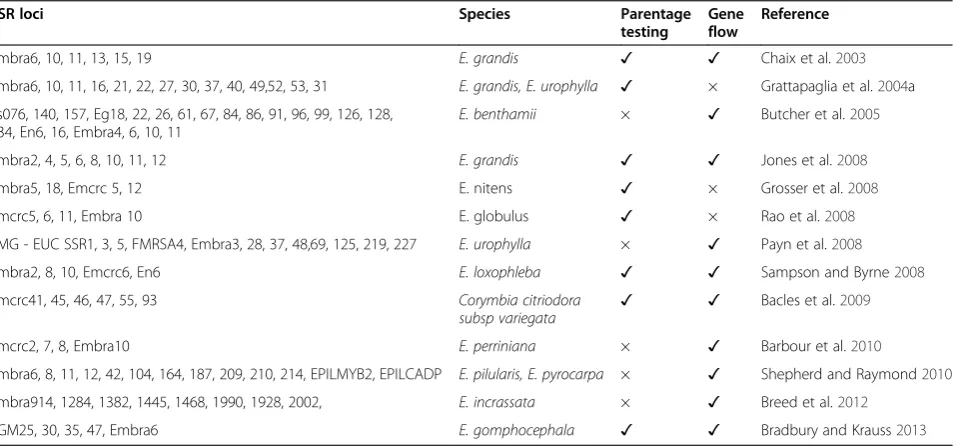
Seed orchards of eucalypt species are established with individuals having high genetic diversity and low levels of inbreeding to achieve the high genetic gain in progen-ies. Microsatellite markers played a major role in attain-ing these goals by displayattain-ing matattain-ing system, degree of contamination, variation in outcrossing rates, gene flow pattern and paternal contribution in the seed orchard. The Table 6 provides the information of SSR loci used for parentage analysis and gene flow studies. Parentage assignments based on microsatellite allele information could lead to the identification of appropriate parents contributing for potential progeny (Grattapaglia et al. 2004a). Microsatellite diversity was considered for the designing of seed orchard in E. dunnii (Zelener et al. 2005) and E. globulus (Dini et al. 2011) thus reducing the risks of inbreeding. Eucalyptus has predominantly outcrossing breeding system, nevertheless the rate of outcrossing varies among the species and populations.E. grandis seed orchard in exotic conditions showed the maximum outcrossing rate of 96.7% however, the pollen contamination in the seed orchard was 39.2% (Chaix et al. 2003). Similarly, another study on E. grandis seed
orchard in Brazil analyzed with 14 SSR markers had 8.3% selfing and 29% pollen contamination (Grattapaglia 2004b). In native locations,E. grandisseed orchard pop-ulations showed a selfing rate of 14% and the paternity analysis showed that 46% seeds were due to contamin-ation (Jones et al. 2008). On contrary, a well isolated clonal seed orchard of E. nitenshad an outcrossing rate of 0.85% with relatively low pollen contamination of 4.5% (Grosser et al. 2008). A small breeding arboretum ofE. globulusin Australia was analyzed with four highly polymorphic SSRs revealed 47.9% outcrosssing rate and 17.6% contamination rate (Rao et al. 2008). These results indicate that microsatellites are the best tools for pre-dicting the seed orchard performance and revealing the importance of strategies to arrest outside pollen like flowering asynchrony and isolation distance of adjacent populations. Recently, Correia et al. (2011) showed that tetra-, penta- and hexa nucleotide microsatellites were more informative than the di and tri nucleotide markers and specific SNPs employed for assessment of parentage and individual identification. Thus, construction of a panel of markers to assess parentage would allow con-siderable inputs for designing of seed orchards conse-quently increased productivity from half-sib eucalypt populations.
The natural populations of eucalypts were subjected to microsatellite based genetic analysis for gene flow estima-tion and populaestima-tion differentiaestima-tion. TheE. camaldulensis species complex in its natural range was assessed for its genetic structure with 15 microsatellite loci and concluded that the populations belongs to several subspecies with intergrade zones and breeding programs should not treat the species as a single genetic entity (Butcher et al. 2009).
Table 6 Parentage testing and gene flow studies in eucalypts
SSR loci Species Parentage
testing
Gene flow
Reference
Embra6, 10, 11, 13, 15, 19 E. grandis ✓ ✓ Chaix et al.2003
Embra6, 10, 11, 16, 21, 22, 27, 30, 37, 40, 49,52, 53, 31 E. grandis, E. urophylla ✓ × Grattapaglia et al.2004a
Es076, 140, 157, Eg18, 22, 26, 61, 67, 84, 86, 91, 96, 99, 126, 128, 134, En6, 16, Embra4, 6, 10, 11
E. benthamii × ✓ Butcher et al.2005
Embra2, 4, 5, 6, 8, 10, 11, 12 E. grandis ✓ ✓ Jones et al.2008
Embra5, 18, Emcrc 5, 12 E. nitens ✓ × Grosser et al.2008
Emcrc5, 6, 11, Embra 10 E. globulus ✓ × Rao et al.2008
FMG - EUC SSR1, 3, 5, FMRSA4, Embra3, 28, 37, 48,69, 125, 219, 227 E. urophylla × ✓ Payn et al.2008
Embra2, 8, 10, Emcrc6, En6 E. loxophleba ✓ ✓ Sampson and Byrne2008
Emcrc41, 45, 46, 47, 55, 93 Corymbia citriodora
subsp variegata ✓ ✓
Bacles et al.2009
Emcrc2, 7, 8, Embra10 E. perriniana × ✓ Barbour et al.2010
Embra6, 8, 11, 12, 42, 104, 164, 187, 209, 210, 214, EPILMYB2, EPILCADP E. pilularis, E. pyrocarpa × ✓ Shepherd and Raymond2010
Embra914, 1284, 1382, 1445, 1468, 1990, 1928, 2002, E. incrassata × ✓ Breed et al.2012
Similarly,E. globulusspecies complex was surveyed with 9 microsatellite loci displayed the existence of intergrade populations and the possibilities of 4 subspecies were identified (Jones et al. 2013). The presence of spatial gen-etic differentiation and large breeding zones inE. globulus populations in its native range revealed a distant pollen movement (Steane et al. 2006; Yeoh et al. 2012). Whereas, in E. urophylla populations of Indonesian islands, low levels of genetic differentiation across populations with high levels of gene diversity within populations were re-corded (Payn et al. 2008). Such information will have large implications in breeding of these economically important plantation species.
Eucalyptusspecies with regional distribution were ana-lyzed for their pollen flow and pattern of genetic diver-sity. These studies involve microsatellite allele diversity largely indicated that in remnant and fragmented popu-lations of E. curtisii (Smith et al. 2003), E. leucoxylon (Ottewell et al. 2005), E. wandoo(Byrne et al. 2008), E. benthamii (Butcher et al. 2005), E. gomphocephala (Bradbury et al. 2013a, b; Bradbury and Krauss 2013),E. incrassata(Breed et al. 2012) andE. loxophleba(Sampson and Byrne 2008) the genetic differentiation were high across the locations and pollen based gene flow is well maintained. On the other hand, fragmentation led to high degree of clonality and inbreeding in few of the species (Smith et al. 2003; Butcher et al. 2005). Further, pollen be-ing the main mode of gene flow, genetic differentiation in quantitative traits was maintained by natural selection (Bloomfield et al. 2011). Nuclear and chloroplast microsat-ellite markers were deployed to examine the spatial distri-bution of genetic diversity in E. pauciflora in Tasmania and the results revealed the route of seed and pollen dispersal and population migration pattern (Gauli et al. 2014). Effective pollen movement and spatial proximity of different species of eucalypts, which has limited reproduc-tion barriers provides sufficient informareproduc-tion for distances required for buffer zone in seed orchards and to maintain genetic integrity of breeding populations in exotic and nat-ural locations. These distinctive features revealed by the microsatellite markers have a high significance in sourcing of seeds and designing breeding and conservation pro-grams (Bacles et al. 2009; Barbour et al. 2010; Shepherd and Raymond 2010).
Linkage map and QTL identification
Microsatellite markers are regarded to be the tools in marker assisted selection and they are widely utilized for genetic mapping in many forest trees and they are ex-tremely suitable for QTL localization and comparative mapping purposes. Detailed information on the genetic maps developed till date was reviewed by Grattapaglia et al. (2012). Most of the genetic mapping studies in eu-calypts targeted the commercially important species
InE. globulusputative QTL forMycosphaerella cryptica resistance was closely associated with microsatellite mark-er Embra48 (Freeman et al. 2008b). Similarly, Embra12 was in closely linked to foliar concentrations of terpenes and formylated phloroglucinol compounds in E. nitens andE. globulus(Henery et al. 2007; Freeman et al. 2008a). Embra173 alone explained 53.8% variation for formylated phloroglucinols in the foliage of E. globulus (Freeman et al. 2008b). In another study by Freeman et al. (2009) in E. globulus several Embra SSR loci were linked to wood properties and growth traits. Additive and dominant QTLs were found in tight linkage with SSR markers tested for drought tolerance in E. grandis×E. urophylla hybrid clones (Teixeira et al. 2011).
The presence of generic genomic regions was validated through SSR markers, which enabled the identification of orthologous QTL regions for wood properties in E. nitensand E. globulus(Thumma et al. 2010) and E. uro-phylla and E. grandis (Gion et al. 2011). Genic SSRs were found to be largely associated with economically important traits in many plant species.Eucalyptus tran-scriptome sequencing projects led to the development of many eSSR loci and many were used in genetic maps (Faria et al. 2011).Eucalyptusspecies have valuable SSR resources for comparative genomic studies and they also serve as framework markers for construction of a con-sensus map across species. Addition of fully informative microsatellites on the framework map permits linkage map homology, QTL and candidate gene positions across different eucalypt species (Freeman et al. 2009). EucalyptusSSRs were proved again for their colinearity across different species and linkage to physical corres-pondence on the reference genome sequence (Grattapaglia et al. 2014).
Future prospects
Microsatellites have major roles to play in various spheres of eucalypts genetics and improvement. They are one of the three major classes of genetic variations along with SNPs (single nucleotide polymorphisms) and CNVs (copy number variations) and have many important biological functions (Gemayel et al. 2010). Recent evidences suggest that variations in microsatellites may lead to phenotypic changes (Joy and Soniya 2012) and adaptive evolution (Fidalgo et al. 2006). The available genome sequence of the eucalypts genome does not diminish the importance of microsatellites, as these markers will extend annotated genome resources of sequencedEucalyptusspecies to gen-etic study/breeding in different eucalypt species.
Genomic SSRs have a broad range of applications, and in particular being neutral markers, which are not linked to any particular trait, but most probably offer a repre-sentation of the underlying genetic diversity in wild pop-ulations and to target poppop-ulations for conservation (van
Zonneveld et al. 2012). Further, microsatellites enable the rapid identification of cryptic species and have been used successfully to identify species hybrids in many tree species including eucalypts. They contribute to a better understanding of the processes involved in the develop-ment of contemporary patterns of variation, including the regional contraction and expansion of populations and refugia (Nevill et al. 2014).
Several reports confirmed the presence of SSRs in transcription factors and promoters of genes for facilitat-ing transcriptional plasticity. Hence, identification of new gSSRs and eSSRs would pave way for better under-standing of theEucalyptus genome. Genic SSR markers could represent the new class of functional markers, finding use in evolutionary studies, comparative map-ping, candidate gene association mapmap-ping, gene discov-ery and molecular breeding (Shi et al. 2014). In silico SSR polymorphism analysis, a novel access to selecting polymorphic markers is currently advocated to reduce the cost and to increase the efficiency of SSR development.
Further, enough care should be exercised while hand-ling null alleles, imperfect repeats, and allelic dropout, equally they can lead to an overestimation of observable alleles, a decrease in observed heterozygosity, and an in-crease in the apparent level of inbreeding. On the basis of microsatellite analysis, spatial genetic structure (SGS) can be estimated to delineate provenances of eucalypts. In addition, non-denaturing FISH (ND-FISH) can be used to compare the distribution of SSRs to determine whether the range of molecular diversity shown by these highly polymorphic sequences is reflected at the chro-mosome level. They are also ideally used as anchor markers in molecular linkage maps and in generation of consensus maps across species and that can be highly saturated with DArT and SNP/genotyping by sequencing markers (GBS). Development of a high-density consen-sus genetic map with SSRs in an important chromo-somal interval provides eucalypt molecular breeding programs with a better choice regarding the quality of markers and a higher probability of polymorphic mark-ers. They play a major role in aligning linkage map due to their high transferability and have a functional role in trait variation and to see the conservation and diversifi-cation of gene order across the species of eucalypts.
Conclusions
position for a large number of microsatellites. Recently, two hundred and twenty three new microsatellite mark-ers were surveyed for allelic divmark-ersity and added to the existing eucalypt SSR map, bringing the total number of genetically mapped SSR loci to >400 and strengthening the comparative genome mapping (Grattapaglia et al. 2014).
Additionally, the miRNA-SSR markers, i.e., presence of SSRs in precursors of miRNA candidates (Joy et al. 2013) brought a new biological significance to microsa-tellites, wherein the microRNAs (miRNAs) play a major role in post transcriptional gene silencing. The length variation of the SSRs in salt responsive miRNA genes provided sensitivity to salinity adaptation ofOryza sativa (Mondal and Ganie 2014). Any prosperous utilization in tree breeding, SSRs is required in greater numbers. Therefore, recognition of such miRNA-SSRs in eucalypts would lead to better understanding of their role in post-transcriptional gene regulations and phenotypic variations.
Additional file
Additional file 1: Table S1.Linkage group information for SSR loci in eucalypts.
Competing interests
The authors declare that they have no competing interests.
Authors’contributions
MS surveyed the literature and drafted the manuscript. RY provided guidence for the review, modified and prepared the final version of the manuscript. Both the authors read and approved the final manuscript.
Acknowledgements
The first author acknowledges the Junior Research Fellowship from the Department of Biotechnology, Government of India.
Received: 6 June 2014 Accepted: 30 September 2014
References
ABRAF (2013) Statistical yearbook. Brazilian Association of Forest Plantation Producers, Brasilia DF, p 74
Acuna C, Villalba P, Garcia M, Hopp E, Marcucci S (2011) Functional markers development and genetic diversity analysis inEucalyptus globuluswith emphasis in wood quality candidate genes. BMC Proc 5(l 7):154 Acuna CV, Fernandez P, Villalba PV, García MN, Hopp E, Poltri SNM (2012a)
Discovery, validation, and in silico functional characterization of EST-SSR markers inEucalyptus globulus. Tree Genet Genomes 8:289–301
Acuna CV, Villalba PV, Garcia M, Pathauer P, Hopp HE, Marcucci Poltri SN (2012b) Microsatellite markers in candidate genes for wood properties and its application in functional diversity assessment inEucalyptus globulus. Electron J Biotechnol 15(2):1–17
Agrama H, George TL, Salah SF (2002) Construction of genome map for Eucalyptus camaldulensisDEHN. Silvae Genet 51(5–6):201–206 Alves AA, Rosado CCG, Faria DA, Da Silva Guimaraes LM, Lau D,
Brommonschenkel SH, Alfenas AC (2011) Genetic mapping provides evidence for the role of additive and non-additive QTLs in the response of inter-specific hybrids ofEucalyptustoPuccinia psidiirust infection. Euphytica 183(1):27–38
Arumugasundaram S, Ghosh M, Veerasamy S, Ramasamy Y (2011) Species discrimination, population structure and linkage disequilibrium inEucalyptus
camaldulensisandEucalyptus tereticornisusing SSR markers. Plos One 6(12):e28252
Bacles CF, Brooks J, Lee DJ, Schenk PM, Lowe AJ, Kremer A (2009) Reproductive biology ofCorymbia citriodorasubsp.variegataand effective pollination across its native range in Queensland, Australia. Southern Forests: J Forest Sci 71(2):125–132
Barbour RC, Wise SL, McKinnon GE, Vaillancourt RE, Williamson GJ, Potts BM (2010) The potential for gene flow from exotic eucalypt plantations into Australia’s rare native eucalypts. For Ecol Manag 260(12):2079–2208 Bartholome J, Salmon F, Vigneron P, Bouvet JM, Plomion C, Gion JM (2013)
Plasticity of primary and secondary growth dynamics inEucalyptushybrids: a quantitative genetics and QTL mapping perspective. BMC Plant Biol 13(1):1–14
Bloomfield JA, Nevill P, Potts BM, Vaillancourt RE, Steane DA (2011) Molecular genetic variation in a widespread forest tree speciesEucalyptus obliqua Myrtaceae on the island of Tasmania. Aust J Bot 59(3):226–237
Bradbury D, Krauss SL (2013) Limited impact of fragmentation and disturbance on the mating system of tuartEucalyptus gomphocephala, Myrtaceae: implications for seed- source quality in ecological restoration. Aust J Bot 61(2):148–160
Bradbury D, Smithson A, Krauss SL (2013a) Development and testing of new gene- homologous EST-SSRs forEucalyptus gomphocephalaMyrtaceae. Appl Plant Sci 1(8). http://dx.doi.org/10.3732/apps.1300004
Bradbury D, Smithson A, Krauss SL (2013b) Signatures of diversifying selection at EST‐SSR loci and association with climate in naturalEucalyptuspopulations. Mol Ecol 22(20):5112–5129
Breed MF, Ottewell KM, Gardner MG, Marklund MHK, Stead MG, Harris JBC, Lowe AJ (2012) Mating system and early viability resistance to habitat fragmentation in a bird- pollinated eucalypt. Heredity. doi:10.1038/ hdy.2012.72
Brondani RPV, Brondani C, Tarchini R, Grattapaglia D (1998) Development, characterization and mapping of microsatellite markers inEucalyptus grandis andE. urophylla. Theor Appl Genet 97(5–6):816–827
Brondani RPV, Brondani C, Grattapaglia D (2002) Towards a genus-wide reference linkage map forEucalyptusbased exclusively on highly informative microsatellite markers. Mol Genet Genom 267(3):338–347
Brondani RPV, Williams ER, Brondani C, Grattapaglia D (2006) A microsatellite-based consensus linkage map for species ofEucalyptusand a novel set of 230 microsatellite markers for the genus. BMC Plant Biol 6(1):20 Bundock PC, Hayden M, Vaillancourt RE (2000) Linkage maps ofEucalyptus
globulususing RAPD and microsatellite markers. Silvae Genet 49:223–232 Butcher PA, Skinner AK, Gardiner CA (2005) Increased inbreeding and inter-species
gene flow in remnant populations of the rareEucalyptus benthamii. Conserv Genet 6(2):213–226
Butcher PA, Mc Donald MW, Bell JC (2009) Congruence between environmental parameters, morphology and genetic structure in Australia’s most widely distributed eucalypt,Eucalyptus camaldulensis. Tree Genet Genomes 5(1):189–210 Byrne M, Hines B (2004) Phylogeographical analysis of cpDNA variation in
Eucalyptus loxophlebaMyrtaceae. Aust J Bot 52(4):459–470
Byrne M, Garcia MMI, Uren T, Smith DS, Moran GF (1996) Conservation and genetic diversity of microsatellite loci in the genusEucalyptus. Austr J Bot 44:331–341
Byrne M, Elliott CP, Yates CJ, Coates DJ (2008) Maintenance of high pollen dispersal inEucalyptus wandoo, a dominant tree of the fragmented agricultural region in Western Australia. Conserv Genet 9(1):97–105 Ceresini PC, Silva PCLS, Missio RF, Souza EC, Fischer CN, Guillherme IR, Gregorio I,
Da Silva EHT, Cicarelli RMB, Da Silva MTA (2005) Satellyptus: analysis and database of microsatellites from ESTs ofEucalyptus. Genet Mol Biol 28(3):589–600
Chaix G, Gerber S, Razafimaharo V, Vigneron P, Verhaegen D, Hamon S (2003) Gene flow estimation with microsatellites in a Malagasy seed orchard of Eucalyptus grandis. Theor Appl Genet 107(4):705–712
Chapuis MP, Estoup A (2007) Microsatellite null alleles and estimation of population differentiation. Mol Bio Evol 24(3):621–631
Chybicki IJ, Burczyk J (2009) Simultaneous estimation of null alleles and inbreeding coefficients. J Hered 100(1):106–113
Correia L, Faria D, Grattapaglia D (2011) Comparative assessment of SNPs and microsatellites for fingerprinting, parentage and assignment testing in species ofEucalyptus. BMC Proc 5:41
loci from an enriched genomic library ofEucalyptus camaldulensisDehnh. Conserv Genet Resou 1(1):465–469
Dakin EE, Avise JC (2004) Microsatellite null alleles in parentage analysis. Heredity 93(5):504–509
Dini TD, Bennadji Z, Cabrera M, Centurion C, Resquin F, Balmelli G (2011) Use of SSR- tools for clone certification in UruguayanEucalyptus grandisand Eucalyptus dunniibreeding programs. BMC Proc 5:58
Ellegren H (2004) Microsatellites: simple sequences with complex evolution. Nat Rev Genet 5(6):435–445
Evans J, Turnbull JW (2004) Plantation forestry in the tropics, 3rd edn. Oxford University Press, Oxford, UK, p 467
Falahati-Anbaran M, Habashi AA, Esfahany M, Mohammadi SA, Ghareyazie B (2007) Population genetic structure based on SSR markers in alfalfa (Medigaco sativaL.) from various regions contiguous to the centres of origin of the species. J Genet 86(1):59–63
Faria DA, Mamani EM, Pappas MR, Pappas GJ, Grattapaglia DA (2010) Selected set of EST-derived microsatellites, polymorphic and transferable across 6 species ofEucalyptus. J Hered 101(4):512–520
Faria DA, Mamani EMC, Pappas GJ, Grattapaglia D (2011) Genotyping systems for Eucalyptusbased on tetra-, penta- and hexanucleotide repeat EST microsatellites and their use for individual fingerprinting and assignment tests. Tree Genet Genomes 7(1):63–77
Fidalgo M, Barrales RR, Ibeas JI, Jimenez J (2006) Adaptive evolution by mutations in the FLO11 gene. Proc Natl Acad Sci 103(30):11228–11233
Field DL, Ayre DJ, Whelan RJ, Young AG (2010) Patterns of hybridization and asymmetrical gene flow in hybrid zones of the rareEucalyptus aggregateand commonE.rubida. Heredity 106(5):841–853
Foster SA, McKinnon GE, Steane DA, Potts BM, Vaillancourt RE (2007) Parallel evolution of dwarf ecotypes in the forest treeEucalyptus globulus. New Phytol 175(2):370–380
Freeman JS, Potts BM, Shepherd M, Vaillancourt RE (2006) Parental and consensus linkage maps ofEucalyptus globulususing AFLP and microsatellite markers. Silvae Genet 55(4–5):202–217
Freeman JS, Marques CM, Carocha V, Borralho N, Potts BM, Vaillancourt RE (2007) Origins and diversity of the Portuguese Landrace ofEucalyptus globules. Ann Forest Sci 64(6):639–647
Freeman JS, O’Reilly-Wapstra M, Vaillancourt RE, Wiggins N, Potts BM (2008a) Quantitative trait loci for key defensive compounds affecting herbivory of eucalypts in Australia. New Phytol 178(4):846–851
Freeman JS, Potts BM, Vaillancourt RE (2008b) Few Mendelian genes underlie the quantitative response of a forest tree,Eucalyptus globulus, to a natural fungal epidemic. Genetics 178(1):563–571
Freeman JS, Whittock SP, Potts BM, Vaillancourt RE (2009) QTL influencing growth and wood properties inEucalyptus globulus. Tree Genet Genomes 5(4):713–722
Freeman JS, Potts BM, Downes GM, Pilbeam D, Thavamanikumar S, Vaillancourt RE (2013) Stability of quantitative trait loci for growth and wood properties across multiple pedigrees and environments in Eucalyptus globulus. New Phytol 198(4):1121–1134
Garcia M, Villalba P, Acuna C, Oberschelp J, Harrand L, Surenciski M, Poltri SM (2011) A genetic linkage map for a full sib population ofEucalyptus grandis using SSR, DArT, CG-SSR and EST-SSR markers. BMC Proc 5:26
Gauli A, Steane D, Vaillancourt R, Potts B (2014) Molecular genetic diversity and population structure inEucalyptus pauciflorassp.pauciflora(Myrtaceae) on the island of Tasmania. Aust J Bot 62(3):175–188
Gemayel R, Vinces MD, Legendre M, Verstrepen KJ (2010) Variable tandem repeats accelerate evolution of coding and regulatory sequences. Ann Rev Genet 44:445–477
Gion JM, Carouche A, Deweer S, Bedon F, Pichavant F, Charpentier JP, Bailleres H, Rozenberg P, Carocha V, Ognouabi N, Verhaegen D, Grima-pettenati J, Vigneron P, Plomion C (2011) Comprehensive genetic dissection of wood properties in a widely- grown tropical tree:Eucalyptus. BMC Genomics 12(1):301
Glaubitz JC, Emebiri LC, Moran GF (2001) Dinucleotide microsatellites from Eucalyptus sieberi: inheritance, diversity, and improved scoring of single-base differences. Genome 44(6):1041–1045
Glaubitz JC, Murrell JC, Moran GF (2003) Effects of native forest regeneration practices on genetic diversity inEucalyptus consideniana. Theor Appl Genet 107(3):422–431
Grattapaglia D (2004) Integrating genomics intoEucalyptusbreeding. Genet Mol Res 3(3):369–379
Grattapaglia D, Sederoff R (1994) Genetic linkage maps ofEucalyptus grandisand Eucalyptus urophyllausing a pseudo-testcross: mapping strategy and RAPD markers. Genetics 137(4):1121–1137
Grattapaglia D, Ribeiro VJ, Rezende GDS (2004) Retrospective selection of elite parent trees using paternity testing with microsatellite markers: an alternative short term breeding tactic forEucalyptus. Theor Appl Genet 109(1):192–199 Grattapaglia D, Vaillancourt RE, Shepherd M, Thumma BR, Foley W, Kulheim C,
Myburg AA (2012) Progress in Myrtaceae genetics and genomics: Eucalyptusas the pivotal genus. Tree Genet Genomes 8(3):463–508 Grattapaglia D, Mamani E, Silva‐Junior OB, Faria DA (2014) A novel genome‐wide
microsatellite resource for species ofEucalyptuswith linkage‐to‐physical correspondence on the reference genome sequence. Mol Ecol Resour. doi: 10.1111/1755-0998.12317
Grosser C, Potts BM, Vaillancourt RE (2008) Microsatellite based paternity analysis in a clonalEucalyptus nitensseed orchard. Silvae Genet 59:57–62
Gross-German E, Viruel MA (2013) Molecular characterization of avocado germplasm with a new set of SSR and EST-SSR markers: genetic diversity, population structure, and identification of race-specific markers in a group of cultivated genotypes. Tree Genet Genomes 9(2):539–555
Hamblin MT, Warburton ML, Buckler ES (2007) Empirical comparison of simple sequence repeats and single nucleotide polymorphisms in assessment of maize diversity and relatedness. PLoS One 2(12):e1367
He X, Wang Y, Li F, Weng Q, Li M, Xu LA, Gan S (2012) Development of 198 novels EST- derived microsatellites inEucalyptusMyrtaceae. Am J Bot 99(4):134–148
Healey A, Furtado A, Henry RJ (2014) Structural genomics of eucalypts. In: Henry R, Kole C (eds) Genetics, genomics and breeding of eucalypts. CRC Press, Boca Raton, FL, pp 103–120
Henery ML, Moran GF, Wallis IR, Foley WJ (2007) Identification of quantitative trait loci influencing foliar concentrations of terpenes and formylated
phloroglucinol compounds inEucalyptus nitens. New Phytol 176(1):82–95 Hirakawa H, Nakamura Y, Kaneko T, Isobe S, Sakai H, Kato T, Hibino T, Sasamoto S,
Watanabe A, Yamada M, Nakayama S, Fujishiro T, Kishida Y, Kohara M, Tabata S, Sato S (2011) Survey of the genetic information carried in the genome of Eucalyptus camaldulensis. Plant Biotech 28:471–480
Hoffman JI, Amos W (2005) Microsatellite genotyping errors: detection approaches, common sources and consequences for paternal exclusion. Mol Ecol 14(2):599–612
Holman JE, Hughes JM, Fensham RJ (2003) A morphological cline inEucalyptus: a genetic perspective. Mol Ecol 12(11):3013–3025
Hudson CJ, Freeman JS, Kullan AR, Petroli CD, Sansaloni CP, Kilian A, Vaillancourt RE (2012) A reference linkage map forEucalyptus. BMC Genomics 13(1):240 Jones ME, Stokoe RL, Cross MJ, Scott LJ, Maguire TL, Shepherd M (2001) Isolation
of microsatellite loci from spotted gumCorymbia variegateand cross-species amplification inCorymbiaandEucalyptus. Mol Ecol Notes 1(4):276–278 Jones RC, Steane DA, Potts BM, Vaillancourt RE (2002) Microsatellite and
morphological analysis ofEucalyptus globuluspopulations. Can J Forest Res 32(1):59–66
Jones TH, Steane DA, Jones RC, Pilbeam D, Vaillancourt RE, Potts BM (2006) Effects of domestication on genetic diversity inEucalyptus globulus. For Ecol Manag 234(1):78–84
Jones TH, Vaillancourt RE, Potts BM (2007) Detection and visualization of spatial genetic structure in continuousEucalyptus globulusforest. Mol Ecol 16(4):697–707
Jones ME, Shepherd M, Henry R, Delves A (2008) Pollenflow inEucalyptus grandis determined by paternity analysis using microsatellite markers. Tree Genet Genomes 4(1):37–47
Jones RC, Steane DA, Lavery M, Vaillancourt RE, Potts BM (2013) Multiple evolutionary processes drive the patterns of genetic differentiation in a forest tree species complex. Ecol Evol 3(1):1–17
Joy N, Soniya EV (2012) Identification of an miRNA candidate reflects the possible significance of transcribed microsatellites in the hairpin precursors of black pepper. Funct Integr Genom 12(2):387–395
Joy N, Asha S, Mallika Vand Soniya EV (2013) De novo transcriptome sequencing reveals a considerable bias in the incidence of simple sequence repeats towards the downstream of‘pre-miRNAs’of black pepper. PLoS One 8(3):e56694 Kalia RK, Rai MK, Kalia S, Singh R, Dhawan AK (2011) Microsatellite markers: an
overview of the recent progress in plants. Euphytica 177(3):309–334 Khadivi-Khub A, Zamani Z, Fattahi R, Wünsch A (2014) Genetic variation in wild
Kirst M, Myburg AA, De Leon JP, Kirst ME, Scott J, Sederoff R (2004) Coordinated genetic regulation of growth and lignin revealed by quantitative trait locus analysis of cDNA microarray data in an interspecific backcross ofEucalyptus. Plant Physiol 135(4):2368–2378
Kirst M, Basten CJ, Myburg AA, Zeng ZB, Sederoff RR (2005a) Genetic architecture of transcript-level variation in differentiating xylem of aEucalyptushybrid. Genetics 169(4):2295–2303
Kirst M, Cordeiro CM, Rezende G, Grattapaglia D (2005b) Power of microsatellite markers for fingerprinting and parentage analysis inEucalyptus grandis breeding populations. J Heredity 96(2):161–166
Kudapa H, Azam S, Sharpe AG, Taran B, Li R, Deonovic B, Varshney RK (2014) Comprehensive transcriptome assembly of chickpeaCicer arietinum L. Using Sanger and next generation sequencing platforms: development and applications. PLoS One 9(1):e86039
Kullan ARK, Van Dyk MM, Jones N, Kanzler A, Bayley A, Myburg AA (2011) High -density genetic linkage maps with over 2,400 sequence-anchored DArT markers for genetic dissection in an F2 pseudo-backcross ofEucalyptus grandis×E. urophylla. Tree Genet Genomes 8(1):163–175
Kullan ARK, Van Dyk MM, Hefer CA, Jones N, Kanzler A, Myburg AA (2012) Genetic dissection of growth, wood basicdensity and gene expression in interspecific backcrosses ofEucalyptus grandisandE. urophylla. BMC Genet 13(1):60 Luo J, Arnold R, Ren S, Jiang Y, Lu W, Peng Y, Xie Y (2013) Veneer grades, recoveries
and values from 5-year old eucalypt clones. Ann For Sci 70(4):417–428 Mamaghani MS, Shojaei TR, Matinizadeh M, Forootan M (2010) Microsatellite loci
and peroxidase alleles correlation in somaclonal variation ofEucalyptus microthecaF. Muell Afr J Biotechnol 9(29):4521–4528
Mamani EM, Bueno NW, Faria DA, Guimaraes LM, Lau D, Alfenas AC, Grattapaglia D (2010) Positioning of the major locus forPuccinia psidiirust resistance Ppr1 on theEucalyptusreference map and its validation across unrelated pedigrees. Tree Genet Genomes 6(6):953–962
Marques CM, Brondani RPV, Grattapaglia D, Sederoff R (2002) Conservation and synteny of SSR loci and QTLs for vegetative propagation in fourEucalyptus species. Theor Appl Genet 105(2–3):474–478
Missiaggia A, Grattapaglia D (2006) Plant microsatellite genotyping with 4-color fluorescent detection using multiple-tailed primers. Genet Mol Res 5(1):72–78 Missiaggia AA, Piacezzi AL, Grattapaglia D (2005) Genetic mapping of Eef1, a
major effect QTL for early flowering inEucalyptus grandis. Tree Genet Genomes 1(2):79–84
Mizrachi E, Hefer C, Ranik M, Joubert F, Myburg AA (2010)De novoassembled expressed gene catalog of a fast-growingEucalyptusplantation tree produced by Illumina mRNA- seq. BMC Genomics 11(1):681
Mondal TK, Ganie SA (2014) Identification and characterization of salt responsive miRNA- SR markers in rice (Oryza sativa). Gene 535(2):204–209
Myburg AA, Potts BM, Marques CM, Kirst M, Gion JM, Grattapaglia D, Grima-Pettenati J (2007) Eucalyptus. In: Kole C (ed) Genome mapping and molecular breeding in plants. Springer, NY, pp 115–160
Myburg AA, Grattapaglia D, Tuskan GA, Hellsten U, Hayes RD, Grimwood J, Jenkins J, Lindquist E, Tice H, Bauer D, Goodstein DM, Dubchak I, Poliakov A, Mizrachi E, Kullan ARK, Hussey SG, Pinard D, van der Merwe K, Singh P, van Jaarsveld I, Silva-Junior OB, Togawa RC, Pappas MR, Faria DA, Sansaloni CP, Petroli CD, Yang X, Priya R, Tschaplinski TJ, Chu-Yu Y et al (2014) The genome ofEucalyptus grandis. Nature 510(7505):356–362
Nagabhushana K, Hendre PS, Sharma N, Rathinavelu R (2011) Novel design and deployment of orthologous genic SSR markers inEucalyptus camaldulensis Dehnh. BMC Proc 5(Suppl 7):51
Neves LG, Mamani EM, Alfenas AC, Kirst M, Grattapaglia D (2011) A high-density transcript linkage map with 1,845 expressed genes positioned by microarray-based Single Feature Polymorphisms SFP inEucalyptus. BMC Genomics 12(1):189
Nevill PG, Reed A, Bossinger G, Vaillancourt RE, Larcombe M, Ades PK (2008) Cross‐species amplification ofEucalyptusmicrosatellite loci. Mol Ecol Res 8(6):1277–1280
Nevill PG, Bossinger G, Ades PK (2010) Phylogeography of the world’s tallest angiosperm,Eucalyptus regnans: evidence for multiple isolated Quaternary refugia. J Biogeogr 37(1):179–192
Nevill PG, Bradbury D, Jorgensen T, Krauss S, Samaraweera S, Gardner MG (2013) Microsatellite primers identified by 454 sequencing in the floodplain tree speciesEucalyptus victrix(Myrtaceae). Appl Plant Sci 1(5), http://dx.doi.org/ 10.3732/apps.1200402
Nevill PG, Bradbury D, Williams A, Tomlinson S, Krauss SL (2014) Genetic and palaeo- climatic evidence for widespread persistence of the coastal tree
speciesEucalyptus gomphocephala(Myrtaceae) during the last glacial maximum. Ann Bot 113(1):55–67
Ochieng J, Steane DA, Ladiges PY, Baverstock PR, Henry RJ, Shepherd M (2007) Microsatellites retain phylogenetic signals across genera in eucalypts (Myrtaceae). Genet Mol Biol 30(4):1125–1134
Ottewell KM, Donnellan SC, Moran GF, Paton DC (2005) Multiplexed microsatellite markers for the genetic analysis ofEucalyptus leucoxylonMyrtaceae and their utility for ecological and breeding studies in otherEucalyptusspecies. J Heredity 96(4):445–451
Paiva JA, Prat E, Vautrin S, Santos MD, Clemente SH, Brommonschenkel S, Grima-Pettenati J (2011) AdvancingEucalyptusgenomics: identification and sequencing of lignin biosynthesis genes from deep-coverage BAC libraries. BMC Genomics 12(1):137
Patterson B, Vaillancourt RE, Pilbeam DJ, Potts BM (2004) Factors affecting variation in outcrossing rate inEucalyptus globulus. Aust J Bot 52(6):773–780 Payn KG, Dvorak WS, Janse BJH, Myburg AA (2008) Microsatellite diversity and
genetic structure of the commercially important tropical tree species Eucalyptus urophylla, endemic to seven islands in eastern Indonesia. Tree Genet Genomes 4(3):519–530
Petroli CD, Sansaloni CP, Carling J, Steane DA, Vaillancourt RE, Myburg AA, Grattapaglia D (2012) Genomic characterization of DArT markers based on high- density linkage analysis and physical mapping to theEucalyptus genome. PLoS One 7(9):e44684
Poltri SM, Zelener N, Traverso JR, Gelid P, Hopp HE (2003) Selection of a seed orchard of Eucalyptus dunnii based on genetic diversity criteria calculated using molecular markers. Tree Physiol 23(9):625–632
Porth I, El-Kassaby YA (2014) Assessment of the genetic diversity in forest tree populations using molecular markers. Diversity 6(2):283–295
Rabello E, Souza NDA, Saito D, Tsai MS (2005) In silico characterisation of microsatellites inEucalyptusspp.: abundance, length variation and transposon associations. Genet Molar Biol 28(3):582–588
Ranade SS, Lin YC, Zuccolo A, Van de Peer Y, García-Gil MR (2014) Comparative in silico analysis of EST-SSRs in angiosperm and gymnosperm tree genera. BMC Plant Biol 14(1):220
Rao HX, Patterson B, Potts B, Vaillancourt R (2008) A microsatellite study on outcrossing rates and contamination in anEucalyptus globulusbreeding arboretum. J For Res 19(2):136–140
Rathbone DA, McKinnon GE, Potts BM, Steane DA, Vaillancourt RE (2007) Microsatellite and cpDNA variation in island and mainland populations of a regionally rare eucalypt,Eucalyptus perrinianaMyrtaceae. Aust J Bot 55(5):513–520 Rengel D, Clemente HS, Servant F, Ladouce N, Paux E, Wincker P, Couloux A,
Sivadon P, Grima-Pettenati J (2009) A newEucalyptusgenomic resource dedicated to wood formation: a comprehensive survey. BMC Plant Biol 9(1):36 Ribeiro MM, Sanchez L, Ribeiro C, Cunha F, Araujo J, Borralho NM, Marques C
(2011) A case study ofEucalyptus globulusfingerprinting for breeding. A Forest Science 68(4):701–714
Rosado TB, Tomaz RS, Ribeiro Junior MF, Rosado AM, Guimaraes LMDS, Araujo EFD, Cruz CD (2010) Detection of QTL associated with rust resistance using IBD-based methodologies in exogamicEucalyptusspp. populations. Crop Breed Appl Biotechnol 10(4):321–328
Sampson JF, Byrne M (2008) Outcrossing between an agroforestry plantation and remnant native populations ofEucalyptus loxophleba. Mol Ecol 17(11):2769–2781 Sexton TR, Henry RJ, McManus LJ, Bowen S, Shepherd M (2010) Capture of assay
template by multiplex PCR of long amplicons for genotyping SNPs and InDels with MALDI-TOF mass spectrometry. Mol Breed 25(3):471–480 Shepherd M, Raymond CA (2010) Species delineation and gene flow in the
Blackbutts genusEucalyptussubgenusEucalyptussection Pseudophloius. Conserv Genet 11(5):1965–1978
Shepherd M, Kasem S, Lee D, Henry R (2006) Construction of microsatellite linkage maps forCorymbia. Silvae Genet 55(4–5):228–237
Shepherd M, Kasem S, Lee DJ, Henry R (2008) Mapping species differences for adventitious rooting in aCorymbia torelliana×Corymbia citriodorasubspecies variegatahybrid. Tree Genet Genomes 4(4):715–725
Shepherd M, Sexton TR, Thomas D, Henson M, Henry RJ (2010) Geographical and historical determinants of microsatellite variation inEucalyptus pilularis. Can J Forest Res 40(6):1051–1063
Shi L, Lv X, Weng J, Zhu H, Liu C, Hao Z, Zhang S (2014) Genetic characterization and linkage disequilibrium mapping of resistance to gray leaf spot in maize (Zea maysL). The Crop Journal 2(2):132–143