D I S C U S S I O N
Open Access
The functional complex network approach
to foster forest resilience to global changes
Christian Messier
1,2*, Jürgen Bauhus
3, Frederik Doyon
1, Fanny Maure
2, Rita Sousa-Silva
1, Philippe Nolet
1,
Marco Mina
2,4, Núria Aquilué
2, Marie-Josée Fortin
5and Klaus Puettmann
6Abstract
Human impacts on Earth’s ecosystems have greatly intensified in the last decades. This is reflected in unexpected disturbance events, as well as new and increasing socio-economic demands, all of which are affecting the resilience of forest ecosystems worldwide and the provision of important ecosystem services. This Anthropocene era is forcing us to reconsider past and current forest management and silvicultural practices, and search for new ones that are more flexible and better at dealing with the increasing uncertainty brought about by these accelerating and cumulative global changes. Here, we briefly review the focus and limitations of past and current forest management and silvicultural practices mainly as developed in Europe and North America. We then discuss some recent promising concepts, such as managing forests as complex adaptive systems, and approaches based on resilience, functional diversity, assisted migration and multi-species plantations, to propose a novel approach to integrate the functionality of species-traits into a functional complex network approach as a flexible and multi-scale way to manage forests for the Anthropocene. This approach takes into consideration the high level of uncertainty associated with future environmental and societal changes. It relies on the quantification and dynamic monitoring of functional diversity and complex network indices to manage forests as a functional complex network. Using this novel approach, the most efficient forest management and silvicultural practices can be determined, as well as where, at what scale, and at what intensity landscape-scale resistance, resilience and adaptive capacity of forests to global changes can be improved.
Introduction
As with most managed natural ecosystems, forests have been traditionally shaped by human actions and managed to meet human needs and expectations. However, as much as there is a desire to confine them to a narrow scope of conditions, forests are dynamic systems driven by rapidly changing socio-environmental conditions. The speed of global changes (e.g., rapid climate and socio-economic changes, fragmentation of forest landscapes, pollution, introduction of new pests and diseases as well as invasive species, etc.) is creating an increasingly dynamic, uncertain and therefore unpredictable future, making long-term for-est planning extremely difficult. Therefore, the current era has been labelled the Anthropocene (Steffen et al.2007),
where human impacts on Earth’s systems, unexpected and extreme disturbance events, and new and increasing socio-economic demands are strongly compromising the provision of ecosystem services, including those from forests. Faced with this changing future, there are several challenges that need to be incorporated into forest planning:
Rapidly shifting societal expectations. Our needs and expectations for the different important functions of forests are constantly evolving, difficult to predict, and often incompatible with each other. A shift in emphasis among values and functions of forests (e.g., water regulation over wood and recreation) is happening in many parts of the world. Also, the role of forests in mitigating climate change (via carbon storage in living forests and the lower carbon footprint of using wood over other materials) is receiving more and more attention (Canadell and Raupach2008; Grassi et al.2017).
* Correspondence:[email protected]
1Département des sciences naturelles and Institut des sciences de la forêt tempérée (ISFORT), Université du Québec en Outaouais (UQO), 58 rue Principale, Ripon, QC J0V 1V0, Canada
2Centre d’étude de la forêt, Université du Québec à Montréal (UQAM), Case postale 8888, succursale Centre-Ville, Montréal, QC H3C 3P8, Canada Full list of author information is available at the end of the article
Increasing fragmentation of forested landscapes. This is occurring in most cultivated regions of the planet. The overall resilience of smaller and less connected forest patches to natural and man-made distur-bances is reduced.
A gradual loss of forest resilience. Resilience is defined as the ability of a system to resist disturbances or absorb them and rapidly self-reorganize to maintain its main structure and functions. Loss of resilience can be due to biotic (e.g., invasive plant species, exotic pests and diseases) and abiotic (e.g., rapid climatic warming, pollution) factors alone or that
can cumulatively interact (Thompson et al.2009).
It can also be due to forest degradation caused by
human mismanagement (Chazdon et al.2017).
The loss of historical reference conditions.With rapidly changing environmental and biotic conditions, the suitability of using historical reference conditions to manage our forests is reduced (Seastedt et al.2008). Instead, desired future conditions for forest ecosystems need be derived from the required ecosystem goods and services as well as conservation values.
An increasing uncertainty in future environmental and socio-economic conditions. This is an integration of the previous arguments and this is due to rapid and compounded environmental, economic and social changes that characterize the so-called Anthropocene making it even harder to understand how forests will respond to future conditions as a socio-ecological system with many feedback loops within and between natural and human systems (Messier et al.2016).
This paper aims at proposing a comprehensive and flexible new forest management approach to face these challenges where forest’s resilience to global changes is increased, while achieving multi-functionality (i.e., en-suring the provision of multiple ecosystems services; Mina et al.2017) under rapidly changing global environ-mental and socio-economic conditions. We articulate this approach in continuity with previous forest manage-ment paradigms and consequently begin this paper by briefly reviewing the focus and limitations of past and current forest management and silvicultural practices in response to the issues of the Anthropocene. We then follow by reviewing some recent promising concepts that could help achieve these new objectives of managing for multi-functionality and resilience while considering the highly variable and uncertain future socio-environmental conditions. These two reviews led us to propose a novel use of silvicultural interventions that could be implemented at both stand and forest landscape scales, using complex network theory and functional diversity, to efficiently foster resilience to
global changes. The approach proposed is generic enough to take advantages of both old and new forestry practices.
Focus and limitations of past and current silvicultural and forest management approaches Until a few decades ago, the objective of forest manage-ment and silviculture has mainly focused on timber pro-duction (Puettmann et al. 2009). Hand in hand with this objective was a major emphasis on increasing forestry effi-ciency by simplifying forest structures and standardizing forest practices (Puettmann et al.2009). Mechanization of forest operations has rapidly improved our ability to shape the fate of forests. This resulted in a homogenization of forest conditions across large landscapes to optimize prof-itability of timber production (more timber/lower extrac-tion costs). This view of the forest as a provision source of raw material for industrial timber products did not change significantly until the latter part of the twentieth century, when society started to acknowledge the other benefits for-est ecosystems provide (Bengston 1994). This awareness was supported by scientific knowledge of the complex dy-namic of forest ecosystems that has raised questions about the impacts of forestry practices on forest sustainability (Puettmann et al. 2009). As a result, forest management objectives have evolved integrating new values, such as maintaining biodiversity and maximizing carbon seques-tration and innovative forestry approaches have been proposed to accomplish this wider range of objectives (Bauhus et al.2017b).
A variety of approaches for a variety of objectives
We have grouped past and current silvicultural and for-est management approaches into five major categories (Table 1) based on their overriding perspective and management objectives (see also Duncker et al.2012).
The first category, timber-oriented silvicultural approaches, is strongly weighted towards the continuous production of timber. Practices in this category might differ in terms of compositional and structural hetero-geneity, e.g., even-aged or uneven-aged (Nolet et al.
production cycles. In the second category, nature-based silvicultural approaches, the focus shifts towards incorp-orating natural processes into management or to using natural processes to guide management. This often fo-cusses less on economic values and more on ecological and cultural values, although some elements of this ap-proach such as natural regeneration or self-pruning of trees might have originally been motivated by cost-sav-ings (Puettmann et al.2009; Duncker et al.2012; O’Hara
2016). A nature-based silviculture rests therefore on the assumption that, by emulating nature, management and harvesting can reduce the impact of disturbances on ecosystem functions and biodiversity and that natural processes can be employed to achieve silvicultural goals (Bauhus et al.2013; O’Hara2016). Attaining a high level of social acceptance is also a key element distinguishing these approaches from intensive harvesting systems. More recently some approaches in our third silvicultural Table 1Major silvicultural and forest management approaches in Europe and North America. They are grouped into five categories: timber-oriented, nature-based, global change, landscape, and conceptual. These general banners reflect the main features of the approaches as defined in the associated literature. Each approach is classified according to their main management goals (maximum two), as taken from literature. Additional benefits that might be achieved but are not targeted themselves are marked with a cross. For instance, the main objective of uneven-aged forestry is to produce large volumes of timber, but the maintenance of ecological diversity is also considered important in this approach (Nolet et al.2017)
Silvicultural and forest management approaches
Management goals Where? Key references
Timber and biomass
Biodiversity Resilience Carbon storage
Social acceptance
Water quality
Europe North America
Stand-level Timber-oriented
Even-aged stand systems
1 + X X Kuuluvainen et al.2012;
Nolet et al.2017
Uneven-aged stand systems
1 + + + + X X Kuuluvainen et al.2012;
Nolet et al.2017
Short-rotation forestry
1 X X Weih2004
Nature-based
Close-to-nature forestry
2 + + 1 X Jacobsen2001;
Bauhus et al.2013
Continuous cover
1 + 2 X Pommerening and
Murphy2004
Retention systems
1 2 + + X X Mitchell and Beese2002;
Lindenmayer et al.2012
Ecological forestry
1 2 + X Seymour and Hunter1999;
Franklin et al.2007
Global-change driven
Adaptive silviculture
2 1 + X Nagel et al.2017;
Halofsky et al.2018
Climate-smart forestry
+ 2 1 X Nabuurs et al.2017
Landscape-level
Sustainable yield forestry
1 X X Wiersum1995
Functional zoning
2 + + 1 X Seymour and Hunter1992;
Messier et al.2009
Ecosystem management
1 2 + + X Kohm and Franklin1997;
Bergeron et al.1999
Sustainable forestry
+ 2 + + 1 + X X Aplet et al.1993;
Oliver2003
Multi-purpose forestry
1 + + 2 + X X Lexer and Brooks2005
Conceptual-level
New forestry 1 + 2 X Franklin1989
Holistic forestry 2 + 1 X Pinkerton1998
Systemic silviculture
and forest management category, which we refer to as
global-change driven approaches, have been developed
to explicitly integrate the challenges and opportunities of climate change into forest management. These ap-proaches reflect notions that nowadays silviculture and forest management should account not only for eco-logical, economic and social issues, but also promote forest resilience to climate change, while maintaining the whole forestry value chain. For instance, in North America, a number of adaptation frameworks, built upon on science-management partnerships, have currently been implemented on-the-ground by the Canadian and US forest agencies to identify optimum combination of already-existent measures to prepare forests to climate change (e.g., Halofsky et al.2016; Nagel et al.2017); for a review, see Halofsky et al. (2018). In Europe, Climate Smart Forestry, a similar concept to the Climate-Smart Agriculture concept developed by FAO, has been suggested to safeguard the mitigation potential of forests against climate change through an array of regionally tai-lored measures (Nabuurs et al. 2017). However, these approaches are still far from being mainstream and build-ing forest resilience to climate change has not yet become a common driver of forest management activities.
While most silvicultural approaches may contribute to various non-timber goals (e.g., biodiversity, carbon storage, and societal acceptance), these are rarely their main goals (Table 1). Shifting focus from primarily the stand to the landscape scale, various approaches can be combined in a manner that can satisfy diverse needs and goals. Multi-pur-pose forestry and functional zoning are two examples of
such landscape-level forest management approaches, our
fourth category (Table1). Multi-purpose forestry requires forest managers to consider a broad range of ecosystem at-tributes, at various spatial and temporal scales, when de-signing management strategies and monitoring their outcomes. This may include trade-off relationships among conflicting management objectives (Lexer and Brooks
2005). When this integrated management method was first proposed, it was expected to maximize all the values lo-cally, even in the same stand, at the same time (Behan
1967). However, it has been rapidly acknowledged that po-tential and constraints for enhancing specific values differ across a landscape, so that maintaining all values every-where would not be optimal (Vincent and Binkley1993). This attempts to simultaneously integrate multiple forest functions with the functional zoning approach, such as the TRIAD concept (Messier et al. 2009). Functional zoning suggests dividing forests into a number of zones for differ-ent, but complementary uses, such as timber production, biodiversity conservation, and multiple use forestry (Sey-mour and Hunter1992). Functional zoning offers the op-portunity to incorporate a wide variety of societal values into forest management activities.
In the fifth category, conceptual forest management
approaches, we have grouped approaches based on
concepts and purposes that go beyond the recommenda-tion of specific management practices, or advance specific silvicultural systems. Examples include New For-estry (Franklin1989), Holistic Forestry (Pinkerton1998), and Systemic Silviculture (Nocentini et al. 2017). These approaches often served as a novel paradigm for defining new conceptual frameworks and ethical perspectives on forest management. For instance, New Forestry thinking has emerged as a unique perspective for dealing with an increased public concern over environmental issues, such as biodiversity decline in managed forests, shifting the focus from tree harvesting revenue to ecological legacies left after harvest.
As different as they are, most of the approaches described above assume that trees and forests can con-tinue to grow in the future as they did in the past, that it is possible to predict what will be the desirable tree species for the future and that a relatively strong com-mand and control over forest management and silvicul-ture is desirable. Consequently, these approaches are not individually well adapted to the increasing environmen-tal and socio-economic uncertainties associated with the Anthropocene.
Promising approaches and concepts for the future In this section, we review recent approaches and con-cepts that we consider useful for the development of the novel functional complex network approach proposed in the section “The functional complex network approach”. This brief discussion is meant to provide readers with enough background to understand how the new approach could be designed.
Managing forests as complex adaptive systems: overcoming the command and control approach
al.2016). Consequently, viewing forests through this novel lens can be applied to any forest management and/or silvi-cultural approach (Fahey et al. 2018). At the same time, applying a mixture of silvicultural approaches simultan-eously to accommodate the variety of ecological condi-tions and social expectacondi-tions can be viewed as a response to the new insights derived from viewing the forest as a complex adaptive system (Messier et al.2013).
For several reasons, forests are a prime example of com-plex adaptive systems (Filotas et al.2014). Firstly, the for-mal recognition of the link between ecological and social components constitutes a major distinction between view-ing forests as a complex adaptive system and other management approaches (Messier et al.2015). This results in the acceptance that in many situations, the challenges faced by forest management are a wicked problem with no optimal solution (DeFries and Nagendra2017).
Secondly, the acceptance that uncertainty is an inherent part of an ecosystem pushes foresters to place more emphasis on the forest natural adaptive capacity. This is based on the recognition that adaptive capacity is neces-sary to allow forest ecosystems to respond to unexpected events and to continue ensuring the provision of desired functions and services (Puettmann2014), especially in an increasingly uncertain future. This aspect is reflected in the appreciation of the value of variability and diversity as key components for adaptive capacity (Conrad 1983). Thus, they become prominent considerations in silvicul-tural prescriptions.
Thirdly, relying more on the ability of ecosystems to re-spond to unexpected and compounded perturbations also reflects the fact that complex adaptive systems are driven from the bottom up. The behaviour of these systems is de-termined by a collection of heterogeneous individual com-ponents that interact across hierarchical scales, including feedback loops, in nonlinear and threshold relationships. This underscores the importance of maintaining or enhan-cing the diversity component as well as their interactions (“keep every cog and wheel,” sense Aldo Leopold). How-ever, it is not simply more diversity or variability that is required, but the right assemblages of components that functionally generate more resilient ecosystems. The emphasis on multi-hierarchical interactions among com-ponents also highlights the notion of emergent properties, which relates to the role of unpredictability as an integral part of complex ecosystem behaviour (Valiente-Banuet et al.2015).
Fourthly, considering management decisions and their im-pact across various scales from local neighbourhoods to landscapes (Puettmann and Tappeiner 2013), and systems from ecological to administrative (DeFries and Nagendra
2017), there is an argument in favour of the need for more flexibility for foresters to prepare for unpredictability. For ex-ample, assessing management success, such as reforestation
standards or carbon storage, at landscape scales may allow for variability within and among stands. This variability may permit foresters to let natural processes play out and allow ecosystems to self-organize and thus adapt to changing conditions, e.g., through natural regeneration.
Lastly, assessing ecosystem responses in the context of non-linear and threshold behaviour further emphasizes self-organization. This assessment highlights where spe-cific management treatments are needed and would optimize achievement of ownership goals. Putting all these aspects together and acknowledging the importance of cross-scale hierarchical interactions and recognizing that complex adaptive systems are“open”, i.e., forestry is part of a socio-ecological system, emphasizes the importance of assessing a multitude of ecosystem functions and services at multiple scales (Messier et al. 2015). A broad array of public influences, perceptions, and expectations that are linked to a wide range of ecosystem services cannot be ignored, even for private landowners who may often have fairly narrow objectives. Only when all players in the socio-ecological system are properly acknowledged and their views and values are integrated into manage-ment decisions will forestry be able to keep the “license” to operate in the long run.
Mixed forests and plantations:providing insurance against global changes
Like viewing forests as complex adaptive systems, mixed-species forests and plantations are also not a forest management or silvicultural approach per se. However, mixing tree species in forest stands and landscapes is a central element of most alternative silvicultural approaches and strategies to incorporate the notion of the insurance hypothesis (Yachi and Loreau 1999) to better prepare forests for the uncertainties derived from global changes (Puettmann et al.2015; Bauhus et al.2017b). The mainten-ance and promotion of tree species mixtures is based chiefly on three motivating factors: a higher provision of ecosystem goods and services, lower risks following distur-bances such as pests and diseases, and higher degree of adaptability than would be possible with mono-specific stands (Pretzsch et al.2017). Mixing tree species can basic-ally be integrated into all forms of current forest manage-ment and silvicultural practices, from close-to-nature forests (which already emphasizes mixtures) to intensively managed plantations.
There is now substantial evidence that mixed species stands are on average more productive in terms of biomass than their monospecific counterparts (Liang et al.
specific monocultures, mixtures are better suited to provide multiple ecosystem services, where each service may be pro-vided at a somewhat reduced degree compared to monocul-tures specifically focussed on the respective ecosystem service; a phenomenon termed the“Jack-of-all-trades-effect” of mixtures (van der Plas et al.2016). This effect appears to be particularly important in contexts such as publicly owned forests managed on long rotations, where it is highly unpre-dictable which ecosystem services future generations may wish to obtain from forests and at what level (Bauhus et al.
2017a). Mixtures may thus buffer forest management against changes in societal aspirations and consequently help main-tain susmain-tainable forest ecosystems.
In addition, mixed species forests and plantations are more likely to be better able to withstand environmental changes and insect outbreaks than monospecific stands. They have been found to be more resistant in relation to a wide range of stress and disturbance factors (Jactel et al.2017). This phenomenon is based on two principal ef-fects: (1) the ecological insurance provided in more diverse communities because a high number of function-ally different species increases the probability that some of these species are more likely to cope with stress and disturbance (Yachi and Loreau 1999), and (2) the inter-actions among species that change the way in which an individual species responds to stress and disturbance such that it may be more or less resistant in mixtures than in monocultures (Bauhus et al. 2017a). Whereas there is much evidence for the insurance function of mixtures, the beneficial effects of mixing on individual species appear to be mostly restricted to biological dis-turbance agents such as specialist insect herbivores and pathogens. Positive examples of mixing on the resistance of individual species are fewer for abiotic disturbances such as wind, fire, and drought (Bauhus et al. 2017a). For some types of disturbances such as insect herbivory, diversity of functionally different tree species in mixtures, e.g., deciduous versus evergreens, has been shown to be more important than mere tree species richness (e.g., Castagneyrol et al.2014). It is conceivable that this may apply to other stress and disturbance factors as well, but more research is needed.
The higher level of ecosystem services provided by mixed versus monospecific forests suggests that mixed and species rich forests may be a more suitable approach for the ecological intensification of forest management, which aims at providing more goods and services at a reduced environmental footprint (Bauhus et al. 2017c). However, impacts of tree species richness on provision of ecosystem services as well as on ecological stability of forests are highly dependent on context and species assemblage (Ratcliffe et al. 2017). Hence, forests with similar tree species richness but different participating species may differ greatly in their level of ecosystem
functioning and even mixed stands with the same spe-cies composition may perform differently depending on soil and climatic conditions of the site (Mina et al.
2018). In this context, such dependencies make the out-come of mixed, species-diverse forest stands difficult to predict, which underpins the importance of combining species mixtures with other forest management and silvicultural approaches in the landscape.
Functional diversity:a new way of managing tree diversity in forests
The maintenance of a high species and structural (stands of different age or structures) diversity in forested landscapes have been proposed as essential for maintaining high resili-ence of natural ecosystems (Messier et al.2013; Seidl et al.
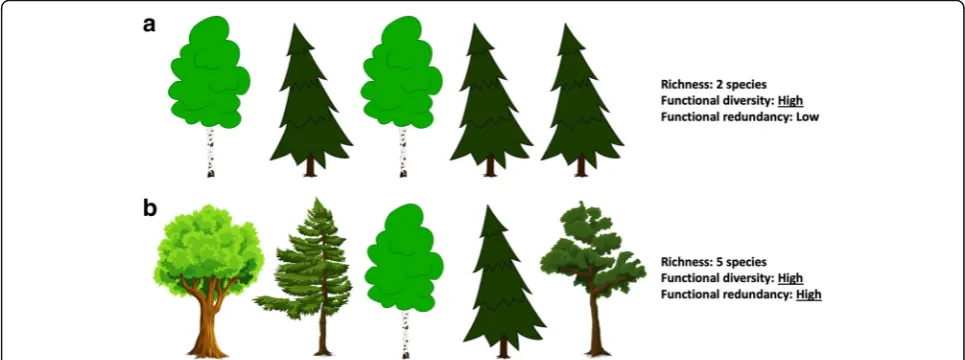
2016; Timpane-Padgham et al.2017). Although the number of different species gives us a good indication of diversity of a community, it does not provide specific information about the diversity of biological functions and ecological services provided by the species present, nor about which ecological niches are occupied or not. A relatively recent approach has advocated the use of biological characteristics of species known as functional traits (Violle et al.2007) to better characterize ecosystem diversity. Functional traits can be defined as any biological characteristic that can be easily measured and that influence the performance of an individual in terms of growth, survival or reproduction of the species (Violle et al.2007). For trees, specific functional traits for adapting to climate change and coping with disturbance (drought, fire, wind, etc.) include tree height, wood structure and density, seed size, specific leaf area, ability to resprout, bark thickness, and rooting depth (Aubin et al. 2016). Communities with both a mixture of traits that enable species to adapt to known stressors – referred to as functional (or response) diversity–as well as a high recurrence of traits that allow species to adapt to un-known stressors –referred to as functional redundancy– will more likely be resistant, resilient or able to transit to another desirable well-adapted community (Yachi and Loreau 1999; Laughlin et al. 2017) (Fig. 1). Facing global changes leading to uncertain social and environmental con-ditions, a resilient forest must be composed of tree species with diverse functional traits that can withstand or adapt to the widest possible spectrum of stress (Fig.1a). To complete this resilience, several species have to share the same func-tional traits in order to maintain a good diversity of traits in case some species are lost from the system (Fig.1b).
density and small seed size will form a different group. Each of these groups is characterized by a specific growth strategy and presents specific responses and adaptations to stress and disturbances and change in the environment. Forests with tree species covering the wid-est possible range of functional groups in more or less equal proportions and with some functional redundancy will be better prepared to face a wide variety of present and future stressors.
Assisted migration of tree species:bringing new traits and genes to cope with global changes
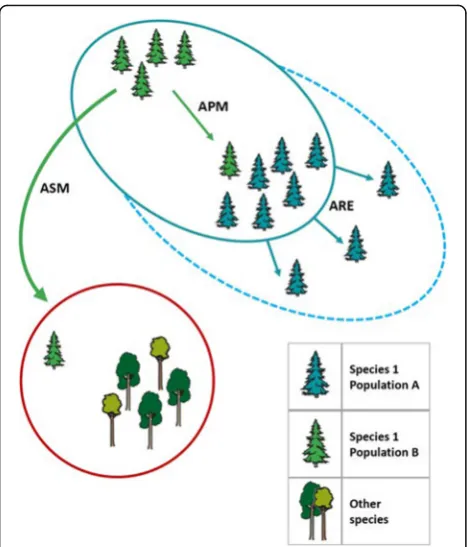
Since prehistoric times, humans have contributed to the dis-persal of many important plants and tree species within and across continents (Ridley 1930). During the past centuries, there have been extensive plantations of exotic timber spe-cies such as Douglas fir and Sitka spruce in Europe, and the introduction of non-native tree and plant species in Eastern North America (Schulz and Gray2013). With the advent of the Anthropocene, several studies have demonstrated that many plant species will likely be unable to adapt or migrate fast enough to new areas with suitable climate to cope with rapid changes in climate (Sittaro et al.2017). Assisted migra-tion, the human-mediated movement of species, genotypes or provenances to locations that better match them climatic-ally in the future, has been proposed as a potential adaptive strategy in response to the changing climate (Williams and Dumroese2013). Depending on the spatial scale of the trans-location of individuals, assisted migration has been described as assisted population migration, assisted range expansion and assisted species migration (see Fig.2). According to the
literature, the scientific community is somewhat divided on the implementation of the different assisted migration op-tions in forest landscapes. In forestry circles, assisted migra-tion is regarded as a tool to maintain optimum productivity in commercial forests and to preserve market-based ecosys-tem services by preventing current species from becoming maladapted to future climate. Conservationists look at assisted migration as the ultimate resource for rescuing en-dangered species or rear-edge marginal populations from ex-tinction and are generally against its extensive implementation, citing potential negative risks, such as cryp-tic maladaptation, invasiveness and other ecological conse-quences (Aubin et al.2011). Pedlar et al. (2012) made a clear distinction between species rescue assisted migration and forestry-based assisted migration. The aim of the first is only to conserve endangered tree species, while the second could be viewed within the larger concept of ecosystem services, with the sole purpose of maintaining a high provision of fu-ture goods and services from forest ecosystems. Several au-thors occasionally have mentioned the idea of using assisted migration to increase forest resilience to global changes and future disturbances (Hof et al.2017; Park and Talbot2018). The aim of such “resilience trait-based assisted migration management option”would be to build climate- and disturb-ance-resilient forests by introducing new functional attri-butes not present in the natural pool of species to the system. Using functional diversity theory, it can be possible to describe species capacity to respond to new climate conditions as well as to disturbances and new pests (Cra-ven et al. 2016; Duveneck and Scheller 2015). We are aware, however, that assisted migration is a contentious
topic and that its implementation would require accept-ance not only within the scientific community but also among social, political, and economic stakeholders (Ste--Marie et al.2011).
Managing for resilience:acknowledging global changes Although forest health and protection have always been two aspects considered in forest management, the increased risk of large-scale disturbances and new stressors brings forest resilience to a new and central position, supplanting many other issues that have been the focus of former paradigms in forestry (D’Amato et al.2017). In this context, forest resilience becomes an explicit objective of forest management and the focus of specific silvicultural approaches (Lindner et al.2010). Indeed, managing for re-silience has become the new beacon in forestry under many jurisdictions, including in Scandinavia (Chapin et al.
2011) and in the USA (DeRose and Long 2014). One
fundamental principle with the resilience management paradigm lies in the acknowledgment that amidst all the rapid global changes happening on Earth, it can no longer be assumed that ecosystem self-regulation and reconstruc-tion after abrupt or continuous forces will occur naturally. However, making the notion of resilience operational for management of forested stands and landscapes has been very challenging. As pioneers, Millar et al. (2007) put resili-ence in a larger context and proposed a series of options for facing uncertainty using a multi-trajectory approach based on: (1) resistance for forestalling impacts and pro-tecting highly valued resources, (2) resilience for improving the capacity of ecosystems to return to desired conditions after disturbance (ability to bounce back), and (3) response for facilitating ecosystem transition to a stable alternative state under the new conditions (ability to bounce forward). The authors encourage flexible approaches that promote the progressive use of reversible measures, continuous learning, and the maintenance of the ability to change dir-ection when the situation requires it. This approach there-fore focuses more on robustness than on optimizing the utilitarian functions of forests. The main issue so far has been a missing harmonized metric for quantifying resili-ence (Angeler and Allen2016). Several recent studies have targeted the development of quantifiable resilience indica-tors. For example, DeRose and Long (2014) presented a conceptual framework for beetle disturbances and pro-posed stand- and landscape-scale indicators of post-disturbance conditions (e.g., maintenance of mature trees in stands and potential for future spruce dominance across the landscape), while Duveneck and Scheller (2016) used a post-wildfire index based on the recovery rate of species composition and aboveground biomass as a proxy for landscape-scale resilience. Still, it cannot be denied that significant progress has been made lately for measuring and comparing resilience a posteriori (Ingrisch and Bahn2018). Although substantial effort has been put into developing resilience indicators based on disturbances (Sasaki et al.
2015), these measures have proven to be very difficult to predict, particularly by managers, given the shifting nature of forest ecosystems under global changes as well as the potential occurrence of novel and unpredictable disturb-ance events (Standish et al.2014; Seidl et al.2017). In this context, indices of functional diversity, redundancy and functional connectivity have been increasingly proposed as suitable proxies for quantifying ecological resilience at mul-tiple spatial-scales (Dymond et al. 2014; Standish et al.
2014; Messier et al.2015).
The functional complex network approach
A landscape-level approach for managing forest for resilience in the Anthropocene
In the section“Focus and limitations of past and current
silvicultural and forest management approaches”, we
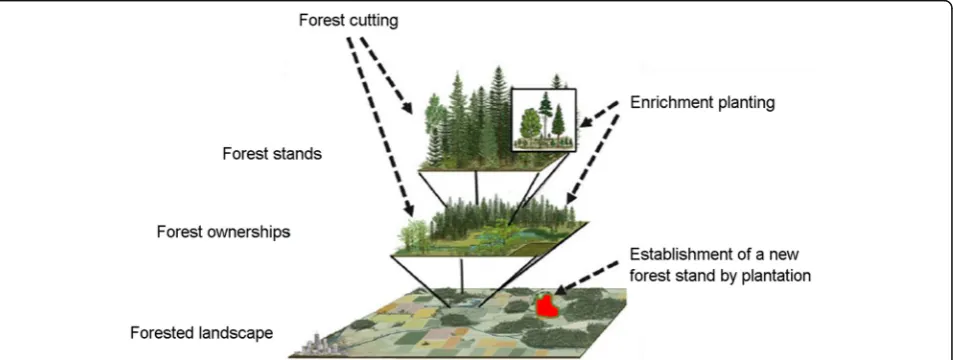
have described past and current forest management and silvicultural practices in Europe and North America typ-ically implemented at the stand scale to reach desirable, relatively stable tree species composition and structure. Because of the urgent need to develop new approaches to adapt to novel local and global situations, a large var-iety of forest management and silvicultural approaches are now being used and proposed worldwide from which any forester could choose options that fit their particular needs (Table1). Hence, we argue that elements from all these approaches could be potentially useful and indeed may be necessary in developing a new flexible and inte-grated forest management for the Anthropocene. How-ever, a way to integrate them at the appropriate scales has been missing so far, whereby the combination of ap-proaches could be optimized or modified to achieve multi-functionality, while at the same time dealing with uncertainty and increasing or maintaining forest resili-ence to global changes. Hresili-ence, we propose a novel ap-proach to increase forest resilience applied at the landscape scale that can integrate any silvicultural prac-tices developed and applied at the stand/ownership scale (Fig.3). This approach makes use of two recent develop-ments in ecology: (1) functional traits to evaluate tree functional diversity and redundancy in any forest stand or landscape (Aubin et al. 2016; Aubin et al.2018), and (2) the adoption of network theory to describe the spatial connectivity of forest stands in terms of seed dis-persal and establishment (Fall et al. 2007; Urban et al.
2009; Dale and Fortin 2010). Network theory can be used to evaluate where and how silvicultural interven-tions should be carried out within the landscape to most efficiently enhance key network properties, namely
connectivity, centrality and modularity that all influence resilience.
The integration of these two recent developments into our proposed novel approach is general and flexible enough to be applied in a variety of settings throughout the world, especially in temperate and boreal biomes, by small and large private or public owners, and in forests already under management or previously unmanaged. This new approach attempts to reconcile past, current and newly proposed forest management and silvicultural approaches by considering new scientific knowledge and socio-environmental conditions. It also recognizes various aspects of complex adaptive systems, e.g., the multi-scale organization of forest stands, public or private, within the whole landscape (Fig.3).
Below we provide an example of how the functional complex network approach can be applied in different forested landscape settings. It is important to note that this approach is nested within a larger social, ecological, and economic context (for brevity not discussed here) which cannot be ignored in real-word applications. Therefore, in this context, we assume that landowners have agreed on a set of goals, and the legal, logistical, and economic feasibility of the treatments.
Managing landscapes as a functional complex network
Here, we consider forest stands as nodes/patches forming a network representing the functional complexity of forested ecosystems. With such an approach, species-traits diversity at the forest stand level can therefore be more efficiently managed to maintain forest overall functional complexity and consequently its resilience. Several properties (or indica-tors) can be optimized to manage forest resilience to
disturbances: functional indices (e.g., diversity and redun-dancy, among others) and spatial network indices (connect-ivity, centrality and modularity, among others; see Rayfield et al.2010). Our approach consists first of calculating the func-tional attributes of each stand within the forested landscape. Then, the spatial structure of the forest-land network is con-sidered to determine how different patches (i.e., forest stands/ownerships) are connected in regards to seed disper-sal and tree establishment capacity to form functional links. Potential functional links exist between patches close enough for tree species to disperse seeds, and account for propor-tions of intra-stand functional diversity that can travel be-tween stands (according to species dispersal capacity) (as proposed by Craven et al.2016). The resulting so-called func-tional networkdescribes spatial distributions of tree commu-nities and their spatial topological layout; it accounts for the whole potential functional diversity of forest landscapes and the likelihood that this functional diversity can disperse across the network, i.e., it quantifies the overall functional connectivity of the landscape (see Craven et al.2016for an example of how this is done). We provide an example of how to apply the functional complex network approach to a fictive temperate forest landscape of 100,000 ha (Tables 2
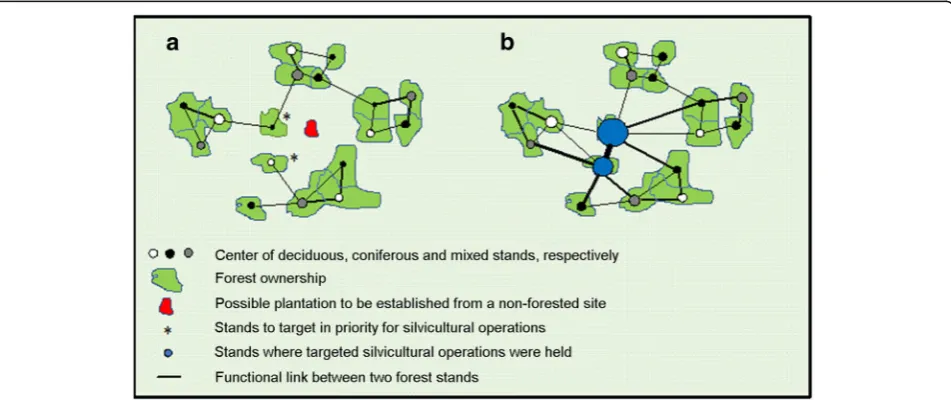
and 3), and how different silvicultural interventions could improve network topology. In this example, three spatial at-tributes related to the resilience of forest-land network are used: effective connectivity, betweenness centrality (illus-trated in Fig.4), and modularity (Delmas et al. 2018). In a landscape where effective connectivity and centrality are strong (Fig. 4b), biological material (i.e., seed-borne func-tional traits) can be easily dispersed from one stand to an-other via multiple possible pathways (Fig. 4b). An effective connectivity ensures a rapid recolonization of disturbed stands by seeds coming from the surrounding intact stands, contributing to a rapid and efficient reorganization of the system. And if the surrounding stands have functionally di-verse tree species, the disturbed stands are more likely to re-grow a functionally diverse tree community, thus reinforcing the overall resilience of the landscape. “Central” patches within forested landscapes are those having many current or potential connections to neighbouring patches (Fig. 4b) or those connecting otherwise isolated patches in the territory. Central patches usually account for a high functional diver-sity because either they currently host multiple diverse spe-cies (and act as a source of diversity) or they can receive new biological material from functionally rich neighbouring stands. By a structured set of highly central patches, the flow of seeds and genetic material across the landscape is more ef-ficient, improving both overall functional diversity and re-dundancy. Modularity (not shown in Fig. 4) is obtained when patches are poorly connected to each other (which greatly limits the dispersal of the biological material following a disturbance) or when they are highly connected, but they have a strong functional (i.e., having tree species with
different functional traits) and structural (stands of different age or structures) discontinuity. In a strongly modular land-scape, it is expected that the propagation of disturbances such as fire, windthrow, diseases and pests would be lim-ited, which is highly desirable. Modularity can also facili-tate the identification of groups of forests stands/ ownerships more vulnerable or susceptible to disturbances (provided that a basic knowledge of the disturbance be-haviour is known), which would allow to efficiently design prevention plans to such disturbances. Once combined, these five attributes allow for the determination of the overall resilience of a forested landscape to global changes (Aquilué2018).
Throughout the implementation of this approach, con-tinued assessment of the feasibility and economic and social acceptability of any silvicultural intervention is im-portant. Results of these assessments in turn may lead to changes in management practices to increase response diversity, functional redundancy, connectivity, centrality and modularity in forest landscapes. Thus, while silvicul-tural interventions are implemented at the stand level, the planning and evaluation of their pertinence and impact are done at the landscape scale. Furthermore, although only a static approach is illustrated in this paper, the values for each of the two functional and three spatial network attri-butes should be continuously assessed over the whole Table 2Example of a management plan of a fictive temperate forest landscape using the functional complex network approach
Table 3Characterization of a simplified national forested landscape of 100,000 ha in an agricultural area through two functional (diversity and redundancy) and three complex spatial network (connectivity, centrality and modularity) indices at three different spatial scales (stand, ownership, and landscape). This territory includes a public forest of 30,000 ha and 300 privately owned forests separated by agricultural fields, roads and small villages. The“landscape after intervention”column provides an example of the improved tree richness, functional indexes and network attributes following targeted silvicultural intervention (see Table2
for details). Figs.3and4depict the management plan provided in Table2
Forest stand Forest patch Landscape before intervention
Landscape after intervention
Quantity 5000 300 1 1
Mean Area (ha) [min, max] 40 [10; 120]a 240 [30; 500] 100,000 100,000
Mean Richness (nb of tree species) ± standard deviation [min, max]
3 ± 2 [1; 10] 6 ± 3 [3; 12] 15 20
Mean Diversityb± standard deviation [min, max] 0.21 ± 0.14 [0; 0.39] 0.32 ± 0.03 [0.22; 0.37] 0.33 0.45
Mean Redundancyc± standard deviation [min, max] 0.85 ± 0.04 [0.73; 0.99] 0.86 ± 0.02 [0.80; 0.93] 0.85 0.93
Connectivityc – – 0.45 0.81
Centralityb – – 1.27 3.67
Modularityc – – 0.53 0.39
Resilience of landscape – – Low High
a
Mean value ± standard deviation [minimum; maximum]
b
No superior limits for these attributes
c
Scale from 0 to 1 where 1 represents the ideal situation
landscape to consider dynamic changes occurring both at the stand and landscape scales (Martensen et al. 2017; Saura 2018). Simulation modelling could also be used to determine what type of silvicultural interventions should be performed and where to obtain the desirable objectives over time and over a large spectrum of possible future scenarios (Ruppert et al.2016; Aquilué2018).
As a first rule to link stand and landscape scales, man-agers may choose to intervene in stands and/or forest own-erships having the lowest functional diversity while prioritizing those that can positively affect most of the se-lected indicators at the landscape level (e.g., the two stands with an asterisk in Fig.4a). Here, the objective is to favour or add tree species with key missing functional traits or which are known to be resilient to current and known future stressors and would greatly contribute to the whole network’s functional connectivity (Aquilué 2018). Increas-ing the diversity and functional redundancy of these two stands, while favouring species that are already present but not abundant on the territory or planting new species with complementary functional traits, results in the most efficient increase in functional connectivity (i.e., the level of functional traits that can be moved rapidly) over the land-scape (Fig. 4b). In a highly fragmented forested landscape or forest ownership matrix, it may be advisable to establish new stands (red stand in Figs. 3 and 4) to increase the connectivity and centrality of the landscape. These new stands would be characterized by the presence of one or more tree species with complementary functional traits that were so far missing in the landscape. The end result will be a more purposefully designed functional network with self-regulating processes promoting forests more resilient to various threats thus limiting the need to intervene in the future to restore heavily impacted stands.
As discussed before, no silvicultural system or practice is a priori excluded from such an approach and a diversity of treatments is encouraged or even required. However, it is necessary to assess all interventions at both the stand and landscape levels to determine if they contribute to the overall functional connectivity and, consequently, forest resilience. For example, although mixed plantations are encouraged when establishing new stands, the approach does not preclude the use of monospecific plantations, if the species planted contributes an important set of functional traits and the location of the plantation results in improved connectivity, centrality, and modularity of the overall landscape.
Incorporating new tree species, provenances, and/or hybrids as part of a resilience trait-based assisted migration strategy (see the section “Promising approaches and
concepts for the future”) needs to be seriously considered for the positive and negative effects it could have in increas-ing the functional connectivity, resilience and/or flexibility of other options. In some parts of the world, the number of
tree species naturally present is small and often composed of functionally similar species. In such cases, it is likely important to add new tree species having complementary functional traits to increase resilience to a wide variety of perturbations. Therefore, future integrated management approaches should use the concept of assisted migration in conjunction with species mixtures in the context of resili-ence trait-based assisted migration. The focal aim of this management option would be to build climate- and disturbance-resilient forests by introducing new functional attributes to the system while at the same time preserving key ecosystem functions and related services such as timber production and biodiversity.
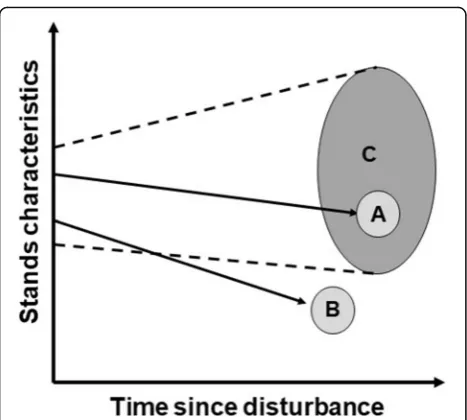
This novel integrated approach, that we call“the func-tional complex network approach” reconciles traditional practices with new challenges, including the need to man-age some protected areas to ensure they will continue to achieve their objective of preservation of biodiversity and ecological processes. Leaving aside forest management and silvicultural approaches based on command and control, determinism and predictability in our forests, the basis of this approach is to accept that different elements and behaviours that are intrinsic to forests are inevitable sources of uncertainty (Messier et al. 2016). In fact, multiple ecological processes governing forests are strongly related to stochasticity and randomness (e.g., seed survival, herbivory), are affected by factors occurring outside the system under management (e.g., forest fires, large-scale insect outbreaks), and/or follow a nonlinear dynamic thus creating an inability to accurately predict fu-ture population evolution. Such complex strucfu-tures and dynamics are inherent in complex adaptive systems and at the root of the heterogeneity and therefore the resilience of forests, allowing them to better adapt to present and future biotic and abiotic conditions. A wider range of pos-sible trajectories for different stands can then be accepted (see Fig.5), while ensuring that the forest landscapes as a whole provide the desired ecosystem services, maybe even with less effort and interventions from foresters. By adopt-ing such a strategy, not only would foresters have more flexibility in their practices, but they could also take ad-vantage of self-organization dynamics and thus the natural adaptability of forests.
various topographical positions, and functional links are established among adjacent stands depending on the seed-borne functional traits that can be dispersed from one stand to another via multiple possible pathways, as shown in Fig. 4 for the two or three adjacent stands being part of a same continuous forest ownership.
Conclusion
The approach presented here is not intended to be a universal recipe or even the promotion of a new type of forestry, but rather an innovative and flexible way of in-tegrating past, present and proposed forestry practices at a large and integrated spatial scale. It also brings the
recent notions of functional diversity and complex spatial network together in a new way that facilitates de-cision making in terms of forest management. Incorpor-ating these concepts into forest management planning would help to better prepare forest systems for the impending and ever-increasing socio-environmental un-certainties and threats. By relaxing control over forest composition and dynamics, allowing more flexibility in our practices and a larger set of desirable tree species, the natural abilities of forests to function and adapt will be strengthened, as well as their ability to provide the majority of ecosystem services the society may expect. The role of foresters within this new approach is that of a true steward of the forest who enhances its resilience to global changes.
Acknowledgements Not applicable.
Funding
Funding for this study was provided in part by the Humboldt Foundation which provided money for an extensive stay in Germany to CM where part of the paper was written and by the Swiss National Science Foundation through a post-doctoral fellowship to MM.
Availability of data and materials
The datasets used and/or analysed during the current study are available from the corresponding author on reasonable request.
Authors’contributions
CM developed the overall idea and structure of the paper and all co-authors (JB, FD, FM, RSS, PN, MM, NA, MJF and KP) provided feedbacks on the proposed structure. CM wrote the first draft of the Abstract and Introduction. RSS and PN wrote the first draft of the section“Focus and limitations of past and current silvicultural and forest management approaches”. HP wrote the first draft of the section“Managing forests as complex adaptive systems”. FM and NA wrote the first draft of the section“Functional diversity: a new way of managing tree diversity in forests”. MM wrote the first draft of the section“Assisted migration of tree species: bringing new traits and genes to cope with global changes”. FD and MM wrote the first draft of the section“Managing for resilience: acknowledging global changes”. CM, MJF and NA wrote the first draft of the section“The func-tional complex network approach: a landscape-level approach for managing forest for resilience in the Anthropocene”. CM wrote the first draft of the Conclusion. CM and all co-authors revised and commented on all sections several times. All au-thors read and approved the final manuscript.
Ethics approval and consent to participate Not applicable.
Consent for publication Not applicable.
Competing interests
The authors declare that they have no competing interests.
Author details
1Département des sciences naturelles and Institut des sciences de la forêt tempérée (ISFORT), Université du Québec en Outaouais (UQO), 58 rue Principale, Ripon, QC J0V 1V0, Canada.2Centre d’étude de la forêt, Université du Québec à Montréal (UQAM), Case postale 8888, succursale Centre-Ville, Montréal, QC H3C 3P8, Canada.3Chair of Silviculture, Institute of Forest Sciences, University of Freiburg, Tennenbacherstr. 4, 79106 Freiburg, Germany.4Swiss Federal Institute for Forest, Snow and Landscape Research WSL, Birmensdorf, Switzerland.5Department of Ecology and Evolution, University of Toronto, Toronto, ON M5S 3B2, Canada.6Department of Ecosystems and Society, Oregon State University, Corvallis, OR 97331, USA.
Fig. 5Representations of different forest stands with various trajectories following forest harvesting. The stand characteristics (y-axis) represent various stand structures, compositions and volumes as well as habitats for living creatures. The stand trajectory to point A could represent a forest managed through single-tree selection, while the trajectory to point B could represent a similar forest managed as an intensive even-aged and single-species plantation, which has consequently a very small envelope of ecological characteristics. In both cases, ecological characteristics develop in a narrow predictable manner due to continuous and intensive management input, but stand A has more structural and compositional complexity than stand B. The shaded ellipse represented by C shows the envelope of possible conditions that any stand can have within a region if the stands are allowed to self-organize following some level of management (such as enrichment planting to introduce tree species with important functional traits and some commercial thinning or partial cutting to maintain an uneven-aged structure and even greater diversity of tree species with different functional traits). The variety of possible outcomes within envelope C allows forests and foresters to be
Received: 15 June 2018 Accepted: 19 February 2019
References
Angeler DG, Allen CR (2016) Quantifying resilience. J Appl Ecol 53(3):617–624.
https://doi.org/10.1111/1365-2664.12649
Aplet GH, Johnson N, Olson JT, Sample VA (1993) Defining sustainable forestry. Island Press, Washington, DC
Aquilué N (2018) Managing forest landscapes under global changes: simulation models for scenario evaluation. Ph.D. thesis. Université du Québec à Montréal, Canada
Aubin I, Boisvert-Marsh L, Kebli H, McKenney D, Pedlar J, Lawrence K, Hogg EH, Boulanger Y, Gauthier S, Ste-Marie C (2018) Tree vulnerability to climate change: improving exposure-based assessments using traits as indicators of sensitivity. Ecosphere 9(2):e02108.https://doi.org/10.1002/ecs2.2108
Aubin I, Gachet S, Messier C, Bouchard A (2007) How resilient are northern hardwood forests to human disturbance? An evaluation using a plant functional group approach. Ecoscience 14(2):259–271.https://doi.org/10. 2980/1195-6860(2007)14[259:HRANHF]2.0.CO;2
Aubin I, Garbe CM, Colombo S, Drever CR, McKenney DW, Messier C, Pedlar J, Saner MA, Venier L, Wellstead AM, Winder R, Witten E, Ste-Marie C (2011) Why we disagree about assisted migration: ethical implications of a key debate regarding the future of Canada’s forests. Forest Chron 87(6):755–765.
https://doi.org/10.5558/tfc2011-092
Aubin I, Messier C, Gachet S, Lawrence K, McKenney D, Arseneault A, Bell W, De Grandpré L, Shipley B, Ricard JP, Munson A (2012) TOPIC-traits of plants in Canada. Natural Resources Canada, Canadian Forest Service, Sault Ste Mariehttp://www.nrcan.gc.ca/forests/research-centres/glfc/20303. Accessed 12 Oct 2018
Aubin I, Munson AD, Cardou F, Burton PJ, Isabel N, Pedlar JH, Paquette A, Taylor AR, Delagrange S, Kebli H, Messier C, Shipley B, Valladares F, Kattge J, Boisvert-Marsh L, McKenney D (2016) Traits to stay, traits to move: a review of functional traits to assess sensitivity and adaptive capacity of temperate and boreal trees to climate change. Environ Rev 24(2):164–186
Bauhus J, Forrester DI, Gardiner B, Jactel H, Vallejo R, Pretzsch H (2017a) Ecological stability of mixed-species forests. In: Pretzsch H, Forrester DI, Bauhus J (eds) Mixed-species forests - ecology and management. Springer Verlag Germany, Heidelberg, pp 337–382
Bauhus J, Forrester DI, Pretzsch H (2017b) Mixed-species forests: the development of a forest management paradigm. In: Pretzsch H, Forrester DI, Bauhus J (eds) Mixed-species forests - ecology and management. Springer Verlag Germany, Heidelberg, pp 1–25
Bauhus J, Kouki J, Paillet Y, Asbeck T, Marchetti M (2017c) How does the forest-based bioeconomy impact forest biodiversity? In: Winkel G (ed) Towards a sustainable European forest-based bioeconomy - assessment and the way forward. What Science Can Tel Us, vol 8. European Forest Institute, Joensuu, pp 67–76
Bauhus J, Puettmann KJ, Kühne C (2013) Close-to-nature forest management in Europe: does it support complexity and adaptability of forest ecosystems. In: Messier C, Puettmann KJ, Coates KD (eds) Managing forests as complex adaptive systems: building resilience to the challenge of global change. Routledge, London, pp 187–213.https://doi.org/10.4324/9780203122808
Behan RW (1967) The succotash syndrome, or multiple use: a heartfelt approach to forest land management. Nat Resour J 7(4):473–484
Bengston DN (1994) Changing forest values and ecosystem management. Soc Nat Resour 7(6):515–533.https://doi.org/10.1080/08941929409380885
Bergeron Y, Harvey B, Leduc A, Gauthier S (1999) Forest management guidelines based on natural disturbance dynamics: stand-and forest-level
considerations. Forest Chron 75(1):49–54.https://doi.org/10.5558/tfc75049-1
Canadell JG, Raupach MR (2008) Managing forests for climate change mitigation. Science 320(5882):1456–1457.https://doi.org/10.1126/science.1155458
Castagneyrol B, Jactel H, Vacher C, Brockerhoff EG, Koricheva J (2014) Effects of plant phylogenetic diversity on herbivory depend on herbivore specialization. J Appl Ecol 51(1):134–141.https://doi.org/10.1111/1365-2664.12175
Chapin FS, Pickett STA, Power ME, Jackson RB, Carter DM, Duke C (2011) Earth stewardship: a strategy for social–ecological transformation to reverse planetary degradation. J Env Stud Sci 1(1):44–53.https://doi.org/10.1007/ s13412-011-0010-7
Chazdon RL, Brancalion PHS, Lamb D, Laestadius L, Calmon M, Kumar C (2017) A policy-driven knowledge agenda for global Forest and landscape restoration. Conserv Lett 10(1):125–132.https://doi.org/10.1111/conl.12220
Ciancio O, Nocentini S (2011) Biodiversity conservation and systemic silviculture: concepts and applications. Plant Biosyst 145(2):411–418.https://doi.org/10. 1080/11263504.2011.558705
Conrad M (1983) Adaptability: the significance of variability from molecule to ecosystem. Plenum Press, New York
Craven D, Filotas E, Angers VA, Messier C (2016) Evaluating resilience of tree communities in fragmented landscapes: linking functional response diversity with landscape connectivity. Divers Distrib 22(5):505–518.https://doi.org/10. 1111/ddi.12423
D’Amato AW, Jokela EJ, O’Hara KL, Long JN (2017) Silviculture in the United States: an amazing period of change over the past 30 years. J For 116(1):55–67.
https://doi.org/10.5849/JOF-2016-035
Dale MRT, Fortin MJ (2010) From graphs to spatial graphs. Annu Rev Ecol Evol Syst 41:21–38
DeFries R, Nagendra H (2017) Ecosystem management as a wicked problem. Science 356(6335):265–270.https://doi.org/10.1126/science.aal1950
Delmas E, Besson M, Brice M-H, Burkle L, Riva GVD, Fortin M-J, Gravel D, Guimaraes P, Hembry D, Newman E, Olesen JM, Pires M, Yeakel JD, Poisot T (2018) Analyzing ecological networks of species interactions. Biol Rev.
https://doi.org/10.1111/brv.12433
DeRose RJ, Long JN (2014) Resistance and resilience: a conceptual framework for silviculture. For Sci 60(6):1205–1212.https://doi.org/10.5849/forsci.13-507
Duncker PS, Barreiro SM, Hengeveld GM, Lind T, Mason WL, Ambrozy S, Spiecker H (2012) Classification of forest management approaches: a new conceptual framework and its applicability to European forestry. Ecol Soc 17(4):51.
https://doi.org/10.5751/ES-05262-170451
Duveneck MJ, Scheller RM (2015) Climate-suitable planting as a strategy for maintaining forest productivity and functional diversity. Ecol Appl 25(6): 1653–1668.https://doi.org/10.1890/14-0738.1
Duveneck MJ, Scheller RM (2016) Measuring and managing resistance and resilience under climate change in northern great Lake forests (USA). Landsc Ecol 31(3):669–686.https://doi.org/10.1007/s10980-015-0273-6
Dymond CC, Tedder S, Spittlehouse DL, Raymer B, Hopkins K, McCallion K, Sandland J (2014) Diversifying managed forests to increase resilience. Can J For Res 44(10):1196–1205
Fahey RT, Alveshere BC, Burton JI, D'Amato AW, Dickinson YL, Keeton WS, Kern CC, Larson AJ, Palik BJ, Puettmann KJ, Saunders MR, Webster CR, Atkins JW, Gough CM, Hardiman BS (2018) Shifting conceptions of complexity in forest management and silviculture. Forest Ecol Manag 421:59–71.https://doi.org/ 10.1016/j.foreco.2018.01.011
Fall A, Fortin M-J, Manseau M, O’Brien D (2007) Spatial graphs: principles and applications for habitat connectivity. Ecosystems 10:448–461
Filotas E, Parrott L, Burton PJ, Chazdon RL, Coates KD, Coll L, Haeussler S, Martin K, Nocentini S, Puettmann KJ, Putz FE, Simard SW, Messier C (2014) Viewing forests through the lens of complex systems science. Ecosphere 5(1):1–23.
https://doi.org/10.1890/ES13-00182.1
Franklin JF (1989) The“new forestry”. J Soil Water Conserv 44(6):549 Franklin JF, Mitchell RJ, Palik BJ (2007) Natural disturbance and stand
development principles for ecological forestry. Gen. Tech. Rep. NRS-19. U.S. Department of Agriculture, Forest Service, Northern Research Station, Newtown Square.https://doi.org/10.2737/NRS-GTR-19
Gamfeldt L, Snäll T, Bagchi R, Jonsson M, Gustafsson L, Kjellander P, Ruiz-Jaen MC, Fröberg M, Stendahl J, Philipson CD, Mikusiński G, Andersson E, Westerlund B, Andrén H, Moberg F, Moen J, Bengtsson J (2013) Higher levels of multiple ecosystem services are found in forests with more tree species. Nat Commun 4:1340.https://doi.org/10.1038/ncomms2328
Grassi G, House J, Dentener F, Federici S, den Elzen M, Penman J (2017) The key role of forests in meeting climate targets requires science for credible mitigation. Nat Clim Change 7:220–226.https://doi.org/10.1038/ nclimate3227
Halofsky JE, Andrews-Key SA, Edwards JE, Johnston MH, Nelson HW, Peterson DL, Schmitt KM, Swanston CW, Williamson TB (2018) Adapting forest
management to climate change: the state of science and applications in Canada and the United States. Forest Ecol Manag 421:84–97.https://doi.org/ 10.1016/j.foreco.2018.02.037
Halofsky JE, Peterson DL, Metlen KL, Myer MG, Sample VA (2016) Developing and implementing climate change adaptation options in forest ecosystems: a case study in southwestern Oregon, USA. Forests 7:268
Ingrisch J, Bahn M (2018) Towards a comparable quantification of resilience. Trends Ecol Evol 33(4):251–259.https://doi.org/10.1016/j.tree.2018.01.013
Jacobsen MK (2001) History and principles of close to nature forest management: a central European perspective. In: Textbook 2 - Tools for Preserving Woodland Biodiversity. Naconex, pp 56–60
Jactel H, Bauhus J, Boberg J, Bonal D, Castagneyrol B, Gardiner B, Gonzalez-Olabarria JR, Koricheva J, Meurisse N, Brockerhoff EG (2017) Tree diversity drives forest stand resistance to natural disturbances. Curr Forestry Rep 3(3): 223–243.https://doi.org/10.1007/s40725-017-0064-1
Kohm KA, Franklin JF (1997) Creating a forestry for the 21st century: the science of ecosystem management. Island Press, Washington DC
Konnert M, Fady B, An Gömöry D, A′hara S, Wolter F, Ducci F, Koskela J, Bozzano M, Maaten T, Kowalczyk J (2015) Use and transfer of forest reproductive material in Europe in the context of climate change. European Forest Genetic Resources Programme (EUFORGEN), Bioversity International, Rome Kuuluvainen T, Tahvonen O, Aakala T (2012) Even-aged and uneven-aged forest
management in boreal Fennoscandia: a review. Ambio 41(7):720–737.
https://doi.org/10.1007/s13280-012-0289-y
Laliberté E, Legendre P (2010) A distance-based framework for measuring functional diversity from multiple traits. Ecology 91(1):299–305
Laughlin DC, Strahan RT, Huffman DW, Sánchez Meador AJ (2017) Using trait-based ecology to restore resilient ecosystems: historical conditions and the future of montane forests in western North America. Restor Ecol 25(SI2):S135–S146 Lexer MJ, Brooks RT (2005) Decision support for multiple purpose forestry. Forest
Ecol Manag 207:1–3.https://doi.org/10.1016/j.foreco.2004.11.002
Liang J, Crowther TW, Picard N, Wiser S, Zhou M, Alberti G, Schulze E-D, McGuire AD, Bozzato F, Pretzsch H, de-Miguel S, Paquette A, Hérault B, Scherer-Lorenzen M, Barrett CB, Glick HB, Hengeveld GM, Nabuurs G-J, Pfautsch S, Viana H, Vibrans AC, Ammer C, Schall P, Verbyla D, Tchebakova N, Fischer M, Watson JV, HYH C, Lei X, Schelhaas M-J, Lu H, Gianelle D, Parfenova EI, Salas C, Lee E, Lee B, Kim HS, Bruelheide H, Coomes DA, Piotto D, Sunderland T, Schmid B, Gourlet-Fleury S, Sonké B, Tavani R, Zhu J, Brandl S, Vayreda J, Kitahara F, Searle EB, Neldner VJ, Ngugi MR, Baraloto C, Frizzera L, Bałazy R, Oleksyn J, Zawiła-Niedźwiecki T, Bouriaud O, Bussotti F, Finér L, Jaroszewicz B, Jucker T, Valladares F, Jagodzinski AM, Peri PL, Gonmadje C, Marthy W, O’Brien T, Martin EH, Marshall AR, Rovero F, Bitariho R, Niklaus PA, Alvarez-Loayza P, Chamuya N, Valencia R, Mortier F, Wortel V, Engone-Obiang NL, Ferreira LV, Odeke DE, Vasquez RM, Lewis SL, Reich PB (2016) Positive biodiversity-productivity relationship predominant in global forests. Science 354:aaf8957.https://doi.org/10.1126/science.aaf8957
Lindenmayer DB, Franklin JF, Lõhmus A, Baker SC, Bauhus J, Beese W, Brodie A, Kiehl B, Kouki J, Pastur GM, Messier C, Neyland M, Palik B, Sverdrup-Thygeson A, Volney J, Wayne A, Gustafsson L (2012) A major shift to the retention approach for forestry can help resolve some global forest sustainability issues. Conserv Lett 5(6):421–431.https://doi.org/10.1111/j.1755-263X.2012.00257.x
Lindner M, Maroschek M, Netherer S, Kremer A, Barbati A, Garcia-Gonzalo J, Seidl R, Delzon S, Corona P, Kolström M, Lexer MJ, Marchetti M (2010) Climate change impacts, adaptive capacity, and vulnerability of European forest ecosystems. Forest Ecol Manag 259(4):698–709
Martensen AC, Saura S, Fortin M-J (2017) Spatio-temporal connectivity: assessing the amount of reachable habitat in dynamic landscapes. Methods Ecol Evol 8(10):1253–1264.https://doi.org/10.1111/2041-210X.12799
Messier C, Maure F, Aquilué N (2018) Une nouvelle approche pour immuniser nos forêts contre l’incertitude. J Forestier Suisse 169(4):199–202
Messier C, Puettmann KJ, Chazdon R, Andersson KP, Angers VA, Brotons L, Filotas E, Tittler R, Parrott L, Levin SA (2015) From management to stewardship: viewing forests as complex adaptive systems in an uncertain world. Conserv Lett 8(5):368–377.https://doi.org/10.1111/conl.12156
Messier C, Puettmann KJ, Coates KD (2013) Managing forests as complex adaptive systems: building resilience to the challenge of global change. Routledge, New York
Messier C, Puettmann KJ, Filotas E, Coates KD (2016) Dealing with non-linearity and uncertainty in forest management. Curr Forestry Rep 2(2):150–161.
https://doi.org/10.1007/s40725-016-0036-x
Messier C, Tittler R, Kneeshaw DD, Gélinas N, Paquette A, Berninger K, Rheault H, Meek P, Beaulieu N (2009) TRIAD zoning in Quebec: experiences and results after 5 years. Forest Chron 85(6):885–896
Millar CI, Stephenson NL, Stephens SL (2007) Climate change and forests of the future: managing in the face of uncertainty. Ecol Appl 17(8):2145–2151 Mina M, Bugmann H, Cordonnier T, Irauschek F, Klopcic M, Pardos M,
Cailleret M (2017) Future ecosystem services from European mountain
forests under climate change. J Appl Ecol 54(2):389–401.https://doi.org/ 10.1111/1365-2664.12772
Mina M, Huber MO, Forrester DI, Thürig E, Rohner B (2018) Multiple factors modulate tree growth complementarity in central European mixed forests. J Ecol 106(3):1106–1119.https://doi.org/10.1111/1365-2745.12846
Mitchell SJ, Beese WJ (2002) The retention system: reconciling variable retention with the principles of silvicultural systems. Forest Chron 78(3):397–403.
https://doi.org/10.5558/tfc78397-3
Nabuurs G-J, Delacote P, Ellison D, Hanewinkel M, Hetemäki L, Lindner M (2017) By 2050 the mitigation effects of EU forests could nearly double through climate smart forestry. Forests 8(12):484
Nagel LM, Palik BJ, Battaglia MA, D'Amato AW, Guldin JM, Swanston CW, Janowiak MK, Powers MP, Joyce LA, Millar CI, Peterson DL, Ganio LM, Kirschbaum C, Roske MR (2017) Adaptive silviculture for climate change: a national experiment in manager-scientist partnerships to apply an adaptation framework. J For 115(3):167–178.https://doi.org/10.5849/jof.16-039
Newman MEJ (2006) Modularity and community structure in networks. Pans 103(23):8577–8582.https://doi.org/10.1073/pnas.0601602103
Nocentini S, Buttoud G, Ciancio O, Corona P (2017) Managing forests in a changing world: the need for a systemic approach. A review. Forest Syst 26(1):eR01.https://doi.org/10.5424/fs/2017261-09443
Nolet P, Kneeshaw DD, Messier C, Béland M (2017) Comparing the effects of even-and uneven-aged silviculture on ecological diversity and processes: a review. Ecol Evol 8(2):1217–1226.https://doi.org/10.1002/ece3.3737
O’Hara KL (2016) What is close-to-nature silviculture in a changing world? Forestry 89(1):1–6.https://doi.org/10.1093/forestry/cpv043
Oliver CD (2003) Sustainable forestry: what is it? How do we achieve it? J For 101(5):8–14
Park A, Talbot C (2018) Information underload: ecological complexity, incomplete knowledge, and data deficits create challenges for the assisted migration of forest trees. BioScience 68(4):251–263
Pedlar JH, McKenney DW, Aubin I, Beardmore T, Beaulieu J, Iverson L, O'Neill GA, Winder RS, Ste-Marie C (2012) Placing forestry in the assisted migration debate. Bioscience 62(9):835–842.https://doi.org/10.1525/bio.2012.62.9.10
Pedlar JH, McKenney DW, Beaulieu J, Colombo S, McLachlan J, O'Neill GA (2011) The implementation of assisted migration in Canadian forests. Forest Chron 87(6):766–777.https://doi.org/10.5558/tfc2011-093
Peters DPC, Lugo AE, Chapin SS III, Pickett STA, Duniway M, Rocha AV, Swanson FJ, Laney C, Jones J (2011) Cross-system comparisons elucidate disturbance complexities and generalities. Ecosphere 2:Article 81.
Pinkerton E (1998) Integrated management of a temperate montane forest ecosystem through wholistic forestry: a British Columbia example. In: Berkes F (ed) Linking social and ecological systems: management practices and social mechanisms for building resilience. Cambridge University Press, New York, pp 363–389
Pommerening A, Murphy ST (2004) A review of the history, definitions and methods of continuous cover forestry with special attention to afforestation and restocking. Forestry 77(1):27–44.https://doi.org/10.1093/forestry/77.1.27
Pretzsch H, Forrester DI, Bauhus J (2017) Mixed-species forests - ecology and management. Springer Verlag Germany, Heidelberg
Puettmann KJ (2014) Restoring the adaptive capacity of forest ecosystems. J Sustain Forest 33(sup1):S15–S27
Puettmann KJ, Coates KD, Messier C (2009) A critique of silviculture: managing for complexity. Island Press, Washington
Puettmann KJ, Parrott L, Messier C (2016) Teaching complex adaptive systems science in natural resource management: examples from forestry. Nat Sci Educ 45(1).https://doi.org/10.4195/nse2016.04.0009
Puettmann KJ, Tappeiner JC (2013) Multi-scale assessments highlight silvicultural opportunities to increase species diversity and spatial variability in forests. Forestry 87(1):1–10
Puettmann KJ, Wilson SM, Baker SC, Donoso PJ, Drössler L, Amente G, Harvey BD, Knoke T, Lu Y, Nocentini S, Putz FE, Yoshida T, Bauhus J (2015) Silvicultural alternatives to conventional even-aged forest management-what limits global adoption? Forest Ecosyst 2:8.https://doi. org/10.1186/s40663-015-0031-x