S T U D Y P R O T O C O L
Open Access
The translation research in a dental setting
(TRiaDS) programme protocol
Jan E Clarkson
1*, Craig R Ramsay
2, Martin P Eccles
3, Sandra Eldridge
4, Jeremy M Grimshaw
5, Marie Johnston
6,
Susan Michie
7, Shaun Treweek
8, Alan Walker
9, Linda Young
10, Irene Black
9, Debbie Bonetti
1, Heather Cassie
1,
Jill Francis
2, Gillian MacKenzie
10, Lorna MacPherson
11, Lorna McKee
2, Nigel Pitts
1, Jim Rennie
12, Doug Stirling
10,
Colin Tilley
13, Carole Torgerson
14, Luke Vale
2Abstract
Background:It is well documented that the translation of knowledge into clinical practice is a slow and haphazard process. This is no less true for dental healthcare than other types of healthcare. One common policy strategy to help promote knowledge translation is the production of clinical guidance, but it has been
demonstrated that the simple publication of guidance is unlikely to optimise practice. Additional knowledge translation interventions have been shown to be effective, but effectiveness varies and much of this variation is unexplained. The need for researchers to move beyond single studies to develop a generalisable, theory based, knowledge translation framework has been identified.
For dentistry in Scotland, the production of clinical guidance is the responsibility of the Scottish Dental Clinical Effectiveness Programme (SDCEP). TRiaDS (Translation Research in a Dental Setting) is a multidisciplinary research collaboration, embedded within the SDCEP guidance development process, which aims to establish a practical evaluative framework for the translation of guidance and to conduct and evaluate a programme of integrated, multi-disciplinary research to enhance the science of knowledge translation.
Methods:Set in General Dental Practice the TRiaDS programmatic evaluation employs a standardised process using optimal methods and theory. For each SDCEP guidance document a diagnostic analysis is undertaken alongside the guidance development process. Information is gathered about current dental care activities. Key recommendations and their required behaviours are identified and prioritised. Stakeholder questionnaires and interviews are used to identify and elicit salient beliefs regarding potential barriers and enablers towards the key recommendations and behaviours. Where possible routinely collected data are used to measure compliance with the guidance and to inform decisions about whether a knowledge translation intervention is required.
Interventions are theory based and informed by evidence gathered during the diagnostic phase and by prior published evidence. They are evaluated using a range of experimental and quasi-experimental study designs, and data collection continues beyond the end of the intervention to investigate the sustainability of an intervention effect.
Discussion:The TRiaDS programmatic approach is a significant step forward towards the development of a practical, generalisable framework for knowledge translation research. The multidisciplinary composition of the TRiaDS team enables consideration of the individual, organisational and system determinants of professional behaviour change. In addition the embedding of TRiaDS within a national programme of guidance development offers a unique opportunity to inform and influence the guidance development process, and enables TRiaDS to inform dental services practitioners, policy makers and patients on how best to translate national recommendations into routine clinical activities.
* Correspondence: [email protected]
1Dental Health Services & Research Unit, University of Dundee, MacKenzie
Building, Kirsty Semple Way, Dundee, DD2 4BF, UK
Background
This protocol describes the TRiaDS (Translation Research in a Dental Setting) programmatic approach to the development of a practical evaluative framework for knowledge translation (KT) research. Improvement in the quality of dental care has been a focus of Scottish Government over successive administrations [1,2]. One such initiative was the establishment of the Scottish Dental Clinical Effectiveness Programme (SDCEP) in 2004, to develop user-friendly guidance to promote best practice and improve the quality of dental care in Scotland [2].
A consistent finding in health services research is that the translation of research findings into practice is unpredictable and can be a slow and haphazard process [3]. Studies in medical care in the USA and the Nether-lands suggest that 30 to 40% of patients do not receive care according to current scientific evidence, and 20 to 25% of care provided is not needed or potentially harm-ful [4-6]. A review of quality of care studies from UK primary care concluded that‘in almost all studies the process of care did not reach the standards set out in national guidelines or those set by the researchers them-selves’ [3]. Evidence about the translation of research findings in dental healthcare identifies similar problems [7].
It is well documented that the translation of guidelines into clinical practice requires more than the publication of evidence-based clinical guidelines [3-7]. There has been increased interest in the scientific study of meth-ods to promote the systematic uptake of research find-ings into routine clinical practice over the past fifteen years [8-10]. It has been demonstrated that interventions can be effective, but their effectiveness varies across dif-ferent clinical problems, contexts, and organisations and this variation is, as yet, largely unexplained [11]. Addi-tionally, there are only limited descriptions of the inter-ventions and contextual data, as well as scant theoretical or conceptual rationale for their choice [12]. There is limited understanding of the impact of, and how best to address, potential barriers and enablers to the transla-tion of research into practice [13,14].
As recommended by the Clinical Effectiveness Research Agenda Group (CERAG) [15], KT research must consider the multiple levels at which healthcare is delivered, their interplay, and the impact of context. There is a need for the development of an understand-ing of the mechanisms of change from both theoretical and empirical perspectives, as well as methodological issues associated with KT research. The challenge for researchers in the KT research field is to develop and evaluate a theory-based approach that moves beyond single evaluation studies to a generalisable framework
that incrementally uses data from a series of evaluations to support, in broadly predictable ways, the choice, development, content, delivery, and evaluation of inter-ventions that aim to change professional behaviour. Such a framework should also facilitate the interpreta-tion of behaviour change research results, both in primary studies and in systematic reviews.
While there is an increasing amount of research look-ing into medical professional behaviour, there is a dearth of examples of translation research in dental set-tings. One UK study has investigated the effect of audit and feedback and computer-aided learning in primary dental care [16]. Neither intervention was developed using a theoretical framework and neither influenced evidence-based third molar management. Another UK study, the ERUPT trial [17], examined the effect of a specific fee-for-service and of a general education course (implementing evidence-based practice) on the number of fissure sealants placed. The trial found significantly more fissure sealants were placed by GDPs offered fee-for-service compared to current practice (a general capi-tation award), but no statistically significant effect of the education intervention. The study contributed to the incentives in healthcare provision debate and led to a policy change with the introduction of a direct fee for this treatment. General dental services are complex small businesses providing a mixture of NHS and pri-vate dental care. Although dental practices are subject to regulatory requirements, there is considerable varia-tion in how these are implemented. Therefore, dental practice in Scotland provides the ideal setting for trans-lation research, with generalisable features across other healthcare services, and the opportunity to influence policy is real.
Efforts to improve the quality of care need to occur at, and be coordinated across, multiple levels such as the patient, clinician, team, organisation and policy [18]. Ferlie and Shortell [19] observed:
tradeoffs between centralization and decentralization
in efforts to sustain the impetus for quality improve-ment over time. The multilevel change framework and associated properties provide a framework for assessing progress along the journey.’(our italics).
Translation research in a dental setting (TRiaDS)
Established in 2008, TRiaDS is a multidisciplinary research collaboration that has been formed to develop a programme of KT research embedded within the SDCEP guidance development process; it has public, academic, policy, service, and professional members.
Adapting the Canadian Institutes of Health Research (CIHR) definition [20], we define KT as:
’a dynamic and iterative process that includes the synthesis, dissemination, exchange and ethically sound application of knowledge to improve ... health ..., provide (higher quality), more effective health ser-vices and products and strengthen the healthcare system.’
KT aims to bridge the gap between best available evi-dence and its routine implementation in clinical practice by facilitating exchange between researchers and stake-holders (e.g., healthcare professionals, patients, educators and policy makers) [21]. To do so requires both the understanding of and effecting of change at both micro-(team, healthcare professional and patient) and macro-(environment, policy, and organisation) levels.
As a research collaboration TRiaDS aims to develop and evaluate the implementation of strategies to improve KT into dental practice [22], and offers the potential to create a research laboratory for the provi-sion and exchange of evidence-based information between the TRiaDS collaboration, dental healthcare professionals, educators, and policy makers on how best to translate service and educational initiatives into practice.
Aim of TRiaDS
The aim of TRiaDS is to improve the quality of the den-tal healthcare of patients in Scotland by establishing a practical evaluative framework for the translation of gui-dance through the conduct of a multi-disciplinary pro-gramme of translation research embedded within SDCEP.
Programme objectives
TRiaDS programme objectives are:
1. To describe current activities, determinants of beha-viour, and the natural history of change in clinical and administrative behaviours in specified areas of dentistry in Scotland.
2. To review and, as necessary, change the routine col-lection of data to support the evaluation of practice in relation to areas of specific relevance to SDCEP.
3. To develop criteria to determine if intervention is required to improve the quality of care.
4. To develop interventions to generate change in targeted professional behaviour(s), as appropriate.
5. To evaluate the effectiveness, cost effectiveness, and sustainability of a range of KT interventions using experimental and quasi-experimental study designs.
6. To investigate and describe the process of profes-sional behaviour change and the process by which change occurs using an appropriate mix of qualitative and quantitative methods.
7. To synthesise knowledge gained from multiple and sequential behaviour change evaluations using a theore-tical framework to build on and improve methodology.
8. Through the conduct of the programme, inform dental healthcare professionals, patients, educators, and policy makers on how to effectively and cost-effectively translate national recommendations into routine clinical activities.
Methods Setting
There are 959 general dental practices in Scotland with 2,546 general dental practitioners (GDPs) working within them [23,24]. The majority work in group prac-tices with, on average, three GDPs per practice working with a practice team of dental nurses, dental hygienists, and administrative staff. Sixteen percent of these prac-tices are training pracprac-tices providing vocational training for approximately 150 vocational dental practitioners per year. In addition, 831 dentists and associated teams of dental healthcare professionals in the salaried/com-munity dental service and 287 in the hospital dental ser-vice are also expected to incorporate SDCEP guidance into both clinical care and training [24].
SDCEP guidance development process
The TRiaDS programmatic evaluation takes place along-side and informs the development of dental clinical gui-dance by SDCEP. The process of guigui-dance development is summarised in Additional file 1, Table S1.
Choice of topics for SDCEP guidance
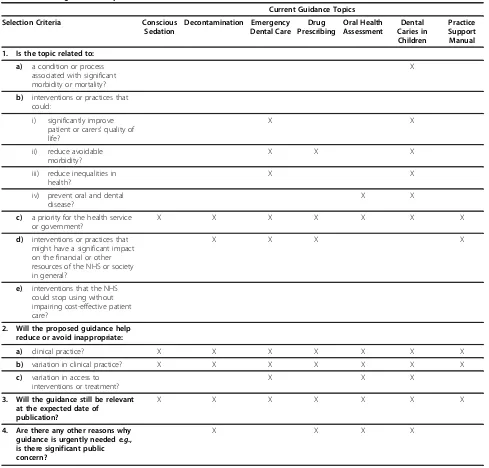
conscious sedation, decontamination, emergency dental care, drug prescribing, oral health assessment, dental caries in children, and a practice support manual that provides guidance to support dental practice manage-ment and organisation. Other topics for guidance devel-opment are being considered. The topic selection criteria and how these relate to the current SDCEP gui-dance topics are described in Table 1.
TRiaDS: The evaluative framework
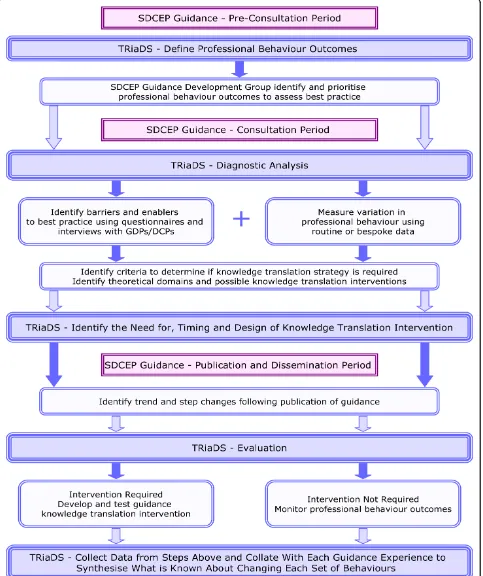
The programmatic evaluation is a standardised process based on investigations using optimal methods and
theory and summarised in Figure 1. For each SDCEP guidance document a diagnostic analysis of relevant cur-rent practice commences during the guidance develop-ment process. The diagnostic analysis involves gathering information on current dental care activities from a gen-eral perspective (e.g., the service funding arrangements) and the specific activities/behaviours related to the parti-cular guidance topic (e.g., drug prescribing). Where pos-sible, routine data sets such as the Management Information and Dental Accounting System (MIDAS) database (which contains information detailing all NHS Scotland dental treatments provided by GDPs) or the
Table 1 SDCEP guidance–topic selection criteria
Current Guidance Topics
Selection Criteria Conscious Sedation
Decontamination Emergency Dental Care
Drug Prescribing
Oral Health Assessment
Dental Caries in Children
Practice Support Manual
1. Is the topic related to:
a) a condition or process associated with significant morbidity or mortality?
X
b) interventions or practices that could:
i) significantly improve patient or carers’quality of life?
X X
ii) reduce avoidable morbidity?
X X X
iii) reduce inequalities in health?
X X
iv) prevent oral and dental disease?
X X
c) a priority for the health service or government?
X X X X X X X
d) interventions or practices that might have a significant impact on the financial or other resources of the NHS or society in general?
X X X X
e) interventions that the NHS could stop using without impairing cost-effective patient care?
2. Will the proposed guidance help reduce or avoid inappropriate:
a) clinical practice? X X X X X X X
b) variation in clinical practice? X X X X X X X
c) variation in access to interventions or treatment?
X X X
3. Will the guidance still be relevant at the expected date of
publication?
X X X X X X X
4. Are there any other reasons why guidance is urgently needede.g., is there significant public concern?
X X X X
PRISMS drug-prescribing database (which contains information about all encashed NHS Scotland drug pre-scriptions written by GDPs) are used. If relevant data are not routinely collected, specific data collection tools are developed, piloted, and used. In some cases, some or all of this information will have already been gathered by the SDCEP programme development team as part of the guidance development scoping process, in which case the diagnostic analysis continues this process. How-ever, we anticipate that it will often be necessary to extend beyond the process required for guidance development.
The degree of variation in practice is quantified and information collected to attempt to understand this var-iation. This process draws information from a range of sources: routinely available data on performance; sys-tematic reviews of the professional behaviour change lit-erature; and focus group and individual interviews with relevant stakeholders (face-to-face or by telephone). These analyses are represented as‘causal maps’with key behaviours, and the links between them identified and set alongside the guidance recommendations.
The diagnostic analysis allows (at least) two questions to be posed:‘What should be done routinely as a conse-quence of this understanding?’ and, ‘what should be investigated further as a consequence of this under-standing?’An answer to the first question may include monitoring the dissemination of the guidance using rou-tine data. Answers to the second question may include developing complex data collection systems or develop-ing bespoke evaluations.
Specific processes for evaluating each guidance
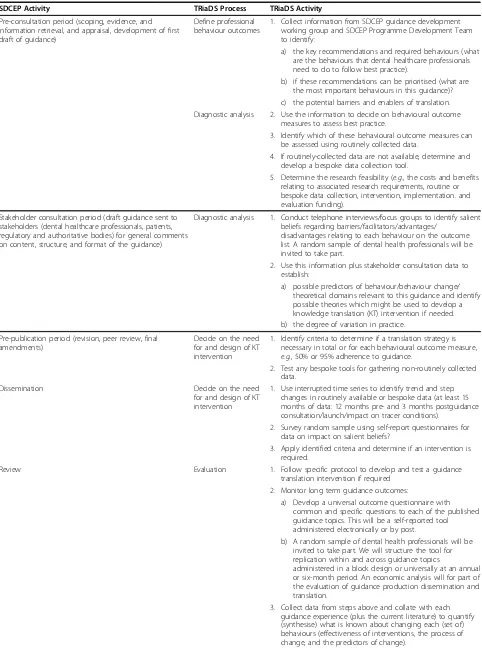
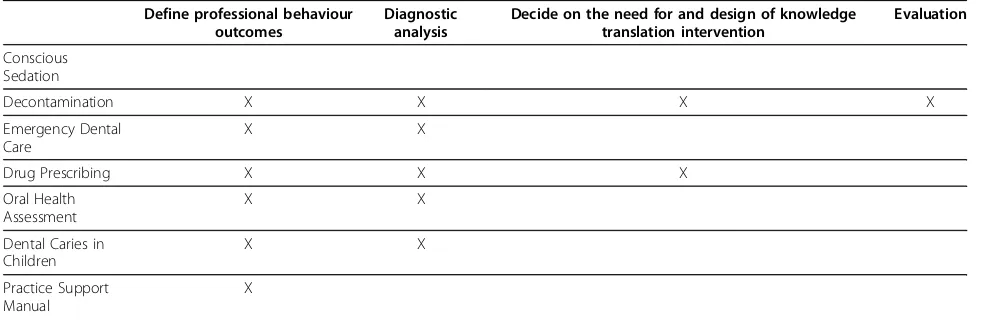
A range of evaluative approaches are used. Specific steps that are undertaken for each of the current SDCEP gui-dance series are detailed below and collated in Table 2. Table 3 summarises TRiaDS’current activities for each of the SDCEP guidance documents.
Define professional behaviour outcomes
During the pre-stakeholder consultation period, the SDCEP guidance development working group, the SDCEP programme development team, and the TRiaDS team identify the key recommendations and their required behaviours. These are prioritised based on their importance for patient health and/or safety. All, or a subset, of the required behaviours associated with the key recommendations are chosen by the TRiaDS team as the outcomes to be assessed.
Diagnostic analysis
During the SDCEP stakeholder consultation process, which typically lasts for a period of three months, SDCEP invites stakeholders, such as dental healthcare
professionals (e.g., GDPs, dental nurses), patients, and regulatory and authoritative bodies (e.g., General Dental Council, British Dental Association) to review and com-ment on the content, structure, and format of the draft guidance document by means of a standardised self-completion questionnaire. In collaboration with SDCEP, TRiaDS incorporates questions to identify current prac-tice and salient beliefs towards the behaviours chosen as the outcomes to be assessed.
In addition, a random sample of dental healthcare professionals is invited to participate in a telephone interview. The interviews follow a standardised structure to identify salient beliefs regarding barriers, facilitators, advantages, and disadvantages that relate to each beha-vioural outcome [25]. The findings are used to inform intervention design.
Data that could inform judgements about compliance with guidance recommendations are collected from routine sources such as MIDAS and PRISMS. In order for compliance to be assessed before and after the gui-dance is published, monthly or quarterly data are col-lected for at least a year prior to consultation until three months post publication. Where routine data do not exist, and the area of practice is judged important, a bespoke data collection exercise is conducted. The bespoke data collection system is generally question-naire based, but can also include primary data collec-tion within dental practices from practice records, including patients’notes or interviews with the dental team and/or patients.
The quantitative performance data from the diagnostic analysis are analysed using time series designs [26]. This allows an understanding of trends and step changes around events such as a guidance launch.
Deciding on the need for a KT intervention
Data from the diagnostic analysis allow (at least) four questions to be answered before a decision is made regarding the need for a KT intervention:
1. Do we know that there is suboptimal performance? 2. Do we understand the determinants of behaviour? 3. Can we measure relevant outcomes?
4. Is it feasible to evaluate an intervention (in terms of programme resources and other external factors)?
Table 2 Specific processes for evaluating each guidance
SDCEP Activity TRiaDS Process TRiaDS Activity
Pre-consultation period (scoping, evidence, and information retrieval, and appraisal, development of first draft of guidance)
Define professional behaviour outcomes
1. Collect information from SDCEP guidance development working group and SDCEP Programme Development Team to identify:
a) the key recommendations and required behaviours (what are the behaviours that dental healthcare professionals need to do to follow best practice).
b) if these recommendations can be prioritised (what are the most important behaviours in this guidance)? c) the potential barriers and enablers of translation. Diagnostic analysis 2. Use the information to decide on behavioural outcome
measures to assess best practice.
3. Identify which of these behavioural outcome measures can be assessed using routinely collected data.
4. If routinely-collected data are not available, determine and develop a bespoke data collection tool.
5. Determine the research feasibility (e.g., the costs and benefits relating to associated research requirements, routine or bespoke data collection, intervention, implementation. and evaluation funding).
Stakeholder consultation period (draft guidance sent to stakeholders (dental healthcare professionals, patients, regulatory and authoritative bodies) for general comments on content, structure, and format of the guidance)
Diagnostic analysis 1. Conduct telephone interviews/focus groups to identify salient beliefs regarding barriers/facilitators/advantages/
disadvantages relating to each behaviour on the outcome list. A random sample of dental health professionals will be invited to take part.
2. Use this information plus stakeholder consultation data to establish:
a) possible predictors of behaviour/behaviour change/ theoretical domains relevant to this guidance and identify possible theories which might be used to develop a knowledge translation (KT) intervention if needed. b) the degree of variation in practice.
Pre-publication period (revision, peer review, final amendments)
Decide on the need for and design of KT intervention
1. Identify criteria to determine if a translation strategy is necessary in total or for each behavioural outcome measure, e.g., 50% or 95% adherence to guidance.
2. Test any bespoke tools for gathering non-routinely collected data.
Dissemination Decide on the need
for and design of KT intervention
1. Use interrupted time series to identify trend and step changes in routinely available or bespoke data (at least 15 months of data: 12 months pre- and 3 months postguidance consultation/launch/impact on tracer conditions).
2. Survey random sample using self-report questionnaires for data on impact on salient beliefs?
3. Apply identified criteria and determine if an intervention is required.
Review Evaluation 1. Follow specific protocol to develop and test a guidance
translation intervention if required 2. Monitor long term guidance outcomes:
a) Develop a universal outcome questionnaire with common and specific questions to each of the published guidance topics. This will be a self-reported tool administered electronically or by post.
b) A random sample of dental health professionals will be invited to take part. We will structure the tool for replication within and across guidance topics
administered in a block design or universally at an annual or six-month period. An economic analysis will for part of the evaluation of guidance production dissemination and translation.
undertaking the diagnostic analysis, and developing the intervention–will also be considered.
Prior to publication of each guidance document, a deci-sion on the timing of an intervention, if required, is made. When current literature and/or synthesised evi-dence from the TRiaDS evaluative framework suggests publication of the guidance alone is unlikely to change the required behaviour(s), the value of and need for a KT intervention to coincide with publication is considered.
Approximately six months after the publication of the guidance, the need for further intervention or an inter-vention for all or a proportion of dental health profes-sionals is decided. This decision is based on the interrupted time series analyses of quantitative routinely available or bespoke data (including at least three dis-crete time points post launch to enable estimation of any trend). The analyses are designed to measure provi-der-specific variation (to enable non-compliant sub-groups to be identified).
Developing an intervention
The content and method of delivery of an intervention are based on prior published evidence and/or data col-lected during the diagnostic phase. When there is some urgency to deliver an intervention (e.g., if current prac-tice may potentially cause harm), it most likely takes the form of an ‘off-the-shelf’ intervention based on pub-lished research evidence on the effectiveness of the pro-posed behaviour change intervention, the (cost) effectiveness of the delivery method, and the ease of delivery. An ‘off-the-shelf’ intervention may also be appropriate where there is less urgency, although such situations offer the opportunity to develop and test tai-lored theory and evidence-based interventions.
Evaluating KT interventions
KT interventions are evaluated using experimental or quasi-experimental trial designs. We consider
pragmatic cluster randomised designs to be the gold standard. Wherever possible, we would propose using designs that allow evaluation of different KT interven-tions, such as multi-arm trials or factorial designs. These designs can also incorporate an evaluation of change by the use of baseline measures. In situations where the interventions are intended to be sequen-tially delivered across all practices, we will consider a stepped-wedge design and randomise the sequence in which practices appear in the delivery process. When randomisation cannot be performed for practical or logistical reasons, interrupted time-series designs will be used. To enhance the time series designs by adjust-ing for known confounders, TRiaDS will use the methods of instrumental variables recommended by Bloom [27] for evaluating policy interventions, if strong instruments can be identified. If the trials are conducted on a subset of the total population of GDPs in Scotland, the behaviour of non-study partici-pants will also be tracked using routine data when available.
In situations where evaluation using routinely available data is possible, the collection of the data beyond the end of the experimental evaluation continues in order to examine the sustainability of an intervention effect. In addition, a standardised, theoretically-based question-naire investigates the continued use and impact of SDCEP guidance. This is a self-administered tool, dis-tributed electronically or by post to a random sample of dental health professionals at multiple times annually. An economic analysis of the impact of any change is conducted in parallel.
Whilst TRiaDS’ability to examine unanticipated con-sequences is limited, it is feasible to routinely monitor the uptake of a number of non-intervention (tracer) conditions [28]. This allows insight into whether activ-ities in one area of guidance appear to have unantici-pated consequences in other areas.
Table 3 TRiaDS process and activity
Define professional behaviour outcomes
Diagnostic analysis
Decide on the need for and design of knowledge translation intervention
Evaluation
Conscious Sedation
Decontamination X X X X
Emergency Dental Care
X X
Drug Prescribing X X X
Oral Health Assessment
X X
Dental Caries in Children
X X
Practice Support Manual
Discussion
The TRiaDS programme is a significant step forward in KT research. To our knowledge, this is one of the first times that a multidisciplinary team has taken for-ward the challenge of systematically and incrementally developing and evaluating a practical, generalisable fra-mework for KT that incorporates consideration of individual, organisational, and system determinants of professional behaviour change. A similar approach is embedded within the Veterans Affairs Quality Enhancement Research Initiative (QUERI) Programme [29]. Whilst QUERI also works across a healthcare sys-tem, it does not have the opportunities offered by a close integration with the guidance development process.
The embedding of TRiaDS within the SDCEP gui-dance development process offers an outstanding opportunity to shape the guidance development pro-cess to promote the translation of the guidance and to prepare the guidance for evaluation. TRiaDS also pro-vides a unique platform to study sustainability. Sus-tainability is of considerable policy relevance, yet is understudied [15]. Opportunities to study the relative rates of change in intervention and control groups beyond the initial timeframe of an intervention are sel-dom explored in KT research. Not only does TRiaDS provide policy relevant information, the programme is also a vehicle to address methodological challenges in conducting KT research.
Being embedded within the SDCEP guidance develop-ment process with its links to both service and profes-sional bodies enables TRiaDS to inform and to exchange knowledge with dental healthcare profes-sionals, patients, educators, and policy makers on how best to translate national recommendations into routine clinical activities. In addition to the standard academic outputs (papers, conferences), key policy makers are invited at least annually to a TRiaDS meeting for updates, and a briefing report is prepared for stake-holders, including the Chief Dental Officer, Postgraduate Dental Dean and Chair of the National Dental Advisory Committee. The implications for NHS Education for Scotland relates to training in both undergraduate and postgraduate sectors. The findings of TRiaDS also have the potential to inform the development of data collec-tion systems in Scotland through the Scottish Dental Information Group.
Although based in primary dental care in Scotland and centred on clinical guidance for dentistry, the TRiaDS process describes a generalisable, evaluative KT framework that is readily transferable across national and international jurisdictions and profes-sional disciplines.
Additional material
Additional file 1: Table S1. SDCEP guidance development process
Acknowledgements
The authors would like to thank Penny Crowe, Aimee Diamond, and Lorna Oxtoby, who provided invaluable administrative and logistical support for this project and preparation of the manuscript. TRiaDS is funded by NHS Education for Scotland. The views expressed in this manuscript are the authors and are independent from the funding source.
Author details 1
Dental Health Services & Research Unit, University of Dundee, MacKenzie Building, Kirsty Semple Way, Dundee, DD2 4BF, UK.2Health Services Research
Unit, Health Services Building, University of Aberdeen, Foresterhill, Aberdeen, AB25 2ZD, UK.3Institute of Health and Society, 21 Claremont Place,
Newcastle University, Newcastle Upon Tyne, NE2 4AA, UK.4Institute for Health Sciences Education, Barts and The London School of Medicine and Dentistry, Queen Mary University of London, Abernethy Building, 2 Newark Street, Whitechapel, London, E1 2AT, UK.5Ottowa Hospital Research Institute,
Administrative Services Building, Room 2-018, 1053 Carling Avenue, Ottawa, K1Y 4EP, Canada.6William Guild Building, University of Aberdeen School of Psychology, Aberdeen, AB24 2UB, UK.7Centre for Outcomes Research and
Effectiveness, Department of Psychology, University College London, 1-19 Torrington Place, London, WC1E 7HB, UK.8Division of Clinical & Population
Sciences and Education, University of Dundee, Kirsty Semple Way, Dundee, DD2 4BF, UK.9NHS Education for Scotland, One Clifton Place, Glasgow, G3
7LD, UK.10Scottish Dental Clinical Effectiveness Programme, NHS Education
for Scotland, Dundee Dental Education Centre, Frankland Building, Small’s Wynd, Dundee, DD1 4HN, UK.11University of Glasgow Dental School, 378
Sauchiehall Street, Glasgow, G2 3JX, UK.12NHS Education for Scotland, Thistle House, 91 Haymarket Terrace, Edinburgh, EH12 5HE, UK.13NHS
Education for Scotland, Dundee Dental Education Centre, Frankland Building, Small’s Wynd, Dundee, DD1 4HN, UK.14School of Education, The University
of Birmingham, Birmingham, B15 2TT, UK.
Authors’contributions
All authors contributed to the conceptual design and intellectual content of the framework. JC, CR, ME, SE, JG, MJ, SM, ST, AW, and LY drafted the manuscript. All authors critically reviewed and contributed to draft revisions, and read and approved the final version of this manuscript.
Competing interests
Professor Nigel Pitts, in addition to his University roles securing external research grants from Research Councils, the NHS, and commercial funders, serves on a range of advisory panels for dental professional organisations and oral health companies. All other authors declare that they have no competing interests.
Received: 14 January 2010 Accepted: 20 July 2010 Published: 20 July 2010
References
1. Scottish Executive:An Action Plan for Dental Services in Scotland. (Online) Scottish Executive.2000 [http://www.scotland.gov.uk/library3/ health/apds-00.asp], (Accessed 17 August 2006).
2. Scottish Executive:An Action Plan for Improving Oral Health and Modernising NHS Dental Services in Scotland.Edinburgh: Scottish Executive 2005.
3. Seddon ME, Marshall MN, Campbell SM, Roland MO:Systematic review of studies of quality of clinical care in general practice in the UK, Australia and New Zealand.QHC2001,10:152-158.
4. Schuster M, McGlynn E, Brook RH:How good is the quality of health care in the United States?Milbank Q1998,76:517-563.
6. McGlynn E, Asch SM, Adams J, Keesey J, Hicks J, DeCristofaro A, Kerr EA: The quality of health care delivered to adults in the United States.N Engl J Med2003,348:2635-2645.
7. Clarkson JE, Turner S, Grimshaw JM, Ramsay CR, Johnston M, Scott A, Bonetti D, Tilley CJ, Maclennan G, Ibbetson R, MacPherson LMD, Pitts NB: Changing Clinicians’Behavior: A Randomized Controlled Trial of Fees and Education.Journal of Dental Research2008,87(7):640-644. 8. Grimshaw JM, Shirran L, Thomas RE, Mowatt G, Fraser C, Bero L, Grilli R,
Harvey E, Oxman A, O’Brien MA:Changing provider behaviour: an overview of systematic reviews of interventions.Med Care2001,39(8) :II-2-II-45.
9. Foy R, Eccles M, Jamtvedt G, Grimshaw J, Baker R:What do we know about how to do audit and feedback?BMC Health Services Research2005, 5:50.
10. Davies P, Walker A, Grimshaw J:Theories of behaviour change in studies of guideline implementation.Proceedings of the British Psychological Society 2003,11(1):120.
11. Grimshaw JM, Thomas RE, MacLennan G, Fraser C, Ramsay CR, Vale L, Whitty P, Eccles MP, Matowe L, Shirran L, Wensing M, Dijkstra R,
Donaldson C:Effectiveness and efficiency of guideline dissemination and implementation strategies.Health Technology Assessment2004,8(6):1-84. 12. Eccles M, Grimshaw J, Walker A, Johnston M, Pitts N:Changing the
behaviour of healthcare professionals: the use of theory in promoting the uptake of research findings.J Clinical Epidemiology2005,58:107-112. 13. Medical Research Council:A framework for development and evaluation
of RCTs for complex interventions to improve health.London: Medical Research Council 2000.
14. Campbell M, Fitzpatrick R, Haines A, Kinmonth AL, Sandercock P, Spiegelhalter D, Tyrer P:Framework for design and evaluation of complex interventions to improve health.BMJ2000,321:694-696.
15. Eccles MP, Armstrong D, Baker R, Cleary K, Davies H, Davies S, Glasziou P, Ilott I, Kinmonth AL, Leng G, Loga S, Marteau T, Michie S, Rogers H, Rycroft-Malone J, Sibbald B:An implementation research agenda.Implementation Science2009,4:18.
16. Bahrami M, Clarkson JE, Pitts NB, Johnston M, Ricketts I, MacLennan G, Nugent ZJ, Tilley C, Bonetti D, Ramsay C:Effectiveness of strategies to disseminate and implement clinical guidelines for the management of impacted and unerupted third molars in primary dental care.British Dental Journal2004,197:691-696.
17. Clarkson J E, Turner S, Grimshaw JM, Ramsay CR, Johnston M, Scott A, Bonetti B, Tilley CJ, Maclennan G, Ibbetson R, MacPherson LMD, Pitts NB: Changing clinicians’behaviour: a randomized controlled trial of fees and education.Journal of Dental Research2008,87:640-644.
18. National Health Service:National Institute for Health and Clinical Excellence. Behaviour change at population, community and individual levels. NICE public health guidance 6.London: NICE 2007.
19. Ferlie EB, Shortell SM:Improving the quality of health care in the United Kingdom and the United States: a framework for change.The Milbank Quarterly2001,79:281-315.
20. Tetroe J:Knowledge translation at the Canadian Institutes of Health Research: A primer. (Online) National Centre for the Dissemination of Disability Research, Focus Technical Brief No. 18, 2007.[http://www. ncddr.org/kt/products/focus/focus18], (Accessed 4 September 2009). 21. Graham ID, Logan J, Harrison MB, Straus SE, Tetroe J, Caswell W,
Robinson N:Lost in knowledge translation: Time for a map?The Journal of Continuing Education in the Health Professions2006,26:13-24. 22. Lindamer LA, Lebowitz B, Hough RL, Garcia P, Aguirre A, Depp C, Jeste DV:
Establishing an implementation network: lessons learned from community-based participatory research.Implementation Science2009, 4:17.
23. NHS Scotland:Scottish Dental Practice Board Annual Report 2006/07. (Online) Scottish Dental Practice Board, 2007.[http://www.show.scot.nhs. uk/sdpb], (Accessed 23 October 2008).
24. ISD Scotland:NHS Scotland Workforce Information. (Online) NHS National Services Scotland.[http://www.isdscotland.org/isd/5898.html], (Accessed 15 June 2009).
25. Michie S, Johnston M, Abraham C, Lawton R, Parker D, Walker A, on behalf of the‘Psychological Theory’Group:Making psychological theory useful for implementing evidence based practice: a consensus approach.Qual Saf Health Care2005,14:26-33.
26. Shadish WR, Cook TD, Campbell DT:Experimental and Quasi-experimental designs for generalised causal inference.Boston: Houghton-Mifflin 2002. 27. Bloom HS:Learning more from social experiments: Evolving analytic
approaches.Russell Sage Foundation 2006.
28. Kessner DM, Kalk CE, Singer ZJ:Assessing health quality–the case for tracers.N Engl J Med1973,288:189-94.
29. Stetler CB, Mittman BS, Francis J:Overview of the VA Quality
Enhancement Initiative (QUERI) and QUERI theme articles: QUERI series. Implementation Science2008,3:8.
doi:10.1186/1748-5908-5-57
Cite this article as:Clarksonet al.:The translation research in a dental setting (TRiaDS) programme protocol.Implementation Science20105:57.
Submit your next manuscript to BioMed Central and take full advantage of:
• Convenient online submission
• Thorough peer review
• No space constraints or color figure charges
• Immediate publication on acceptance
• Inclusion in PubMed, CAS, Scopus and Google Scholar • Research which is freely available for redistribution