Open Access
Research article
EQUIP: Implementing chronic care principles and applying
formative evaluation methods to improve care for schizophrenia:
QUERI Series
Alison H Brown*
1,3, Amy N Cohen
1,3, Matthew J Chinman
1,4,
Christopher Kessler
2and Alexander S Young
1,3Address: 1VA Desert Pacific Mental Illness Research, Education, and Clinical Center, Los Angeles, California, USA, 2Veterans Affairs Greater Los Angeles Healthcare System, Los Angeles, California, USA, 3UCLA Department of Psychiatry, Los Angeles, California, USA and 4RAND Corporation, Santa Monica, California, USA
Email: Alison H Brown* - [email protected]; Amy N Cohen - [email protected]; Matthew J Chinman - [email protected]; Christopher Kessler - [email protected]; Alexander S Young - [email protected]
* Corresponding author
Abstract
Background: This paper presents a case study that demonstrates the evolution of a project entitled "Enhancing QUality-of-care In Psychosis" (EQUIP) that began approximately when the U.S. Department of Veterans Affairs' Quality Enhancement Research Initiative (QUERI), and implementation science were emerging. EQUIP developed methods and tools to implement chronic illness care principles in the treatment of schizophrenia, and evaluated this implementation using a small-scale controlled trial. The next iteration of the project, EQUIP-2, was further informed by implementation science and the use of QUERI tools.
Methods: This paper reports the background, development, results and implications of EQUIP, and also describes ongoing work in the second phase of the project (EQUIP-2). The EQUIP intervention uses implementation strategies and tools to increase the adoption and implementation of chronic illness care principles. In EQUIP-2, these strategies and tools are conceptually grounded in a stages-of-change model, and include clinical and delivery system interventions and adoption/implementation tools. Formative evaluation occurs in conjunction with the intervention, and includes developmental, progress-focused, implementation-focused, and interpretive evaluation.
Results: Evaluation of EQUIP provided an understanding of quality gaps and how to address related problems in schizophrenia. EQUIP showed that solutions to quality problems in schizophrenia differ by treatment domain and are exacerbated by a lack of awareness of evidence-based practices. EQUIP also showed that improving care requires creating resources for physicians to help them easily implement practice changes, plus intensive education as well as product champions who help physicians use these resources. Organizational changes, such as the addition of care managers and informatics systems, were shown to help physicians with identifying problems, making referrals, and monitoring follow-up. In EQUIP-2, which is currently in progress, these initial findings were used to develop a more comprehensive approach to implementing and evaluating the chronic illness care model.
Discussion: In QUERI, small-scale projects contribute to the development and enhancement of hands-on, action-oriented service-directed projects that are grounded in current implementation science. This project supports the concept that QUERI tools can be useful in implementing complex care models oriented toward evidence-based improvement of clinical care.
Published: 15 February 2008
Implementation Science 2008, 3:9 doi:10.1186/1748-5908-3-9
Received: 22 August 2006 Accepted: 15 February 2008
This article is available from: http://www.implementationscience.com/content/3/1/9
© 2008 Brown et al; licensee BioMed Central Ltd.
Background
Shortly after the inauguration of the U.S. Department of Veterans Affairs (VA) Quality Enhancement Research Ini-tiative (QUERI) in 1998, a Request for Proposals (RFP) was released for Investigator-Initiated Research (IIR) projects that focused on implementing clinical guidelines in VA healthcare facilities. Recognizing that implementa-tion of guidelines was not a straightforward endeavor, the RFP suggested particular attention be paid to barriers to guideline implementation, such as "provider issues (knowl-edge, attitudes, and behavior) and system issues (e.g., resources, culture, patient population, etc.)." At that time, "implementation" was to be operationalized "in terms of observed changes in practice and, when possible, changes in patient and system outcomes (cost, quality of care, average length of stay, policy or procedure changes, prac-tice variations), i.e., not mere dissemination of, or pro-nouncements about, guidelines." The science of implementation was still in development; specific meth-ods for engaging in implementation science had not yet been spelled out, and instead, more traditional approaches were being used to design and assess the proc-ess of implementation.
In this paper, we present the evolution of a project that began approximately when QUERI and implementation science began, and that has been transformed, with con-tinued funding, into a project that explicitly engages in implementation science as it is currently defined and operationalized within QUERI [1]. The initial project, "Enhancing QUality-of-care In Psychosis," or EQUIP, developed methods and tools to apply a chronic illness care model in schizophrenia, and evaluated the imple-mentation of this care model using a small-scale control-led trial. The EQUIP intervention used strategic tools to increase the adoption and improve the implementation of
this care model. It included substantial qualitative meth-ods, though its formative evaluation was modest by cur-rent standards.
Evaluation of EQUIP led to a more recent project, EQUIP-2, which is a larger-scale trial of the chronic illness care model implementation currently in progress. Tools from EQUIP have been refined, and improvements have been made to the original implementation method. In addi-tion, EQUIP-2 incorporates a more complete formative evaluation to optimize future, broader implementation of the EQUIP intervention. Our ability to design the project in this way reflects recent advances that have been made in the science of implementation, particularly with regard to the various types of formative evaluation that can be used over the stages of a project [2]. In describing the evo-lution of the EQUIP project, we illustrate the value of the QUERI expectation that study development and refine-ment should occur in implerefine-mentation research within and across phased, improvement-focused projects. We hope the paper will stimulate additional scientific discus-sion about the challenges of implementation.
This article is one in a Series of articles documenting implementation science frameworks and approaches developed by the U.S. Department of Veterans Affairs (VA) Quality Enhancement Research Initiative (QUERI). QUERI is briefly outlined in Table 1 and described in more detail in previous publications [3,4]. The Series'
introductory article [1] highlights aspects of QUERI that are related specifically to implementation science, and describes additional types of articles contained in the
QUERI Series.
Below we provide a brief overview of the Mental Health QUERI Center which supports the current project. We
Table 1: The VA Quality Enhancement Research Initiative (QUERI)
The U.S. Department of Veterans Affairs' (VA) Quality Enhancement Research Initiative (QUERI) was launched in 1998. QUERI was designed to harness VA's health services research expertise and resources in an ongoing system-wide effort to improve the performance of the VA healthcare system and, thus, quality of care for veterans.
QUERI researchers collaborate with VA policy and practice leaders, clinicians, and operations staff to implement appropriate evidence-based practices into routine clinical care. They work within distinct disease- or condition-specific QUERI Centers and utilize a standard six-step process:
1) Identify high-risk/high-volume diseases or problems. 2) Identify best practices.
3) Define existing practice patterns and outcomes across the VA and current variation from best practices. 4) Identify and implement interventions to promote best practices.
5) Document that best practices improve outcomes.
6) Document that outcomes are associated with improved health-related quality of life.
Within Step 4, QUERI implementation efforts generally follow a sequence of four phases to enable the refinement and spread of effective and sustainable implementation programs across multiple VA medical centers and clinics. The phases include:
1) Single site pilot,
2) Small scale, multi-site implementation trial, 3) Large scale, multi-region implementation trial, and 4) System-wide rollout.
then briefly describe EQUIP and the evaluation research methods used in the project, followed by a presentation of the EQUIP findings. The second half of the paper concen-trates on a description of EQUIP-2 methods, which was funded through a different mechanism than EQUIP, and, as noted above, is more clearly a project that engages in implementation science. We conclude by reflecting on the utility of the QUERI process and proposing directions for future hands-on, action-oriented research [4].
The Mental Health QUERI (MHQ) focus on schizophrenia Schizophrenia is a chronic medical disorder that occurs in about 1% of the population, and results in substantial morbidity and mortality when poorly treated. Although evidence-based practices (EBPs) improve outcomes in schizophrenia, these treatments are not often used [5,6]. Some EBPs, such as 'Assertive Community Treatment' and 'Individualized Placement and Support,' have not been widely implemented, thereby limiting patient access. For other EBPs, such as clozapine (commonly used drug for schizophrenia) and caregiver services, clinicians may lack the competencies to deliver them, and typical clinic organization is not consistent with their use. In addition, evidence-based quality improvement (EBQI, [7]) has been nearly impossible in treating schizophrenia because existing medical records (including electronic medical records) lack reliable information regarding patient symp-toms, side-effects, and functioning [8]. Although national organizations, including the VA, have made implementa-tion of appropriate care for schizophrenia a high priority [9,10], there has been only modest success in developing interventions to overcome implementation barriers [11-13]. Clearly, interventions that enhance the implementa-tion of evidence-based treatments are needed in schizo-phrenia. The interventions tested in EQUIP and EQUIP-2 involve tools for supporting the implementation of chronic illness care principles in schizophrenia.
EQUIP Methods
This section describes the EQUIP project and implemen-tation intervention methods in more detail, and the meth-ods used in the formative evaluation component of EQUIP.
EQUIP overview and specific aims
Funded in 2001, the goals of EQUIP were to develop, implement and evaluate a strategy designed to apply the chronic illness care model to the outpatient treatment of schizophrenia in a Step 4, Phase 1 QUERI project (see Table 1). As noted above, projects responding to the 1998 RFP were geared toward "guideline implementation." In schizophrenia, application of a chronic illness care model requires attention to several sets of pertinent guidelines, including established principles of chronic illness man-agement [14,15] and national treatment guidelines for
schizophrenia. At the time of EQUIP, these guidelines included the American Psychiatric Association guidelines [16], the Agency for Healthcare Research and Quality Patient Outcomes Research Team (PORT) treatment rec-ommendations [17], and a VA treatment algorithm (These guidelines have subsequently been updated [18,19]). Taken together, the EQUIP care model focused on improving treatment in three domains: 1) treatment assertiveness and care coordination, 2) guideline-con-cordant medication management of symptoms and side-effects, and 3) family services.
The specific aims of EQUIP were to: 1) Assess, in a rand-omized, controlled trial, the effect of a chronic illness care model for schizophrenia relative to usual care on: a) clini-cian attitudes regarding controlling symptoms and side-effects, and regarding family/caregiver involvement in care; b) clinician practice patterns and adherence to guide-line recommendations; c) patient compliance with treat-ment recommendations; d) patient clinical outcomes (e.g., symptoms, side-effects, quality of life, and satisfac-tion); and e) patient utilization of treatment services; and 2) Assess, using mixed qualitative and quantitative meth-ods, the success of the implementation strategy's impact on uptake of the model.
EQUIP research design and methods
The chronic illness care principles were evaluated at two outpatient mental health clinics within two large, urban VA medical centers in Southern California. At these two clinics, psychiatrists were randomized to the best practice intervention (care model) or control (treatment as usual). Case managers and patients were assigned to the same study arm as the psychiatrists with whom they were asso-ciated. At the third clinic, within one of the medical cent-ers, all the clinicians and patients were assigned to the control group. The chronic illness care model intervention was developed, implemented and fully operational in Jan-uary 2003 and was sustained for more than 15 months. The relevant institutional review boards approved all trial procedures.
psy-chiatrists, 1 nurse practitioner, 3 nurse case managers, and 173 patients. The control group included 43 psychiatrists, 1 psychiatric pharmacist, 3 nurse case managers, and 225 patients. Informed consent was obtained from all patients, or their legal conservators, and all clinicians.
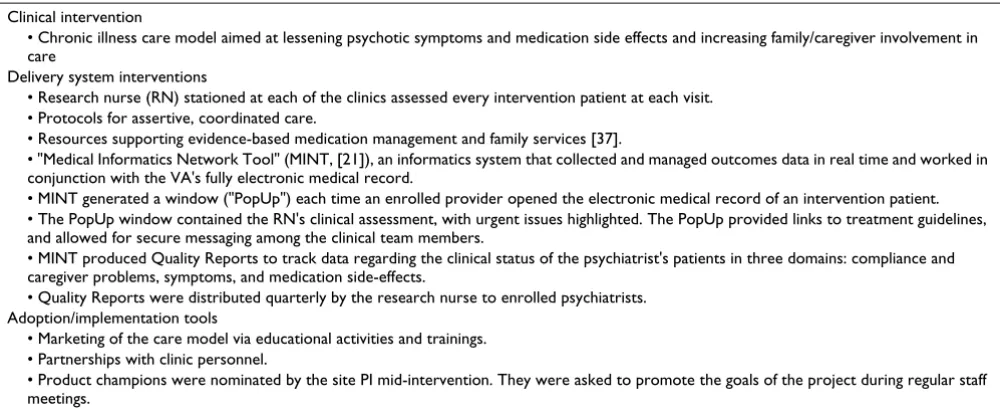
The study included clinical interventions, delivery system interventions, and adoption/implementation tools. These interventions and tools are presented in Table 2. One of the innovations of EQUIP was the use of the Medical Informatics Network Tool (MINT) to provide instant, summarized clinical information (via a "PopUp" win-dow, see Table 2) to clinicians as they accessed the patient's medical record. As noted in the table, adoption and implementation tools also were utilized to enhance the utility and effectiveness of the intervention.
EQUIP formative evaluation methods
In addition to the implementation strategy described above, EQUIP involved formative evaluation. Table 3 depicts the methods that were utilized in the evaluation.
Pre- and post-implementation semi-structured interviews and surveys were conducted to assess experience with research, clinical practice and competencies, plus expecta-tions and observaexpecta-tions of the implementation. At the time of the post-implementation survey, the research team was already planning EQUIP-2 (described below) and, there-fore, specific feedback was desired for the next phase of implementation. These pre- and post-implementation interviews and surveys were conducted by research staff. There was an attempt to interview and survey as many psy-chiatrists as possible from both the intervention and con-trol arms of the study.
Mid-implementation interviews and surveys were con-ducted to assess the process of intervention implementa-tion. These mid-intervention interviews were conducted by an independent contractor (A. Brown). Via surveys, cli-nicians were asked specifically how the informatics system was working for them, as well as about the effect of the Quality Report. Both the mid-implementation interview and survey were conducted with a sub-sample of psychia-trists- those who were most involved with the implemen-tation due to higher caseloads of patients in the sample. As a result of the timing of this mid-implementation feed-back, changes were made midway through, to make rele-vant interventions more effective and appealing.
EQUIP results
Main evaluation findings
The evaluation of EQUIP provided an understanding of quality gaps and how to address related problems in schiz-ophrenia. Our findings are summarized in the left column of Table 4.
EQUIP revealed that solutions to quality problems in schizophrenia differ by treatment domain. For example, challenges to implementing family services proved to be very different from challenges to implementing weight management using wellness groups. Improving family services required assessment of each patient-caregiver rela-tionship, intensive negotiation with patients and caregiv-ers, major care reorganization to accommodate family involvement, and attention to clinician competencies (e.g., knowledge, attitude, and skills). Improving weight and wellness required assessment of the problem in each patient, the establishment of therapeutic groups, involve-ment of nutrition and recreational services, and help with referrals and follow-ups.
Table 2: EQUIP intervention components
Clinical intervention
• Chronic illness care model aimed at lessening psychotic symptoms and medication side effects and increasing family/caregiver involvement in care
Delivery system interventions
• Research nurse (RN) stationed at each of the clinics assessed every intervention patient at each visit. • Protocols for assertive, coordinated care.
• Resources supporting evidence-based medication management and family services [37].
• "Medical Informatics Network Tool" (MINT, [21]), an informatics system that collected and managed outcomes data in real time and worked in conjunction with the VA's fully electronic medical record.
• MINT generated a window ("PopUp") each time an enrolled provider opened the electronic medical record of an intervention patient. • The PopUp window contained the RN's clinical assessment, with urgent issues highlighted. The PopUp provided links to treatment guidelines, and allowed for secure messaging among the clinical team members.
• MINT produced Quality Reports to track data regarding the clinical status of the psychiatrist's patients in three domains: compliance and caregiver problems, symptoms, and medication side-effects.
• Quality Reports were distributed quarterly by the research nurse to enrolled psychiatrists. Adoption/implementation tools
• Marketing of the care model via educational activities and trainings. • Partnerships with clinic personnel.
EQUIP also revealed that quality problems can arise from poor clinician competencies [20]. For example, we found clinician competency problems in the use of clozapine. This clozapine competency problem is well established anecdotally, although there is little empirical evidence of it. The main competency problems that we encountered, in at least a subset of clinicians, were: 1) clinicians were
not trained in the use of clozapine, or had not used it despite training; 2) clinicians were not credentialed to use clozapine in their settings; 3) clinicians were discouraged by the possibility that having patients on clozapine would necessitate longer clinical visits with more clinical effort; and/or 4) clinicians did not believe clozapine would be helpful. Quality problems can also arise due to difficulty
Table 3: EQUIP formative evaluation methods
Pre-implementation
• Semi-structured interviews conducted by research personnel with intervention and control psychiatrist participants (n = 35): gathered data on psychiatrists' previous experience with research, their clinical practices, and expected barriers and facilitators of intervention components. • Self-report questionnaire completed by intervention and control psychiatrist participants (n = 44): gathered data on psychiatrists' training, attitudes, knowledge and skills related to schizophrenia and guidelines, and on workload.
Mid-implementation
• Semi-structured qualitative interviews conducted by an independent contractor with a sub-sample of the intervention clinical and research staff (n = 18): gathered data on usefulness of the PopUps, in order to make any necessary changes that would enhance the remainder of the EQUIP intervention.
• Computer System Usability Questionnaire [38] completed by sub-sample of intervention psychiatrist participants (n = 16): gathered quantitative data on experiences with the PopUps.
• Quality Report survey completed by sub-sample of intervention psychiatrist participants (n = 8): provided data on uptake of the Quality Report they received quarterly.
Post-implementation
• Semi-structured qualitative interviews conducted by research personnel with intervention and control clinical and research staff (n = 11): gathered data on psychiatrists' current clinical practices, barriers and facilitators of intervention components, especially the unsuccessful family component, satisfaction/dissatisfaction with the implementation program, and recommendations for future programs.
• Self-report questionnaire completed by intervention and control psychiatrist participants (n = 14): gathered data on psychiatrists' attitudes, knowledge and skills related to schizophrenia and guidelines, their attitudes about recovery and family services, and on workload.
Table 4: Findings in EQUIP and resulting adjustments made in EQUIP-2
EQUIP Finding EQUIP-2 Adjustment: Intervention
Clinical interventions
Care targets were equally applied at all sites. Sites choose their preferred care targets based on local needs and resources.
Delivery system interventions
Providers made limited use of symptom assessments performed by highly trained nurse assessors, and questioned the accuracy of the assessments.
Patients complete self-assessments, which are given to relevant providers.
Providers at the clinics had high levels of depersonalization, high levels of exhaustion, and a low sense of personal accomplishment (burn-out).
One clinic staff member included in project calls and meetings in order to modify the care model to local needs and organization. Staff provided with more feedback throughout implementation, including material and other reinforcements for high achievers.
The Quality Report was distributed quarterly by the nurse to each individual psychiatrist, with only modest discussion.
The Quality Report is distributed at monthly staff meetings by the product champion. Quality of care outliers (good and bad) and clinic-wide problems are discussed among the team.
The PopUp included links to summaries of treatment guidelines, but psychiatrists did not use these links.
Treatment recommendations will be "pushed" to psychiatrists in the context of specific patients, and computers will provide patients with education about guideline-concordant treatments.
Adoption/implementation tools
A non-systematic approach to site inception may have affected buy-in and enthusiasm.
A project "kick-off" is highlighted with participation of all sites.
Engagement was primarily with clinic-level personnel. Engagement occurs with clinic-level personnel, medical center personnel, and regional policy-makers.
Case managers were important, but were available only at one site and entered the project late.
Case managers are involved from the beginning.
Product champions were appointed by medical center administration late, and were less intensively involved than desired.
in changing psychiatric treatments. In EQUIP, we noted that psychiatrists made minimal use of data showing that their patients had high levels of symptoms and side-effects (Quality Reports), and they also made minimal use of the guidelines that were easily accessible via the MINT "PopUp" (see Table 2) that was available on their compu-ter at every clinical encouncompu-ter [21].
Quality problems such as these can be exacerbated by a general lack of awareness of evidence-based practices, such as approaches to managing increased weight or treat-ment-refractory psychosis. During the course of imple-mentation, it became apparent to the research team that increasing the intensity of follow-up (e.g., adding clinic visits) for severely ill patients was of limited use. Clini-cians typically did not change treatments in response to clinical data. Therefore, additional treatment visits were of limited value because they were not likely to lead to appropriate changes in treatment in response to psychosis or medication side-effects.
Based on what we were seeing in terms of these persistent quality problems, we began to conclude that improving care required creating resources to support clinicians and reorganizing care to help them easily implement changes in their clinical practices. Also, there was a need for inten-sive education and product champions who would work with clinicians to encourage awareness and use of these resources. Care managers and the informatics system did help physicians identify clinical problems in their patients, but these interventions and tools needed reas-sessment and possibly redesign. For example, we learned, through the involvement of the case managers, that tools designed for clinicians may not have the same appeal across types of clinicians. We found that psychiatrists and case managers (though the sample was small) had differ-ing perspectives on the value of bediffer-ing provided with clin-ical data by their computer (e.g., PopUps) during the encounter. This supported the assertion that formative evaluation data must be gathered from multiple perspec-tives. As Lyons et al. point out, it is essential to examine the perspectives of multiple individuals: the "single-pro-vider focus does not well represent clinical reality as expe-rienced by interdisciplinary teams [22]."
Finally, we learned that improving care within the VA healthcare system (and perhaps other large healthcare organizations) can require high-level organizational involvement. For example, implementing wellness groups or clozapine clinics required active involvement from nutrition and pharmacy, respectively, which were medical center-wide services. Indeed, sometimes management of these services resided at the level of the Veterans Inte-grated Service Network (VISN; the 21 VA regions of the United States). Nutrition and pharmacy services did not
respond to requests from staff at the level of mental health clinics, and this lack of responsiveness impeded our abil-ity to implement a clozapine clinic or to involve the nutri-tion department in the wellness programs.
EQUIP-2 Methods
This section describes: 1) the EQUIP-2 project and con-ceptual framework, 2) the evolution of the EQUIP-2 implementation strategy (i.e., interventions and tools), and 3) the formative evaluation component of EQUIP-2.
EQUIP-2 overview
As noted above, the next phase of work building toward national roll-out of the EQUIP intervention is EQUIP-2 – a Step 4, Phase 2 multi-site evaluation (See Table 1). As the Overview to the Series notes [1], projects within this phase are considered "clinical trials to further refine and evaluate an improvement/implementation program." These trials involve a small sample of facilities conducting the implementation program under somewhat idealized conditions. Moreover, it is noted [4] that these projects require active research team support and involvement, plus modest real-time refinements to maximize the likeli-hood of success and to study the process for replication requirements. They employ formative evaluation (to monitor and feed back information regarding implemen-tation and acceptance and impacts), as well as develop-ment and use of formal measuredevelop-ment tools and evaluation methods.
EQUIP-2 is a three-year project that was funded in January 2006, and aimed at our implementation strategy refine-ment and broad formative evaluation in eight sites across four VISNs that used the implementation approaches adopted by QUERI. As noted above, EQUIP-2 was funded as an SDP [4], which involves a unique set of expectations in terms of addressing what are called "quality gaps" (i.e., the current lack of evidence-based care for schizophrenia, described above).
taking place; maintenance and optimization of research implementation interventions; and provision of feedback, e.g., regarding progress on targeted goals. They also rec-ommend collecting data from experts, representative cli-nicians/administrators, and other key informants regarding both pre-implementation barriers and facilita-tors and post-implementation perceptions of the evi-dence-based practice and implementation strategy. All of these elements are being utilized in EQUIP-2 and are described further below with regard to the formative eval-uation.
Conceptual framework: Simpson Transfer Model & PRECEDE
Though informed by more than one conceptual frame-work, EQUIP-2 is organized around the Simpson Transfer Model (STM). This model guides the development and refinement of a diversified, flexible menu of tools and interventions to improve schizophrenia care. Incorporat-ing the notion of readiness to change [23] at both the individual and organizational levels, Simpson developed a program change model for transferring research into practice [24]. The STM has provided important conceptual input to many studies in technology transfer [25-27]. This model involves four action stages: exposure, adoption, implementation, and practice. Exposure is dedicated to introducing and training in the new technology; adoption
refers to an intention to try a new technology/innovation through a program leadership decision and subsequent support; implementation refers to exploratory use of the technology/innovation; and practice refers to routine use of the technology/innovation, likely with the help of cus-tomization of the technology/innovation at the local level. Crucial to moving from exposure to implementa-tion are personal motivaimplementa-tions of staff and resources pro-vided by the institution (e.g., training, leadership), organizational characteristics such as "climate for change" (e.g., staff cohesion, presence of product champions, openness to change), staff attributes (e.g., adaptability, self-efficacy), and characteristics of the innovations them-selves (e.g., complexity, benefit, observability).
EQUIP-2 also draws upon the PRECEDE planning model for designing behavior change initiatives [28]. Because the STM model does not recommend specific behavior change tools to be used in a knowledge transfer intervention, additional guidance is necessary regarding development of the implementation framework. The PRECEDE acro-nym stands for "predisposing, reinforcing, and enabling factors in diagnosis and evaluation." PRECEDE stresses the importance of applying multiple interventions to influence the adoption of targeted clinician behaviors. These include: 1) academic detailing and consultation with an opinion leader or clinical expert, which can help
predispose clinicians to be willing and able to make the
desired changes; 2) patient screening technologies, clini-cal reminders, and/or other cliniclini-cal support tools that can
enable clinicians to change; and 3) social or economic incentives that can reinforce clinicians' implementation of targeted behaviors.
A key part of the PRECEDE model is the active participation
of the target audience in defining the issues and factors that influence targeted behaviors, and in developing and implementing solutions [28]. This participation principle is consistent with the social marketing framework, which emphasizes the importance of understanding a target audience's initial and ongoing perceptions of the innova-tion, in order to facilitate behavior change [29,30]. Both PRECEDE and social marketing theory state that messages and interventions should be tailored to perceptions in order to influence the desired behavior change.
Taken together, the models and frameworks discussed above suggest that the impact of implementation efforts will be maximized when they: 1) are based on assess-ments of the needs, barriers, and incentives of targeted end users; 2) are based on an understanding of the local context; 3) involve representatives of diverse stake-holder groups in the planning process; 4) use expert involvement in planning, especially when behaviors to be adopted and/or changed are complex; 5) draw on marketing prin-ciples for developing and disseminating intervention tools; and 6) secure support and involvement from top level management and product champions [31-33]. Each of these factors is integrated into the STM, which guides the EQUIP-2 strategy and formative evaluation. Table 5 provides an overview of how we will engage in each phase of the STM.
Evolution of the schizophrenia implementation strategy Several modifications were made in EQUIP-2 as a result of the findings and observations in EQUIP. An overview of each type of strategy is provided below; Table 4 (right col-umn) notes the specific changes made in EQUIP-2 based on findings from EQUIP.
Evidence-based clinical/therapeutic practices
Table 5: Simpson Transfer Model stages and corresponding activities
STM stages Intervention components and tools Formative evaluation
Exposure • Secure commitment Developmental evaluation • Training and observation of care model by site PIs and
regional project managers
• Organizational Readiness for Change (ORC: prior to implementation)
• Review evidence • Key informant interviews • Address values
• Identify and prioritize needs and treatment targets • Begin tailoring care practice protocols
• Kick-off meeting and video conferences on treatments to be implemented
Adoption Predisposing activities: Developmental evaluation • VISN Implementation Teams Rogers' adoption questions: • Product champions • Complexity
• Continue tailoring care practice protocols • Relative advantage • Continue to secure commitment, address values • Observability
Implementation Enabling activities: Progress-focused evaluation • Patient self- assessment informatics (PAS) with provision of
data to clinicians.
• PAS tracking (ongoing)
• Treatment-specific implementation activities, such as help with wellness groups and liaison with supported
employment.
Implementation-focused evaluation
• Discuss and start using provider supports and incentives. • Project documents (minutes from Implementation Team meetings, project managers' field notes, quality coordinators' logs: all ongoing).
• Provider and clinic manager interviews (mid-implementation)
Practice Reinforcing activities (performance monitoring & feedback):
Interpretive evaluation
• Monthly quality meeting and Quality Reports • Provider & clinic manager interviews (post-implementation) • Quarterly conference calls re: treatment target
implementation and use
• Computer system usability questionnaire
• Implementation team meetings • Continue tailoring with provider input • Finalize provider supports and incentives • Continue tailoring with leader input
Sustainability • Stakeholder feedback discussions Interpretive evaluation • Level of Institutionalization • ORC
Table 6: Evidence-based clinical/therapeutic practices that could be supported in EQUIP-2:
1. Clozapine for patients with severe psychosis, with the goal of increasing the proportion who receive clozapine (Evidence level1 = 1b, [39]);
2. Wellness intervention for elevated weight, with the goals of increasing the proportion of patients receiving antipsychotic medication with less weight gain potential (Evidence level = 1a, [40]), and increasing the proportion of patients who receive a group-based wellness intervention [41]); 3. Family involvement to improve symptom control and functioning (Evidence level = 1a, [42]), with the goals of increasing the proportion of family members who are involved in developing the patient's treatment plan; and
4. Supported Employment for unemployment (Evidence level = 1b, [43]), with the goal of increasing the proportion of patients (who want to work) receiving evidence-based rehabilitation services that lead to competitive employment.
Evidence Pyramid
1a: Evidence obtained from meta-analysis of randomized controlled trials (RCTs)
1b: Evidence obtained from at least 1 RCT
2a: Evidence obtained from at least 1 well-designed controlled study without randomization
2b: Evidence obtained from at least 1 other type of well-designed quasi-experimental study
3: Evidence obtained from well-designed non-experimental descriptive studies, such as comparative studies, correlation studies and case control studies
recovery. Each VISN involved was asked to choose two evidence-based practices from a list of four practices that EQUIP-2 was prepared to support (Table 6). All four VISNs chose the same two targets – wellness and sup-ported employment.
Delivery system interventions
During the intervention period, there is a monthly quality meeting at each intervention clinic. This quality meeting is "local" and the site PI (principal investigator), quality coordinator, product champion, and clinicians attend this meeting. During the meeting, each clinician is given his/ her personal "Quality Report." Quality meetings: 1) allow pervasive quality problems to be identified, 2) optimize teamwork by encouraging group problem-solving on patient management problems, and 3) identify resources needed to address care problems. Lastly, high-achieving clinicians are discussed (i.e., those who are accomplishing the specific goals of each care target) and incentives are distributed.
Adoption/implementation tools
In terms of marketing, all of the sites had an explicit project "kick-off" that signalled the start of the project and promoted a sense of excitement. Educational activities and trainings commenced both at the coordinating center and at the individual clinics.
In order to promote further engagement and collabora-tion, additional levels of personnel are involved in the project from its inception. Prior to enrolment, we have had monthly planning calls involving clinic staff, regional managers, and medical center leadership. These calls address practical issues regarding study set-up, as well as plans for marketing. Once enrollment begins, we will have monthly Implementation Team calls involving site PIs, site project directors, product champions, VISN-level staff, and the research team. These calls will examine and address all implementation issues as they arise and will work toward sustainability of the model. During the course of implementation, we maintain the research nurse position from EQUIP in the form of "Quality Coordina-tors." These individuals were reported to make a differ-ence in EQUIP, not only to clinicians, in that they provided additional clinical information about patients, but also to patients, in that they provided an additional source of support. Further, we engage case managers from the beginning of the project.
We encourage staff to identify who they go to for expertise in the chosen care targets, and ask that individual to vol-unteer as product champions for the project. We identify product champions based on this information and ask them to participate in monthly Implementation Team calls, as well as other mechanisms of involvement.
Formative evaluation
As noted above, this Phase 2 implementation project involves a more formal evaluation component, due to the importance at this stage of program refinement. Below we describe each component of the formative evaluation.
Developmental evaluation
In EQUIP, we observed that organizational climate and staff engagement and structure significantly affected the degree to which the tools presented in the project were effective. This observation is consistent with emerging implementation science, which itself is increasingly recog-nizing the importance of context. In order to better under-stand and "diagnose" [2] the organizational climate of the sites, the Simpson Transfer Model organizational readi-ness measures will be used in EQUIP-2. We also conduct key informant interviews in order to better understand the clinics' preparedness for the intervention.
Implementation-focused evaluation
Each month during implementation, there are Implemen-tation Team meetings, which serve to link intervention sites and the research team from the coordinating center. Here, barriers and facilitators to implementation are iden-tified and discussed, and group problem-solving and any needed reorganization of care is planned and docu-mented. Product champions and other site personnel also report on any informal feedback they have received about problems with the implementation. As implementation continues, this team works toward sustainability of the model. Minutes from these meetings, project managers' field notes, and quality coordinators' logs are analyzed to evaluate implementation throughout the intervention period. In addition, midway through the intervention, the research team conducts semi-structured interviews with clinicians and clinic managers to evaluate the operation-alization of the intervention, necessary refinements to the intervention, and areas of desired guidance. In order to reduce burn-out, promote and maintain enthusiasm for the project, and to optimize successful implementation overall, various interventions are modified if feedback and other formative data indicate that change is necessary.
Progress-focused evaluation
Interpretive evaluation
At the conclusion of the project, we will conduct semi-structured interviews with the clinicians and clinic manag-ers regarding the usefulness of the EQUIP-2 strategy, their satisfaction with the implementation process, barriers to and facilitators of implementation, and recommenda-tions for future refinements [2]. In order to re-evaluate the delivery system interventions, we will collect quantitative data about the usability of the informatics system. Meas-ures of organizational readiness will be repeated, in order to describe changes in organizational climate during the course of the project, as another potential influence on successful implementation. And the extent to which the care model has become "institutionalized," (i.e., degree to which the care model has become part of routine clinical practice) will be examined.
For the final interpretive evaluation, we will explore all formative evaluation data in light of our outcome data in order to provide: alternative explanations of results; clari-fication of our implementation effort success (or failure); and assessment of the potential for reproducibility of our implementation strategy in a broader segment of the VA [4].
Discussion
The evolution of the EQUIP implementation program took shape during the development of the field of imple-mentation science. The experience in EQUIP, combined with the guidance received from the subsequent EQUIP-2 protocol, led to a Step 4, Phase 2 activity that more explic-itly engages in evidence-based quality improvement and in formal evaluation. Although the formative evaluation in EQUIP was more limited compared to recently devel-oped formative evaluations, it produced important new information regarding quality improvement in schizo-phrenia. It has been widely acknowledged that there are major problems with the quality of routine care for schiz-ophrenia, but there has been limited research on how to improve this care and on the challenges to improving care. EQUIP identified effective and ineffective methods and strategies for improving care, and provided results that can be of substantial use to people working to improve treatment and outcomes in this disorder.
We agree with Kitson, Harvey, & McCormack [35] that the level and nature of evidence, the environment in which research is placed, and the method in which the process of implementation is undertaken can be equally important in successful implementation: "Implementation may not be successful within a context that is receptive to change, because there is non-existent or ineffective facilitation ... For implementation to be successful, there needs to be a clear understanding of the nature of evidence being used, the quality of context in terms of its ability to cope with
change and type of facilitation needed to ensure a success-ful change process" (p. 152). Accordingly, our approach in EQUIP-2 addresses the interventions, environment, and process equally, and involves thorough assessment of each component.
Clearly a multi-faceted evaluation is needed to develop a comprehensive understanding of barriers to and facilita-tors of implementation of the chronic illness care model in schizophrenia. In this disorder, barriers to improving care in EQUIP varied by evidence-based practice, and included under-developed clinician competencies, burn-out among clinicians, limited availability of psychosocial treatments, inadequate attention to medication side-effects, and organization of care that was not consistent with high quality practice. Facilitators to improving care included interest among clinicians and policymakers in improving care, and robust specialty mental health serv-ices. Summative evaluation is not sufficient to understand these components. Instead, as begun in EQUIP and more fully developed in EQUIP-2, we believe that a conceptu-ally-driven formative evaluation can provide more detail as to the interactions between interventions, process, and context. Research such as EQUIP-2 should help to deter-mine the relative importance of each component, provid-ing direction as to when one component needs more attention than another during the course of a quality improvement implementation project [36]. Scientifically-based qualitative evaluations of quality improvement in schizophrenia may guide project development, strengthen future stages of intervention development (as illustrated in the development of EQUIP-2), and inform future mixed methods evaluation within the field of implementation science.
Competing interests
The author(s) declare that they have no competing inter-ests.
Authors' contributions
AHB conducted the independent qualitative study, ana-lyzed the data, and drafted the manuscript. ANC served as the project director, and she conducted the pre-post EQUIP semi-structured interviews, analyzed the data, and helped draft the manuscript. MJC collaborated on instru-ment developinstru-ment and analyses, and helped draft the manuscript. CK served as a product champion for the project, and helped draft the manuscript. ASY conceived of the study, participated in its design and coordination, and helped draft the manuscript. All authors read and approved the final manuscript.
Disclaimer
do not necessarily represent the views of the U.S. Depart-ment of Veterans Affairs.
Acknowledgements
The authors thank Daniel Auerbach, MD; Michelle Briggs, RN; Qing Chen; Kimmie Kee, PhD; Kirk McNagny, MD; Daniel Mezzacapo, RN; Jim Mintz, PhD; Jennifer Pope; Christopher Reist, MD; Kuo-Chung Shih; and Julia Yosef, MA.
This project was supported by the Department of Veterans Affairs through the Health Services Research & Development Service (RCD 00-033 and CPI 99–383) and the Desert Pacific Mental Illness Research, Education and Clinical Center (MIRECC); and by the National Institute of Mental Health (NIMH) UCLA-RAND Center for Research on Quality in Managed Care (MH 068639).
References
1. Stetler CB, Mittman BS, Francis J: QUERI series overview paper.
2008.
2. Stetler CB, Legro MW, Wallace CM, Bowman C, Guihan M, Hage-dorn H, Kimmel B, Sharp ND, Smith JL: The role of formative evaluation in implementation research and the QUERI expe-rience. J Gen Intern Med 2006, 21 Suppl 2:S1-8.
3. McQueen L, Mittman BS, Demakis JG: Overview of the Veterans Health Administration (VHA) Quality Enhancement Research Initiative. Journal of the American Medical Informatics Asso-ciation 2004, 11:339-343.
4. Demakis JG, McQueen L, Kizer KW, Feussner JR: Quality Enhance-ment Research Initiative (QUERI): A collaboration between research and clinical practice. Med Care 2000, 38(6 Suppl 1):I17-25.
5. Lehman AF: Quality of care in mental health: the case of schiz-ophrenia. Health Aff (Millwood) 1999, 18(5):52-65.
6. Young AS, Sullivan G, Burnam MA, Brook RH: Measuring the qual-ity of outpatient treatment for schizophrenia. Arch Gen Psychi-atry 1998, 55(7):611-617.
7. Rubenstein LV, Meredith LS, Parker LE, Gordon NP, Hickey SC, Oken C, Lee ML: Impacts of Evidence-Based Quality Improvement on Depression in Primary Care. J Gen Intern Med 2006,
21(10):1027-1035. Epub 2006 Jul 7.
8. Cradock J, Young AS, Sullivan G: The accuracy of medical record documentation in schizophrenia. J Behav Health Serv Res 2001,
28(4):456-465.
9. Institute of Medicine: Improving the quality of healthcare for mental health and substance-use conditions: quality chasm
series. 2006 [http://www.nap.edu/cata
log.php?record_id=11470#toc]. Washington, D.C., National Acade-mies Press
10. Veterans Health Administration: VHA comprehensive mental health strategic plan. [http://www.ha.osd.mil/afeb/meeting/
dec2004meeting/Brown-VHA_Comprehensive_Mental_Health_Strategic_Plan.ppt#256]. 11. Lehman AF, Postrado LT, Roth D, NcNary SW, Goldman HH:
Con-tinuity of care and client outcomes in the Robert Wood Johnson Foundation Program on chronic mental illness. Mil-bank Quarterly 1994, 72(1):105-122.
12. Young AS: Evaluating and improving the appropriateness of treatment for schizophrenia. Harvard Review of Psychiatry 1999,
7(2):114-118.
13. Miller AL, Crismon ML, Rush AJ, Chiles J, Kashner TM, Toprac M, Carmody T, Biggs M, Shores-Wilson K, Witte B, Bow-Thomas C, Vel-ligan DI, Trivedi M, Suppes T, Shon S: The Texas medication algo-rithm project: clinical results for schizophrenia. Schizophr Bull 2004, 30(3):627-647.
14. Bodenheimer T, Wagner EH, Grumbach K: Improving primary care for patients with chronic illness: the chronic care model, Part 2. JAMA 2002, 288(15):1909-1914.
15. Wagner EH, Austin BT, Von Korff M: Organizing care for patients with chronic illness. Milbank Q 1996, 74(4):511-544.
16. Practice guideline for the treatment of patients with schizo-phrenia. American Psychiatric Association. Am J Psychiatry 1997, 154(4 Suppl):1-63.
17. Lehman AF, Steinwachs DM: Translating research into practice: the Schizophrenia Patient Outcomes Research Team (PORT) treatment recommendations. Schizophr Bull 1998,
24(1):1-10.
18. Lehman AF, Kreyenbuhl J, Buchanan RW, Dickerson FB, Dixon LB, Goldberg R, Green-Paden LD, Tenhula WN, Boerescu D, Tek C, Sandson N, Steinwachs DM: The Schizophrenia Patient Out-comes Research Team (PORT): updated treatment recom-mendations 2003. Schizophr Bull 2004, 30(2):193-217.
19. Lehman AF, Lieberman JA, Dixon LB, McGlashan TH, Miller AL, Per-kins DO, Kreyenbuhl J, American Psychiatric Association, Steering Committee on Practice Guidelines: Practice guideline for the treatment of patients with schizophrenia, second edition.
Am J Psychiatry 2004, 161(2 Suppl1-56 [http://www.psychiatryon line.com/content.aspx?aid=45859].
20. Hoge MA, Paris M Jr., Adger H Jr., Collins FL Jr., Finn CV, Fricks L, Gill KJ, Haber J, Hansen M, Ida DJ, Kaplan L, Northey WF Jr., O'Connell MJ, Rosen AL, Taintor Z, Tondora J, Young AS: Workforce compe-tencies in behavioral health: an overview. Adm Policy Ment Health 2005, 32(5-6):593-631.
21. Young AS, Mintz J, Cohen AN, Chinman MJ: A network-based sys-tem to improve care for schizophrenia: the medical infor-matics network tool (MINT). J Am Med Inform Assoc 2004,
11(5):358-367.
22. Lyons SS, Tripp-Reimer T, Sorofman BA, Dewitt JE, Bootsmiller BJ, Vaughn TE, Doebbeling BN: VA QUERI informatics paper: infor-mation technology for clinical guideline implementation: perceptions of multidisciplinary stakeholders. J Am Med Inform Assoc 2005, 12(1):64-71.
23. Prochaska JO, DiClemente CC, Norcross JC: In search of how people change. Applications to addictive behaviors. Am Psy-chol 1992, 47(9):1102-1114.
24. Simpson DD: A conceptual framework for transferring research to practice. J Subst Abuse Treat 2002, 22(4):171-182. 25. Dansereau DF, Dees SM: Mapping training: the transfer of a
cognitive technology for improving counseling. J Subst Abuse Treat 2002, 22(4):219-230.
26. Liddle HA, Rowe CL, Quille TJ, Dakof GA, Mills DS, Sakran E, Biaggi H: Transporting a research-based adolescent drug treat-ment into practice. J Subst Abuse Treat 2002, 22(4):231-243. 27. Roman PM, Johnson JA: Adoption and implementation of new
technologies in substance abuse treatment. J Subst Abuse Treat 2002, 22(4):211-218.
28. Green LW, Kreuter MW, Deeds SG, Partridge KB: Health educa-tion planning model (PRECEDE). In Health education planning: a diagnostic approach Edited by: Green LW, Kreuter MW, Deeds SG, Partridge KB. Mountain View, CA , Mayfield Publishers; 1980. 29. McDonald KM, Graham ID, Grimshaw J: Toward a theoretic basis
for quality improvement interventions. In Closing the quality gap: a critical analysis of quality improvement strategiesVolume 1: diabetes mel-litus and hypertension. Edited by: Shojania KG, McDonald KM, Wachter RM, Owens DK. Rockville, MD , Stanford University - University of California San Francisco Evidenced-base Practice Center, Agency for Healthcare Research and Quality; 2004.
30. Weinreich NK: Hands-on social marketing. Thousand Oaks, CA , Sage Publications; 1999.
31. Bartholomew LK, Parcel GS, Kok G, Gottleib NH: Changing behavior and environment: how to plan theory- and evi-dence-based disease management programs. In Changing patient behavior: improving outcomes in health and disease management Edited by: Patterson R. San Francisco , Joey-Bass; 2001:73-112. 32. Rosenheck RA: Organizational process: A missing link
between research and practice. Psychiatr Serv 2001,
52(12):1607-1612.
33. Rubenstein LV, Mittman BS, Yano EM, Mulrow CD: From under-standing health care provider behavior to improving health care: the QUERI framework for quality improvement. Qual-ity Enhancement Research Initiative. Medical Care 2000, 38(6 Suppl 1):I129-I141.
34. President’s New Freedom Commission on Mental Health
[http://www.mentalhealthcommission.gov]
35. Kitson A, Harvey G, McCormack B: Enabling the implementa-tion of evidence based practice: a conceptual framework.
Qual Health Care 1998, 7(3):149-158.
Publish with BioMed Central and every scientist can read your work free of charge "BioMed Central will be the most significant development for disseminating the results of biomedical researc h in our lifetime."
Sir Paul Nurse, Cancer Research UK
Your research papers will be:
available free of charge to the entire biomedical community
peer reviewed and published immediately upon acceptance
cited in PubMed and archived on PubMed Central
yours — you keep the copyright
Submit your manuscript here:
http://www.biomedcentral.com/info/publishing_adv.asp
BioMedcentral
conceptual framework. Qual Saf Health Care 2002,
11(2):174-180.
37. Desert Pacific MIRECC [http://www.desertpacific.mirecc.va.gov/ equip]
38. Lewis JR: IBM computer usability satisfaction questionnaires: psychometric evaluation and instructions for use. International Journal of Human-Computer Interaction 1995, 7:57-78.
39. McEvoy JP, Lieberman JA, Stroup TS, Davis SM, Meltzer HY, Rosen-heck RA, Swartz MS, Perkins DO, Keefe RS, Davis CE, Severe J, Hsiao JK: Effectiveness of clozapine versus olanzapine, quetiapine, and risperidone in patients with chronic schizophrenia who did not respond to prior atypical antipsychotic treatment.
Am J Psychiatry 2006, 163(4):600-610.
40. Lieberman JA, Stroup TS, McEvoy JP, Swartz MS, Rosenheck RA, Per-kins DO, Keefe RS, Davis SM, Davis CE, Lebowitz BD, Severe J, Hsiao JK: Effectiveness of antipsychotic drugs in patients with chronic schizophrenia. N Engl J Med 2005, 353(12):1209-1223. 41. Menza M, Vreeland B, Minsky S, Gara M, Radler DR, Sakowitz M:
Managing atypical antipsychotic-associated weight gain: 12-month data on a multimodal weight control program. J Clin Psychiatry 2004, 65(4):471-477.
42. Glynn SM, Cohen AN, Dixon LB, Niv N: The potential impact of the recovery movement on family interventions for schizo-phrenia: opportunities and obstacles. Schizophr Bull 2006,
32(3):451-463.
43. Cook JA, Lehman AF, Drake R, McFarlane WR, Gold PB, Leff HS, Blyler C, Toprac MG, Razzano LA, Burke-Miller JK, Blankertz L, Shafer M, Pickett-Schenk SA, Grey DD: Integration of psychiatric and vocational services: a multisite randomized, controlled trial of supported employment. Am J Psychiatry 2005,