R E V I E W
Open Access
Type D personality in the general population: a
systematic review of health status, mechanisms
of disease, and work-related problems
Floortje Mols
*, Johan Denollet
Abstract
Background:The objective was to review all available literature concerning Type D (distressed) personality among the general population and to discuss its implications for research on health status, disease-promoting mechanisms and work-related problems in non-clinical populations.
Methods:A computerized search of the literature was performed independently and in duplicate by both investigators on December 21st, 2009. Published research reports were included if they studied Type D personality among the general population. Nineteen articles were selected and they were subjected to an 11-item
standardised quality checklist by both investigators.
Results:The methodological quality of the selected studies was adequate to high. The studies included in this review showed that the presence of Type D characteristics had a negative impact on mental health status (more symptoms of depression, anxiety, post-traumatic stress disorder, mental distress, passive coping, and less social support) and physical health status (more somatic complaints, lower health status, more influenza-like illness reporting). Other studies reported on behavioral and biological mechanisms of disease in apparently healthy individuals with a Type D personality. Finally, some studies also showed a negative effect of Type D personality on work-related problems (higher absence-leave, higher levels of vital exhaustion and burnout, and more work-related stress).
Conclusions:Type D personality is a vulnerability factor for general psychological distress that affects mental and physical health status and is associated with disease-promoting mechanisms and work-related problems in apparently healthy individuals.
Introduction
In the past decade, studies on the effects of Type D per-sonality on clinical and psychological outcomes have been flourishing. Type D personality has been described as the tendency to experience a high joint occurrence of negative affectivity and social inhibition [1]. People that score high on negative affectivity have the tendency to experience negative emotions, while people that score high on social inhibition have the tendency not to express these emotions, because of fear of rejection or disapproval by others. Persons with high levels onboth
personality traits are classified as having a Type D per-sonality [1].
The Type D construct can be measured with the short and easy-to-use DS14 questionnaire [1,2]. It consists of two 7-item subscales assessing negative affectivity (e.g.
“I often feel unhappy”) and social inhibition (e.g.“I am a closed person”) respectively. Individuals are categorized
as Type D using a standardized cut-off score ≥ 10 on
both the negative affectivity and social inhibition sub-scales. Correlational studies have shown that Type D personality is different from behavior patterns Type A and Type B [2]. In addition, validation of the Type D construct against the Five Factor Model of personality, showed that negative affectivity correlated positively with neuroticism, social inhibition correlated negatively with extraversion, and both negative affectivity and * Correspondence: [email protected]
CoRPS - Center of Research on Psychology in Somatic Diseases, Department of Medical Psychology, Tilburg University, The Netherlands
social inhibition correlated negatively with conscien-tiousness [1].
The majority of studies on Type D personality have focused on its prevalence and effects in patients with a variety of cardiovascular diseases since the Type D construct was originally described and further devel-oped in this patient group [3]. These studies in cardio-vascular patients have shown that Type D personality is an independent predictor of negative health out-comes such as poor health status, (recurrent) myocar-dial infarction, and increased risk of mortality [4-7]. Given the clinical relevance of findings on Type D research in the context of cardiovascular disorders, it is also important to assess the potential relevance of the Type D construct among apparently healthy people from the general population.
Although Type D personality has been shown to pre-dict cardiac prognosis after adjustment for clinical mar-kers of disease severity [4,7], there still is a possibility that markers of disease severity that were not controlled for might have led to the occurrence of Type D charac-teristics in these studies. Studying Type D personality in apparently healthy people from the general population would provide a more direct test of the notion that Type D is not an epiphenomenon caused by cardiovas-cular disorder. Moreover, Type D personality is based on normal personality traits rather than psychopathol-ogy which implies that it should be prevalent in the gen-eral population as well [1], and that it may have an adverse effect on the perceived health status as reported by individuals from the general population.
Recently, a number of studies have been published on the effect of Type D personality in different subgroups from the general population. The primary aim of the present study was to review all the available evidence concerning Type D personality in relation to mental and physical health status among apparently healthy people from the general population. In addition, we wanted to review the role of Type D personality in potential mechanisms of disease as markers of health risks in apparently healthy people. Finally, we sought to describe potential work-related problems that are associated with Type D personality in economically active populations.
Methods Search strategy
A computerized search of the literature through the search engines Pubmed, Science Direct, and PsychINFO was performed on December 21st, 2009, using the terms
‘Type D personality’ and‘Type D’. Reference lists of all identified publications were checked to retrieve other relevant publications, which were not identified by means of the computerized search.
Selection criteria
Studies that met the following criteria were included; (1) if the objective was to describe Type D personality in the general population, (2) if the publication was an ori-ginal article (e.g. no poster abstracts, letters to the editor etc.), (3) if they were published in peer-review journals, and (4) if they were written in English. Studies were excluded for the following reasons; (1) if they included a patient population, and (2) if they only reported results on negative affectivity or social inhibition instead of Type D. The literature search was conducted indepen-dently and in duplicate by both investigators.
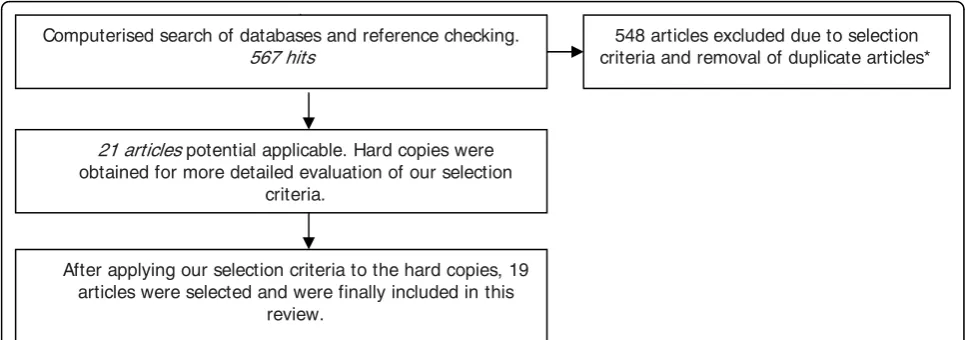
The described inclusion and exclusion criteria were applied to our initial 567 hits. Based on their titles and abstracts 21 articles met our criteria. These studies were conducted between 2002 and 2009. Hard copies were obtained of 21 studies and were reviewed by both investi-gators. After careful review, 19 articles fulfilled our selec-tion criteria and were included in this review [8-26]. A flow-chart of this selection procedure is shown in Figure 1.
Quality assessment
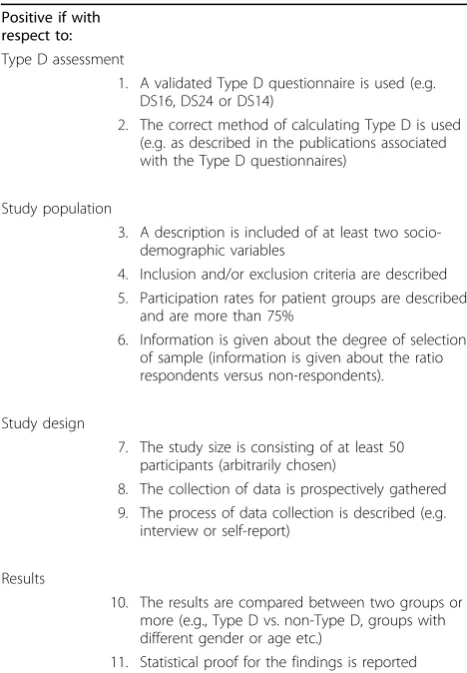
The methodological quality of each of the selected arti-cles was assessed with an 11-item standardised checklist of predefined criteria by both investigators. The check-list was based on established criteria check-lists for systematic reviews [27,28]. The criteria are presented in Table 1.
Each item of a selected study, that matched our cri-teria, received one point. If an item did not meet our criteria or was described insufficiently or not at all, zero points were assigned. The highest possible score was thus 11. Studies scoring 75% or more of the maximum attainable score (= 8 points) were arbitrarily considered to be of‘high quality’. Studies scoring between 50% and 75% (6-7 points) were rated as‘adequate quality’. Studies scoring lower then 50% (i.e. <6 points) were considered to be of‘low quality’.
Results
Methodological quality of the studies
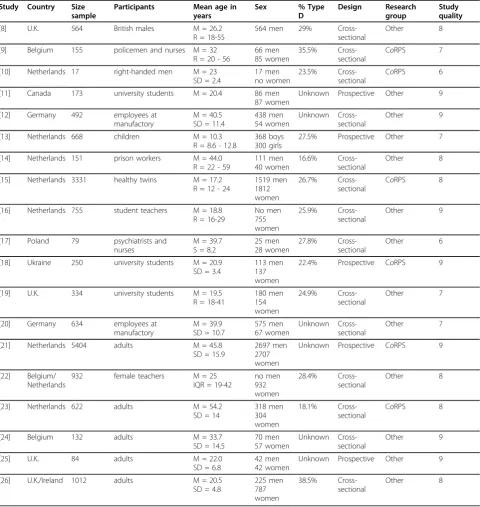
The evaluation of the methodological quality of the 19 studies by the two reviewers yielded the following results. On 5 items, there was disagreement between the reviewers, mostly due to differences in interpretation. These were solved through discussion in a consensus meeting. The quality scores ranged from 6 to 9 points (Table 2) and the mean quality score was 8. Thirteen studies were of a high quality although none of the
stu-dies received the maximum attainable score
and criteria 6 (information on the degree of selection of the sample).
Study characteristics
All studies were published after 2001. The studied popu-lations included policemen, nurses, psychiatrists, prison workers, employees at a manufacturing plant, female teachers, right-handed males, university students, under-graduates, youngsters, twins, and respondents from the general population (Table 2). Because the studies included children, students, and middle-aged adults, the age range of participants differed between the included studies. The lowest mean age was 10.7 [13] and the highest was 54.2 [23]. Most studies included both males and females.
The most frequently used questionnaire to determine Type D personality was the 14-item DS14 scale [8,10,12,14,17-21,23-26]. In the other studies the DS16 [16,22] or DS24 [9,11] scales were used. One study assessed social inhibition with the social avoidance and distress items of the Social Anxiety Scale for Children and used the Children’s Depression Inventory to assess negative affect [13]. Another study assessed Type D by a combination of the Amsterdam Biographical Question-naire, the Spielberger Trait Anxiety Inventory and the Young Adult Self-Report [15]; after the combination of scales method, 20 items were selected and used to determine Type D status.
Whereas the majority of publications on Type D per-sonality among patients with cardiovascular diseases ori-ginate from the Center of Research on Psychology in
Somatic diseases (CoRPS) at Tilburg University, the
Netherlands, only 6 studies in the present review
origi-nated from CoRPS and 13 studies on Type D in the
general population were performed by other research groups. The studies were conducted in populations from
8 different countries: Netherlands (n = 8), United King-dom (n = 4), Belgium (n = 3), Germany (n = 2), Canada, Ireland, Poland, and Ukraine.
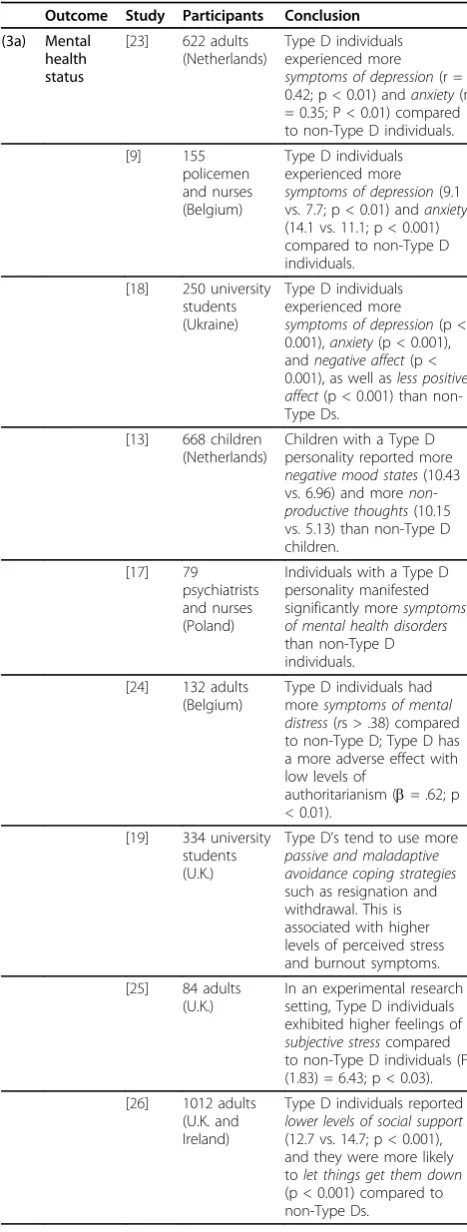
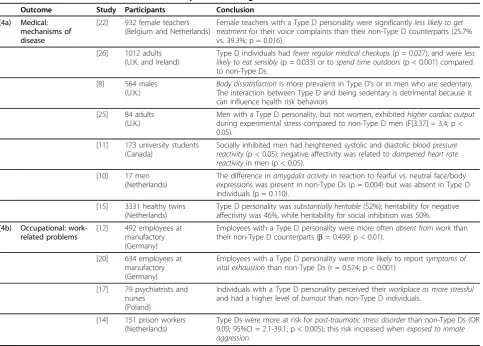
The results of the studies included in this review are first described below according to the impact of Type D personality on mental and physical health status (Table 3). Next, evidence is reviewed regarding the role of Type D in the medical (mechanisms of disease in healthy people) and the occupational (work-related pro-blems in economically active populations) context (Table 4). Because some studies included a variety of outcomes, they are included in more than one category.
Type D personality and health status
Eight studies included in this review reported that Type D personality was negatively associated with mental health status (Table 3 - section a). Type D personality was associated with more remembered alienation from parents and control by parents while growing up [23]. Furthermore, adults with a Type D personality experi-enced more symptoms of depression and anxiety com-pared to non-Type D adults [9,18,23], and they reported significantly more negative affect and less positive affect compared to non-Type D’s [18]. In addition, children with a Type D personality reported more negative mood states and more productive thoughts than non-Type D children [13]. Moreover, individuals with a non-Type D personality manifested significantly more symptoms of mental health disorders [17], had more symptoms of mental distress [24], and exhibited higher feelings of subjective stress than non-Type D individuals [25]. Indi-viduals with a Type D personality also tend to use more passive and maladaptive avoidance coping strategies which is associated with higher levels of perceived stress and burnout symptoms [19]. Finally, Type D individuals reported lower levels of social support, and they were
21 articles potential applicable. Hard copies were obtained for more detailed evaluation of our selection
criteria.
After applying our selection criteria to the hard copies, 19 articles were selected and were finally included in this
review.
548 articles excluded due to selection criteria and removal of duplicate articles* Computerised search of databases and reference checking.
567 hits
more likely to let things get them down compared to non-Type Ds [26].
Six studies reported results on the effect of Type D personality on physical health status (Table 3 - section b). Children with a Type D personality reported more somatic complaints (24 vs. 18; p < 0.05) compared to non-Type D children [13]. Adult men and women with a Type D personality also reported a significantly lower health status compared to non-Type D’s [9,23]. Another study reported that negative affectivity was associated with more influenza-like illness reporting while social inhibition was associated with less influenza-like illness reporting [21]. Finally, female teachers with a Type D personality were more bothered by their voice com-plaints [22] and reported a higher biopsychosocial impact of their voice complaints [16] than their non-Type D counterparts.
Apart from Type D personality and perceived health status, we also reviewed empirical and experimental evi-dence regarding the role of Type D personality in poten-tial mechanisms of disease as well as work-related
problems in apparently healthy individuals from the general population.
Type D personality and mechanisms of disease
Six studies examined behavioral and biological mechan-isms of disease as a function of Type D personality in apparently health individuals (Table 4 - section a). Regarding behavioral mechanisms, two studies showed that Type D personality was associated a decreased like-lihood of getting appropriate medical care. Female Type D teachers with recent voice complaints seek out less (para-)medical care and were less likely to have under-gone a treatment for their complaints than their non-Type D counterparts [22]. In another study, non-Type D individuals were less likely to have a regular medical check-up [26]. In the latter study, Type D was also asso-ciated with an unhealthy lifestyle; i.e., Type D indivi-duals were less likely to eat sensibly or to spend time outdoors compared to non-Type Ds [26]. Finally, a recent study showed that body dissatisfaction was more prevalent in men with a Type D personality and in men who are sedentary [8]. The interaction between Type D personality and being sedentary is detrimental to health because it can influence health risk behaviors.
Biological mechanisms of disease in Type D research among healthy populations included the cardiovascular system, emotion-processing in the brain, and heritability. Men with a Type D personality, but not women, exhib-ited higher cardiac output during experimental stress compared to non-Type D men [25]. Another study showed that socially inhibited men had heightened sys-tolic and diassys-tolic blood pressure reactivity, while nega-tive affectivity was related to dampened heart rate reactivity [11]. Type D was also associated with a differ-ential activity of the amygdala in reaction to fearful ver-sus neutral face and body expressions. Emotion-evoked activation of the amygdala was present in non-Type D’s but was absent in Type D individuals [10]. Finally, evi-dence suggests that Type D personality may be substan-tially heritable; heritability has been estimated to be 52% [15]. Heritability for negative affectivity was 46% due to additive genetic factors, while heritability for social inhi-bition was 50% due to nonadditive or dominance genetic effects [15].
Type D personality and work-related problems
Associations between Type D personality and impaired health status may also have an impact on health pro-blems in the occupational setting. Four studies reported that a Type D personality was associated with work-related problems (Table 4 - section b). With reference to this issue, Type D personality has been associated with effort-reward imbalance, overcommitment, per-ceived adverse physical working conditions, and sub-stantial problems in interactions with supervisors and co-workers [12]. Importantly, this study also showed Table 1 List of criteria for assessing the methodological
quality of studies on the relationship between Type D personality and the general population.
Positive if with respect to: Type D assessment
1. A validated Type D questionnaire is used (e.g. DS16, DS24 or DS14)
2. The correct method of calculating Type D is used (e.g. as described in the publications associated with the Type D questionnaires)
Study population
3. A description is included of at least two socio-demographic variables
4. Inclusion and/or exclusion criteria are described 5. Participation rates for patient groups are described
and are more than 75%
6. Information is given about the degree of selection of sample (information is given about the ratio respondents versus non-respondents).
Study design
7. The study size is consisting of at least 50 participants (arbitrarily chosen)
8. The collection of data is prospectively gathered 9. The process of data collection is described (e.g.
interview or self-report)
Results
10. The results are compared between two groups or more (e.g., Type D vs. non-Type D, groups with different gender or age etc.)
Table 2 Characteristics of studies*
Study Country Size
sample
Participants Mean age in
years
Sex % Type
D
Design Research
group
Study quality
[8] U.K. 564 British males M = 26.2
R = 18-55
564 men 29%
Cross-sectional
Other 8
[9] Belgium 155 policemen and nurses M = 32 R = 20 - 56
66 men 85 women
35.5% Cross-sectional
CoRPS 7
[10] Netherlands 17 right-handed men M = 23 SD = 2.4
17 men no women
23.5% Cross-sectional
CoRPS 6
[11] Canada 173 university students M = 20.4 86 men
87 women
Unknown Prospective Other 9
[12] Germany 492 employees at
manufactory
M = 40.5 SD = 11.4
438 men 54 women
Unknown Cross-sectional
Other 9
[13] Netherlands 668 children M = 10.3
R = 8.6 - 12.8
368 boys 300 girls
27.5% Prospective Other 7
[14] Netherlands 151 prison workers M = 44.0 R = 22 - 59
111 men 40 women
16.6% Cross-sectional
Other 8
[15] Netherlands 3331 healthy twins M = 17.2 R = 12 - 24
1519 men 1812 women
26.7% Cross-sectional
CoRPS 8
[16] Netherlands 755 student teachers M = 18.8 R = 16-29
No men 755 women
25.9% Cross-sectional
Other 9
[17] Poland 79 psychiatrists and
nurses
M = 39.7 S = 8.2
25 men 28 women
27.8% Cross-sectional
Other 6
[18] Ukraine 250 university students M = 20.9 SD = 3.4
113 men 137 women
22.4% Prospective CoRPS 9
[19] U.K. 334 university students M = 19.5
R = 18-41
180 men 154 women
24.9% Cross-sectional
Other 7
[20] Germany 634 employees at
manufactory
M = 39.9 SD = 10.7
575 men 67 women
Unknown Cross-sectional
Other 7
[21] Netherlands 5404 adults M = 45.8
SD = 15.9
2697 men 2707 women
Unknown Prospective CoRPS 9
[22] Belgium/ Netherlands
932 female teachers M = 25
IQR = 19-42
no men 932 women
28.4% Cross-sectional
Other 8
[23] Netherlands 622 adults M = 54.2
SD = 14
318 men 304 women
18.1% Cross-sectional
CoRPS 8
[24] Belgium 132 adults M = 33.7
SD = 14.5
70 men 57 women
Unknown Cross-sectional
Other 9
[25] U.K. 84 adults M = 22.0
SD = 6.8
42 men 42 women
Unknown Prospective Other 9
[26] U.K./Ireland 1012 adults M = 20.5
SD = 4.8
225 men 787 women
38.5% Cross-sectional
Other 8
* In alphabetical order
that employees with a Type D personality were more often absent from work than their non-Type D counter-parts [12]. A possible explanation for this higher rate of sick-leave is the fact that employees with a Type D per-sonality are more likely to report symptoms of vital exhaustion [20], and perceive their workplace as more stressful [17]. Employees with a Type D personality also have higher levels of burnout, and show a lower sense of personal accomplishment [17]. Type D employees may be up to 9 times more likely to develop
post-trau-matic stress disorder than non-Type D’s, especially
when they are confronted with significant stressors at work [14].
Conclusions
Although the majority of studies on Type D personality has focussed on cardiovascular [1,3-7,29-34], or other medical populations [35], this systematic review indi-cates that Type D may negatively affect health status of apparently healthy individuals from the general popula-tion as well.
First, the studies included in this review showed that the presence of Type D personality had an adverse effect on mental health status. Various studies showed that individuals from the general population with a Type D personality experienced more symptoms of distress,
depression and anxiety compared to non-Type D’s
[9,13,18,19,23-25]. This increased vulnerability for men-tal health problems in Type D individuals was also found in chronic pain patients [36], diabetes patients [37], and cardiac patients [38]. Furthermore, the studies included in this review showed that people with a Type D personality more often reported mental health disor-ders [17] as well as lower levels of social support [26] compared to non-Type D adults.
The presence of Type D personality among people from the general population was also associated with a
poor physical health status. For example, Type D’s
reported more somatic complaints [13,16,22] and a sig-nificantly lower health status compared to non-Type D’s [9,23]. This is in line with the adverse effects of Type D on somatic health status in cardiovascular conditions. In patients with heart failure, it was found that Type D personality was an independent predictor of impaired health status [39] and more cardiac symptoms [40]. Also, Type D patients with heart failure were at 6-fold increased risk of reporting impaired health status com-pared to the reference group of non-Type D patients [41]. Finally, Type D was a strong predictor of adverse cardiac outcome after acute myocardial infarction, and the associated risk was similar to that of traditional car-diovascular risk factors [7].
Some studies that are included in this review explored the behavioral and biological mechanisms of disease as a Table 3 Outcomes of studies: Health status
Outcome Study Participants Conclusion
(3a) Mental health status
[23] 622 adults (Netherlands)
Type D individuals experienced more symptoms of depression(r = 0.42; p < 0.01) andanxiety(r = 0.35; P < 0.01) compared to non-Type D individuals.
[9] 155
policemen and nurses (Belgium)
Type D individuals experienced more symptoms of depression(9.1 vs. 7.7; p < 0.01) andanxiety (14.1 vs. 11.1; p < 0.001) compared to non-Type D individuals.
[18] 250 university students (Ukraine)
Type D individuals experienced more symptoms of depression(p < 0.001),anxiety(p < 0.001), andnegative affect(p < 0.001), as well asless positive affect(p < 0.001) than non-Type Ds.
[13] 668 children (Netherlands)
Children with a Type D personality reported more negative mood states(10.43 vs. 6.96) and more non-productive thoughts(10.15 vs. 5.13) than non-Type D children.
[17] 79 psychiatrists and nurses (Poland)
Individuals with a Type D personality manifested significantly moresymptoms of mental health disorders than non-Type D individuals. [24] 132 adults
(Belgium)
Type D individuals had moresymptoms of mental distress(rs > .38) compared to non-Type D; Type D has a more adverse effect with low levels of
authoritarianism (b= .62; p < 0.01).
[19] 334 university students (U.K.)
Type D’s tend to use more passive and maladaptive avoidance coping strategies such as resignation and withdrawal. This is associated with higher levels of perceived stress and burnout symptoms. [25] 84 adults
(U.K.)
In an experimental research setting, Type D individuals exhibited higher feelings of subjective stresscompared to non-Type D individuals (F (1.83) = 6.43; p < 0.03). [26] 1012 adults
(U.K. and Ireland)
function of Type D personality in apparently health individuals. Hence, a poor physical health status can be explained by the fact that Type D individuals perform significantly fewer health-related behaviors (eat sensibly, spend time outdoors, get a regular medical check-up) [26] and that they are more likely to smoke [6] as com-pared to non-Type D individuals. Furthermore, two stu-dies showed that individuals with a Type D personality are less likely to seek appropriate medical care [22,26]. This has also been shown in Type D patients with chronic heart failure causing a significant decrease in health status among these patients [41,42].
The fact that Type D individuals tend to experience interpersonal situations as being stressful may also have direct biological effects that may impact on the cardio-vascular system. Responding to these situations can eli-cit physiological reactivity every time a potentially
“threatening”situation is encountered [11]. Accordingly, Type D was associated with increased cardiac output [25], heightened systolic and diastolic blood pressure
reactivity [11], and dampened heart rate reactivity dur-ing experimental stress. Type D was also associated with a decreased activity in the amygdala in response to fear-ful expressions [10], suggesting inadequate emotion-pro-cessing in the brain. Finally, heritability might be an underlying third variable that explains the co-occurrence of disease and Type D personality through a shared genetic component that predispose people to both phy-sical and psychological distress. In fact, Type D person-ality has been shown to be substantially heritable [15] and research on genetic linkage has provided more evi-dence for the biological underpinnings of the Type D construct [43].
Clinical research in cardiac populations confirmed that Type D personality was independently associated with indices of cardiovascular reactivity such as reduced heart rate recovery [44]. Other findings from clinical research also pointed towards neuroendocrine and immunological pathways that may explain the adverse health outcomes associated with Type D personality. Type D personality has been associated with elevated levels of the stress hormone cortisol [45], increased oxi-dative stress [46], immune dysfunction, and decreased numbers of bone-marrow derived endothelial progenitor cells [47] in cardiac patients. These initial findings are promising, but more research is needed to examine the cardiovascular effects of stress in apparently healthy individuals with a Type D personality. Hence, future research should also focus on neuroendocrine and immunological mechanisms that may advance our understanding of biological pathways in non-clinical populations.
The presence of Type D personality may also be asso-ciated with health-related problems in the occupational setting. Type Ds were more often absent from work [12], were more likely to report symptoms of vital exhaustion [20] or post-traumatic stress disorder [14], perceived their workplace as more stressful, had higher levels of burnout, and showed a lower sense of personal accomplishment [17] than non-Type D’s. To our knowl-edge, only one other study investigated the relationship between work and Type D personality in patients with an acute coronary syndrom, and found that failure to resume work was not related to Type D personality [48]. This review has some limitations. The cross-sectional nature of most studies (14 out of 19) did not allow us to determine causal associations between Type D and the studied outcomes. A prospective study might pro-vide us with more answers about the exact relationship between Type D personality and specific outcomes and the extent of this relationship. In addition, the studies included in this review used a number of different ques-tionnaires to assess Type D personality. Also, not all studies used the correct method of calculating Type D. Table 3: Outcomes of studies: Health status(Continued)
(3b) Physical health status
[13] 668 children (Netherlands)
Children with a Type D personality reported more somatic complaints(24 vs. 18; p < 0.05) compare to non-Type D children. [23] 622 adults
(Netherlands)
Individuals with a Type D personality reported a significantlylower health status(allps < 0.01) compared to non-Type D individuals.
[9] 155
policemen and nurses (Belgium)
Individuals with a Type D personality reported a significantlylower health status(50.4 vs. 42.5; p < 0.001) compared to non-Type D individuals. [21] 5404 adults
(Netherlands)
Negative affectivity was related tomore influenza-like illnessreporting (OR = 1.05, p = 0.009); however, social inhibition toless influenza-like illnessreporting (OR = 0.97; p = 0.011). [22] 932 female
teachers (Belgium and Netherlands)
Female teachers with a Type D personality were morebothered by their voice complaints(10 vs. 7; p < 0.001) than their non-Type D counterparts.
[16] 755 student teachers (Belgium and Netherlands)
Some studies claim to report on the effects of Type D personality on health but only report on the effects of social inhibition and negative affectivity on health. Stan-dardisation of the use of valid Type D questionnaires is essential for adequate evaluation and mutual compari-son of studies. Finally, one study reported on the effect of Type D personality in children [13]. Although the results of this study were similar to the results found in studies among adults, we need to be careful with draw-ing conclusions on the association between personality and health in children, since personality is likely to change from childhood into adulthood.
This review also has some strengths. It is the first review that reports about the effects of Type D person-ality in the general population. Furthermore, all available literature on the subject matter was systematically reviewed and we managed to retrieve hard copies of all articles that fulfilled our selection criteria. Finally, the methodological quality of each of the selected articles was assessed with an 11-item standardised checklist of predefined criteria by both investigators.
The available evidence suggests that Type D is a vul-nerability factor that not only affects people with
medical conditions, but also apparently healthy indivi-duals from the general population. Consequently, addi-tional attention is justified for those with a Type D personality because they are at risk for work-related problems and a lower mental and physical health status. Although Type D is a stable construct [49], this does not imply that the individual’s level of distress cannot be modified. Individuals with a Type D personality have a limited ability to cope adequately with stressful life events [50], and for this reason may benefit from psy-chological interventions that are aimed towards improv-ing their copimprov-ing skills in order to decrease the acute and chronic stress that they experience and thus to decrease their work-related problems and increase their mental and somatic health status. Future intervention trials are needed to study the extent to which interventions are able to decrease work-related problems and increase their mental and somatic health status among various people with a Type D personality.
If anything, this review suggests that Type D personal-ity is a vulnerabilpersonal-ity factor for general psychological dis-tress that may not only affect people with medical conditions, but also affects the health status of Table 4 Outcomes of studies: Medical and occupational setting
Outcome Study Participants Conclusion
(4a) Medical: mechanisms of disease
[22] 932 female teachers (Belgium and Netherlands)
Female teachers with a Type D personality were significantlyless likely to get treatmentfor their voice complaints than their non-Type D counterparts (25.7% vs. 39.3%; p = 0.016).
[26] 1012 adults (U.K. and Ireland)
Type D individuals hadfewer regular medical checkups(p = 0.027), and wereless likely to eat sensibly(p = 0.033) or tospend time outdoors(p < 0.001) compared to non-Type Ds.
[8] 564 males (U.K.)
Body dissatisfactionis more prevalent in Type D’s or in men who are sedentary. The interaction between Type D and being sedentary is detrimental because it can influence health risk behaviors
[25] 84 adults (U.K.)
Men with a Type D personality, but not women, exhibitedhigher cardiac output during experimental stress compared to non-Type D men (F[3,37] = 3.4; p < 0.05).
[11] 173 university students (Canada)
Socially inhibited men had heightened systolic and diastolicblood pressure reactivity(p < 0.05); negative affectivity was related todampened heart rate reactivityin men (p < 0.05).
[10] 17 men (Netherlands)
The difference inamygdala activityin reaction to fearful vs. neutral face/body expressions was present in non-Type Ds (p = 0.004) but was absent in Type D individuals (p = 0.110).
[15] 3331 healthy twins (Netherlands)
Type D personality wassubstantially heritable(52%); heritability for negative affectivity was 46%, while heritability for social inhibition was 50%. (4b) Occupational:
work-related problems
[12] 492 employees at manufactory (Germany)
Employees with a Type D personality were more oftenabsent from workthan their non-Type D counterparts (b= 0.499; p < 0.01).
[20] 634 employees at manufactory (Germany)
Employees with a Type D personality were more likely to reportsymptoms of vital exhaustionthan non-Type Ds (r = 0.574; p < 0.001)
[17] 79 psychiatrists and nurses
(Poland)
Individuals with a Type D personality perceived theirworkplace as more stressful and had a higher level ofburnoutthan non-Type D individuals.
[14] 151 prison workers (Netherlands)
individuals from the general population. This review thereby provides evidence that Type D personality is not just a state of mind that people develop in reaction to the diagnosis of a medical condition, but rather repre-sents a broad personality construct that is prevalent in a large subgroup of the general population. Consequently, it may be an important vulnerability factor to assess in future studies on work-related problems and mental and somatic health status in the general population.
Abbreviations
(CoRPS): Center of Research on Psychology in Somatic diseases.
Acknowledgements
This work was supported by a VICI grant [#453-04-004] from the Netherlands Organization for Scientific Research (The Hague, The Netherlands) awarded to Johan Denollet.
Authors’contributions
The concept of this review was designed by JD. After that, both authors reviewed the available literature and checked the quality of the articles that were included in this review. FM wrote the first draft of this paper and JD supervised the writing process. Both authors approved the final version of this manuscript.
Competing interests
The authors declare that they have no competing interests.
Received: 12 October 2009
Accepted: 23 January 2010 Published: 23 January 2010
References
1. Denollet J:DS14: standard assessment of negative affectivity, social inhibition, and Type D personality.Psychosom Med2005,67(1):89-97. 2. Kupper N, Denollet J:Type d personality as a prognostic factor in heart
disease: assessment and mediating mechanisms.J Pers Assess2007, 89(3):265-276.
3. Denollet J:Personality, emotional distress and coronary heart disease. Eur J Pers1997,11:343-357.
4. Denollet J, Sys SU, Stroobant N, Rombouts H, Gillebert TC, Brutsaert DL: Personality as independent predictor of long-term mortality in patients with coronary heart disease.Lancet1996,347(8999):417-421.
5. Denollet J, Vaes J, Brutsaert DL:Inadequate response to treatment in coronary heart disease: adverse effects of type D personality and younger age on 5-year prognosis and quality of life.Circulation2000, 102(6):630-635.
6. Pedersen SS, Lemos PA, van Vooren PR, Liu TK, Daemen J, Erdman RA, Smits PC, Serruys PW, van Domburg RT:Type D personality predicts death or myocardial infarction after bare metal stent or sirolimus-eluting stent implantation: a Rapamycin-Eluting Stent Evaluated at Rotterdam Cardiology Hospital (RESEARCH) registry substudy.J Am Coll Cardiol2004, 44(5):997-1001.
7. Martens EJ, Mols F, Burg MM, Denollet J:Type D personality predicts clinical events after myocardial infarction, above and beyond disease severity and depression.J Clin Psychiat2009.
8. Borkoles E, Polman R, Levy A:Type-D personality and body image in men: The role of exercise status.Body Image2009.
9. De Fruyt F, Denollet J:Type D personality: A Five Factor Model perspective.Psychol Health2002,17(5):671-683.
10. de Gelder B, Riet van de WA, Grezes J, Denollet J:Decreased differential activity in the amygdala in response to fearful expressions in Type D personality.Neurophysiol Clin2008,38(3):163-169.
11. Habra ME, Linden W, Anderson JC, Weinberg J:Type D personality is related to cardiovascular and neuroendocrine reactivity to acute stress.J Psychosom Res2003,55(3):235-245.
12. Hanebuth D, Meinel M, Fischer JE:Health-related quality of life, psychosocial work conditions, and absenteeism in an industrial sample
of blue- and white-collar employees: a comparison of potential predictors.J Occup Environ Med2006,48(1):28-37.
13. Jellesma FC:Health in Young People: Social Inhibition and Negative Affect and Their Relationship with Self-Reported Somatic Complaints.J Dev Behav Pediatr2008,29(2):94-100.
14. Kunst MJ, Bogaerts S, Winkel FW:Peer and inmate aggression, Type D personality and post-traumatic stress among Dutch prison workers. Stress and health2009.
15. Kupper N, Denollet J, de Geus EJ, Boomsma DI, Willemsen G:Heritability of type-D personality.Psychosom Med2007,69(7):675-681.
16. Meulenbroek LFP, Thomas G, Kooijman PGC, de Jong FICRS: Biopsychosocial impact of the voice in relation to the psychological features in female student teachers.Journal of Psychosomatic Research 2010.
17. Oginska-Bulik N:Occupational stress and its consequences in healthcare professionals: the role of type D personality.Int J Occup Med Environ Health2006,19(2):113-122.
18. Pedersen SS, Yagensky A, Smith OR, Yagenska O, Shpak V, Denollet J: Preliminary Evidence for the Cross-Cultural Utility of the Type D Personality Construct in the Ukraine.Int J Behav Med2009,16(2):108-15. 19. Polman R, Borkoles E, Nicholls AR:Type D personality, stress, and
symptoms of burnout: The influence of avoidance coping and social support.Br J Health Psychol2009.
20. Preckel D, von Kanel R, Kudielka BM, Fischer JE:Overcommitment to work is associated with vital exhaustion.Int Arch Occup Environ Health2005, 78(2):117-122.
21. Smolderen KG, Vingerhoets AJ, Croon MA, Denollet J:Personality, psychological stress, and self-reported influenza symptomatology.BMC Public Health2007,7:339.
22. Thomas G, de Jong FI, Kooijman PG, Cremers CW:Utility of the Type D Scale 16 and Voice Handicap Index to assist voice care in student teachers and teachers.Folia Phoniatr Logop2006,58(4):250-263. 23. Broek Van den KC, Smolderen KG, SS P, Denollet J:Type D personality
mediates the relationship between remembered parenting and perceived health.Psychosomatics2009.
24. Van Hiel A, De Clercq B:Authoritarianism is good for you: right-wing authoritarianism as a buffering factor for mental distress.European Journal of personality2009,23:33-50.
25. Williams L, O’Carroll RE, O’Connor RC:Type D personality and cardiac output in response to stress.Psychology and Health2008.
26. Williams L, O’Connor RC, Howard S, Hughes BM, Johnston DW, Hay JL, O’Connor DB, Lewis CA, Ferguson E, Sheehy N, Grealy MA, O’Carroll RE: Type-D personality mechanisms of effect: The role of health-related behavior and social support.J Psychosom Res2008,64(1):63-69. 27. Mols F, Vingerhoets AJ, Coebergh JW, Poll-Franse van de LV:Quality of life
among long-term breast cancer survivors: A systematic review.European Journal of Cancer2005,41(17):2613-2619.
28. Den Oudsten BL, Van Heck GL, De Vries J:Quality of life and related concepts in Parkinson’s disease: a systematic review.Mov Disord2007, 22(11):1528-1537.
29. Pedersen SS, Denollet J:Type D personality, cardiac events, and impaired quality of life: a review.Eur J Cardiovasc Prev Rehabil2003,10(4):241-248. 30. Denollet J, Sys SU, Brutsaert DL:Personality and mortality after myocardial
infarction.Psychosom Med1995,57(6):582-591.
31. Pedersen SS, Denollet J:Validity of the Type D personality construct in Danish post-MI patients and healthy controls.J Psychosom Res2004, 57(3):265-272.
32. Aquarius AE, Denollet J, Hamming JF, De Vries J:Role of disease status and Type D personality in outcomes in patients with peripheral arterial disease.Am J Cardiol2005,96(7):996-1001.
33. Pedersen SS, Denollet J:Is Type D personality here to stay? Emerging evidence across cardiovascular disease patient groups.Current Cardiology Reviews2006,2:205-213.
34. Denollet J, Schiffer AA, Kwaijtaal M, Hooijkaas H, Hendriks EH, Widdershoven JW, Kupper N:Usefulness of Type D personality and kidney dysfunction as predictors of interpatient variability in inflammatory activation in chronic heart failure.Am J Cardiol2009, 103(3):399-404.
36. Barnett MD, Ledoux T, Garcini LM, Baker J:Type D Personality and chronic pain: Construct and concurrent validity of the DS14.J Clin Psychol Med Settings2009,16(2):194-199.
37. Simson U, Nawarotzky U, Porck W, Friese G, Schottenfeld-Naor Y, Hahn S, Scherbaum WA, Kruse J:[Depression, anxiety, quality of life and Type D pattern among inpatients suffering from diabetic foot syndrome]. Psychother Psychosom Med Psychol2008,58(2):44-50.
38. Spindler H, Kruse C, Zwisler AD, Pedersen SS:Increased anxiety and depression in Danish cardiac patients with a Type D personality: Cross-Validation of the Type D Scale (DS14).Int J Behav Med2009,16(2):98-107. 39. Schiffer AA, Pedersen SS, Widdershoven JW, Denollet J:Type D personality
and depressive symptoms are independent predictors of impaired health status in chronic heart failure.Eur J Heart Fail2008,10(9):922-930. 40. Schiffer AA, Denollet J, Widdershoven JW, Hendriks EH, Smith OR:Failure to
consult for symptoms of heart failure in patients with a Type D personality.Heart2007,93(7):814-818.
41. Pelle AJ, Schiffer AA, Smith OR, Widdershoven JW, Denollet J:Inadequate consultation behavior modulates the relationship between Type D personality and impaired health status in chronic heart failure.Int J Cardiol2009.
42. Schiffer AA, Denollet J, Widdershoven JW, Hendriks EH, Smith OR:Failure to consult for symptoms of heart failure in patients with a type-D personality.Heart2007,93(7):814-818.
43. Ladwig K, Emeny R, Gieger C, Ruf E, Klopp N, Illig T, Meitinger T, Wichmann H:Single nucleotide polymorphisms associations with Type D personality in the general population: findings from the KORA K-500-Substudy.APS: 2009: Psychosomatic med2009.
44. von Kanel R, Barth J, Kohls S, Saner H, Znoj H, Saner G, Schmid JP:Heart rate recovery after exercise in chronic heart failure: Role of vital exhaustion and type D personality.J Cardiol2009,53(2):248-256. 45. Molloy GJ, Perkins-Porras L, Strike PC, Steptoe A:Type D personality and
cortisol in survivors of acute coronary syndrome.Psychosom Med2008, 70(8):863-868.
46. Kupper N, Gidron Y, Winter J, Denollet J:Association between type D personality, depression, and oxidative stress in patients with chronic heart failure.Psychosom Med2009,71(9):973-980.
47. Van Craenenbroeck EM, Denollet J, Paelinck BP, Beckers P, Possemiers N, Hoymans VY, Vrints CJ, Conraads VM:Circulating CD34+/KDR+ endothelial progenitor cells are reduced in chronic heart failure patients as a function of Type D personality.Clin Sci (Lond)2009,117(4):165-172. 48. Bhattacharyya MR, Perkins-Porras L, Whitehead DL, Steptoe A:Psychological
and clinical predictors of return to work after acute coronary syndrome. Eur Heart J2007,28(2):160-165.
49. Martens EJ, Kupper N, Pedersen SS, Aquarius AE, Denollet J:Type D personality is a stable taxonomy in post-MI patients over an 18-month period.J Psychosom Res2007,63(5):545-550.
50. Doering LV, Dracup K, Caldwell MA, Moser DK, Erickson VS, Fonarow G, Hamilton M:Is coping style linked to emotional states in heart failure patients?.J Card Fail2004,10(4):344-349.
doi:10.1186/1477-7525-8-9
Cite this article as:Mols and Denollet:Type D personality in the general
population: a systematic review of health status, mechanisms of disease, and work-related problems.Health and Quality of Life Outcomes 20108:9.
Publish with BioMed Central and every scientist can read your work free of charge
"BioMed Central will be the most significant development for disseminating the results of biomedical researc h in our lifetime."
Sir Paul Nurse, Cancer Research UK
Your research papers will be:
available free of charge to the entire biomedical community
peer reviewed and published immediately upon acceptance
cited in PubMed and archived on PubMed Central
yours — you keep the copyright
Submit your manuscript here:
http://www.biomedcentral.com/info/publishing_adv.asp