R E S E A R C H
Open Access
Fixed night workers and failed smoking
cessation
Youn-Mo Cho, Hyoung-Ryoul Kim
*, Mo-Yeol Kang, Jun-Pyo Myong and Jung Wan Koo
Abstract
Background:The objective of this study was to examine the relationship between employee work schedule and failure in smoking cessation.
Methods:Logistic regression was used to estimate the association between work schedule and failed smoking cessation rate among 4927 male workers who had attempted smoking cessation. The data was obtained from the annual Korean National Health and Nutrition Examination Survey from 2007 to 2015 (excluding data from 2013). An adjusted model, including demographic and occupational variables, was constructed after stratifying the data into two subgroups by age (the 19- to 40-year-old group and the 41- to 60-year-old group).
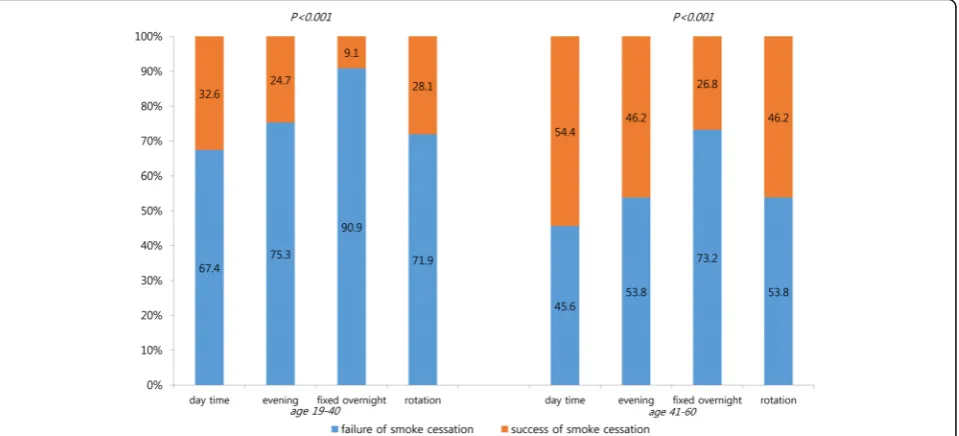
Results:The percentage of smoking-cessation failure varied according to work schedule and age. The failure rate in the 19- to 40-year-old group was generally higher for all work schedule categories than in the 41- to 60-year-old group. In particular, the highest percentage (90.9%) of smoking-cessation failure was in the fixed overnight work group. After adjusting for demographic characteristics and work organization variables, the odds ratio for failed smoking cessation across all ages was 3.30 (95%CI 2.23–4.86) among the fixed overnight workers compared to the daytime workers. Both of the age-stratified subgroups maintained this relationship, with a notably higher OR in the 19- to 40-year-old group (OR 3.74, 95% CI 1.80–7.77).
Conclusions:Fixed overnight work is likely to negatively affect smoking cessation compared to other work schedules. Tailored anti-smoking intervention programs are required based on work schedule.
Keywords:Smoke cessation, Fixed night work, Shift work schedule, Occupations
Background
Although smoking prevalence has been declining during the recent decades [1], it is still high in Korea, with an estimated 42.1% of South Koreans being smokers in 2013 [2]. This plays a major role in respiratory diseases, such as lung cancer, chronic obstructive pulmonary dis-ease, and bronchitis, as well as cardiovascular diseases such as hypertension, coronary artery disease, and
an-gina [1,3]. Smoking cessation policies have been actively
implemented to reduce smoking rates and have been found to be more cost effective than related health care services [4]. However, considering that the majority of the world population works outside the home, there should be a constant emphasis on smoking cessation in the workplace. Particularly, the fact that the smoking
rate is reported to be highest in nighttime workers [5] demonstrates that professionals, such as occupational physicians or health care providers, should offer smok-ing intervention programs focused on night workers.
Night work is likely to increase the incidence rate of various diseases, including digestive disorders, sleep disor-ders, hypertension, diabetes, dyslipidemia, atherosclerosis,
and breast cancer, compared to day work [6–9]. The
mechanisms of the diseases associated with night work are rather complex, though a general mechanism could be the disturbance of the circadian rhythm [10]. Recently the conclusion were made that night-shift work involving cir-cadian disruption is probably carcinogenic to humans (group 2A) by the International Agency for Research on Cancer (IARC) [11]. Melatonin is a hormone that main-tains the circadian rhythm and helps regulate other hor-mones such as female sex horhor-mones. When melatonin, which is secreted mostly after sunset and decreases right
© The Author(s). 2019Open AccessThis article is distributed under the terms of the Creative Commons Attribution 4.0 International License (http://creativecommons.org/licenses/by/4.0/), which permits unrestricted use, distribution, and reproduction in any medium, provided you give appropriate credit to the original author(s) and the source, provide a link to the Creative Commons license, and indicate if changes were made. The Creative Commons Public Domain Dedication waiver (http://creativecommons.org/publicdomain/zero/1.0/) applies to the data made available in this article, unless otherwise stated.
* Correspondence:[email protected]
before sunrise, is suppressed by artificial light while work-ing at night, it results in disturbance of the circadian rhythm, as well as shortage of the hormone itself [12]. Sleep disorders, digestive problems, and decreased func-tion and concentrafunc-tion due to disrupfunc-tion of the circadian rhythm are likely to increase an individual’s stress level, leading to maintained smoking use to release stress. How-ever, studies drawing from working populations who attempted to quit smoking are rare. Specifically, very few studies have analyzed the relationships between factors that cause failure in smoking cessation and occupational backgrounds. One recent study focused on the rate of failed smoking cessation by occupation category, showing that young male workers engaged in service and sales are vulnerable in quitting smoking compared to those in other categories [13]. However, to our knowledge, the relation-ship between nighttime work and smoking-cessation fail-ure has not yet been studied. Smoking cessation policies at workplaces include smoking cessation counselling by health managers, periodic smoking cessation meeting, sharing smoking cessation diary among the meeting mem-bers, group medication, anti-smoking education. These various smoking cessation policies are usually targeted to-ward the day workers as the health managers at work-places who are in charge of the policies are mostly day workers. Night work includes both fixed overnight work and night-including rotating work, and the two work schedules are expected to be different in terms of life
pat-tern and circadian rhythm adjustment [6,14–16]. Though
some previous studies that investigated the two work schedules reported no significant differences in adjust-ment or greater negative effects with rotating work than fixed overnight work [15], some studies have concluded that circadian adaptation is impossible even with consist-ent fixed overnight work [14,16].
To this end, the present study instigated the following hypotheses: (1) the smoking-cessation failure rate in the overnight work group is higher compared to day work, and (2) different to night-including rotation work.
Subjects and methods
Study population
The Korean National Health and Nutrition Examination Survey (KNHANES) is a national survey representing the non-institutionalized, civilian population in South Korea and is conducted annually by the Korean Ministry of Health and Welfare and the Korean Center for Disease Control and Prevention (KCDC). The character-istics of the data are similar to the National Health and Nutrition Examination Survey (NHANES) administered in the US. The data in the survey were collected by trained interviewers and examiners and comprise three sub-surveys: a health interview, a health examination, and a nutrition survey. The participants are selected
randomly every year by computer algorithm from the samples which were stratified by cities, ages, sexes etc. Therefore it is less likely for the participants to be dupli-cated in the study. Further details of the KNHANES are available on the KCDC website (https://knhanes.cdc.go. kr/knhanes/eng/index.do) and in previously published
literatures [13,17]. Present study included the data from
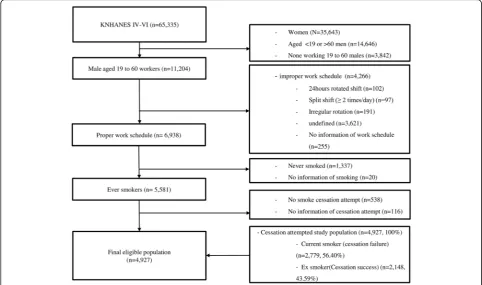
KNHANES IV and V that was collected from 2007 to 2015 (excluding 2013) and partial data from VI (2014 and 2015 only). We excluded the data from 2013 be-cause the relevant information on smoking-cessation attempts was not obtained in that year. The total num-ber of participants was 65,335 with a response rate of 78.3 to 80.8% throughout the phases. Among these participants, the following were excluded: all women (35,643), men less than 19 or more than 60 years old (14, 646), non-working men age 19 to 60 (3842), men who did not satisfy our work schedule classifications of daytime shift, evening shift, fixed overnight shift, and night-includ-ing rotation shift (4266), men who were non-smokers (1337), men for whom there was no information regarding smoking or smoking-cessation attempts (136), and men who did not attempt smoking cessation (538). The remaining 4927 subjects who were 19- to 60-year-old male workers with a suitable work schedule and who had attempted smoking cessation were finally enrolled as the eligible population for the present study (Fig.1).
Measurements
All responses were self-reported. For the purpose of this study, current smokers were defined as individuals who smoked either daily or occasionally in the past month. Ex-smokers were defined as individuals who had smoked more than 100 cigarettes in the past but had quit for at least the last month. Failure in smoking cessation was defined as a current smoker who had attempted smok-ing cessation but resumed smoksmok-ing. The demographic and working organization variables were included as control variables in the adjusted analysis.
The demographic variables included age, education level, economic status, marriage status, and perceived stress level and were defined as follows. Education level was divided into three levels of “middle school or less,” “high school,” and“university or more.”Economic status was determined by categorizing the family income into quartiles. For mari-tal status,“married or cohabiting”was regarded as a
“posi-tive” marital status and “separated or not married” as a
“negative” marital status. Perceived stress was categorized
from the response to the question “How much stress do
you feel on a daily basis?” using a four-point Likert point
scale. The response of either“very much”or “much” was
The working condition variables included four categor-ies of working schedule, weekly work hours, job category, and type of employment. The working schedule
classifica-tion was determined from the quesclassifica-tion“Do you work
dur-ing the day time (between 6 am and 6 pm) or at another
time?” The individuals were allowed to choose from the
following schedules: (1) day time, (2) evening, between 2 pm and 12 am, (3) night time, between 9 pm to 8 am, (4) night-included regular rotation shift, (5) 24-h shift, (6) split shift, more than 2 times a day, (7) irregular rotation shift, and (8) others. We excluded respondents from clas-sifications 5 to 8 due to the small number and high uncer-tainty. The response“day time”was classified as“day time
work,” “evening” as “evening time work,” “night time”as
“fixed overnight work,”and “night-included regular rota-tion shift”as“night-included rotation work.” Work hours were defined as the average weekly working hours includ-ing overtime work and excludinclud-ing meal times occurrinclud-ing during work. The nine job categories were classified into
three subcategories: “administrator,” “professional,” and
“clerk”as“office workers”;“service worker”and “salesper-son”as“service and sales”; and“agricultural, forestry, and fishery workers,” “technicians,” “machinery operators,” and“laborers”as“manual work.”The type of employment was classified as permanent employment, temporary em-ployment, daily work, and other (employer, self-employed, unpaid family workers, etc.)
Statistical analyses
We generated descriptive statistics for the overall study population, as well as bivariate variables of the younger population (aged between 19 and 40) and of the older population (aged between 41 and 60). Student’s t-test, Rao-Scott Chi-square test, and survey logistic regression were performed. For multivariate analysis, multiple logistic regression analysis was conducted to estimate the odds ratio (OR) for failed smoking cessation among Korean male workers. First, an unadjusted model using only work schedule was estimated, then two adjusted models (model 1: work schedule and demographic vari-ables, model 2: work schedule, demographic varivari-ables, and work organization variables) were estimated. The statis-tical analyses were performed using SAS, version 9.4
(Stat-istical Analysis System Institute, Cary, NC, USA). A P
-value less than 0.05 was considered statistically significant.
Results
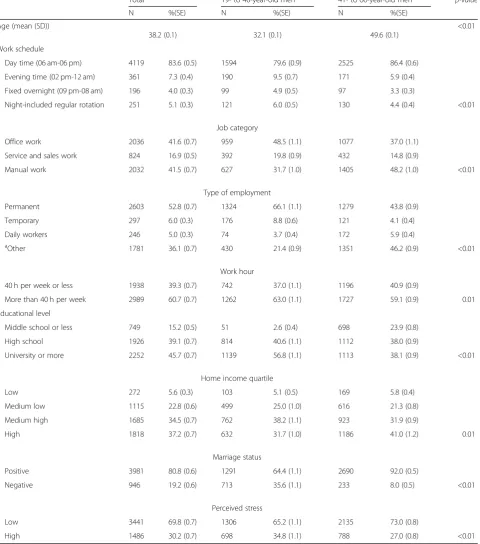
A general description of the study population is
dis-played in Table1. More than 80% of the population was
day time workers. Fixed overnight workers and night-in-cluded rotation workers composed 4.0 and 5.1% of the population, respectively. The work organization charac-teristics revealed that the majority of the population (60.7%) was working more than 40 h a week, and that 52.8% of people were permanent workers. Office workers and service workers composed almost 58% of the popu-lation. The study population tended to be well educated (84.8%), economically stable (71.7%), living with a spouse (80.8%), and had a low level of perceived stress (69.8%). However, the characteristics were quite varied according to age as the younger male workers were more likely to be night workers, non-manual workers, or permanent workers; more educated; less likely to be married; and had more stress than the older male workers. The char-acteristics also varied according to work schedule
(Table 2). Workers were more likely to be manual
workers (59.3%), to work 40 h a week or less (64.8%), or be unmarried or separated from their spouse (31.6%) if they were engaged in fixed night work.
As shown in Table3, fixed overnight work was found
to be strongly predictive of failure in smoking cessation
in the unadjusted model (OR 3.90, 95% CI 2.70–5.77),
the demographic-adjusted model (model 1, OR 3.39, 95% CI 2.30–4.96), and the demographic- and work organization-adjusted model (model 2, OR 3.30, 95% CI
2.23–4.86). Night-included rotation work was predictive
of slightly higher failure rate in smoking cessation com-pared to daytime workers in the unadjusted model (OR
1.42, 95% CI 1.10–1.85) and the model 2 (OR 1.34, 95%
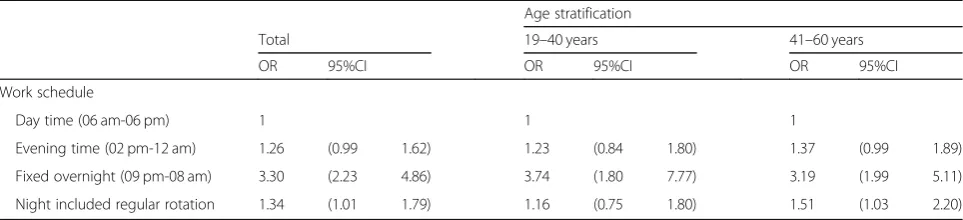
CI 1.01–1.79). After age stratification into two groups,
as seen in Table 4, fixed overnight work was predictive
of high odds of failing to quit smoking in the younger
male workers (OR 3.74, 95% CI 1.80–7.77). The odds
ra-tio of failure in smoking cessara-tion declined to 3.19
(95%1.99–5.11) in fixed overnight workers in their 40s
or 50s. Night-included rotation work was predictive of an approximately 50% higher odds of failure in smoking cessation in older male workers compared to day time
work (OR 1.51, 95% CI 1.03–2.20).
Discussion
In the present study, the association between failure in smoking cessation and work schedule was examined in 4927 male workers aged 19 to 60 years old who had attempted smoking cessation using data from the Ko-rean National Health and Nutrition Examination survey collected from 2007 to 2015, excluding the 2013 survey data. Several existing studies have examined the effects
of night work on smoking rates [6,18,19], but few
stud-ies of night work and smoking-cessation failure exist to our knowledge. We confirmed the hypothesis that men who work during the night would find it harder to quit smoking compared to day workers. Furthermore, we identified an interesting outcome in the differing inten-sity of this effect on fixed overnight work and night-in-cluded rotating work.
the age groups with the highest ORs for fixed overnight workers. However, the intensity of the effect of fixed overnight work was higher in the younger group. The different outcomes according to age could be explained by different perspectives on health issues among
different age groups [13]. The elderly tend to have more fear about the possibility of health deterioration; more-over, their existing symptoms or illness regarding pul-monary disease or cardiovascular disease might affect smoking cessation in a positive way [20].
Table 1Demographic and occupational characteristics of the subjects stratified by age
Total 19- to 40-year-old men 41- to 60-year-old men p-value
N %(SE) N %(SE) N %(SE)
Age (mean (SD))
38.2 (0.1) 32.1 (0.1) 49.6 (0.1)
<0.01
Work schedule
Day time (06 am-06 pm) 4119 83.6 (0.5) 1594 79.6 (0.9) 2525 86.4 (0.6)
Evening time (02 pm-12 am) 361 7.3 (0.4) 190 9.5 (0.7) 171 5.9 (0.4)
Fixed overnight (09 pm-08 am) 196 4.0 (0.3) 99 4.9 (0.5) 97 3.3 (0.3)
Night-included regular rotation 251 5.1 (0.3) 121 6.0 (0.5) 130 4.4 (0.4) <0.01
Job category
Office work 2036 41.6 (0.7) 959 48.5 (1.1) 1077 37.0 (1.1)
Service and sales work 824 16.9 (0.5) 392 19.8 (0.9) 432 14.8 (0.9)
Manual work 2032 41.5 (0.7) 627 31.7 (1.0) 1405 48.2 (1.0) <0.01
Type of employment
Permanent 2603 52.8 (0.7) 1324 66.1 (1.1) 1279 43.8 (0.9)
Temporary 297 6.0 (0.3) 176 8.8 (0.6) 121 4.1 (0.4)
Daily workers 246 5.0 (0.3) 74 3.7 (0.4) 172 5.9 (0.4)
a
Other 1781 36.1 (0.7) 430 21.4 (0.9) 1351 46.2 (0.9) <0.01
Work hour
40 h per week or less 1938 39.3 (0.7) 742 37.0 (1.1) 1196 40.9 (0.9)
More than 40 h per week 2989 60.7 (0.7) 1262 63.0 (1.1) 1727 59.1 (0.9) 0.01
Educational level
Middle school or less 749 15.2 (0.5) 51 2.6 (0.4) 698 23.9 (0.8)
High school 1926 39.1 (0.7) 814 40.6 (1.1) 1112 38.0 (0.9)
University or more 2252 45.7 (0.7) 1139 56.8 (1.1) 1113 38.1 (0.9) <0.01
Home income quartile
Low 272 5.6 (0.3) 103 5.1 (0.5) 169 5.8 (0.4)
Medium low 1115 22.8 (0.6) 499 25.0 (1.0) 616 21.3 (0.8)
Medium high 1685 34.5 (0.7) 762 38.2 (1.1) 923 31.9 (0.9)
High 1818 37.2 (0.7) 632 31.7 (1.0) 1186 41.0 (1.2) 0.01
Marriage status
Positive 3981 80.8 (0.6) 1291 64.4 (1.1) 2690 92.0 (0.5)
Negative 946 19.2 (0.6) 713 35.6 (1.1) 233 8.0 (0.5) <0.01
Perceived stress
Low 3441 69.8 (0.7) 1306 65.2 (1.1) 2135 73.0 (0.8)
High 1486 30.2 (0.7) 698 34.8 (1.1) 788 27.0 (0.8) <0.01
a
One of the assumptions regarding smoking-cessation failure in night workers is that the failure is related to sleep problems, and that night workers are vulnerable to sleep issues due to insufficient circadian adjustment [14]. Among smokers, smoking cessation is known to result in drowsiness while awake and sleep disturbances due to nicotine withdrawal [21], and maintaining nicotine serum levels reduces waking during sleep, thereby improving the quality of sleep [22]. In a normal circadian structure, melatonin is secreted at night due to its induction during the dark phase of the light-dark cycle. However, even a
low intensity of light, such as a computer screen, is cap-able of interrupting melatonin secretion [23]. This desynchronization of the light-dark cycle manifests as various nonspecific clinical symptoms such as chronic fa-tigue and chronic sleep deprivation [24]. To avoid the sleepiness and difficulty concentrating derived from fixed fatigue and chronic sleep deprivation, night time workers require enhanced alertness, which can be obtained by smoking as it improves concentration, calculation skill, motor coordination, and alertness in the short term [25, 26]. The hypothesis‘situations attention-demanding elicit Table 2Demographic and occupational characteristics of the subjects according to work schedule
Day time (06 am-06 pm)
Evening time (02 pm-12 am)
Fixed overnight (09 pm-08 am)
Night included
regular rotation p-value
N % (SE) N % (SE) N % (SE) N % (SE)
Age (yr, mean (SD))
43.9 (0.2) 39.8 (0.6) 40.3 (0.8) 41.2 (0.6)
<0.01
Job category
Office work 1826 44.6 (0.8) 139 38.8 (2.6) 31 16.0 (2.6) 40 16.0 (2.6) <0.01
Service and sales work 596 14.6 (0.6) 126 35.2 (2.5) 48 24.7 (3.1) 54 21.6 (3.1)
Manual work 1668 40.8 (0.8) 93 26.0 (2.3) 115 59.3 (3.5) 156 62.4 (3.5)
Type of employment
Permanent 2177 52.8 (0.8) 75 20.8 (2.1) 115 58.7 (3.5) 236 94.0 (1.5) <0.01
Temporary 201 4.9 (0.3) 63 17.5 (2.0) 25 12.7 (2.4) 8 3.2 (1.1)
Daily workers 226 5.5 (0.4) 9 2.5 (0.8) 9 4.6 (1.5) 2 0.8 (0.6)
a
Others 1515 36.8 (0.8) 214 59.3 (2.6) 47 24.0 (3.1) 5 2.0 (0.9)
Work hour
40 h per week or less 1544 37.5 (0.8) 192 53.2 (2.6) 127 64.8 (3.4) 75 29.9 (2.9) <0.01
More than 40 h per week 2575 62.5 (0.8) 169 46.8 (2.6) 69 35.2 (3.4) 176 70.1 (2.9)
Educational level
Middle school or less 656 15.9 (0.6) 46 12.7 (1.8) 27 13.8 (2.5) 20 8.0 (1.7) <0.01
High school 1510 36.7 (0.8) 151 41.8 (2.6) 120 61.2 (3.5) 145 57.7 (3.1)
University or more 1953 47.4 (0.8) 164 45.4 (2.6) 49 25.0 (3.1) 86 34.3 (3.0)
Home income quartile
Low 226 5.5 (0.4) 25 7.0 (1.4) 14 7.2 (1.8) 7 2.8 (1.0) 0.12
Medium low 944 23.1 (0.7) 80 22.4 (2.2) 39 20.0 (2.9) 52 20.8 (2.6)
Medium high 1383 33.8 (0.7) 121 33.9 (2.5) 76 39.0 (3.5) 105 42.0 (3.1)
High 1535 37.6 (0.8) 131 36.7 (2.6) 66 33.8 (3.4) 86 34.4 (3.0)
Marriage status
Positive 3407 82.7 (0.6) 241 66.6 (2.5) 134 68.4 (3.3) 199 79.3 (2.6) <0.01
Negative 712 17.3 (0.6) 120 33.6 (2.5) 62 31.6 (3.3) 52 20.7 (2.6)
Perceived stress
Low 2869 69.7 (0.7) 244 67.6 (2.5) 145 74.0 (3.1) 183 72.9 (2.8) 0.30
High 1250 30.3 (0.7) 117 32.4 (2.5) 51 26.0 (3.1) 68 27.1 (2.8)
a
smoking’ is in line with a previous article, which reveals certain conditions that are conducive to smoking [27] and to increased failure in attempting to quit.
The higher smoking cessation failure rate of night workers compared to the day workers can be explained by circadian rhythm and addiction. Many previous studies highlighted that the circadian disruption may increase the risk of substance abuse as circadian misalignment has a tendency to increase reward sensitivity and impulsivity [28–30]. Moreover, genes that control circadian rhythms are involved in regulating the dopaminergic reward cir-cuitry and the regulation may be the one cause of
addic-tion tendency [31,32]. Compared to the day workers, the
night workers could be more vulnerable to addiction due to the circadian misalignment, which can explain the higher failure rate of smoking cessation.
Another reason night workers are vulnerable to failure in quitting smoking is their disconnection from social re-lationships including family and friends. Due to opposite life patterns, overnight workers have little chance to main-tain social relations, which markedly increases the possi-bility of social isolation. Family support is known to be one of the major factors leading to successful smoking cessation [33]. However, having a differing life pattern from the rest of the family can lessen the intensity of the family support due to the limited interaction. Also, diffi-culty in engaging in leisure activities due to an incompat-ible life pattern can lead to negative effects on mental
health. The failure in maintaining social relations and leis-ure activities leads to continuous anxiety and stress, which increase the tendency for smokers to rely on nicotine’s
ef-fects [34,35]. Nicotine is known to be a stimulant in low
doses and a sedative in high doses [27]. During anxiety-and stress-provoking situations, the sedative effect of nico-tine is desired to reduce muscle tension, stabilize the mood, and reduce aggression [27].
Night tasks, such as being a security guard, working in markets open 24 h, and food delivery service, tend to be monotonous. Moreover, the basic stimulation afforded in the day time is absent, increasing boredom and isolation. Therefore, the combination of monotonous night tasks and less stimulation causes intensive nicotine dependency during night work, making it hard to quit smoking.
An additional reason for the vulnerability of fixed over-night workers regarding smoking cessation is the possibil-ity of limited access to health care resources. The
company’s health managers whose job involves counseling
smoke issues are usually day time workers, leaving work when the overnight workers attend the workplace. Night fixed workers may find it difficult to access the health care resources as smoking cessation support services are usu-ally available during the daytime when fixed overnight workers are mostly sleeping. But on the other hand, it may be easier to access to the medical services as the workers can use their time during the day if they are will-ing to access the services as they are mostly free on
Table 4Age stratified odds ratio of smoking-cessation failure by work schedule
Age stratification
Total 19–40 years 41–60 years
OR 95%CI OR 95%CI OR 95%CI
Work schedule
Day time (06 am-06 pm) 1 1 1
Evening time (02 pm-12 am) 1.26 (0.99 1.62) 1.23 (0.84 1.80) 1.37 (0.99 1.89)
Fixed overnight (09 pm-08 am) 3.30 (2.23 4.86) 3.74 (1.80 7.77) 3.19 (1.99 5.11)
Night included regular rotation 1.34 (1.01 1.79) 1.16 (0.75 1.80) 1.51 (1.03 2.20)
All models are adjusted for demographic characteristics of age, education, household income, marital status, and perceived stress and work organization variables of weekly work hours, job category, and type of employment (permanent/temporary)
Table 3The odds ratio of smoking-cessation failure by work schedule
Unadjusted Model 1 Model 2
OR 95%CI OR 95%CI OR 95%CI
Work schedule
Day time (06 am-06 pm) 1 1 1
Evening time (02 pm-12 am) 1.59 (1.27 1.99) 1.31 (1.03 1.66) 1.26 (0.99 1.62)
Fixed overnight (09 pm-08 am) 3.90 (2.70 5.77) 3.39 (2.30 4.96) 3.30 (2.23 4.86)
Night-included regular rotation 1.42 (1.10 1.85) 1.24 (0.94 1.63) 1.34 (1.01 1.79)
Model 1: adjusted for demographic characteristics of age, education, household income, marital status, and perceived stress
daytime. There is still a lack of clear empirical research, which needs to be examined in the subsequent studies.
Despite the research-based background on smoking-cessation failure among night workers, the reason for the different OR between fixed overnight work and night-included rotation work was curious to us. Both of the work schedules include night time work, which is known for sleep deprivation, chronic fatigue, monotony, social insufficiency, and minimal leisure time. However, minimal attempts to describe the differences in health effects between fixed overnight work and night-included rotation work have been made. Moreover, the findings in the literature are rather inconsistent [14, 36]. Dirkx J et al. addressed fixed night work has less negative effect on circadian adjustment compared to the night rotation work [36]. However, according to one review article, the fixed night work is minimally effective in providing suffi-cient circadian adjustments; hence it cannot minimize the various health issues associated with night work [14]. Considering the two different views mentioned
for-ward, workers’ nicotine dependence should either be
higher in the night rotation group or similar between the fixed night workers and night included rotation workers. However, our results showed that smoke cessa-tion failure was higher in fixed night work group. It could be assumed that fixed night work might be more vulnerable to circadian adjustment than night included rotation work due to the permanent (unless quitting the work) discrepancy between internal clock and light-dark cycle. This assumption requires further research.
Other hypotheses could shed light on this discrepancy. The OR of smoking cessation failure for lowest edu-cated, lowest income, and unmarried participants was 1.23(95%CI 0.99–1.53), 1.34(0.99–1.81), and 1.22(95%CI 1.02–1.46) respectively. After adjusting factors including education, SES, and marital status, the OR of fixed over-night work group became smaller and the difference of the ORs would mean the combination effect of adjusted
factors (Table 3). The adjusted OR for the fixed
over-night group decreased from 3.90 to 3.30. (Table 3). The
other work schedule group showed a decrease in OR as well. Therefore the lower education level, the lower SES, and the lower marital status could have affected higher smoking cessation failure in the working groups. In our study, the education level of the fixed night workers was significantly lower than of the night-included rotation
group (p = 0.001, Table 2). As low socio-economic level,
including education level, is a known factor for higher rates of smoking and lower smoking-cessation rates [37, 38], the different education distributions among the two groups could have resulted in the different smoking-ces-sation rates. Second, the percentage of married persons was lower in the fixed overnight work group than the
night included rotation work group (Table2). A previous
meta-analysis identified that family support is a major positive factor associated with smoke cessation [33]. As less percentage of overnight workers have chance to ob-tain family (spouse) support than rotating shift workers, the overnight workers are likely to be vulnerable to smoke cessation. Third, social insufficiency is generally greater in fixed night workers, as night rotation shift workers have several days of a normal life pattern during the rotating schedule. The chronic stress derived from severe social insufficiency could result in a strong de-pendency on nicotine [39]. We assumed that the social insufficiency could have influenced especially on the
younger worker’s higher smoking cessation failure.
monotony associated with night tasks, additional alertness is required to perform tasks and could be produced by the stimulant effects of nicotine delivered through smoking. It is assumed that both sedative effect and stimulant effect are required to the overnight workers as they are exposed both to the increased stress as well as the sleep deprivation and monotony. However, further studies are needed to identify whether sedative nicotine effect or stimulant effect is more desired among the overnight workers.
The present study faces several notable limitations. The major limitation lies in the cross-sectional study de-sign due to the limitation of the data. We could not in-vestigate the potential effects of a change in work schedule among study subjects. However, we analyzed the coincidence of current occupation category and the longest lifetime occupation category, which showed a 71.7% coincidence. Further prospective studies are re-quired to confirm the association between smoking-ces-sation failure and work schedule. Second, due to the limitation of the data, we could not access the exact time of smoking cessation, which might have preceded the in-dependent variable (work schedule) for some
partici-pants. However, we expect that an individual’s work
schedule would usually be maintained and not change often. The high coincidence of the current job category and longest lifetime job category mentioned above also indirectly supports the low possibility of a change in work schedule. Furthermore, smoking cessation can be defined not as an unchangeable status after the achieve-ment, but as maintaining the cessation status. To this point, even if an individual had stopped smoking before he started the current work, maintaining the cessation status at the present point implies the proper order be-tween the independent variable (work schedule) and the outcome variable (smoking-cessation failure). The other limitation is that only male workers were involved in the study. Women in South Korea tend to hide their smok-ing habit due to the negative social view of women smoking. Hence, obtaining reliable information from the interview data was difficult. Therefore, we excluded women from the analysis to maintain accuracy.
Despite these limitations, the present study has several strengths. It confirmed the hypothesis that fixed overnight workers are vulnerable to failure in smoking cessation, which is the first such report, to our knowledge. Further-more, we attempted to deduce the reasons for the differ-ent ORs between fixed overnight workers and night-included rotation workers based on previous literature. Additionally, the subjects in the study are representative of the non-institutionalized, adult, Korean, civilian popula-tion. Finally, we focused on the outcome of smoking ces-sation among the economically active male population; therefore, the results could be applied as basic information in workplace health-promotion programs.
There are several suggestions that could alleviate the circadian disruption and thus lower the smoking cessa-tion failure rate among the night workers. The recent lit-eratures highlighted that timed exercise is a zeitgeber for the human circadian system so that potential exercise-zeitgeber action could be used as one of the keys to
alleviate the circadian disruption [43,44]. Another study
reported that the meal timing regulated the circadian rhythm in humans so that timed meal could help im-prove the circadian system disorders for night workers [45]. In addition, timed exercise or timed meal may alle-viate monotony, social disconnection as well as increase health awareness. Thus, these interventions would even-tually influence positively on quitting smoking for the night shift workers.
Conclusions
The present study provides evidence that failed smoking cessation is related to work schedule, and that fixed over-night workers are the most vulnerable population. The different effects on smoking cessation from fixed over-night work and over-night included rotation work were discussed with several objective pieces of evidence; how-ever, more studies with objective methods are needed to confirm the different effects between the two working groups. Our findings suggest that smoking intervention guidelines should be tailored according to the type of work schedule, particularly focusing on night work groups.
Abbreviations
IARC:International Agency for Research on Cancer; KCDC: Korean Center for Disease Control and Prevention; KNHANES: The Korean National Health and Nutrition Examination Survey; NHANES: National Health and Nutrition Examination Survey; ORs: odds ratios
Acknowledgements Not applicable.
Authors’contributions
YC, HK, MK, JM, and JK contributed to study design. YC, JM completed statistical analysis. YC wrote the first manuscript. All the team members contributed to the writing of the manuscript. HK submitted the manuscript on behalf of the team. All authors read and approved the final manuscript.
Funding None.
Availability of data and materials
All the data generated or analyzed during the study are included in this published article. The raw data of this research can be obtained on the KCDC website (https://knhanes.cdc.go.kr/knhanes/eng/index.do).
Ethics approval and consent to participate
The data collection was performed after approval of Korea Centers for Disease Control and Prevention IRB.
Consent for publication Not applicable.
Competing interests
Received: 19 October 2018 Accepted: 29 July 2019
References
1. U.S. Department of health and human services. The health consequences of smoking: 50 Years of Progress. A Report of the Surgeon General. Atlanta, GA: U.S. Department of Health and Human Services, Centers for Disease Control and Prevention, National Center for Chronic Disease Prevention and Health Promotion, Office on Smoking and Health; 2014.
2. Choi S, Kim Y, Park S, Lee J, Oh K. Trends in cigarette smoking among adolescents and adults in South Korea. Epidemiol Health. 2014;36:e2014023. 3. Freund KM, Belanger AJ, D'Agostino RB, Kannel WB. The health risks of
smoking. The Framingham study: 34 years of follow-up. Ann Epidemiol. 1993;3:417–24.
4. Kahende JW, Loomis BR, Adhikari B, Marshall L. A review of economic evaluations of tobacco control programs. Int J Environ Res Public Health. 2009;6:51–68.
5. Bae MJ, Song YM, Shin JY, Choi BY, Keum JH, Lee EA. The association between shift work and health behavior: findings from the Korean National Health and nutrition examination survey. Korean J Fam Med. 2017;38:86–92. 6. Biggi N, Consonni D, Galluzzo V, Sogliani M, Costa G. Metabolic syndrome in
permanent night workers. Chronobiol Int. 2008;25:443–54.
7. Costa G. The impact of shift and night work on health. Appl Ergon. 1996;27: 9–16.
8. Schernhammer ES, Kroenke CH, Laden F, Hankinson SE. Night work and risk of breast cancer. Epidemiology. 2006;17:108–11.
9. Knutsson A. Health disorders of shift workers. Occup Med (Lond). 2003;53: 103–8.
10. Puttonen S, Härmä M, Hublin C. Shift work and cardiovascular disease -pathways from circadian stress to morbidity. Scand J Work Environ Health. 2010;36:96–108.
11. Straif K, Baan R, Grosse Y, Secretan B, Ghissassi FE, Bouvard V, et al. Carcinogenicity of shift-work, painting, and fire-fighting. Lancet Oncol. 2007; 8:1065–6.
12. Touitou Y, Reinberg A, Touitou D. Association between light at night, melatonin secretion, sleep deprivation, and the internal clock: health impacts and mechanisms of circadian disruption. Life Sci. 2017;173:94–106. 13. Cho YM, Myong JP, Kim HR, Lee H, Koo JW. Service and sales workers, are
they vulnerable to smoking cessation? Ind Health. 2017;55:406–15. 14. Folkard S. Do permanent night workers show circadian adjustment? A
review based on the endogenous melatonin rhythm. Chronobiol Int. 2008; 25:215–24.
15. Pilcher JJ, Lambert BJ, Huffcutt AI. Differential effects of permanent and rotating shifts on self-report sleep length: a meta-analytic review. Sleep. 2000;23:155–63.
16. Alward RR, Monk TH. A comparison of rotating-shift and permanent night nurses. Int J Nurs Stud. 1990;27:297–302.
17. Myong JP, Kim HR, Choi SE, Koo JW. Dose-related effect of urinary cotinine levels on bone mineral density among Korean females. Osteoporos Int. 2013;24:1339–46.
18. Buchvold HV, Pallesen S, Oyane NM, Bjorvatn B. Associations between night work and BMI, alcohol, smoking, caffeine and exercise--a cross-sectional study. BMC Public Health. 2015;15:1112.
19. Bushnell PT, Colombi A, Caruso CC, Tak S. Work schedules and health behavior outcomes at a large manufacturer. Ind Health. 2010;48:395–405. 20. Freund KM, D'Agostino RB, Belanger AJ, Kannel WB, Stokes J 3rd. Predictors of
smoking cessation: the Framingham study. Am J Epidemiol. 1992;135:957–64. 21. Htoo A, Talwar A, Feinsilver SH, Greenberg H. Smoking and sleep disorders.
Med Clin North Am. 2004;88:1575–91.
22. Rieder A, Kunze U, Groman E, Kiefer I, Schoberberger R. Nocturnal sleep-disturbing nicotine craving: a newly described symptom of extreme nicotine dependence. Acta Med Austriaca. 2001;28:21–2.
23. Chang AM, Aeschbach D, Duffy JF, Czeisler CA. Evening use of light-emitting eReaders negatively affects sleep, circadian timing, and next-morning alertness. Proc Natl Acad Sci U S A. 2015;112:1232–7. 24. Reinberg AE, Ashkenazi I, Smolensky MH. Euchronism, allochronism, and
dyschronism: is internal desynchronization of human circadian rhythms a sign of illness? Chronobiol Int. 2007;24:553–88.
25. Denny C, Priya J, Thattil B, Ongole R, Ahmed J, Binnal A, et al. Psychological factors influencing initiation and cessation of tobacco habit among Indian population-a cross sectional study. J Res Med Den Sci. 2014;2:32–7.
26. Dumatar C, Chauhan J. A study of the effect of cigarette smoking on cognitive parameters in human volunteers. Natl J Integr Res Med. 2011;2:71–6. 27. Rose JE, Ananda S, Jarvik ME. Cigarette smoking during anxiety-provoking
and monotonous tasks. Addict Behav. 1983;8:353–9.
28. Logan RW, Wiliams WP, McClung CA. Circadian rhythms and addiction: mechanistic insights and future directions. Behav Neurosci. 2014;(3):387–412. 29. Becker-Krail D, McClung CA. Implications of circadian rhythm and stress in
addiction vulnerability. F1000Res. 2016;5:59.
30. Logan RW, Hasler BP, Forbes EE, Franzen PL, Torregrossa MM, Huang YH, Buysse DJ, Clark DB, McClung CA. Biol Psychiatry. 2018;83:987–96. 31. Parekh PK, Ozburn AR, McClung CA. Circadian clock genes; effects on
dopamine, reward and addiction. Alcohol. 2015;49:341–9.
32. Falcon E, McClung CA. A role for the circadian genes in drug addiction. Neuropharmacology. 2008;56suppl1:91–6.
33. Park EW, Tudiver F, Schultz JK, Campbell T. Does enhancing partner support and interaction improve smoking cessation? A meta-analysis. Ann Fam Med. 2004;2:170–4.
34. Lindström M, Hanson BS, Ostergren PO, Berglund G. Socioeconomic differences in smoking cessation: the role of social participation. Scand J Public Health. 2000;28:200–8.
35. Lindström M, Isacsson SO, Elmståhl S. Impact of different aspects of social participation and social capital on smoking cessation among daily smokers: a longitudinal study. Tob Control. 2003;12:274–81.
36. Dirkx J. Adaptation to permanent night work: the number of consecutive work nights and motivated choice. Ergonomics. 1993;36:29–36. 37. Sorensen G, Gupta PC, Pednekar MS. Social disparities in tobacco use in
Mumbai, India: the roles of occupation, education, and gender. Am J Public Health. 2005;95:1003–8.
38. Lindström M. Social capital, social class and tobacco smoking. Expert Rev Pharmacoecon Outcomes Res. 2008;8:81–9.
39. Cheeta S, Irvine E, File SE. Social isolation modifies nicotine’s effects in animal tests of anxiety. Br J Pharmacol. 2001;132(7):1389–95.
40. Fung HH, Carstensen LL, Lang FR. Age-related patterns in social networks among Eruopean Americans and African Americans: implications for socioemotional selectivity across the lifespan. Int J Aging Hum Dev. 2001; 52(3):185–206.
41. Fingerman KL. Consequentaial strangers peripheral ties: the importance of unimportant relationships. J Fam Theory Rev. 2009;1:69–86.
42. Chung MH, Kuo TB, Hsu N, Chuo KR, Chu H, Yang CC. Comparison of sleep-related cardiac autonomic function between rotating-shift and permanent night-shift workers. Ind Health. 2011;49:589–96.
43. Lewis P, Korf HW, Kuffer L, Groß V, Erren TC. Exercise time cues (zeitgebers) for human circadian systems can foster health and improve performance: a systematic review. BMJ Open Sport Exerc Med. 2018;4(1):e000443. 44. Youngstedt SD, Elliott JA, Kripke DF. Human circadian phase–response
curves for exercise. J Physiol. 2019;597(8):2253–68.
45. Wehrens SMT, Christou S, Isherwood C, Middleton B, Gibbs MA, Archer SN, Skene DJ, Johnston JD. Meal timing regulates the human circadian system. Curr Biol. 2017;27(12):1768–75.
Publisher’s Note