Product Ranking System in E-Commerce Website
for Validation using Sentimental Analysis
Jayasree J Sri Amitha Mathi M
Student Student
Department of Information Technology Department of Information Technology
Pondicherry Engineering College, Puducherry Pondicherry Engineering College, Puducherry
Malini S Bavithra E
Student Student
Department of Information Technology Department of Information Technology Pondicherry Engineering College, Puducherry Pondicherry Engineering College, Puducherry
Dr. P. Boobalan Associate Professor
Department of Information Technology
Pondicherry Engineering College, Puducherry
Abstract
In today’s technological advanced world many e-commerce websites like Amazon, Snapdeal and Flipkart, and other online shopping sites tend to collect product reviews from customers to ascertain the satisfaction level on specific products. Data analysis are applied on product reviews in order to bring about useful analytical information in the form of statistics that can help people working in an organization for business analysis in making high end decisions in order to seek out the demand of customer against their existing business competitors. In Product Ranking System, reviews plays vital role in determining customer satisfaction as well as market trend for that particular product, say in case in terms of electronic products to get relevant data in less time. The proposed system provides summary of reviews for an electronic products by classifying these products as positive, negative or neutral. The proposed system is a web application that takes product reviews from customers as input and performs Classification Analysis (CA) on the reviews to categorize reviews as positive and negative feedbacks based on both the structured or unstructured input reviews given by the user, performs pre-processing, calculates polarity of reviews extracts features of the given electronic product, validate review by analyzing the satisfactory level of customer and plot the result in the form of graph. This system analysis helps both manufacturers to predict public opinion of their product and also customers to make better decisions and in order to obtain improved services.
Keywords: Data Analytics, Graphical representation, Naïve Bayes classifier, Product Recommendation, Product Recommendation, Support Vector Machine and Sentiment polarity
________________________________________________________________________________________________________
I. INTRODUCTION
Data analytics a r e u s e d to analyze large volumes of stored data generated by an organization to extract useful information which helps business people to make better decisions and thereby improve the profit from products they manufactured. Now with exhaustive growth among competent organizations, new technologies and tools should be used to analyze huge volumes of information stored in various heterogeneous sources which contains both structure and un-structured data to predict future business trends.
There are many users who purchase products through E-commerce websites. Through online shopping many E-commerce enterprises were unable to know whether the customers are satisfied by the services provided by the firm. This boosts to develop a system where various customers give reviews about the product and online shopping services, which in turn help the E-commerce enterprises and manufacturers to get customer opinion to improve service and merchandise through mining customer reviews. A sentiment classifier algorithm could be used to track and manage customer reviews, through mining topics and sentiment orientation from online customer reviews.
algorithm. The proposed system takes electronic products review as input and classify the reviews given by the customers based on the feature of the respective product and finding their respective sentiment polarity and visualized representation of data as outcome of analysis.
In present scenario, reviews have become an integral part of online shopping. Consumers are ready to provide reviews so that others will not repeat their mistakes. Large scale analysis will reveal information that will be extremely helpful to the customer as well as the seller. The output of this analysis involves calculating the number of positive and negative reviews and recommending products to similar customers. This helps customers to make useful business oriented decisions and allows manufacturers to understand public opinion about their products. The predicted result in the form of plotted graph saves time since they need not read all the reviews.
II. RELATED WORKS
In recent years knowledge-based topic models were used which had the requirement of users providing domain knowledge prior to mining. Various research works are done to find a solution for lifelong or incremental learning. The results were found to be dramatically better than state-of-the-art mining algorithms. Text analysis also includes sentiment analysis. It is the process of determining opinion in a text. Various classifiers are available for sentiment analysis of user opinion. It is easy to classify text into classes of interest using such classifiers.
A particular application of product recommendation are used in industries nowadays that the idea of data analytics used to lead users of various electronic product tha t would able to influence customers more likely to buy that particular product. Former research in the area of product recommendation includes trying to derive demographic information from mentions of product adopters from online reviews. Product adopters are those who have bought the product for someone else. These adopters are then categorized into user groups based on their physical locations. The results are then incorporated by recommending products to those in similar user groups using regularized matrix factorization.
There are over 190 million tweets received from twitter and companies receive more product surveys, and reviews about the product from the customers. These tweets and reviews are used as a source to identify customer opinion towards various services provided.
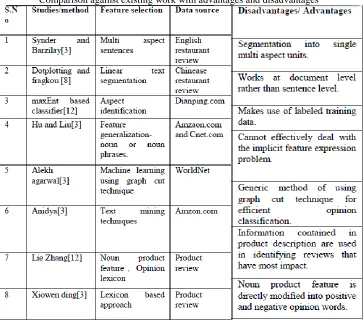
Table 1 below shows the related works done as research in the area of Sentiment Analysis based on aspect or feature identification of particular product and data analysis are done for various data sources.
Table – 1
Machine learning approaches simulate the way humans learn from their past experiences to acquire knowledge and apply it in making future decisions. These learning techniques are widely used in artificial intelligence and document classification. The classification using machine learning can be summed up in two steps:
1) Learning the model using the training dataset 2) Applying the trained model to the test dataset
Sentiment analysis is a text classification problem and thus any existing supervised classification method can be applied. Our work uses the Naive Bayes classifier and Support Vector Machines for classifying the movie reviews and compares the results obtained using the two approaches.
Naïve Bayes classifier is a simple probabilistic classifier that is based on the Bayes theorem. This classification technique assumes that the presence or absence of any feature in the document is independent of the presence or absence of any other feature. Naïve Bayes classifier considers a document as a bag of words and assumes that the probability of a word in the document is independent of its position in the document and the presence of other word. For a document d and class c:
Support vector machines have been the most efficient way for document classification. These are large margin classifiers and perform better than Naïve Bayes and Maximum Entropy in almost all cases. The basic idea behind SVM classification is to find a maximum margin hyper plane that separates the document vector in one class from the other with maximum margin.
III. PROPOSED SYSTEM
The proposed system allows customer to give input as textual reviews of various electronic products by means of specifying the quality of feature of respective product. The web based product ranking system here acts as an interface between the user and the back end where large volumes of customer reviews are stored. The system performs data analysis on the customer reviews to classify them as positive reviews and negative reviews. While positive reviews expose the satisfaction level of the customer, negative reviews assist the manufacturers to enhance the quality of the product.
Merchants selling products on the Web often ask their customers to review the products that they have purchased and the associated services. As e-commerce is becoming more and more popular, the number of customer reviews that a product receives grows rapidly. For a popular product, the number of reviews can be in hundreds or even thousands. This makes it difficult for a potential customer to read them to make an informed decision whether to purchase the product. It also makes it difficult for the manufacturer of the product to keep track and to manage customer opinions. For the manufacturer, there are additional difficulties because many merchant sites may sell the same product and the manufacturer normally produces many kinds of products. In this research, we aim to mine and to summarize all the customer reviews of a product. This summarization task is different from traditional text summarization because we only mine the features of the product on which the customers have expressed their opinions and whether the opinions are positive or negative. Our system task is performed in three steps: (1) Obtain textual input as reviews from customer to analyze the specified electronic product feature-wise (2) Mining product features that have been commented by customers; (3) Identifying opinion sentences in each review and deciding whether each opinion sentence is positive or negative; (4) Applying classification algorithm for feature categorization of product (5) Summarizing the results in the form of graph for easy analysis.
In the proposed product ranking system, products are ranked depending on its match with a feature based opinion search query. Also, feature dependent sentiment lexicons are used to solve the implicit aspect identification problem. Better ranking is achieved as this problem is resolved. The ranking of products are done for feature of electronic product such as resolution, touch screen and so on. We use sentiment analysis to classify the reviews based on positive and negative comments using the words such as ‘good’, ‘amazing’, ‘excellent’ and ‘poor’, ‘bad’, ‘disappointed’ and so on in order to count the positive, negative and neutral reviews. Only the textual lexicons are given to every electronic product are taken into account to rank them. Scores are given based on these criteria and ranking is done based on the polarity of the reviews .Thus we would achieve better ranking of products in the form of graphical representation. The UI allows users to select the product category, feature and brand names.
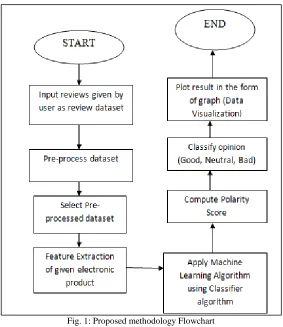
Fig. 1: Proposed methodology Flowchart
In this system, Selection of Products takes place after choosing the product name(s) and product category, the system searches for products with the given query and retrieves the matching products. The user can choose multiple brands and also specify a limit to limit the number of products returned for the search query. Features: The system allows user to select features for the specified product category. Multiple features quality can be given by user as review which is used for further data analysis. Finally, pressing button “Submit” would retrieve the products along with their feature scores for the specified aspects and rank them according to the scores.
The pseudo code for process is as shown: Input- Dataset of product reviews given by user
Output- Classification of these reviews as positive and negative. Steps involved in data analysis of electronic reviews given by the user: Step1: Pre-process the data
Removal of special characters Removal of stop words
Stemming the word - Stemming defines a technique that is used to find the root or stem of a word. The filtered token set undergoes stemming to reduce the length of words until a minimum length is reached. This resulted in reducing the different grammatical forms of a word to a single term. The basic stemming process can be summarized under two main headings:
Removing the endings:
The general rules for dropping the endings from words include: If a word ends in „es‟ drop the s.
If a word ends in „ing‟, delete the ingunless the remaining word consists of a single letter or th. If a word ends in a consonant, other than s, followed by s then delete s.
Transforming the words:
Table – 2
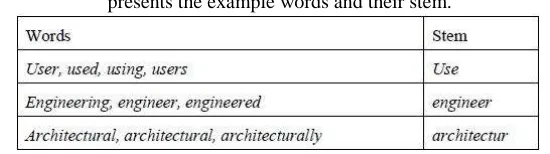
presents the example words and their stem.
Table 2: Different Grammatical forms of a Word and the Corresponding Stem
The stemming technique increases the efficiency and effectiveness of the information retrieval and text mining processes. Matching the similar words results in improved recall rate and also reduces the indexing size as much as 40-50%.
Step2: Get feature list
If word in stop word list Removal word
Return file after cleaning Step3: Extract feature list
Match every word in preprocessed list If word matches adjective in base list Display word
If word matches feature in base list Display feature
Step4: Combine both feature and pre-processed list
Step5: Apply machine learning classification algorithms and compute polarity Step6: Classify opinion as positive, negative or neutral.
Step7: Visualized representation for business analytics based of feature of given electronic products given by customers.
After the identification of aspects and polarity of every sentence, we rank the products based on review scores and we perform ranking for every feature of the electronic products considered.
This product ranking system will use text mining algorithm in order to mine keywords. The System takes review of various users, based on the review, system will specify whether the products and services provided by the E-commerce enterprise is good, bad, or worst. We use a database of sentiment based keywords along with positivity or negativity weight in database and then based on these sentiment keywords mined in user review is ranked. This system is a web application where user will view various products and purchase products online and can give review about the merchandise and online shopping services. This system will help many E-commerce enterprises to improve or maintain their services based on the customer review as well as to improve the merchandise based on the customer review.
Advantage of Proposed System:
System will take review of the customer about the online shopping service and will rate those services.
This system will help E-commerce enterprise to know about their customer services as well as about the products say in our case electronic products.
The system takes review of various users, based on the review; system will specify whether the products and services provided by the E-Commerce enterprise are good, bad or worst.
We use text based analysis along with positivity or negativity weight in database and then based on these sentiment keywords mined in customer review, product and services provided by the E-commerce enterprise is ranked.
This system will help many E-commerce enterprises to know about the opinion customers.
Text data mining used in this system to derive high quality information from text. High-quality information is typically derived through the devising of patterns and trends.
This system scans a set of text written in natural language.
IV. RESULT
Screenshot 1: Electronic Product with positive reviews
Screenshot 2: Electronic Products with negative reviews
Screenshot 4: Bar graph of Intex product based on given review
Screenshot 6: Bar graph of Samsung product based on given review
The results obtained contains the classification of reviews for various electronic products and GUI which gives the ranking of products based on reviews and feature-wise analysis for every given electronic product brand in the form of graphical representation. In this paper of product ranking system we performed opinion mining by means of feature-wise analysis of data. We find that querying products by aspects will retrieve effective results and also relevant products based on the user’s needs. In this paper, we have given reviews manually for specific products like Intex, Samsung, Lenova, Apple, Honor, etc., and then the data entered as reviews as analyzed graphically based on positive and negative sentiment.
V. FUTURE SCOPE
Table 3: Most Frequent Emoticons used in Reviews as per Survey
In sentiment analysis, polarity of sentiment (e.g., positive, negative or neutral) is of particular interest to researchers and business applications. However, the emotions expressed by the emoticons often cannot be captured by the three polarity categories. Many emoticons do not belong to exactly one of the categories. For example, ( :/ ) is often used to express an emotional state of annoyed and uneasy, which could be an indication of negative sentiment for some people but neutral for others. To validate and quantify this intuition, we did a survey of emotions expressed by each participant was asked to choose one from the following four options for each emoticon: Positive, Negative, Neutral, and None of the above or not sure. There are two groups of emoticons that were labeled by majority of the participants as positive or negative. Almost all participants agreed with little uncertainty that: D and :) are positive and : -(, :'( and :( are negative. However, a large number of emoticons was labeled with a mix of the three polarities as well as uncertain. For example, positive has the most responses for :') but negative and None of the above or not sure also have large shares of the responses, which reflects the complex and ambiguous nature of human emotion and language. It is also worth noting that even for some of the most common emoticons (e.g., :-) and :p) the interpretation of the emotions ex-pressed is not perfectly consistent among the participants.
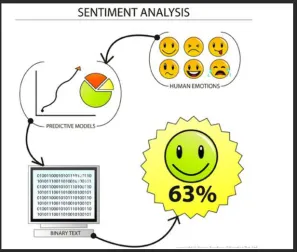
Fig. 2: Sentimental Analysis with emoticons
This survey of sentiment expressed by emoticons confirmed the hypothesis that some emoticons are reliable indicators of sentiment polarity while there is also large variation in how people express emotions through emoticons and how they interpret the sentiment conveyed by emoticons. Therefore, extreme caution should be exercised when utilizing the rich information in emoticons for better sentiment analysis. To further investigate the relationship between emoticons and sentiment, we can carry out three more analyses to understand the contexts in which emoticons are used and the influence of emoticons on sentiment classification.
Emoticons, such as :) ;) :-) and :(, are frequently used online in social media, IM (e.g., Skype), blogs, forums, and other kinds of online social interactions. Be-cause they are commonly used in online communications and they are often direct signals of sentiment, emoticons in text were widely used by NLP researchers in tasks such as sentiment analysis as features to machine learning algorithms or as entries of sentiment lexicons for rule-based approaches.
Different online communities and tools may elicit varied degrees of emoticon usage. Twitter, a micro-blogging site, is one of most popular social media. For researchers and businesses, having access to its huge amount of user-generated data is critical for understanding user behavior and the sentiment expressed. With access to about 50 mil-lion tweets per day (through the Twitter API), we thought it would be interesting to understand the prevalence of emoticons on Twitter nowadays, how users express and perceive sentiment through emoticons, and whether emoticons can be used as a reliable cue for sentiment polarity classification.
Another possible direction for future research includes applying sentiment analysis in a multilingual context and thus investigating how robust the system is across languages.
with real time data analysis. It provides wide varieties of sentiment analysis tools to review user comments from online portals. It also provides distributed computing environment.
Disadvantages of Existing System:
The drawbacks of the existing systems are that sentiment analysis cannot provide accurate classification of positive and negative comments. Hence can introduce errors in aspect ranking.
The reviews are disorganized, leading to difficulties in information navigation and knowledge acquisition. The frequency-based solution is not able to identify the truly important aspects of products which may lead to
decrease in efficiency of the review.
VI. CONCLUSION
Sentiment analysis or opinion mining is a field of study that analyzes people’s sentiments, attitudes, or emotions towards certain entities. This paper tackles a fundamental problem of sentiment analysis, sentiment polarity categorization and experiments for both sentence-level categorization and review-level categorization have been performed. Sentimental analysis helps customer visualize satisfaction while purchasing by simple summarization of these reviews into positive or negative- two broader classified classes. Feedbacks are mainly used for helping customers purchase online and for knowing current market trends about products which is helpful for developing market strategies by merchants. In this paper, we examine the effectiveness of applying machine learning techniques to the sentiment classification problem. In order to mine the data instead; it measures how far a word is inclined towards positive and negative. To understand sentiment analysis this paper focuses on supervised machine learning approaches.
ACKNOWLEDGMENT
I would like to thank the anonymous referees for their helpful guidance that has improved the quality of this paper. Also I would like to thank our Project Guide Prof. P. Boobalan, Associate Professor, Department of Information Technology, Pondicherry Engineering College for his valuable guidance.
REFERENCES
[1] N. Jindal, and B. Liu. “Opinion Spam and Analysis”. Proceedings of the ACM Conference on Web Search and Data Mining (WSDM), 2008.
[2] Jensen C et al,2000, The Effect of Communication Modality on Cooperation in Online Environments, In Proceedings of CHI 2000, The Hague, Netherlands
March 2000. http://research.microsoft.com/scg/papers/dilemmachi2000.pdf
[3] Hearst, Marti A., Susan T. Dumais, Edgar Osman, John Platt, and Bernhard Scholkopf. "Support vector machines." Intelligent Systems and their Applications, IEEE 13,Volume. 4 ,pp.18-28, 1998.
[4] Anderson EW,1998, Customer satisfaction and word of mouth - Journal of Service Research, 1998
[5] Avouris N et al, 2004, The effect of group size in synchronous collaborative problem solving activities, Proceedings AACE Conference ED-MEDIA 2004,
Lugano, June 2004.
[6] Cui et al,2006, Comparative Experiments on Sentiment Classification for Online Product Reviews, proceedings of the 21st national conference on Artificial
intelligence (2006)
[7] Gindl et al, 2008, Evaluation of different sentiment detection methods for polarity classification on web-based reviews. 18th European Conference on Artificial Intelligence, ECAI2008 Patras Greece ECAI Workshop on Computational Aspects of Affectual and Emotional Interaction p. 35–43
[8] Wang, Min, and Hanxiao Shi. "Research on sentiment analysis technology and polarity computation of sentiment words." Progress in Informatics and Computing (PIC), 2010 IEEE International Conference on. Vol. 1. IEEE, 2010.
[9] Lancieri L, 2008, Relation between the Complexity of Individuals' Expression and Groups Dynamic in Online Discussion Forums, The Open Cybernetics
and Systemics Journal (TOCSJ), Volume 2. 2008;
[10] Morris MR et al, 2010, What Do People Ask Their Social Networks, and Why? , Proceedings of the 28th ACM International conference on Human factors
in computing systems (CHI10)
[11] Qiang Y et al, 2009, Sentiment classification of online reviews to travel destinations by supervised machine learning approaches, Elsiever Journal Expert
Systems with Applications, Volume 36, Issue 3, Part 2, April 2009, pp. 6527-6535.
http://hci.ece.upatras.gr/pubs_files/c80_Avouris_Margaritis_Komis_2004_ED_MEDIA.pdf,
[12] Pang, Bo, and Lillian Lee. "Thesis on Opinion mining and sentiment analysis."Foundations and trends in information retrieval Volume1-2,pp 1-135,2008.
[13] Xia H et al, 2010, Sentiment Text Classification of Customers Reviews on the Web Based on SVM, 2010, Sixth International Conference on Natural Computation (ICNC 2010)
[14] Kim S-M, Hovy E (2004) Determining the sentiment of opinions In: Proceedings of the 20th international conference on Computational Linguistics, page
1367.. Association for Computational Linguistics, Stroudsburg, PA, USA.Google Scholar
[15] Pak A, Paroubek P (2010) Twitter as a corpus for sentiment analysis and opinion mining In: Proceedings of the Seventh conference on International Language Resources and Evaluation, European Languages Resources Association, Valletta, Malta. Google Scholar
[16] Pang B, Lee L (2004) A sentimental education: Sentiment analysis using subjectivity summarization based on minimum cuts In: Proceedings of the 42Nd
Annual Meeting on Association for Computational Linguistics, ACL ’04.. Association for Computational Linguistics, Stroudsburg, PA, USA.Google Scholar
[17] Pang B, Lee L (2008) Opinion mining and sentiment analysis. Foundations and Trends in Information Retrieval 2(1-2), pp. 1–135, 2008. View Article Google Scholar
[18] Zhang Y, Xiang X, Yin C, Shang L (2013) Parallel sentiment polarity classification method with substring feature reduction In: Trends and Applications in
[19] Zheng-Jun Zha, Jianxing Yu, Jinhui Tang Meng Wang, Member, IEEE, and Tat-Seng Chua, “ Product Aspect Ranking And its Applications”, IEEE Transactions On Knowledge And Data Engineering, Vol. 26, No. 5, May 2014
[20] J. Yi, T. Nasukawa, R. Bunescu, and W. Niblack,(2003), "Sentiment Analyzer: Extracting Sentiments about a Given Topic using Natural Language Processing Techniques," presented at the Proceedings of the Third IEEE International Conference on Data Mining.
[21] J. S. Kessler and N. Nicolov,(2009), "Targeting sentiment expressions through supervised ranking of linguistic configurations," in Proceedings of the Third International AAAI Conference on Weblogs and Social Media,,San Jose, California, USA, pp. 90-97.
[22] Msgweb. List of Emoticons in MSN Messenger, 2006. Available online, http://www.msgweb.nl/en/MSN_Images/Emoticon_list/.
[23] R. Navigli. Word Sense Disambiguation: A Survey, ACM Computing Surveys, 41(2):1{69, 2009.
[24] P.Gil. Emoticons and Smileys 101, 2011. Available online, http://netforbeginners.about.com/cs/netiquette101/a/bl_emoticons101.htm.
[25] A. Pak and P. Paroubek. Twitter as a Corpus for Sentiment Analysis and Opinion Mining. In 7th Conference on International Language Resources and
Evaluation (LREC 2010), pages 1320{1326. European Language Resources Association, 2010.
[26] G. Paltoglou and M. Thelwall. A Study of Information Retrieval Weighting Schemes for Sentiment Analysis. In 48th Annual Meeting of the Association
for Computational Linguistics (ACL 2010), pages1386{1395. Association for Computational Linguistics,2010.
[27] Wikipedia. List of Emoticons, 2011. Available online, http://en.wikipedia.org/wiki/List_of_emoticons/.
[28] D. Davidov, O. Tsur, and A. Rappoport, "Enhanced sentiment learning using twitter hashtags and smileys," in Proceedings of the 23rd International Conference on Computational Linguistics: Posters, 2010, pp. 241-249.
[29] S. Baccianella, A. Esuli, and F. Sebastiani. SentiWordNet 3.0: An Enhanced Lexical Resource for Sentiment Analysis and Opinion Mining. In 7th
Conference on International Language Resources and Evaluation (LREC 2010), pages 2200{2204. European Language Resources Association, 2010.
[30] D. Bal, M. Bal, A. van Bunningen, A. Hogenboom, Hogenboom, and F. Frasincar. Sentiment Analysis with a Multilingual Pipeline. In 12th International
Conference on Web Information System Engineering (WISE 2011), volume 6997 of Lecture Notes in Computer Science, pages 129{142. Springer, 2011.
[31] J. Burgoon, D. Buller, and W. Woodall. Nonverbal Communication: The Unspoken Dialogue. McGraw-Hill, 2nd edition, 1996.
[32] Amit Gupte, Sourabh Joshi, Pratik Gadgul, Akshay Kadam “Comparative Study of Classification Algorithms used in Sentiment Analysis” at (IJCSIT)
International Journal of Computer Science and Information Technologies, 2014.
[33] Federica Bision, Paolo Gastaldo, Chiara Peretti, Rodolfo Zunino and Erik Cambria “Data Intensive Review Mining for Sentiment Classification across
Heterogeneous Domains” 2013 IEEE at ACM International Conference on Advances in Social Networks Analysis and Mining.
[34] HarunaIsah, Paul Trundle, Daniel Neagu “Social Media Analysis for Product Safety using Text Mining and Sentiment Analysis”2014 IEEE.
[35] Christopher D. Manning, Prabhakar Raghavan, HinrichSch¨utze, “Introduction to Information Retrieval”, ISBN-13 978-0-511-41405-3, 2013.
[36] Kang Liu, Liheng Xu, and Jun Zhao “Co-Extracting Opinion Targets and Opinion Words from Online Reviews Based on the Word Alignment Model”2014
IEEE proceeding at IEEE TRANSACTIONS ON KNOWLEDGE AND DATA ENGINEERING.
[37] Manisha Shinde-Pawar, Formation of Smart Sentimental Analysis Techniques for BigData ,International Journal of Innovative Research in Computer and
Communication Engineering , Vol. 2, Issue 12, December 2014
[38] D.Mali, M.Abhyankar, Sentiment Analysis of product reviews for E-Commerce Recommendations, Proceedings of 44th IRF International Conference, 29th
November 2015, Pune, India.
[39] Prashast Kumar Singh, An approach towards feature specific opinion mining and sentimental analysis across e-commerce websites, 5th International Conference- Confluence The Next Generation Information Technology Summit.
[40] Mohammad Salehan, Dan J. Kim, Predicting the performance of online consumer reviews: A sentiment mining approach to big data analytics, Department
of Computer Information Systems, College of Business Administration, California State Polytechnic University, Pomona, 3801 West Temple Avenue, Pomona, CA 91768, USA.
[41] B. Liu. Sentiment Analysis and Subjectivity. Handbook of Natural Language Processing, Second Edition, (editors: N. Indurkhya and F. J. Damerau), 2010.
[42] J. Wiebe, T. Wilson, R. Bruce, M. Bell, and M. Martin, “Learning Subjective Language,” Computational Linguistics, vol. 30, pp. 277–308, September
2004.
[43] M. Hu and B. Liu, “Mining and Summarizing Customer Reviews,” Proceedings of the ACM SIGKDD Conference on Knowledge Discovery and Data