Page | 6 CONCEPT OF E-COMMERCE: SYSTEMS ANALYSIS AND DESIGN FOR ONLINE-STORES
Emeka Joshua Chukwuemeka
Department of Information and Communication Technologies in Education Eastern Mediterranean University
Gazimağusa
Mail: [email protected]
Samson Oluwaseun Fadiya
Department of Management Information Systems Girne American University
University Drive, Girne Email: [email protected]
Odeh Acheme Okolobia
Department of Information and Communication Technology in Education Eastern Mediterranean University
Gazimağusa
Email: [email protected]
Turkey Abstract:
The Internet related data and communication advancements offer extraordinary open doors for business development. The internet and related advancements Organizations can utilize a global innovation program for commerce. Onlinstores systems are developed as distributed applications. The architecture of an e-commerce system conceived as a distributed application.
The Internet associated information and communication technologies offer unprecedented opportunities for business innovation. Companies can use the Internet and associated technologies extensively as a global and cost effective program for e-commerce. This paper suggests that processes such as project design are personalized, and profiling, control, and security should be implemented in an e-commerce application. Also, search management, content management, payment systems, catalog management, workflow management, event notification, and collaboration and trading.
This paper suggests that processes such as project design or content management, payment systems, and search management coordinated effort and exchanging.
Keyword: Cloud, Customer, Design, Online-store, Software.
1. Introduction:
Page | 7
Moreover, Nigeria has the facility to advertise their sales for customers who resides in another location of the country to see what is available in other region or state of the country.
Electronic commerce or business is more than simply purchasing and selling a product on the web. The e-commerce also covers the whole online procedure of formulating, servicing, delivering, marketing and selling goods and services purchased globally. Moreover, the support of International network of business partners with customers Buyya, R., Broberg, J., & Goscinski, A. M. (Eds.) (2010).
The goal of this paper is to steer up a research onus towards formulating a universal purpose e-commerce store where the product (such as jewelry, clothing, computers, mobile phones, electronic items, and home appliances), can be viewed from its location, store from the comfort of home through the Internet. Moreover, get the product at the point of sales of respective locations. However, for implementation purposes, this paper will base proposed project to deal with an online store. The online store is a virtual store on the Internet where customers can browse the catalog and select products that interest them to the wish list. The selected items may be gathered into a wish list for a preview and customers can go to the location store to get their products selected at any time. Meanwhile, the customer will have their items selected in a wishlist attached to their membership page.
The e-commerce also covers the entire online process of formulating, servicing, delivering, marketing and selling goods and services purchased globally.With the support of International network of business partners with customers.
2. Review of Previous Studies:
Developing storage and data handling need. Be that as it may, receiving a distributed computing worldview may have dynamic and unfriendly effects on the data security of service consumers. The primary focus of this project is to develop, operate, and manage a store’s website on the cloud as they become high-priority destinations for consumers who will repeatedly choose to go there to buy products and services. Therefore, it is necessary to describe in a nutshell what e-commerce entails.
2.1.E-commerce:
Electronic commerce is more than just buying and selling products online. Instead, it encompasses the entire online process of developing, marketing, selling, delivering, servicing, and paying for goods and services purchased by internetworked, global marketplaces of customers, with the support of a worldwide network of business partners Buyya, R., Broberg, J., & Goscinski, A. M. (Eds.) (2010).
Electronic commerce systems depend on the assets of the Internet, intranets, extranets, and other PC systems. Electronic commerce can include:
• Interactive is showcasing, requesting, installment, and client support forms at e-business sites. • The extranet access of stock databases by customers and suppliers.
• Intranet access to customer relationship management systems by sales and customer service reps • Customer collaboration in product development via Internet newsgroups and e-mail exchanges.
2.1.1. The Scope of E-commerce:
Companies involved in electronic commerce as either buyers or sellers rely on Internet-based technologies and e-commerce applications and services to accomplish marketing, discovery, transaction processing, and product and customer service processes.
Page | 8
between the components of a business and its clients, suppliers, and other trading partners. This permits organizations to take part in three fundamental classifications of electronic commerce applications:
i. Business-to-Consumer (B2C) e-Commerce In this form of e-commerce, businesses must develop attractive electronic marketplaces to entice and sell products and services to customers [1]. Organizations may offer:
ii. Secure Internet or extranet e-trade sites for their business clients and suppliers.
iii. Electronic data interchange (EDI) using the Internet or extranets for the computer-to-computer exchange of electronic commerce documents with their larger business customers and suppliers. B2B e-commerce portals that provide auction and sharing markets for organizations.
iv. Consumer-to-Consumer (C2C) e-Commerce: Successes of online barters like e-Bay, permit consumers (and businesses) to buy and sell with each other through an auction process on a bartering website. Online shopper or business barters are a critical e-trade elective for B2C or B2B e-trade.
v. An electronic individual promoting of items or administrations to purchase or offer to customers at electronic daily paper sites, consumer e-business entries or individual websites is an essential type of C2C e-trade.
2.1.2E-commerce and Cloud Environment:
Organizations in today business are under expanding weight to decrease IT costs while as yet selecting an ideal software to bolster their activities forms. "Software as a Service" (SaaS) applications offer a perfect solution, empowering organizations to decrease drastically in advance speculation and progressing support and administration costs for their product.
SaaS solutions offer many e-commerce systems a breed of software for electronic commerce, e.g. promoting mechanization and lead management, and enrollment management, all with no capital venture, electric usage, and no expense to keep up or deal with the framework sparing the organization time, work, and cash. These advantages combine to give the company leading business solutions faster with SaaS solutions.
This brought about the idea of migrations onto a staging e-commerce in a cloud environment. We shall set up a store, shop on the cloud environment before application design sites. Content is filtered, and layouts are formatted based on the location objective, currently navigating, searching and others on Cloud Saas, using one application for the sites, makes for ease of maintenance, ensures that functionality is consistent between sites and provides an implementation of a single user database.
2.2 Cloud Computing Effect on e-Commerce:
Ercan, T. (2010) surveyed and analyzed the use of Information and Communication Technologies (ICT) in small businesses. They paid attention to the creation of a website, the use of internet and e-commerce, and its cost reduction effect. Czaja, S. J., & Lee, C. C. (2009) examined the effects of information technology (IT) knowledge and media selection on operational performance in small firms. Their findings showed that: individual IT knowledge and both traditional and electronic communication methods significantly contribute to the internal process performance of small enterprises, internal process performance, organizational IT knowledge, and electronic communication methods affect customer performance, financial performance is influenced by process and customer performance.
Page | 9 industrial sectors. Because the business model does not currently meet all the needs of high-performance computing (HPC), worked on the demands of capability computing and the relationship between clouds and HPC. Tai, S., Nimis, J., Lenk, A., & Klems, M. (2010, May) discussed the need for valuation of Cloud Computing, identify key components, and structure these elements in a framework that assisted decision makers in estimating Cloud Computing costs mainly based on actual service usage. Weinhardt, C., Anandasivam, D. I. W. A., Blau, B., Borissov, D. I. N., Meinl, D. M. T., Michalk, D. I. W. W., & Stößer, J. (2009) classified the business opportunities of the Cloud Computing and presented a business model framework for Clouds. Neves, F. T., Marta, F. C., Correia, A. M. R., & Neto, M. D. C. (2011) proposed a Cloud service model which aims to provide e-commerce functions as services over a Cloud infrastructure and described architecture for the dynamic web applications in a Cloud Computing environment. They used a front-end load balancer for routing and balancing user requests to web applications and discussed the on-demand capability of the Cloud while allocating resources to users to reduce infrastructure and management costs. Han, H., Kim, S., Jung, H., Yeom, H. Y., Yoon, C., Park, J., & Lee, Y. (2009, September) proposed an alternative architecture that would be applied to a management system for cloud computing infrastructures. Zhang, L. J., & Zhou, Q. (2009, July). Presented seven architectural principles and derived ten interconnected architectural modules to form a reusable and customizable Cloud Computing Open Architecture (CCOA) by bridging the power of the service-oriented architecture (SOA) and virtualization in the context Of Cloud Computing ecosystem.
Software as a service (SaaS) and related administrations have shown up as of late as a development of the application administration supplier plan. SaaS empowers corporate clients to utilize services that are as of now being given as opposed to developing and owning business systems all alone. Namjoshi, J., & Gupte, A. (2009, September) described a Cloud approach which is Software-as-a-Service for the design of travel reservations used by corporate business travelers. They focused on saving the cost of IT ownership and accelerating time to market due to ready-to-use. Alajrami, S., Gallina, B., & Romanovsky, A. (2015) explained cloud-based platforms and their core problems. They outlined generic cloud architecture for three cloud forms - a compute cloud, a storage cloud, and a cloud-based software service- in the context of globally distributed software development (GSD). They believed that software practitioners would focus more on cloud computing platforms and saw clouds as a means to support clients, developers in the future.
2.3Business Impact of Cloud Computing:
There is no need for a particular training period for the users about the services. A new shift in the area of distributed computing and networking will be inevitable. Companies will be able to switch quickly between service providers to compete with other firms in the market. The way to obtain the maximum benefits is to treat the new virtual systems as a part of the existing system like broadband internet connection, application and database servers. Cloud services increase company’s in-house capabilities and satisfy better the needs of their end-users, as well as their customers and strategic partners. Private cloud computing gives company executives the opportunity of maximizing their organization’s resources by their business requirements.
Building a private cloud is a good practice for many of the SMBs like online store called ‘Fardeyar’ that prefer to manage their in-house services. Of course, the main economic impact of this technology is in the reduction of operational costs due to the size of demand and production. When the cloud is considered on the Internet scale, it also provides a significant and pervasive impact on the global economy with a considerable cost saving.
2.3.1Cloud Computing Features:
The cloud computing emerging capabilities that need to be considered a cloud includes:
i.Pay as you go this is a case in point of payment based on customer's actual consumption.
Page | 10
computing capacities while holding protection and security over their data.
iii.Immediately adaptable utilization, limit, and along these lines expense can be scaled up or down with no additional contractor punishments.
There is a broadly held perspective that the cloud is not another idea. For sure, enormous numbers of the innovations and services connected with distributed computing, for example, Web 2.0 or virtualization, have been in existence for some time Rappa, M. A. (2004).
3. Methodology:
This section explains the proposed system analysis and design. This is intended to show the approach taking in the development of what this project demands. Waterfall model was found to be well suited for this purpose and was therefore employed.
3.1.History of Waterfall Model:
Royce proposed in his Waterfall Model with 1970 as a model, which he battled, was deficient. His paper then examined how the starting model could be produced into an original or interactive model, with criticism from each stage influencing past the stage, numerous techniques utilize broadly and highly and profoundly respected by many today. Unexpectedly, it is just the starting models that get noticed: the feedback he enrolled of his starting model has been to a great extent disregarded. The waterfall model came to point not to Royce's final, iterative design, yet rather to his successively ordered model Royce, W. W. (1970, August).
3.2.The model:
Despite Royce's goals of the waterfall model to be adjusted to an iterative model, use of the waterfall model as a back to the back procedure is still main stream. The individuals who utilize the expression "waterfall model" ordinarily see the waterfall model as unsuitable for an iterative procedure. The following stages are followed all together in Royce's original waterfall illustrate:
i. Prerequisites specification ii. Design Plan
iii. Development (AKA implementation or coding) iv. Integration or Mix
v. Testing and debugging (AKA Verification) vi. Installation
vii. Maintenance
Page | 11
In this way, the waterfall model keeps up that one ought to move into a stage just when it is proceeding stage is done. Regardless, there are different adjusted waterfall models, counting Royce's last model that may incorporate real varieties upon this procedure.
Requirement Definition: this involves the objective and function of the project to be developed, the purpose and limitation that are participating in the software.
Analysis: the study of the existing system is studied to identify and determine the problems in the current system.
Design: the architectural design of both the software and the hardware is involved. For emphasis architecture here means the input, output, and database while the Hardware architecture defines the requirement for the software to run smoothly.
Coding: this is developing the software using development tools.
Testing: testing and verification will be carried out. The verification ensures the overall component of the software and that the software is well integrated. Testing ensures there is no error from the component (Hardware and Software). At this point, a need for software documentation is required for reference purposes if the need arises.
There are series of approaches involved in the waterfall model which is shown in Figure 1 below:
Figure 1 – Systems Development Life Cycle (SDLC)
4. Existing System:
From the insignificant amount of the current Stores Online, has issues with its software, then a complaint about what isn't correct is imperative for Stores Online to remedy the condition. General postings made about Stores Online services are frequently indistinct concerning what purchasers need Stores Online to do. Stores Online's products are always enhanced when clients distinguish particular glitches in the software.
4.1. Proposed System:
Page | 12
Online, we give superior, which means we "incorporate" many tools through our on-demand software model that permit clients and small organizations to share assets, individuals and technology innovation.
4.2. Objectives:
It is our aim of being a complete online resource for promoting services for customers. Stores Online is for customers looking for a location to get a product and the product accessible in its store.
The primary objectives are as per the following;
i. Responsible for providing product support ii. Responsible for handling all client inquiries
iii. Provides technical assistance for e-commerce software on a cloud iv. Provides marketing information to the client
v. Responsible for follow up communication with the client
vi. Responsible for returning calls to customers that have left messages.
4.3. System structure:
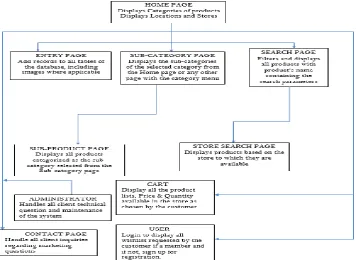
The system structure and its elements are internally organized where components are so personally associated that they work as one in connection to external conditions and different systems. A component may be characterized as the insignificant unit performing a distinct capacity in the entirety shown below in Figure 2.
Figure 2 - Functional Decomposition Diagram
Page | 13
This should be possible by:
i. Making incentives to urge guests to register
ii. Develop Web cookie documents to automatically recognize returning guests
iii. Contracting with website tracking organizations for software to consequently record and break down the points of interest of the site conduct and preferences of Web customers
iv. Guarantee that our site has the look and feel of an appealing, friendly, and proficient Web store.
4.4Data Storage Requirements:
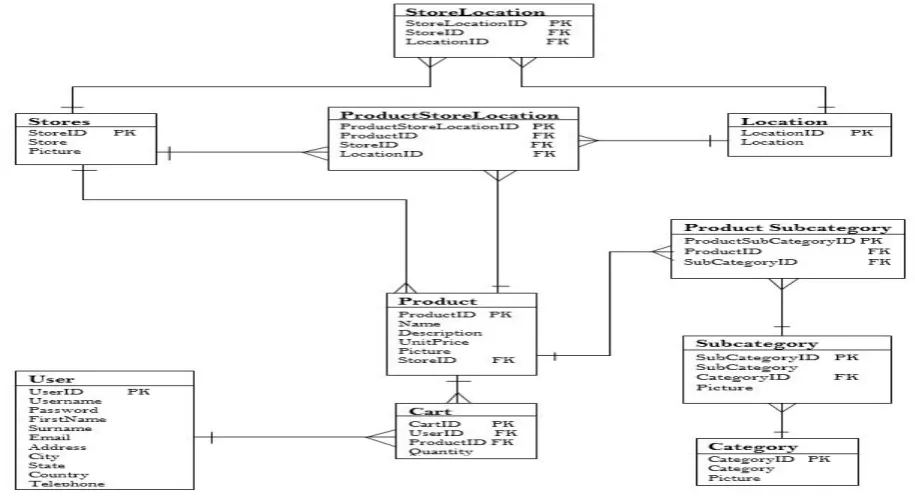
Data storage requirements comprise of components and architecture that stores the system records. These components are Tables, Entities, Attributes and Entity Relationship Diagrams.
4.4.1. Tables:
The proposed project has ten tables, namely Cart, Category, Location, Product, ProductStoredLocation, ProductSubCategory, StoreLocation, Stores, SubCategory and User tables.
i. The system records the following information about Cart Table: •CartID
•UserID •ProductID •Quantity
ii. The system records the following information about Category Table: •CategoryID
•Category •Picture
iii. The system records the following information about Location Table: •LocationID
•Location
iv. The system records the following information about Product Table: •ProductID
•Name •Description •UnitPrice •Picture •StoreID
v. The system records the following information about ProductStoredLocation Table: •ProductStoredLocationID
•ProductID •StoredID •LocationID
vi. The system records the following information about ProductSubCategory Table: •ProductSubCategoryID
Page | 14
vii. The system should record the following information about StoreLocation Table: •StoreLocationID
•StoreID •LocationID
viii. The system records the following information about ProductSubCategory Table: •ProductSubCategoryID
•ProductID •SubCategoryID
ix. The system should record the following information about StoreLocation Table: •StoreLocationID
•StoreID •LocationID
x. The system records the following information about Stores Table: •StoreID
•Store •Picture
xi. The system records the following information about SubCategory Table: •SubCategoryID
•SubCategory •CategoryID •Picture
xii. The system records the following information about User Table:
•UserID Address
•Username City
•Password State
•FirstName Country
•Surname Telephone
Xiii. The system should be able to add records to all tables of the database, including images where applicable, are at least eight characters long and nvarchar (Max).
Xiv. The system should be able to store at least 300 products, customer’s records at any one time, with the upper limit increasing as storage space for the database is increased on the cloud.
4.4.2. Entities, Attributes, Entity Relationship Diagrams:
Page | 15 Figure 3 - Entity Relationship Diagrams
4.5Data Flow Diagram:
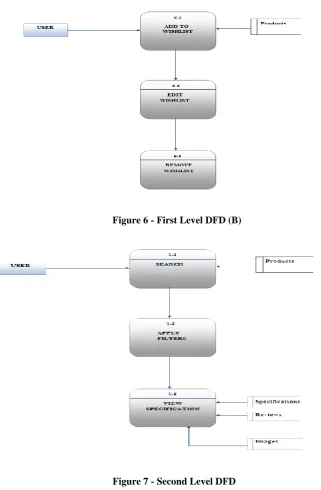
DFD (Data Flow Diagram)is a graphical representation of data flow through an information system. A DFD do not give the timing of procedures, or about whether processes will work in parallel.
Figure 4- Context Level Diagram
Page | 16 Figure 6 - First Level DFD (B)
Figure 7 - Second Level DFD
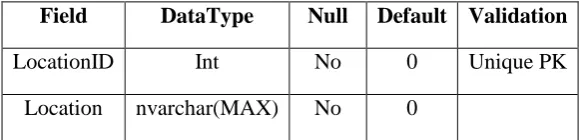
4.6. Data Dictionary:
Choosing the data model and develop a conceptual schema pattern in view of the specification that was laid out in the planning and analysis stage. This design concentrates on how the data will be composed without worrying about the specifics of the tables, keys, and attributes. Distinguish the entities that will represent to tables in the database, the attribute that will account for the field in a table, and every entity-attribute-relationship.
Table 1: Category Columns/Attributes
Field DataType Null Default Validation
CartID Int No 0 Unique PK
UserID Int No 0 Foreign Key
ProductID Int No 0 Foreign Key
Page | 17 Table 2: Location Columns/Attributes
Field DataType Null Default Validation
LocationID Int No 0 Unique PK
Location nvarchar(MAX) No 0
Table 3: Product Columns/Attributes
Field DataType Null Default Validation
ProductID Int No 0 Unique PK
Name nvarchar(MAX
)
No 0
Description nvarchar(MAX
)
No 0
UnitPrice small money No 0
Picture nvarchar(MAX
)
Yes 0
StoreID Int No 0 Foreign Key
Table 4: ProductStoreLocation Columns/Attributes
Field DataType Null Default Validation
ProductStoreLocationID Int No 0 Unique PK
ProductID Int No 0 Foreign Key
StoreID Int No 0 Foreign Key
LocationID Int No 0 Foreign Key
Table 5: SubCategory Columns/Attributes
Field DataType Null Default Validation
SubCategoryID Int No 0 Unique PKs
Subcategory nvarchar(50) No 0
CategoryID Int No 0 Foreign Key
Page | 18 Table 6: ProductSubcategory Columns/Attributes
Field DataType Null Default Validation
ProductSubCategoryID Int No 0 Unique PK
ProductID Int No 0 Foreign Key
SubCategoryID Int No 0 Foreign Key
Table 7: StoreLocation Columns/Attributes
Field DataType Null Default Validation
UserID Int No 0 Unique PK
Username nvarchar(50) No 0
Password nvarchar(50) No 0
FirstName nvarchar(50) No 0
Surname nvarchar(50) No 0
Email nvarchar(50) Yes 0
Address nvarchar(50) Yes 0
City nvarchar(50) Yes 0
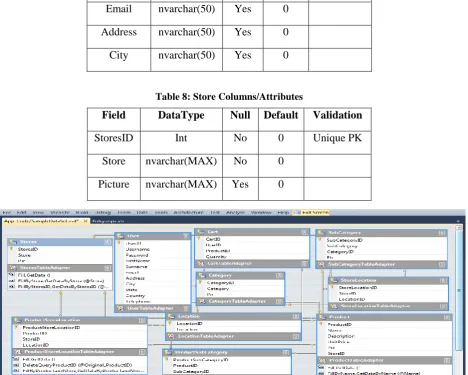
Table 8: Store Columns/Attributes
Field DataType Null Default Validation
StoresID Int No 0 Unique PK
Store nvarchar(MAX) No 0
Picture nvarchar(MAX) Yes 0
Page | 19 4.7. Database Dataset Diagram:
What this dataset appeared above in Figure 8 is the various relationships, entities, and constraints utilized, the data is endured in memory, and the data in it can be manipulated and updated independently of the database. At the point when the utilization of this data set is done, changes can be made back to the central database when updated in the cloud. The data in the dataset can be stacked from any valid data sources like Oracle database or Microsoft SQL server database yet for this project the recent will be utilized.
4.8. Consideration of Alternatives:
The rich decision of the programming language/system; ASP.NET permits software or programmer engineers to create web applications that interface with a database. Two parts of ASP.NET make it quick compiled the code and caching.
4.8.1. Justification of Chosen Solution:
The advantage of ASP.NET is that it is object-oriented and has numerous programming tools that take into account speedier advancement and more functionality (3). In ASP.NET the code is arranged into “machine language" before a guest ever goes to the website. Caching is the storage of data in memory for speedier access later on. ASP.NET permits programmers or developers to set up pages or area of pages that are usually refused to be stored in a set time frame to enhance the performance of web applications.
4.9. Design of User Interface:
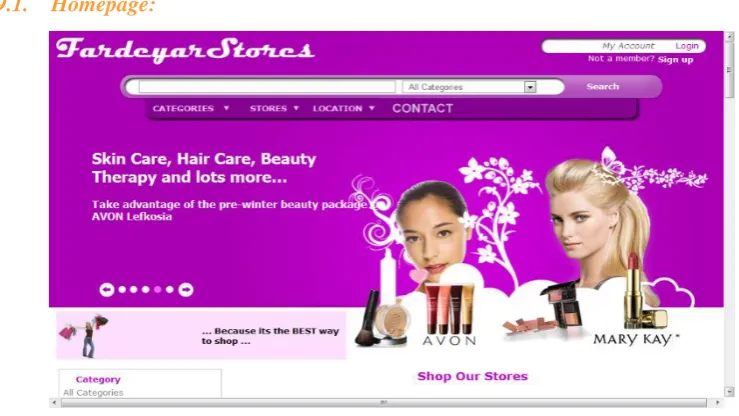
Before actualizing the good design of the project, a couple of client interface designs were built to imagine the customer interaction with the system as they browse the store and get the area of product accessibility. The interface of the client design will nearly take after our Functional Decomposition Diagram
4.9.1. Homepage:
Figure 9– Homepage
Page | 20
4.9.2. Login Form:
Figure 10 – Authentication of the user
The above Figure 10 shows the validation of the user if register and if not validation rule is applied.
4.9.3. Search Form:
Figure 11 – For searching for products, category, and location
The above Figure 11 searches the stores for products and where they are located.
4.9.4. Sign up Form:
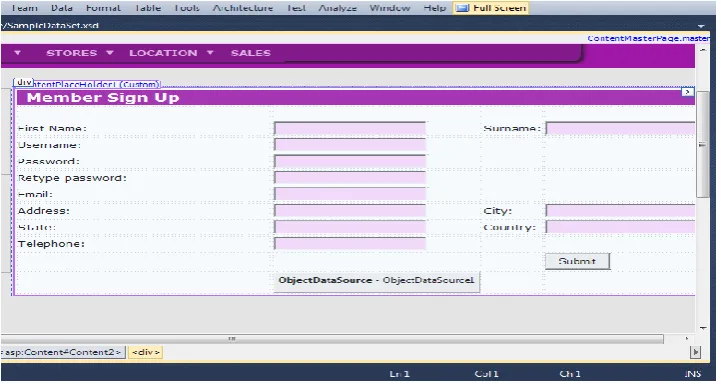
Figure 12 – Sign up for customers, not members
The above Figure 12 is the registration page for a new member.
5. Conclusion:
Page | 21
have picked up significance from the entrepreneur’s as well as from the customer's perspective. For the business person, electronic shopping produces new business opportunities and for the client, it makes comparative shopping conceivable.
According to a review, most consumers of online stores are incautious and normally settle on a choice to remain focused website inside of the initial few moments. "Website design is similar to a shop inside if the shop looks poor many different outlets, the customer is destined to skip to the next website. Consequently, we have planned the project to give the simple client route, retrieval or recovery of data and valuable feedback however much as could reasonably be expected.
References:
Alajrami, S., Gallina, B., & Romanovsky, A. (2015). Enabling Global Software Development via Cloud-Based Software Process Enactment.
Buyya, R., Broberg, J., & Goscinski, A. M. (Eds.). (2010). Cloud computing: Principles and
paradigms (Vol. 87). John Wiley & Sons.
Czaja, S. J., & Lee, C. C. (2009). Information technology and older adults(pp. 17-32). CRC Press.
Ercan, T. (2010). Business Impact Of Cloud Computing In Small And Medium Sized Companies. In 6th
International Conference on Business, Economics and Management (pp. 1-9).
Everett, G. D., & McLeod Jr, R. (2007). Software testing: testing across the entire software development life
cycle. John Wiley & Sons.
Han, H., Kim, S., Jung, H., Yeom, H. Y., Yoon, C., Park, J., & Lee, Y. (2009, September). A RESTful approach to the management of cloud infrastructure. In 2009 IEEE International Conference on Cloud
Computing (pp. 139-142). IEEE.
Namjoshi, J., & Gupte, A. (2009, September). Service oriented architecture for cloud based travel reservation software as a service. In 2009 IEEE International Conference on Cloud Computing (pp. 147-150). IEEE.
Neves, F. T., Marta, F. C., Correia, A. M. R., & Neto, M. D. C. (2011). The adoption of cloud computing by SMEs: identifying and coping with external factors.
Masoud, F. A., & Halabi, D. H. (2006). ASP. NET and JSP Frameworks in Model View Controller Implementation. In 2006 2nd International Conference on Information & Communication
Technologies (Vol. 2, pp. 3593-3598). IEEE.
Rappa, M. A. (2004). The utility business model and the future of computing services. IBM Systems Journal, 43(1), 32.
Royce, W. W. (1970, August). Managing the development of large software systems. In proceedings of
IEEE WESCON (Vol. 26, No. 8, pp. 328-338).
Tai, S., Nimis, J., Lenk, A., & Klems, M. (2010, May). Cloud service engineering. In Proceedings of the
32nd ACM/IEEE International Conference on Software Engineering-Volume 2 (pp. 475-476). ACM.
Page | 22 Weinhardt, C., Anandasivam, D. I. W. A., Blau, B., Borissov, D. I. N., Meinl, D. M. T., Michalk, D. I. W. W., & Stößer, J. (2009). Cloud computing–a classification, business models, and research directions. Business & Information Systems Engineering, 1(5), 391-399.
Zhang, L. J., & Zhou, Q. (2009, July). CCOA: Cloud computing open architecture. In Web Services, 2009.