Original Research Article
Comparison of Haemodynamic and Analgesic Effects of 0.5% Hyperbaric
Bupivacaine and 0.5% Hyperbaric Bupivacaine with Different Doses of
Clonidine under Spinal Anaesthesia
Balwinder Kaur Rekhi
1, Harnam Singh Rekhi
2, Sahil Satish Arora
3*, Sandeep Sidhu
4,
Amita Mhatre Arora
51Associate Professor, 4Junior Resident,
Department of Anaesthesia, Government Medical College & Rajindra Hospital, Patiala, Punjab, India.
2Assistant Professor, 3*Senior Resident,
Department of Surgery, Government Medical College & Rajindra Hospital, Patiala, Punjab, India.
5Consultant IVF Specialist and Obstetrics & Gynaecology Surgeon, Arora Hospital, Samana, Punjab, India.
ABSTRACT
Background: Alpha 2 agonists such as clonidine have been used neuroaxially as local anaesthetic adjuvant to enhance perioperative analgesia. This study compared three different combinations of the clonidine with bupivacaine and bupivacaine alone.
Material and Methods: A total of 60 patients scheduled for surgery under spinal anaesthesia were randomly allocated into 4 groups (n=15 each) to receive intrathecal bupivacaine 15 mg [Control group (group 1)], bupivacaine 15 mg + clonidine 0.5 mcg/kg (group II), bupivacaine 15 mg + .75 mcg/kg clonidine (group III), bupivacaine 15 mg + 1mcg/kg clonidine (group IV). Heart rate, SBP, DBP, MAP, oxygen saturation were monitored. The level of the sensory block recorded every 5th min till 20th min with level achieved at 20th min was considered as highest dermatome level achieved, time to onset of different grades of motor block, time to complete motor block, recovery and duration of spinal analgesia were recorded. p value <0.05 considered significant.
Results: Demographic data and duration of surgery were comparable amongst the groups. On haemodynamical comparison there was highly significant fall in heart rate, systolic and diastolic in group II,III,IV as compared to I. There was no incidence of bradycardia in group I whereas there were 2, 4 and 11 cases in group II,III,IV respectively. Similarly there was no hypotension in group I whereas there were 2, 5 and 11 cases in group II,III,IV respectively. On statistical analysis the level of sensory block was comparable at 5 min and highly significant at 10, 15, 20 mins in group II,III,IV as compared to I.
The attainment of the different grades of motor block (modified bromage scale) at 5, 10, 15, 20 min interval was comparable amongst all groups. The duration of analgesia was highly significant when analysed statistically (p=0.000) in group II,III,IV as compared to I.
Conclusion: In conclusion our study demonstrates that addition of 0.75 μg/Kg of clonidine to intrathecal bupivacaine is safe as compared to 1.0 μg/Kg. By using small dose of intrathecal clonidine side effects were not increased whereas intrathecal clonidine at the usual dose of 1μg/kg is associated with bradycardia and relative hypotension. So, 0.75 μg/Kg of clonidine is the preferred dose for addition to 0.5% hyperbaric bupivacaine in patients undergoing gynaecological and lower abdominal surgeries.
Keywords: Intrathecal Clonidine, Spinal Adjuvants.
*Correspondence to:
Dr. Sahil Satish Arora,
Senior Resident, Department of Surgery,
Government Medical College & Rajindra Hospital, Patiala. Article History:
Received: 13-01-2017, Revised: 01-02-2017, Accepted: 21-02-2017
Access this article online
Website:
www.ijmrp.com
Quick Response code
DOI:
10.21276/ijmrp.2017.3.2.027
INTRODUCTION
A number of drugs e.g. opioids, benzodiazepines, neostigmine and ketamine have been used intrathecally as an adjuvant to local anaesthetics.1
Clonidine is of interest because it preserves cardiovascular reflexes, provides sedation, greater intra operative haemodynamic stability and a reduction in anaesthetic and postoperative analgesics requirements and also has a marked opioid sparing
130 | P a g e Int J Med Res Prof.2017; 3(2); 129-36. www.ijmrp.com MATERIAL AND METHODS
After institutional ethics committee approval and written informed consent 60 adult patients, ASA grade I and II scheduled for gynaecological and other lower abdominal surgeries were included in the study. Exclusion criteria included any patient on alpha blocker, contraindication to regional anaesthesia, history of significant coexisting disease like ischemic heart disease, hepatic or renal disease, hypertension, diabetes mellitus, neuropathies, rheumatoid arthritis, spinal deformity like kyphoscoliosis, history of allergy to local anaesthetics and morbidly obese patients. A detailed pre anaesthetic check-up was conducted one day prior to surgery. Patients were instructed about the use of VAS preoperatively as a tool for measuring postoperative pain. Investigations such as complete haemogram, urine routine, renal function tests, random blood sugar, chest X-Ray, ECG were done prior to surgery. Patients were allowed light meals 6 hrs before surgery. All patients were premedicated with tablet ranitidine 150 mg and tablet alprazolam 0.5 mg a night prior to surgery and 2 hr before surgery. After shifting the patient to operation theatre monitoring of ECG, NIBP, and SpO2 was established and documented. All patients were preloaded with 20 ml/kg of Ringer lactate over 15 -20 mins. Patients were assigned to one of the 4 groups randomly. A midline lumbar puncture was performed with 25 G quinke’s needle at L3 – L4 interspace with patient in lateral
decubitus position under complete aseptic precautions. After ensuring free flow of CSF patients intrathecal drugs were given as:
Group I (n=15): Patients received 15 mg of 0.5% bupivacaine heavy intrathecally.
Group II (n=15): Patients received 15 mg of 0.5% bupivacaine heavy and 0.5 µg/kg of clonidine intrathecally
Group III (n=15): Patients received 15 mg of 0.5% bupivacaine heavy and 0.75 µg/kg of clonidine intrathecally
Group IV (n=15): Patients received 15 mg of 0.5% bupivacaine heavy and 1.0 µg/kg of clonidine intrathecally
The total volume of drug was made to 3.5 ml using saline in all the groups if required. Immediately after injecting the drug the patients were turned supine for surgery.
Intraoperative monitoring
Systolic, diastolic blood pressure and pulse rate were recorded every 5 mins till 30 mins after giving sub-arachnoid block and then every 15 mins till the end of surgery. The level of the sensory block recorded every 5th min till 20th min with level achieved at 20th min was considered as highest dermatome level achieved, Time of onset of different grades of motor block using modified Bromage scale4 in 5 mins,10 mins,15 mins and 20 mins were recorded.
Grade Criteria Degree of block
I Free movement of legs and feet Nil
II Just able to flex knees with free movement of feet Partial
III Unable to flex knees, but with free movement of feet Almost complete
IV Unable to move legs or feet Complete
Duration of spinal analgesia as determined by the time elapsed before the first supplemental analgesic request by the patient was recorded. Onset time of analgesia was taken as time from injection of drug up to feeling of warmth. At the end of procedure patients were shifted to PACU where monitoring was continued. All patients were observed in the post anaesthesia recovery room and then in the ward. Severity of pain was measured using a 10 cm visual analogue scale (VAS) at hourly interval for first 6 hrs and 2 hourly till 24 hrs. The pain free post-operative period was observed and recorded and rescue analgesia was provided by diclofenac sodium 75 mg intramuscularly. The study was completed once the rescue analgesia was given to the patients Statistical Analysis: The relevant data on each patient was entered into the proforma and compiled and analyzed statistically with one way ANOVA test, independent samples t-test and chi-square test. p>0.05 was considered not significant, p<0.05 was considered significant and p<0.01 was highly significant.
RESULTS
Age, Weight, Sex, Duration of surgery were comparable amongst all the groups.
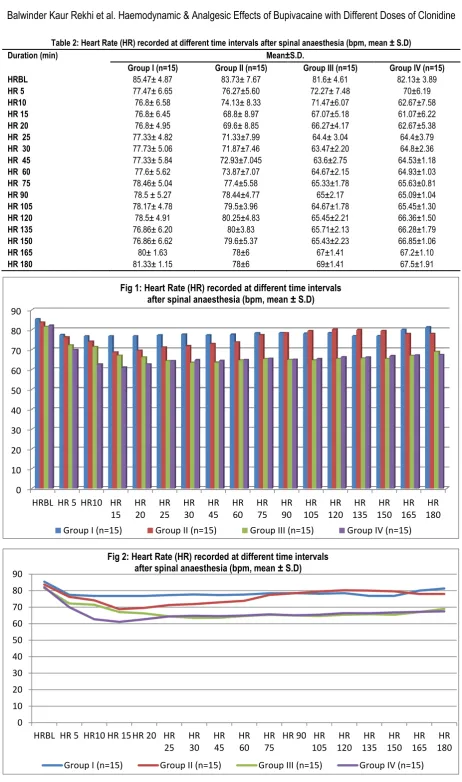
On comparison of baseline heart rate amongst all the groups p value is non-significant and decrease in heart rate was significant (p<0.05) in group II as compared to group I from 15th minute to 30th minute interval, was highly significant (p<0.01) in group III as compared to group I from 15th minute to 180th minute interval, rate was highly significant (p<0.01) in group IV as compared to group I from 5th minute to 180th minute interval, was highly significant (p<0.01) in group III as compared to group II from 25th minute to 180th minute interval, decrease in heart rate was significant (p<0.05) in group IV as compared to group II from 5th minute to 45th minute interval, was highly significant (p<0.01) in group IV as compared to group II from 60th to 180th minute interval and was non-significant (p>0.05) in group IV as compared to group III from 5th to 180th minute interval except at 10th ,15th , 20th.
Table 1: Demographic Characteristics
GROUP I GROUP II GROUP III GROUP IV
Age 41.73±11.16 40.73± 7.27 39.27± 10.09 39.67± 11.39
Weight 55.67± 4.95 57.33± 4.58 53.33± 4.88 56.00 ±5.07
Sex(M/F) 2/13 4/11 3/12 4/11
Table 2: Heart Rate (HR) recorded at different time intervals after spinal anaesthesia (bpm, mean ± S.D)
0 10 20 30 40 50 60 70 80 90
HRBL HR 5 HR10 HR 15
HR 20
HR 25
HR 30
HR 45
HR 60
HR 75
HR 90
HR 105
HR 120
HR 135
HR 150
HR 165
HR 180
Fig 1: Heart Rate (HR) recorded at different time intervals after spinal anaesthesia (bpm, mean ± S.D)
Group I (n=15) Group II (n=15) Group III (n=15) Group IV (n=15)
0 10 20 30 40 50 60 70 80 90
HRBL HR 5 HR10 HR 15 HR 20 HR 25
HR 30
HR 45
HR 60
HR 75
HR 90 HR 105
HR 120
HR 135
HR 150
HR 165
HR 180
Fig 2: Heart Rate (HR) recorded at different time intervals after spinal anaesthesia (bpm, mean ± S.D)
Group I (n=15) Group II (n=15) Group III (n=15) Group IV (n=15)
Duration (min) Mean±S.D.
Group I (n=15) Group II (n=15) Group III (n=15) Group IV (n=15)
HRBL 85.47± 4.87 83.73± 7.67 81.6± 4.61 82.13± 3.89
HR 5 77.47± 6.65 76.27±5.60 72.27± 7.48 70±6.19
HR10 76.8± 6.58 74.13± 8.33 71.47±6.07 62.67±7.58
HR 15 76.8± 6.45 68.8± 8.97 67.07±5.18 61.07±6.22
HR 20 76.8± 4.95 69.6± 8.85 66.27±4.17 62.67±5.38
HR 25 77.33± 4.82 71.33±7.99 64.4± 3.04 64.4±3.79
HR 30 77.73± 5.06 71.87±7.46 63.47±2.20 64.8±2.36
HR 45 77.33± 5.84 72.93±7.045 63.6±2.75 64.53±1.18
HR 60 77.6± 5.62 73.87±7.07 64.67±2.15 64.93±1.03
HR 75 78.46± 5.04 77.4±5.58 65.33±1.78 65.63±0.81
HR 90 78.5 ± 5.27 78.44±4.77 65±2.17 65.09±1.04
HR 105 78.17± 4.78 79.5±3.96 64.67±1.78 65.45±1.30
HR 120 78.5± 4.91 80.25±4.83 65.45±2.21 66.36±1.50
HR 135 76.86± 6.20 80±3.83 65.71±2.13 66.28±1.79
HR 150 76.86± 6.62 79.6±5.37 65.43±2.23 66.85±1.06
HR 165 80± 1.63 78±6 67±1.41 67.2±1.10
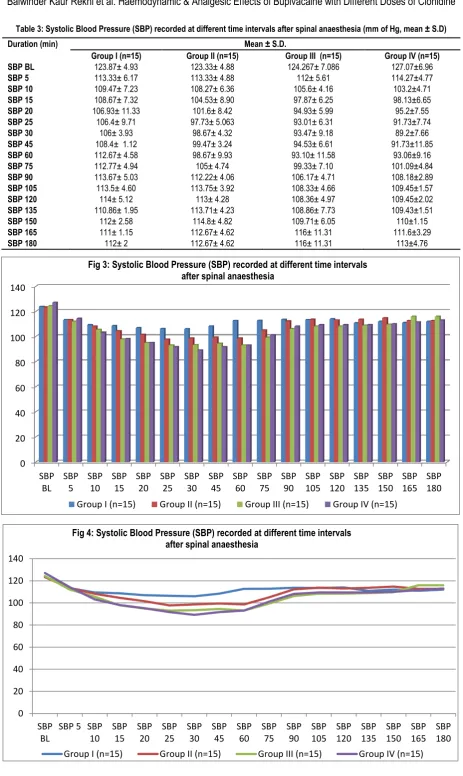
132 | P a g e Int J Med Res Prof.2017; 3(2); 129-36. www.ijmrp.com Table 3: Systolic Blood Pressure (SBP) recorded at different time intervals after spinal anaesthesia (mm of Hg, mean ± S.D)
0 20 40 60 80 100 120 140
SBP BL
SBP 5
SBP 10
SBP 15
SBP 20
SBP 25
SBP 30
SBP 45
SBP 60
SBP 75
SBP 90
SBP 105
SBP 120
SBP 135
SBP 150
SBP 165
SBP 180
Fig 3: Systolic Blood Pressure (SBP) recorded at different time intervals after spinal anaesthesia
Group I (n=15) Group II (n=15) Group III (n=15) Group IV (n=15)
0 20 40 60 80 100 120 140
SBP BL
SBP 5 SBP 10
SBP 15
SBP 20
SBP 25
SBP 30
SBP 45
SBP 60
SBP 75
SBP 90
SBP 105
SBP 120
SBP 135
SBP 150
SBP 165
SBP 180
Fig 4: Systolic Blood Pressure (SBP) recorded at different time intervals after spinal anaesthesia
Group I (n=15) Group II (n=15) Group III (n=15) Group IV (n=15)
Duration (min) Mean ± S.D.
Group I (n=15) Group II (n=15) Group III (n=15) Group IV (n=15) SBP BL 123.87± 4.93 123.33± 4.88 124.267± 7.086 127.07±6.96 SBP 5 113.33± 6.17 113.33± 4.88 112± 5.61 114.27±4.77 SBP 10 109.47± 7.23 108.27± 6.36 105.6± 4.16 103.2±4.71 SBP 15 108.67± 7.32 104.53± 8.90 97.87± 6.25 98.13±6.65 SBP 20 106.93± 11.33 101.6± 8.42 94.93± 5.99 95.2±7.55 SBP 25 106.4± 9.71 97.73± 5.063 93.01± 6.31 91.73±7.74
SBP 30 106± 3.93 98.67± 4.32 93.47± 9.18 89.2±7.66
SBP 45 108.4± 1.12 99.47± 3.24 94.53± 6.61 91.73±11.85 SBP 60 112.67± 4.58 98.67± 9.93 93.10± 11.58 93.06±9.16 SBP 75 112.77± 4.94 105± 4.74 99.33± 7.10 101.09±4.84 SBP 90 113.67± 5.03 112.22± 4.06 106.17± 4.71 108.18±2.89 SBP 105 113.5± 4.60 113.75± 3.92 108.33± 4.66 109.45±1.57
SBP 120 114± 5.12 113± 4.28 108.36± 4.97 109.45±2.02
SBP 135 110.86± 1.95 113.71± 4.23 108.86± 7.73 109.43±1.51
SBP 150 112± 2.58 114.8± 4.82 109.71± 6.05 110±1.15
SBP 165 111± 1.15 112.67± 4.62 116± 11.31 111.6±3.29
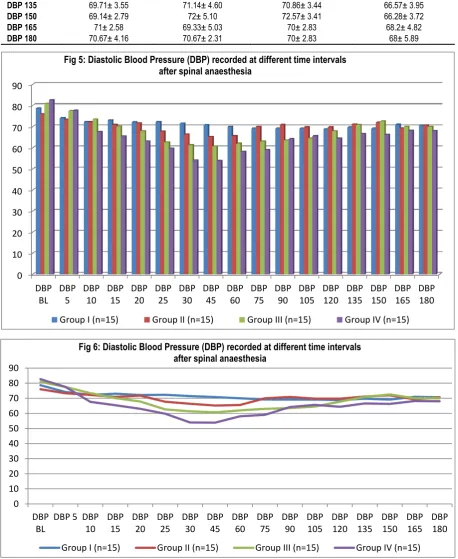
Table 4: Diastolic Blood Pressure (DBP) recorded at different time intervals after spinal anaesthesia (mm of Hg, mean ± S.D)
Duration (min) Mean ± S.D.
GroupI Group II Group III Group IV
DBP BL 78.67± 6.39 76± 6.32 80.93± 7.96 82.67± 7.03
DBP 5 74.13± 7.65 73.33± 4.64 77.46± 7.38 77.6± 6.85 DBP 10 72.26± 6.18 72.2± 4.77 73.46± 6.25 67.6± 6.49 DBP 15 73.06± 5.95 70.8± 5.89 70.13± 7.73 65.4± 6.64 DBP 20 72.13± 6.06 71.73± 5.49 67.86± 7.87 63.0± 5.71 DBP 25 72.33± 5.59 67.73± 7.12 62.66± 8.40 59.73± 5.59 DBP 30 71.47± 6.30 66.4± 6.73 61.33± 6.07 54.0± 6.07 DBP 45 70.8± 5.79 65.2± 5.49 60.69± 5.34 53.86± 7.87
DBP 60 70± 6.37 65.6± 5.14 62± 4.43 58.13± 4.71
DBP 75 69.23± 4.36 70± 5.66 63± 5.49 59.09± 4.59
DBP 90 69.17± 3.86 70.89± 5.58 63.5± 3.20 64.18± 2.08 DBP 105 69.17± 3.95 69.75± 5.39 64.5± 2.11 65.63± 2.65 DBP 120 68.83± 3.66 69.75± 6.18 67.81± 1.88 64.36± 4.27 DBP 135 69.71± 3.55 71.14± 4.60 70.86± 3.44 66.57± 3.95 DBP 150 69.14± 2.79 72± 5.10 72.57± 3.41 66.28± 3.72
DBP 165 71± 2.58 69.33± 5.03 70± 2.83 68.2± 4.82
DBP 180 70.67± 4.16 70.67± 2.31 70± 2.83 68± 5.89
0 10 20 30 40 50 60 70 80 90
DBP BL
DBP 5
DBP 10
DBP 15
DBP 20
DBP 25
DBP 30
DBP 45
DBP 60
DBP 75
DBP 90
DBP 105
DBP 120
DBP 135
DBP 150
DBP 165
DBP 180
Fig 5: Diastolic Blood Pressure (DBP) recorded at different time intervals after spinal anaesthesia
Group I (n=15) Group II (n=15) Group III (n=15) Group IV (n=15)
0 10 20 30 40 50 60 70 80 90
DBP BL
DBP 5 DBP 10
DBP 15
DBP 20
DBP 25
DBP 30
DBP 45
DBP 60
DBP 75
DBP 90
DBP 105
DBP 120
DBP 135
DBP 150
DBP 165
DBP 180
Fig 6: Diastolic Blood Pressure (DBP) recorded at different time intervals after spinal anaesthesia
134 | P a g e Int J Med Res Prof.2017; 3(2); 129-36. www.ijmrp.com On comparison of baseline SBP amongst all the groups p value is
non-significant whereas decrease in systolic blood pressure was highly significant (p<0.01) in group II as compared to group I from 25th to 75th minute interval, was highly significant (p<0.01) in group III as compared to group I from 15th to 120th minute interval, was highly significant (p<0.01) in group IV as compared to group I from 10th to 120th minute interval, was significant (p<0.05) in group III as compared to group I from 15th to 150th minute interval except at 90th and 105th minute interval where it was highly significant(p<0.01), was significant (p<0.05) in group IV as compared to group II from 10th to 150th minute interval except at 25th to 30th minute and 90th to 150th minute interval where the decrease is highly significant(p<0.01),was non-significant (p>0.05) in group IV as compared to group III from 5th to 180th minute interval except at 30th to 45th minute interval (p<0.05). The no. of patients with heart rate less than 60 (bradycardia) was statistically significant between group I and IV , group II and IV and group III and IV(p<O.O5).The no. patients having hypotension was statistically significant on comparison between group I and III, group I and IV and group II and IV.
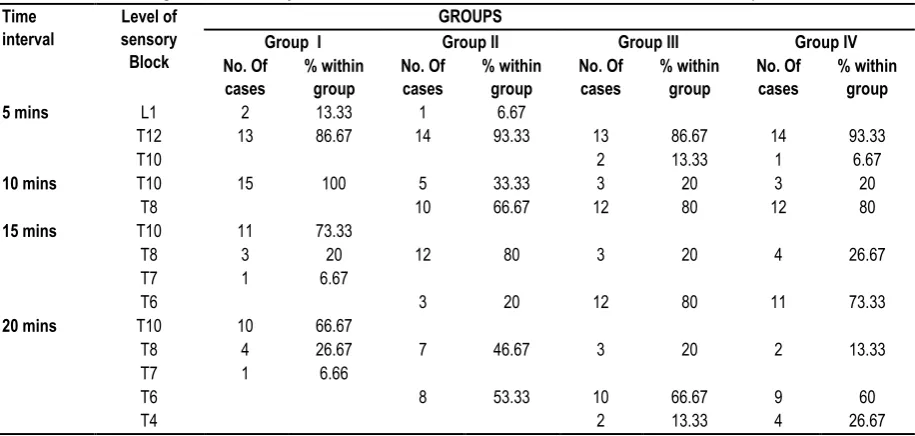
On statistical analysis level of sensory block was comparable in all the groups at 5 mins but at 10 mins on comparing group I with group II, III and IV the difference was highly significant (p<0.01).
On comparing group II with group III as well as group IV the difference was non-significant(p>0.05) and comparison between group III and group IV was also non-significant(p>0.05).At 15 mins on comparing group I with group II, III and IV the difference was highly significant (p<0.01). On comparing group II with group III and IV the difference significant(p<0.05) and comparison between group III and group IV was non-significant(p>0.05).At 20 mins on comparing group I with group II, III and IV the difference was highly significant (p<0.01). On comparing group II with group III and IV the difference was non-significant (p>0.05) and comparison between group III and group IV was non-significant (p>0.05).
AT 5, 10, 15 and 20 min interval all the groups were comparable. There was no Statistical difference obtained between these groups (p>0.05).
Duration of analgesia , as determined by the time elapsed before the first supplemental analgesic request by the patient, lasted for 198±40.96 min, 265.16±38.73 min, 334±66.47 min and 351±54.91 min in group I, II , III and IV respectively. It was statistically highly significant (p<0.01) when group I was compared to group II, III and IV. It was also highly significant (p<0.01) when group II was compared to group III and IV, but it was not significant when group III was compared to group IV (p>0.05).
Table 5: Bradycardia And Hypotension
GROUP I GROUP II GROUP III GROUP IV
Bradycardia (Y/N) O/15 2/13 4/11 11/4
Hypotension (Y/N) 0/15 2/13 5/10 11/4
Table 6: Showing Level Of Sensory Block Distribution Of Patients At 5,10,15 And 20 Minutes In Group I , II,III And IV Time
interval
Level of sensory Block
GROUPS
Group I Group II Group III Group IV
No. Of cases
% within group
No. Of cases
% within group
No. Of cases
% within group
No. Of cases
% within group
5 mins L1 2 13.33 1 6.67
T12 13 86.67 14 93.33 13 86.67 14 93.33
T10 2 13.33 1 6.67
10 mins T10 15 100 5 33.33 3 20 3 20
T8 10 66.67 12 80 12 80
15 mins T10 11 73.33
T8 3 20 12 80 3 20 4 26.67
T7 1 6.67
T6 3 20 12 80 11 73.33
20 mins T10 10 66.67
T8 4 26.67 7 46.67 3 20 2 13.33
T7 1 6.66
T6 8 53.33 10 66.67 9 60
T4 2 13.33 4 26.67
Table 7: Showing Level Of Motor Block Distribution Of Patients At 5 Minutes In Group I, II,III And IV (Bromage Scale)
Time interval
Level of Block
GROUPS
Group I Group II Group III Group IV
No. Of cases
% within group
No. Of cases
% within group
No. Of cases
% within group
No. Of cases
% within group
5 MIN III 3 20 2 13.33
IV 12 80 13 86.67 15 100 15 100
10 MIN IV 15 100 15 100 15 100 15 100
15 MIN IV 15 100 15 100 15 100 15 100
Table 8: Duration Of Analgesia In Min
Group No of patients Mean ± S.D. Range
I 15 198±40.96 120-270
II 15 265±38.73 180-330
III 15 334±66.47 225-420
IV 15 351±54.91 240-420
DISCUSSION
Clonidine is known to increase both sensory and motor blockade of local anaesthetics.5 Intrathecal clonidine has been used as an adjuvant to local anaesthetics in various surgical procedures without any clinically significant side effects.6 Previous studies have described the use of clonidine in a wide range (15µg-150µg). However best regimen remains unknown.
The present study was done to assess the haemodynamic response and post-operative analgesia provided by low dose (0.5, 0.75,1.0μg/kg body weight) intrathecal clonidine admixed with 0.5%hyperbaric bupivacaine as compared to 0.5% hyperbaric bupivacaine alone in patients undergoing gynaecological and other lower abdominal surgeries. Clonidine is known to exert its
hemody namic effects by acting at several sites, either in the central
nervous system or in the periphery. Clonidine decreases the heart rate by a presynaptic mediated inhibition of nor- epinephrine release and by direct suppression of atrioventricular node after systemic absorption. Our findings were in consonance with the study by B.S. Sethi et al 2007 in which he observed that the decrease in mean heart rate from 45 minutes until the end of 6 hours was greater in clonidine group than in the control group (p<0.001).1
Similar results were shown by Grandhe et al 2008 in which the mean heart rate was significantly lower in clonidine group compared to control group between 105 min to 8hrs following intrathecal drug administration.7
It has been demonstrated that intrathecal clonidine has depressed effect on systemic blood pressure, mediated by spinal α2 adreno receptors.
In our study the mean basal values of SBP and DBP for all the groups were statistically comparable. There was significant fall in SBP and DBP in group II, III and IV as compared to group I (P<0.05). The fall in blood pressure showed a similar trend in SBP and DBP.
Similar results were shown by Kriton et al 1992 who recorded significant decrease in mean arterial pressure in the clonidine group than in the control group from 20 to 120 min. He observed that the mean arterial pressure was significantly less compared to the baseline value (89.7±16.2mmHg) between 60 and 360 min, with a maximum decrease (18.2±11.7%) recorded at 90 min. It was also observed that the diastolic arterial pressure decreased significantly after intrathecal clonidine compared to control group from 15 to 120 min.8
Our observations were similar to that by Dobrydnjov et al 2003. In this study it was observed that significant decrease in systolic and diastolic blood pressure occurred at 45-120 min after spinal injection in groups BC15 (6mg 0f 0.5% bupivacaine +15μg clonidine) and BC30 (6mg 0f 0.5% bupivacaine +30μg clonidine) than in group B (6mg 0f 0.5% bupivacaine).9
Our findings were also in consonance with the study by B.S. Sethi et al 2007 where they recorded significant fall in mean arterial pressure in the clonidine group as compared to the control group from 45 minutes to end of 6 hours.1
Grandhe RP et al 2008 also observed significant decrease in mean arterial pressure in groups BC1 (1.5ml of 0.5% heavy bupivacaine +clonidine 1μg/kg) and BC2 (1.5ml of 0.5% heavy bupivacaine +clonidine 1.5μg/kg) as compared to group B from 45 min to 8 h after intrathecal injection.7
Duration of analgesia, as determined by the time elapsed before the first supplemental analgesic request by the patient, lasted for 198±40.96 min, 265.16±38.73 min, 334±66.47 min and 351±54.91 min in group I, II, III and IV respectively. Similar results were observed by studies.1,7
CONCLUSION
To conclude, three doses (0.5, 0.75, 1.0 μg/Kg) are effective in increasing the duration of analgesia and the time to first analgesic request in the post-operative period. These doses do have an effect on systolic, diastolic blood pressure and heart rate of the patients.
The addition of clonidine to bupivacaine yields long lasting, profund pain relief, although hemodynamic effects require careful monitoring. Number of patients having bradycardia were 11 & 4 in group IV & III respectively and number of patients having hypotension were 11 & 5 in group IV & III respectively.
In conclusion our study demonstrates that addition of 0.75 μg/Kg of clonidine to intrathecal bupivacaine is safe as compared to 1.0 μg/Kg. By using small dose of intrathecal clonidine side effects were not increased whereas intrathecal clonidine at the usual dose of 1μg/kg is associated with bradycardia and relative hypotension. So, 0.75 μg/Kg of clonidine is the preferred dose for addition to 0.5% hyperbaric bupivacaine in patients undergoing gynaecological and lower abdominal surgeries.
REFERENCES
1. Shetty PS, Picard J. Adjuvant agents in regional anaesthesia. Anaesthesia and intensive care medicine 2006;7(11):407-10.
2. Harbhej Singh, Jin Liu, George Y. Effects of oral clonidine and intrathecal fentanyl on tetracaine spinal block. Anesth Analg, 1994; 79:1113-6.
3. Gaumann DM, Brunet PC, Jirounek P. Clonidine enhances the effects of lidocaine C fibers action potential. Anesth Analg, 1992; 74: 719-25.
4. Bromage PR. Philadelphia: WB Saunders;1978:144.
136 | P a g e Int J Med Res Prof.2017; 3(2); 129-36. www.ijmrp.com 6. Van Tuijl, W. A. van Klei, D. B. M. van der Werff and C. J.
Kalkman. The effect of addition of intrathecal clonidine to hyperbaric bupivacaine on postoperative pain and morphine requirements after Caesarean section: a randomized controlled trial. British Journal of Anaesthesia 97 (3): 365–70
7. Grandhe RP, Wig J, Yaddanapudi LN. Evaluation of bupivacaine – clonidine combination for unilateral spinal anaesthesia in lower limb orthopaedic surgery. J Anaesth Clin Pharmacol 2008; 24(2):155-158.
8. Kriton S. Filos, Leo nidas C. Goudas, Ourania Patroni, Vassiliki Polyzou. Intrathecal clonidine as a sole analgesia for pain relief after caesarean section. Anaesthesiology 77; 267-274. 1992. 9. Dobrydnjov, K. Axelsson, S. E. Thron, P. Matthiesen, H. Klockhoff, B. Holmstrom and A. Gupta Clonidine combined with small dose bupivacaine during spinal anaesthesia for inguinal herniorrhaphy: a randomized double blinded study. Anesth Analg 2003; 96:1496-1503.
[
Source of Support: Nil. Conflict of Interest: None Declared.
Copyright: © the author(s) and publisher. IJMRP is an official publication of Ibn Sina Academy of Medieval Medicine & Sciences, registered in 2001 under Indian Trusts Act, 1882. This is an open access article distributed under the terms of the Creative Commons Attribution Non-commercial License, which permits unrestricted non-commercial use, distribution, and reproduction in any medium, provided the original work is properly cited.