Original Research Article.
A Comparative Study of Preincisional Infiltration of Levobupivacaine 0.2%
and Ropivacaine 0.375% for Postoperative Analgesia after
Abdominal Surgery under General Anesthesia
Narendra Singh Deval
1*, Durga Jethava
2, Sudhir Sachdev
3, D. D. Jethava
31*PG Resident, 2Professor and Head, 3Professor,
Department of Anaesthesia, Mahatma Gandhi Medical College & Hospital, Jaipur, Rajasthan, India. ABSTRACT
Introduction: Pre-emptive analgesia is defined as
administration before surgical incision that prevent the development of central sensitization of incisional injury or inflammatory injuries (i.e. intraoperative and postoperative period). The aim of our study was to compare the analgesic potency of preincisional tissue infiltration with ropivacaine and levobupivacine in treating pain after abdominal surgeries.
Materials and Methods: The present observational study was
conducted among 90 patients posted for major abdominal surgery under general anaesthesia. Patients were randomly allocated into three groups of 30 patients each to compare the duration of postoperative analgesia with preincisional infiltration of levobupivacaine 0.2%, ropivacaine 0.375% and placebo in patients undergoing abdominal surgeries under general anaesthesia. Preincisional surgical field infiltration was done with study drug 20 ml of levobupivacaine, ropivacaine or normal saline by the operating surgeon after tracheal intubation. Statistical analysis was performed with the SPSS- 23. Groups were compared for quantitative data, presented as mean, standard deviation and by using students t-test. Probability P value <0.05 was considered statistically significant.
Results: The study demonstrated that preemptive analgesia given by preincisional infiltration with both the study drugs, has a significant and beneficial effect on postoperative pain in the first 24 hours following in abdominal surgeries. In the present study, 16.66% of patients who received levobupivacaine, and 6 % of patients who received ropivacaine required rescue
analgesic tramadol in 8 hours-12 hours interval and 13.33% patients of group L and 6.66% patients of group R required rescue analgesia in 12 hours – 24 hours interval in postoperative period. 6.66% of patients in groups L and 3.33% of patients in group R required rescue analgesic at 24 hours in postoperative period. But 73.33% patients of group C require rescue analgesic at 20-30 min interval and 26.66% patients of this group require analgesic dose at 30min- 60 min interval.
Conclusion: Tissue infiltration with ropivacaine 0.375% or levobupivacaine 0.2% appears similarly effective in reducing the postoperative pain associated with abdominal surgeries under general anesthesia compared to patients receiving normal saline.
Keywords: Analgesia; Pain; Preincisional Infiltration.
*Correspondence to:
Dr. Narendra Singh Deval,
PG Resident,
Department of Anaesthesia,
Mahatma Gandhi Medical College & Hospital, Jaipur, Rajasthan, India.
Article History:
Received: 06-12-2017, Revised: 04-01-2018, Accepted: 28-01-2018 Access this article online
Website:
www.ijmrp.com
Quick Response code
DOI:
10.21276/ijmrp.2018.4.1.126
INTRODUCTION
Pain is defined by taxonomy committee of International Association for the Study of pain (IASP) as an unpleasant sensory and emotional experience associated with actual or potential tissue damage or described in terms of such damage.1 It is an
unpleasant subjective sensation. Sensation is often described as either protopathic (noxious) or epicritic (non noxious). Epicritic sensation (light touch, pressure, proprioception and temperature discrimination) is described as low threshold receptors (specialized end organs on the different neurons) and conducted by large myelinated nerve fibers while; protopathic sensation
(pain) is sub served by high threshold receptors (free nerve endings).2
of response to doses of opioids used in the postoperative period.3
Pre-emptive analgesia is defined as administration before surgical incision that prevent the development of central sensitization of incisional injury or inflammatory injuries (i.e. intraoperative and postoperative period). The experimental data and positive clinical trials strongly recommonds that preemptive analgesia is a clinically relevant phenomenon. “Maximum benefit is observed when there is complete blockade of noxious stimuli.4
There is less work done regarding pre-emptive analgesia in abdominal surgeries so we decided to explore this area. In the context of present study was conducted to compare the duration of postoperative analgesia with preincisional infiltration of levobupivacaine 0.2%, ropivacaine 0.375% and placebo in patients undergoing abdominal surgeries under general anaesthesia.
MATERIALS AND METHODS
The present prospective hospital based double blind comparative type of observational study was conducted among 90 patients posted for major abdominal surgery under general anaesthesia under the department of anesthesiology and department of general surgery, Mahathma Gandhi Medical College and hospitals, Jaipur.
Patients were randomly allocated into three groups of 30 patients each to compare the duration of postoperative analgesia with preincisional infiltration of levobupivacaine 0.2%, ropivacaine 0.375% and placebo in patients undergoing abdominal surgeries under general anaesthesia.
Permission was taken from Research Review Board & Informed consent was obtained for performance of general anaesthesia after complete explanation about the study protocol and the procedure. Patients with ASA grade I and II aged 20 to 60 years with body wt. 40 to 80 kg of either sex having normal ECG, normotensive undergoing surgery under general anaesthesia were included in the study.
The sample size was calculated at 80% study power and α(alpha) error 0.05 assuming variability (S.D.) of 17 points in 90 points VAS score as found in reference study. 5 Randomization was done by
CHIT IN BOX method. A total of 90 chits (30 per group were made; each chit mentioned a particular study group and the patient was asked to pick up a chit from the box. Patient was allocated to group mentioned on the chit.
Among the patients posted for abdominal surgery the first 90 patients fulfilling eligibility criteria and ready to provide an informed written consent were randomly divided into three groups of 30 each according to drug used.
Patient received pre incisional surgical field infiltration with study drug by the operating surgeon immediately after tracheal intubation.
▪ Ropivacaine (Group R) n=30 - patients received 10 ml of Ropivacaine 0.75% diluted with 10 ml normal saline 0.9% (total volume 20 ml).
▪ Levobupivacaine (Group L) n=30 - patients received 8ml of levobupivacaine 0.5% diluted with 12 ml normal saline 0.9% (total volume 20 ml).
▪ Normal saline (Group C) n= 30- patients received 20 ml normal
Randomization was done by chit in box method (30 A chits + 30 B chits +30 Cchits), kept in a box shuffling random
picking allocation to either group by an anaesthesiologist according to chit.
All patients were visited on the day prior to surgery and explained about the anaesthetic technique and preoperative course. Each patient had a pre-anaesthetic checkup. On arrival in the operation theatre, fasting status, consent and PAC was checked. Routine noninvasive monitors were attached and baseline parameters i.e. heart rate (HR), Systolic blood pressure (SBP), Diastolic blood pressure (DBP), Mean arterial pressure (MAP), SpO2 & ECG were
noted. Intravenous line was secured and i.v. fluid R.L. started. Patients were premedicated with inj.Glycopyrolate 0.2mg iv, inj.Midazolam 1mg iv, inj.Fentanyl 2mcg/kg iv. Preoxygenation was done with 100% oxygen for 3 minutes. Patient was induced with inj.Propofol 2mg/kg iv administered until loss of eyelash reflex, followed by inj.Succinylcholine 1.5mg/kg iv and ventilated with 100% oxygen. Direct laryngoscopy was done and patient was intubated with appropriate size E.T.T. Bilateral air entry was checked & tube fixed.
Preincisional surgical field infiltration was done with study drug 20 ml of levobupivacaine, ropivacaine or normal saline by the operating surgeon after tracheal intubation. Then surgery was allowed to commence after 15 min & anaesthesia was maintained. Intraoperative H.R, SpO2was monitored continuously. Any
complication such as laryngospasm, bronchospasm or desaturation was managed according to the standard protocols. Post-operative 24 hour monitoring protocol was followed
Visual analog scale involves use of 10 cm line divided into 10 equal parts, wherein one end of the line represents worst imaginable pain while the other end represents no pain at all.
• Score 0 - No pain • Score 1,2,3 - mild pain • Score 4,5,6 - moderate pain • Score 7,8,9 - severe pain • Score 10 - worst imaginable pain Statistical analysis was performed with the SPSS, Trial version 23 for Windows statistical software package (SPSS inc., Chicago, il, USA) and Primer. The Categorical data were presented as numbers (percent) and were compared between groups using Chi square test. Groups were compared for quantitative data, presented as mean, standard deviation and by using students t-test. Probability P value <0.05 was considered statistically significant.
RESULTS
Minimum and maximum ages were 20 and 60 years respectively. Difference in age between groups was not statistically significant (p value >0.05). Patients in the groups were evenly distributed and no significant difference was found with respect to age gender and weight. (p value >0.05).
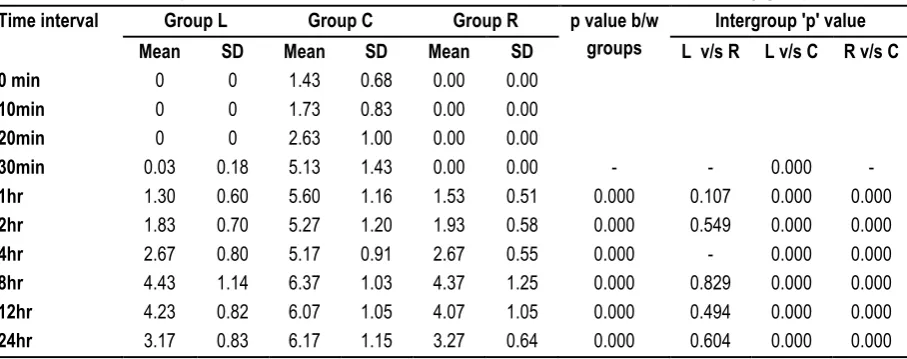
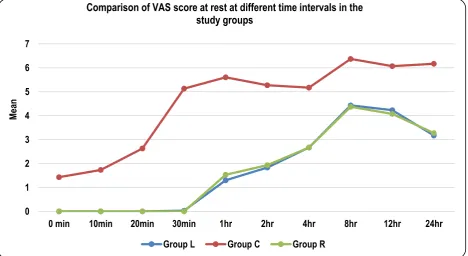
Analysis for the VAS pain score at rest is presented in table 1 and graph 1. The VAS pain scores at different time intervals in postoperative period did not differ significantly between the groups (p>0.05) but the VAS pain score between (group L and Group C) and group (R & C) differ significantly. (p<0.05)
Table 1: Comparison of VAS score at rest at different time intervals in the study groups
Time interval Group L Group C Group R p value
b/w roups
Intergroup 'p' value
Mean SD Mean SD Mean SD L v/s R L v/s C R v/s C
0 min 0 0 0.48 0.63 0.00 0.00 - - - -
10min 0 0 0.77 0.77 0.00 0.00 - - - -
20min 0 0 1.70 0.88 0.00 0.00 - - - -
30min 0 0 4.37 1.19 0.00 0.00 - - - -
1hr 0 0 4.67 1.24 0.13 0.35 0.000 - - 0.000
2hr 0.57 0.50 4.27 1.20 0.67 0.48 0.000 0.434 0.000 0.000
4hr 1.13 0.73 4.17 0.91 1.30 0.70 0.000 0.371 0.000 0.000
8hr 3.10 0.48 5.57 1.30 3.17 0.46 0.000 0.585 0.000 0.000
12hr 2.63 0.81 5.30 1.37 2.63 0.67 0.000 - 0.000 0.000
24hr 1.73 0.98 5.30 1.44 1.83 0.79 0.000 0.665 0.000 0.000
Graph 1: Graphical representation of comparison of VAS score at rest at different time intervals in the study groups
Table 2: Comparison of VAS scores at ambulation at different time intervals in the study groups
Time interval Group L Group C Group R p value b/w
groups
Intergroup 'p' value
Mean SD Mean SD Mean SD L v/s R L v/s C R v/s C
0 min 0 0 1.43 0.68 0.00 0.00
10min 0 0 1.73 0.83 0.00 0.00
20min 0 0 2.63 1.00 0.00 0.00
30min 0.03 0.18 5.13 1.43 0.00 0.00 - - 0.000 -
1hr 1.30 0.60 5.60 1.16 1.53 0.51 0.000 0.107 0.000 0.000
2hr 1.83 0.70 5.27 1.20 1.93 0.58 0.000 0.549 0.000 0.000
4hr 2.67 0.80 5.17 0.91 2.67 0.55 0.000 - 0.000 0.000
8hr 4.43 1.14 6.37 1.03 4.37 1.25 0.000 0.829 0.000 0.000
12hr 4.23 0.82 6.07 1.05 4.07 1.05 0.000 0.494 0.000 0.000
24hr 3.17 0.83 6.17 1.15 3.27 0.64 0.000 0.604 0.000 0.000
0 1 2 3 4 5 6
0 min 10min 20min 30min 1hr 2hr 4hr 8hr 12hr 24hr
M
ea
n
Comparison of VAS score at rest at different time intervals in the study groups
Graph 2: Graphical representation of comparison of VAS scores at ambulation at different time intervals in the study groups.
Table 3: Comparisons of first rescue analgesic need time in the study groups.
Rescue analgesic need time Group L No (%) Group C No (%) Group R No (%)
0-10 min 0(0) 0 0
11-20 min 0(0) 0 0
21-30 min 0(0) 22 (73.33) 0
31 min-1hr 0(0) 8 (26.66) 0
1hr-2hr 0(0) 0 0
2hr-4hr 0(0) 0 0
4hr-8hr 5(16.66) 0 6(20)
8hr -12hr 4(13.33) 0 2(6.66)
12hr-24hr 2(6.66) 0 1(3.33)
Graph 3: Graphical representation of comparisons of first rescue analgesic need time in the study groups. 0
1 2 3 4 5 6 7
0 min 10min 20min 30min 1hr 2hr 4hr 8hr 12hr 24hr
M
ea
n
Comparison of VAS score at rest at different time intervals in the
study groups
Group L Group C Group R
0 5 10 15 20 25
0-10 min 11-20 min 21-30 min 31 min-1hr 1hr-2hr 2hr-4hr 4hr-8hr 8hr -12hr 12hr-24hr
Nu
m
ber
o
f ca
se
s
Comparison of VAS score at rest at different time intervals in the
study groups
No significant difference was seen between the need for first rescue analgesic in group R and group L but group C required rescue analgesic at earlier time (table 3 and graph 3). First rescue analgesic required in 73.33% patients at 30 min and 26.66% patients at 1hr in group C. First rescue analgesic required at 8 hours in 16.66% patients of group L and 20% patients of group R. First rescue analgesic required at 12 hr in 13.3% patients of group L and 6.66% of patients in group R. First rescue analgesic required at 24 hrs in 6.66% patients of group L and 3.33% patients of group R.
DISCUSSION
Recent understandings in pre-emptive analgesia have defined it as an intervention given before incision or surgery, which makes it more effective than the same treatment administered after incision or surgery.4,6 It is important to remember the timing of pre-emptive
analgesia. It is an anti-nociceptive treatment given prior to incision or surgery. This helps to prevent the development of altered processing of afferent input, which would otherwise amplify postoperative pain.7
The aim of our study was to compare the analgesic potency of preincisional tissue infiltration with ropivacaine and levobupivacine in treating pain after abdominal surgeries. We demonstrated that preemptive analgesia given by preincisional infiltration with both the study drugs, has a significant and beneficial effect on postoperative pain in the first 24 hours following in abdominal surgeries. In the present study, 16.66% of patients who received levobupivacaine, and 6% of patients who received ropivacaine required rescue analgesic tramadol in 8 hours-12 hours interval and 13.33% patients of group L and 6.66% patients of group R required rescue analgesia in 12 hours – 24 hours interval in postoperative period. 6.66% of patients in groups L and 3.33% of patients in group R required rescue analgesic at 24 hours in postoperative period. But 73.33% patients of group C require rescue analgesic at 20-30 min interval and 26.66% patients of this group require analgesic dose at 30min- 60 min interval.
The VAS scores were monitored postoperatively for 24 hours after completion of surgery. VAS scores increased gradually as time elapsed after the completion of surgery. Our study demonstrated similar VAS scores at different time intervals postoperatively both at rest and at ambulation in the study groups. This was in concordance to the findings of Bicer C et al5 who included 60
patients in their study and divided into two groups of 30 patients each. One received 0.375% Ropivacaine and the other received 0.25% Levobupivacaine for local tissue infiltration combined with general anesthesia. This improved significantly the management of postoperative pain for patients who underwent septorhinoplasty. Another study conducted by Tverskoy M et al8 also supported our
results. They compared postoperative pain characteristics in 3 different groups: (a) patients receiving GA alone; (b) patients receiving GA and LA infiltration; and (c) patients receiving GA combined with spinal anesthesia. A significant reduction in postoperative hyperalgesia in the second and third groups was reported and regional anesthesia combined with GA was found to reduce postoperative pain. Our results are also comparable to finding of Ejlersen et al9 who published similar results showing
significant delay in analgesic remedication in a group receiving preincision local infiltration for hemorrhoidectomy. Another study conducted by Pettersson N et al10 compared the pain relief by
wound infiltration with bupivacaine or high-dose ropivacaine after inguinal hernia repair in 144 patients. They divided the patients in two groups and the operating field was infiltrated with 40 mL ropivacaine7.5 mg/mL (in = 73) or bupivacaine 2.5 mg/mL (n = 71 ) for postoperative analgesia. Pain at rest, on mobilization and on coughing was assessed repeatedly during 24 hours using a visual analog scale. They found that no statistically significant differences were found between the two groups in terms of pain scores similar to our study.
Our results are also in concordance with Fayman M et al11 who
compared the bupivacaine and ropivacaine for infiltration analgesia for bilateral breast surgery in 15 patients. Either bupivacaine or ropivacaine was infiltrated into each of the breasts of 15 patients who underwent either breast augmentation or breast reduction. They found that overall analgesia achieved with bupivacaine and ropivacaine infiltrations was not statistically different. Our study validates the findings of Sakellaris Get al12
who compared effects of ropivacaine infiltration on cortisol and prolactin responses to postoperative pain after inguinal hernioraphy in 45 children who underwent inguinal hernia repair under general anesthesia. They found that infiltration with ropivacaine decreases the stress response to surgery and the postoperative pain.
Our findings also match with the results of Cnar SO et al13 who
compared the postoperative analgesic effects of preincisional and postincisional wound infiltration with levobupivacaine in 96 children following inguinal hernia repair under GA. They concluded that infiltration with levobupivacaine after induction of general anaesthesia and before the end of the surgery both provided postoperative pain relief following hernia repair and decreased the stress response to postoperative pain.
Our results are also supported by Kasapoglu F et al14 who
conducted a study to evaluate the efficacy of levobupivacaine infiltration into the post-tonsillectomy analgesia in 40 adults. Patients were divided in two groups, study group which received levobupivacaine infiltration to peritonsillary fossae prior to surgery or control group with no medication. They found that there were significant differences between the groups regarding pain scores for the first 24 hours with lower scores in the study group. Another study by Song J et al15 conducted among 60 patients also
validates our results. They compared the analgesic efficacy of preemptive scalp infiltrations with 1% lidocaine and 0.5% ropivacaine on the postoperative pain after craniotomy. Patients were divided in two groups. In group A, local anesthetic was injected throughout the entire thickness of the scalp before skin incision. In group B, it was injected before skin closure. They found that postoperative pain scores were lower in group A than in group B within the first 6 h after surgery.
Our results were different from findings of Papagiannopoulou et al16 who compared the analgesic efficacy of 20 ml ropivacaine 1%
significantly lower VAS scores (p < 0.001) than the Placebo group at 4 h postoperatively. This may be due to difference in concentration of the study drugs.
In order to blunt surgical stress response an optimal intraoperative analgesia is recommended. The evidence concerning the effect of preemptive analgesia on chronic pain states is sparse and further research is warranted.
It should be emphasized that VAS scores and other measures of pain may be influenced by side effects and other confounding variables and may not be reliable as the sole measure in the study of pre-emptive analgesia. Furthermore, various psychosocial variables have been shown to influence pain experience of varying duration, but they have not been evaluated in studies of pre-emptive analgesia. Assessment of such factors ‘may help to shed light on the processes involved in recovery from post-surgical pain.17
Using fentanyl during the induction of anesthesia might have been a limitation of this study, because of its intraoperative hemodynamic stabilization effects by increasing the depth of anesthesia and decreasing sympathetic discharge.
CONCLUSION
The present study concluded that both ropivacaine and levobupivacaine effectively controlled the postoperative pain after lower abdominal surgeries. Tissue infiltration with ropivacaine 0.375% or levobupivacaine 0.2% appears similarly effective in reducing the postoperative pain associated with abdominal surgeries under general anesthesia compared to patients receiving normal saline.
REFERENCES
1. Merskey H, Bogduk N. Part III: Pain Terms, A Current List with Definitions and Notes on Usage recommended by the IASP subcommittee on Taxonomy. Pain. 2012; 6:209-214.
2. Morgan GE, Mikhail Ms, Murray MJ. Clinical anesthesiology. 4th edition ; USA: McGraw Hill; 2006
3. Macrae WA. Chronic pain after surgery. British Journal Anesthesia.2001; 87: 88.
4. Moiniche S, Kehlet H, Dahl JB. A qualitative and quantitative systematic review of pre-emptive analgesia for postoperative pain relief: the role of timing of analgesia. Anesthesiology. 2002; 96: 725–741.
5. Bicer C, Eskıtascıoglu T, Aksu R, Ulgey A, Yildiz K, Madenoglu H. Comparison of Preincisional Infiltrated Levobupivacaine and Ropivacaine for Acute Postoperative Pain Relief After Septorhinoplasty. Current Therapeutic Research, Clinical and Experimental.2011 Feb; 72(1):13–22.
6. Katz J, McCartney CJ. Current status of pre-emptive analgesia. Curr Opin Anaesthesiol. 2002;15:435–441.
7. Kissin I. Pre-emptive analgesia. Anesthesiology. 2000;93:1138– 1143.
8. Tverskoy M, Cozacov C, Ayache M, Bradley EL, Kissin I. Postoperative pain after inguinal herniorrhaphy with different types of anesthesia. AnesthAnalg. 1990;70:29–35. [PubMed]
9. Ejlersen E, Andersen HB, Eliasen K, Mogensen T. A comparison between preincisional and postincisionallidocaine infiltration and postoperative pain. AnesthAnalg. 1992;74:495– 498. [PubMed]
10. Pettersson N, Berggren P, Larsson M, Westman B, Hahn RG. Pain relief by wound infiltration with bupivacaine or high-dose ropivacaine after inguinal hernia repair.RegAnesth Pain Med. 1999 Nov-Dec;24(6):569-75
11. Fayman M, Beeton A, Potgieter E, Becker PJ. Comparative analysis of bupivacaine and ropivacaine for infiltration analgesia for bilateral breast surgery.Aesthetic Plast Surg. 2003 Mar-Apr;27(2):100-3.
12. Sakellaris G, Petrakis I, Makatounaki K, Arbiros I, Karkavitsas N, Charissis G. Effects of ropivacaine infiltration on cortisol and prolactin responses to postoperative pain after inguinal hernioraphy in children.J Pediatr Surg. 2004 Sep;39(9):1400-3. 13. Cinar SO, Kum U, Cevizci N, Kayaoglu S, Oba S. Effects of levobupivacaine infiltration on postoperative analgesia and stress response in children following inguinal hernia repair. Eur J Anaesth. 2009; 26:430-434.
14. Kasapoglu F, Demir UL, Kaya FN, Cetin YS, Yavascaoglu B. The effects of levobupivacaine infiltration on post-tonsillectomy pain relief in adults: a single-blinded, randomized, and controlled clinical study.Eur Arch Otorhinolaryngol. 2013Feb;270(2):761-6. 15. Song J, Li L, Yu P, Gao T, Liu K ,Preemptive scalp infiltration with 0.5% ropivacaine and 1% lidocaine reduces postoperative pain after craniotomy. ActaNeurochir (Wien). 2015 Jun;157(6):993-8.
16. Papagiannopoulou P, Argiriadou H, Georgiou M, et al. Preincisional local infiltration of levobupivacainevsropivacaine for pain control after laparoscopic cholecystectomy. Surg Endosc.2003;17:1961–1964.
17. Jorgen B. Dahl and Steen Møiniche, Pre-emptive analgesia Br Med Bull (2004) 71 (1): 13-27.
[
Source of Support: Nil.
Conflict of Interest: None Declared.
Copyright: © the author(s) and publisher. IJMRP is an official publication of Ibn Sina Academy of Medieval Medicine & Sciences, registered in 2001 under Indian Trusts Act, 1882. This is an open access article distributed under the terms of the Creative Commons Attribution Non-commercial License, which permits unrestricted non-commercial use, distribution, and reproduction in any medium, provided the original work is properly cited.