Analysis and Determination of Inner Lip Texture
Descriptors for Visual Speech Representation
Xibin Jia
College of Computer Science, Beijing University of Technology, Beijing, China Email: [email protected]
Hua Du and Yanfang Han
College of Computer Science, Beijing University of Technology, Beijing, China Email: [email protected], [email protected]
David M W Powers
College of Computer Science, Beijing University of Technology, Beijing, China
School of Computer Science, Engineering & Mathematics, Flinders University, Adelaide, Australia Email: [email protected]
Abstract—The problem of visual speech representation for bimodal based speech recognition includes particular challenges in the modeling of the inner lip texture reflecting different pronunciations, such as the appearance of teeth and tongue. This paper proposes and analyzes several possible statistical inner lip texture descriptors to determine an effective and discriminant feature. Simply using grayscale without full specification of the underlying colour model tends to loss some significant discriminative information. Therefore thorough exploration on the color space components selection in computing the local inner lip texture is thus a primary goal of the present research. The L channel of Lab color space is finally determined as the basis for the development of the inner lip texture model. Through feature level fusion, the final classification of visual speech is performed based on the proposed inner lip texture descriptor and standard geometric features. Together with audio speech, this paper furthers the development of the CHMM based bimodal Chinese character pronunciation recognition system. The experimental results show that the local inner texture descriptors, such as the color moment with geometric feature, outperform the holistic inner texture descriptors, such as the statistical histogram, in representing visual speech with the close discriminability but low dimensionality.
Index Terms—inner lip texture descriptor, local feature, feature fusion, visual speech representation
I. INTRODUCTION
Speech recognition is one of the fundamental technologies in natural human computer interaction. Traditional speech recognition technologies have achieved higher recognition rate of words or phrases for a noise environment. However, for use in a realistic environment, the recognition performance is compromised because of factors such as the background noise and the complexity of the auditory and
reverberatory environment[1,2]. Indeed psychological research results suggest that only 11% percent of information comes from audio speech and 83% from the visual modality for human speech understanding[3]. Thus, bimodal or multimodal speech recognition is critical for effective improvement of the rate and robustness of speech recognition, as it is necessary to use both the complementary information (one modality strongly better) and the redundant information (balanced strength across modalities) in order to exploit their different artefact and noise properties – what is redundant under perfect conditions can provide critical information under noisy, degraded or impoverished conditions.
Traditional speech recognition focuses exclusively on auditory information[4], while this paper concentrates on improving the ability to extract visual speech information. Currently there are two major categories to visual feature for speech.
The first class of algorithm focuses on geometric-based feature such as lip contour. This category of techniques employ algorithms such as ASM (Active Shape Model) [5], snake algorithms [6] and AAM (Active Appearance Model) [7] to track interested points or contours to compute the geometric feature such as lip width and lip height (of either or both the outer and inner lip). Zhang [8] shows that inner contour information has good performance in representing visual speech by improving the recognition rate of 11%. Zhi [9,10] makes comprehensive comparison among geometric features such as pixel counts for outer lip width (X), height (Y), area of outer lip surround region, along with the angle at the lip corners (θ), the outer aspect ratio Y/X, and first-order derivatives or differences of the above features. The experiment results prove that combination feature such as X-Y-dθ/dt gives the best recognition results.
such as PC (discrete co wavelet tran have higher visual speec redundancy i Chan [13] of mouth he profile as a tracking, sho by both aver box (in a sm task). Merse state of teeth two addition tongue states teeth or tongu
Eric Benh representatio local interes oriented gra optical flow in selection (appearance orders. Topk obtain mult approaches, techniques to Geometric dimension a illumination. the visibility describing s complex info description, aspects of the
In view of paper adopts local texture explore the together with opening widt features are comparing ex form. We th CHMM (cou recognition s features.
The rema Section II in visual speec comprehensi effective inn the adopted introduces ou pronunciation performance Conclusions section. CA (principle osine transfor nsformation) dimensionali ch representa in revealing th ] presents a h eight and wid a surrogate f owing immen rage intensity mall single-sp
ereau [8] also h and tongue
nal compone s with 0 repre
ue, with the re haim etc.[14] p on based on h sted region adient (HOG
(HOF). Multi n and com and motion) kaya [15] etc tiple visual
discriminant o improve the c features h and robustne
But, it canno y of tongue o speech. Holi formation but whilst the lo e target states f the limitatio s a joint featu e information local texture h general geom
th and height e proposed xperiments ar hus used sev uple hidden M
system to ana
aining parts ntroduces our ch features. S
ive compariso ner lip texture d color spa ur CHMM-ba n recognitio
of possib and Future W
e component rmation) and [11,12]. But ity and are n
ation or the he visual spee hybrid techniq dth plus a no for detailed t nse sensitivity and tracking eaker isolated o discusses t in describing nts to expre esenting invis ecognition rat proposed a no histogram-bas by computin G) and histog iple kernel lea mbination of structured fe c. uses multi
tandem fe t classifiers
understanding have the ad
ss to both ot reveal speak or teeth, whic istic features it is not opti ocal texture c but missing t ns of each tec ure vector w n combined.
representatio metric feature t. Several pos or used an re done to dete
veral differen Markov Mode alyze the effe
of the paper r computation Section III pr on experiment representatio ace compone
ased bimodal n system a ble visual Work are disc
t analysis), d DWT (dis these approa not specialized e exploitation ch characteris que that makes
rmalized inte tooth and to y to normaliz contour boun d digit recogn the importanc the speech, u ess the teeth
sible and 1 vi te increase 5% ovel visual sp sed descriptor ng histogram grams of orie arning is empl a discrim atures of diff iple classifier atures. In t are one of g of visual spe dvantage of
face gesture king states suc ch is importa s have rich
imized for sp can correlate the outline. chnique alone
ith geometric We specifi n of the inne s in describin sible inner tex nd comprehen ermining the b nt features in el) bimodal sp ectiveness of
r are as foll nal model of rovides detai ts for choosin
n and determi ents. Section
Chinese char and explores
speech feat cussed in the
DCT screte aches d for n of stics. s use ensity ongue zation nding nition ce of using and isible %. peech rs of ms of ented loyed minant ferent rs to these key eech. low and ch as ant in and peech with e, this c and ically er lip ng the xture nsive better n our peech joint lows. joint ls of ng an mining n IV racter the tures. final A. O F phon with used featu lips, form the r be o settl geom h4, the o the i repr loca lip p lowe lip t adop prov erro open redu for o AA uses poin as th in F Taki textu pape inste type AAM seen follo the m shap ones
II. JOINT V GEOME Our Geometric Form of our g netic states a h the change l d parameters
ure that reflec , including the med at the mo repetitive sym of use in speci led on a 7-dim metric feature
h3, h2, h1) sho outer lip corn inner width, h esent the inn ations. Note th points is relat er, influencing texture as fac pt the three vide further s r influence, a ning extent undant inform outer lip heigh
AM for comp s the AAM alg nts in the face he reference p igure 2.
ing the fact in ure brings the er proposes ead of a uniqu es. Analyzing M template (s n that the m owing two sit
mouth closing pe with inner s. Therefore
Figure Figure
VISUAL SPEECH ETRIC AND INN c Visual Speec geometric visu are mainly ref ip shapes, we
to construct ct the extent o e outer and inn
uth corners. F mmetric compo ific, noisy or a mension featu e FG in terms
own in Figure er, w2 is the w h4 is the outer ner height at hat the precisi
tively higher g by the subtl ced by the A
inner height shape inform and increase t
description w mation while r
ht.
puting the geo gorithm in AA e images. Usi point, we segm
nto account th e lower accur to training m ue AAM temp
the mismatch see results sho mismatching i
uations, show g state and the corner points we propos 2.Illustration of 1.Illustration of
H FEATURE BA NER LIP TEXTU
ch Feature ual speech fea
flected in the e adopt the mo t visual spee of opening and
ner width, hei For simplicity onents, althou abnormal case ure vector rep of the tuple ( e 1, where θ i width of the o r height,and three increa ion of the loc while that o lety of the ch AAM algorith t parameters, mation but to the stableness with comple retain only on
ometric featur AMlib to extra ing the extrac gment the lip
hat the change racy of point multiple AA plate based on hing cases wi own in Figure is mainly ca wn in Figure 4 e second is the
s are away fr se training f Lip Region Imag Geometric Featu
ASED ON URE
ature: As the e mouth area ost frequently ch geometric d rounding of ight and angle y we removed ugh these may es. We finally presenting the θ,w2,w1, s the angle of outer lip, w1is h3, h2 and h1 asingly lateral ation of outer of inner lip is hange of inner hm. Thus we not only to mitigate the s of inner lip ementary and ne component
re: The paper act the feature cted prenasale region shown
templates respectively with separating the round and close speaking mouth shapes from the others where we designate as ① closed mouth AAM template, for the phonemes such as “b,p,m,f” in Chinese, ②rounded open mouth “O” type AAM template for phonemes such as “o,ou,ong” in Chinese, and ③ general AAM for the remaining lip shapes. The representative lip shapes are shown in Figure 4.
Figure 5 shows point location results using this cluster various AAM templates. We can see that the location of inner corner points improved when the outer and inner ones are not overlapped due to the use of separate AAM template rather than the single template. The illustration also makes obvious the accurate inner lip point location in closing mouth states.
B. Texture Feature of Inner Lip
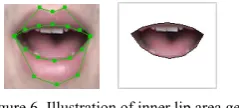
Partition of inner mouth area image: The inner contours are obtained by simply connected the extracted inner points as boundary. The pixels outside the boundary are removed by assigning a constant pixel value, here we use 255. Images of inner lip area are generated as shown in Figure 6.
Multi-feasible local inner texture features: Referring to some general texture descriptors and combing our understanding of pronouncing inner lip texture states, we explore the following inner texture features.
①Histogram of inner lip region. This feature describes the distribution of gray/color in the inner lip region. To eliminate differences such as mouth size of individuals, we use the normalized histogram feature representing in (H0, H1, ... H255), where each component is obtained by dividing the total pixel number in inner lip area as in formula (1). As we count frequency of every gray/color scale, the dimension of this gray/color histogram feature is 255.
SUM Ni
H i= (1)
where SUM =∑255i=0Ni , 0 ≤i≤255 , and Ni is the number of pixels with pixel value i, SUM is total number of pixels inside the inner lips.
As this 256 grayscale histogram is a feature with higher dimensionality, we seek to establish a compact feature of low dimension histogram by combing several continuous grayscale as one scale. In the paper, we use the 32 grayscale/color histogram with 8 continuous pixel values as one scale.
②Block Histogram. This feature is proposed in order to represent visibility of upper and lower teeth separately. Actually the different visibility of upper and lower teeth is relative to the different pronunciation, but the holistic histogram can’t discriminate this phenomena. So we separate the inner lip region into upper and lower parts (shown in Figure 7)to compute the histogram respectively and concatenate them into 512 or 62 dimension histogram or compact histogram feature vectors with the above form we call it block histogram feature.
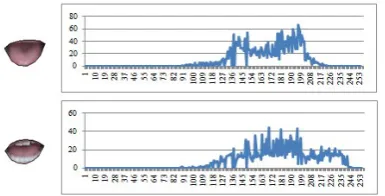
③Teeth appearance proportion: teeth in the inner lip region are salient comparing with the rest area and robust to lighting relatively. The visibility extent of teeth also reflects the different pronouncing states. So the paper proposes a kind of inner lip pronouncing texture descriptor with the teeth appearing proportion. Actually analyzing the histogram of inner lip texture images with and without teeth in Figure 8, we could find that grayscale of teeth locates in range [200,400] while non-teeth’s grayscale locates in range around [120,200]. Thresholding approach is employed in the paper to extract the teeth area. Then the teeth area proportion and also the upper and lower teeth area proportion are counted to construct the three dimension local inner lip texture descriptor.
Figure 7.Partition Blocks of Inner Lip Region
Figure 6.Illustration of inner lip area generation Figure 5.Point Location Result based on Cluster-Various AAM
Templates
④ Blockaverage. This feature is established by partitioning the inner lip region averagely into 8 sub-region and counting the average grayscale/color of pixels in each sub-region representing in bi for ith block, then concatenating into 8 dimension vector (b1, b2, ... b8) as the inner lip texture descriptor. Formula (2) illustrates the counting of each component bi, where Ni is total pixel number in ith sub-region, Xij is grayscale/color value of jth pixel in ith sub-region.
8 i i
N 1
j xij 1
i N
1 i
b = ∑ = where ≤ ≤
(2)
⑤Grayscale/Color moment. Color moment is one of
common texture descriptors and good at reveal the local texture changes. Considering the texture change involving with the pronunciation mainly happens along the vertical direction, we establish a kind of inner lip texture feature by counting the first color moment in vertical direction. To mitigate the noise influence, we count the color moment of three local regions shown in Figure 10. And establish the three dimension feature (c1, c2, c3) with color moment. The computing formula of each component is shown in formula (3). Where xij is value of grayscale/color of jth pixel from upper to down in the ith vertical, Sij is the index of this pixel counting down from the top along the ith vertical, Ni is total amount of pixels in ith vertical that lie inside the inner lip.
3 i i
N 1
j xij S ij 1
i N
1 i
c = ∑ = ⋅ where ≤ ≤
(3)
⑥DCT(Discrete Cosine Transformation):One of the most frequently used holistic transformation feature is the DCT, which we therefore use as one of local features in our paper to explore its capability of representing
phonetic information. It is computed as formula (4) for a M×N image with pixel value fx,y in each coordinator (x,y).
N v y
M
x N
y M
u x y x f v
a u a v u C
2 ) 1 2 ( cos
1
0 1
0 2
) 1 2 ( cos , )
( ) ( ) , (
Π +
−
= −
=
Π +
= ∑ ∑
(4)
where a(u) is:
( )
1
0
2
1, 2,3 1
if u N
a u
if u N
N ⎧
=
⎪⎪
=⎨
⎪ = … −
⎪⎩
The energy of DCT mainly concentrates in top-left of the transform plot shown in Figure 11, so we use just the first 32 dimension of the DCT of inner lip area as our DCT features.
Color component for inner lip texture: Based on the definition of the above feasible features, it is appropriate to explore and choose an efficient color channel in the feature computation, to get a better discriminative inner texture descriptor for speaking states.
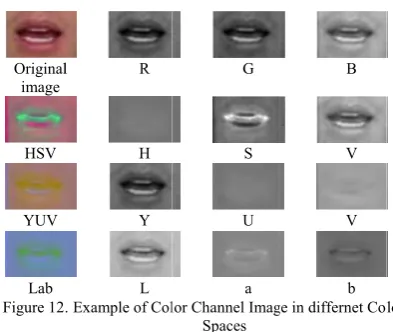
From the perspective that inner texture information is easily influenced by the illumination, the paper prefers to choose a color space component that is robust to illumination changes. Taking the lip images in Figure 12 as an example, we compare our images in each chromatic channel in some of the most frequent used color spaces, viz. HSV, Lab and RGB, shown in Figure 12. The discriminability of inner lip texture varies among those color spaces. For example, the S channel image in HSV color space, which represents the strength or saturation of the colour, has given more obvious contrast between the region of white teeth and pigmented skin or inner mouth tissue. Conversely, the H namely hue component is of little value as the skin and tissue is basically a filtered red or blood color [16] and useful for finding faces but not for finding features within faces. It could be inferred that selecting the S component to building the inner lip texture may be helpful to reflect the difference of speaking mouth inner lip texture, while the H component would not.
Figure 11.Example of DCT Transformation Result
Figure 10.Ilustration of Computing Region of Color Moment Figure 9.Ilustration of Partition of Inner Lip Area Figure 8.Comparison of inner lip texture distribution of Pronouncing Speech
For each c to realize th additive colo to be emitted human visio characteristic stores individ and is the m display. HSV describe the rather than components, by humans i transformatio B correspond (mod 360) al byte (mod represents th components, between the grayscale de value). The Y version defin namely bri components, of human v reflect all RG being design just two low backward c remains the techniques su more sophi opponent spa human perc conditions, a particular de and b for the important a independenc independentl the device th the RGB co approximate uniformity, a perception o Original image HSV YUV Lab Figure 12 color system, e description or mixing, des d to produce a on capabilitie cs of camera dual values fo most common
V (hue, satur color of imag
in terms of and is design in color select on of the RGB ding to hue a lthough this is 255), while he strength o
and the satu e components efined as all R
YUV model a nes a color sp ightness) an
and is based ision, with a GB componen ned to allow c w bandwidth c ompatible m underlying m uch as JPEG sticated deri ace that is des ception under
as well as a evices, with d e color-oppone
attributes of e. This mean ly of the appa hey are display olor models, human visi and its L com of lightness.
l R
H
Y
L .Example of Col
it uses the d of the color cribing what k a given color, es and defin and display or red (R), gree
form for des ration, value) ge in terms of additive or ned for ease o tor interfaces B color space, angles of 60, s often renorm
the graysc of the strong uration the m s (and hence RGB compon also called YC pace in terms nd two chr d on the oppon a grayscale m
nts, not just th colour TV sign colour differen mono-chrome
model for mo . The Lab co ivatives) is signed to more r the full r accurate mapp dimension L f
ent dimension f the Lab-m
ns that the c aratus they ar yed on. At the
as Lab colo ion, it aspir mponent closel It can thus
G
S
U
a lor Channel Imag
Spaces
different princ space. RGB kind of light n and is inspire ed based on technology. R en (G) and blu scribing color ), is employe hue and satur subtractive of selecting c . HSV is a si with the R, G 120 240 deg malized to fit i
ale-like valu gest of the R maximal differ
e difference nents having e
CbCr in its d s of one luma
rominance ( nent colour m model weighte he most domi nals to piggy nce signals on
signal, and odern compre olor space (an
a similar c e accurately re range of ligh ping to and for lightness a ns. One of the model is de colors are de
re created wi e same time, u or is designe res to perce ly matches hu
be used to m B
V
V
b ge in differnet Col
ciples uses needs ed by n the RGB ue (B) rs for ed to ration color colors imple G and grees into a ue V RGB rence from equal digital a (Y, (UV) model ed to inant, back nto a this ssion nd its color-eflect hting from and a most evice fined ith or unlike ed to eptual uman make accu curv cont Lab enha clea T colo emp C. J Inne T com featu Supp (g1,g joint follo T cont prep tech The outp rese the j spee the m joint deno featu w II A. D F for a inne selec phon Part sent DM 25fp spea was phon The the s lor
urate color ba ves in compon
trast using th color space ance the disc
rly defined by This gives us b or component pirically in Sec Joint Visual Sp er Lip Texture This paper ado mbine the geo ure together to posing that t g2...gm) and t feature F is ows: F=(G,T) To tradeoff th
tributing we processing s hniques includ simple Min-M performing th
arch on this joint feature F ech image sam
maximum and t visual speec oting as Gmax ure of sample
=
' '
i i
F
G ,T
where:
g
m i',=
I. ATTRIBUTIO
Data Collectio or this researc analyzing the er lip texture cted from so neme balance
of corpus w ences in our c C_LX3 camer ps. We captu aker while rea
manually se nemes (Cons
correspondin sample data.
alance correct nents a and b e L compone is preferred t crimination of y human perce broad idea of t ts appropriate ction III. peech Feature
opts a feature ometric featu o generate the the geometric the texture fe the concaten =(g1,g2...gm, he metric dif
ight, normal step. The de Z-Score, M
Max normaliz he others [17] basis. The no F is performed mple set {Xi|i=
d the minimum ch feature Fi=
x, Gmin, Tmax Xi is
F
i'in fo' '
1, 2
(
g g
i,
=
' i
T
,
m i min
max min
g
G
G
G
−
−
ON ANALYSIS FEATUR nch we collecte performance o
defined in ome reading
rules to cove we used is as
corpus. The d ra with resolu ure the front
ading the mat egmented into
onant and vo ng frame sequ
tions by mod b, or to adjust ent. Thus in to for inner l f visual spee eption charact the importanc ely, and we
e Based on Ge
e-level fusion ure and inne e joint visual s c feature G i eature T as (t nated vector o
,t1,t2...tn). ifference and alization is
common n Media-MAD, M
zation techniq ], and is ado ormalization p d as follows, f i=1,2...N}.}
m of each com =(Gi, Ti) in th
and Tmin, th ormula (5)
' '
2,i
...
g
m i,, ,
t t
1,i, '
,
,
n in i max
t
t
T
−
=
−
EXPERIMENT RESed a dataset fo of the above f
section 1. T materials b er most Chine s Table I. T data is collecte ution of 720x5 face data of terials. The co o clips of si owel) with M uence images
difying output t the lightness principle, the lip texture, to ech, which is teristics. ce of selecting
explore this
eometric and
n approach to er lip texture speech feature is marked as t1,t2...tn), the of G and T as
balance the done as a normalization Min-Max etc. que was tested opted for this procedure for for the visual Counting up mponent of the he sample set, he normalized
' '
2,i
... )
n i,t
t
(5)min min
T
T
−
−
OF VISUALAccording to lip shapes of Chinese viseme pronunciation and referring to the definition of Chinese viseme cluster proposed by Zhao and Tang [18], we adopt the 9 Chinese viseme cluster shown in Table II. The number is viseme cluster number and relative Chinese phonemes. This is employed into the labeling of the above data collection.
We didn’t use all the images in the Chinese phoneme pronouncing sequences, but selected the keyframes with the salient pronouncing states and abandoned the transitional images. For the single vowels viz. ‘a’ and simple compound finals viz. as ‘ang’, we selected multiple salient images representing the varied lip shapes and label them with relative cluster labels. For the complex compound finals such as ‘ia,iao,ian,iang,ie,ua,uai,ui,ue,iou,iong,uo’ with multiple pronouncing lip shapes, we chopped them into several here two segments and do the salient frame selection and labeling then. For example, ‘ia’ is separated into ‘i’ and ‘a’ clips and labelled with cluster No. 9 and 5 separately. We finally have 450 labeled images in our sample dataset. B. The Experiment Results and Analysis
On the labeled dataset, we employ the optimized support vector model, SMO, as well as BayesNet as classifiers respectively to realize the Chinese viseme recognition and do the following analysis: 1) Analyzing the performance of color components in computing the inner lip texture. 2) Analyzing the discriminability of the above inner lip texture. 3) Analyzing the performance of the joint geometric and each inner lip texture. During the experiments, we use 10-fold cross-validation (CV) to
allow reliable assessment without the need for expensive hold out data. The experiments are done as follows.
We first analyze the performance of color components in computing the inner lip texture. Here we use the four color systems: RGB, HSV, Lab and YCrCb. The inner lip texture features described in section I (Colormoment, Blockaverage etc. which are listed in Table 3) are computed respectively based on each color channel to represent the speaking mouth images. Training and testing the classification results in the collected dataset with identifying the 9 viseme clusters, we count up the
TABLEII
DEFINITION OF CHINESE VISEME CLUSTER
Cluster No of viseme
Relative phonemes
Cluster No of viseme
Relative phonemes
1 b,p,m,f 6 o,ou,ong
2 d,t,n,l,g,k,h 7 e,er,ei,en,eng
3 j,q,x 8 u,v,un
4 z,c,s,zh,ch,sh,r 9 i,in,ing
5 a,ai,ao,ang,an TABLEI
PART OF CORPUS SET
我是北京工业大学学生(I am a student of Beijing University of technology)
wo shi bei jing gong ye da xue xue sheng.(In Pin Yin)
走到半路天色暗了下来(It gets dark on the way) zou dao ban lu tian se an le xi alai(In Pin Yin)
这件任务使他有点儿手足无措(This task makes him bewildered) zhe jian ren wu shi ta you dian shou zu wu cuo. (In Pin Yin)
琳决定宴会一开始就分发礼物(Lynn decided to distribute gifts at the beginning of banquet.
lin jue ding yan hui yi kai shi jiu fen fa li wu. (In Pin Yin)
我和我女儿路过这儿上摩天岭(My daughter and I will go to Motian Ling Mountain through here)
wo he wo nv er lu guo zhe shang mo tian ling(In Pin Yin) SPEAKING LIP SHAPE RECOGNITION RESULTS BASED ON EACH TABLEIII COLOR SPACE COMPONENT WITH DIFFERENT INNER LIP TEXTURE
FEATURES.
Color channel
Colormoment SMO BayesN
Blockaverage SMO BayesN
DCT SMO BayesN H 15.1 22 43.4 49.1 49.5 45.6 S 34.8 36 54 56 62 57.6 V 41.5 33.4 41.7 44.8 60.2 58.3 L 39.2 36.9 52.1 54.8 63.7 59 a 22 33.6 49.2 48.3 50.7 49.8 b 26.9 29.2 47.5 46.2 55.8 54.2 Y 45.1 38.2 48.7 49.9 62.5 58.3 Cr 14.4 23.2 47.5 30 40.7 37.3 Cb 20.4 30 41.2 45.7 44 40.3 R 45.2 37.8 48.7 51.5 63.1 57.6 G 42.9 38.5 48.4 51.7 62 58.1 B 41.5 33.4 48.7 51.2 60.6 58.3 Gray 40.7 36.5 48.3 49.9 59.5 57.4 Average1
(%) 33.1 33.0 47.6 48.4 56.5 53.2
Average2
(%) 33.0 48.0 54.9
Color channel
Histogram Blockhistogram
Average (%)
SMO BayesN SMO BayesN
`H 25.6 29.1 32.1 28.5 34 S 48.8 53.7 57.4 65 52.5 V 58.5 60.9 61.8 67.3 52.8 L 59.2 67.5 62.3 71.8 56.7
a 50.5 51.4 54.9 53.2 46.4 b 57.4 57.8 61.1 61.3 49.8 Y 56.9 64.3 62.9 68 55.5 Cr 42.1 41.4 47.2 48.1 37.2 Cb 49.5 52.3 53.7 54.1 43.1 R 56.7 60.4 57.8 67.3 54.6 G 52.3 58.6 57.4 67.3 53.7 B 58.3 60.8 61.8 67.3 54.2 Gray 51.2 57.3 56.7 65.2 52.3 Average1
(%) 51.3 55.0 55.9 60.3
Average2
accuracy rates that the tested visual speech images are correctly classified into the right viseme clusters. Then we discuss the discriminant performance of the color space component and determine the one as the basis for computing inner lip texture feature. Note that teeth proportion feature is based on thresholding approach, the boundary of teeth and tongue region is hard to be found and determine the threshold, so we don’t list teeth proportion feature in these color channels with incomplete data.
The experiments results are shown in Table III (with best results indicated in bold). We can find that the average recognition accuracy rates of each color channel show that L component in Lab color space has the highest rate 56.7% in different inner texture feature comparing with the other channels. This accords with our understanding discussed above that definition of L is matched to human perceptual characteristics. Therefore, we select the L channel as the basis to compute the inner lip texture. From the perspective of the texture feature, we could find that the block histogram has the highest average recognition rate, it proves that upper and lower texture contribute different in telling the inner texture of visual speech. Another two holistic features: DCT and Histogram also shows better discriminability comparing to the local ones when using the inner texture feature only. But the effectiveness still needs to be considered together with geometric features, for local texture features lose too much information about lip shapes.
We also test the effectiveness of our proposed compact histogram representations histogram-32 and blockhistogram-64 in Table IV compared with the uncompact ones: Histogram-256 and Blockhistogram-512. The results show that although the recognition rate is little bit lower but it is still close and allows us to see how much (or little) we stand to gain for the additional memory and computing cost. We use the compact representations in the following fusion experiments.
Combining with the geometric feature together, we test the joint feature with each inner lip feature. The experiment results are shown in Table 5. From this table, we could find that recognition rate in the joint features with all feasible texture features are higher than that in geometric one only. It proves that effectiveness and importance of the inner lip texture in visual speech representation. The results in Table 5 also show that after combining with geometric feature, the recognition results improve comparing with each individual texture feature in representing the visual speech. Especially to the local inner texture features, such as the teeth proportion and
color moment, the recognition results improve largely. It proves that the contribution of geometric and the local inner lip textures are complementary for visual speech recognition. It is helpful in improving the bi-model recognition results using the fusion method in much compact way. Looking at the holistic inner lip texture features in Table V, the block histogram has the highest recognition rate in both cases before and after feature fusion. Together with the geometric feature, the recognition results indeed improve, but comparing with that of local texture features such as teethe proportion or color moment, the increasing extent is not so large. This is to some extent reflecting that the redundancy information exists between the holistic inner lip texture feature and the geometric feature for Chinese viseme recognition. From this point, the local inner lip texture, teeth proportion has obvious advantage in computing cost with lower dimension and relatively higher recognition results when fusion with the lip shape feature together. It only has 3 extra dimensions adding to the geometric feature, but on average 18.5% increase in accuracy (26.3% using SMO and 11.1% using BayesNet) compared with using the geometric feature only.
We don’t specifically discuss the performance of using the different classifiers for Chinese viseme recognition, but the experiment results in Table 3-5 still reflects the difference existing when using various classifiers. For example, with BayesNet using the local inner texture: Blockhistogram as the feature, it has the highest viseme recognition rate whilst SMO with DCT has the highest accuracy rate. Therefore how to employ the complementary contribution of classifiers such as multi-classifier fusion to improve the overall recognition performance remains a matter for future investigation.
C. CHMM based Bimodal Chinese Character Speech Recognition System
We employ our proposed joint visual speech feature, viz. the local inner lip texture and the geometric feature
TABLEV
RECOGNITION RATE OF JOINT FEATURE WITH EACH DIFFERENT INNER LIP TEXTURE FEATURE
individual Feature SMO BayesNet Average G 52.0 55.0 53.5 Teethproportion 42.5 39.8 41.2
Colormoment 39.2 36.9 38.1 Blockaverage 52.1 54.8 53.5
DCT 63.7 59.0 61.4
Histogram-32 57.3 64.5 60.9 Blockhistogram-64 58.9 66.4 62.7
Joint Feature SMO BayesNet Average G+Teethproportion 65.7 61.1 63.4 G+Colormoment 56.3 58.8 57.6
G+Blockaverage 56.3 57.6 57.0 G+DCT 64.6 60.2 62.4 G+Histogram-32 67.6 69.2 68.4
G+Blockhistogram-64 67.3 69.9 68.6
TABLEIV
COMPARISON BETWEEN HISTOGRAM FEATURE BEFORE AND AFTER COMPACTION
Inner lip texture feature SMO BayesNet Average Histogram-32 57.3 64.5 60.9 Blockhistogram-64 58.9 66.4 62.7
into the bimodal Chinese character speech recognition system to test its effectiveness further.
Overview of Bimodal Speech Recognition System: The system block diagram is shown in Figure 13. The speech video is chopped into the Chinese character clips and the audio and visual speech sequences are processed separately as input of Coupled Hidden Markov Model (CHMM) to do the fusion Chinese character recognition. Here we use the Mel-Frequence Cepstral coefficient (MFCC) as the audio feature and our proposed joint feature to represent the visual speech images.
CHMM[19,20] is an effective solution to realize the medium fusion at the state level shown in Figure 14, where cycle symbols represent the hidden level, viz. states (the upper level represents the audio states and lower level is the visual states), and rectangle symbols represent the observed node, viz. audio and video inputs separately in the graph. This model takes the time correlation multiple modalities into account and solves the asynchrony problem of audio visual speech fusion.
In our CHMM based bimodal speech recognition system, we refer to the approach introduced in reference [21] to realize the training and recognition. The states and observers in the CHMM are combined and reconstructed into the structure like that in Figure 15 under the transition, where observe nodes use the different symbols to represent the corresponding compound observers. Then the traditional HMM training and testing algorithm such as Baum-Welch are used in the CHMM based bimodal speech recognition system.
Bimodal Chinese Character Pronouncing Dataset: We test our approach on our own collection bimodal dataset. The corpus is selected based on Chinese phoneme
defined in the SAPI[22], which actually points to the Pinyin of Chinese characters including initial consonant and vowel. We select 200 Chinese characters and 20 local Beijing mandarin speakers (ten females and ten males) to reading these Characters. We capture the frontal faces of these subjects using Sony HDR-XR160E and each character is repeated ten times. So there are 10 by 20 samples for each Chinese character.
In this pilot study, we only use the 10 Chinese characters listed in Table VI to do the experiment. The symbol column lists the used Chinese characters and example column is the reading words containing these Chinese characters marking with the tones. It covers most Chinese visemes described in section III. To separate the character pronouncing from the words not the single character has the natural pronouncing states and results are much practical.
Experiment results and analysis: Taking the 60 samples of each Chinese character as training data and the other 40 as the testing samples, we do a series of comparative experiments with individual modality HMM and multimodality CHMM. Here we select 3-states/15-observers for audio-HMM and 3-states/ 9-3-states/15-observers for visual-HMM, and then 5 compound states for CHMM and coherent observers similar to HMM. K-means clustering algorithm is utilized in obtaining the observer serial number. Multi-observer based Baum-Welch training algorithm is used in the paper.
Each Chinese character’s recognition results are listed in Table VII and Table VIII. Here ‘A’ in the Table represents the audio with MFCC as feature. The visual speech feature we test the geometric feature only and joint feature with several local inner lip texture features. The number indicates the number of characters (phonemes) correctly recognized out of 40 test samples (the result that is best within the visual modality with 2 errors or 5% is shown in italic; bold if comparable to or better than achieved with the other; chance level is 4 right or 10%).
Analyzing the above experiment results, we can find the results as follows.
Accuracy rates with CHMM based bimodal speech recognition system are much higher than that with HMM based single modal system. With CHMM, the average recognition rate of all feasible features is 93.4% and increases by 43.8% comparing with visual speech and 14.6% with single audio speech.
TABLEVI
CHINESE CHARACTERS USED IN EXPERIMENT
Symbol Example Symbol Example ban mu 4 ban 3 jiang jiang 1 he 2
ci ci 2 qi 4 mo mo 4 shui 3 da da 4 jia 1 qi qi 3 qiu 2 deng ban 3 deng 4 she mang 3 she 2
gong ban 3 deng 4 zhuang mang 3 she 2
Figure 15.Illustration of equivalent transformation of CHMM Figure 14.Structure of coupled HMM
Under this situation, the joint feature geometric with the local color moment in the L color channel has the highest accuracy rate 55.3% in HMM system and 95.8% in CHMM system. It proves the effectiveness of the joint feature and in particular the utility of the local inner texture feature. Our results also show that for multiple subjects, the color moment feature shows stable performance in contrast with the teeth proportion apparently owing to individual differences in teeth appearance and habit. The local inner texture feature also has lower computational cost and lower dimensionality.
IV CONCLUSION AND FUTURE WORK
The paper proposes a joint visual speech feature which combines the geometric feature with several feasible features for describing the local inner lip texture. The feature are fused at the feature level and normalized with the simple min-max technique. We demonstrate the effectiveness of the joint feature through experiments on Chinese viseme recognition system and a bimodal Chinese character recognition system. The experiment demonstrates the potential of our joint visual speech feature, including especially the geometric and local inner texture feature, which has the good ability to represent
speaking mouths no matter in in a multi-speaker bimodal phoneme plus viseme based Chinese speech recognition system. The complementary nature of the information in the bimodal features reveals the state of visual speech from different point of view. The joint features also have obvious advantage in terms of computational cost due to lower feature dimension required in the visual modality. The comparison experiments between HMM and CHMM-based recognition system shows that the CHMM system outperforms HMM based system with a considerably higher recognition rate of over 95% versus HMMs at under 80% with audio alone and at best around 55% for visual alone.
In the future work, we will explore the contribution of different classifiers and improve the performance visual speech recognition by employing multi-classifier fusion. AAM based feature point location needs to be discussed further to improve the automatic location accuracy to provide the basis for visual feature extraction to obtain more label data for further experiments to test the generation of our proposed joint feature.
ACKNOWLEDGMENT
This work was supported in part by a grant from the Chinese Natural Science Foundation under Grants No.61070117, the Beijing Natural Science Foundation under Grant No.4122004, the Importation and Development of High-Caliber Talents Project of Beijing Municipal Institutions
R
EFERENCE[1] Yaming Wang, Fuqian Tang and Junbao Zheng, “Robust Text-independent Speaker Identification in a Time-varying Noisy Environment,” Journal of Software, vol. 7(9), 2012, pp.1975-1980.
[2] Neti, C.Potamianos, G.Luettin, “Large-vocabulary audio-visual speech recognition:a summary of the Johns Hopkins Summer 2000 Workshop,” Multimedia Signal Processing 2001 IEEE Fourth Workshop on. 2001, pp. 619-624.
[3] Mehrabian A. “Communication without words,” Psychology Today, vol. 2(4), 1968, pp.53-56.
[4] XinGuang Li, MinFeng Yao, JiaNeng Yang , “Speech Recognition Approach Based on Speech Feature Clustering and HMM,” Journal of Computers, vol. 7(9), 2012, pp.2269-2276.
[5] Potamianos G, Neti C, Gravier G, et al. “Recent advances in the automatic recognition of audiovisual speech,” Proceedings of the IEEE, vol. 91(9): 2003, pp.1306-1326. [6] Wu Z, Aleksic P S, Katsaggelos A K. “Lip tracking for
MPEG-4 facial animation,” Fourth IEEE International Conference on Multimodal Interfaces, 2002, pp. 293-298. [7] Stillittano S, Caplier A. “Inner lip segmentation by
combining active contours and parametric models,” Proceedings of the 3rd International Conference on Computer Vision Theory and Applications (VISAPP’08). 2008, pp.297-304.
[8] Zhang X, Mersereau R M, Clements M, et al. “Visual speech feature extraction for improved speech recognition,” IEEE International Conference on Acoustics, Speech, and Signal Processing (ICASSP 2002), 2002, pp.1993-1996. mo qi she zhuang Total Right Number RATE(%)
40 39 36 37 370 92.5
40 39 39 36 375 93.8
40 39 39 38 383 95.8
40 39 36 36 368 92
TABLEVIII
CHMM-BASED BIMODAL-MODAL CHINESE CHARACTER SPEECH
RECOGNITION RESULTS
Feature ban ci da deng gong jiang G+A 38 33 37 38 36 36
G+Teethprotation+A 40 34 39 32 38 38
G+Colormoment +A 40 34 38 38 37 40
G+Blockaverage+A 39 34 36 35 37 36
TABLEVII
HMM-BASED SINGLE-MODAL CHINESE CHARACTER SPEECH
RECOGNITION RESULTS (CORRECT OUT OF 40 TEST CHARS)
Feature ban ci da deng gong jiang A 35 34 34 31 32 36
G 23 6 19 8 25 12 G+Teethprotation 29 7 16 3 28 16 G+Colormoment 17 15 27 14 35 11
G+Blockaverage 35 26 26 12 31 7
mo qi she zhuang Total Correct Accuracy (%)
22 40 37 14 315 78.8
29 3 9 27 161 40.3
37 16 19 31 202 50.5
28 12 29 33 221 55.3
[9] Zhi Q, C modeling Internatio Cybernet [10]Zhi Q, C
geometric IEEE Tra A: System [11]Matthews visual fe Pattern A pp.198-2 [12]XinGuan extraction 2010, pp. [13]Chan M integratin features,” Signal Pr [14]Benhaim “Designin ICASSP Acoustics 2424. [15]Topkaya, multiple recognitio Conferen 2011, pp. [16]Lewis, Tr Speech R Networks (Sydney: [17]Boodoo N
recognitio Journal o 6(2), 200 [18]Zhao Hui “Audio-v triphone,” Congress [19]Rao B D using the audio-vis Internatio Processin [20]M.Brand, interactin 1996, pp. [21]Gang Liu Splitting Computer http://msd .aspx.
visiting schola months from S
Cheok A D, S g for bimodal onal Confere tics, 2001, pp.18 Cheok A D, Se c features for ansactions on S ms and Humans s I, Cootes T F, eatures for lip Analysis and Ma
13.
ng Li, MinFen n in speechread . 705-712.
T. “HMM-base ng geometric ” 2001 IEEE rocessing, 2001 , Eric,Sahbi, ng relevant feat
2013, IEEE
s, Speech and S
, Ibrahim Sa visual tandem on,” ICASSP nce on Acoustic
. 4988-4991. rent W. and Po Recognition u s,” Australasia
ACS, 2002), 20 N B, Subraman on using face of Computer Sc 9, pp.164-169. i, Chen Yue-Bi visual speech s ” Proceedings s on Image and D, Trivedi M M
iterative decod sual speech re onal Conferenc ng, 2008, pp.22 , “Coupled hid ng process,” te
.150-156. u, Wei Chen, J
for CHMM rs, Vol 4(11), 2 dn.microsoft.co Xibin 1969. compu Beijin 2007, instrum Techn wirele Unive ar at Flinders Sep. 2009 to Ma
Sengupta K, e speech recogn ence on Sys
81-186. engupta K, et
audio-visual s Systems, Man an
s, vol.34(4) , 20 , Bangham J A, preading,” IEE achine Intellige
ng Yao, JiaNe ding,” Journal o
ed audio-visual and appear Fourth Works 1, pp.9-14.
Hichem and tures for visual E Internationa Signal Processi
aygin, Erdogan m streams in
P 2011, IE cs, Speech and
owers, David M using Red Exc an Computer S 002, pp.149-156 nian R K. “Rob e and ear ima ience and Infor
ing, Shen Ya-M synthesis based s of the 2009 Signal Process M. “Multimodal ding algorithm a ecognition,” IC ce onAcoustics 241-2244. dden Markov m
ch.Rept TR 40
Jun Guo, “A R Based on D 2009, pp.1167-1 om/enus/library
n Jia, was born Xibin Jia rece uter science an ng University M.E. degr ment from Nor nology in 1996 ess technology ersity in 1991
University, So ar. 2010.
et al. “Audio-v nition,” 2001 stems, Man,
al. “Analysis o speech recogni
nd Cybernetics, 004, pp.564-570 , et al. “Extracti EE Transaction ence, vol.24(2),
eng Yang, “Fe of Software, Vo
l speech recogn rance-based v hop on Multim
Vitte, Guilla l speech recogn al Conference ing, 2013, pp. 2
n, Hakan, “U audio-visual sp EEE Internat d Signal Proces
M. W., “Audio-V clusion and N Science Confe 6.
bust multi biom ages,” Internat rmation Security
Min, Tang Chao d on Chinese v 9 2nd Internat sing, CISP'09.
l information f and its applicati CASSP 2008.
s, Speech and S
models for mod 05, MIT Media
Research on Mi DBC,” Journa 1175.
y/ee125160(v=v
in Shanxi, Chi eived PhD degr nd technology of Technolog ree in intel rth China Institu
and B.E. degr y from Chong
. Xibin Jia w outh Australia visual IEEE and of lip ition,” , Part 0. ion of ns on 2002, eature ol.5(7), nition visual media aume, nition,” e on 2420-Using peech tional ssing, Visual Neural erence metric tional ty, vol.
o-Jing. visual tional fusion ion to IEEE Signal deling a Lab, ixture al of vs.85) ina in ree in from gy in ligent ute of ree in ngqing was a for 6 Sh Scien Tech 1. X with Telk 2. X visua Infor 4185 3. X Expr Featu Vol. H and recog A Hua "Aud Eval Inter 4, No recog Her Davi Chin Scien Yanf Spee and Intel 2013 the
he is an Assoc nce and Tec hnology in Beiji Xibin Jia, Yanfe the Geometri komnika,2013 ibin Jia, Yanfan al speech fea rmation and Co 5.
Xibin Jia, Xiyu ression Recogn ure, Journal of 8(5):282-289. Her areas of int
multi-informat gnition and visu Assoc.Prof. Jia is
Du, Yanfan dio/Visual Sp luation Algori rnational Journa
o. 1, pp. 98 ~ 1 Mr. Du is a m
gnition. current public id Powers, Spa nese phonemes,
nce,2012, V fang Han, Kew ech based Pron
Comparison P lligent Informat 3.
University o
ciate Professor chnology at
ing, China. Her eng Sun, A Ki ic and Local I ,Vol.11(2):87 ng Han, David ature for Chi omputational Sc
uan Bao, David ition Based on Convergence In
terest include v ion fusion, esp ual speech reco s a member of I
Hua Du, w
China in degree in technology Technology visual info recognition He is college of B current pub ng Han, Kew peech based ithm and Co al of Intelligent
04, 2013. member of CCF.
Yanfang H
China in 19 in computer Beijing Un 2013, bach science and Normal Uni Han focus cognition, i
cations include atial and tempo ,Journal of In ol.9(14):4177-4 wei Zhang, D nunciation Auto Platform", IJII tion Processing David M. Sydney, Au of Scienc Sydney in mathematic science programmi intelligence the School f New South
in the Colleg the Beijing r recent publica ind of Visual S
Inner Texture 77-889 .
Powers, Spatia inese phonem cience, 2012, V
d Powers, Yuj Block Gabor W Information Tec
visual informa pecially for fac ognition.
IEEE, CCF.
was born in In 1989. He ea n computer
from Beijing y in 2012. Hua
ormation cogn n and machine le a MS candidat BJUT in Beiji blications inclu wei Zhang, D Pronunciatio omparison Pla t Information P
.
Han,was bo
988. She earned r science and te niversity of T
helor degree d technology iversity in 2010 ses on visua image processi
:1. Xibin Jia, oral visual spee nformation and
4185. 2. Xibin David Powers, omatic Evaluat IP: Internation g, Vol. 4, No. 1
. W. Powers
ustralia and ear ce from the 1979 with a cs and Honour
including a ing languages e. His PhD was l of Electrical h Wales in
e of Computer University of ations include:
Speech Feature Description,
al and temporal e, Journal of
Vol.9(14):4177-jian Li, Facial Wavelet Fusion chnology, 2012 ation cognition, cial expression nner Mongolia, arned bachelor science and University of Du focuses on nition, pattern earning. te in Computer ng, China. His ude: Xibin Jia, David Powers, on Automatic atform", IJIIP: Processing, Vol.
orn in Henan, d master degree echnology from Technology in in computer from Xinyang 0. Yanfang al information
ng and pattern
Yanfang Han, ech feature for Computational n Jia, Hua Du, "Audio/Visual tion Algorithm nal Journal of , pp. 98 ~ 104,
psycholinguistics, as a pioneer in the new interdisciplinary fields of unsupervised learning, cognitive science and machine learning of natural language, the PhD being awarded in 1989 and published by Springer in the same year. He also has qualifications in linguistics (Summer Institute of Linguistics, 1980), theology (Moore Theological College, 1984), technical analysis of financial markets (Securities Institute Australia, 2001) and teaching English as a second or other language (LinguaEdge, 2011).
He is currently Full Professor of Cognitive and Computer Science, Associate Dean (International) and Director of the Centre of Knowledge and Interaction Technologies, in the School of Computer Science, Engineering and Mathematics, Flinders University, Adelaide, South Australia, as well as Visiting Professor at the Beijing University of Technology, with support from the Importation and Development of High-Caliber Talents Project of Beijing Municipal Institutions. Previous positions were at Telecom Paris (1993), University of Tilburg (1992), University of Kaiserslautern/German Artificial Intelligence Institute/DFKI (1989-1991), Macquarie University (1984-1989) and University of New South Wales (1983-1984). Significant publications include
1. David M. W. Powers, Parallelized QuickSort with Optimal Speedup, in N.N. Mirenkov, Parallel Computing Technologies
(Singapore: World Scientific, 1991): 167-176.
2. David M. W. Powers. How far can self-organization go? Results in unsupervised language learning, Spring Symposium on Machine Learning of Natural Language and Ontology (Stanford: AAAI, 1991): 131-136.
3. Jin Hu Huang, and David M. W. Powers (2001), Large scale experiments on correction of confused words. Australasian Computer Science Conference (Sydney: ACS, 2001): 77-82. 4. David M. W. Powers, The Problem with Kappa, Conference of the European Chapter of the Association for Computational Linguistics (Avignon: ACL, 2012): 343-355.