ISSN (e): 2250-3021, ISSN (p): 2278-8719
Vol. 09, Issue 4 (April. 2019), ||S (II) || PP 63-67
A Study of Performance of Non-Conventional For Low Volume
Roads
Anil Kumar
1,
Dr. S. Rehan Ali
2, Dr. Pradeep Kumar
31Research Scholar, Department of Civil Engineering, Teerthanker Mahaveer University, Moradabad
2Professor, Department of Civil Engineering, Teerthanker Mahaveer University, Moradabad
3
Associate Professor, Department of Civil Engineering, Harcourt Butler Technological University, Kanpur Corresponding Author: Anil Kumar
Abstract:
A worldwide temperature alteration and environmental obliteration have turned into the real issue as of late. Surge of host of ozone harming substances from modern systems and its adversarial affect on climate has changed the attitude of people from the substantial scale fabricating, mass-usage, mass waste society of the past to a zero-release society, use of mechanical squanders and security of normal assets. Keeping the utilization of common assets and updating the use of waste materials has transformed into a test to the analyst and masters.Different examinations have been driven concerning the protection of normal assets, balancing activity of ecological pollution and promise to the economy by using this waste material. The ordinary describe the nature of bond is embraced in the essential period of tests and best crude material synthesis was landed at. In the second stages, solid models were set up with taking steel slag as coarse total ground granulated impact heater slag as fine total and cover that is found to best execution from the trial of stage one.The structure of above crude materials was changed to think about the impact of crude material creations on compressive quality, flexural quality and flexibility embracing traditional testing strategy. The impact of restoring period on quality was likewise considered and reported. Examination is likewise made between the Steel slag hydrated network and the traditional cement.Keywords:
Worldwide temperature, Environmental, Industrial procedures, Industrial wastes and protection, Natural resources, Construction industry.--- --- Date of Submission: 02-04-2019 Date of acceptance: 17-04-2019
---
I.
INTRODUCTION
Concrete construction hone is unsustainable in light of the fact that, not just it devours colossal amounts of stones, sand, and drinking water, yet moreover one billion tons each season of concrete, which isn't a situation very much arranged material. For generation of concrete colossal proportion of vitality is required and around 8% of CO2 is released to air in the midst of bond creation. As a matter of fact, various outcomes and strong squanders can be used in cement blends as totals or concrete substitution, dependent upon their compound and physical depiction, if adequately treated. The steel business slag having appealing attributes and can be used as coarse totals in solid development. Graf and Grube have uncovered that the Ground granulated impact heater slag relieved honestly has bring down vulnerability.The joining of fly fiery debris and impact heater slag in solid prompts various particular ideal conditions. Exactly when two mineral admixtures are used together, better results can essentially achieve.The use of such modern symptom or waste material having charming qualities can achieve saving of vitality and common materials. With augmentation in masses, the interest for development of private and open structures is furthermore extending. The iron and steel industry makes to an incredible degree a ton of slag as symptom of the iron making and steel making frames. As significant reused materials, iron and steel making slag are principally used in fields related to structural building, for example, in bond, roadbed material, and solid aggregate.Their reusing proportion is close 100%, making a basic promise to the arrangement of a reusing centered society. In any case, open works extends, that is solidly related to reused fields, tend to be diminished starting late and, what's more, other reused materials, for instance, reused roadbed materials and fly powder, advance toward getting to be contender of slag in the fields. Along these lines, the headway of new application propels has transformed into a problem that is begging to be addressed.
International organization of Scientific Research
64 | Page
subsequent settlements, etc settle on it a favored choice for the makers. The pozzolanic property makes it reasonable for use in solid asphalts as a section substitution of bond up to 35% in traditional cements and up to 66% in roller compacted cements. It is likewise a shown material for development of sub-base layers just as all season engine capable rustic streets by adjustment of fly fiery debris by around 2-4% lime. Models and guidelines issued by BIS, IRC and Ministry of Rural Development exist for these usages.II.
HIGH STRENGTH CONCRETE
Concrete is called as "high-quality cement" based on its 28 days compressive quality. High quality cement (HSC) is characterized as a solid with a trademark quality between 60 - 100 MPa, in spite of the fact that qualities higher than 100MPa have just been accomplished and used. Compressive quality dimensions of 80MPa and more can be used for both precast and in-situ solid work. According to ACI 363 cement having 28days compressive quality of more than 41 MPa is considered as high-quality cement.For the most part, super plasticizers normal pozzolana silica seethe, etc., are used to accomplish high-quality in cement by keeping water cover proportion at lower level. Shannag have used normal pozzolana and silica smoke to make HSC of 69 MPa to 85 MPa at 28 days with medium usefulness. For delivering high quality cement (HSC), use of FD (foundry slag) as substitution for characteristic regular total in cement has additionally been accounted.
In tall structures, HSC has been gainfully used in numerous countries. A tall structure reasonable for use of high-quality cement is taken into thought to be a structure in excess of 30 stories as showed up in figure 1. Not simply, these extraordinary cements have made such undertakings suitable due to stack limit, it has moreover considered the decline in the proportion of fragments and light emissions segments.Decline in the proportion of solid people, additionally achieves bringing down dead loads which again realize decreasing the heaps connected with establishment plan. Also, owner's leverage monetarily from the amount of rentable floor region, conventionally on the lower floors, increments as the space required by the areas decreases. HSC is normally used in the development of street extensions and fly-overs. HSC permits the fortified or pre concentrated on solid supports to traverse a bigger number of lengths than regular solid braces having ordinary quality.Likewise, increment in the individual prop limits may have the ability to lessen the amount of supports required. Hence, a fiscal gain is made for solid producers, with the objective that solid is raised to be used in a specific expansion venture as opposed to steel.
Figure 1: Applications of High Strength Concrete
III.
SOIL SUBGRADE STABILIZATION
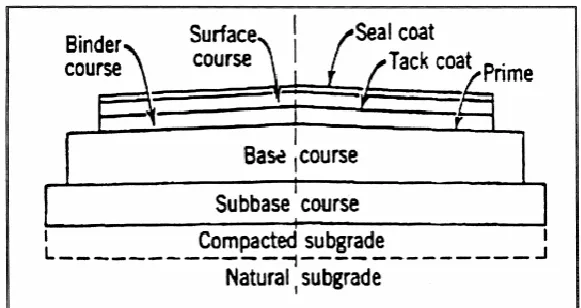
Figure 2: Flexible Pavement Structure Terminology
1 Techniques of Soil Sub-grade
Stabilization The sub-grade contains unbound earth materials, for example, gravel, sand, residue, and clay that influence the plan and construction of roads. The assessment of properties of soil sub-grades, as far as density, soil stiffness, CBR strength is vital in the outline of roads, and their performance. Sub-level has a critical influence in giving auxiliary strength to the asphalt structure as it gets loads constrained upon it by street traffic. Traffic burdens ought to be transmitted in a way that the sub-review distortion is inside flexible limits, and the burdens and strains created are within safe cutoff points under adverse climatic and loading conditions. The soil sub-grade fails primarily because of over the top rutting failure if the bearing capacity of the sub-grade is weak. Weak soil sub-grades having soaked CBR value under 4 percent are the cause of worry of the pavement engineers. Most likely the pavement segment can be intended for low CBR values however the more thickness prerequisite for base and sub base courses demand greater quantity of granular and high CBR (more than 30) materials which lead to borrowing and exhaustion of natural granular stores. Consequently to meet the increased vehicular traffic and super heavy axle load configuration it has turned out to be almost mandatory to enhance the CBR strength of the sub grade or to increase the pavement thickness. Pavement engineers have perceived the long haul advantages of increased strength and durability of pavement sub grade by stabilizing and strengthening it during the construction of another road pavement or during reconstruction for widening of existing road segment. In India there are large varieties of soils that happen in the sub grade of road pavements. Soil stabilizing and reinforcing technologies have been widely utilized during the past couple of decades to strengthen the soils. Soil adjustment is the route toward mixing and blending materials with a dirt to upgrade properties of the dirt. The method may incorporate the mixing of soils to accomplish a pined for degree or the blending of economically accessible added substances that may change the degree, surface or versatility, or go about as a folio for cementation of the dirt.
International organization of Scientific Research
66 | Page
3. Fly Ash Mission of India: The Government of India through the division of Science and Technology has started the Fly Ash Mission under TIFAC (Technology Information and Assessment Council) , The mission spreads different progressions in the territory of fly fiery debris usage completed by the R and D establishments in India.Fly fiery debris mission was approved in 1994 with Department of Science and Technology (DST) as the nodal organization and TIFAC as the executing office, in context of by and large stress for the earth and the prerequisite for the sheltered transfer and powerful usage of fly cinder. The Ministry of Environment and Forest (MoEF), Ministry of Power, Thermal Power Stations, R&D organizations and industry together have propelled a Technology Project in Mission Mode (TPMM).Their consideration is on the showing of innovations identified with coal fiery debris for mixing sureness and thusly guaranteeing huge scale appropriation. A judicious blend of push zones has been taken up for compelling use of fly powder. The activities are attempted in the territories of fly fiery debris portrayal, taking care of and transportation, farming related applications, recovery of powder lakes, underground mine fills and usage in streets and dikes.Hard and fast endeavors are required to utilize this fly fiery remains from ecological contemplations, just as to stay away from land utilization for fly cinder dumping. Regardless of the way that there has been an unfaltering development in fly powder usage from 1990, we have far to go to achieve the objective of 100 percent fly slag use. It is represented that the agribusiness increment of grains is around 15 percent, green vegetables 35 percent and root vegetables 50 percent, when fly cinder is blended with soil. Harmfulness tests have shown that there is no unsafe segment due to fly fiery debris.In any case, it has higher supplements as a result of expanded accessibility of iron and calcium. Fly fiery remains can transform into a riches generator by making use of it for delivering 'green building' materials, streets, farming, etc. Full use of the creating stock will give work potential to three hundred thousand individuals and result in a business volume of over Rs.4,000 crore."IV.
HIGH STRENGTH CONCRETE
High quality cement (HSC) has been a great part of the time used in structural designing structures to decrease the range of auxiliary segments, for example pillars and portions of lifted structures. Concrete is called as "high-quality cement" based on its 28 days compressive quality. High quality cement (HSC) is characterized as a solid with a trademark quality between 60 - 100 MPa, despite the fact that qualities higher than 100MPa have just been accomplished and used.Compressive quality dimensions of 80MPa and more can be used for both precast and in-situ solid work. According to ACI 363 cement having 28days compressive quality of more than 41 MPa is considered as high-quality cement. For the most part, super plasticizers characteristic pozzolana silica seethe, etc., are used to accomplish high-quality in cement by keeping water fastener proportion at lower level. Shannag have used normal pozzolana and silica smoke to make HSC of 69 MPa to 85 MPa at 28 days with medium usefulness.For creating high quality cement (HSC), use of FD (foundry slag) as substitution for regular ordinary total in cement has additionally been accounted. The fundamental applications for high quality cement (HSC) in solid work at site of development are in fragments for hoisted structures, seaward structures, long-length spans and other thruway structures. The principle preferred standpoint of HSC is the decline in the degree of the weight segments and the amount of longitudinal support required.The water/fastener proportions ought to be in the range 0.20– 0.35. Alccofine (AF) and waste foundry slag (FD) can be used in blend to upgrade the quality properties at unusual states. High-quality cement is required in those structural designing activities which have solid fragments that can restrict high weight loads. High-quality cement is generally used in the erection of tall structures. It very well may be used in solid people, for instance, portions (particularly on lower floors), establishments and shear dividers. High quality cements can likewise be every so often used in associates structures also.
V.
CONCLUSION
International organization of Scientific Research
67 | Page
REFERENCES[1]. Deshmukh S. H., Bhusari J. P , Zende A. M. (2012), “ Effect of Glass Fibers on Ordinary Portland cement Concrete”, IOSR Journal of Engineering June., Vol. 2(6) pp: 1308-1312.
[2]. Dhadse Sharda, PramilaKumari and Bhagia L. J. (2008), “Fly ash characterization, utilization and Government initiatives in India. A review”, Journal of Scientific & Industrial research, Vol. 67, January, pp. 11-18.
[3]. Dharani. N, Ashwini. A, Pavitha. G, Prince Arulraj. G (2013), “Experimental Investigation on Mechanical Properties of Recron 3S Fiber Reinforced Hyposludge Concrete”, International Journal of Civil Engineering and Technology (UCIET) ISSN 0976 - 6308 (Print) ISSN 0976 - 6316(Online) Volume 4, Issue 1, January- February, pp. 182-189 © IAEM
[4]. EmamulHaqueMd (2013), “Indian fly-ash: production and consumption scenario”, Intemat. J. Waste Resources, Vol. 3 (1) ISSN: 2252-5211, International Journal of Waste Resources (UWR), http://www.ijwr.co, PP-22-25.
[5]. Eskioglou P., Oikonomou N. (2008), “Protection of Environment by the Use of Fly Ash in Road Construction”, Global NEST Journal, Vol 10, No 1, pp 108-113.
[6]. Fava Gabriele, Letizia Ruello Maria, Corinaldesi Valeria (2011), “Paper Mill Sludge Ash as Supplementary Cementitious Material”, Journal of Materials in Civil Engineering, Vol. 23, No. 6, June, pp. 772-776,
[7]. Ferrira J.G., Branco FA (2011). “GRC mechanical properties for structural applications.” Institute Superior Teehnico, A.V RoviscoPais, 1049-001 Lisboa, Portugal
[8]. Ferreria J.P.J.G and Brance F.A.B (2007) “The Use Of Glass Fibre Reinforced Concrete As A Structural Material” May/June Experimental Techniques.pp-64-72.
[9]. FreedaChristya C., Tensing D. (2010), “Effect of Class-F fly ash as partial replacement with cement and fine aggregate in mortar”, Indian Journal of Engineering & Materials Sciences, Vol 17, April, pp. 140-144.
[10]. Goh, Chia-Chia., Show, Kuan-Yeow and Cheong, Hee-Kiat. (2003), “Municipal Solid Waste Fly Ash as a Blended Cement Material.”, Journal of Materials in Civil Engineering, Vol. 15, No. 6, pp. 513-53-23 [11]. Gomale A., Quadri S.I., Quadri S.M., Ali S.M.A., & Hussaini S.S., (2012), “Strength aspects of glass
fibre reinforced concrete”, International Journal of Scientific & Engineering Research, 3(7).
[12]. Gowri R., M. Mary Angeline (2013), “Effect of Glass Wool Fibres on Mechanical Properties of Concrete”, International Journal of Engineering Trends and Technology (IJETT) - Volume4 Issue7- July, ISSN: 2231-5381, http://www.ijettjoumal.org, pp- 3045-3048.
[13]. Gupta Pardeep Kumar (2013), “High Volume Fly Ash Concrete Road”, International Journal of Emerging Technology and Advanced Engineering Website: www.ijetae.com (ISSN 2250-2459, ISO 9001:2008 Certified Journal, Volume 3, Issue 3, March) PP-852-856.