Partitioning Based Clustering Method for Image
Retrieval
Kiran P. Khandare Swati V. Kamble
Student Student
Department of Computer Science & Engineering Department of Computer Science & Engineering DES’sCOET, Dhamangaon Rly DES’sCOET, Dhamangaon Rly
Shivani R. Jaiswal Nutan P. Khelkar
Student Student
Department of Computer Science & Engineering Department of Computer Science & Engineering DES’sCOET, Dhamangaon Rly DES’sCOET, Dhamangaon Rly
Prof. A. V. Zade Assistant Professor
Department of Computer Science & Engineering DES’sCOET, Dhamangaon Rly
Abstract
Clustering is a major technique used for grouping of numerical and image data in data mining and image processing applications. Clustering makes the job of image retrieval easy by finding the images as similar as given in the query image. The images are grouped together in some given number of clusters. Image data are grouped on the basis of some features such as color, texture, shape etc. contained in the images in the form of pixels. Content Based Image Retrieval (CBIR) is a collection of techniques for retrieving images from large database. The images are retrieved based on content. The term “content” demonstrate to color, texture and shapes. In this system, color and texture features are retrieved from images. The color features are obtained using Dynamic Color Distribution Entropy of Neighborhoods (D_CDEN). The texture features are obtained using Gray Level Co-occurrence Matrix (GLCM). The clustering technique is presented to solve the above problem. In this system, K-Means and Contribution based clustering techniques are used. The K-Means clustering algorithm optimizes only intra cluster similarity. Contribution based clustering enhance both intra and inter cluster similarity. The experimental results shows the comparison between average dispersion measures for both K-Means and Contribution based clustering.
Keywords: Feature Extraction Approaches, Partitioning Based Clustering
________________________________________________________________________________________________________
I. INTRODUCTION
Clustering is the unsupervised classification of patterns such as observations, data items, or feature vectors into groups named as clusters [1]. Applications of clustering is growing nowadays very rapidly because it saves a lot of time and the results obtained from the clustering algorithm is very suitable for the algorithms in the later stages of the applications. Clustering basically groups the data. The data in every group is similar to each other but quiet dissimilar to the data in different groups [5]. So, the data which are grouped together are similar to each other. Clustering has very wide range of applications in the field of research & development like in medical science, where the symptoms and cures of diseases are grouped into clusters to save time and achieve efficient results [10]. It is applied in image processing, data mining and marketing etc. In information retrieval clustering can enhance the performance of retrieving of information from the Internet considerably. All pages are grouped into clusters and optimal results are achieved.
(IJSTE/ Volume 4 / Issue 10 / 005)
The images are retrieved based on content. The term ―content‖ demonstrates color, texture and shapes. In this paper, color and texture features are used. The color features are obtained using Dynamic Color Distribution Entropy of Neighborhoods (D-CDEN) and Texture features are obtained using Gray Level Co-occurrence Matrix (GLCM). Comparison of two images in the database is very easy but comparison of lot of images in the database is very difficult. The clustering technique is presented to solve the above problem. Clustering is the method of grouping the data point based on similarity. The data points in the one cluster are similar and data points in another cluster are dissimilar. The clustering algorithms can be classified into five categories. The five categories are Partitioning based clustering, Hierarchical based clustering, Grid based clustering, Density based clustering and Model based clustering. The Partitioning based clustering approaches are 1) K-Means 2) K- Medoid 3) CLARANS (Clustering Large Application with Randomized Search). In this paper, Partitioning based clustering is used. K-Means clustering algorithm optimizes only intra cluster similarity [12] and Contribution based clustering optimizes intra and inter cluster similarity [12]. Intra cluster similarity indicates the nearness between the elements of a cluster and inter-cluster similarity indicates the similarity between all the clusters present in the image. In this paper, the average dispersion measures of contribution based clustering are compared with dispersion measures of K-Means Clustering.
II. RELATED WORK
The mixture of Region content based image retrieval (RCBIR) and Global content based image retrieval (GCBIR) [1] provides better retrieval results compared to different algorithms. In this paper [3], The RGB colors and Textures (Entropy) features are acquired from images. The acquired features are grouped using Fuzzy C-Means algorithm. Entropy is used to differentiate two images with some threshold limit. Hierarchical Divide and Conquer K-Means (HDK) and feature extraction methods are discussed [4]. Four clustering techniques are 1) K-Means 2) Ward’s Linkage 3) Complete Linkage 4) Average Linkage are explored [5]. The resemblance between query and database images are compared using Euclidean distance and for classification K-Means clusters are used [6]. Here, using hierarchical clustering algorithm the images in the database are grouped into clusters of images depending on the similar color content [7]. Fuzzy Linking approaches are used [8]. It needs only some bins to describe the color distribution of the image. The mixture of Divisive and Agglomerative clustering algorithms is called hybrid clustering [9]. The combination of these two algorithms produces a good cluster quality. The PSNR (Peak Signal to Noise Ratio) values and K-Means clustering algorithm are discussed [10].
Clustering
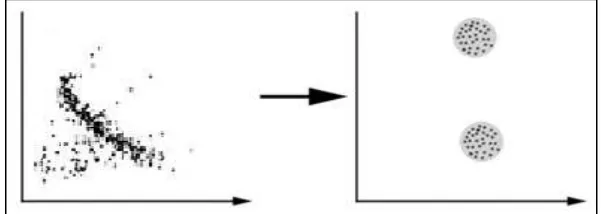
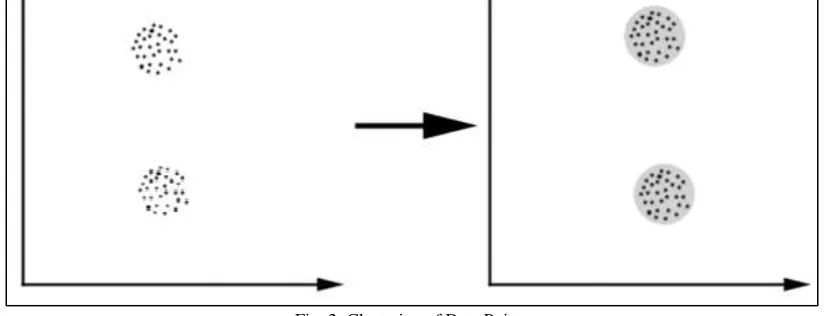
Clustering is a method which groups data into clusters, where objects within each clusters have high degree of similarity, but are dissimilar to the objects in other clusters. So, Clustering is a method of grouping data objects into different groups, such that similar data objects belong to the same cluster and dissimilar data objects to different clusters [9]. Clustering involves dividing a set of data points into non-overlapping groups or clusters of points where points in a cluster are ―more similar‖ to one another than the points present in other clusters [2]. Clustering of images is done on the basis of the intra-class similarity. Target or close images can be retrieved a little faster if it is clustered in a right manner [8]. Data points in each cluster are calculated with a data points in the cluster, similar data points are brought in one cluster. So, each data points exhibits same characteristics present in one cluster.
Fig. 2: Clustering of Data Points
So, a good clustering method would exhibit high similarity in a single cluster and a very less similarity with other clusters. In 1997, Haung brought the concept of k-modes which was the extension made on k-means algorithm. K-modes algorithm was introduced to cluster the numeric objects.
In 1999, Guha et al proposed a clustering algorithm of number of links between tuples. These links were used to captures the records and used to describe that which records are similar with each other. It gave satisfactory results.
In 2006, Csorba and Vajk introduced a document clustering method in which there was no need to assign all the documents to the cluster, only relevant documents were being assigned to the cluster. So, it leads to the cleaner results. In 2007, Jing et al introduced a new k-means technique for the clustering of high dimensional data. So, different topic documents are placed with the different keywords.
III. PROPOSED WORK
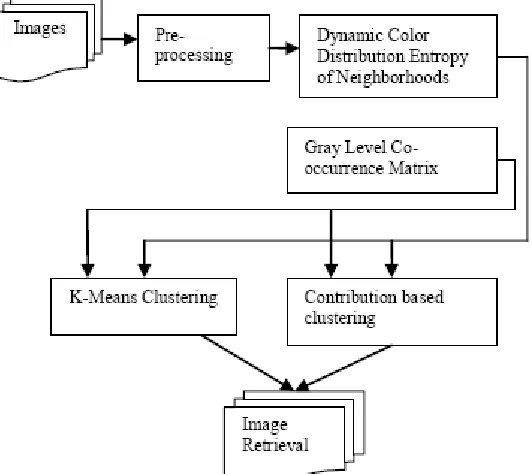
The proposed system takes input as images. Dynamic Color Distribution Entropy of Neighborhoods and Gray Level Co-occurrence Matrix are used for feature extraction purpose. The clusters are formed based on the feature extraction using K-means and Contribution based clustering. Clustering will be more advantageous to reduce the search time of images from the database. K-Means and Contribution based clustering is a partition based clustering. Contribution based clustering optimizes inter cluster similarity and intra cluster similarity. K-Means optimizes only intra cluster similarity. Finally, the average dispersion measures of contribution based clustering are compared with dispersion measures of K-Means clustering.
Fig. 3: Overview of Proposed System Model
Dynamic Color Distribution Entropy of Neighborhoods (D-CDEN)
D-CDEN method illustrates spatial information of colors and based on Color Distribution Entropy (CDE). Color Distribution Entropy is based on Normalized Spatial Distribution Histogram (NSDH). The NSDH is described using (1). In (1), where N is the number of extracted neighborhoods for color bin x and is different for every color bins and Ax ′is the set of pixels with color bin x of an image and |Axy ′| is the count of the pixels of neighborhood y for color bin x. The D-CDEN is calculated using NSDH. The D-CDEN is given below, The D-CDEN is computed by Taking logarithm forxyp and multiply with pxy is illustrated in (2).
Gray Level Co-occurrence Matrix
Gray Level Co-occurrence Matrix is used for texture feature extraction purpose [3]. It is used to extort statistics from an image. Co-occurrence matrix works both distribution of intensities and intensity values. The co-occurrence matrix is constructed in four different directions like horizontal, vertical, left diagonal and right diagonal. In this system, horizontal direction is used for construction of co-occurrence matrix. Many features are taken from this constructed co-occurrence matrix. In this system, Entropy is taken from this matrix. The texture denotes the energy content of the image. Entropy is used to determine the disorder of an image.
K-Means Clustering
(IJSTE/ Volume 4 / Issue 10 / 005)
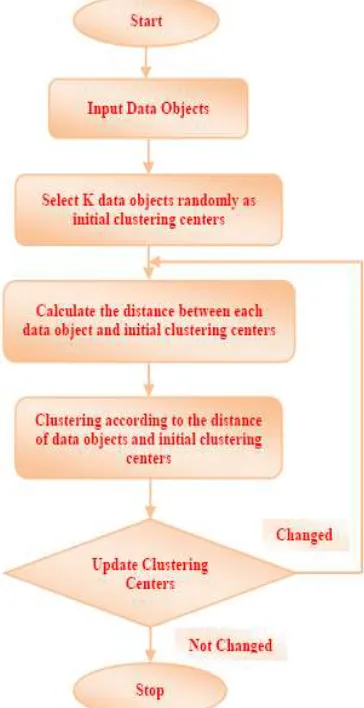
Steps of the K-Means [10] algorithm can be outlined as mentioned below: 1) Choose k number of points randomly and make them initial centroids.
2) Select a data point from the collection, compare it with each centroid and if the data point is found to be similar with the centroid then assign it into the cluster of that centroid.
3) When each data point has been assigned to one of the clusters, re-calculate the value of the centroids for each k number of clusters.
4) Repeat steps 2 to 3 until no data point moves from its previous cluster to some other cluster (termination criterion has been satisfied).
Fig. 4: Flowchart for K-Means Clustering Algorithm IV. CONCLUSION
The images are retrieved based on minimum distance by using K-means and contribution based clustering. The experimental results indicate that Contribution optimizes multi objective optimization but k-means not optimizes the multi objective optimization. In future, valuable features like shape can be integrated for better image retrieval purpose.
REFERENCES
[1] Ibrahim S. I, Abuhaiba1Ruba A, and A. Salamah―Efficient Global and Region Content Based Image Retrieval‖, I.J. Image, Graphics and Signal Processing,
no.5 , pp.38-46, 2012.
[2] Fuhui Long, Hongjiang Zhang , and David Dagan Feng,‖ Fundamentals Of Content – Based Image Retrieval ―,pp.1-23, 2002.
[3] Kannan.A, V.Mohan , and N. Anbazhagan ‖Image Clustering and Retrieval using Image Mining Technique‖,IEEE International Conference on Computational
Intelligence and Computing Research ,pp.1-5, 2010.
[4] MonikaJain.S, and K.Singh,‖Content Based Image retrieval Systems Using Clustering Techniques For Large Data sets ‖, International Journal of Managing
Information Technology (IJMIT) Vol.3, No.4, pp. 24-39, 2011.
[5] Mesfin Sileshi, and Bjorn Gamback, ―Evaluating clustering Algorithms:Cluster Quality and Feature Selection in Content-Based Image Clustering‖ ,
Int.conf.Image Process, pp.1-7, 2008.
[6] Ramamurthy.B, and K.R. Chandran, “Content Based Medical Image Retrieval With Texture Content Using Gray Level Co-Occurrence Matrix And K-Means
[7] Santhana Krishnamachari, and Mohamed Abdel-Mottaleb,‖ Hierarchical clustering algorithm for fast image retrieval ”,Part of the IS&T/SPIE Conference on Storage and Retrieval for Image and Video Databases VII San Jose, Californi, pp. 427-435,1999.
[8] K. Konstantinidis, A. Gasteratos, and I. Andreadis ,‖ Image retrieval based on fuzzy color histogram processing” ,Optics Communications 248 ,pp.375–386,
2005.
[9] Anderson Rocha, Jurandy Almeida1, Mario A, NascimenRicardo Torres, and Siome Goldenstein,―Efficient and Flexible Cluster-and-Search for
CBIR‖,http://www.liv.ic.unicamp.br /undersun /pub/ communications .html pp. 1-12, 2008.
[10] JuliRejito,RetantyoWardoyo, Sri Hartati, and Agus Harjoko, ‖Optimization CBIR using K-Means Clustering for Image Database‖, International Journal of
Computer science and Information Technologies, Vol. 3 (4) , pp.4789-4793,2012.
[11] K. Arun Prabha , and P.Malini , “An Efficient Algorithm For Clustering Of Images Using Fuzzy Local Information C Means”,The International Journal of
Computer Science & Applications (TIJCSA), Volume 1, No. 11, ISSN – 2278-1080,pp. 39-50, 2013.