Thermal Analysis of Micro Channel Heat Sink
with Various Shapes of Dimples
Jagadale. V. A Kadam. S. T
PG Student Associate Professor
Department of Heat Power Engineering Department of Mechanical Engineering Dr. D.Y.Patil School of Engineering, Talegaon, Pune Dr. D.Y.Patil School of Engineering, Talegaon, Pune
Jadhav. S. V
Assistant Professor
SVERIS College of Engineering, Pandharpur
Abstract
The higher power density of modern electronic equipment posed a challenge of ever increasing heat removal requirement. Cooling of these equipment is essential in order to ensure their proper functioning. Microchannel heat sinks are considered to be one of the best solutions for this problem. Microchannel heat sink are investigated experimentally in terms of different thermal performance parameters like heat transfer coefficient and Nusselts number. Microchannel with four different dimple shapes viz circular, square, almond and elliptical, on their base are considered for their analysis. Experimental results show that dimpled microchannels perform better than microchannel without dimples. The elliptical dimples perform better than other dimple shapes. Keywords: Convective Heat transfer, Convective Heat Transfer Coefficient, Micro- channels, Nusselts Number, Reynolds Number
________________________________________________________________________________________________________
I. INTRODUCTION
Today’s electronic components are required to perform tasks at a faster rate, and so high-powered integrated circuits have been produced in order to meet this need. These high-speed circuits are expected to generate heat fluxes that will cause the circuit to exceed its allowable temperature. In order to solve this problem, microchannel heat sinks were introduced in 1981 by Tuckerman and Pease and a lot of research effort has been dedicated to the use of dimples and other devices used for heat transfer enhancement in different engineering applications. Researchers have carried out experimental and numerical studies for the use of dimples. A lot of research is done on heat transfer & pressure drop through micro-channel with different configurations, both experimentally and numerically. This chapter deals with the literature review of analysis of heat transfer through micro-channel with different shaped dimples.
Kuethe (1970) can be considered as the first person who suggested the use of dimples on flat surfaces to increase the heat transfer rate. Afanasyev et al (1993) carried out an experimental investigation on friction and heat transfer on surfaces having spherical dimples. They used totally ten plates for the investigation and the experiment was carried out for turbulent flow condition. They observed an increase of 30-40% in the heat transfer rate with no significant effect on the hydrodynamics of flow. Chyuet al.(1997) carried out an experiment to study local heat transfer coefficient distribution in a channel having two different shaped dimples (spherical and tear drop type) at the bottom. Chen et al. (2001) carried out an experimental investigation to study the effect of dimples (present at the inner tube of a coaxial pipe heat exchanger) on heat transfer rate. Burgess and Ligrani (2005), carried out an experiment to study the effect of dimple depth on friction and heat transfer characteristics in a channel. Small et al. (2006), carried out investigations numerically and experimentally on heat sinks with and without dimples. Wei et al. (2007) carried out a numerical study of laminar flow inside a micro-channel having dimples at the bottom surface. Hui Lu and Liang Gong (2013) carried out thermal performance of micro channels with dimples for electronics cooling. Pooja Patil (2014) carried out an experimental study of heat transfer enhancement in the circular channel with almond shape dimples. Faheem Akthar (2015) studied heat transfer augmentation using dimples in forced convection an experimental approach. Hasibur Rahman Sardar (2015) studied forced convection heat transfer analysis through dimpled Surfaces with different arrangements. Jamil Ahmed (2016) studied forced convection heat transfer analysis of square shaped dimples on flat plates. D. S. Ghodake studied convective heat transfer through micro channels with different configurations
From the above literature, it is very much clear that dimples have a high potential to increase heat transfer. However, most of the researchers carried out experimental or numerical study on spherical shaped dimples in channels and a very few studies were reported on non-spherical dimples.
II. DESIGN OF MICRO CHANNELS
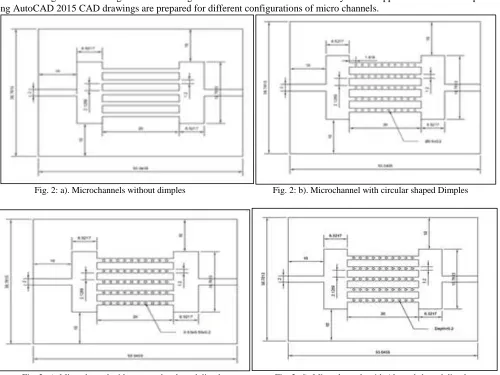
The microchannels are developed for constant flow ratio throughout. All geometries are designed by keeping volume of each dimple and depth of micro channel as constant, so that their thermal performance can be compared. Following geometries are selected for this work.
Selection of Geometries
The following geometries are selected, Microchannels without dimples –case1 Circular shaped dimples- case2 Square shaped dimples –case3 Almond shaped dimples-case4 Elliptical Shaped Dimples-case5
Designing of Geometries
The parameter used for the designing the geometries are as follows, 1) Length of a Microchannel (L) =20mm
2) Depth of a Microchannel (H) =1.0mm 3) Width of a Microchannel (W) =1.2mm 4) Depth of Dimples (d) =200µm
5) Center to center distance between each dimples (S) =1.818mm 6) Area of each Dimple (Ad) =0.28274mm2
Preparation of AutoCAD Drawing
In order to design the different geometrical configurations micro channel heat sink very careful approach has to be adopted. By using AutoCAD 2015 CAD drawings are prepared for different configurations of micro channels.
Fig. 2: e). Microchannels with Elliptical Shaped Dimples
Fabrication of Microchannels
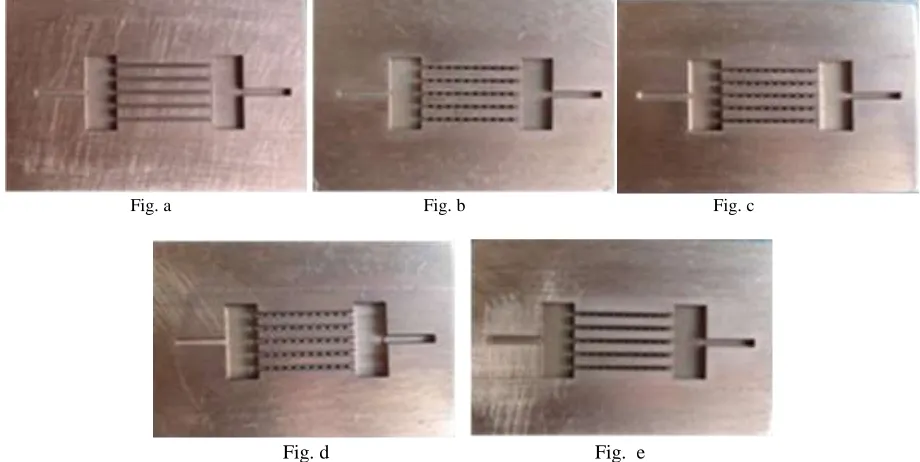
As per the designs mentioned above the heat sink were fabricated in aluminum metal. Aluminum is the most common material because of its high conductivity, low cost, low weight, and easiness with respect to manufacturability. The fabricated heat sinks are as shown in fig.2.a, fig.2.b, fig.2.c, fig.2.d and fig.2.e respectively.
Fig. a Fig. b Fig. c
Fig. d Fig. e
Fig. 3: Design of Micro Channels (Actual photographs of microchannels)
III. EXPERIMENTAL ANALYSIS OF MICROCHANNEL HEAT SINK
Fig. 3.1: Heater Assembly Fig. 3.2: Sensor and Temperature Measuring Unit
Following equations are used for analyzing the performance of heat sink, The Heat transferred to the cooling water in the test section, Qw, is given by,
Qw = mwCpw [(Tw,ave)out− (Tw,ave)in] ……… (1) Where,
mw = Mass flow rate of water (Kg/Sec.) Cpw = Specific heat capacity of water (kJ/KgK)
(Tw,ave)out & (Tw,ave)in are the average outlet and inlet water temperatures respectively. Heat added to the micro-channel is given by,
Qheater = V* I ………. (2)
The average heat transfer rate, Qavg, used in the calculation is determined from the heat transferred to the cooling water and the heat supplied to the heat source as follows:
Qavg = [(Qw + Qheater) / 2] ……….... (3) The average heat transfer coefficient can be calculated from
Qavg = hm Am(ΔTLMTD) ………. (4) Where,
ΔTLMTD ………. (5)
Where,
Ts,avg = average surface temperature (0C) Am = surface area of the micro-channel (mm2)
The average heat transfer coefficient is presented in terms of average Nusselts Number as given bellow,
Nu = ……… (6)
Where,
K = Thermal Conductivity of water (W/mK) Dh = Hydraulic diameter of channel (mm)
The Reynolds number based on Dh of micro- channel is,
Re = ………. (7)
Where,
Dh = ……… (8)
Where,
u = Water velocity (m/s) ν = Kinematic viscosity (m2/s)
And the experimental findings have been plotted in the form of graphs, mainly Nusselt number (Nu) vs Reynolds number (Re)
Heat transfer coefficient (h) vs Reynolds number (Re) Heat transfer rate Q vs Reynolds number (Re)
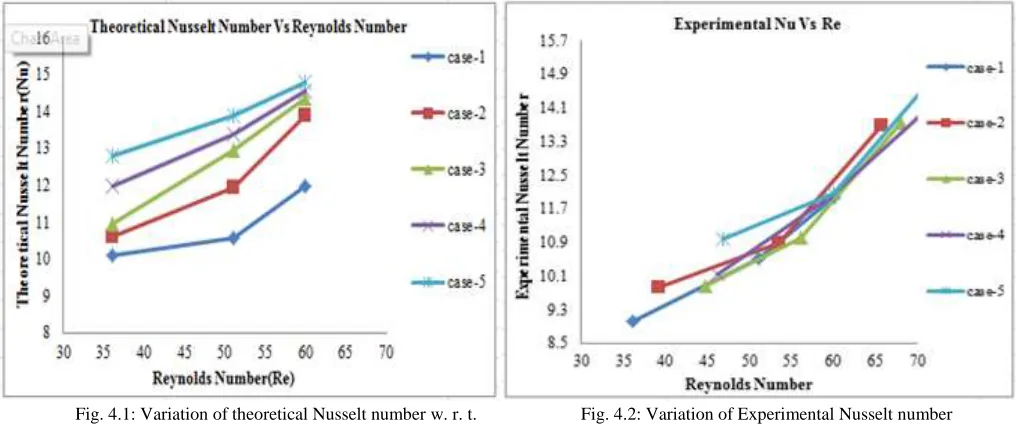
Fig. 4.1 shows the variation of theoretical Nusselt number (Nu) with respect to Reynolds Number for all microchannels. For micro channel with elliptical dimples geometry the theoretical value of Nusselt number is higher as compared with rest three geometries.Fig.4.2 shows the variation of Experimental Nusselt number with Reynolds number for all microchannels. It can be seen that the value of experimental Nusselt number goes on increasing with increase in the value of Reynolds Number for all the cases.
Fig. 4.1: Variation of theoretical Nusselt number w. r. t. Fig. 4.2: Variation of Experimental Nusselt number Reynolds Number for all microchannels w. r. t. Reynolds Number for all microchannels
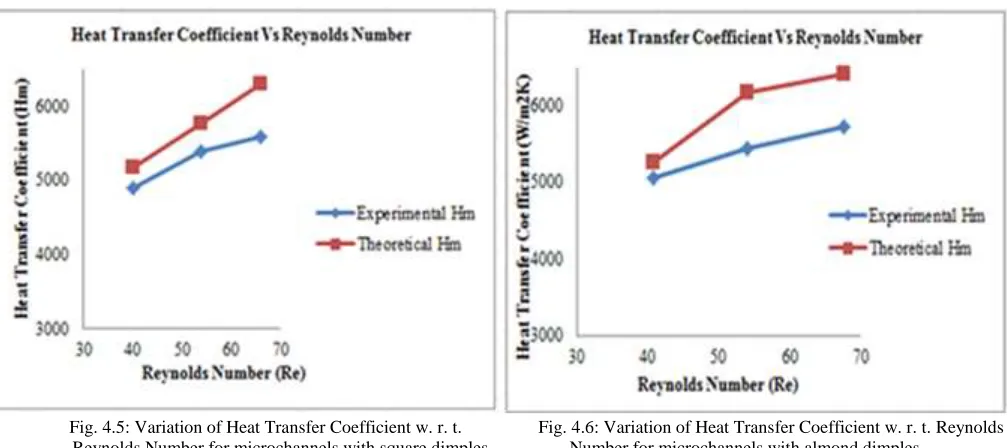
Figure 4.3 shows the variation of Heat transfer coefficient with Reynolds number ‘Re’ for the micro channels without dimple surfaces. It can be seen that the value of heat transfer coefficient goes on increasing with increase in the value of Reynolds Number.
Fig. 4.3: Variation of Heat Transfer Coefficient w. r. t. Fig. 4.4: Variation of Heat Transfer Coefficient w. r. t. Reynolds Number for microchannel without dimples Reynolds Number for microchannels with circular dimples
Fig. 4.5: Variation of Heat Transfer Coefficient w. r. t. Fig. 4.6: Variation of Heat Transfer Coefficient w. r. t. Reynolds Reynolds Number for microchannels with square dimples Number for microchannels with almond dimples
Fig. 4.8 shows the variation of theoretical heat transfer coefficient with respect to Reynolds Number for all microchannels. For micro channel with elliptical dimples geometry the theoretical heat transfer coefficient is higher as compared with rest three geometries.
Fig.4.9 shows the variation of heat transfer rate with Reynolds number for all microchannels. For micro channel with elliptical dimples geometry the heat transfer rate is higher as compared with rest three geometries.
Figure 4.10 shows the variation of temperature of cooling fluid with Reynolds number ‘Re’ for all micro channels. It can be seen that the value of temperature of cooling fluid goes on increasing with increase in the value of Reynolds Number. For micro channel with elliptical dimples geometry of temperature of cooling fluid is higher as compared with rest three geometries.
Fig. 4.9: Theoretical Nusselts Number vs. Reynolds Fig. 4.10: Variation of Temperature of cooling fluid w. r. t. Number for all Micro channels Reynolds Number for all microchannels
V. CONCLUSION
An experimental analysis is carried out for study the thermal performance of microchannel with dimples of different shapes on the base in terms of heat transfer coefficient and Nusselt number. The shapes of the dimples considered for this study are circular, square, almond and elliptical. The results are compared with theoretical result. The main conclusions of this study can be summarizes as below,
1) Experimental result are in good agreement with theoretical results.
2) Dimpled microchannels show enhanced performance than microchannels without dimples. 3) Elliptical dimples perform better than dimples of other shapes.
NOMENCLATURE A Area (m2)
Pr Prandtl Number Cp Specific Heat, (kJ/kgK) P Wet Perimeter, (m) Dh Hydraulic Diameter, (m) Q Heat Transfer Rate, (W)
h Heat Transfer Coefficient, (kW/m2 K)
Re Reynolds Number
k Thermal Conductivity, (W/mK) T Temperature, (°C)
m Mass Flow Rate, (kg/s) u Velocity, (m/s) Nu Nusselts Number ρ Density, (kg/m3) ΔP Pressure Drop, (kPa) W Water
SUBSCRIPTS avg Average
in Inlet out Outlet
REFERENCES
[2] Pooja Patil1, Prof.Padmakar Deshmukh, “An experimental study of heat transfer enhancement in the circular channel with almond shape dimples’, e-ISSN: 2278-1684,p-ISSN: 2320-334X,Volume 11, Issue 5 Ver. I (Sep- Oct. 2014), PP 48-57.
[3] Huancheng Qu, Zhongyang Shen, and Yonghui Xie,“Numerical Investigation of Flow and Heat Transfer in a Dimpled Channel among Transitional Reynolds Numbers”, Volume 2013, Article .ID 989237.
[4] RajuR.Yenare, Prof KundlikV.Mal,. “Experimental Study for Heat Transfer Enhancement Due To Surface Roughness at Laminar Flow”, ISSN: 2248-9622, Vol. 4, Issue 3(Version 1),March 2014, PP.239-243.
[5] Jamil Ahmed, Hasibur Rahman Sardar,Abdul Razak Kaladgi, (2015), “Forced Convection Heat Transfer Analysis of Square Shaped Dimples on Flat Plates”, American Journal of Energy Engineering.Vol.3,No.5,2015,PP.6610.11648/j.ajee.2015030511.
[6] Faheem Akthar, Abdul Razak R Kaladgi and Mohammed Samee (2015), “Heat Transfer Augmentation using dimples in forced convection an experimental approach”, IJMERR Vol. 4, No. 1.
[7] Hemant C. Pisal1, Avinash A. Ranaware2 (2015),” Heat Transfer Enhancement by Using Dimpled Surface”,ISSN: 2278-1684, PP: 07-15.