Page | 1
APPLICATION OF MULTI AGENT SYSTEM FOR SELF
HEALING SMART GRIDS- A REVIEW
Mr.Mohit Haridas Tapase
Student, Department of Electronics and Telecommunication, D.Y.Patil College of Engineering, Shivaji University, Kolhapur, India
Prof.Ajitsinh N Jadhav
Professor, Department of Electronics and Telecommunication, D.Y.Patil College of Engineering, Shivaji University, Kolhapur, India
ABSTRACT
In this paper author is trying to review many techniques used for self healing in smart grid. In history there are many blackouts reported all over the world. To avoid blackouts on a larger scale some strong system is needed, that attracted a researchers and many development are falling in this area. Fast and accurate finding of fault location is very important aspect of self healing of the smart grid. In this paper various techniques travelling waves for self healing, multi agent system, super conducting fault current locators, and constrained based approach for self healing are discussed in great detail.
KEYWORDS: Fault location and isolation, Power distribution, multi agent system Self healing system, Smart Grids, Information and communication technology, fault location isolation and restoration service.
I. INTRODUCTION
Based on available world literature, it is been learnt that 80% of the outages are caused by the distribution system. Three major causes of failure of electrical network are 1) Tree related failure, 2) Animal related failure, 3) lightening failures. Though the technology is advancing day by day and prediction of faults has become possible, but still there are inevitable faults. There are many uncertainties are increasing day by day due to adoption of renewable resources and distributed generation (DG) and increasing nature of load in industries and at residential load. A wide range of power electronics devices, namely called as flexible AC transmission devices (FACTS), and cyber based systems are employed to strengthen and protect the electrical network. In this paper author has
tried to review five most promising techniques for self healing smart grid using multi agent system.
II. LITERATURE REVIEW
Mohammad Jawad Ghorbani, Muhammad Akram Choudhry, and Ali Feliachi: Paper has written keeping in mind that learning from history is very important. The algorithm presented in this paper has an inbuilt q learning facility. This will help serviceman to have greater knowledge of the history and speed up restoration process. This will help reducing an FLI. Two main agents have been made in this paper
1. Zone Agent (ZA): Normally for making an agent to control the area, isolation switches are provided on both ends of the system. ZA has direct communication ability with feeder agent (FA). ZA has a dedicated measuring device, which measures a voltages, currents, impedance etc. in the specified and if any abnormality found in data is directly communicated to FA.
2.Feeder Agent: Each feeder has a dedicated feeder agent and it is provided with suitable controlling arrangement. Whenever ZA gives an intimation of fault to FA. FA will start to look for an alternative solution, by solving a mathematical optimization problem. Else it will try to look at history to find the available solution. Both this task are initiated simultaneously, whichever offers a reasonable solution, will be a preferred best solution to overcome the situation. FA uses an active learning method for identification of fault [2].
Page | 2
Power System in operation
Fault in power system
distribution?
Try for restoring network by
traditional methods.
Check for history
Is solution exits?
Operate restoration switches
based on history.
Communicate with target FA
Confirmation of the data,
mathematical optimization
Operate restoration switches based
on mathematical optimization
Updation of
learning
database.
Y
A
A
N
Fig.1 PROPOSED SYSTEM FOR LEARNING ALGORITHM
In the given approach, self learning or we can say Q-learning algorithm has been introduced with MAS capability. The major change in this paper as compared to other papers is uses of distribution approach for FLI. One major aspect this paper differs from other research paper is self learning capability.
Page | 3
Grid
DG
Load
Transmission line
Power from DG Power from grid
Resultant Power Individual Power
Fig. 2 Proposed network topology for injection of current using DG
Figure above illustrates the contribution of DG’s power for increasing demand. But one more factor must be taken into consideration here is the power contribution has changed, the fault current sharing will change. Increase in the fault current is the major point of worry, because it should not exceed beyond interruption capacity of the protective equipment.
Nowadays utilities are more worried about level of fault, and it is increasing day by day. The interconnection between smart grids and DG will increase and dynamicity of the network, because of this protection system may damage the coordination amongst them. If this system is compared with proposed FCC system can control the fault current to significant level, which will help to control the malfunction of existing protection system.
Liu Qianqian, Zeng Xiangjun, MaXue, Li Xiang: In view to find fast and accurate fault location we need an more smarter technique for self healing smart grid system. Technique presented is here on the basis of travelling waves. More accurately fault detection in on the basis of secondary
winding of potential transformer. The fault occurred can be identified if current voltage is higher than the reference voltage level. This technique is said to be fast and more accurate as compared to other technique, which uses an arithmetic calculation and optimization based on various iterations.
This paper has presented a very good technique if the distribution or transmission is of mixed type i.e. overhead and underground. The technique presented here can be used for all types of electrical power transmission. This technique has a very high importance in self healing systems of smart grid. The core travelling sensor and other sensor having very high inner impedance and developed are used extensively to give accurate results in this paper. The acquisition of travelling waves presented in this paper is based on pure hardware [3]. Moreover this paper completed all testing of each function for prototype model based on transient voltage wave.
Vasileios Koutsoumpas and Pragya K. Gupta:
Page | 4
to do survey of all smart grid and of all six different regions. This project is named as “E-Energy” where all different teams are working for betterment of smart grid spread across Germany. One of the greatest challenges in electrical network is to maintain a zero gap between generation and load [5]. But in smart grid, due to increase of distributed generation sometimes it becomes a complex thing to do. In this kind of situation need of smart solution arises i.e. help of computer infra of stronger communication network using an information and communication technology (ICT)[6].
The function of ICT in this paper is to collect all the information available across all the buses, loads and generating and fed it to central server. The information collected by ICT is use for mathematical optimization of the power system network and more use of distributed network. This paper presents an approach based on technique called FOCUS [7], i.e. theory for formal specification of system. This paper presented constrained base approach for self healing of smart grids using a multi agent system. The implementation of multi agent system and gives an overall information of the network, which helps understand the behavior of the system. At conclusion
FOCUS & predicate logic has been introduced for the first time in self healing smart grids. The advantage of this method understands logical constraints of the system; therefore formalization of self healing smart grid system using multi agent system is possible.
Zaibin Jiao, Xiaobing Wang, Heteng Gong:
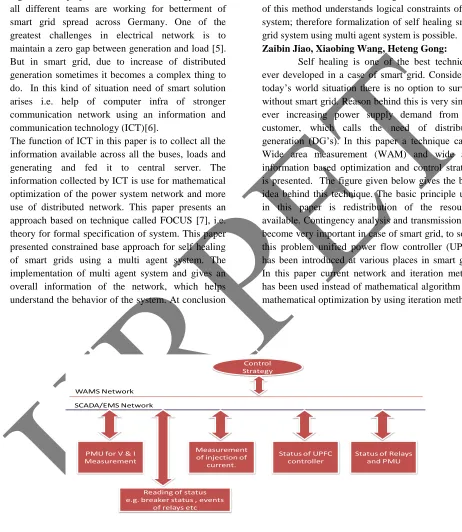
Self healing is one of the best techniques ever developed in a case of smart grid. Considering today’s world situation there is no option to survive without smart grid. Reason behind this is very simple ever increasing power supply demand from the customer, which calls the need of distributed generation (DG’s). In this paper a technique called Wide area measurement (WAM) and wide area information based optimization and control strategy is presented. The figure given below gives the brief idea behind this technique. The basic principle used in this paper is redistribution of the resources available. Contingency analysis and transmission has become very important in case of smart grid, to solve this problem unified power flow controller (UPFC) has been introduced at various places in smart grid. In this paper current network and iteration method has been used instead of mathematical algorithm and mathematical optimization by using iteration method.
Control Strategy
WAMS Network
SCADA/EMS Network
PMU for V & I Measurement
Reading of status e.g. breaker status , events
of relays etc
Measurement of injection of
current.
Status of UPFC controller
Status of Relays and PMU
Page | 5
If the contingencies occurred in the system redistributing a power flow using UPFC by using reverse current injection method will be very useful.
III. CONCLUSION
Author is trying to review different techniques available for self healing of smart grids using a different techniques main using a multi agent system
or information and communication techniques. However, author has given brief introduction about hardware implementation of travelling waves installed on secondary winding of potential transformer. The advantage of later technique is to fast reliable and not computer or mathematics dependent.
IV. REFERENCES
[1] L. Xu, M.-Y. Chow, J. Timmis, and L. Taylor, “Power distribution outage cause identification with imbalanced data using artificial immune recognition system (AIRS) algorithm,” IEEE Trans. Power Syst., vol. 22, no. 1, pp. 198–204, Feb. 2007.
[2] M. J. Ghorbani, M. Akhbari, and H. Mokhtari, “Direct torque control of induction motor by active learning method,” in Proc. 1st Power Electron. Drive Syst. Technol. Conf. (PEDSTC), Tehran, Iran, Feb. 2010, pp. 267–272.
[3] Zeng. Xiangjun, Chen. Nan, Li. Zewen, DengFeng, "Network-based Aigorithm for Fault Location with Traveling Wave,” Proceedings 0/the CSEE, vol. 28(31), pp. 48-53, 2008.
[4] Dong. Xinzhou, Ge. Yaozhong, "A fault location method of EHV using double terminal data, " Automation 0/ Electric Power Systems, vol. 19(8), pp. 47-53, 1995.
[5] D. Garlan and B. Schmerl, “Model-based adaptation for self-healing systems,” in Proceedings of the first workshop on Self-healing systems, ser. WOSS ’02. New York, NY, USA: ACM,
2002, pp. 27–32. [Online]. Available:
http://doi.acm.org/10.1145/582128.582134
[6] G. S. Blair, G. Coulson, L. Blair, H. Duran-Limon, P. Grace, R. Moreira, and N. Parlavantzas, “Reflection, awareness and self-healing in openorb,” in Proceedings of the first workshop on Self-healing systems, ser. WOSS ’02. New York, NY, USA: ACM,
2002, pp. 9–14. [Online]. Available:
http://doi.acm.org/10.1145/582128.582131
[7] M. Broy and K. Stølen, Specification and development of interactive systems: focus on streams, interfaces, and refinement. Secaucus, NJ, USA: Springer-Verlag New York, Inc., 2001.
[8] Mohammad Jawad Ghorbani,Muhammad Akram Choudhry, and Ali Feliachi, “A Multiagent Design for Power Distribution Systems Automation” IEEE TRANSACTIONS ON SMART GRID.
[9] Jae Woong Shim, Taesik Nam, Jae Young Jang, TaeKukKo,
Min Cheol Ahn, and Kyeon Hur,” Towards a Self-Healing Electric Grid With Superconducting Fault Current Controllers” IEEE TRANSACTIONS ON APPLIED SUPERCONDUCTIVITY, VOL. 22, NO. 3, JUNE 2012
[10] Liu Qianqian, Zeng Xiangjun, MaXue, Li Xiang, “A New Smart Distribution Grid Fault Self-healing System Based on Traveling-wave”, 2013-PSEC-261
[11] Vasileios Koutsoumpas and Pragya K. Gupta : “Towards a Constraint Based Approach for Self-Healing Smart Grids”, SE4SG 2013, San Francisco, CA, USA